78 | http://www.jomes.org J Obes Metab Syndr 2020;29:78-80 Insulin resistance is considered to be an important factor in de-
veloping sarcopenia as well as nonalcoholic fatty liver disease (NAFLD).1-3 Indeed, our study showed that insulin resistance-re- lated metabolic factors such as diabetes, hypertension, and lipid profile have significant associations with both sarcopenia and NAFLD.4 In this context, it is very important to properly adjust for these confounding factors when looking for the independent ef- fects of sarcopenia on the risk of NAFLD.
Considering that, adjustment for confounders in our stratifica- tion analysis might have been insufficient. We had this discussion with reviewers during the review process. In the stratification analy- sis in our study, some subgroups were small in number. In addition, some variables that were applied in the main analysis had missing data, so there was concern that statistical power would not be ro- bust when all these variables were applied to the stratification anal- ysis. For this reason, we first analyzed all the variables and then se- lected the variables that seemed to have more confounding effects.
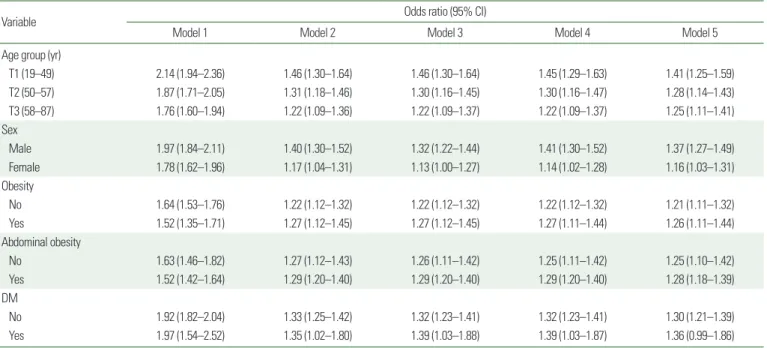
As shown in Table 1, attenuation of the odds ratio for the risk of NAFLD was noticeable after correction for abdominal visceral fat area. However, further adjustment for diabetes, hypertension, total
cholesterol, low-density lipoprotein cholesterol, smoking, triglycer- ide and high-density lipoprotein cholesterol didn’t make much dif- ference (Table 1). Due to these results, we believe that the results of stratification analysis would still be valid even if we consider ad- ditional confounders such as hypertension, diabetes, lipid profile, and smoking.
It is well-known that physical activity has a protective role against sarcopenia development.5 Physical activity is also important in the pathophysiology and management of NAFLD and an exercise in- tervention showed beneficial effects on hepatic lipid reduction.6 Given these associations with sarcopenia and NAFLD, physical ac- tivity can be an important confounder in analyzing the effects of sarcopenia on the risk of NAFLD. It would have been better if con- founders, such as physical activity, had been further adjusted in our study. We look forward to further research to overcome this weak- ness in the future.
Insulin resistance is a possible link between sarcopenia and NAFLD.1-3 In our study, we could not adjust insulin resistance in our analysis because of many missing values. However, abdominal obesity is associated with insulin resistance,7 and we adjusted vis-
Copyright © 2020 Korean Society for the Study of Obesity
This is an Open Access article distributed under the terms of the Creative Commons Attribution Non-Commercial License (https://creativecommons.org/licenses/by-nc/4.0/) which permits unrestricted non-commercial use, distribution, and reproduction in any medium, provided the original work is properly cited.
pISSN 2508-6235 eISSN 2508-7576 Journal of Obesity & Metabolic Syndrome 2020;29:78-80
https://doi.org/10.7570/jomes20009 CROSSMARK_logo_3_Test 1 / 1
2017-03-16 https://crossmark-cdn.crossref.org/widget/v2.0/logos/CROSSMARK_Color_square.svg
Response
Response: Sarcopenia Is Significantly Associated with Presence and Severity of Nonalcoholic Fatty Liver Disease (J Obes Metab Syndr 2019;28:129-38)
Goh Eun Chung, Ji Won Yoon*
Department of Internal Medicine, Seoul National University Hospital Healthcare System Gangnam Center, Seoul, Korea
Received January 9, 2020 Reviewed January 27, 2020 Accepted February 13, 2020
* Corresponding author Ji Won Yoon
https://orcid.org/0000-0001-9003-0614 Department of Internal Medicine, Seoul National University Hospital Healthcare System Gangnam Center,
152 Teheran-ro, Gangnam-gu, Seoul 06236, Korea
Tel: +82-2-2112-5677 Fax: +82-2-2112-5794 E-mail: [email protected]
Chung GE, et al. Sarcopenia and Nonalcoholic Fatty Liver Disease
J Obes Metab Syndr 2020;29:78-80 http://www.jomes.org | 79
Response: Sarcopenia Is Significantly Associated with Presence and Severity of Nonalcoholic Fatty Liver Disease (J Obes Metab Syndr 2019;28:129-38)
Goh Eun Chung, Ji Won Yoon*
Department of Internal Medicine, Seoul National University Hospital Healthcare System Gangnam Center, Seoul, Korea
Received January 9, 2020 Reviewed January 27, 2020 Accepted February 13, 2020
* Corresponding author Ji Won Yoon
https://orcid.org/0000-0001-9003-0614 Department of Internal Medicine, Seoul National University Hospital Healthcare System Gangnam Center,
152 Teheran-ro, Gangnam-gu, Seoul 06236, Korea
Tel: +82-2-2112-5677 Fax: +82-2-2112-5794 E-mail: [email protected]
ceral fat area (in the form of a continuous variable) as a surrogate marker of insulin resistance. In the stratified analysis, we used ab- dominal obesity instead of visceral fat area, because abdominal obesity defined by waist circumference cutoff criteria has been widely used in many studies. The presence of abdominal obesity did not significantly modify the relationship between sarcopenia and NAFLD in our study.
We are grateful to have the opportunity to clarify our work by sharing the details of our analyses. We look forward to further com- prehensive research with a larger sample size and more sophisticat- ed evaluation tools that can robustly reveal the association between sarcopenia and NAFLD.
CONFLICTS OF INTEREST
The authors declare no conflict of interest.
AUTHOR CONTRIBUTIONS
Study concept and design: all authors; acquisition of data: all au- thors; analysis and interpretation of data: all authors; drafting of the
manuscript: JWY; critical revision of the manuscript: GEC; statisti- cal analysis: all authors.
REFERENCES
1. Khan RS, Bril F, Cusi K, Newsome PN. Modulation of insulin resistance in nonalcoholic fatty liver disease. Hepatology 2019;
70:711-24.
2. Kim TN, Yang SJ, Yoo HJ, Lim KI, Kang HJ, Song W, et al.
Prevalence of sarcopenia and sarcopenic obesity in Korean adults: the Korean sarcopenic obesity study. Int J Obes (Lond) 2009;33:885-92.
3. Guillet C, Boirie Y. Insulin resistance: a contributing factor to age-related muscle mass loss? Diabetes Metab 2005;31:5S20- 5S26.
4. Chung GE, Kim MJ, Yim JY, Kim JS, Yoon JW. Sarcopenia is significantly associated with presence and severity of nonalco- holic fatty liver disease. J Obes Metab Syndr 2019;28:129-38.
5. Steffl M, Bohannon RW, Sontakova L, Tufano JJ, Shiells K, Holmerova I. Relationship between sarcopenia and physical activity in older people: a systematic review and meta-analysis.
Table 1. NAFLD risk due to muscle mass reduction by subgroup
Variable Odds ratio (95% CI)
Model 1 Model 2 Model 3 Model 4 Model 5
Age group (yr)
T1 (19–49) 2.14 (1.94–2.36) 1.46 (1.30–1.64) 1.46 (1.30–1.64) 1.45 (1.29–1.63) 1.41 (1.25–1.59)
T2 (50–57) 1.87 (1.71–2.05) 1.31 (1.18–1.46) 1.30 (1.16–1.45) 1.30 (1.16–1.47) 1.28 (1.14–1.43)
T3 (58–87) 1.76 (1.60–1.94) 1.22 (1.09–1.36) 1.22 (1.09–1.37) 1.22 (1.09–1.37) 1.25 (1.11–1.41)
Sex
Male 1.97 (1.84–2.11) 1.40 (1.30–1.52) 1.32 (1.22–1.44) 1.41 (1.30–1.52) 1.37 (1.27–1.49)
Female 1.78 (1.62–1.96) 1.17 (1.04–1.31) 1.13 (1.00–1.27) 1.14 (1.02–1.28) 1.16 (1.03–1.31)
Obesity
No 1.64 (1.53–1.76) 1.22 (1.12–1.32) 1.22 (1.12–1.32) 1.22 (1.12–1.32) 1.21 (1.11–1.32)
Yes 1.52 (1.35–1.71) 1.27 (1.12–1.45) 1.27 (1.12–1.45) 1.27 (1.11–1.44) 1.26 (1.11–1.44)
Abdominal obesity
No 1.63 (1.46–1.82) 1.27 (1.12–1.43) 1.26 (1.11–1.42) 1.25 (1.11–1.42) 1.25 (1.10–1.42)
Yes 1.52 (1.42–1.64) 1.29 (1.20–1.40) 1.29 (1.20–1.40) 1.29 (1.20–1.40) 1.28 (1.18–1.39)
DM
No 1.92 (1.82–2.04) 1.33 (1.25–1.42) 1.32 (1.23–1.41) 1.32 (1.23–1.41) 1.30 (1.21–1.39)
Yes 1.97 (1.54–2.52) 1.35 (1.02–1.80) 1.39 (1.03–1.88) 1.39 (1.03–1.87) 1.36 (0.99–1.86)
Model 1, adjusted for age and sex; Model 2, model 1+visceral fat area; Model 3, model 2+DM, hypertension, total cholesterol, and low-density lipoprotein cholesterol; Model 4, model 3+smoking; Model 5, model 4+triglyceride and high-density lipoprotein cholesterol. ASM% quartile was used as an independent variable. ASM% quartile was treated as continuous variable, and odds ratio implies a degree of increased risk that NAFLD will accompany each ASM% quartile reduction.
NAFLD, nonalcoholic fatty liver disease; CI, confidence interval; DM, diabetes mellitus; ASM, appendicular skeletal muscle mass.
Chung GE, et al. Sarcopenia and Nonalcoholic Fatty Liver Disease
J Obes Metab Syndr 2020;29:78-80
80 | http://www.jomes.org
Clin Interv Aging 2017;12:835-45.
6. Keating SE, Hackett DA, George J, Johnson NA. Exercise and non-alcoholic fatty liver disease: a systematic review and meta-
analysis. J Hepatol 2012;57:157-66.
7. Engin A. The definition and prevalence of obesity and meta- bolic syndrome. Adv Exp Med Biol 2017;960:1-17.