Allergic rhinitis (AR) is one of the most common chronic allergic respira- tory diseases worldwide. Various practical guidelines for AR have been developed and updated to improve the care of AR patients; however, up to 40% patients remain symptomatic. The unmet need for AR care is one of the greatest public health problems in the world. The gaps be- tween guideline and real-world practice, and differences according to the region, culture, and medical environments may be the causes of un- met needs for AR care. Because there is no evidence-based AR practi- cal guideline reflecting the Korean particularity, various needs are in- creasing. The purpose of the study was to evaluate whether existing guidelines are sufficient for AR patient management in real practice
and whether development of regional guidelines to reflect regional dif-
Unmet Primary Physicians’ Needs for Allergic Rhinitis Care in Korea
Hyeon-Jong Yang,
1,2Young Hyo Kim,
3Bora Lee,
4Do Youn Kong,
5Dong-Kyu Kim,
6Mi-Ae Kim,
7Bong-Seong Kim,
8Won-young Kim,
9Jeong Hee Kim,
10Yang Park,
11So Yeon Park,
12Woo Yong Bae,
13Keejae Song,
14Min Suk Yang,
15Sang Min Lee,
16Young-Mok Lee,
17Hyun Jong Lee,
18Jae-Hong Cho,
19Hye Mi Jee,
20Jeong-Hee Choi,
21* Young Yoo,
22,23* Young-Il Koh,
24and Work Group for Rhinitis, the Korean Academy of Asthma, Allergy and Clinical Immunology
1Department of Pediatrics, Pediatric Allergy and Respiratory Center, Soonchunhyang University College of Medicine, Seoul, Korea
2SCH Biomedical Informatics Research Unit, Soonchunhyang University Hospital, Seoul, Korea
3Department of Otorhinolaryngology, Inha University College of Medicine, Incheon, Korea
4Department of Biostatistic Consulting, Clinical Trial Center, Soonchunhyang Medical Center, Bucheon, Korea
5MBL Children’s Hospital, Daejeon, Korea
6 Department of Otorhinolaryngology-Head and Neck Surgery, Hallym University Chuncheon Sacred Heart Hospital and Nano-Bio Regenerative Medical Institute, Hallym University College of Medicine, Chuncheon, Korea
7Department of Pulmonology, Allergy and Critical Care Medicine, CHA Bundang Medical Center, CHA University, Seongnam, Korea
8Department of Pediatrics, Gangneung Asan Hospital, University of Ulsan College of Medicine, Gangneung, Korea
9Wooridul Private Internal Clinic, Gwangju, Korea
10Department of Pediatrics, Inha University Hospital, Inha University College of Medicine, Incheon, Korea
11Department of Pediatrics, Wonkwang University Sanbon Hospital, Wonkwang University College of Medicine, Gunpo, Korea
12A & A Clinic, Seongnam, Korea
13Department of Otorhinolaryngology, Head and Neck Surgery, Dong-A University College of Medicine, Busan, Korea
14Department of Otorhinolaryngology-Head & Neck Surgery, Catholic Kwandong Universtiy, International St. Mary’s Hospital, Incheon, Korea
15Division of Allergy and Clinical Immunology, Department of Internal Medicine, Seoul National University Boramae Medical Center, Seoul, Korea
16Division of Pulmonology and Allergy, Department of Internal Medicine, Gachon University Gil Medical Center, Incheon, Korea
17GF Internal Medicine Allergy Clinic, Seoul, Korea
18Lee & Hong ENT, Sleep and Cosmetic Center, Seongnam, Korea
19Cho & Park ENT Clinics, Suwon, Korea
20Derpartment of Pediatrics, CHA Bundang Medical Center, CHA University School of Medicine, Seongnam, Korea
21Department of Pulmonology and Allergy, Hallym University Dongtan Sacred Heart Hospital, Hwaseong, Korea
22Department of Pediatrics, Korea University Anam Hospital, Seoul, Korea
23Allergy Immunology Center, Korea University, Seoul, Korea
24Department of Internal Medicine, Chonnam National University Medical School & Hospital, Gwangju, Korea
This is an Open Access article distributed under the terms of the Creative Commons Attribution Non-Commercial License (http://creativecommons.org/licenses/by-nc/4.0/) which permits unrestricted non-commercial use, distribution, and reproduction in any medium, provided the original work is properly cited.
Correspondence to: Young Yoo, MD, PhD, Department of Pediatrics, Korea University, College of Medicine, 73 Inchon-ro, Sungbuk-gu, Seoul 02841, Korea.
Tel: +82-2-920-5090; Fax: +82-2-922-7476; E-mail: [email protected] Co-Correspondence to: Jeong-Hee Choi, MD, PhD, Department of Pulmonology and Allergy, Hallym University Dongtan Sacred Heart Hospital, 7 Keunjaebong-gil, Hwaseong 18450, Korea.
Tel: +82-31-8086-2928; Fax: +82-31-8086-2482; E-mail: [email protected] Received: May 23, 2016; Revised: October 2, 2016; Accepted: November 7, 2016
•Hyeon-Jong Yang and Young Hyo Kim contributed equally to this work.
•There are no financial or other issues that might lead to conflict of interest.
Allergy Asthma Immunol Res. 2017 May;9(3):265-271.
https://doi.org/10.4168/aair.2017.9.3.265 pISSN 2092-7355 • eISSN 2092-7363
ferences is needed in Korea. A total of 99 primary physicians comprising internists, pediatricians, and otolaryngologists (n=33 for each) were sur- veyed by a questionnaire relating to unmet needs for AR care between June 2 and June 16 of 2014. Among 39 question items, participants strongly agreed on 15 items that existing guidelines were highly insufficient and needed new guidelines. However, there was some disagreement according to specialties for another 24 items. In conclusion, the survey results demonstrated that many physicians did not agree with the current AR guideline, and a new guideline reflecting Korean particularity was needed.
Key Words: Allergic rhinitis; needs assessment; survey and questionnaires
INTRODUCTION
Allergic rhinitis (AR) is one of the most common chronic al- lergic respiratory diseases worldwide. Although AR is not a life- threatening disease, it causes a significant healthcare problem through the chronic, and relapsing characteristics, inducing poor quality of life and work/school loss.
1,2The impact of AR on the social, professional, and educational performance has been recognized; furthermore, AR in childhood leads to socioeco- nomic inequalities.
3Therefore, early diagnosis and adequate management of AR have been highlighted to achieve healthy aging.
The prevalence of AR has progressively increased over the last 3 decades in developed countries including Korea, and has been estimated approximately 40% in the world population.
The nation-wide prevalence of AR in Korea has varied with 28%
in 2008 based on the questionnaire alone, and 16.2% in 2010 based on the questionnaire, examination, and test for atopic sensitization.
4,5The Korean National Health Insurance Corpo- ration reported an increased trend of medical care-use associ- ated with AR, approximately 4.28 million cases in 2007 (10th ranked prevalent chronic disease) to 6.35 million cases in 2014 (fifth ranked prevalent chronic disease).
6The direct and indi- rect costs related with AR have been estimated at $223.68 mil- lion and $49.25 million, respectively, in 2007.
7Practical guidelines, proposed by Allergic Rhinitis and its Im- pact on Asthma (AIRA),
8and Academy of Otolaryngology- Head and Neck Surgery,
9recommended evidence-based man- agement. However, up to 40% of patients with AR remain symp- tomatic.
10Although international practical guidelines are well established, unmet needs for AR care still exist in real-world practice. The existing guidelines were developed on the basis of evidence from randomized controlled trials (RCTs). RCTs would be the best way to assess the effect size under the high- quality design. However, they cannot answer every clinical question in the real-practice.
3Furthermore, existing guidelines do not reflect the characteristics of Korean patients because these guidelines are based on Western populations. Therefore, unmet needs in the clinical practice of AR should be evaluated.
The purpose of the study was to identify the needs for AR care of primary physicians to manage AR patients in Korea and to evaluate needs on the development of new guidelines reflect- ing the clinical features of Korean patients.
MATERIALS AND METHODS
A questionnaire-based survey was conducted through e-mail, among a total of 99 clinic based primary physicians consisting of internal medicine (IM), otorhinolaryngology (ORL), and pe- diatrics (PD) groups (each 33) between June 2 and June 16 of 2014.
Questionnaire development
The questionnaire was developed by the collaborative work- ing group comprising allergists in the departments of IM, ORL, and PD; and the Allergic Rhinitis Work Group (ARWG) in the Korean Academy of Asthma, Allergy and Clinical Immunology (KAAACI). It was based on the free-text questions arising from primary physicians in the clinic-based, real practice. A total of 117 free-text questions were collected and reviewed by the ex- pert panel of ARWG, and consequently developed as 39 ques- tions relating to the respondents’ agreement or disagreement with the existing practical guidelines for the diagnosis, treat- ment, and prevention of AR. The questionnaire-items were un- categorized and shuffled to minimize the proximity effects. The questionnaire asked “Do you agree that the existing guidelines unclearly answer the following question, and do you need de- velopment of a new practical-guideline reflecting real prac- tice?” Each questionnaire item was rated on a 5-point Likert scale from 1 to 5 where 1=strongly disagree, 2=disagree, 3=un- sure, 4=agree, and 5=strongly agree.
Statistical analysis
To select items that showed overall high agreement, the re- sponses were presented as mean and standard deviation (SD) and assessed by the average deviation index AD
med. The AD
medindex proposed by Burke and Dunlap
11provided a clear ratio-
nale for defining acceptable levels of interrater agreement on a
5-point Likert scale for values of ≤0.833. We separated the re-
sponses into agreement, no opinion, and disagreement. Agree-
ment was the responders choosing 4 (agree) or 5 (strongly
agree), and disagreement was considered present if the re-
sponders choosing 2 (disagree) or 1 (strongly disagree) for each
statement. Thereafter, the items were divided into 3 subgroups,
including consensus items, polarized items, and neither con-
sensus nor controversy. The criteria of categorized items were
follows: (1) consensus items were defined as <25% of respond-
ers indicating neutral opinion and the percentage of agreement was at least 4 times as large as that of disagreement; (2) polar- ized items were defined as >30% of responders indicating agreement and also disagreement; and (3) neither consensus nor controversy was defined as not included in the consensus or the polarized items. All statistical analyses were performed using R 3.1.3 version (R Foundation for Statistical Computing, Vienna, Austria) and SPSS 14.0 version (SPSS Inc., Chicago, IL, USA).
RESULTS
Of the 39 items, there were 20 “consensus items” (51.3%), 17
“neither consensus nor controversy items” (43.6%), and 2 po- larized items (5.1%). Fifteen of the 20 consensus items with AD-
med
of ≤0.833, showed strong interrater agreement, and the re- maining 5 items showed poor agreement (AD
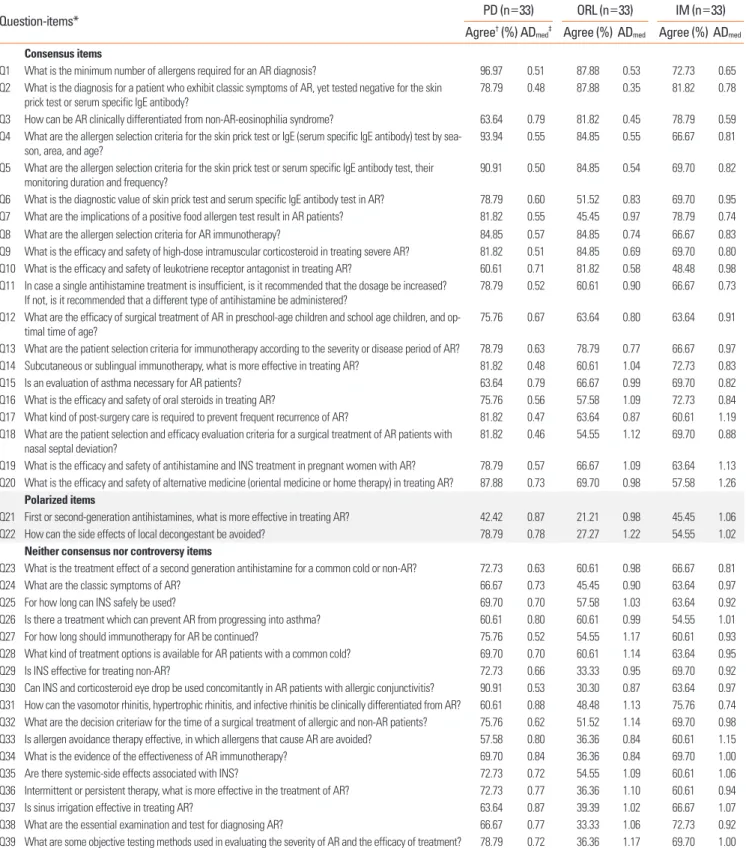
med>0.833). How- ever, all the proportion of agreement for these items was ap- proximately 70% (Table 1). Table 2 summarizes the proportion of agreement and the value of AD
medin each specialty-group, respectively, and the specialty-agreement gap.
Among 20 consensus items, 15 (Q1-15) showed the overall agreement. However, only 5 items (Q1-5) showed no specialty- specific agreement gaps (each AD
med≤ 0.833), the others did not. The Q1-5 consensus items for AR diagnosis that included the minimum test battery of allergens for AR diagnosis, differ- ential diagnosis with non-AR with eosinophilia syndrome or non-AR, and allergen differences by age, season, and area, showed strong agreement on the lack of guidance in the exist- ing guidelines (AD
med; Q1, 0.53; Q2, 0.48; Q3, 0.59; Q4, 0.55; Q5, 0.54) without specialty-specific agreement gaps. However, Q6-7 for the diagnostic value of allergy test and implications of food sensitization showed weak agreement (AD
med: Q6, 0.83; Q7, 0.74) with a specialty-specific agreement gap. The gap was more prominent in PD group than in the IM and OR (Q6-7 AD
med: PD group, 0.60, 0.55; ORL group, 0.83, 0.97; IM group, 0.95, 0.74).
Only 3 items for the second-generation antihistamines, effec- tiveness of immunotherapy, and effectiveness of sinus irrigation showed overall poor agreement without specialty-specific agree- ment gaps (AD
med: Q21, 0.98; Q34, 0.84, Q37, 1.02). Twenty-nine other items showed significant specific-specialty agreement gaps, suggesting respondents’ needs for specialty dependence.
The specific-specialty agreement gaps were mainly observed in the PD group. Neither the IM nor the ORL group showed agree- ment gaps in 20 of 29 items with specific-specialty agreement gaps, while the PD group showed significant opposing respons- es, resulting in poor agreement on each question. Q16 for the efficacy and safety of oral steroids and Q20 for alternative medi- cine, showed disagreement (AD
med: 0.84, 0.98) caused by spe- cialty-gaps (PD, ORL, IM groups: Q16, 0.56, 1.09, 0.84; Q20, 0.73, 0.98, 1.26). Q17-19 also showed disagreement and specialty- gap in the PD group.
In PD group, 35 of 39 items showed acceptable interrater agreement and higher proportion of agreement (90.0%) than the other groups. On the contrary, the ORL and IM groups showed less acceptable interrater agreement (28.2% and 30.8%), respectively. Particularly, 4 items showed interrater agreement for the ORL group, but not IM, group 5 items showed agreement to the contrary.
DISCUSSION
This is the first study to identify the needs for AR care in Korea, to evaluate the gap between real-life practice and existing guidelines, and primary physicians’ needs for the development of new guidelines reflecting Korean particularity.
Our results demonstrated various consensus needs for clini- cal questions, particularly in diagnosis and treatment. There is consensus agreement that existing guidelines are insufficient for AR diagnosis indicating that certain guidance on the mini- mal selection of allergen tests is needed and should also reflect Korean particularity according to age, area, and season.
However, there are no Korean guides of “How many allergen, and what kind of allergens should be tested to diagnose and ex- clude AR in Korea?” and “How frequently allergic sensitization should be tested?” An investigation of offending allergens is es- sential for the diagnosis and treatment of AR. The offending al- lergens may vary with age, region, and season. Existing guide- lines are based on patients outside of Korea; therefore, the min- imum test battery of 18 inhalant allergens (Dermatophagoides
pteronyssinus and Dermatophagoides farinae, Cat and Dogdander, Artemisia, Blatella, Alternaria, Parietaria, Ambroisia,
Aspergillus, Cladosporium, Grass, Cypress-, Olive-, Birch-, Al-der-, Plane-pollen, and Hazel) advocated by the Global Allergy and Asthma European Network would not be relevant in Kore- an patients.
12In Korea, particular pollens, including Japanese hop (Humulus japonicas) or Japanese Cedar (Cryptomeria ja-
ponica) have been reported as the major pollens of AR in southprovinces.
13,14Furthermore, offending allergens are significantly different according to age, variability of offending allergens from indoor allergens in early childhood to outdoor allergens in late childhood.
14Indeed, the National Guideline for the Di- agnosis and Management of Allergic disease, published by the KAAACI in 1999, recommended 17 allergens in skin prick test.
15Nevertheless, consensus agreement indicates that respondents still have difficulty in diagnosing AR in the real practice.
Despite existing guidelines, AR primary care seems to be in-
dependent of guideline recommendations.
16Furthermore, spe-
cialty-specific knowledge and agreement gaps among allergists,
otolaryngologists, and pediatricians are known to exist.
17Our
findings also demonstrated specialty-specific need gaps that
may be caused by specialty-knowledge or -interest gaps. We
found the specialty-agreement gap even in the consensus
items. The gap was prominent in the safety and effectiveness of
Table 1. Agreement of respondents (a total of 99 primary physician) for the survey “Do you agree that existing guidelines are insufficient to answer the following question, and a new guideline to reflect real-practice is needed”
Question-items* Mean SD ADmed† Disagree‡ (%) Agree§ (%)
Consensus items
Q1 What is the minimum number of allergens required for an AR diagnosis? 4.13 0.79 0.53 4.00 85.90
Q2 What is the diagnosis for a patient who exhibit classic symptoms of AR, yet tested negative for the skin prick test or serum specific IgE antibody?
4.09 0.81 0.48 4.00 82.80
Q3 How can be AR clinically differentiated from non-AR-eosinophilia syndrome? 3.93 0.82 0.59 6.10 74.70
Q4 What are the allergen selection criteria for the skin prick test or IgE (serum specific IgE antibody) test by season, area,
and age? 4.11 0.86 0.55 5.10 81.80
Q5 What are the allergen selection criteria for the skin prick test or serum specific IgE antibody test, their monitoring du-
ration and frequency? 4.06 0.89 0.54 6.10 81.80
Q6 What is the diagnostic value of skin prick test and serum specific IgE antibody test in AR? 3.69 1.02 0.83 16.20 66.70 Q7 What are the implications of a positive food allergen test result in AR patients? 3.80 1.06 0.74 15.20 68.70
Q8 What are the allergen selection criteria for AR immunotherapy? 4.10 0.95 0.74 5.10 78.80
Q9 What is the efficacy and safety of high-dose intramuscular corticosteroid in treating severe AR? 4.02 0.94 0.69 6.10 78.80 Q10 In case a single antihistamine treatment is insufficient, is it recommended that the dosage be increased? If not,
is it recommended that a different type of antihistamine be administered?
3.84 0.94 0.73 8.10 68.70
Q11 What is the efficacy and safety of leukotriene receptor antagonist in treating AR? 3.66 1.00 0.71 15.20 63.60 Q12 What are the efficacy of surgical treatment of AR in preschool-age children and school age children, and optimal
time of age? 3.83 1.03 0.80 9.10 67.70
Q13 What are the patient selection criteria for immunotherapy according to the severity or disease period of AR? 3.94 1.04 0.77 14.10 74.70 Q14 Subcutaneous or sublingual immunotherapy, what is more effective in treating AR? 3.84 1.05 0.83 16.20 71.70
Q15 Is an evaluation of asthma necessary for AR patients? 3.79 1.06 0.82 16.20 66.70
Q16 What is the efficacy and safety of oral steroids in treating AR? 3.77 1.06 0.84 16.20 68.70
Q17 What kind of post-surgery care is required to prevent frequent recurrence of AR? 3.88 1.10 0.87 10.10 68.70 Q18 What are the patient selection and efficacy evaluation criteria for a surgical treatment of AR patients with nasal sep-
tal deviation?
3.72 1.12 0.88 15.20 68.70
Q19 What is the efficacy and safety of antihistamine and INS treatment in pregnant women with AR? 3.90 1.16 1.09 15.20 69.70 Q20 What is the efficacy and safety of alternative medicine (oriental medicine or home therapy) in treating AR? 3.91 1.26 0.98 17.20 71.70
Polarized items
Q21 First or second-generation antihistamines, what is more effective in treating AR? 3.13 1.19 0.98 36.40 36.40
Q22 How can the side effects of local decongestant be avoided? 3.29 1.38 1.02 31.30 53.50
Neither consensus nor controversy items
Q23 What is the treatment effect of a second generation antihistamine for a common cold or non-AR? 3.66 1.00 0.81 18.20 66.70
Q24 What are the classic symptoms of AR? 3.57 1.07 0.90 20.20 58.60
Q25 For how long can INS safely be used? 3.76 1.07 0.92 16.20 63.60
Q26 Is there a treatment which can prevent AR from progressing into asthma? 3.62 1.09 0.99 19.20 58.60
Q27 For how long should immunotherapy for AR be continued? 3.67 1.10 0.93 18.20 63.60
Q28 What kind of treatment options is available for AR patients with a common cold? 3.73 1.11 0.95 20.20 64.60
Q29 Is INS effective for treating non-AR? 3.58 1.13 0.92 23.20 58.60
Q30 Can INS and corticosteroid eye drop be used concomitantly in AR patients with allergic conjunctivitis? 3.62 1.14 0.87 20.20 61.60 Q31 How can the vasomotor rhinitis, hypertrophic rhinitis, and infective rhinitis be clinically differentiated from AR? 3.66 1.15 0.88 19.20 61.60 Q32 What are the decision criteria for the time of a surgical treatment of allergic and non-AR patients? 3.74 1.15 0.98 19.20 65.70 Q33 Is allergen avoidance therapy effective, in which allergens that cause AR are avoided? 3.42 1.15 0.84 22.20 51.50
Q34 What is the evidence of the effectiveness of AR immunotherapy? 3.55 1.16 0.84 23.20 58.60
Q35 Are there systemic-side effects associated with INS? 3.67 1.17 1.06 20.20 62.60
Q36 Intermittent or persistent therapy, what is more effective in the treatment of AR? 3.62 1.18 0.94 23.20 56.60
Q37 Is sinus irrigation effective in treating AR? 3.46 1.21 1.02 26.30 56.60
Q38 What are the essential examination and test for diagnosing AR? 3.52 1.22 0.92 26.30 57.60
Q39 What are some objective testing methods used in evaluating the severity of AR and the efficacy of treatment? 3.64 1.27 1.00 24.20 61.60
*Criteria of question-items: “Consensus items” if less than 25% of responders indicated neutral opinion and if the percentage of agreement was at least 4 times as large as the percent- age of disagreement; “Polarized items” if over 30% of the responders indicated agreement and if over 30% of responders indicated disagreement; “Neither consensus nor controversy”
if it was not included in “Consensus items” or “Polarized items.”; †ADmed values less than or equal to 0.833 were interpreted as indicating acceptable interrater agreement; ‡Disagree:
disagreement was considered present if the responders choosing 2 (disagree) or 1 (strongly disagree) for each statement; §Agree: agreement was considered present if the responders choosing 4 (agree) or 5 (strongly agree) for each statement. Overall degree of agreement was ascertained using a 5-point Likert scale with 1=strongly disagree and 5=strongly agree.
SD, standard deviation; AR, allergic rhinitis; INS, intranasal corticosteroid.
Table 2. Specialty-agreement gaps for the question “Do you agree that existing guidelines is insufficient to answer the following question, and new guideline to re- flect real-practice is needed”
Question-items* PD (n=33) ORL (n=33) IM (n=33)
Agree† (%) ADmed‡ Agree (%) ADmed Agree (%) ADmed
Consensus items
Q1 What is the minimum number of allergens required for an AR diagnosis? 96.97 0.51 87.88 0.53 72.73 0.65 Q2 What is the diagnosis for a patient who exhibit classic symptoms of AR, yet tested negative for the skin
prick test or serum specific IgE antibody?
78.79 0.48 87.88 0.35 81.82 0.78
Q3 How can be AR clinically differentiated from non-AR-eosinophilia syndrome? 63.64 0.79 81.82 0.45 78.79 0.59 Q4 What are the allergen selection criteria for the skin prick test or IgE (serum specific IgE antibody) test by sea-
son, area, and age? 93.94 0.55 84.85 0.55 66.67 0.81
Q5 What are the allergen selection criteria for the skin prick test or serum specific IgE antibody test, their monitoring duration and frequency?
90.91 0.50 84.85 0.54 69.70 0.82
Q6 What is the diagnostic value of skin prick test and serum specific IgE antibody test in AR? 78.79 0.60 51.52 0.83 69.70 0.95 Q7 What are the implications of a positive food allergen test result in AR patients? 81.82 0.55 45.45 0.97 78.79 0.74
Q8 What are the allergen selection criteria for AR immunotherapy? 84.85 0.57 84.85 0.74 66.67 0.83
Q9 What is the efficacy and safety of high-dose intramuscular corticosteroid in treating severe AR? 81.82 0.51 84.85 0.69 69.70 0.80 Q10 What is the efficacy and safety of leukotriene receptor antagonist in treating AR? 60.61 0.71 81.82 0.58 48.48 0.98 Q11 In case a single antihistamine treatment is insufficient, is it recommended that the dosage be increased?
If not, is it recommended that a different type of antihistamine be administered? 78.79 0.52 60.61 0.90 66.67 0.73 Q12 What are the efficacy of surgical treatment of AR in preschool-age children and school age children, and op-
timal time of age? 75.76 0.67 63.64 0.80 63.64 0.91
Q13 What are the patient selection criteria for immunotherapy according to the severity or disease period of AR? 78.79 0.63 78.79 0.77 66.67 0.97 Q14 Subcutaneous or sublingual immunotherapy, what is more effective in treating AR? 81.82 0.48 60.61 1.04 72.73 0.83
Q15 Is an evaluation of asthma necessary for AR patients? 63.64 0.79 66.67 0.99 69.70 0.82
Q16 What is the efficacy and safety of oral steroids in treating AR? 75.76 0.56 57.58 1.09 72.73 0.84
Q17 What kind of post-surgery care is required to prevent frequent recurrence of AR? 81.82 0.47 63.64 0.87 60.61 1.19 Q18 What are the patient selection and efficacy evaluation criteria for a surgical treatment of AR patients with
nasal septal deviation? 81.82 0.46 54.55 1.12 69.70 0.88
Q19 What is the efficacy and safety of antihistamine and INS treatment in pregnant women with AR? 78.79 0.57 66.67 1.09 63.64 1.13 Q20 What is the efficacy and safety of alternative medicine (oriental medicine or home therapy) in treating AR? 87.88 0.73 69.70 0.98 57.58 1.26
Polarized items
Q21 First or second-generation antihistamines, what is more effective in treating AR? 42.42 0.87 21.21 0.98 45.45 1.06
Q22 How can the side effects of local decongestant be avoided? 78.79 0.78 27.27 1.22 54.55 1.02
Neither consensus nor controversy items
Q23 What is the treatment effect of a second generation antihistamine for a common cold or non-AR? 72.73 0.63 60.61 0.98 66.67 0.81
Q24 What are the classic symptoms of AR? 66.67 0.73 45.45 0.90 63.64 0.97
Q25 For how long can INS safely be used? 69.70 0.70 57.58 1.03 63.64 0.92
Q26 Is there a treatment which can prevent AR from progressing into asthma? 60.61 0.80 60.61 0.99 54.55 1.01
Q27 For how long should immunotherapy for AR be continued? 75.76 0.52 54.55 1.17 60.61 0.93
Q28 What kind of treatment options is available for AR patients with a common cold? 69.70 0.70 60.61 1.14 63.64 0.95
Q29 Is INS effective for treating non-AR? 72.73 0.66 33.33 0.95 69.70 0.92
Q30 Can INS and corticosteroid eye drop be used concomitantly in AR patients with allergic conjunctivitis? 90.91 0.53 30.30 0.87 63.64 0.97 Q31 How can the vasomotor rhinitis, hypertrophic rhinitis, and infective rhinitis be clinically differentiated from AR? 60.61 0.88 48.48 1.13 75.76 0.74 Q32 What are the decision criteriaw for the time of a surgical treatment of allergic and non-AR patients? 75.76 0.62 51.52 1.14 69.70 0.98 Q33 Is allergen avoidance therapy effective, in which allergens that cause AR are avoided? 57.58 0.80 36.36 0.84 60.61 1.15
Q34 What is the evidence of the effectiveness of AR immunotherapy? 69.70 0.84 36.36 0.84 69.70 1.00
Q35 Are there systemic-side effects associated with INS? 72.73 0.72 54.55 1.09 60.61 1.06
Q36 Intermittent or persistent therapy, what is more effective in the treatment of AR? 72.73 0.77 36.36 1.10 60.61 0.94
Q37 Is sinus irrigation effective in treating AR? 63.64 0.87 39.39 1.02 66.67 1.07
Q38 What are the essential examination and test for diagnosing AR? 66.67 0.77 33.33 1.06 72.73 0.92
Q39 What are some objective testing methods used in evaluating the severity of AR and the efficacy of treatment? 78.79 0.72 36.36 1.17 69.70 1.00
*Criteria of question-items: “Consensus items” if less than 25% of responders indicated neutral opinion and if the percentage of agreement was at least 4 times as large as the percent- age of disagreement; “Polarized items” if over 30% of the responders indicated agreement and if over 30% of responders indicated disagreement; “Neither consensus nor controversy”
if it was not included in “Consensus items” or “Polarized items.”; †Agree: agreement was considered present if the responders choosing 4 (agree) or 5 (strongly agree) for each state- ment. The overall degree of agreement was ascertained using a 5-point Likert scale with 1=strongly disagree and 5=strongly agree; ‡ADmed values less than or equal to 0.833 were in- terpreted as indicating acceptable interrater agreement.
AR, allergic rhinitis; PD, pediatrics; ORL, otorhinolaryngology; IM, internal medicine; INS, intranasal corticosteroid.
treatment. Most guidelines recommend intranasal corticoste- roid (INS) as the best monotherapy, while our results showed that 63.6% of respondents still have questioned “How long can INS be safely used?” (Q25). Concerns of INS-safety was stron- ger in the PD group (69.7% of agreement, AD
med0.70) than in the ORL group (57.58% of agreement, AD
med1.03) and IM (63.64% of agreement, AD
med0.92) groups. The item for the effi- cacy and safety of oral steroid (Q16) showed specialty-specific agreement gaps between the PD and ORL/IM groups, sugges- tive of relatively higher concerns of oral steroid use in children than in adults. Therefore, guidance of oral steroid use needs consideration of age specificity. The question on the efficacy and safety of alternative medicine (Q20) also showed conflict- ing response between the PD and ORL/IM groups. This gap may arise from conflict between guidelines. The ARIA guide- line 2010 did not recommend any of acupuncture or herbal medicine in the treatment of AR
8; however, the American Acad- emy of Otolaryngology-Head and Neck Surgery stated that cli- nicians may offer acupuncture for patients who are interested in nonpharmacologic therapy.
9The efficacy and safety of acu- puncture or herbal medicine remain controversial. Our results showed high agreement in the PD group, but disagreement in ORL and IM groups. Patients attempt to use alternative or com- plementary medicine because of several reasons, such as con- cern of life-long medicine, steroid phobia, and dissatisfaction with the conventional treatments, particularly in children.
18For this reason, the need for unified guidance is growing.
Most guidelines draw their recommendation not from real- world practice, but from the world of RCTs. Although RCTs are considered the gold standard of treatment intervention effica- cy, it occasionally fails to be replicated in the real-life setting be- cause it reflects only 10% of the general population.
19In real-life practice, patients do not desire life-long use of steroid, have many co-morbidities, tend to suffer from the mixed type of AR and non-AR rather than AR alone.
20Thus, although RCTs pro- vide highest evidence, guidelines need careful consideration for the acceptance of RCT-driven evidence. Practical guidelines and most of the studies have focused on the management of moderate to severe AR; however, mild intermittent AR is the most prevalent type, comprising approximately >50% of AR at the population level.
4,21The grading of recommendation, as- sessment, development, and evaluation system is accepted as the best tool for grading evidence for developing guidelines. It guarantees the highest evidence from the high-graded study;
however, numerous questions derived from real practice can- not be answered. Evidence-based guidelines would be insuffi- cient to answer the real world questions. To resolve these gaps, comparative-effectiveness derived from pragmatic trials or real world observation should be considered. Although there has been no pragmatic AR-guideline up to now, The Global Initia- tive for Asthma Guideline 2016 began to reflect the evidence from real-world effectiveness studies as well as from efficacy
studies in the choice of the preferred asthma-controller.
22Taken together, the present survey highlights that existing in- ternational guidelines are insufficient for application to real- world practice, and needs of primary physicians for AR care re- main unmet; consequently, development of a Korean practical guideline reflecting regional particularity is needed. Further- more, guideline developers should reflect efficacy from RCTs and effectiveness from the real-world practice, as well the de- velopment of regional guidelines.
ACKNOWLEDGMENTS
This study was supported by a grant of Korean Research- based Pharmaceutical Industry Association (Grant No. NA14- 00118).
REFERENCES
1. Yoo KH, Ahn HR, Park JK, Kim JW, Nam GH, Hong SK, et al. Bur- den of respiratory disease in Korea: an observational study on al- lergic rhinitis, asthma, COPD, and rhinosinusitis. Allergy Asthma Immunol Res 2016;8:527-34.
2. Kim DH, Han K, Kim SW. Relationship between allergic rhinitis and mental health in the general Korean adult population. Allergy Asthma Immunol Res 2016;8:49-54.
3. Price D, Smith P, Hellings P, Papadopoulos N, Fokkens W, Muraro A, et al. Current controversies and challenges in allergic rhinitis man- agement. Expert Rev Clin Immunol 2015;11:1205-17.
4. Rhee CS, Wee JH, Ahn JC, Lee WH, Tan KL, Ahn S, et al. Prevalence, risk factors and comorbidities of allergic rhinitis in South Korea:
the fifth Korea National Health and Nutrition Examination Survey.
Am J Rhinol Allergy 2014;28:e107-14.
5. Cho YS, Choi SH, Park KH, Park HJ, Kim JW, Moon IJ, et al. Preva- lence of otolaryngologic diseases in South Korea: data from the Ko- rea national health and nutrition examination survey 2008. Clin Exp Otorhinolaryngol 2010;3:183-93.
6. National Health Insurance Service (KR); Health Insurance Review
& Assessment Service (KR). National health insurance statistical yearbook: 2006. Seoul: National Health Insurance Service; 2007.
7. Kim SY, Yoon SJ, Jo MW, Kim EJ, Kim HJ, Oh IH. Economic burden of allergic rhinitis in Korea. Am J Rhinol Allergy 2010;24:e110-3.
8. Brozek JL, Bousquet J, Baena-Cagnani CE, Bonini S, Canonica GW, Casale TB, et al. Allergic rhinitis and its impact on asthma (ARIA) guidelines: 2010 revision. J Allergy Clin Immunol 2010;126:466-76.
9. Seidman MD, Gurgel RK, Lin SY, Schwartz SR, Baroody FM, Bon- ner JR, et al. Clinical practice guideline: allergic rhinitis. Otolaryn- gol Head Neck Surg 2015;152:S1-43.
10. Mullol J, Bartra J, del Cuvillo A, Izquierdo I, Muñoz-Cano R, Valero A. Specialist-based treatment reduces the severity of allergic rhini- tis. Clin Exp Allergy 2013;43:723-9.
11. Burke MJ, Dunlap WP. Estimating interrater agreement with the average deviation index: a user’s guide. Organ Res Methods 2002;5:
159-72.
12. Bousquet PJ, Burbach G, Heinzerling LM, Edenharter G, Bachert C, Bindslev-Jensen C, et al. GA2LEN skin test study III: minimum bat- tery of test inhalent allergens needed in epidemiological studies in patients. Allergy 2009;64:1656-62.
13. Lee J, Lee KH, Lee HS, Hong SC, Kim JH. Japanese cedar (Crypto- meria japonica) pollinosis in Jeju, Korea: is it increasing? Allergy Asthma Immunol Res 2015;7:295-300.
14. Lee JE, Ahn JC, Han DH, Kim DY, Kim JW, Cho SH, et al. Variability of offending allergens of allergic rhinitis according to age: optimi- zation of skin prick test allergens. Allergy Asthma Immunol Res 2014;6:47-54.
15. The Korean Academy of Asthma, Allergy and Clinical Immunolo- gy. National guideline for the diagnosis and management of aller- gic rhinitis [Internet]. Seoul: The Korean Academy of Asthma, Al- lergy and Clinical Immunology; 1999 [cited 2016 Aug 22]. Available from: http://www.allergy.or.kr/public/November_1999.pdf.
16. Van Hoecke H, Vandeplas G, Acke F, Thas O, De Sutter A, Gevaert P, et al. Dissemination and implementation of the ARIA guidelines for allergic rhinitis in general practice. Int Arch Allergy Immunol 2014;163:106-13.
17. Larenas Linnemann DE, Medina Ávalos MA, Lozano Sáenz J. How an online survey on the treatment of allergic rhinitis and its impact
on asthma (ARIA) detected specialty-specific knowledge-gaps.
World Allergy Organ J 2015;8:18.
18. Chang MY, Kim JW, Rhee CS. The quality of health information on allergic rhinitis, rhinitis, and sinusitis available on the internet. Al- lergy Asthma Immunol Res 2015;7:141-7.
19. Costa DJ, Amouyal M, Lambert P, Ryan D, Schünemann HJ, Daures JP, et al. How representative are clinical study patients with allergic rhinitis in primary care? J Allergy Clin Immunol 2011;127:920-926.
e1.
20. Bernstein JA. Allergic and mixed rhinitis: epidemiology and natu- ral history. Allergy Asthma Proc 2010;31:365-9.
21. Bauchau V, Durham SR. Epidemiological characterization of the intermittent and persistent types of allergic rhinitis. Allergy 2005;
60:350-3.
22. Global Initiative for Asthma. Global strategy for asthma manage- ment and prevention: 2016 [Internet]. [place unknown]: Global Ini- tiative for Asthma; 2016 [cited 2016 Sep 1]. Available from: http://
www.ginasthma.org.