Peripheral T-cell lymphoma (PTCL) has recently been described as a pathologic entity by the World Health Organization classification system for lymphoid neo- plasms, and PTCL represents a relatively small propor- tion of all the lymphomas (1). It has a lower prevalence in Western countries than else where; it makes up ap- proximately 10-15% of all non-Hodgkin’s lymphomas in Europe (2), versus 25% in Korea (3). Subcutaneous panniculitis-like T-cell lymphoma (SPTCL) is an unusual type of PTCL. Clinically, it is often confused with in- flammatory panniculitis. The medical literature contains little information on the diagnostic images of SPTCL, and especially the MR images. To the best of our knowl- edge, there are only a few reports on PTCL in the
English-language medical literature (4, 5)
We report here on the MR findings in a case of SPTCL that presented with a popliteal mass.
Case Report
A 65-year-old female presented with 1-month history of a left popliteal mass. A 5×3 cm sized hard mass was palpated on the physical examination. The mass was mildly tender and had localized warmth. No evidence of peripheral lymphadenopathy or hepatosplenomegaly was found. Laboratory tests were performed; the WBC count was slightly increased (10290) but the other tests were unremarkable.
MR imaging of the left knee was performed on a 1.5 T unit (Magnetom Vision, Simens Medical Systems, Iselin, NJ, U.S.A.) with using a knee coil. MR imaging of her left knee included the precontrast T1 weighted sagittal and coronal images, the fat suppressed proton density sagittal images, the T2 weighted axial and coronal im- ages, and the fat suppressed T1 weighted axial and sagit- tal images after contrast injection. The mass was located in the subcutaneous layer of the popliteal fossa. It mea-
J Korean Radiol Soc 2007;57:479-482
─ 479 ─
MR Findings of Subcutaneous Panniculitis-like T-Cell Lymphoma: A Case Report1
Yong Hoon Kim, M.D., Han Seong Kim, M.D.2, Su Young Kim, M.D., Yoon Joon Hwang, M.D., Jung Wook Seo, M.D., Ji Young Lee, M.D., Soon Joo Cha, M.D., Gham Hur, M.D.
1Department of Radiology, Ilsanpaik Hospital, University of Inje College of Medicine
2Department of Pathology, Ilsanpaik Hospital, University of Inje College of Medicine
This work was supported by a 2001 Inje University Research Grant.
Received July 23, 2007 ; Accepted September 21, 2007
Address reprint requests to : Yong Hoon Kim, M.D., Department of Radiology, Ilsanpaik Hospital, 2240, Daehwa-dong, Ilsanseo-gu, Goyang- si, Gyeonggi-do 411-706, Korea.
Tel. 82-31-910-7395 Fax. 82-31-910-7369 E-mail: [email protected]
Subcutaneous panniculitis-like T-cell lymphoma (SPTCL) is a rare cancer and it is widely regarded as being distinct from the other subtypes of peripheral T-cell lym- phoma. SPTCL commonly presents with subcutaneous nodules that resembles panni- culitis. The clinicopathologic features of SPTCL have recently been described.
However, only a few cases with their CT and sonographic findings have been reported in the radiologic literature. We illustrate here the MR findings of this rare tumor in one case that presented with a popliteal mass.
Index words :Lymphoma, T-cell peripheral Subcutaneous tissue
Magnetic resonance (MR)
sured about 3.5×1.3×3.2 cm with an ill-defined margin and lower signal intensity than the adjacent subcuta- neous fat on the T1-weighted sagittal images. The lesion demonstrated heterogeneous high signal intensity with an infiltrative pattern on the proton density fat sup- pressed sagittal images, like that seen for panniculitis.
After administration of intravenous contrast material (Gd-DTPA; 0.1 mmol/kg body weight), the lesion demonstrated heterogeneous mild enhancement (Fig. 1).
During the operation, the lesion was localized in the subcutaneous layer and it displayed inflammatory
changes. Wide excision and then frozen sectioning of the subcutaneous lesion were undertaken.
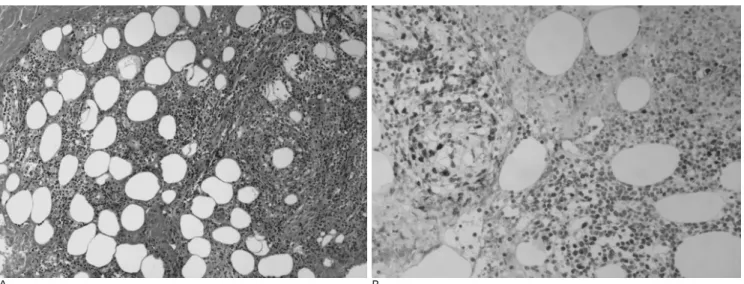
Histopathologic examination of a mass showed lym- phoid cell infiltration in the subcutaneous fat layer, and the lymphoid cells were surrounded by individual adipocytes and granuloma formation on the photomi- crograph (H-E stain ×100).
Immunohistochemistry revealed that the atypical lym- phocytes and granuloma were positive for CD3 (Fig. 2) and CD20 and they were negative for CD30.
Yong Hoon Kim, et al: MR Findings of Subcutaneous Panniculitis-like T-Cell Lymphoma
─ 480 ─
A B C
Fig. 1. 65-year-old female with a popliteal mass.
A. The T1 weighted sagittal image shows a low signal intensity lesion with an ill-defined margin and infiltration in the subcuta- neous layer of the popliteal fossa (arrow).
B. On the fat suppressed proton density sagittal image, the lesion demonstrates heterogeneous high signal intensity with an infiltra- tive pattern.
C. The fat suppressed T1 weighted sagittal image with Gd-DTPA demonstrates mild enhancement.
A B
Fig. 2. A. Subcutaneous adipose tissues are surrounded by tumor cells. The right lower corner reveals a granulomatous reaction.
(HE ×100)
B. The tumor cells infiltrating the adipose tissue and the granuloma are positive for CD3 staining. (×200, CD3 immunohistochem- istry)
Discussion
According to the World Health Organization (WHO) classification, lymphoid malignancies are divided into B- cell neoplasms, T-cell neoplasms and Hodgkin’s disease (1). T-cell neoplasms are divided into precursor T-cell neoplamsms and peripheral T-cell neoplasms. The pe- ripheral T-cell neoplasms are also divided into peripher- al T-cell leukemia and peripheral T-cell lymphoma (1).
Subcutaneous panniculitis-like T-cell lymphoma was originally described by Gonzalez et al. (6) as an uncom- mon form of cutaneous lymphoma that was localized within the subcutis and it mimicked lobular panniculi- tis. Subcutaneous panniculitis-like T-cell lymphoma is increasingly being recognized, after having been incor- porated as a distinct entity into the recent WHO classifi- cation of lymphomas. Yet it remains an uncommon type of cutaneous T-cell lymphoma with fewer than 100 cas- es having been reported worldwide. It most frequently occurs in women between the 4th and 5th decade, but it also affects people of a broad age range, including chil- dren and young adults (7). These patients typically pre- sent with multiple subcutaneous tumors or plaques on the lower extremities or trunk, and less commonly on the upper extremities or the face (3-5). Clinically, it is often confused with inflammatory panniculitis associat- ed with connective tissue disease. The prognosis of SPT- CL is generally poor. Some of the disease features such as the constitutional symptoms, the pancytopenia, the involvement of multiple sites, and the haemophagocytic syndrome (HPS) tend to be associated with a poor clini- cal outcome (6, 8). Two clinical courses have been de- scribed for this condition: an indolent one and a more aggressive form (8). In the more aggressive form, death is often a result of the HPS, in which there is phagocyto- sis of platelets, white and red blood cells by macrophages, histiocytes or malignant cells, resulting in pancytopenia.
Histologically, all the previously reported patients ex- hibited an infiltrate of atypical lymphoid cells with hy- perchromatic nuclei, and these cells were labeled with pan T-cell markers such as CD2 and CD3. The prolifer- ated and infiltrated lymphocytes tend to surround indi- vidual adipocytes. This is the characteristic rimming of fat spaces (6, 9)
There have been few case reports describing the US, CT or MR imaging as applied to peripheral T-cell lym- phoma (4, 5, 10, 11). In these articles, the sonographic
findings of subcutaneous panniculitis-like T-cell lym- phoma showed poorly defined, homogeneous hypere- chogenicity in the subcutaneous fat layer (5, 10, 11). On CT examination, multiple subcutaneous nodules in SPT- CL patients are well recognized as multiple enhancing nodules (4). The MR imaging findings are nonspecific for soft-tissue tumors and soft tissue inflammation, the same as for our case. The tumor of our patient had sig- nal intensity similar to or slightly higher than that of normal muscle on the T1-weighted images and a slightly higher signal than that of fat on the T2-weighted images (11).
For our case, the MR imaging findings were similar to soft tissue inflammation or infection. The lesion had an ill-defined margin and infiltration to the subcutaneous layer with mild enhancement. Unfortunately, we could not determine any specific findings on the MR images for making the diagnosis of SPTCL, but the relatively mild enhancement of the lesion is different from that of soft tissue infection.
In our opinion, although it is a rare condition, SPTCL should be included in the differential diagnosis not only when multiple nodules are noted on US and CT, as pre- viously reported in past studies, but also when subcuta- neous inflammation or infection is suspected on the US CT or MR imaging.
References
1. Harris NL, Jaffe ES, Diebold J, Flandrin G, Muller-Hermelink HK, Vardima J, et al. The World Health Organization classification of hematological malignancies report of the Clinical Advisory Committee Meeting, Airlie House, Virginia, November 1997.
Histopathology 2000;36:69-86
2. Fujii Y, Shinozaki T, Koibuchi H, Ono T, Omoto K, Taniguchi N, et al. Primary peripheral T-cell lymphoma in subcutaneous tissue:
sonographic findings. J Clin Ultrasound 2004;32:361-364
3. Lee SS, Cho KJ, Kim CW. Clinicopathological analysis of 501 non- Hodgkin’s lymphomas in Korea accorking to the revised European-American classification of lymphoid neoplasms.
Histopathology 1999;35:345-354
4. Lee HJ, Im JG, Goo JM, Kim KW, Choi BI, Chang KH, et al.
Peripheral T-cell lymphoma: spectrum of imaging findings with clinical and pathologic features. Radiographics 2003;23:7-26 5. Lee VS, Martinez S, Coleman RE. Primary muscle lymphoma:
clinical and imaging findings. Radiology 1997;203:237-244 6. Gonzalez CL, Medeiros LJ, Braziel RM, Jaffe ES.T-cell lymphoma
involving subcutaneous tissue: a clinicopathologic entity common- ly associated with hemophagocytic syndrome. Am J Surg Pathol 1991;15:17-27
7. Pauli M, Berti E. Cutaneous T-cell lymphomas (including rare sub- types): current concepts II. Haematologica 2004;89:1371-1372 8. Perniciaro C, Zalla MJ, White JW jr., Menke DM. Subdutaneous T-
cell lymphoma. Report of two additional cases and further obser- J Korean Radiol Soc 2007;57:479-482
─ 481 ─
vations. Arch Dermatol 1993; 129:1171-1176
9. Hoque SR, Child FJ, Whittaker SJ, Ferreira S, Orchard G, Jenner K, et al. Subcutaneous panniculitis-like T-cell lymphoma: a clinico- pathological, immunophenotypic and molecular analysis of six pa- tients. Br J Dermatol 2003;148:516-525
10. Chiou HJ, Chou YH, Chiou SY, Chen WM, Wang HK, Chang CY,
et al. High-resolution ultrasonography of primary peripheral soft tissue lymphoma. J Ultrasound Med 2005;24:77-86
11. Yuh WT, Wen BC, Argenyi ZB, Mayr NA, Moore TE. Magnetic resonance imaging of peripheral T-cell lymphoma. Australas Radiol 1991;35:284-286
Yong Hoon Kim, et al: MR Findings of Subcutaneous Panniculitis-like T-Cell Lymphoma
─ 482 ─
대한영상의학회지 2007;57:479-482
피하 지방층염과 유사한 T-세포 임파종의 자기공명영상: 1예 보고1
1인제대학교 의과대학 부속 일산백병원 영상의학과
2인제대학교 의과대학 부속 일산백병원 병리과
김용훈・김한성2・김수영・황윤준・서정욱・이지영・차순주・허 감
피하지방층염과 유사한 T-세포 임파종은 드문 예로써 보통 지방층염과 유사한 피하 결절로 표현되어 다른 말초 부위의 임파종과 구별된다. 최근에는 임상과 병리 소견에 대한 보고들이 늘고 있으나 영상의학적으로는 컴퓨터 단 층 촬영이나 초음파 소견만이 제한적으로 보고되어 있다. 저자들은 슬와 종괴로 나타난 T-세포 임파종의 자기공 명영상을 문헌 고찰과 함께 보고한다.