Printed in the Republic of Korea
요 약. 현재 수행하는 작업은 피페리딘 또는 암모늄 아세테이트 존재하에서 malononitrile와 β- ar- oylacrylic acid 유도체의 DMF 용매조건에서 상호작용에 대한 연구이며, 형성된 화합물을 이용한 퓨즈 되고 단리된 이중고리화 시스템의 합성에 관한 것이다. β-aroylacrylic acid (3)이 DMF 용매와 피페리딘 촉매조건에malononitrile와 반응하여 4H-피란유도체(4)를 형성한다. 촉매를 암모늄 아세테이트로 바꿈 으로서 피리딘 유도체를 얻었다. 또한 N-말레암산 유도체 (19)와 (27)은 말레 무수물과 함께 (4)와 (5)의 반응을 경유하여 합성되었다. 마이클 첨가 반응에서 이용되는 메틸렌화합물에 관한 이 연구는 B-ar- oylacrylic acid의 경우와 유사하게 형성된 말레암산 유도체의 반응성에 대한 것이다.
주제어: β-Aroylacrylic acid, 마이클 반응, 2-아미노피란, 2-아미노피리딘, 피리미딘, 말레암산
ABSTRACT. The present work is devoted to study the interaction of β-aroylacrylic acid derivative (3) with malononitrile in (DMF) in the presence of piperidine and/or ammonium acetate, then using the formed compounds as starting materials for synthesizing fused and isolated heterocyclic systems. It has been established that the β-aroylacrylic acid (3) reacts with malononitrile in (DMF) in the presence of piperidine as a catalyst with the formation of 4H-pyran derivative (4). By changing the catalyst into ammonium acetate, pyridine derivative (5) has been obtained. Also the N-maleamic acid derivatives (19) and (27) have been synthesized via the interaction of (4) and (5) with maleic anhydride. The purpose of this step is to study the behavior of the formed maleamic acid derivatives – as analogies of β-aroylacrylic acids – towards different active methylene compounds under Michael addition reaction.
Keywords: β-Aroylacrylic acid, Michael reaction, 2-aminopyran, 2-aminopyridine, Pyrimidine, Maleamic-acid.
이중고리 합성에 블록제로서 이용된 피란과 피리딘
Maher. A. El-Hashash*, Abdallah. A. El-Sawy†, Abdelmonem. M. F. Eissa†, and Mohammed. S. Sallam
Chemistry Department, Faculty of Science, Ain Shams University, Abbassia 11566, Cairo, Egypt
†Chemistry Department, Faculty of Science, Benha University, Benha, Egypt (2009. 3. 13 접수)
Pyran and Pyridine as Building Blocks in Heterocyclic Synthesis
Maher. A. El-Hashash*, Abdallah. A. El-Sawy†, Abdelmonem. M. F. Eissa†, and Mohammed. S. Sallam
Chemistry Department, Faculty of Science, Ain Shams University, Abbassia 11566, Cairo, Egypt
†Chemistry Department, Faculty of Science, Benha University, Benha, Egypt (Received March 13, 2009)
INTRODUCTION
Compounds Containing the triazolo[1,5-c]pyri- midine moiety have attracted considerable attention due to their remarkable adenosine and benzo- diazepine receptor affinity. Particularly, the 5-
amino- 9-chloro-2-(2-furyl)-1,2,4-triazolo[1,5-c]
quinazoline (1) (Figure 1) was found to be a highly potent adenosine antagonist,1 while the 9-chloro-2-(2-fluorophenyl)-1,2,4-triazolo[1,5-c]
quinazolin-5(6H)-one (2) displayed a very signifi- cant benzodiazepine binding activity.2
N NN
N O
NH2
Cl
NH NN N
O Cl
F
(1) (2)
Fig. 1.
Also pyran and fused 4H-pyran derivatives have attracted a great deal of interest owing to their antimicrobial activity,3,4,5 inhibition of influ- enza, virus sialidases,6 mutagenic activity as anti- viral,7 antiproliferation agents,8 sex pheromones activity,9,10 antitumor11 and anti-inflammatory agent.12 Moreover, pyran derivatives are well known for their antihistaminic activity.13
Also, pyrimidines and fused pyrimidines play an inertial role in several biological processes and have a considerable chemical and pharmacologi- cal importance. In particular pyrimidine nucleus can be found in a broad variety of antibacterial and antitumor agents as well as in agrochemical and veterinary products.14-17 This current pharma- cological importance has stimulated our interest to synthesize several new and biologically active derivatives of these heterocyclic systems.
EXPERIMENTAL SECTION All melting points are uncorrected and deter- mined by the open capillary method using Gallen Kamp melting point apparatus. Microanalyses were carried out by the Micro Analytical Center at Cairo University. The IR spectra were recorded on FT/IR-300E Jasco spectrophotometer as (KBr) discs. The 1H NMR spectra were measured on a Varian Gemini 200 MHz instrument with chemical shifts (δ) expressed in ppm downfield from TMS.
Mass spectra were recorded on Shomadzu GC-MS (QP-1000EX) instrument operating at 70eV.
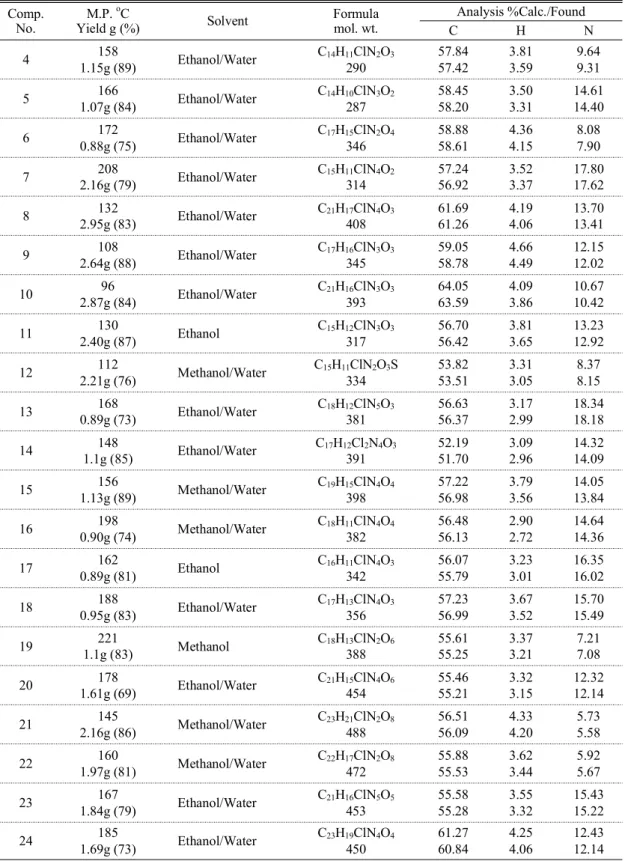
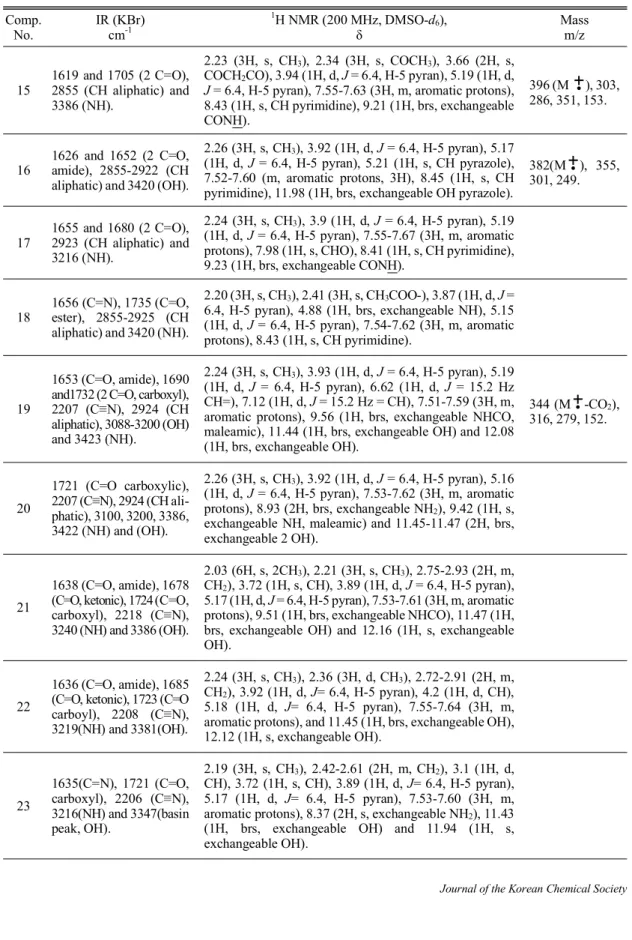
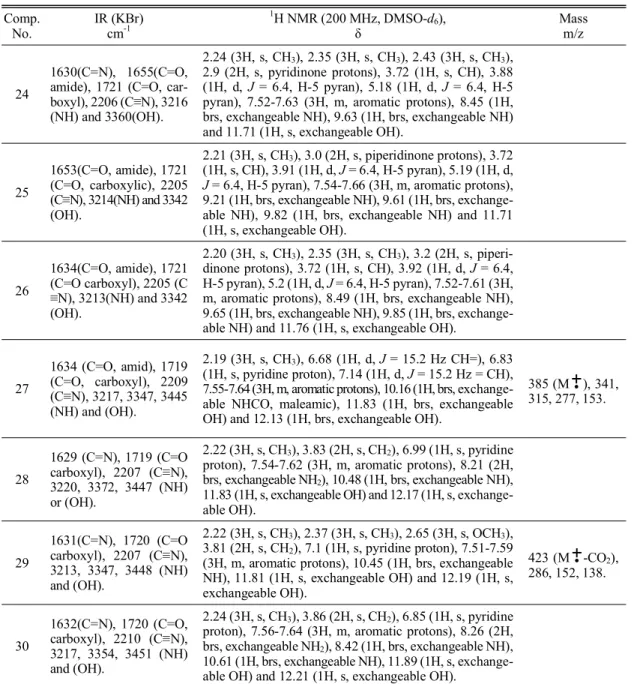
(Tables 1&2).
(E)-2-amino-6-(4-chloro-3-methylphenyl)-3-c yano-4H-pyran-4-carboxylic acid (4) and (E)-2- amino-6-(4-chloro-3-methylphenyl)-3-cyanopyri-
dine-4-carboxylic acid (5).
To a solution of 4-(4-chloro-3-methylphenyl)- 4-oxobut-2-enoic acid (3) (1.00 g, 4.47 mmol) and malononitrile (0.3 g, 4.47 mmol) in refluxing DMF (20 mL) few drops of piperidine or ammonium acetate (0.34 g, 4.47 mmol) were added; the result- ing mixture was refluxed for (2h). The reaction mixture was allowed to cool at room temperature then poured into water (100 mL). The precipitate formed was filtered off and washed on the filter funnel with water, then dried and crystallized from the proper solvent to give 4H-Pyran derivative (4) and/or Pyridine derivative (5) respectively.
6-(4-chloro-3-methylphenyl)-3-cyano-2-(ethox- ymethyleneamino)-4H-pyran-4-carboxylic acid (6).
4H-Pyran derivative (4) (1.00 g, 3.4 mmol) in triethylorthoformate18,19,20 (10 mL) was stirred under reflux for (5h). The reaction mixture was concentrated and the obtained brown precipitate then crystallized from ethanol/water to afford ethoxymethyleneamino-4H-pyran (6).
5-(4-chloro-3-methylphenyl)-1,2,3a-trihydro-6- oxa-1,2,7,9-tetrazaphenalen-3(3H)-one (7) and 7- (4-chloro-3-methylphenyl)-4-imino-3-(phenylam ino)-4-hydro-5H-pyrano[2,3-d] pyrimidine-5-car- boxylic acid (8).
A mixture of ethoxymethyleneamino-4H-pyran (6) (3.00 g, 8.70 mmol) and hydrazine hydrate21 (0.30 mL, 8.70 mmol) or phenylhydrazine (0.85 mL, 8.70 mmol) in absolute ethanol (30 mL) was refluxed for (7h) .The reaction mixture was left to cool at room temperature then acidified with diluted HCl, the formed solid was filtered off, washed with cold water, dried and crystallized from the proper solvent to afford pyranopyrimidines (7) and/or (8).
7-(4-chloro-3-methylphenyl)-3-ethyl-4-imino- 4-hydro-5H-pyrano[2,3-d] pyrimidine-5-carboxylic- acid-(9) and 7-(4-chloro-3-methylphenyl)-4-imino- 3-phenyl-4hydro-5H-pyrano [2,3-d] pyrimidine- 5-carboxylic acid (10).
A mixture of ethoxymethyleneamino-4H-pyran (6) (3.00 g, 8.70 mmol) and ethylamine (0.57 mL, 8.70 mmol) and/or aniline (0.75 mL, 8.70 mmol) in absolute ethanol (30 mL) was refluxed for (5h).
Table 1. Characterization and physical data of synthesized compounds Comp.
No. M.P. oC
Yield g (%) Solvent Formula
mol. wt.
Analysis %Calc./Found
C H N
4 158
1.15g (89) Ethanol/Water C14H11ClN2O3
290
57.84 57.42
3.81 3.59
9.64 9.31
5 166
1.07g (84) Ethanol/Water C14H10ClN3O2
287
58.45 58.20
3.50 3.31
14.61 14.40
6 172
0.88g (75) Ethanol/Water C17H15ClN2O4
346
58.88 58.61
4.36 4.15
8.08 7.90
7 208
2.16g (79) Ethanol/Water C15H11ClN4O2
314
57.24 56.92
3.52 3.37
17.80 17.62
8 132
2.95g (83) Ethanol/Water C21H17ClN4O3
408
61.69 61.26
4.19 4.06
13.70 13.41
9 108
2.64g (88) Ethanol/Water C17H16ClN3O3
345
59.05 58.78
4.66 4.49
12.15 12.02
10 96
2.87g (84) Ethanol/Water C21H16ClN3O3
393
64.05 63.59
4.09 3.86
10.67 10.42
11 130
2.40g (87) Ethanol C15H12ClN3O3
317
56.70 56.42
3.81 3.65
13.23 12.92
12 112
2.21g (76) Methanol/Water C15H11ClN2O3S 334
53.82 53.51
3.31 3.05
8.37 8.15
13 168
0.89g (73) Ethanol/Water C18H12ClN5O3
381
56.63 56.37
3.17 2.99
18.34 18.18
14 148
1.1g (85) Ethanol/Water C17H12Cl2N4O3
391
52.19 51.70
3.09 2.96
14.32 14.09
15 156
1.13g (89) Methanol/Water C19H15ClN4O4
398
57.22 56.98
3.79 3.56
14.05 13.84
16 198
0.90g (74) Methanol/Water C18H11ClN4O4
382
56.48 56.13
2.90 2.72
14.64 14.36
17 162
0.89g (81) Ethanol C16H11ClN4O3
342
56.07 55.79
3.23 3.01
16.35 16.02
18 188
0.95g (83) Ethanol/Water C17H13ClN4O3
356
57.23 56.99
3.67 3.52
15.70 15.49
19 221
1.1g (83) Methanol C18H13ClN2O6
388
55.61 55.25
3.37 3.21
7.21 7.08
20 178
1.61g (69) Ethanol/Water C21H15ClN4O6
454
55.46 55.21
3.32 3.15
12.32 12.14
21 145
2.16g (86) Methanol/Water C23H21ClN2O8
488
56.51 56.09
4.33 4.20
5.73 5.58
22 160
1.97g (81) Methanol/Water C22H17ClN2O8
472
55.88 55.53
3.62 3.44
5.92 5.67
23 167
1.84g (79) Ethanol/Water C21H16ClN5O5
453
55.58 55.28
3.55 3.32
15.43 15.22
24 185
1.69g (73) Ethanol/Water C23H19ClN4O4
450
61.27 60.84
4.25 4.06
12.43 12.14
Table 2. IR, 1HNM and Mass spectral data of synthesized compounds Comp.
No. IR (KBr)
cm-1
1H NMR (200 MHz, DMSO-d6),
δ Mass
m/z
4 1712 (C=O, carboxyl), 2196 (C≡N) and 3280 (NH).
2.32 (3H, s, CH3), 3.93 (1H, d, J = 6.4, H-4 pyran), 5.19 (1H, d, J = 6.4, H-5 pyran), 7.52-7.60 (3H, m, aromatic protons), 8.37 (2H, brs, exchangeable NH2) and 11.74 (1H, brs, exchangeable OH)
288 (M -H2), 152, 137, 125, 79.
5 1629 (C=N), 1718 (C=O, carboxyl), 2200 (C≡N) and 3285 (NH).
2.35 (3H, s, CH3), 6.91 (1H, s, H-5 pyridine), 7.63-7.71 (3H, m, aromatic protons ), 7.97 (2H, brs, exchangeable NH2) and 11.54 (1H, brs, exchangeable OH).
287 (M ), 153, 121, 105, 77.
6 1682(C=N), 1726 (C=O, carboxyl), 2210 (C≡N) and 3390 (OH).
1.33 (3H, t, J = 7.62Hz, OCH2CH3), 2.38 (3H, s, CH3), 3.9 (1H, d, J = 6.4, H-4 pyran), 4.27 (2H, q, J = 7.62Hz, OCH2), 5.16 (1H, d, J = 6.4, H-5 pyran), 7.59-7.66 (3H, m, aromatic protons), 8.32 (1H, s, N=CH-O) and 11.59 (1H, brs, exchange- able OH).
7 1610(C=N), 1651(C=O amide) and 3324 (broad band, N-H).
2.27 (3H, s, CH3), 3.91 (1H, d, J = 6.4, H-5 pyran), 4.56 (1 H, s, exchangeable CONH-NH), 5.18 (1H, d, J = 6.4, H-5 pyran), 7.59-7.66 (3H, m, aromatic protons), 9.27 (1H, s, exchangeable CONH), 9.41 (1H, s, CH pyrimidine).
314 (M ), 264, 152.
8 1600 (C=N), 1722 (C=O, carboxyl) and 3386 (basin peak, OH and NH).
2.21 (3H, s, CH3), 3.95 (1H, d, J = 6.4, H-5 pyran), 5.2 (1H, d, J = 6.4, H-5 pyran), 7.51-7.60 (3H, m, aromatic protons), 8.73 (1H, s, exchangeable -NHPh), 9.12 (1H, s, NH imino), 9.55 (1H, s, CH pyrimidine), 11.51 (1H, brs, exchangeable OH).
9 1648 (C=N), 1720(C=O, carboxyl) and 3359 (NH and OH)
1.29 (3H, t, J = 7.4, N-CH2CH3), 2.23 (3H, s, CH3), 3.88 (1H, d, J = 6.4, H-5 pyran), 4.87 (2H, q, J= 7.3, N-CH2CH3), 5.14 (1H, d, J = 6.4, H-5 pyran), 7.54-7.62 (3H, m, aromatic protons), 9.08 (1H, s, NH imino), 9.45 (1H, s, CH pyri- midine) and 11.48 (1H, brs, exchangeable OH).
10 1684(C=N), 1726(C=O, carboxyl) and 3351 (NH and OH)
2.26 (3H, s, CH3), 3.94 (1H, d, J = 6.4, H-5 pyran), 5.22 (1H, d, J = 6.4, H-5 pyran), 7.52-7.63 (3H, m, aromatic protons), 9.05 (1H, s, NH imino), 9.42 (1H, s, CH pyri- midine), 11.45 (1H, brs, exchangeable OH).
11 1648(C=N), 1728 (C=O, carboxyl) and 3386 (NH or OH).
2.21 (3H, s, CH3), 3.89 (1H, d, J = 6.4, H-5 pyran), 5.16 (1H, d, J = 6.4, H-5 pyran), 7.31 (2H, s, exchangeable NH2) 7.53-7.61 (3H, m, aromatic protons), 9.22 (1H, s, CH pyrimidine) and 11.49 (1H, brs, exchangeable OH).
12 1444 (C=S), 1682 (C=N), 1727 (C=O, carboxyl) and 3366 (NH or OH).
2.23 (3H, s, CH3), 3.1 (1H, brs, exchangeable SH), 3.9 (1H, d, J = 6.4, H-5 pyran), 5.17 (1H, d, J = 6.4, H-5 pyran), 7.51-7.59 (3H, m, aromatic protons), 8.41 (1H, s, CH pyri- midine), 9.25 (1H, brs, exchangeable NH) and 11.45 (1H, brs, exchangeable OH).
13 1620 (C=N), 1650 (C=O, amide), 3300-3390 (NH).
2.25 (3H, s, CH3), 3.92 (1H, d, J = 6.4, H-5 pyran), 4.46 (1H, s, CH pyrazol), 5.21 (1H, d, J = 6.4, H-5 pyran), 6.35 (1H, brs, exchangeable NH2), 7.53-7.61 (3H, m, aromatic protons), 8.45 (1H, s, CH pyrimidine).
14 1656 and 1670 (2 C=O, amide) and 3395 (NH).
2.18 (3H, s, CH3), 3.91 (1H, d, J = 6.4, H-5 pyran), 3.94 (2H, s, CH2Cl), 5.2 (1H, d, J = 6.4, H-5 pyran), 7.51-7.64 (3H, m, aromatic protons), 8.44 (1H, s, CH pyrimidine), 9.26 (1H, brs, exchangeable CONH).
Table 2.
Comp.
No. IR (KBr)
cm-1
1H NMR (200 MHz, DMSO-d6),
δ Mass
m/z
15 1619 and 1705 (2 C=O), 2855 (CH aliphatic) and 3386 (NH).
2.23 (3H, s, CH3), 2.34 (3H, s, COCH3), 3.66 (2H, s, COCH2CO), 3.94 (1H, d, J = 6.4, H-5 pyran), 5.19 (1H, d, J = 6.4, H-5 pyran), 7.55-7.63 (3H, m, aromatic protons), 8.43 (1H, s, CH pyrimidine), 9.21 (1H, brs, exchangeable CONH).
396 (M ), 303, 286, 351, 153.
16 1626 and 1652 (2 C=O, amide), 2855-2922 (CH aliphatic) and 3420 (OH).
2.26 (3H, s, CH3), 3.92 (1H, d, J = 6.4, H-5 pyran), 5.17 (1H, d, J = 6.4, H-5 pyran), 5.21 (1H, s, CH pyrazole), 7.52-7.60 (m, aromatic protons, 3H), 8.45 (1H, s, CH pyrimidine), 11.98 (1H, brs, exchangeable OH pyrazole).
382(M ), 355, 301, 249.
17 1655 and 1680 (2 C=O), 2923 (CH aliphatic) and 3216 (NH).
2.24 (3H, s, CH3), 3.9 (1H, d, J = 6.4, H-5 pyran), 5.19 (1H, d, J = 6.4, H-5 pyran), 7.55-7.67 (3H, m, aromatic protons), 7.98 (1H, s, CHO), 8.41 (1H, s, CH pyrimidine), 9.23 (1H, brs, exchangeable CONH).
18 1656 (C=N), 1735 (C=O, ester), 2855-2925 (CH aliphatic) and 3420 (NH).
2.20 (3H, s, CH3), 2.41 (3H, s, CH3COO-), 3.87 (1H, d, J = 6.4, H-5 pyran), 4.88 (1H, brs, exchangeable NH), 5.15 (1H, d, J = 6.4, H-5 pyran), 7.54-7.62 (3H, m, aromatic protons), 8.43 (1H, s, CH pyrimidine).
19
1653 (C=O, amide), 1690 and1732 (2 C=O, carboxyl), 2207 (C≡N), 2924 (CH aliphatic), 3088-3200 (OH) and 3423 (NH).
2.24 (3H, s, CH3), 3.93 (1H, d, J = 6.4, H-5 pyran), 5.19 (1H, d, J = 6.4, H-5 pyran), 6.62 (1H, d, J = 15.2 Hz CH=), 7.12 (1H, d, J = 15.2 Hz = CH), 7.51-7.59 (3H, m, aromatic protons), 9.56 (1H, brs, exchangeable NHCO, maleamic), 11.44 (1H, brs, exchangeable OH) and 12.08 (1H, brs, exchangeable OH).
344 (M -CO2), 316, 279, 152.
20
1721 (C=O carboxylic), 2207 (C≡N), 2924 (CH ali- phatic), 3100, 3200, 3386, 3422 (NH) and (OH).
2.26 (3H, s, CH3), 3.92 (1H, d, J = 6.4, H-5 pyran), 5.16 (1H, d, J = 6.4, H-5 pyran), 7.53-7.62 (3H, m, aromatic protons), 8.93 (2H, brs, exchangeable NH2), 9.42 (1H, s, exchangeable NH, maleamic) and 11.45-11.47 (2H, brs, exchangeable 2 OH).
21
1638 (C=O, amide), 1678 (C=O, ketonic), 1724 (C=O, carboxyl), 2218 (C≡N), 3240 (NH) and 3386 (OH).
2.03 (6H, s, 2CH3), 2.21 (3H, s, CH3), 2.75-2.93 (2H, m, CH2), 3.72 (1H, s, CH), 3.89 (1H, d, J = 6.4, H-5 pyran), 5.17 (1H, d, J = 6.4, H-5 pyran), 7.53-7.61 (3H, m, aromatic protons), 9.51 (1H, brs, exchangeable NHCO), 11.47 (1H, brs, exchangeable OH) and 12.16 (1H, s, exchangeable OH).
22
1636 (C=O, amide), 1685 (C=O, ketonic), 1723 (C=O carboyl), 2208 (C≡N), 3219(NH) and 3381(OH).
2.24 (3H, s, CH3), 2.36 (3H, d, CH3), 2.72-2.91 (2H, m, CH2), 3.92 (1H, d, J= 6.4, H-5 pyran), 4.2 (1H, d, CH), 5.18 (1H, d, J= 6.4, H-5 pyran), 7.55-7.64 (3H, m, aromatic protons), and 11.45 (1H, brs, exchangeable OH), 12.12 (1H, s, exchangeable OH).
23
1635(C=N), 1721 (C=O, carboxyl), 2206 (C≡N), 3216(NH) and 3347(basin peak, OH).
2.19 (3H, s, CH3), 2.42-2.61 (2H, m, CH2), 3.1 (1H, d, CH), 3.72 (1H, s, CH), 3.89 (1H, d, J= 6.4, H-5 pyran), 5.17 (1H, d, J= 6.4, H-5 pyran), 7.53-7.60 (3H, m, aromatic protons), 8.37 (2H, s, exchangeable NH2), 11.43 (1H, brs, exchangeable OH) and 11.94 (1H, s, exchangeable OH).
Table 2.
Comp.
No. IR (KBr)
cm-1
1H NMR (200 MHz, DMSO-d6),
δ Mass
m/z
24
1630(C=N), 1655(C=O, amide), 1721 (C=O, car- boxyl), 2206 (C≡N), 3216 (NH) and 3360(OH).
2.24 (3H, s, CH3), 2.35 (3H, s, CH3), 2.43 (3H, s, CH3), 2.9 (2H, s, pyridinone protons), 3.72 (1H, s, CH), 3.88 (1H, d, J = 6.4, H-5 pyran), 5.18 (1H, d, J = 6.4, H-5 pyran), 7.52-7.63 (3H, m, aromatic protons), 8.45 (1H, brs, exchangeable NH), 9.63 (1H, brs, exchangeable NH) and 11.71 (1H, s, exchangeable OH).
25
1653(C=O, amide), 1721 (C=O, carboxylic), 2205 (C≡N), 3214(NH) and 3342 (OH).
2.21 (3H, s, CH3), 3.0 (2H, s, piperidinone protons), 3.72 (1H, s, CH), 3.91 (1H, d, J = 6.4, H-5 pyran), 5.19 (1H, d, J = 6.4, H-5 pyran), 7.54-7.66 (3H, m, aromatic protons), 9.21 (1H, brs, exchangeable NH), 9.61 (1H, brs, exchange- able NH), 9.82 (1H, brs, exchangeable NH) and 11.71 (1H, s, exchangeable OH).
26
1634(C=O, amide), 1721 (C=O carboxyl), 2205 (C
≡N), 3213(NH) and 3342 (OH).
2.20 (3H, s, CH3), 2.35 (3H, s, CH3), 3.2 (2H, s, piperi- dinone protons), 3.72 (1H, s, CH), 3.92 (1H, d, J = 6.4, H-5 pyran), 5.2 (1H, d, J = 6.4, H-5 pyran), 7.52-7.61 (3H, m, aromatic protons), 8.49 (1H, brs, exchangeable NH), 9.65 (1H, brs, exchangeable NH), 9.85 (1H, brs, exchange- able NH) and 11.76 (1H, s, exchangeable OH).
27
1634 (C=O, amid), 1719 (C=O, carboxyl), 2209 (C≡N), 3217, 3347, 3445 (NH) and (OH).
2.19 (3H, s, CH3), 6.68 (1H, d, J = 15.2 Hz CH=), 6.83 (1H, s, pyridine proton), 7.14 (1H, d, J = 15.2 Hz = CH), 7.55-7.64 (3H, m, aromatic protons), 10.16 (1H, brs, exchange- able NHCO, maleamic), 11.83 (1H, brs, exchangeable OH) and 12.13 (1H, brs, exchangeable OH).
385 (M ), 341, 315, 277, 153.
28
1629 (C=N), 1719 (C=O carboxyl), 2207 (C≡N), 3220, 3372, 3447 (NH) or (OH).
2.22 (3H, s, CH3), 3.83 (2H, s, CH2), 6.99 (1H, s, pyridine proton), 7.54-7.62 (3H, m, aromatic protons), 8.21 (2H, brs, exchangeable NH2), 10.48 (1H, brs, exchangeable NH), 11.83 (1H, s, exchangeable OH) and 12.17 (1H, s, exchange- able OH).
29
1631(C=N), 1720 (C=O carboxyl), 2207 (C≡N), 3213, 3347, 3448 (NH) and (OH).
2.22 (3H, s, CH3), 2.37 (3H, s, CH3), 2.65 (3H, s, OCH3), 3.81 (2H, s, CH2), 7.1 (1H, s, pyridine proton), 7.51-7.59 (3H, m, aromatic protons), 10.45 (1H, brs, exchangeable NH), 11.81 (1H, s, exchangeable OH) and 12.19 (1H, s, exchangeable OH).
423 (M -CO2), 286, 152, 138.
30
1632(C=N), 1720 (C=O, carboxyl), 2210 (C≡N), 3217, 3354, 3451 (NH) and (OH).
2.24 (3H, s, CH3), 3.86 (2H, s, CH2), 6.85 (1H, s, pyridine proton), 7.56-7.64 (3H, m, aromatic protons), 8.26 (2H, brs, exchangeable NH2), 8.42 (1H, brs, exchangeable NH), 10.61 (1H, brs, exchangeable NH), 11.89 (1H, s, exchange- able OH) and 12.21 (1H, s, exchangeable OH).
After cooling, the reaction mixture was poured into diluted HCl, the precipitated product was filtered off and washed several times with cold water, dried and crystallized from the proper solvent to afford the iminopyranopyrimidines (9) and/or (10).
4-amino-7-(4-chloro-3-methyphenyl)-5H-pyrano [2,3-d]pyrimidine-5-carboxylic acid (11).
To a solution of ethoxymethyleneamino-4H- pyran (6) (3.00 g, 8.70 mmol) and absolute ethanol (30 mL), ammonia solution (0.31 mL, 8.70 mmol) was added; the resulting mixture was refluxed for (2h). After cooling, the reaction mixture was acidi- fied with very diluted solution of cold HCl, the precipitate formed was filtered off and washed on the filter funnel with water, dried then crystallized
from ethanol/water to afford the aminopyrano- pyrimidine (11).
7-(4-chloro-3-methylphenyl)-4-mercapto-5H- pyrano[2,3-d]pyrimidine-5-carboxylic acid (12).
A mixture of ethoxymethyleneamino-4H-pyran (6) (3.00 g, 8.70 mmol) in ethanol (30 mL) and sodium hydrogensulphide (0.48 g, 8.70 mmol) was stirred under reflux for (7h). The reaction mixture was allowed to cool at room temperature then poured into water. The solid product was collected by filtration and crystallized from methanol/water to afford mercaptopyranopyrimidine (12).
4-amino-3H-pyrazolo[1,2-a]-12-(4-chloro-3- methyphenyl)-1aH-pyrano[3,4-d]pyrimido- [4,5-e]-1a,2,3,4-tetrahyd-ropyridazine-2,6-dione (13).
A mixture of pyranopyrimidine (7) (1.00 g, 3.20 mmol) and ethyl cyanoacetate22,23 (0.34 mL, 3.20 mmol) in absolute ethanol (15 mL) was refluxed for (7 h). The reaction mixture was allowed to cool at room temperature then poured into water (200 mL), the solid formed was filtered off, washed with water, dried and crystallized from ethanol/water to afford aminopyrazolinone (13).
5-(4-chloro-3-methylphenyl)-1-(1-oxo-2-chlo- roethyl)-2,3a-dihydro-6-oxa-1,2,7,9-tetrazaphena- len-3(3H)-one (14).
A solution of pyranopyrimidine (7) (1.00 g, 3.20 mmol) and ethyl chloroacetate (0.34 mL, 3.20 mmol) in absolute ethanol (15 mL) was refluxed for (10 h). The reaction mixture was allowed to cool at room temperature then poured into water (200 mL), the solid formed was filtered off, washed with water, dried and crystallized from ethanol/water to afford the non-cyclized oxo-chloro- ethyltetrazaphenalen (14).
5-(4-chloro-3-methylphenyl)-1-(1,3-dioxobutyl)- 2,3a-dihydro-6-oxa-1,2,7,-9-tetrazaphenalen-3 (3H)-one (15).
A mixture of pyranopyrimidine (7) (1.00 g, 3.20 mmol) and ethyl acetoacetate24 (0.40 mL, 3.20 mmol) in absolute ethanol (15 mL) was refluxed for (10 h). The reaction mixture was allowed to cool at room temperature then poured into water (200 mL), the solid formed was filtered
off, washed with water, dried and crystallized from methanol/water to afford dioxobutyltetra- zaphenalen (15).
4-hydroxy-3H-pyrazolo[1,2-a]-12-(4-chloro-3- methyphenyl)-1aH-pyrano[3,4-d]pyrimido[4,5- e]-1a,2,3,4-tetrahyd-ropyridazine-2,6-dione (16).
A mixture of pyranopyrimidine (7) (1.00 g, 3.20 mmol) and diethylmalonate22,23,24 (0.48 mL, 3.20 mmol) in absolute ethanol (15 mL) was refluxed for (10 h). The reaction mixture was allowed to cool at room temperature then poured into water (200 mL), the solid formed was filtered off, washed with water, dried and crystallized from methanol/water to afford pyrazolinedione derivative (16).
5-(4-chloro-3-methylphenyl)-1-formyl-2,3a- dihydro-6-oxa-1,2,7,9-tetrazaphenalen-3(3H)- one (17).
Pyranopyrimidine (7) (1.00 g, 3.20 mmol) in formic acid25 (85%) (15 mL) was refluxed for (15 h).
The reaction mixture was left to cool, then poured into water (300 mL) the formed precipitate was filtered off, washed thoroughly with water, dried and crystallized from absolute ethanol to afford formyl derivative (17).
5-(4-chloro-3-methylphenyl)-1,3a-dihydro-6- oxa-1,2,7,9-tetrazaphenalen-3-yl acetate (18).
In acetylchloride (15 mL), pyranopyrimidine (7) (1.00 g, 3.20 mmol) was refluxed in water bath for (2 h).The reaction mixture was concentrated, the separated brown solid crystallized from ethanol/
water to afford acetoxy derivative (18).
(E)-2-(3-carboxyacrylamido)-6-(4-chloro-3- methylphenyl)-3-cyano-4H-pyran-4-carboxylic- acid (19).
Maleic anhydride26,27 (0.33 g, 3.4 mmol) was completely dissolved at room temperature in glacial acetic acid (30 mL), and then 4H-pyran derivative (4) (1.00 g, 3.4 mmol) was added to the solution;
the resulting mixture was stirred under reflux for (1 h).The reaction mixture was allowed to cool at room temperature, then poured into water (500 mL), the precipitate formed was filtered off, washed with water, dried and crystallized from methanol to afford N-cyclic maleamic acid (19).
2-amino-6-[4-carboxy-6-(4-chloro-3-methylph enyl)-3-cyano-4H-pyran-2-ylamino]-3-cyano-4H- pyran-4-carboxylic acid (20).
To a solution of maleamic acid (19) (2.00 g, 5.15 mmol) and malononitrile28 (0.34 g, 5.15 mmol) in dioxan (20 mL) few drops of piperidine was added; the resulting mixture was refluxed at 60 oC for (7 h). The reaction mixture was allowed to cool at room temperature then acidified with diluted acetic acid (200 mL), the solid formed was filtered off, washed with water, dried and crystallized from the ethanol/water to afford bis compound (20).
2-[3-acetyl-2-(carboxymethyl)-4-oxopentana- mido]-6-(4-chloro-3-methylphenyl)-3-cyano-4H- pyran-4-carboxylic acid (21).
To a solution of maleamic acid (19) (2.00 g, 5.15 mmol) and acetylacetone (0.53 mL, 5.15 mmol) in DMF (20 mL) few drops of piperidine was added; the resulting mixture was refluxed at 60 oC for (7 h). The reaction mixture was allowed to cool at room temperature then acidified with diluted acetic acid (200 mL), the solid formed was filtered off, washed with water, dried and cry- stallized from methanol/water to afford Michael adduct (21).
2-[3-acetyl-4-(carboxymethyl)-2,5-dioxopy- rrolidin-1-yl]-6-(4-chloro-3-methylphenyl)-3-cyano- 4H-pyran-4-carboxylic acid (22).
A mixture of maleamic acid (19) (2.00 g, 5.15 mmol) and ethyl acetoacetate (0.65 mL, 5.15 mmol) in dioxan (20 mL) in the presence of piperidine was refluxed at 60 oC for (10 h).The reaction mixture was allowed to cool at room temperature then poured into diluted solution of acetic acid (200 mL), the solid formed was filtered off, washed with water, dried and crystallized from methanol/
water to afford N-cyclic maleimide (22).
2-[5-amino-3-(carboxymethyl)-4-cyano-3,4- dihydro-2H-pyrrol-2-ylideneamino]-6-(4-chloro - 3-methylphenyl)-3-cyano-4H-pyran-4-carboxy- lic acid (23).
A mixture of maleamic acid (19) (2.00 g, 5.15 mmol) and malononitrile (0.34 g, 5.15 mmol) in DMF (30 mL) in the presence of ammonium
acetate was refluxed in water bath at 60 oC for (10 h). The reaction mixture was allowed to cool at room temperature then poured into diluted solution of acetic acid (200 mL), the solid formed was filtered off, washed with water, dried and crystallized from ethanol/water to afford iminopyrrol deri- vative (23).
6-(4-chloro-3-methylphenyl)-3-cyano-2-[3,4- dimethyl-6-oxo-6,7-dihydro-2H-pyrrolo[3,4-c]
pyridin-1-ylamino]-4H-pyran-4-carboxylic acid (24).
To a solution of maleamic acid (19) (2.00 g, 5.15 mmol) and acetylacetone28 (0.53 mL, 5.15 mmol) in DMF (30 mL) ammonium acetate was added; the resulting mixture was refluxed in water bath at 60 oC for (8 h). The reaction mixture was allowed to cool at room temperature then acidified with diluted acetic acid (200 mL), the solid formed was filtered off, washed with water, dried and crystallized from ethanol/water to afford pyridino- pyrrol (24).
6-(4-chloro-3-methylphenyl)-3-cyano-2-[3,4,6- trioxo-3,3a,4,5,6,7-hexahydro-2H-pyrrolo- [3,4-c] pyridin-1-ylamino)-4H-pyran-4-carboxylic acid (25).
A mixture of maleamic acid (19) (2.00 g, 5.15 mmol) and diethylmalonate (0.78 mL, 5.15 mmol) in DMF (30 mL) in the presence of ammonium acetate was refluxed in water bath at 60 oC for (6 h).The reaction mixture was allowed to cool at room temperature then poured into diluted solution of acetic acid (200 mL), the solid formed was filtered off, washed with water, dried and crystallized from ethanol/water to afford pyridinopyrrol (25).
6-(4-chloro-3-methylphenyl)-3-cyano-2-[3-methyl- 4,6-dioxo-4,5,6,7-tetrahydro-2H-pyrrolo [3,4-c] pyri- din-1-ylamino]-4H-pyran-4-carboxylic acid (26).
A mixture of maleamic acid (19) (2.00 g, 5.15 mmol) and ethyl acetoacetate (0.65 mL, 5.15 mmol) in DMF (30 mL) in the presence of ammonium acetate was refluxed in water bath at 60 oC for (3 h).The reaction mixture was allowed to cool at room temperature then poured into diluted solution of acetic acid (200 mL), the solid formed was filtered off, washed with water, dried and cry- stallized from ethanol/water to afford pyridino-
Ar COOH O
Ar =
O N
COOH CN NH2 Ar
COOH CN
NH2 Ar
CH2(CN)2 piperdine
CH2(CN)2
(4) (3)
(5)
CH3
Cl
CH3COONH4
Scheme 1.
pyrrol (26).
(E)-2-(3-carboxyacrylamido)-6-(4-chloro-3- methylphenyl)-3-cyanopyridine-4-carboxylic acid (27).
Maleic anhydride26,27 (0.33 mL, 3.4 mmol) was completely dissolved at room temperature in glacial acetic acid or THF (30 mL), and then pyridine derivative (5) (1.00 g, 3.4 mmol) was added to the solution; the resulting mixture was stirred under reflux for (1 h). The reaction mixture was allowed to cool at room temperature, then poured into water (500 mL), the precipitate formed was filtered off, washed with water, dried and crystallized from methanol to afford N-cyclic maleamic acid (27).
2-[5-amino-3-(carboxymethyl)-4-cyanofuran-2- ylamino]-6-(4-chloro-3-methylphenyl)-3-cyano- pyridine-4-carboxylic acid (28).
To a solution of N-cyclic maleamic acid (27) (2.00 g, 5.19 mmol) and malononitrile (0.34 g, 5.19 mmol) in DMF (15 mL) few drops of piperi- dine was added; the resulting mixture was refluxed at 60 oCfor (5h). The reaction mixture was allowed to cool at room temperature then acidified with diluted acetic acid (200 mL), the solid formed was filtered off, washed with water, dried and cry- stallized from methanol/water to afford furan derivative (28).
2-[4-acetyl-3-(carboxymethyl)-5-methylfuran- 2-ylamino]-6-(4-chloro-3-methylphenyl)-3-cyan- opyridine-4-carboxylic acid (29).
A mixture of N-cyclic maleamic acid (27) (2.00 g, 5.19 mmol) and acetylacetone (0.53 mL, 5.19 mmol) in DMF (20 mL) in the presence of piperi- dine was refluxed at 60 oC for (3 h).The reaction mixture was allowed to cool at room temperature then poured into diluted solution of acetic acid
(200 mL), the solid formed was filtered off, washed with water, dried and crystallized from ethanol/
water to afford furan derivatives (29).
2-[5-amino-3-(carboxymethyl)-4-cyano-1H- pyrrol-2-ylamino]-6-(4-chloro-3-methylphenyl)- 3-cyanopyridine-4-carboxylic acid (30).
A mixture of N-cyclic maleamic acid (27) (2.00 g, 5.19 mmol) and malononitrile28 (0.34 g, 5.19 mmol) in DMF (30 mL) in the presence of ammonium acetate was refluxed at 60 oCfor (3 h).
The reaction mixture was allowed to cool at room temperature then poured into diluted solution of acetic acid (200 mL), the solid formed was filtered off, washed with water, dried and crystallized from ethanol/water to afford aminopyrrol deriva- tive (30).
RESULTS AND DISCUSSION The β-aroylacrylic acid derivative 4-(4-chloro- 3-methylphenyl)-4-oxo-but-2-enoic acid29-38 (3) has interacted with malononitrile in dimethyl- formamide (DMF) in the presence of piperidine as a catalyst to afford-2-amino-6-(4-chloro-3-methyl- phenyl)-3-cyano-4H-pyran-4-carboxylic acid (4).
On the other hand, when the reaction was carried out in the presence of ammonium acetate it yielded 2-amino-6-(4-chloro-3-methylphenyl)-3-cyanopyri- dine-4-carboxylic acid (5) (Scheme 1). Both (4) and (5) were used as pre-key starting materials for synthesizing both fused and isolated heterocyclic systems.
The structure of compounds (4) and (5) were established by their correct analytical data and their IR spectra which exhibited strong absorption bands at the regions 1649-1655, 1712-1720, 2196 and 3280-3285 attributable to vC=N, vC=O, vC≡N and vNH
O COOH
Ar CN
N HCOEt
NH2NH2
EtNH2
O N
N COOHNH
Ar
O N
N COOHNH
Ar
NHPh
O N
N COOH
Ar
NH3 NH2
O N
N COOH
Ar
SH
TEOF O N
N NH HN
Ar O
O N
N NH
Ar COOH
Ph
PhNHNH2
Et NaSH
Ph-NH2
O COOH
Ar N
N NH2 NH
O COOH
Ar N
S NH
(4)
(6)
(7)
(8)
(9) (10)
(11) (12)
CH3 Cl Ar =
Scheme 2.
respectively. The 1H NMR spectrum of compound (4) revealed two doublets at δ 3.93 and 5.19 assigned to pyran protons H-4 and H-5 respec- tively, multiplet at δ 7.52-7.60 assigned for aromatic protons, singlet at δ 2.32 ppm assigned for pro- tons of methyl group and finally two exchangeable singlets at δ 8.37 and 11.74 ppm consistent with the protons of (NH2) and (OH) respectively. The
1H NMR spectrum of compound (5) exhibited multiple signal at δ 7.63-7.71 assigned for aromatic protons, singlet at δ 2.35 ppm assigned for protons of methyl group and finally two exchangeable singlets at δ 7.97 and 11.45 ppm consistent with the protons of (NH2) and (OH) respectively. EI-MS for compounds (4) and (5) exhibited m/z 288 and 287 (M ) respectively. The reaction takes place via nucleophilic addition of the carbanion derived from the malononitrile to the α,β-unsaturated car- bonyl moiety in the acid (3) followed by cyclization in case of (4) and ring closure and dehydrogena- tion in case of (5).
Refluxing of (4) with neat triethylorthoformate afforded 6-(4-chloro-3-methylphenyl)-3-cyano-2- (ethoxymethyleneamino)-4H-pyran-4-carboxylic acid (6). Its IR displayed an absorption bands at 1682, 1726, 2210 and 3390 attributable to vC=N,
vC=O, vC≡N and vOH and showed no absorption frequency in the NH region. The 1H NMR spec- trum of compound showed singlet signal of the azamethine proton (N=CH) at δ 8.32 , triplet at δ 1.33 assigned for terminal methyl protons (OCH2CH3) and quartet signal at δ 4.27 assigned with the two protons of methylene (OCH2). Compound (6) was used as key-starting material for synthesizing some interesting annulated heterocyclic systems (Scheme 2).
Thus, interaction of compound (6) with hydrazine hydrate in boiling ethanol yielded 5-(4-chloro-3- methylphenyl)-1,2,3a-trihydro-6-oxa-1,2,7,9-tetr azaphenalen-3(3H)-one (7), without isolation of the imino derivative. This could be explained by the formation of the imino derivative first, which in the presence of a base (hydrazine hydrate) under- went a Dimroth rearrangement39,40,41 to give the thermodynamically more stable hydrazino derivate which underwent ring closure and yielded the desired product (7). IR spectrum of compound (7) exhibited strong absorption bands at 1610, 1651 and 3324 (broad band) attributable to vC=N, vC=O (amide) and vNH devoid any band for vC≡N. The 1H NMR spectrum revealed exchangeable two singlet signals at δ 9.27 and 4.56 ppm attributable to the protons
O N N C N
Ar
Y O
HO
O N
N C N
Ar
Y O
OH
O N
N N C
Ar
Y O
HO
H H H
A B C
8, Y= NHPh, 9, Y= Et 10,Y= NPh
Fig. 2.
of (CONH) and (CONH-NH) at the pyridazinone ring , and devoid any exchangeable (OH) signals.
Refluxing an ethanolic solution of (6) with phenyl- hydrazine afforded the corresponding 7-(4-chloro- 3-methylphenyl)-4-imino-3-(phenylamino)-4-hy dro-5H-pyrano[2,3-d]pyrimidine-5-carboxylic acid. The structure of compound (8) was bared on microanalytical and spectral data. Its IR spectrum exhibited strong absorptions at 1600, 1722 and 3386, (basin peak) attributable to vC=N, vC=O, vNH
and vOH.
When compound (6) was submitted to react with primary amines, namely ethylamine and aniline led to the formation of 7-(4-chloro-3-methylphenyl)- 3-ethyl-4-imino-4-hydro-5H-pyrano[2,3-d]
pyramidine-5-carboxylic acid (9) and/or 7-(4-chloro- 3-methylphenyl)-4-imino-3-phenyl-4-hydro-5H- pyrano[2,3-d] pyrimidine-5-carboxylic acid (10).
The structures of compounds (9) and (10) were established by their correct analytical data and compatible spectroscopic data. Their IR spectra exhi- bited strong absorptions at the regions 1648-1684, 1720-1726, 3351 and 3359 attributable to vC=N, vC=O, vNH and/or vOH respectively. The 1H NMR spectrum supported the structure of (9) as it showed triplet at δ 1.29 and quartet at δ 3.87 consistent with the methyl and methylene protons of (N-CH2CH3) respectively, singlet at δ 9.08 for the imonopyrimidine proton (NH). The reaction takes place via nucleo- philic substitutions on the methylidene carbon followed by ring closure.
Each compound of (8), (9) and (10) can exist in one of three conformations A, B, or C, both A and B are stabilized via hydrogen bond formation, so they are more stable than C. In case of A hydro- gen bond is formed by using one lone pair of electrons on the oxygen of hydroxyl group (OH,sp3), while in B the formed hydrogen bond will use lone pair on the oxygen of carbonyl moiety (C=O, sp2), so hydrogen bond in case of A is stronger than B (Figure 2).
Ammonolysis of compound (6) gave-4-amino-7- (4-chloro-3-methylphenyl)-5H-pyrano-[2,3-d]
pyrimidine-5-carboxylic acid (11). Structure of compound (11) was inferred from correct analytical
data and on the basis of 1H NMR and IR spectra, the later showed the absence of (C≡N) and presence of signals related to vNH and vCH pyrimidine, bands at 1648, 1728 and 3386 attributable to vC=N, vC=O
and vNH or vOH respectively. The 1H NMR spec- trum of compound (11) exhibited apparent exchan- geable singlet at δ 7.13 assigned with the two protons of (NH2) at the pyrimidine ring and broad exchangeable singlet at δ 11.49 correlated with (COOH) proton at the pyran ring. The reaction involved nucleophilic substitution on the unsaturated carbon atom followed by ring closure to afford the desired product (11).
Reaction of compound (6) with sodium hydro- gensulphide in anhydrous ethanol afforded 7-(4- chloro-3-methylphenyl)-4-mercapto-5H-pyrano[
2,3-d]pyrimidine-5-carboxylic acid (12). The struc- ture of compound (12) was inferred from its correct analytical data and its IR spectrum which revealed strong absorption bands at 1444, 1682, 1727 and 3366 attributable to vC=S, vC=N, vC=O and vNH or vOH
respectively. Such IR data illustrate that compound (12) exhibits the phenomenon of thiolactam thiolac- tim dynamic equilibrium. The 1H NMR spectrum supported that by revealing two exchangeable broad singlet signals at δ 3.1 and 9.25 attributable to (SH) and (NH) protons respectively. Surprisingly compound (12) was obtained directly without isolation of the expected imino derivative. This could be explained by the formation of the imino derivative first, which in the presence of ethoxide ion underwent a Dimroth rearrangement to give the thermodynamically more stable (12).
The multi-functional pyranopyrimidine deri- vative 4-amino-3H-pyrazolo[1,2-a]-12-(4-chloro- 3-methyphenyl)-1aH-pyrano[3,4-d] pyrimido[4,5-e]
COOEt CH2CN
COOEt CH2COCH3 CH3COCl
COOEt H2C Cl
COOEt CH2COOEt
HCOOH
Ar O N N NN O
H2N
O
O N
N N HN
Ar O
CH2Cl O
O N
N N HN
Ar O
CH2COCH3 O
O N
N NN
Ar
O O
HO
O N
N N HN
Ar O
O H
O N
N N NH
Ar O C H3C
O
(7)
(13)
(14)
(16) (15) (17)
(18)
CH3
Cl Ar =
Scheme 3.
1a,2,3,4-tetrahydropyridazine-2,6-dione (13) was prepared via the interaction of compound (7) with ethyl cyanoacetate. The lactam form of compound (7) is more predominate in the solution due to the high polarity of ethanol, so the reaction possibly takes place via the acylation of more nucleophilic nitrogen of the pyridazinone moiety followed by ring closure to give the desired product (13) (Scheme 3). Structure of the compound (13) was established by microanalytical and spectral data.
Its IR spectrum exhibited strong absorption bands at 1620, 1650, 3300 and 3391 attributable to vC=N, vC=O and vNH respectively, and devoid any absorp- tions for vC≡N. The 1H NMR spectrum of the com- pound showed two singlet signals at δ 4.46 and exchangeable one at δ 6.35 for protons of (CH) and (NH2) at the pyrazole ring respectively.
When compound (7) was allowed to react with ethyl chloroacetate in boiling ethanol it yielded 5-(4-chloro-3-methylphenyl)-1-(1-oxo-2-chloroet hyl)-2,3a-dihydro-6-oxa-1,2,7,9-tetrazaphenalen- 3(3H)-one (14). The reaction takes place via nucleo- philic substitution involving the more nucleophilic nitrogen on the carbonyl group of the ethoxycar-
bonyl moiety (Tetrahedral Mechanism). The out puts of reading IR spectrum for compound (14) showed absorption vibrational bands at 1656, 1670 and 3395 attributable to vmax of two carbonyl groups and vNH respectively.
Treating compound (7) with ethyl acetoacetate in boiling ethanol afforded 5-(4-chloro-3-methyl- phenyl)-(1,3-dioxobutyl)-2,3a-dihydro-6-oxa-1,2, 7,9-tetrazaphenalen-3(3H)-one (15). The structure of compound (15) was substantiated from its microanalytical and spectral data. The IR spectrum revealed strong absorption bonds at 1619, 1705, 2855 and 3392 cm-1 attributable to vmax of two carbonyl groups, aliphatic vCH and vNH respectively.
The 1H NMR spectrum revealed two singlet signals at δ 2.38 and 3.66 attributable to aliphatic methyl and methylene protons of (COCH2COCH3) respec- tively. EI-MS exhibits m/z 396 corresponding to (M ). The reaction possibly takes place via nucleo- philic attack by lone pair of N1 (more nucleophile) on the carbonyl of the ethoxycarbonyl moiety in which (N-C) bond was formed between (NH) of pyridazinone moiety and carbonyl group of the ester moiety before (C-OEt) bond started to break
O COOH
CN
NH O
O HO
NC CN
COCH3 CH2COCH3
O COOH
CN NH
Ar COOH
O
CH(COCH3)2
O COOH
CN
Ar NH O
COOH CN NH2 COOEt
CH2COCH3 O
COOH CN Ar N
O
O
CH2COOH COCH3
Ar (4)
O O
O
(19)
(20)
(21) (22)
piperidine AcOH
piperidine
piperidine
Scheme 4.
and consequently a lot of energy is accumulated in the reaction medium which decreases the activation energy of the reaction and facile convert- sion was occurred.
Reacting compound (7) with diethylmalonate in boiling ethanol afforded 4-hydroxy-3H-pyrazolo- [1,2-a]-12-(4-chloro-3-methyphenyl)-1aH-pyran o-[3,4-d]pyrimido[4,5-e]1a,2,3,4-tetrahydropyrid azine-2,6-dione (16). Its IR spectrum exhibited strong absorption bands at 1626, 1652, 2855-2922 and 3420 attributable to vmax of two amide groups, aliphatic vCH and vNH respectively. The 1H NMR spectrum revealed two singlet signals at δ 5.21 and exchangeable one at δ 11.98 consistent with protons of (CH) and (OH) at the pyrazole ring.
EI-MS exhibited m/z at 382 corresponding to (M ).
The formylated derivative 5-(4-chloro-3-methyl- phenyl)-1-formyl-2,3a-dihydro-6-oxa-1,2,7,9-tetr azaphenalen-3(3H)-one (17) was prepared by reflux- ing compound (7) with formic acid. Compound (7) exhibits lactam-lactim dynamic equilibrium in solution, (lactam form is more predominate), so the reaction takes place by formylating the more nucleophilic nitrogen of the pyridazinone moiety to give the desired product. The structure of com- pound (17) was substantiated from its micro-
analytical and spectral data. Its IR spectrum revealed strong absorption bands at 1655, 1680, 2923 and 3216 attributable to vmax of two carbonyl groups, vCH and vNH respectively.
Acylation of compound (7) by using acetyl- chloride afforded 5-(4-chloro-3-methylphenyl)- 1,3a-dihydro-6-oxa-1,2,7,9-tetrazaphenalen-3-yl acetate (18). The reaction takes place via acyla- tion of hydroxyl moiety of the lactim form of com- pound (7) which exhibits lactam-lactim dynamic equilibrium in the solution, (the lactim form in the presence of acetylchloride is more predominate due to the weak polarity of the later in comparison with ethanol or formic acid). The IR exhibited strong absorption bands at 1656, 1735, 2855, 2925-3420 cm-1 attributable to vC=N, vC=O (ester), vCH and vNH_ respectively. The 1H NMR spectrum of compound (18) showed singlet at δ 2.41 assigned for (CH3COO-) at the pyridazine ring and exchangeable broad singlet at δ 4.88 for (NH) proton of the same ring.
The N-cyclic maleamic acid26,27 (19) has been synthesized via interaction of compound (4) in refluxing acetic acid with maleic anhydride (Scheme 4). The N-cyclic maleamic acid is con- structed such that due to the ring-cleaved structure of maleic anhydride (-COCH=C- HCOOH) that
bonded to the amino group (NH2) of the starting N-cyclic amine via a malemic bond (-NH-CO-).
The structure of the N-cyclic maleamic acid (19) has confirmed by microanalytical and spectral data. Its IR spectrum revealed strong absorption bands at 1653, 1690, 1732, 2207, 2924, 3088, 3200,and basin peak centered at 3423 attributable to vmax of amide and two carboxylic carbonyls, vC≡
N, vCH, vNH and vOH respectively. The 1H NMR spectrum revealed two doublet signals for (CH=CH) protons in the downfield region at δ 6.62 and δ 7.12 with J = 15.2 Hz, also it showed exchangeable singlet signal at δ 9.56 for the proton of maleamic bond (NH-CO). EI- MS exhibited m/e at 344 corresponding to (M-CO2). In this investigation the author sought to investigate the behavior of maleamic acid derivative (19) towards active methylene compounds under Michael reaction conditions with the aim of obtaining more precise information about the course of the reaction and synthesizing some interesting heterocyclic compound.
When maleamic acid derivative (19) was allowed to react with malononitrile in the presence of few drops of piperidine as a catalyst it yielded 2-amino- 6-[4-carboxy-6-(4-chloro-3-methylphenyl)-3-cya no-4H-pyran-2-ylamino]-3-cyano-4H-pyran-4-ca rboxylic acid (20). Compound (20) was obtained from Michael addition reaction (α,β-unsaturated amide rather than α,β-unsaturated acid) and gave an adduct through the fleeting intermediate which underwent ring closure to give the desired product.
IR spectrum of (20) revealed strong absorption bands at 1721, 2207, 2924, 3100, 3200, 3386 and 3422 attributable to vC=O, vC≡N, vCH, vNH and vOH
respectively. The 1H NMR spectrum exhibited two exchangeable singlet signals at δ 8.93 and 9.42 attributable to the protons of (NH2), (NH maleamic) respectively.
Treating compound (19) with acetylacetone in the presence of piperidine as a catalyst afforded the Michael adduct 2-[3-acetyl-2-(carboxymethyl)- 4-oxopentanamido]-6-(4-chloro-3-methylphenyl)- 3-cyano-4H-pyran-4-carboxylic acid (21). The struc- ture of the compound (21) was evidenced from microanalytical and spectral data. Its IR spectrum
revealed strong absorption bands at 1638, 1678, 1724, 2218, 3240 and 3380 attributable to vmax of carbonyl groups (amide, ketonic and carboxylic), vC≡N, vNH and vOH respectively. Maleamic acid (19) reacts with acetylacetone under Michael reaction conditions as α,β-unsaturated acid rather than α,β- unsaturated amide, this is due to the polarization by the carbonyl of the carboxyl group outweighs the polarization by the carbonyl of amide group.
Interaction of the maleamic acid (19) with ethyl acetoacetate in the presence of piperidine as a catalyst yielded N-cyclic maleimide 2-[3-acetyl-4- (carboxymethyl)-2,5-dioxopyrrolidin-1-yl]-6-(4- chloro-3-methylphenyl)-3-cyano-4H-pyran-4-car boxylic acid (22). The structure of compound (22) was proved from microanalytical and spectral data. Its IR spectrum revealed strong absorption bands at 1636, 1685, 1723, 2208, 3219 and 3381 attributable to vmax of carbonyl groups, vCN, vNH
and vOH respectively. The 1H NMR spectrum of the compound showed absorption signals correlated with the (COCH3) and (CH2COOH) protons. Also the maleamic acid (19) reacts with ethyl aceto- acetate under Michael reaction conditions as α,β- unsaturated acid rather than α,β-unsaturated amide, this is due to polarization by carbonyl of carboxyl group leads to more stable (less electrostatic repul- sion) intermediate.
By changing the catalyst into ammonium acetate, maleamic acid derivative (19) interacted with malononitrile to afforded 2-[5-amino-3-(carboxy- methyl)-4-cyano-3,4-dihydro-2H-pyrrol-2-yliden eamino]-6-(4-chloro-3-methylphenyl)-3-cyano-4 H-pyran-4-carboxylic acid (23) (Scheme 5). The structure of compound (23) was inferred from microanalytical and spectral data. Its IR spectrum revealed a strong absorption bands at 1635, 1721, 2206, 3216 and 3347 (basin peak) attributable to vC=N, vC=O, vC≡N, vNH and vOH respectively. Com- pound (23) was obtained from Michael addition of malononitrile and α,β-unsaturated acid followed by cyclization to give the desired product.
Interaction of maleamic acid derivative (19) with acetylacetone in the presence of ammonium acetate in water bath yielded 6-(4-chloro-3-methyl-