Printed in the Republic of Korea DOI 10.5012/jkcs.2010.54.6.737
요약. 5-Amino-1,3-diaryl-pyrazoles 1a-c 와 다양한 aryl amine의diazonium salts를 반응시켜서 1,3-diaryl-5-amino-4-arylazo- pyrazoles 3a-l을 합성하였으며, 몇 가지 화합물은 5-amino-1,3-diaryl-4-nitroso-1H-pyrazoles 2a-c와 aryl amine의 diazonium salts를 반응시켜서 얻었다. 합성한 azo 유도체 화합물 3a-l을 DMF 용매 속에서 cupric acetate와 산화반응시켜서 2,4,6-triaryl- 2,4-dihydropyrazolo [4,3-d]-1,2,3-triazoles 4a-l을 합성하였으며, 합성한 cyclic triazoles에 대한 형광 특성을 측정하였다. 한편, Diazotization of sodium nitrite/ortho-phosphoric acid 조건에서 5-amino-1,3-diaryl-1H-pyrazoles 1a-c를 diazotization화 반응시 킨 다음에, aryl amines과 반응시켜서 o-aminoazo compounds 5a-f를 합성하였다. 합성한 화합물 5a-f를 pyridine/cupric acetate 반응 조건에서 반응시켜서 triazole 6a-f들을 합성하였으며, 얻어진 화합물 6a-f을 aryl diazonium salts과 반응시켜서 화합물 7a-j을 합성하였다. 합성한 염료 화합물을 polyesters에 분산염료와 정착성을 측정하였다.
주제어: Pyrazolo[4,3-d]-1,2,3-triazoles, o-Aminoazo 화합물, 형광 특성, 정착성
ABSTRACT. Coupling of 5-amino-1,3-diaryl-pyrazoles 1a-c with diazonium salts of different aryl amines gave a series of novel 1,3-diaryl-5-amino-4-arylazopyrazoles 3a-l. Such compounds could be also obtained by reaction of 5-amino-1,3-diaryl-4-nitroso- 1H-pyrazoles 2a-c with different aryl amines in alkaline medium. Oxidation of azo derivatives 3a-lwith cupric acetate, in dimethyl formamide and stream of air, gave 2,4,6-triaryl-2,4-dihydropyrazolo [4,3-d]-1,2,3-triazoles 4a-l. and the fluorescence properties of the cyclic triazoles were studied. Diazotization of 5-amino-1,3-diaryl-1H-pyrazoles 1a-c by sodium nitrite in ortho-phosphoric acid followed by coupling with some aryl amines gave o-aminoazo compounds 5a-f. Cyclisation of compounds 5a-f in pyridine and cupric acetate gave the corresponding triazoles 6a-f. The coupling of compounds 6a-f with different aryl diazonium salts gave compounds 7a-j. The synthesized dyes were applied to polyesters as disperse dyes and the fastness properties were evaluated.
Keywords: Pyrazolo[4,3-d]-1,2,3-triazoles, o-Aminoazo compounds, Fluorescent properties, Fastness properties
Pyrazole과 Pyrazolotriazole 유도체의 합성 및 특성 연구
Hala F. Rizk, Mahmoud A. El-Badawi, Seham A. Ibrahim, and Mohamed A. El-Borai*
Department of Chemistry, Faculty of Science, Tanta University, 31527 Tanta, Egypt (접수 2010. 4. 5; 수정 2010. 6. 24; 게재확정 2010. 6. 28)
Synthesis, Fastness and Spectral Properties
of Some New Azo Pyrazole and Pyrazolotriazole Derivatives
Hala F. Rizk, Mahmoud A. El-Badawi, Seham A. Ibrahim, and Mohamed A. El-Borai*
Department of Chemistry, Faculty of Science, Tanta University, 31527 Tanta, Egypt (Received April 5, 2010; Revised June 24, 2010; Accepted June 28, 2010)
INTRODUCTION
Pyrazoles are an interesting group of compounds because they have a broad spectrum pharmacologically properties such as antibacterial,1 antihyperglycemice analgesic,2 anti- parasitic,3 antimicrobial4 and antischistosomal activities.5 The pyrazole synthesis of particular use because there are themselves building block for a variety of pyrazole contain- ing structure such as pyrazoloisoquinolines,6 pyrazolopyri- midines,7 pyrazolopyridines,8pyrazolopyrazines9 and pyra- zolotriazoles.10 Some azopyrazole derivatives have many applications in dyes.11 As a part of our continuing interest in heterocyclic chemistry, we now report the successful synthe-
sis of some new pyrazolotriazoles and fused pyrazolotriazole derivatives.
RESULTS AND DISCUSSION
The nitrosation of the 5-amino-1,3-diaryl-1H-pyrazoles 1a-c was carried out according to the previously reported methods to give compounds 2a-c.12 The reaction of 2a-c with aromatic amines gave the corresponding o-amino azo compounds 3a-l in good yield. Also, 5-amino-1,3-diaryl- 1H-pyrazoles 1a-c coupled with aryl diazonium salts to yield 5-amino-4-arylazo-1,3-diaryl-1H-pyrazoles 3a-l which on oxidation with cupric acetate in the presence of air gave 2,4,6-
a: X = H b: X =Cl c: X = CH3
a : X = H, R = OCH3 b : X = H, R = Cl c : X = H, R = COOH d : X = H, R = OH e : X = Cl, R = OCH3 f : X = Cl, R = Cl g : X = Cl, R =COOH h : X = Cl,R = OH i : X = CH3, R = OCH3 j :X = CH3, R = Cl k : X = CH3, R = COOH l : X = CH3, R = OH Cu (OAC)2
DMF/Air 1a-c 3a-l
4a-l
2a-c p-R-C6H4N2Cl
N N X
NH2
N N X
NH2 NO
N
N N
N N X R
N
N NH2
N N R
X
p-R-C6H4NH2
Scheme 1
Table 1. Synthesis of substituted 2,4,6-triaryl-2,4-dihydropyra- zole[4,3-d][1,2,3] triazoles 4a-l
Entry X R Yield (%) mp (oC)
4a H OCH3 91 210 - 212
4b H Cl 98 228 - 230
4c H COOH 95 338 - 340
4d H OH 90 189 - 190
4e Cl OCH3 88 140 - 143
4f Cl Cl 90 199 - 200
4g Cl COOH 95 230 - 232
4h Cl OH 87 185 - 187
4i CH3 OCH3 98 170 - 171
4j CH3 Cl 98 170 - 171
4k CH3 COOH 93 330 - 332
4l CH3 OH 85 195 - 197
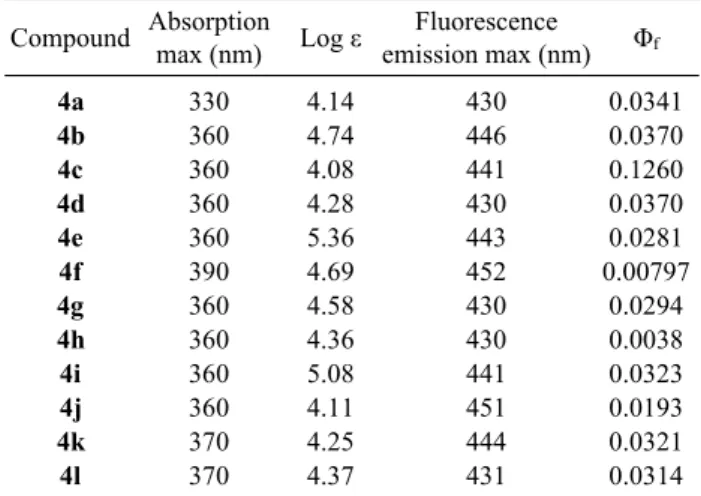
Table 2. Absorption and fluorescence emission spectral data of the compounds 4a-l
Compound Absorption
max (nm) Log ε Fluorescence emission max (nm) Φf
4a 330 4.14 430 0.0341
4b 360 4.74 446 0.0370
4c 360 4.08 441 0.1260
4d 360 4.28 430 0.0370
4e 360 5.36 443 0.0281
4f 390 4.69 452 0.00797
4g 360 4.58 430 0.0294
4h 360 4.36 430 0.0038
4i 360 5.08 441 0.0323
4j 360 4.11 451 0.0193
4k 370 4.25 444 0.0321
4l 370 4.37 431 0.0314
triaryl-6H-pyrazolo[3,4-d]-1,2,3-triazoles 4a-l (Scheme 1) in good yield (Table 1). The 1H NMR and IR spectra of 4a-l showed the absence of an exchangeable singlet band and the vibrational frequency for the amino groups. The absorption and fluorescence emission spectra of compounds 4a-l have been measured in DMF as a solvent, and the spectral data were collected in (Table 2). As can be seen the absorption spectra display strong bands (log εmax range from 4.08 to 5.36) in the range from 330 to 390 nm, depending on the nature of substituent at the phenyl rings. Such behavior is character- istic for an allowed π-π* transition over the whole skeleton of the molecule. The fluorescence emission characteristics of the mentioned compounds 4a-l have been also investigated.
The spectra reveal blue to green emission (λex = 330 - 490
nm) depending on the substituent group. The shift of the emission maximum shows no general trend, however, the emission maximum is red shifted on changing the substi- tuent from Cl or COOH to OCH3 or OH group in the case of monosubstituted compounds 4a-l which is in agreement with the π-π* nature of the excited single state. The fluore- scence quantum yield is also depending on the nature of substituent where Φf increases by introduction of an elect- ron withdrawing group as can be seen from the value of 4a and 4d. In fact the Φf -value was markedly decreased when additional substituent was introduced on the co-axial phenyl groups. These results are in agreement with the previously reported data.13
The diazotization of compounds 1a-c followed by cou-
Table 3. Synthesis of substituted o-amino azo dyes 5a-f Entry X R1 R2 R1R2 Yield (%) mp (oC)
5a H H CH3 80 135 - 137
5b H - - benzo 75 165 - 167
5c Cl H CH3 87 145 - 155
5d Cl - - benzo 60 199 - 200
5e CH3 H CH3 50 134 - 136
5f CH3 - - benzo 80 144 - 147
Table 4. Synthesis of substituted 5-triazoly-1,3-diarylpyrazole derivatives 6a-f
Entry X R1 R2 R1R2 Yield (%) mp (oC)
6a H H CH3 - 80 120 - 122
6b H - - benzo 75 148 - 150
6c Cl H CH3 - 83 142 - 145
6d Cl - - benzo 77 189 - 190
6e CH3 H CH3 - 75 120 - 121
5f CH3 - - benzo 80 130 - 132
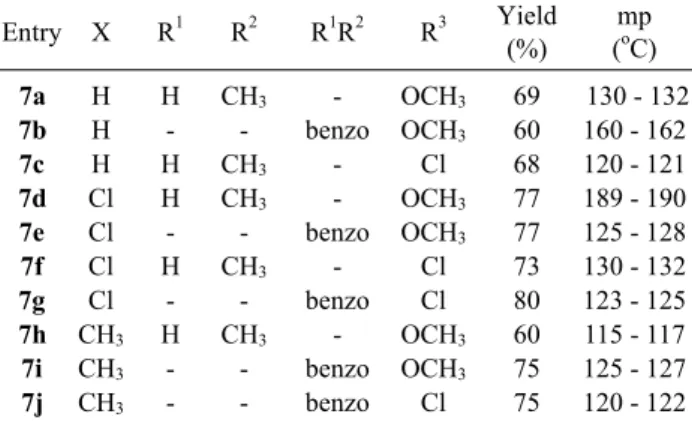
Table 5. Synthesis of substituted 5-triazol-1,3-diaryl-4-arylazo pyrazole derivatives 7a-j
Entry X R1 R2 R1R2 R3 Yield (%)
mp (oC)
7a H H CH3 - OCH3 69 130 - 132
7b H - - benzo OCH3 60 160 - 162
7c H H CH3 - Cl 68 120 - 121
7d Cl H CH3 - OCH3 77 189 - 190
7e Cl - - benzo OCH3 77 125 - 128
7f Cl H CH3 - Cl 73 130 - 132
7g Cl - - benzo Cl 80 123 - 125
7h CH3 H CH3 - OCH3 60 115 - 117
7i CH3 - - benzo OCH3 75 125 - 127
7j CH3 - - benzo Cl 75 120 - 122
(i) H3PO4 /NaNO2 (ii)
Cu (OAC)2/pyridine
N N X
N N N N
N N
N N
N N R3
X
a: X = H b: X =Cl c: X = CH3
5a-f
7a-j 6a-f
p-R3-C6H4N2Cl
a : R1 = H, X = H, R2 = CH3, R3 = OCH3 b: R1R2 = benzo, X = H, R3 = OCH3 c: R1 = H, X = H, R2 = CH3, R3 = Cl d :R1= H, X = Cl , R2 =CH3, R3 = OCH3 e :R1 R2 = benzo, X= Cl, R3= OCH3 f : R1 = H, X = Cl, R2 =CH3, R3= Cl g : R1R2 = benzo, X= Cl, R3= Cl h :R1 = H, X = CH3, R2 = CH3, R3= OCH3 i : R1R2 = benzo, X= CH3,R3 = OCH3 j: R1R2 = benzo, X= CH3, R3 = Cl
NH2
R1 R2
R1 R2 R2
R1 1a-c
N
N N N
R2 R1 X
H2N
a : R1= H, X = H, R2 = CH3 b : R1R2 = benzo, X = H c : R1 = H, X = Cl, R2 = CH3 d: R1 R2 = benzo, X= Cl e : R1 = H, X = CH3,R2 = CH3 f : R1R2 = benzo X = CH3 N
N NH2
X
Scheme 2 pling with aryl amines gave the corresponding dyes 5a-f in good yield (Table 3). The IR spectra of 5a-f showed the azo groups (N=N) vibration frequencies at 1662 - 1675 cm-1 region, stretching vibrations for the amino group at 3275 - 3423 cm-1 region. The oxidation of o-aminoazo dyes gave 5-triazoly-1,3-diarylpyrazole derivatives 6a-f in good yield
(Table 4). The 1H NMR spectra of compounds 6a-f showed singlets within the region of 6.7 - 7.2 ppm due to CH proton of the pyrazole ring, a sharp singlets at δ = 2.1 - 2.3 ppm corresponding to CH3 groups. Coupling of 6a-f with aryl diazonium salts in ethanol, buffered with sodium acetate solution at pH = 6, gave the corresponding 7a-j in good yield (Table 5). IR spectra of 7a-j showed the azo groups (N=N) vibration frequencies at 1496 - 1596 cm-1 region. The 1H NMR spectra of 7a-j showed the absence of singlet signals at 6.6 - 6.8 ppm region corresponding for the CH proton of the pyrazole ring (Scheme 2).
It is worthy to mention that compounds 4a-l have fluore- scent properties due to the fused triazole ring to the pyrazole moiety, while compounds 6a-f and 7a-j have no fluorescent properties.
EXPERIMENTAL
Melting points were uncorrected. IR spectra were recorded on a Perkin-Elmer1430 spectrophotometer using KBr disk technique. 1H-NMR spectra were measured on a Bruker AC spectrometer (300 MHz) in DMSO, in deuterated dimethyl- sulphoxide (DMSO-d6) using tetramethylsilane (TMS) as the internal reference; chemical shifts were expressed in (δ) ppm. Standardelectron impact mass spectra (EI) were obtain- ed using a Finnigan MAT 8222 spectrometer at 70 eV. The electronic absorption spectra of the compounds 4a-l have been measured by using Shimadzu 1301-PC spectrophoto- meter while their fluorescence spectra have been recorded on Perkin-Elmer L550B spectroflurometer. The measure- ments were done at room temperature using two matched quartz cuvettes. The fluorescence yield was measured relative to quinine bisulphate with an absorption maximum. Pro- gress of reactions was monitored by the thin-layer chromato- graphy (TLC) using benzene/ethyl acetate (9:1) as eluent.
Synthesis of 4-Arylazo-5-amino-1,3-diaryl-1H-pyrazoles (3a-l)
Method A: A mixture of 5-amino-1,3-diaryl-4-nitroso-1H- pyrazoles 2a-c (1.5 mmol) and aromatic amines (1.9 mmol) in NaOH (50%; 1.8 mL) was refluxed for 5 h. The mixture was allowed to cool to room temperature and then, poured into crushed ice with vigorous stirring. The solid formed was filtered, washed with water several times and then dried.
Method B: The conversation of amino pyrazoles 1a-c to 4-arylazo-5-amino-1,3-diaryl-1H-pyrazoles 3a-l was carried out according to the previously reported method.14
General procedure of synthesis 2,4,6-triaryl-2,4-dihydro- pyrazole [4, 3-d] [1,2,3]triazoles (4a-l)
A solution of compounds 3a-l (1.3 mmol)in 2.6 mL of pyridine was added to 0.14 g of cupric acetate (0.17 mmol) and the reaction mixture was refluxed for 7 h while a stream of air was bubbled in the reaction mixture. The reaction mix- ture was kept for 12 h at room temperature. The separated product was filtered, washed with ethanol, dried and recry- stallizated from EtOH to give compounds 4a-l.
2-(4-Methoxyphenyl)-4,6-diphenyl-2,4-dihydropyrazolo
[4,3-d] [1,2,3]triazole (4a): IR (KBr) (νmax, cm-1): 3052, 2924; 1H NMR; δH (ppm): 3.8 (s, 3H, OCH3), 7.2-8.2 (m, 14H, ArH); Ms: 368 (M+).
2-(4-Chlorophenyl)-4,6-diphenyl-2,4-dihydropyrazolo [4,3-d] [1,2,3] triazole (4b): IR (KBr) (νmax, cm-1): 3057, 2923;
1H NMR; δH (ppm): 7.2-8.2 (m, 14H, ArH); Ms: 373 (M++2).
4-(4,6-Diphenylpyrazolo [4,3-d] [1,2,3] triazol-2(4H)-yl) benzoic acid (4c): IR (KBr) (νmax, cm-1):3051, 2923, 1695;
1H NMR; δH (ppm): 7.05-8.5 (m, 14H, ArH), 13 (s, 1H, COOH); Ms: 381 (M+).
4-(4,6-Diphenylpyrazolo [4,3-d] [1,2,3] triazol-2(4H)-yl) phenol (4d): IR (KBr) (νmax, cm-1): 3054, 2925; 1H NMR; δH
(ppm): 5.8 (s, 1H, OH), 7.2-8 (m, 14H, ArH); Ms: 353 (M+).
6-(4-Dichlorophenyl)-2-(4-methoxyphenyl)-4-phenyl- 2,4-dihydropyrazolo[4,3-d] [1,2,3] triazole (4e): IR (KBr) (νmax, cm-1):3058, 2928; 1H NMR; δH (ppm): 3.8 (s, 3H, OCH3), δ 7.1-7.8 (m, 13H, ArH); Ms: 403 (M++2).
2,6-Bis(4-chlorophenyl)-4-phenyl-2,4-dihydropyrazolo [4,3-d] [1,2,3] triazole (4f): IR (KBr) (νmax, cm-1): 3058, 2928; 1H NMR; δH (ppm): 6.9-8.1 (m, 13H, ArH); Ms: 408 (M++2).
4-[6-(4-Chlorophenyl)-4-phenylpyrazolo[4,3-d][1,2,3]
triazol-2(4H)-yl]benzoic acid (4g): IR (KBr) (νmax, cm-1):
3060, 2924), 1600; 1H NMR; δH (ppm): 7.05-8.5 (m, 13H, ArH), 12.5 (s, 1H, COOH); Ms: 417 (M++2).
4-[6-(4-Chlorophenyl)-4-phenylpyrazolo[4,3-d][1,2,3]
triazol-2(4H)-yl]phenol (4h): IR (KBr) (νmax, cm-1): 3059, 2922; 1H NMR; δH (ppm): 5.8 (s, 1H, OH), 7.1-8.2 (m, 13H, Ar-H); Ms: 388 (M++2).
2-(4-Methoxyphenyl)-4-phenyl-6-p-tolyl-2,4-dihydro- pyrazolo[4,3-d][1,2,3]triazole (4i): IR (KBr) (νmax, cm-1):
3056, 2919. 1H NMR; δH (ppm): 2.3 (s, 3H, CH3), 3.8 (s, 3H, OCH3), 6.9-8.1 (m, 13H, ArH); Ms: 381 (M+).
2-(4-Chlorophenyl)-4-phenyl-6-p-tolyl-2,4-dihydropyra- zolo[4,3-d][1,2,3]triazole (4j): IR (KBr) (νmax, cm-1): 3048, 2920; 1H NMR; δH (ppm): 2.3 (s, 3H, CH3), 6.7-8 (m, 13H, ArH); Ms: 387 (M++2).
4-(4-Phenyl-6-p-tolylpyrazolo[4,3-d][1,2,3]triazole-2 (4H)-yl)benzoic acid (4k): IR (KBr) (νmax, cm-1): 3055, 2920,
1599; 1H NMR; δH (ppm): 2.3 (s, 3H, CH3), 6.7-8.05 (m, 13H, ArH), 12.3 (s, 1H, COOH); Ms: 396 (M+).
4-(4-Phenyl-6-p-tolylpyrazolo [4,3-d][1,2,3]triazole-2 (4H)-yl) phenol (4l): IR (KBr) (νmax, cm-1): 3056, 2920; 1H NMR; δH (ppm): 2.3(s, 3H, CH3), 5.8 (s, 1H, OH), 6.7-8 (m, 13H, ArH); Ms: 367 (M+).
General procedure for synthesis of 5-triazoly-1,3-diaryl- pyrazole derivatives (6a-f)
Preparation of o-amino azo dye.
The appropriate 5-amino-1,3-diaryl-pyrazoles 1a-c (4.3 mmol) was dissolved in 4.25 mL of phosphoric acid and then, cooled (0 oC). 0.85 mL of concentrated nitric acid was slowly added in portions (over 15 - 20 min). The reaction mixture was stirred for 30 - 40 min at 0 - 5 oC, and then, 0.64 g of sodium nitrite as a solid (9.3 mmol) was added slowly (over 30 - 45 min). The mixture was stirred for 1 h, at 0 - 5 oC and excess sodium nitrite was decomposed by addi- tion of urea. The diazonium salt prepared was added to the appropriate aromatic amine (4.3 mmol) which dissolved in 2.5 mL of NaHCO3 (25%), cooled to 0 - 5 oC and the pH was kept at 5 - 6 by the addition of sodium acetate. The reaction mixture was stirred for a further period of 3 - 3.5 h and the solid separated was filtered, washed with water and dried to give the o-amino azo dyes 5a-f.
2-[(1,3-Diphenyl-1H-pyrazol-5-yl) diazenyl]-5-methyl- benenamine (5a): IR (KBr) (νmax, cm-1): 1663, 3396, 3057, 2928; Ms: 353 (M+).
1-[(1,3-Diphenyl-1H-pyrazol-5-yl) diazenyl] naphthal- ene-2-amine (5b): IR (KBr) (νmax, cm-1): 1666, 3400, 3058, 2928; Ms: 390 (M++1).
2-[(3-(4-Chlorophenyl)-1-phenyl-1H-pyrazol-5-yl)diaze- nyl]-5-methyl benzenamine (5c): IR (KBr) (νmax, cm-1):
1662, 3423, 3062, 2931; Ms: 389 (M++2).
1-[(3-(4-Chlorophenyl)-1-phenyl-1H-pyrazol-5-yl)diaze- nyl]naphthalene-2-amine (5d): IR (KBr) (νmax, cm-1): 1666, 3427, 3059, 2928; Ms: 425 (M++2).
5-Methyl-2-[(1-phenyl-3-p-tolyl-1H-pyrazol-5-yl)diaze- nyl] benzenamine (5e): IR (KBr) (νmax, cm-1): 1675, 3275, 3027, 2926; Ms: 367 (M+).
1-[(1-Phenyl-3-p-tolyl-1H-pyrazol-5-yl) diazenyl] naph- thalene-2-amine (5f): IR (KBr) (νmax, cm-1): 1674, 3423,
3055, 2925, 3055; Ms: 403 (M+).
Triazolyzation
A mixture of the appropriate o-amino azo dyes 5a-f (4.3 mmol) and 0.28 g of cupric acetate (4.3 mmol) in 7 mL of pyridine was heated under reflux for 4 - 5 h, till the color of the dyes had disappeared. The reaction mixture was cooled to 0 - 5 oC and 28.3 mL of HCl (5%) was added with con- stant stirring. The solid formed was filtered, washed with water and dried. The solid was then dissolved in acetic acid (10 - 15 mL) and a small amount of Zn dust (4.3 mmol) was added, and the mixture was refluxed for 1 h. The reaction mixture was filtered while hot, and the filtrate was cooled and then added to ice-water mixture. The solid formed was filtered, washed with water, dried and recrystallized from ethanol to give compounds 6a-f.
2-(1,3-Diphenyl-1H-pyrazol-5-yl)-5-methyl-2H-benzo [d][1,2,3]triazole (6a): IR (KBr) (νmax, cm-1): 3056, 2929;
1H NMR; δH (ppm): 2.3 (s, 3H, CH3), 6.8 (s, 1H, CH), 7.2- 8.5 (m, 13H, ArH); Ms: 351 (M+).
2-(1,3-Diphenyl-1H-pyrazol-5-yl)-2H-naphtho [2, 3-d]
[1,2,3]triazole (6b): IR (KBr) (νmax, cm-1): 3056, 2929; 1H NMR; δH (ppm): 6.8 (s, 1H, CH), 7.1-8.3 (m, 16H, ArH);
Ms: 386 (M+-1).
2-[3-(4-Chlorophenyl)-1-phenyl-1H-pyrazol-5-yl]-5- methyl-2H-benzo[d][1,2,3] triazole (6c): IR (KBr) (νmax, cm-1): 3057, 2935; 1H NMR; δH (ppm): 2.3 (s, 3H, CH3), 6.8 (s, 1H, CH), 7-8.7 (m, 12H, ArH);Ms: 387 (M++2).
2-[3-(4-Chlorophenyl)-1-phenyl-1H-pyrazol-5-yl]-2H- naphtho[2,3-d][1,2,3] triazole (6d): IR (KBr) (νmax, cm-1):
3057, 2927; 1H NMR; δH (ppm): 6.7 (s, 1H, CH), 7.1-8.5 (m, 15H, ArH);Ms: 423 (M++2).
5-Methyl-2-(1-phenyl-3-p-tolyl-1H-pyrazol-5-yl)-2H- benzo[d][1,2,3]triazole (6e): IR (KBr) (νmax, cm-1): 3060, 2928; 1H NMR; δH (ppm): 2.1 (s, 3H, CH3), 2.3 (s, 3H, CH3) 7 (s, 1H, CH), 7.1-8.7 (m, 12H, ArH);Ms: 365 (M+).
2-(1-Phenyl-3-p-tolyl-1H-pyrazol-5-yl)-2H-naphtho[2, 3-d][1,2,3]triazole (6f): IR (KBr) (νmax, cm-1): 3055, 2924;
1H NMR; δH (ppm): 2.3 (s, 3H, CH3) 6.8 (s, 1H, CH), 7.1-8.7 (m, 15H, ArH); Ms: 401 (M+).
General procedure for synthesis of 5-triazol-1,3-diaryl-4- arylazopyrazole derivatives 7a-j
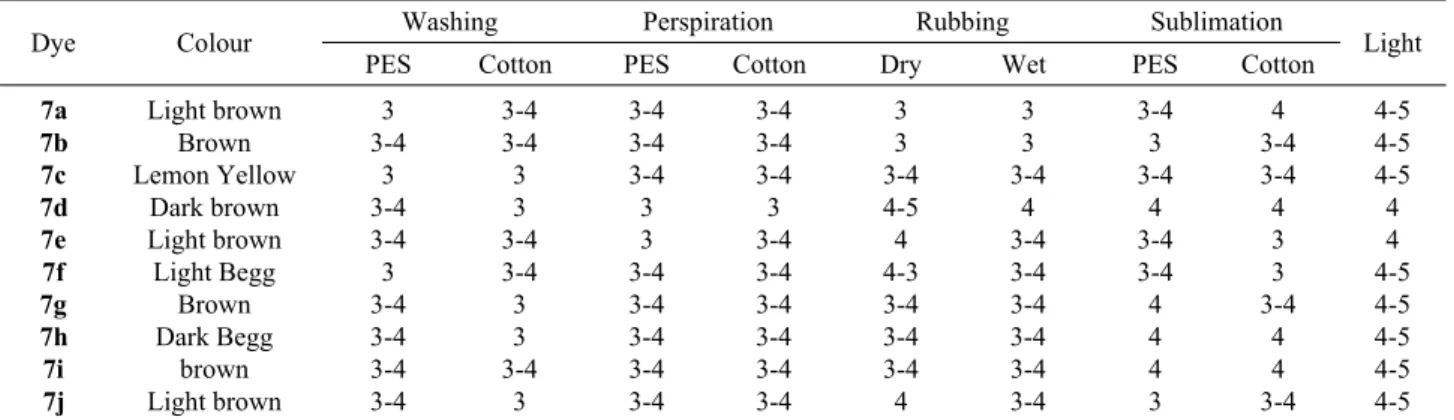
Table 6. Fastness propertiesa of dyes 7a-j on polyester fabricsb
Dye Colour Washing Perspiration Rubbing Sublimation
Light
PES Cotton PES Cotton Dry Wet PES Cotton
7a Light brown 3 3-4 3-4 3-4 3 3 3-4 4 4-5
7b Brown 3-4 3-4 3-4 3-4 3 3 3 3-4 4-5
7c Lemon Yellow 3 3 3-4 3-4 3-4 3-4 3-4 3-4 4-5
7d Dark brown 3-4 3 3 3 4-5 4 4 4 4
7e Light brown 3-4 3-4 3 3-4 4 3-4 3-4 3 4
7f Light Begg 3 3-4 3-4 3-4 4-3 3-4 3-4 3 4-5
7g Brown 3-4 3 3-4 3-4 3-4 3-4 4 3-4 4-5
7h Dark Begg 3-4 3 3-4 3-4 3-4 3-4 4 4 4-5
7i brown 3-4 3-4 3-4 3-4 3-4 3-4 4 4 4-5
7j Light brown 3-4 3 3-4 3-4 4 3-4 3 3-4 4-5
aRate for light fastness: 4-5 (acceptable), 1-3 (not acceptable); rate for different fastness: 3-4 (acceptable), 1-2 (not acceptable). bPES: Polyester
A solution of 0.11 g of sodium nitrite (1.6 mmol) was gra- dually added to a cold solution of an aromatic amine (1.6 mmol) in 0.5 mL of conc. HCl. The diazonium salt obtained was added with continuous stirring to a cold of compounds 6a-f (1 mmol) in 4.9 mL of ethanol containing sodium ace- tate. The reaction mixture was stirred at 0 oC for 2 h. The solid obtained was filtered, washed with water and crystal- lized from ethanol to give compounds 7a-j.
1-(4-Methoxyphenyl)-2-(5-(5-methyl-2H-benzo[d][1,2, 3]triazol-2-yl)-1,3-diphenyl-1H-pyrazol-4-yl) diazene (7a):
IR (KBr) (νmax, cm-1): 3058, 2927, 1600; 1H NMR; δH (ppm):
2.3 (s, 3H, CH3), 3.7 (s, 3H, OCH3), 6.1-8.2 (m, 17H, ArH);
Ms: 485 (M+).
1-(5-(2H-naphtho[2,3-d][1,2,3]triazol-2-yl)-1,3-diphe- nyl-1H-pyrazol-4-yl)-2-(4-methoxyphenyl)diazene (7b): IR (KBr) (νmax, cm-1): 3060, 2927, 1600; 1H NMR; δH (ppm):
3.8 (s, 3H, OCH3), 6.6-8.8 (m, 20H, ArH); Ms: 521 (M+).
1-(4-Chlorophenyl)-2-[5-(5-methyl-2H-benzo[d][1,2,3]
triazol-2-yl]-1,3-diphenyl-1H-pyrazol-4-yl)diazene (7c): IR (KBr) (νmax, cm-1):3059, 2925, 1597; 1H NMR; δH (ppm):
2.3 (s, 3H, CH3), 7-8.9 (m, 17H, ArH); Ms: 491 (M++2).
1-[3-(4-Chlorophenyl)-5-(5-methyl-2H-benzo[d][1,2,3]
triazol-2-yl]-1-phenyl-1H-pyrazol-4-yl)-2-(4-methoxyphe- nyl)diazene (7d): IR (KBr) (νmax, cm-1): 3058, 2928, 1598;
1H NMR; δH (ppm): 2 (s, 3H, CH3), 3.8 (s, 3H, OCH3), 7-8 (m, 16H, ArH); Ms: 521 (M++2).
1-[3-(4-Chlorophenyl)-5-(2H-naphtho[2,3-d][1,2,3]tria- zol-2-yl]-1-phenyl-1H-pyrazol-4-yl)-2-(4-methoxyphenyl) diazene (7e): IR (KBr) (νmax, cm-1): 3056, 2928, 1597; 1H NMR; δH (ppm): 3.79 (s, 3H, OCH3), 7.5-8 (m, 19H, Ar-H);
Ms: 558 (M++2).
1-(4-Chlorophenyl)-2-(3-(4-chlorophenyl)-5-(5-methyl- 2H-benzo[d][1,2,3]triazol-2-yl)-1-phenyl-1H-pyrazol-4- yl)diazene (7f): IR (KBr) (νmax, cm-1): 3060, 2926, 1599; 1H NMR; δH (ppm): 2.3 (s, 3H, CH3), 7-8.7 (m, 16H, Ar-H);
Ms: 526 (M++2).
1-(4-Chlorophenyl)-2-(3-(4-chlorophenyl)-5-(2H-naph- tho[2,3-d][1,2,3]triazol-2-yl)-1-phenyl-1H-pyrazol-4-yl) diazene (7g): IR (KBr) (νmax, cm-1): 3059, 2928, 1698; 1H NMR; δH (ppm): 7-8.35 (m, 19H, Ar-H); Ms: 562 (M++2).
1-(4-Methoxyphenyl)-2-[5-(5-methyl-2H-benzo[d][1,2, 3]triazol-2-yl)-1-phenyl-3-p-tolyl-1H-pyrazol-4-yl]diazene (7h): IR (KBr) (νmax, cm-1): 3024, 2925, 1598; 1H NMR; δH
(ppm): 2.3 (s, 3H, CH3), 3.7 (s, 3H, OCH3), 7-8.35 (m, 16H, Ar-H); Ms: 489 (M+).
1-[5-(2H-Naphtho[2,3-d][1,2,3]triazol-2-yl)-1-phenyl- 3-p-tolyl-1H-pyrazol-4-yl]-2-(4-methoxyphenyl)diazene (7i): IR (KBr) (νmax, cm-1): 3055, 2924, 1598; 1H NMR; δH
(ppm): 2.3 (s, 3H, CH3), 3.7 (s, 3H, OCH3), 6.6-7.9 (m, 19H, ArH); Ms: 535 (M+).
1-[5-(2H-Naphtho[2,3-d][1,2,3]triazol-2-yl)-1-phenyl- 3-p-tolyl-1H-pyrazol-4-yl]-2-(4-chlorophenyl)diazene (7j): IR (KBr) (νmax, cm-1): 3056, 2925, 1598; 1H NMR; δH
(ppm): 2.2 (s, 3H, CH3), 6.6-8.4 (m, 19H, ArH); Ms: 542 (M++2).
Dyeing of Polyester Fabrics and Dyeing Properties The prepared azo dyes 7a-j was applied to polyester fiber.
The dyeing procedure14,15 and color fastness to light, wash- ing, perspiration, and rubbing of the prepared dyes on fibers
were studied using standard methods for the assessment of color fastness of textile (the grey scale).16 The results obtain- ed are shown in (Table 6). The results revealed that these dyes have good fastness properties. In conclusion, a set of ten useful disperse dyes 7a-j were synthesized by azo cou- pling. The dyes were investigated for their dyeing charac- teristics on polyester and showed moderate to good (3-4) washing, perspiration, sublimation and rubbing fastness dry and wet. The light fastness of dyed exhibit good (4-5) fast- ness properties.
REFERENCES
1. Ho, Y. W. Dyes and Pigments 2005, 64, 223.
2. Bazgir, A.; Khanaposhtani, M.; Maryam, M.; Soorki, A. A.
Bioorg. Med. Chem. Lett. 2008, 18, 5800.
3. Dias, L. R. S.; Alvim, M. J; Freitas, A. C. C.; Barreiro, E. J.;
Miranda, A. L. P. Pharmaceutica Acta Helvetiae 1994, 69, 163.
4. El-Kashef, H. S.; El-Emary, T. I.; Gasquet, M.; Timon-David, P.; Maldonado, J.; Vanelle, P. Pharmazie. 2000, 55, 572.
5. El-Emary, T. I.; Al-Muaikel, N.; Moustafa, O. S. Phosphorus, Sulfur, Silicon 2001, 177, 195.
6. Abramov, A. M.; Ceulemans, E.; Jacker, C.; Auweraer, M. V.;
Dehaen, W. Tetrahedron 2001, 57, 9123.
7. (a) Karci, F.; Demircah, A. Dyes and Pigments 2006, 71, 97.
(b) Quiroga, J.; Cruz, S.; Nogueras, M. J. Heterocycl. Chem.
2001, 38, 53.
8. Wu, Y.-C.; Chen, Y.-J.; Li, H.-J.; Zou, X.-M.; Hu, F.-Z.; Yang, H.-Z. J. Fluorine Chem. 2006, 127, 409.
9. El-Emary, T. I. J. Chin. Chem. Soc. 2006, 533, 91.
10. Rangnekar, D. W.; Dhamnaskar, S. V. J. Heterocycl. Chem.
1988, 25, 1663.
11. Vicentini, C.; Manfredini, S.; Manfrini, M.; Bazzanini, R.; Mu- siu, C.; Putzolu, M.; Perra, G.; Marongiu, M. E. Archiv der pharmazie. 1998, 331, 269.
12. Benjamam, E. B.; Srivastava, A.; Coburn, K. R.; Faulkner, A.
L.; Seibel, W. L. Tetrahedron Lett. 2003, 44, 3009.
13. (a) Rangnekar, D. V.; Dhamnaskar, S. V. J. Heterocyclic. Chem.
1988, 25, 1. (b) Rangnekar, D. W.; Tagdiwala, P. V. Dyes and Pigments. 1986, 7, 289.
14. Rizk, H. F.; El-Badawi, M. A.; Ibrahim, S. A.; El-Borai, M. A.
Arab. J. Chem. 2010, 4, xx.
15. Rizk, H. F;. El-Badawi, M. A.; Ibrahim, S. A.; El-Borai, M.
A. Org. Chem. An. indian J. 2008, 4, 115.
16. Anon Standard Methods for the Determination of the Color Fastness of Textiles and Leather, 5th edn, Society of Dyes and Colorists Publication, Bradford, England, 1990.