http://dx.doi.org/10.9721/KJFST.2016.48.1.15
15
©The Korean Society of Food Science and Technology
건조과정 중 갈변에 의한 양파가루의 항산화 특성 연구
이동진·한정아
1·임승택*
고려대학교 식품공학과, 1상명대학교 외식영양학과
Enhancement of Antioxidant Activity of Onion Powders by
Browning during Drying Process
Dong-Jin Lee, Jung-Ah Han1, and Seung-Taik Lim* School of Life Sciences and Biotechnology, Korea University 1Department of Foodservice Management and Nutrition, Sangmyung University
Abstract Drying process was applied to increase the antioxidant activity of onion powder: freeze-drying or air-drying at 50, 70, and 90°C and onion extracts were obtained from each powder using water or aqueous ethanol (50%) at 25°C and 60°C. In the color analysis, the freeze-dried powders showed higher L* and lower a* and b* values than did the air-dried ones. The browning index of powders air-dried at 90°C was significantly higher than that of freeze-dried powders or those air-dried at temperatures below 90°C. Phenolic content in the extracts was 4.02-23.12 mg gallic acid equivalent/g sample, and was the highest in the extract from the sample air-dried at 90°C, regardless of the extraction condition. The highest antioxidant activity, measured by 2,2-azinobis-3-ethylbenzothiazoline-6-sulfonic acid and 1,1-diphenyl-2-picrylhydrazyl methods, was found in the powder air-dried at 90°C, which induced browning. These findings indicate that antioxidant activity depends more on browning during drying than on extraction conditions.
Keywords: onion powder, air-drying, browning index, phenolic content, antioxidant activity
Introduction
Onion (Allium cepa L.) is a popular vegetable consumed worldwide due to its unique flavor and functional properties resulting from residual polyphenols. It is specifically recognized as the major dietary source of quercetin in the form of aglycone or O-glycosylated derivatives (1). The quercetin has also been reported to have many health-promoting functions based on its strong antioxidant activity (2), which includes cholesterol-reducing (3), allergy-suppressing (4), blood circulation (5), and blood sugar-reducing functions (6).
Onion is, however, readily spoiled during storage due to the residual enzymatic action and/or microbial contamination. Dehydration is one of the common processes to minimize the spoilage as well as to reduce bulk handling and enable off-season use (7). Dried onion powders have been used in various processed foods like soups, sauces, salad dressing, sausages, and meat products (8) with superior storage stability and convenience (9). Different methods for drying using air (8), steam (10), freezing
(11,12), sun, oven, and microwave (13) have been reported. Thermal treatments for drying, however, often cause significant changes in chemical and biological functions of onions, which may cause the changes in taste, color, and nutrient components. Mota et al. (8) reported that the nutrient composition of onion was highly susceptible to the temperature for drying. Pérez-Gregorio et al. (12) reported that freeze-drying has a positive effect on the levels of total flavonols and anthocyanins in red onions because of the change in the tissue structure during freeze-drying.
In addition, onion extracts have been reported to possess many biological activities including antioxidant, anti-carcinogenic, anti-mutagenic, and prebiotic activities (14) or anti-browning effect (15). Despite the studies on the functionality of onion extracts (12,16,17), few studies have been reported on the effects of extraction and drying process in association with the physical and physiological properties of onion products.
Recently, since the positive correlations between browning and antioxidant properties have been reported in food systems including onion (11,18-22), more researches about processing condition inducing browning in foods are needed for improving functionality. In this study, onion powders using different processes for drying were prepared and onion extracts were obtained from each onion powder under different extraction conditions. Physical properties of the onion powders and antioxidant activity of the onion extracts were then compared.
*Corresponding author: Seung-Taik Lim, School of Life Sciences and Biotechnology, Korea University, Seoul 02841, Korea
Tel: 82-2-3290-3435 Fax: 82-2-921-0557 E-mail: [email protected]
Received November 18, 2015; revised January 26, 2016; accepted January 27, 2016
Materials and Methods
Materials
Onions harvested at Mun-Kyeong (Gyeongsangbuk-do, Korea) in 2014 were purchased from a local market. Gallic acid, Folin-Ciocalteu phenol reagent, 1, 1-diphenyl-2-picrylhydrazyl (DPPH), 2, 2-azinobis-3-ethylbenzothiazoline-6-sulfonic acid (ABTS), 3, 5-dinitrosalicylic acid (DNS), L-ascorbic acid, and D-glucose were purchased from Sigma-Aldrich Co. (St. Louis, MO, USA). Preparation of onion powders
After removing roots and stems, the onion bulbs peeled and washed with tap water. Only onion pulp were sliced to a width of 1-2 cm, and then dried using a freeze-dryer (Eyela FDU-2100, Tokyo Rikakikai Co., Tokyo, Japan) at −80oC for 3 days (FDOP) or a convection oven (MOV-212F, Sanyo Electric, Osaka, Japan) at 50oC for 24 h, 70oC for 12 h, or 90oC for 9 h (50OP, 70OP, and 90OP, respectively). The dried onion slices were ground to powders using a grinder (JL-1000, Hibell, Seoul, Korea), and the onion powders were stored in sealed bags at −20oC before analysis.
Moisture, color, and browning index of onion powders The moisture content of onion powder was measured by the AOAC method (23) by drying at 105°C and presented by dry basis %.
The color of the onion powders was measured using a colorimeter (CR-10, Konica Minolta Sensing Inc., Osaka, Japan). Total color difference (∆E) was calculated as follows:
where, L1, a1, b1 are the values of control (fresh onion), and L2, a2, and b2 are the values of each dried onion.
The browning index was determined using the method of Baloch et al. (24), with minor modifications. Onion powder (0.5 g, dry base) was mixed with 20 mL of distilled water and 5 mL of 10% trichloroacetic acid. The mixture was kept at room temperature for 2 h and then centrifuged at 2600 g for 15 min. The supernatant was filtered (Whatman No. 1) and the browning index was measured at 420 nm using 2% trichloro-acetic acid solution as a blank.
Preparation of onion powder extracts
For extraction, dried onion powders (1.5 g, dry base) were dispersed in 30 mL of distilled water or an aqueous ethanol (50% alcohol) at different temperatures (25 and 60oC) for 2 h. The dispersions were centrifuged at 2600 g for 15 min, and the supernatants were filtered, evaporated under a reduced pressure at 60oC to remove ethanol, and then freeze-dried. The pH of extracts was measured by a pH meter (Model 440, Corning Inc., New York, USA) before freeze-drying. The recovery yield was calculated as the percent solids in the extracts based on the solids of powders.
Total phenolic content in onion extracts
The total phenolic content (TPC) was determined using the method of Cho et al. (25) and expressed as gallic acid equivalent (GAE).
Reducing sugar content in extracts
The reducing sugar content in the onion powder extracts was determined using DNS reagent following the method of Miller (26).
Radical scavenging activity assessed by DPPH and ABTS The DPPH radical scavenging activity and ABTS radical scavenging activity were measured according to the method of Brand-Williams et al. (27) and Re et al. (28), respectively. Vitamin C (ascorbic acid, 20µg/mL) was used as a positive control.
Statistical analysis
All experiments were carried out in triplicate, and statistical analyses were performed using SAS software version 9.4 (SAS Institute Inc., Cary, NC, USA). Statistical differences were tested using one-way analysis of variance (ANOVA) and Duncan’s multiple-range tests at a significant level at 0.05. The critical p-values were set at 0.05 and a probability value of p<0.05 was considered statistically significant.
Results and Discussion
Color and browning of onion powder by drying
Moisture contents of the air-dried onion powders varied from ∆E∗ = (L2*–L1*)2+(a2*–a*1)2+(b2*–b1*)2
Table 1. Moisture content, color and browning index of fresh onion and onion powders Samples Moisture content
(dry basis%)
Color Browning
Index
L value a value b value ∆E
FO 91.71±0.69 79.0±0.2b -2.2±0.2d 15.9±0.5e 0
-FDOP 13.98±0.11 82.0±0.5a 1.7±0.2d 21.5±0.2d 6.4±0.2 a 0.083±0.002d
50OP 4.21±0.11 73.3±0.6c 5.0±0.3c 28.1±0.1b 14.3±0.1b 0.136±0.004c
70OP 3.94±0.14 63.2±0.3d 11.1±0.5b 30.4±0.6a 25.4±0.8c 0.755±0.005b
90OP 3.55±0.04 43.7±0.4e 13.4±0.4a 23.8±0.4c 39.5±0.4d 1.218±0.001a
FO: fresh onion; FDOP: freeze-dried onion powder; 50OP, 70OP, and 90OP: air-dried onion powders at 50, 70 and 90ºC for 24, 12 and 9 h, respectively. Values in the same column with different letters (a-e) mean significant difference (p<0.05).
3.55 to 4.21% depending on drying temperature and time. The freeze-dried samples contained a higher amount of moisture than the air-dried samples (Table 1). The color characteristics were significantly different among the dry onion powders indicating the susceptibility on drying methods and conditions. The FDOP showed a higher L* value and lower a* and b* values than the air-dried samples, indicating that the air drying induced more changes on the color. As the temperature increased for air-drying, the L* value decreased whereas the a* value increased, consistent with a report published elsewhere (17). Total color differences (∆E*), which indicate the color difference between fresh and dried onion powder were presented in Table 1. The ∆E* of air-dried onion powder was higher than that of freeze-dried one, and the value increased dramatically with drying temperature increase. Regarding the browning index, the FDOP showed the much lower value (0.083) than those of air-dried samples. It was increased from 0.136 to 1.218 as the drying temperature increased, indicating that the browning was facilitated by increasing drying temperature (29). The values between color difference (∆E) and browning index of onion powders was closely correlated (R2=0.9614).
Characteristics of onion powder extracts
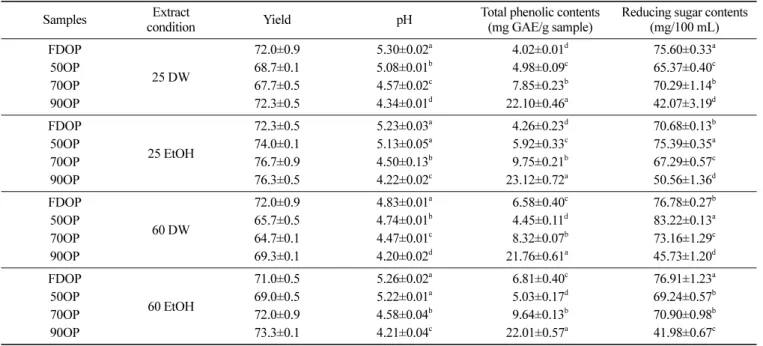
The extraction yields of solids from the onion powders either in water and alcohol solutions were shown in Table 2, which ranged from 64.7-76.7%. The highest yield was obtained when onion powders dried at 70 or 90oC were extracted at 25oC in aqueous alcohol solution.
The pH values of the onion powder extracts were in a range between 4.20 and 5.30 depending on the drying conditions. The pH of the freeze-dried samples was higher than those of the air-dried ones, and the higher temperature for drying resulted in
the lower pH, indicating that the browning induced by the thermal drying caused the pH decrease for the onion extracts. Similarly, Kehrberg and Johnson (30) reported that pH decrease during maillard reaction has been attributed to the reaction of the basic amino groups with reducing sugars.
The total phenol contents (TPC) of the onion powder extracts are shown in Table 2. It ranged from 4.02 to 23.12 mg GAE/g depending on the drying and extraction conditions. More importantly, the drying temperatures instead of methods for extraction appeared the major determining factor for the TPC. Especially when the drying temperature increased from 70 to 90oC for air-drying, the TPC increase was substantial. The increase in TPC by heating may reflect the production of phenolic compounds in dry onion powders. Air-drying at a high temperature could induce production and/or thermal release of polyphenols from plant matrices, which could result in an increase of antioxidant activity (31). In onion powder, because the release of polyphenol aglycones increased by hot air drying (32), so it could be assured that high temperature air-drying could deactivate some enzymes, which would destroy the antioxidants in food, and this could avoid the loss of phenolic acids, resulting in increase of polyphenol. Similar result was reported by Chang et al. (33).
The reducing sugar contents of onion powder extracts were varied according to the drying and extraction conditions (Table 2). Like the TPC, the reducing sugar content in the extracts was more susceptible to the drying temperature than the drying methods or extraction conditions. Among the air-dried samples, the temperature increased from 70 to 90oC resulted in significant decreases in reducing sugar content, whereas that from 50 to 70oC caused relatively minor decreases. The sugar degradation with formation of phenolic compounds proved that there was Maillard browning reactions during drying process (8).
Table 2. Yield, pH, total phenolic and reducing sugar contents of onion powder extracts
Samples Extract
condition Yield pH
Total phenolic contents (mg GAE/g sample)
Reducing sugar contents (mg/100 mL) FDOP 25 DW 72.0±0.9 5.30±0.02a 4.02±0.01d 75.60±0.33a 50OP 68.7±0.1 5.08±0.01b 4.98±0.09c 65.37±0.40c 70OP 67.7±0.5 4.57±0.02c 7.85±0.23b 70.29±1.14b 90OP 72.3±0.5 4.34±0.01d 22.10±0.46a0 42.07±3.19d FDOP 25 EtOH 72.3±0.5 5.23±0.03a 4.26±0.23d 70.68±0.13b 50OP 74.0±0.1 5.13±0.05a 5.92±0.33c 75.39±0.35a 70OP 76.7±0.9 4.50±0.13b 9.75±0.21b 67.29±0.57c 90OP 76.3±0.5 4.22±0.02c 23.12±0.72a0 50.56±1.36d FDOP 60 DW 72.0±0.9 4.83±0.01a 6.58±0.40c 76.78±0.27b 50OP 65.7±0.5 4.74±0.01b 4.45±0.11d 83.22±0.13a 70OP 64.7±0.1 4.47±0.01c 8.32±0.07b 73.16±1.29c 90OP 69.3±0.1 4.20±0.02d 21.76±0.61a0 45.73±1.20d FDOP 60 EtOH 71.0±0.5 5.26±0.02a 6.81±0.40c 76.91±1.23a 50OP 69.0±0.5 5.22±0.01a 5.03±0.17d 69.24±0.57b 70OP 72.0±0.9 4.58±0.04b 9.64±0.13b 70.90±0.98b 90OP 73.3±0.1 4.21±0.04c 22.01±0.57a0 41.98±0.67c
FDOP: freeze-dried onion powder; 50OP, 70OP, and 90OP: air-dried onion powders at 50, 70 and 90oC for 24, 12 and 9 h, respectively. Values in the same column with different letters (a-d) mean significant difference (p<0.05).
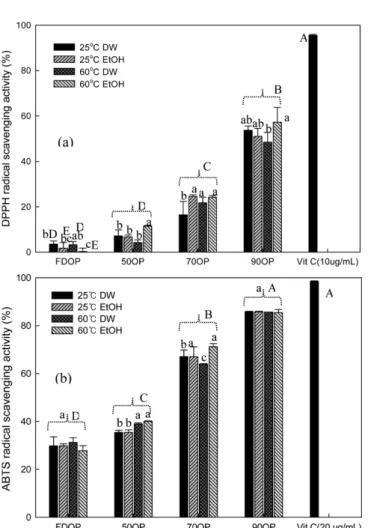
The antioxidant activity of onion powder extracts was evaluated by measuring their ABTS and DPPH radical scavenging activities and the results are shown in Fig 1. (a) and (b), respectively. The extraction conditions for onion powder extracts did not affect the ABTS and DPPH radical scavenging activity; however, the drying process before extraction, especially the drying temperature for onion powder, significantly affected the results. For the DPPH radical scavenging activity, the extracts from 90OP had the highest activity (about 60% for a concentration of 1.0 mg/mL), although the highest activity of 90OP was lower than that of vitamin C (at a concentration of 10µg/mL). The ABTS radical scavenging activity of onion extracts showed a similar trend to the DPPH radical scavenging activity, and the activity was comparable to that of vitamin C (at a concentration of 20µg/mL).
Conclusion
The drying process before extraction, especially the drying temperature for onion powder preparation, significantly affected
the properties of powders such as pH, color or browning index. Air-dried one, especially at the highest temperature (90oC) had the strongest antioxidant activity, resulting from the highest TPC and the lowest reducing sugar content. It seems that the increased polyphenol contents was due to the liberation from matrix as well as melanoidins produced via Maillard reaction. Extraction conditions, including solvents and temperature after drying, however, little affected the ABTS and DPPH radical scavenging activity of onion powder.
Acknowledgment
This research was supported by the High Value-Added Food Technology Development Program, Ministry of Agriculture, Food and Rural Affairs, Republic of Korea.
References
1. Hertog MG, Hollman PC, Venema DP. Optimization of a quanti-tative HPLC determination of potentially anticarcinogenic fla-vonoids in vegetables and fruits. J. Agr. Food Chem. 40: 1591-1598 (1992)
2. Helen A, Krishnakumar K, Vijayammal P, Augusti K. Antioxi-dant effect of onion oil (Allium cepa. Linn) on the damages induced by nicotine in rats as compared to alpha-tocopherol. Tox-icol. Lett. 116: 61-68 (2000)
3. Jain RC, Vyas CR, Mahatma OP. Hypoglycaemic action of onion and garlic. The Lancet 302: 1491 (1973)
4. Middleton E, Drzewiecki G, Krishnarao D. Quercetin: an inhibitor of antigen-induced human basophil histamine release. J. Immunol. 127: 546-550 (1981)
5. Chung HK, Shin MJ, Cha YJ, Lee KH. Effect of onion peel extracts on blood lipid profile and blood coagulation in high fat fed SD rats. J. Korean Soc. Food Sci. Nutr. 24: 442-450 (2011) 6. Sheela CG, Kumud K, Augusti KT. Anti-diabetic effects of onion
and garlic sulfoxide amino acids in rats. Planta Med. 61: 356-357 (1995)
7. Kaymak-Ertekin F, Gedik A. Kinetic modelling of quality deterio-ration in onions during drying and storage. J. Food Eng. 68: 443-453 (2005)
8. Mota CL, Luciano C, Dias A, Barroca MJ, Guiné R. Convective drying of onion: kinetics and nutritional evaluation. Food Bio-prod. Process 88: 115-123 (2010)
9. Rapusas RS, Driscoll RH. The thin-layer drying characteristics of white onion slices. Dry. Technol. 13: 1905-1931 (1995)
10. Choi IH, Lee GD. Monitoring of the steaming and drying condi-tions for onion dehydration. Korean J. Food Preserv. 19: 703-711 (2012)
11. Moreno FJ, Corzo-Martínez M, del Castillo MD, Villamiel M. Changes in antioxidant activity of dehydrated onion and garlic during storage. Food Res. Int. 39: 891-897 (2006)
12. Pérez-Gregorio MR, Regueiro J, González-Barreiro C, Rial-Otero R, Simal-Gándara J. Changes in antioxidant flavonoids during freeze-drying of red onions and subsequent storage. Food Control 22: 1108-1113 (2011)
13. Arslan D, Özcan MM. Study the effect of sun, oven and micro-wave drying on quality of onion slices. LWT-Food Sci. Technol. 43: 1121-1127 (2010)
14. Corzo-Martínez M, Corzo N, Villamiel M. Biological properties of onions and garlic. Trends Food Sci. Tech. 18: 609-625 (2007) 15. Lee M. Inhibitory effect of banana polyphenol oxidase during
rip-ening of banana by onion extract and maillard reaction products. Food Chem. 102: 146-149 (2007)
16. Shon MY, Choi SD, Kahng GG, Nam SH, Sung NJ. Antimu-tagenic, antioxidant and free radical scavenging activity of ethyl acetate extracts from white, yellow and red onions. Food Chem. Toxicol. 42: 659-666 (2004)
Fig 1. (a) DPPH and (b) ABTS radical scavenging activity (%) of onion powder extracts; FDOP: freeze-drying, 50OP: 50ºC hot-air drying, 70OP: 70ºC hot-hot-air drying, and 90OP: 90ºC hot-hot-air drying. Bars with different letters (A-E, in samples with different drying condition at same extraction, and a-c, in samples with same drying condition at different extraction) indicate significant (p<0.05) differences.
17. Yang YR, Park YK. Black onions manufactured via the browning reaction and antioxidant effects of their water extracts. Korean J. Food Preserv. 18: 310-318 (2011)
18. Manzocco L, Calligari S, Mastrocola D, Nicoli MC, Lerici CR. Review of non-enzymatic browning and antioxidant capacity in processed foods. Trends Food Sci. Tech. 11: 340-346 (2001) 19. Kiligaya N, Kato H, Fujimaki M. Studies on antioxidant activity
of nonenzymatic browning reaction products. Part I. Relations of color intensity and reductones with antioxidant activity of brown-ing reaction products. Agr. Biol. Chem. Tokyo 32: 289-290 (1968)
20. Eichner K. Antioxidative effect of maillard reaction intermediates. pp. 367-385. In: Autoxidation in food and biological systems. Plenum Press, New York, USA (1980)
21. Lingnert, Hans, and C. E. Eriksson. Antioxidative effect of mail-lard reaction-products. Prog. Food Nutr. Sci. 5: 453-466 (1981) 22. Huyghebaert A, Vandewalle L, van Landschoot G. Comparison of
the antioxidative activity of maillard and caramelisation reaction products. In: Recent developments in food analysis: proceedings of the First European Conference on Food Chemistry (EURO FOOD CHEM I), Vienna, Austria 17-20. (1982)
23. AOAC. Official Method of Analysis of AOAC Intl. 16th ed. Method 991.43. Association of Official Analytical Communities, Arlington, VA, USA (1995)
24. Baloch AK, Buckle KA, Edwards RA. Measurement of nonenzy-mic browning of dehydrated carrot. J. Sci. Food Agr. 24: 389-398 (1973)
25. Cho ML, Lee HS, Kang IJ, Won MH, You SG. Antioxidant prop-erties of extract and fractions from Enteromorpha prolifera, a type of green seaweed. Food Chem. 127: 999-1006. (2011) 26. Miller GL. Use of dinitrosalicylic acid reagent for determination
of reducing sugar. Anal. Chem. 31: 426-428 (1959)
27. Brand-Williams W, Cuvelier ME, Berset C. Use of a free radical method to evaluate antioxidant activity. LWT-Food Sci. Technol. 28: 25-30 (1995)
28. Re R, Pellegrini N, Proteggente A, Pannala A, Yang M, Rice-Evans C. Antioxidant activity applying an improved ABTS radi-cal cation decolorization assay. Free Radiradi-cal Bio. Med. 26: 1231-1237 (1999)
29. Cardelle-Cobas A, Moreno FJ, Corzo N, Olano A, Villamiel M. Assessment of initial stages of maillard reaction in dehydrated onion and garlic samples. J. Agr. Food Chem. 53: 9078-9082 (2005)
30. Kehrberg N, Johnson J. Storage stability of dried sweet cheese whey. J. Food Sci. 40: 644-646 (1975)
31. Murakami M, Yamaguchi T, Takamura H, Matoba T. Effects of thermal treatment on radicalscavenging activity of single and mixed polyphenolic compounds. J. Food Sci. 69: 7-10 (2004) 32. Fu HY. Free radical scavenging and leukemia cell growth
inhibi-tory properties of onion powders treated by different heating pro-cesses. J. Food Sci. 69: 50-54 (2004)
33. Chang CH, Lin HY, Chang CY, Liu YC. Comparisons on the antioxidant properties of fresh, freeze-dried and hot-air-dried tomatoes. J. Food Eng. 77: 478-485 (2006)