588
©The Korean Society of Food Science and Technology
가압조건에서 생강 유래 6-shogaol 변환을 위한 가열 조건 최적화
박호영·하상근·최지원·최희돈·김윤숙·박용곤*
한국식품연구원 전략산업연구본부 소재연구센터
Optimization Study for the Production of 6-Shogaol-rich Ginger
(Zingiber officinale Roscoe) under Conditions of
Mild Pressure and High Temperature
Ho-Young Park, Sang Keun Ha, Jiwon Choi, Hee-don Choi, Yoonsook Kim, and Yongkon Park* Food Resource Research Center, Korea Food Research Institute
Abstract Under optimized condition mild pressure in combination with specific temperature for heat treatment transform the 6-gingerol into 6-shogaol. The purpose of this study was to optimize the conditions used for heat treatment under pressure for increasing 6-shogaol content in ginger (Zingiber officinale Roscoe). A central composite experimental design
was used to evaluate the effects of application temperature (70-130oC) and temperature-holding time (95-265 min) on the
transformation of 6-shogaol. The experimental values were shown to be in significantly good agreement with the predicted
values (adjusted determination coefficient, R2
Adj=0.9857). 6-Shogaol content increased as the application temperature and
temperature-holding time increased. By analyzing the response surface plots, the optimum conditions of heat treatment
(temperature and time) for increasing 6-shogaol content were found to be 127oC and 109 min, respectively. Under these
optimal conditions, the predicted 6-shogaol content was 3.98 mg/g dried ginger. The adequacy of the model equation for predicting the optimum response values was effectively verified by the validation data.
Keywords: Zingiber officinale Roscoe, 6-shogaol, 6-gingerol, response surface methodology
서
론
생강(Zingiber offcinale Roscoe)은 생강과에 속하는 아열대, 또 는 열대원산의 다년생 초본식물의 하나이며, 그 근경은 특유의 독특한 향과 매운맛을 지니고 있으며 생생강(fresh ginger)이나 건 생강(dried ginger)과 이들로부터 추출한 올레오레진, 정유 등의 형태로 유통되고 있다(1,2). 또한, 생강은 gingerol, shogaol, para-dol, zingerone과 같은 생리활성 유효성분 및 유리당, 단백질, 지 방, 무기질 등의 다양한 영양성분들이 함유되어 있다는 연구결과 가 보고되어 있으며(3), 이중 gingerol, shogaol, zingerone 등은 독 특한 향과 매운맛을 지니고 있어 전 세계적으로 애용하는 향신 료 중 하나이다. 특히 생강의 주요 성분인 6-gingerol과 6-shogaol 동종체는 생강의 가장 강력한 매운맛 성분일 뿐만 아니라 다른 성분에 비하여 그 함량이 많기 때문에 생강의 저장, 유통 중의 품질지표로 많이 사용되고, 건강기능식품소재로서 많은 주목을 받고 있다(3,4). Gingerol은 여러 이성질체의 구조에 따라 생리적 활성이 달라 지는데, 이 가운데 6-gingerol은 항염증, 진통제, 항혈전, 항암, 항 산화 활성에 뛰어난 효과를 보이고 있음이 보고되고 있다(5,6). Shogaol은 gingerol 구조에서 탈수반응을 거쳐 생성되는데, 그 중 6-shogaol은 항균, 항산화 작용 등의 생화학적 효과를 가진다고 보고되었고, 최근에는 6-shogaol이 6-gingerol보다 항염증, 항산화, 암예방 효과가 있다는 연구가 보고되고 있다(5-7). 생강 내 gingerol 화합물은 저장, 가공 및 유통과정 중 고온이 나 산성 조건이 가해지면 shogaol 및 zingerone으로 변화되는 특 성을 가지고 있다. 탈수에 의해 생성된 shogaol은 pH가 산성이고 온도가 증가할수록 촉진되며 알칼리 조건에서는 실온에서 급속 히 일어나며 온도에 대한 영향은 100~180°C 범위에서 일어난다 고 한다(8,9). 최근 각광받고 있는 추출공정 중 하나인 가압조건 추출법은 전 통적인 상압가온 추출방법에 비해 단시간 낮은 온도에서 진행되 기 때문에 열에 불안정한 물질의 손상을 낮출 수 있으며 용매의 사용이 적기 때문에 친환경적인 방법으로 평가되고 있다(10). 이 와 더불어 가압조건은 효율적으로 탈수, 분해 및 환원 반응 등의 반응을 촉진하기 때문에 광범위한 분야에 응용되고 있으며, 온도 와 압력 그리고 반응시간이 주요 제어 요소로 보고되고 있다(11,12). 본 연구에서는 다진 생강에 물리적 처리를 가하여 극소량 존 재하는 것으로 알려진 6-shogaol 함유량을 최대치로 생성시키는 최적 조건을 도출하기 위한 방법으로 중심합성계획법(central composite design, CCD)을 도입하였다. 본 연구를 통해 6-shogaol 이 강화된 다진 생강이나 추출·정제를 통한 6-shogaol 식의약소 재가 개발된다면 향후 6-shogaol과 관련한 연구 및 산업화에 도 움을 줄 수 있을 것으로 기대된다.
*Corresponding author: Yongkon Park, Korea Food Research Insti-tute, Seongnam, Gyeonggi 463-746, Korea
Tel: 82-31-780-9063 Fax: 82-31-780-9876 E-mail: [email protected]
Received May 30, 2014; revised July 28, 2014; accepted July 30, 2014
재료 및 방법
재료
본 실험에 사용한 생강(Zingiber officinale Roscoe)은 2012년 충 남 서산지역에서 재배, 생산된 생강을 서울 가락동 농수산물시장 에서 구입하여 표면의 흙을 수세, 완전히 제거하여 분쇄하여 다 진 생강(수분함량 약 90%)을 만든 뒤 −20oC 냉암소에 보관하면
서 시료로 사용하였다. 순도 98% 이상의 HPLC 분석용 유기용 매는 J.T. Baker사(Phillipsburg, NJ, USA)제품을 사용하였으며, 표 준물질인 6-gingerol과 6-shogaol은 Chromadex사(Laguna Hills, CA, USA)에서 구입하여 사용하였다. 생강 유효성분 추출 정량분석을 위해서 다음과 같이 실험액을 제조하였다. 가압처 리 된 생강을 열풍건조기를 이용하여 45oC에서 수분의 변화가 없 을 때 까지 약 30시간 건조한 뒤, 1.0 mm 이하로 분쇄하였다. 이 때, 다진 생생강을 CCD에 의하여 최대 온도 130oC, 최대 시간 265분간 6.4 MPa의 가압처리를 진행 후 건조한 결과 8.8±0.8% 수 율을 확인하였다. 건조, 분쇄한 생강분말 시료의 gingerol, 6-shogaol 함량 분석을 위한 추출액은 초음파 추출기(Sonics & Materials Inc., Newtown, CT, USA)를 이용하여 추출하였다. 생강 분말 5 g을 취하여 MeOH 100 mL을 가하여 추출기의 probe가 시료 혼합물에 잠기게 설치한 후 pulse (on:off) 20:10초 간격으로 30oC 이하의 온도에서 20분 동안 70% 진폭(amplitude), 20 kHz 진동(frequency)으로 초음파 추출한 다음 여과지(Whatman No. 1) 를 이용하여 감압 여과한 뒤 분석에 이용하였다. 6-Shogaol 변환 최적화를 위한 실험계획 생강의 주요 유효성분인 6-gingerol로부터 가열 및 가압 처리를 통하여 6-shogaol로의 최적 변환 조건을 도출하기 위한 수단으로 써 설계변수(design variables)로부터 실험적으로 얻어낸 반응변수 (response variables)에서 근사적 반응표면모델을 만들어 내는 반 응표면분석법(response surface methodology, RSM)(13)을 적용하였 다. 이때, 실험설계와 도출된 결과의 그래픽 제작을 위하여 MINITAB Release 14(Minitab Inc., State College, PA, USA)와 Maple 7.00 (Waterloo Maple Inc., Waterloo, Canada) 소프트웨어 를 각각 이용하였다. 자체 제작한 500 mL 용량의 가압 챔버 내 고온 및 가압에 의한 시료의 손상을 억제하기 위하여 CO2를 주 입하여 6.4 MPa의 일정 가압조건을 유지하였다. 온도(X1; 70, 80, 100, 120, 130oC)와 시간(X2; 95, 120, 180, 240, 265분)을 독립변 수(independent variables)로 설정하였으며 이를 각각 5단계(−1.414, −1, 0, 1, 1.414)로 부호화하여 중심합성계획법에 따라 이론치 (theoretical value)를 설계하였고 시간과 온도의 미세한 조정에 있 어 실험치(experimental value)를 부여한 후 진행하였다(Table 1). 실험군의 수는 2개의 요인변수가 5 수준을 갖도록 중심합성계획 에 의해 13 구간으로 설정하여 실험을 실시하였으며 독립변수에
영향을 받는 종속변수(dependent variable)는 6-gingerol (mg/g, Y1)
과 6-shogaol (mg/g, Y2)로 설정하였다.
6-Gingerol 및 6-shogaol 함량 측정
생강의 지표성분이라 할 수 있는 6-gingerol, 6-shogaol 함량 분 석은 HPLC (Jasco, Tokyo, Japan)을 이용하였다(8). 이때 사용한 컬럼은 Eclipse XDB-C18 (4.6×250 mm)이고 시료의 검출은 UV detector를 사용하여 225 nm 파장에서 생성되는 크로마토그램을 이용하여 정량하였다. 시료는 20 µL 주입하였고 이동상은 HPLC 용 증류수와 acetonitrile을 이용하여 1.0 mL/min의 유속으로 30분 간 전개하였는데, 최초 acetonitrile 함량은 45%에서 12분에 65%, 18분에 80%로 올린 후 25분까지 유지하고 27분에 45%로 내린 후 30분까지 유지하였다. 정량분석을 위하여 6-gingerol, 6-shogaol 을 각각 10, 25, 50, 100, 250 µM 농도로 희석하여 표준곡선을 작성하였으며, 상관계수(R2)가 0.99 이상의 분석값을 채택하였다. 통계처리 적용 온도와 시간에 따른 다진 생강의 특성은 Minitab program 을 사용하여 반응표면회귀분석으로 통계처리 하였다. 이때 독립 변수 Xi와 Xj에 대한 종속변수(6-gingerol, 6-shogaol)는 다음과 같 은 2차 회귀식으로 나타내었으며, β0는 상수이고 βi, βii, βij는 회 귀계수이다. 마찬가지로 생강의 가압조건 최적화는 Minitab program을 이용 하여 각각의 반응변수에 대한 목표 값을 설정하여 그 범위를 만 족시키면서 만족도(D)를 최대화하는 인자의 최적조합으로 결정 하였다.
결과 및 고찰
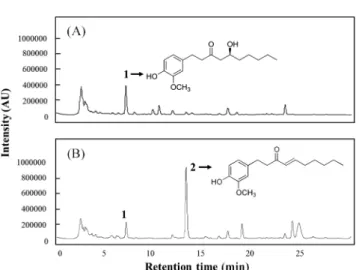
6-Gingerol에서 6-shogaol로의 변환 확인 생생강과 100oC에서 2시간 동안 6.4 MPa의 압력을 처리한 생 강 간의 유효성분 함량 변화는 Fig. 1의 크로마토그램과 같다. 225 nm의 파장에서 측정한 결과 생생강의 경우 6-gingerol이 주 를 이루었으며(6-gingerol 4.25 mg/g, 6-shogaol 0.08 mg/g), 가압조 건에서 열처리를 병행한 생강의 경우 확연하게 6-gingerol이 감소 하고 생생강에서는 확인할 수 없었던 6-shogaol이 대부분을 차지 하는 것을 확인할 수 있었다. 이는 구조적으로 생생강에 존재하 는 6-gingerol의 C6에 존재하는 수산기가 탈수반응을 거쳐 불포화 케톤구조로 변환되는 것이다(14). 반응표면분석법을 이용한 6-shogaol 최적 변환 조건 생강 내 6-gingerol, 6-shogaol 함량은 여러 연구결과에 보고된 바와 같이 가공 및 저장 중 열에 노출되는 정도에 따라 그 양이 반비례적으로 변하는 것으로 알려져 있다(15-17). 가열 온도와 시 간이 6-gingerol의 함량 감소와 6-shogaol의 함량 증가에 영향을 미치기 때문에 단시간에 효율적으로 확보하기 위한 기술로써 가Table 1. Coded level of independent variables in of experimental design
Factor Symbol Value Levels
-1.414 -1 0 1 1.414 Temperature (oC) X1 X1 Theoretical 71.72 80 100 120 128.28 Experimental 70 80 100 120 130 Time (min) X2 X2 Theoretical 95.16 120 180 240 264.84 Experimental 95 120 180 240 265
압처리 조건으로 반응표면분석법을 도입하였다. 이때, gingerol, shogaol, paradol과 같이 알려진 생강 gingerol 유도체 중에서 6-shogaol의 함량을 선택적으로 높이기 위하여 6-gingerol 함량은 최 저치(0.1 mg/g)가 되도록 설정하고 6-shogaol 함량은 예상되는 최 고치(4.0 mg/g)가 되도록 목표치(target)를 설정하여 결과를 분석하 였다. 가압처리 조건에서 적용 온도(X1; 70, 80, 100, 120, 130oC)와 적용 시간(X2; 95, 120, 180, 240, 265분)을 조절하여 다진 생강의 가압처리 적용 시 요인변수에 영향을 받는 종속변수 Y1 (6-gingerol
함량, mg/g dried ginger)와 Y2 (6-shogaol 함량, mg/g dried
gin-ger)의 값은 Table 2에 나타내었다. 6-Gingerol의 경우 70oC 180분 가압 적용 조건에서 가장 높은 함량(4.32 mg/g)을 나타내었고 최 소 함량인 0.30 mg/g을 나타내는 조합은 온도 130oC와 시간 180 분이 확인되었는데, 동일한 반응시간 조건에서 온도가 증가할수 록 뚜렷하게 함량이 감소하는 경향을 보였다. 반대로, 6-shogaol 의 경우에는 70oC, 180분 조건에서 가장 낮은 함량(0.42 mg/g)을 나타내었고 120oC, 120분 조건에서 가장 높은 3.80 mg/g을 나타 내었다. 즉, 실험에 이용한 일정 가압 조건에서 가열온도와 시간 이 증가할수록 6-gingerol 함량은 감소하고 반대로 6-shogaol 함량 은 증가하는 것으로 나타났다. 통계분석에 앞서, 온도와 시간 변화에 따른 6-gingerol (Y1)과 6-shogaol (Y2) 함량 분석 결과가 정규분포를 따르는지 Anderson-Darling 검정을 이용한 결과 p-value가 각각 0.316, 0.195를 나타 내어 유의수준 0.05 보다 크므로 정규분포를 따르는 것으로 확인 하였다. 또한, Table 2에서 제시한 변수들을 코드화시켜 통일된 변수로 적용하고 t-statistic에 근거하여 종속변수 Y1의 일차항(X1, X2), 이 차항(X12, X22), 상호항(X1·X2)의 계수와 유의성을 나타낸 결과(Table 3), Y1의 경우 일차항에서 X1와 X2은 통계적으로 유의한 차이를 보였다(p<0.05). Y1(6-gingerol 함량)과 Y2(6-shogaol 함량)에 대한
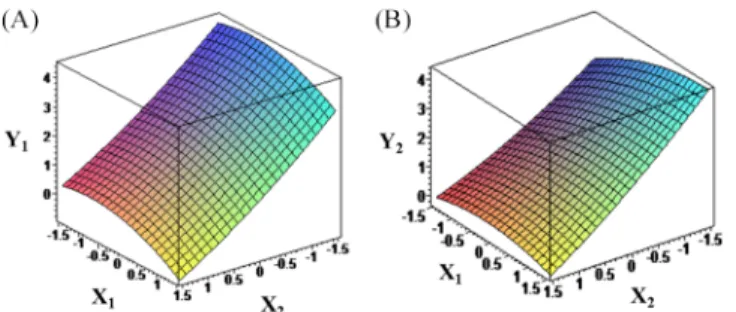
반응표면 모델식(response surface model equation)을 다중회귀분석 한 결과 6-gingerol 함량의 회귀곡선에 대한 결정계수 R2은 0.962 로 회귀방정식에 대한 설명력이 높았으며, p-value는 5% 이내 유 의수준을 보였다. 6-Shogaol 함량의 경우에는 회귀곡선의 R2 결 정 계수 값은 0.958로 회귀방정식에 대한 설명력이 높았으며, p-value는 5% 이내 유의수준을 보였다(Table 5). 또한, 전체 모델의 적합성 외에 Table 2의 회귀분석 및 분산분 석을 통해 전체 모델에 어떻게 영향을 주는지를 파악하기 위하 여 분산분석을 수행한 결과 선형항(linear)은 p<0.01로서 높은 유 의성을 나타났지만, 이차항(quadratic)과 상호항(cross-product)은 모 두 5% 유의수준에서 귀무가설을 기각하지 못하는 것으로 나타 남으로써 6-gingerol과 6-shogaol 함량 모두 온도와 시간이 각각 독립적으로 작용하는 linear model이 선택되었다. 적용온도(X1)와 적용시간(X2)에 따른 6-gingerol, 6-shogaol 함량 에 미치는 영향을 시각적으로 나타내기 위하여 Maple software를 사용하여 그래프로 나타내었다(Fig. 2). 다진 생강을 가압처리조 건에서 적용 온도(X1)와 시간(X2)의 상관관계를 살펴보면 온도가 높아질수록 6-gingerol이 감소하는 경향을 보였다.
Fig. 2(A)에서 6-gingerol은 낮은 온도에서 시간이 증가해도 크 게 감소하지 않았으나 높은 온도에서는 시간이 조금만 증가해도 크게 감소하는 경향을 나타냈다. 또한 Fig. 2(B)에서는 6-shogaol 의 적용 온도(X1)와 적용시간(X2)과의 상관관계에서도 시간이 증 가하면 6-shogaol은 완만하게 증가되었으며, 온도가 높아지고 시 간이 길어질수록 6-shogaol은 급격히 증가되었다. 최적 반응 조건 예측 가압처리 조건에서 생강의 최적 6-shogaol 증폭 조건을 설정하 기 위해 Table 4의 반응표면 모델식을 분석하여 도출한 결과값은 Fig. 1. HPLC chromatograms of 6-gingerol (1) and 6-shogaol (2)
in ginger. (A) fresh ginger and its major peak of 6-gingerol; (B) pressure/heat-treated ginger and its major peak of 6-shogaol.
Table 2. Central composite design (CCD) and responses of dependent variables for reaction optimum condition
Exp. No.
Coded levels of variable Responses
X1 X2 Y1 Y2 1 -1 -1 3.25 0.59 2 1 -1 0.65 3.80 3 -1 1 3.18 1.02 4 1 1 0.47 3.50 5 -1.414 0 4.32 0.42 6 1.414 0 0.30 3.49 7 0 -1.414 2.49 1.51 8 0 1.414 0.78 2.61 9 0 0 2.03 1.88 10 0 0 2.17 1.85 11 0 0 2.11 1.79 12 0 0 1.98 1.91 13 0 0 1.97 1.85
X1 (Application temperature, oC), X2 (Application time, min), Y1 (6-gingerol mg/g), Y2 (6-shogaol mg/g)
Table 3. Estimated coefficients of the fitted quadratic polynomial equation for different responses based on t-statistic
Y1 Y2
Coefficient p-value Coefficient p-value Constant 2.0520 0.000 1.856 0.000 X1 -1.3744 0.000 1.254 0.000 X2 -0.3335 0.017 0.211 0.078 X1·X1 0.1078 0.382 0.105 0.373 X2·X2 -0.2298 0.087 0.157 0.195 X1·X2 -0.0275 0.862 -0.1825 0.248 X1 (Application temperature, oC), X2(Application time, min). Y1 (6-gingerol mg/g), Y2 (6-shogaol mg/g)
Table 5, 6과 같았다. 중심합성법을 실시한 결과 반응변수의 최적 값의 경우 종속변수 Y2 (6-shogaol, mg/g)의 목적값은 초기 6-gingerol 함량을 고려하여 4.0 mg/g으로 설정하였으며, 최적 조건 을 산출한 결과 압력이 6.4 MPa일 경우 적용 온도(X1)는 130oC, 적용 시간(X2)는 204분이었다. 그 결과 예측된 gingerol과 6-shogaol 함량은 각각 건조시킨 생강을 기준으로 0.13, 3.85 mg/g 이며, 이때 만족도는 0.991 이었다. 기존 6-shogaol을 생산하기 위 한 연구에서 95oC에서 3시간 증숙한 생강의 6-shogaol 함량은 기 준함량 대비 4.7배 증가하였고, 80oC, 85% 항온항습 조건에서 30 일간 숙성한 조건에서 6-shogaol 함량은 최고 11.6배 증가하였으 나(18), 본 연구에서 제시된 최적조건에서는 48.1배 증가가 관 찰되었으며, 이러한 가압조건을 이용한 6-gingerol에서 6-shogaol 로의 변환은 기존 연구논문에서 보고된 스팀 등의 물리적 열처 리 기술에 비해(17) 시간과 소모되는 에너지가 줄어들고 6-gingerol 대비 6-shogaol 생성량이 탁월하기 때문에 친환경적이고 효율적 으로 6-shogaol을 얻을 수 있는 기술임을 확인하였다. 예상된 최적 조건의 적용 가압 조건에서 단시간에 효율적으로 생강 내 gingerol을 6-shogaol로 물리적 전환이 가능한 것을 확인하였고 이를 토대로 실제 적용하여 보았다. 다진 생강을 가압 기기에 담고 CO2 가스 를 주입하여 6.4 MPa의 압력으로 130oC에서 204분간 처리하였 을 때 얻어진 생강의 아임계 생성물은 100 g 건조량 당 6-gingerol 과 6-shogaol의 함량이 각각 13, 385 mg 함유된 것으로 확인하였 다. 이는 예상된 결과에서 오차를 고려하였을 때 RSM의 설계와 예측이 타당함을 입증하였으며, 건조물 기준 0.38% 6-shogaol이 함유된 다진 생강을 제조할 수 있었다.
요
약
본 연구는 다진 생강에 다량 함유된 6-gingerol을 뇌질환 개선 Fig. 2. Response surface plots for 6-gingerol contents. (A) X1(Application temperature, oC), X2 (Application time, min), Y1 (6-gingerol, mg/g); (B) X1 (Application temperature, oC), X2 (Application time, min), Y2 (6-shogaol, mg/g).
Table 4. Response surface model for reaction optimum condition
Responses Quadratic polynomial model R2 p-value
Y1 Y1=2.0520-1.3744X1-0.3335X2+0.1077X12-0.2297X22-0.0275X1·X2 0.995 0.013 Y2 Y2=1.8560+1.2540X1+0.2107X2+0.1045X12+0.1570X22-0.1825X1·X2 0.985 0.028 X1 (Application temperature, oC), X2 (Application time, min). Y1 (6-gingerol mg/g), Y2 (6-shogaol mg/g)
Table 5. Analysis of variance for response of dependent variables (Y1 and Y2)
Responses Sources Degree of freedom Sum of squares Mean squares F-value p-value
Y1 Model 5 16.5061 3.3012 35.58 0.001 Linear 2 16.0016 8.0008 86.24 0.001 Quadratic 2 0.5014 0.2507 2.70 0.135 Cross-product 1 0.0030 0.0030 0.03 0.862 Residual 7 0.6494 0.0927 - -Lack of fit 3 0.6197 0.2065 27.84 0.004 Pure error 4 0.0297 0.00742 - -Total 12 17.1555 - - -Y2 Model 5 13.2890 2.6578 31.75 0.001 Linear 2 12.9344 6.4672 77.25 0.001 Quadratic 2 0.2214 0.1107 1.32 0.326 Cross-product 1 0.1332 0.1332 1.59 0.248 Residual 7 0.5860 0.0837 - -Lack of fit 3 0.5781 0.1927 97.33 0.001 Pure error 4 0.0079 0.0020 - -Total 12 13.8751 - - -Y1 (6-gingerol mg/g), Y2 (6-shogaol mg/g)
Table 6. Optimal conditions for transformation of 6-gingerol into 6-shogaol
Independent variables Critical values Coded Uncoded
X1 1.414 130
X2 0.414 204
등의 기능성이 보고된 6-shogaol로 변환시키기 위하여 CO2를 이
용한 6.4 MPa의 가압조건에서 가열 온도와 시간을 변수로 두고 중심합성설계법을 이용한 최적반응표면분석법을 적용하였다. 적 용 온도 70-130oC (X
1)와 적용 시간 95-265분(X2)을 독립변수로,
6-gingerol함량(Y1, mg/g dried ginger)와 6-shogaol함량(Y2, mg/g dried ginger)을 종속변수로 설정하였다. 그 결과 온도와 시간이 대체적으로 증가할수록 6-gingerol은 감소하였으며 반대로 6-shogaol 은 증가하였다. 도출된 반응표면 설계를 분석한 결과 압력이 6.4 MPa일 경우 적용 온도(X1)는 130oC, 적용 시간(X2)는 204분이었 다. 최적반응표면분석 결과 예측된 6-gingerol과 6-shogaol 함량은 각각 건조시킨 생강을 기준으로 0.13, 3.85 mg/g이며, 이때 만족 도는 0.991이었다. 본 실험 결과를 통하여 도출된 가압조건에서 의 열처리 방법은 스팀 등을 이용한 물리적 열처리 기술에 비해 소요 시간과 소모되는 에너지를 줄일 수 있었고, 6-gingerol에서 6-shogaol로의 변환율이 탁월하기 때문에 친환경적이고 효율적인 6-shogaol을 얻을 수 있는 기술임을 확인할 수 있었다.
감사의 글
본 연구는 농림축산식품부 생명산업기술개발사업(과제번호: 112136-4)의 연구개발비 지원에 의해 수행되었으며, 이에 감사드 립니다.References
1. Lee YN. Flora of Korea. Kyohaksa, Seoul, Korea. 1107-1109 (1996)
2. Lee CB. Illustrated flora of Korea. Hyangmoon Publish Co., Seoul, Korea. 231 (1979)
3. Connell DW. The chemistry of the essential oil and oleoresin of ginger (Zingiber officinale Roscoe). Flavour Ind. 1: 677-693 (1970)
4. Connell DW, Sutherland MD. A re-examination of gingerol, shogaol, and zingerone the pungent principle of ginger (Zingiber officinale Roscoe). Aust. J. Chem. 22: 1033-1043 (1969)
5. Dugasani S, Pichika MR, Nadarajah VD, Balijepalli MK, Tandra S, Korlakunta JN. Comparative antioxidant and anti-inflammatory
effects of [6]-gingerol, [8]-gingerol, [10]-gingerol and [6]-shogaol. J. Ethnopharmacol. 127: 515-520 (2009)
6. Suekawa M, Ishige A, Yuasa K, Sudo K, Aburada M, Hosoya E. Pharmacological studies on ginger. I. Pharmacological actions of pungent constitutents, (6)-gingerol and (6)-shogaol. J. Pharmaco-biodyn. 7: 836-848 (1984)
7. Pan MH, Hsieh MC, Kuo JM, Lai CS, Wu H, Sang S, Ho CT. 6-Shogaol induces apoptosis in human colorectal carcinoma cells via ROS production, caspase activation, and GADD 153 expres-sion. Mol. Nutr. Food Res. 52: 527-537 (2008)
8. Jo KS. Analysis of gingerol compounds of raw ginger (Zingiber officinale Roscoe) and its paste by HPLC-mass spectrometry (LC/ MS). J. Korea Soc. Food Sci. Nutr. 29: 747-751 (2000)
9. Ok S, Jeoung WS. Optimization of extraction conditions for the 6-shogaol-rich extract from ginger (Zingiber officinale Roscoe). Prev Nutr Food Sci. 17: 166-171 (2012)
10. Ra YJ, Lee YW, Kim JD, Row KH. Supercritical fluid extraction of catechin compounds from green tea. Korean J. Biotechnol. Bioeng. 16: 327-331 (2001)
11. Savage PE, Gopalan S, Mizan TI, Martino CJ, Brock EE. Coking and activity of solid acid alkylation catalysts in supercritical reac-tion media. AIChE J. 41: 1723 (1995)
12. Eckert CA, Knutson BL, Debenedetti PG. Supercritical fluids as solvents for chemical and materials processing. Nature 383: 313-318 (1996).
13. Gontard N, Guilbert S, Cuq JL. Edible wheat gluten films: influ-ence of the main process variables on film properties using response surface methodology. J. Food Sci. 57: 190-196 (1992) 14. Nair KPP. The Agronomy and Economy of Turmeric and Ginger.
16-The Chemistry of Ginger. Elsevier, MA, USA. pp. 293-337 (2013)
15. Bhattarai S, Tran VH, Duke CC. The stability of gingerol and shogaol in aqueous solutions. J. Pham. Sci. 90: 1658-1664 (2001) 16. Cheng XL, Liu Q, Peng YB, Qi LW, Li P. Steamed ginger
(Zin-giber officinale): Changed chemical profile and increased antican-cer potential. Food Chem. 129: 1785-1792 (2011)
17. Lim TS, Kwon OJ, Kwon JH, Kim HK. Monitoring of extraction yields and functional properties of ginger (Zingiber officinale) extracts using response surface methodology. J. Korean Soc. Food Sci. Nutr. 36: 348-354 (2007)
18. Lee MH, Kim KT, Lee KH. Quality characteristics of ginger (Zingiber officinale Roscoe) as the ripening periods. J. Fd Hyg. Safety. 27: 479-486 (2012)