Bioethanol Production Using Lignocellulosic Biomass - review
Part I. Pretreatments of biomass for generating ethanol
Mominul Islam Sheikh MD., Chul-Hwan Kim
1†, Shabina Yesmin, Ji-Yong Lee
2, Gyeong-Chul Kim, Byeong-Il Ahn
3, Sung-Ho Kim and Hyeon-Jin Park
(Received November 2, 2010: Accepted December 10, 2010)
∙ Graduate student
1 Associate professor, Division of Environmental Forest Sciences, IALS, Gyeongsang National University, Jinju, 660-701, Korea 2 Assistant professor
3 Assistant professor, Department of Food and Resource Economics, Korea University, Korea
† Corresponding author’s E-mail: [email protected]
ABSTRACT
Bio-ethanol is a promising alternative energy source for reducing both consumption of crude oil and environmental pollution from renewable resources like lignocellulosic biomass such as wood, forest residuals, agricultural leftovers and urban wastes. Based on current technologies, the cost of ethanol production from lignocellulosic materials is relatively high, and the main challenges are the low yield and high cost of the hydrolysis process. Development of more efficient pretreatment technology (physical, chemical, physico-chemical, and biological pretreatment), integration of several microbiological conversions into fewer reactors, and increasing ethanol production capacity may decrease specific investment for ethanol producing plants. The purpose of pretreatment of lignocellulosic material is to improve the accessible surface area of cellulose for hydrolytic enzymes and enhance the conversion of cellulose to glucose and finally high yield ethanol production which is economic and environmental friendly.
Keywords : Bioethanol, pretreatment, lignocellulosic biomass.
1. Introduction
One of the greatest challenges for society in the 21st century is not only to meet the increasing energy demand for transportation, heating and industrial processes, but also to provide raw materials for the
industry in a sustainable way 1). Demerits of fossil derived from transportation fuels i.e. greenhouse gas emissions, pollution, unsustainable supply, unequal supply-demand relations are strongly reduced or even absent with bio-transportation fuels 2,3). Environmental, long‐term economic and national security concerns have motivated researches over the last 25 years into
renewable, domestic sources of fuels and chemicals now mostly derived from petroleum 4). During the last decades, global warming from the increased amount of greenhouse gases, mainly carbon dioxide, has become a major political and scientific issue. Burning fossil fuels i.e. natural gas, coal and oil releases CO2, which is also a major cause of global warming 5). In the past, shortages of fossil energy and environment pollutions have awaked the interest of renewable energies in many countries.
Among the clean energies, bioethanol is considered as a promising renewable fuel because of clean burning characteristics, reduction of particulate and NOx emission from combustion 6). Diminution of world’s petroleum supply and greenhouse gas (GHG) effects has resulted in a growing interest in alternative fuels 7). The increasing concerns about environmental protection, the increase of oil prices and the decrease of the world reserves of fossil energy carriers have attracted scientific interest to the use of bioethanol as a transportation fuel. Biomass residues are potential raw materials for ethanol production since they are inexpensive, abundant and rich in carbohydrates 8).
Biorefinery integrates biomass conversion processes and equipment to fossil resources for production of energy carrier’s fuels, power, and high value chemicals.
In most cases, commodity product bioethanol is produced from not only corn or wheat but also from cassava, rye, barley or sorghum. But these raw materials are not sufficient for supplying increasing demands for animal or even human feeding. In this case, Biological material as renewable energy source derived from living, or recently living organisms, such as forest and mill residues, agricultural crops and wastes, wood and wood wastes, animal wastes, livestock operation residues, aquatic plants, fast‐
growing trees and plants, municipal and industrial wastes for bioethanol production. This ethanol also can reduce net CO2 emissions i.e. help to alleviate global warming and environmental pollution to
approximately zero 9‐11). Therefore, future energy generation and fundamental sources of raw materials will come to rely more and more on renewable sources 12). Bioethanol production from renewable biomass has received considerable worldwide attention in current years. Ethanol for fuel can also decrease strong dependence on foreign oil, reduce trade deficits, create jobs in rural areas, reduce air pollution, and reduce global climate change CO2 buildup. Currently, the National Renewable Energy Laboratory (NREL) identifies biomass pretreatment as one of the factors standing in the way of cost effective lignocellulosic bioethanol 13). Technologies that will allow cost effective conversion of biomass into fuels and chemicals consider economy of scale, low‐cost pretreatment systems and highly effective and efficient biocatalysts 14,15). Different pretreatment methods have been investigated for different materials 16). A variety of techniques have been studied for the conversion of lignocellulosic materials to fermentable sugars.
Pretreatment is an important tool for practical cellulose conversion processes. This is required to alter the structure of cellulosic biomass to make cellulose more accessible to the enzymes that convert the carbohydrate polymers into fermentable sugars 17).
Different pretreatment technologies have been developed (dilute acid or alkali, flow‐through, ammonia fiber explosion, ammonia recycle percolation, steam explosion, and organosolv), and the common purpose of these technologies is to break open the lignocellulosic structure.
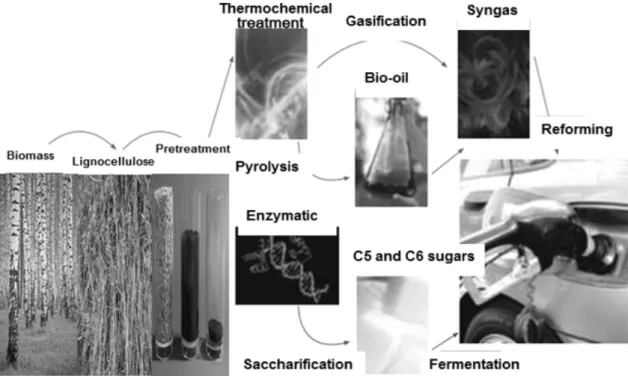
Lignocellulosic biomass includes four main steps for bioethanol production as represented in Fig. 1:
1. Pretreatment-breaking down the structure of the lignocellulosic matrix.
2. Enzymatic hydrolysis-depolymerizing cellulose to glucose by means of cellulolytic enzymes.
3. Fermentation-metabolizing the glucose to ethanol, generally by microorganisms, bacteria or yeast strain.
4. Distillation-separating and purifying the ethanol
Fig. 1. A summary of the primary processing steps involved in the conversion of lignocellulosic materials to biofuels.
to meet fuel specifications.
The goal of pretreatment of lignocellulosic material is to make the cellulose accessible to hydrolysis for conversion to biofuels using microorganisms which is economic, environmental friendly and also renewable.
2. The composition of lignocellulosic materials
Lignocellulose is the primary building block of plant cell walls. Plant biomass consists of mainly three different types of polymers, namely cellulose, hemicellulose and lignin, which are associated with each other 18). Cellulose and hemicellulose comprise the carbohydrate fraction of biomass while lignin consists of poly (aromatic) moieties from phenylpropanoid building blocks and minor constituents include organic extractives (mainly terpenes) and inorganic compounds (ash) 19). Plant biomass consists of
40-55% cellulose, 25-50% hemicellulose and 10-40%
lignin, depending on whether the source is hardwood, softwood, or grasses 20). Cellulose is the main part of the cell wall, with the elementary formula (C6H10O5)n, highly linear polysaccharide but hemicellulose has more branched structure and more susceptible to chemical degradation than cellulose. Lignin acts like the bounds in the cells, and gives rigidity to the cell wall. It has complex three dimension polymers of phenylpropane, namely p‐coumaryl, coniferyl, and sinapyl alcohols.
3. Lignocellulosic feedstock biorefinery
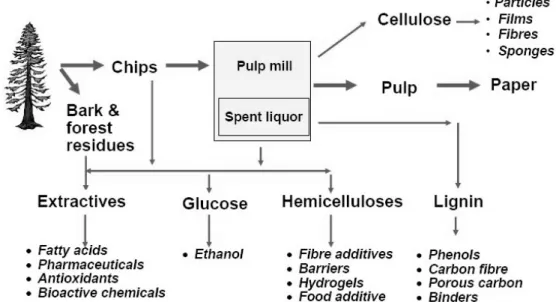
It is generally known that the pulp and paper industry generates about 50% of its own energy needs from biomass residues and makes extensive use of combined heat and power. Biorefinery in pulp and
Fig. 2. Biorefinery in the pulp and paper industry. (Source: Biorefineries in pulp and paper sector, IEA Implementing Agreement, April, 2007)
paper industry is an integrated system of interdependent processes, which converts a set of renewable feedstock effectively into the actually most profitable portfolio of value‐added products with a minimum of external energy needs and practically no wastes and emissions. Such value‐added products include different kinds of biomaterials and bioproducts, chemicals, biofuels and energy. Among the several definitions of biorefinery, the most exhaustive was recently formulated by the International Energy Agency Bioenergy Task 42 "Biorefinery". Utilization of biomass as raw materials in a biorefinery is a promising alternative to fossil resources for production of energy carriers and chemicals, as well as for mitigating climate change, reducing dependence on imported fossil fuels and enhancing energy security 21) as depicted in Fig. 2. In the near future, the second generation biofuel facilities in pulp and paper industry are expected to develop towards biorefinery concepts, where bioenergy, biochemicals, and biomaterials are co‐produced along with transportation biofuels.
4. Pretreatment of lignocellulosic materials
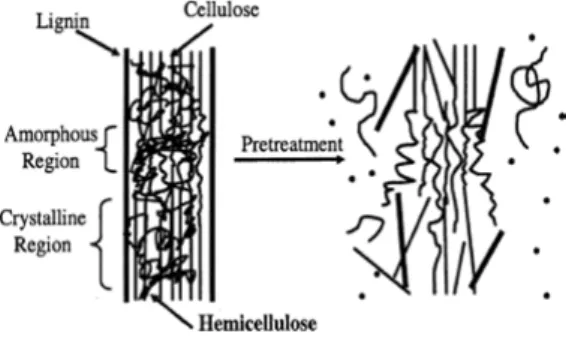
An effective and economical pretreatment of lignocellulosic materials is indicated by several criteria. The useful effects of pretreatment of lignocellulosic materials have been recognized for a long time. The aim of the pretreatment is to remove lignin and hemicellulose, diminish cellulose crystallinity, and augment the porosity of the lignocellulosic substrates as represented in Fig. 3. Pretreatment should meet the following requirements: (a) production of reactive cellulosic fiber for enzymatic attack, (b) avoiding destruction of hemicelluloses and cellulose, (c) avoiding formation of possible inhibitors for hydrolytic enzymes and fermenting microorganisms, (d) minimizing the energy demand, (e) reducing the cost of size reduction for feedstocks, (f) diminishing the cost of material for construction of pretreatment reactors, (g) producing less residues, (h) consumption of little or no chemical and using a cheap chemical, (i) being simple and effective at low humidity. Several
Fig. 3. Schematic of goals of pretreatment on lignocellulosic material 17).
methods have been introduced for pretreatment of lignocellulosic materials prior to enzymatic hydrolysis or digestion such as physical, chemical, physico‐
chemical and biological processes. 22‐45).
4.1 Physical pretreatments 4.1.1 Mechanical pulverization
The objective of mechanical treatment is a reduction of particle size and crystallinity of lignocellulosic in order to increase the specific surface and reduce the degree of polymerization. This can be produced by a combination of chipping, grinding or milling depending on the final particle size of the material (10-30 mm long and 3 to 6 mm thick after chipping and 0.2-2 mm diameter holes after milling or grinding) 20). Vibratory ball milling with 80 meshes (0.177 mm) is used for more effective in breaking down the cellulose crystallinity and improving the digestibility of the biomass than ordinary ball milling 46).
4.1.2 Pyrolysis & Hydrothermal treatment Pyrolysis is a form of incineration that chemically decomposes organic materials by heat above 300 °C and pressure in the absence of oxygen. When biomass is treated with that temperature, cellulose rapidly decomposes to gaseous products, bio‐oil, or residual biochar 47,48). The decomposition is much slower and less volatile products are produced at lower
temperatures. The process can be increased with the presence of O2 48), called thermal treatment. During a hydrothermal process, temperature, pressure, and reaction time are the most important factors affecting the material conversion. A higher temperature and pressure lead to a faster hydrolysis rate but a faster decomposition rate as well, which consequently leads to a relatively lower yield of hexoses. Nevertheless, flow technology has the advantage of shorter reaction times, as it skips the preheating stage of the reactor 49).
If zinc chloride, ZnCl2 or sodium carbonate, Na2CO3 is added as a catalyst, the decomposition of pure cellulose can occur at a lower temperature 50).
4.1.3 Extrusion
Extrusion process is also a novel and promising physical pretreatment method for biomass conversion to ethanol production. In this technique, the materials are submitted to heating, mixing and shearing, resulting in physical and chemical medications during the passage through the extruder 51). Several parameters must be taken into account to achieve the highest efficiency in the process. Screw speed and barrel temperature are considered to disrupt the lignocellulose structure causing defibrillation, fi brillation and shortening of the fibers, and finally increasing accessibility of carbohydrates to enzymatic attack.
4.2 Chemical pretreatments 4.2.1 Ozonolysis treatment
Ozonolysis is a novel pretreatment method that can enhance biomass digestibility with minimal generation of chemical waste streams and degradation of the carbohydrate components. It employs powerful oxidant O3, which forms highly reactive free hydroxyl ions upon decomposition. This method can effectively degrade lignin and part of hemicellulose. This treatment has several advantages: (1) it effectively removes lignin; (2) it does not produce toxic residues for the
downstream processes; and (3) the reactions are carried out at room temperature and pressure 52).
Furthermore, the fact that ozone can be easily decomposed by using a catalytic bed or increasing the temperature means that processes can be designed to minimize environmental pollution 53). However, a large amount of ozone and verities of parameters i.e.
oxygen cylinder, automatic gas flow control valve, ozone generator, process gas humidifier, reactor, ozone UV spectrophotometer, ozone catalytic destroyer, iodide trap to test catalyst efficiency, vent, pressure regulation valve, three‐way valve, moisture content of the sample, particle size, and O3 concentration are obligatory for this process. This is an attractive pretreatment method for industrial process since it does not leave acidic, basic, or toxic residues in the treated material 54). As for laboratory‐scale, this process is expensive. It is expected that the results of this study will help in the development of a pretreatment process that provides higher specificity towards lignin removal compared than other delignifying agents/pretreatments.
4.2.2 Acid treatment
The acid pretreatment can operate either under a high temperature and low acid concentration (dilute‐
acid pretreatment) or under a low temperature and high acid concentration (concentrated‐acid pretreatment) 16). Treatment of lignocellulosic materials with acid at a high temperature can efficiently improve the enzymatic hydrolysis. Different concentrated sulfuric acid is the most applied acid, while other acids HCl, phosphoric acid and nitric acid are also used 55).
Although they are powerful agents for cellulose hydrolysis but concentrated acids are toxic, corrosive and hazardous and require reactors that are resistant to corrosion. In addition, the concentrated acid must be recovered after hydrolysis to make the process economically feasible 56). Dilute‐acid hydrolysis is probably the most commonly applied method among the chemical pretreatment methods. At an elevated
temperature (140-190 °C) and low concentration of acid (0.1-1% H2SO4), the dilute‐acid treatment can achieve high reaction rates and significantly improve cellulose hydrolysis. In general, pretreatments with diluted acids involve high temperature (>160 ºC) continuous processes with low solid content (5-10%) 57) and discontinuous low temperatures (<160 ºC) processes with high content of solids (10-40%) 58). Its cost is usually higher than some physico‐chemical pretreatment processes such as steam explosion or AFEX. The major drawback of this method, particularly at low pH, is the formation of different types of non‐accessible molecules such as carboxylic acids, furans and phenolic compounds 55). These chemicals may not affect the enzymatic hydrolyses, but they usually inhibit the microbial growth and fermentation, which results in less yield and productivity of ethanol or biogas 59).
4.2.3 Alkaline treatment
Alkali pretreatment refers to the application of alkaline solutions such as NaOH, lime Ca(OH)2 or NH3 to remove lignin and a part of the hemicellulose, and efficiently increase the accessibility of enzyme to the cellulose 16). Sodium, potassium, calcium, and ammonium hydroxides are suitable agents for alkaline pretreatment. NaOH has a strong base activity which catalyzes the removal of lignin and swells celluloses 60‐63). This base and sodium sulfide are used in kraft paper pulping. Ca(OH)2 has the additional benefits of low reagent cost and safety 64,65) and this process is also similar to Kraft paper pulping technology. Alkali pretreatment processes use lower temperatures and pressures compared to other pre‐treatment technologies.
This pretreatment may be carried out at ambient conditions, but time is measured in terms of hours or days rather than minutes or seconds 66). Alkali pretreatment reduces the lignin and hemicellulose content in biomass, enhances the surface area, allowing penetration of water molecules to the inner layers, and breaks the bonds between hemicellulose
and lignin carbohydrate. Dilute NaOH is usually used for alkali pre‐treatment. As for considering economic and environmental aspects, dilute NaOH treatment would be much more suitable than concentrated NaOH pretreatment.
4.2.4 Oxidative delignification
Lignin biodegradation could be catalyzed by the peroxidase enzyme with the presence of hydrogen peroxide, H2O2. Almost 50% lignin and most hemicellulose were solubilized by 2% H2O2 at 30 °C within 8 hours, and 95% efficiency of glucose production from cellulose was achieved in the subsequent saccharification by cellulase at 45 °C for 24 hours 67). An oxidative pretreatment consists of additional oxidizing compounds, like H2O2 or Peracetic acid to the biomass which is suspended in water. During oxidative pretreatment, several reactions can take place such as electrophilic substitution, displacement of side chains, cleavage of alkyl aryl ether linkages or the oxidative cleavage of aromatic nuclei 68). In many cases, the used oxidant is not selective and therefore losses of hemicellulose and cellulose can occur. Oxidative lime pretreatment of poplar 69) removed 77.5% lignin from the wood chips at 150 °C for 6 hours and improved the yield of glucose by enzymatic hydrolysis from 7% (untreated) to 77%
(treated) compared to the untreated and pretreated poplar wood. Peracetic acid is very lignin selective and no significant carbohydrate losses occurred.
4.2.5 Organosolv process
The organosolv process is a promising pretreatment strategy which has attracted more attention and proved the potential for utilization in lignocellulosic pretreatment 70). In the organosolv process, an organic or aqueous organic solvent mixture with inorganic acid catalysts (HCl or H2SO4) is used to break the internal lignin and hemicellulose bonds. Methanol, ethanol, acetone, ethylene glycol, triethylene glycol, and tetrahydrofurfuryl alcohol are the common solvents for this process 71,72). Organic acids such as
oxalic, acetylsalicylic, and salicylic acids also can be used as catalysts 73). The applied solvents should be separated by evaporation and condensation, and recycled to reduce the operational costs of the process.
Scientists observed the highest ethanol yield to be 99.5% at 195 °C, 5 minutes, pH 2.0, and 1:1 ratio of acetone‐water after pretreatment 74).
4.2.6 Ionic liquids (ILs) pretreatment
The use of ILs as solvents for pretreatment of lignocellulosic biomass has recently received much attention. ILs is salts, typically composed of large organic cations and small inorganic anions, which exist as liquids at relatively low temperature or room temperature. Their solvent properties can be varied by adjusting the anions and the alkyl constituents of the cations. These interesting properties include chemical and thermal stability, non‐flammability, low vapour pressures and a tendency to remain liquid in a wide range of temperatures 75). In this process, no toxic or explosive gases are produced, so ILs also called
‘‘green” solvents. Carbohydrates and lignin can be simultaneously dissolved in ILs with anions activity (1
‐butyl‐3 methylimidazolium cations) because ILs forms hydrogen bonds between the non‐hydrated chloride ions of the IL and the sugar hydroxyl protons in a 1:1 stoichiometric. In this study using 1‐ethyl‐3‐
methyl imidazolium diethyl phosphate, the yield of reducing sugars from wheat straw pretreated with this ionic liquid at 130 oC for 30 min was 54.8% after being enzymatically hydrolyzed for 12 h 76). Inspite of some current limitations, advanced research e.g. as potential synthesis of ILs from carbohydrates may play an important role in reducing their cost. Development of ILs pretreatment offers a great potential for future lignocellulose biorefinering processes.
4.3 Physico-chemical pretreatments 4.3.1 Steam explosion (autohydrolysis)
Steam explosion is an increasingly popular
pretreatment of raw lignocellulosic biomass to separate the cellulose and lignin. This treatment is typically initiated at a temperature of 160-260 °C (corresponding pressure 0.69-4.83 MPa) for several seconds to a few minutes before the material is exposed to atmospheric pressure. 90% efficiency of enzymatic hydrolysis has been achieved in 24 hours for poplar chips pretreated by steam explosion, compared to only 15% hydrolysis of untreated chips 77). Small amounts of lignin are removed but it is melted and depolymerized and spread back over the surface of the cellulose fibre. The factors that affect steam explosion pretreatment are residence time, temperature, chip size and moisture content 78).
Researchers primarily apply to improve the fermentation process for the conversion of bamboo into methane by the use of steam‐explosion technology 79). Recent studies indicate that lower temperature and longer residence time are more favorable than high temperature and short residence time. Optimal hemicellulose solubilization and hydrolysis can be achieved by either high temperature and short residence time (270 °C, 1 minute) or lower temperature and longer residence time (190 °C, 10 minutes) 78).
This process offers several attractive features‐
potential for significantly lower environmental impact, lower capital investment, more potential for energy efficiency, less hazardous process chemicals and conditions and complete sugar recovery 80).
4.3.2 Liquid hot water
The objective of this water is to solubilize mainly the hemicellulose, to make the cellulose more accessible and to avoid the formation of inhibitors at pH 4‐7. This is similar to autohydrolysis, except that the larger amounts of water are employed and the pressure is elevated to ensure that the water remains liquid. This is also called hydrothermolysis 81), and aquasolv 82). Cocurrent, countercurrent or flow‐
through reactor configurations may be used. Co‐
current treatment involves the biomass and water
being held in slurry which is warmed and then cooled;
counter‐current treatment moves the biomass and water in opposite directions; and flow‐through treatment involves the water passing over the stationary biomass 75). This treatment, pH is decreased for two reasons‐ increasing temperatures lowers the pKa of water and liberates acids from biomass. Water has an unusually high dielectric constant that enables to dissociate ionic substances and able to dissolve all of the hemicellulose. One half to two thirds of the lignin also dissolves from most biomass materials when these materials are treated at 220 oC for 2 min. Hot water cleaves hemi‐acetal linkages and liberates acids during biomass hydrolysis. This facilitates the breakage of such ether linkages in biomass 83). In general, liquid hot water pretreatments are attractive from a cost‐savings potential for no catalyst requirement and low‐cost reactor construction due to low‐corrosion potential.
4.3.3 Supercritical water
Supercritical water treatment is thought to be a promising pretreatment for bioethanol production from lignocelluloses. This treatment is more suitable for obtaining high yields of hydrolyzed products and cellulose is found to be more liable to fragment 84).
The treatment (water with a temperature higher than 374 °C and a pressure higher than 22 MPa) has been considered as one of the main hydrothermal technologies because of the high dissolving and catalyzing capacity of supercritical water, which can separate lignin from cellulose and rapidly hydrolyze the cellulose through catalysis by H+ ions 85,86).
4.3.4 Ammonia fiber/ freeze explosion (AFEX) Ammonia fibre explosion is very similar concept to steam explosion, with the main difference being the ammonia is used instead of superheated steam. This treatment is regarded as an attractive method for high yielding digestible cellulose 36,87). AFEX depolymerizes the lignin, dissolves the hemicellulose and decrystallizes
the cellulose 88,89). The moderate temperature and pH also minimize formation of sugar degradation products. In this process, the raw materials are exposed to liquid ammonia at high temperature and pressure for a period of time, and then the pressure is swiftly reduced. The dosage of liquid ammonia is 1-2 kg ammonia/kg dry biomass, temperature 90 °C, and residence time 30 minutes. Pressures exceeding 12 atm are required for operation at ambient temperature.
For diminishing the cost and protecting the environment, ammonia NH3 must be recycled after the pretreatment. In NH3 recovery process, a superheated ammonia vapor with a temperature up to 200 °C is used to vaporize and strip the residual ammonia in the pretreated biomass and the evaporated ammonia is then withdrawn from the system by a pressure controller for recovery 90). The inhibitor products are not produced for the downstream biological processes, and thus water wash is not necessary 91,92).
4.3.5 Supercritical CO2 explosion
Carbon dioxide, CO2 explosion is similar to steam and ammonia explosion treatment methods for lignocellulosic materials. As for developing improved lignocellulose pretreatment techniques, the supercritical CO2 explosion uses a lower temperature than steam explosion and is possibly less expensive compare to ammonia explosion. CO2 is helpful for hydrolyzing hemicellulose and cellulose. Furthermore, low temperature prevents any appreciable decomposition of monosaccharide’s by using acid 93). It is hypothesized that CO2 will form carbonic acid and enhance the hydrolysis rate. Researchers used this method to pretreat alfalfa (4 kg CO2/kg fiber at the pressure of 5.62 MPa) and obtained 75% glucose during 24 hours of the enzymatic hydrolysis 88).
Scientists compared and found that CO2 explosion was more cost‐effective than ammonia explosion and did not cause the formation of inhibitory compounds that could occur in steam explosion 94).
5. Biological pretreatment
Biological treatment means the use of whole organisms (fungi and bacteria) or enzymes of lignocellulosic materials for safe and environmentally friendly method. These enzymes are controlled by carbon and nitrogen sources. Fungal pretreatment of agricultural residues is a new method for improvement of digestibility 95). White‐rot fungi (such as Phanerochaete chrysosporium, Trametes versicolor, Ceriporiopsis subvermispora, and Pleurotus ostreatus) are the most effective for biological pretreatment of lignocellulosic materials 96,97). Biological pretreatment might be used not only for lignin removal, but also for biological removal of specific components such as antimicrobial substances. The main advantages of biological pretreatment include low energy requirement, no chemical requirement, and mild environmental conditions but this treatment is slow process.
6. Conclusions
With the possibility of depletion of the world’s petroleum supply, biomass has attracted attention as an alternative energy resource. The cell‐wall structural of biomass material is composed of cellulose and hemicellulose encrusted with lignin. The biodegradability of lignocellulosic biomass is limited by several factors like crystalline cellulose, available surface area, and lignin content. Such a complex structure of biomass prevents enzymatic accessibility of microorganisms to the cell‐wall components and also contributes to the resistance of cellulose to hydrolysis. Pretreatment and intrinsic structures of the biomass itself are primarily responsible for its subsequent hydrolysis. The conditions employed in the opted pretreatment method affects various substrate characteristics that regulate the susceptibility of the substrate to hydrolysis and the subsequent fermentation of the released sugars. For these reasons, biomass pretreatment is an extremely important step for the synthesis of
biofuels. There is a critical need to understand the fundamentals of various processes, which can help in making a suitable option depending on the structure of the biomass substrate, operating conditions and the hydrolysis agent for low cost bioethanol production.
Acknowledgement
This study was carried out with the support of
‘Forest Science & Technology Projects’ (Project No.03‐2009‐0136) provided by Korea Forest Service.
Literature Cited
1. Hahn-Hagerdal, B., Galbe, M., Gorwa-Grauslund, M.F., Liden, G. and Zacchi, G., Bioethanol-the fuel of tomorrow from residues of today, Trends Biotechnol. 24:549-556 (2006).
2. Goldemberg, J., World Energy Assessment, United Nations Development Programme, New York NY USA, p.135-171 (2000).
3. Williams, R.H., Larson, E.D., Katofsky, R.E. and Chen, J., Methanol and hydrogen from biomass for transportation, with comparisons to methanol and hydrogen from natural gas and coal, PU/ CEES Report 292, Princeton University/Center for Energy and Environmental Studies, Princeton, NJ, USA, p.47 (1995).
4. Mosier, N., Wyman, C., Dale, B., Elander, R., Lee, Y., Holtzapple, M. and Ladisch, M., Features of promis- ing technologies for pretreatment of lignocellulosic biomass, Bioresource Technol. 96:673-686 (2005).
5. Yat, S. C., Berger, A. and Shonnard, D. R., Kinetic characterization of dilute surface acid hydrolysis of timber varieties and switchgrass, Bioresour Technol.
99:3855-3863 (2008).
6. Prasad, S., Singh, A. and Joshia, H.C., Ethanol as an alternative fuel from agricultural, industrial and ur- ban residues, Resour Conserv Recycli. 50:1-39 (2007).
7. Aristidou, A. and Penttila, M., Metabolic engineering application to renewable resources utilization, Curr Opin Biotechnol. 11:187-198 (2000).
8. Wyman, C.E., Biomass ethanol: technical progress,
opportunities and commercial challenges, Annu. Rev.
Energy Enivorn. 24:189-226 (1999).
9. Lynd, L.R., Overview and evaluation of fuel ethanol from cellulosic biomass: technology, economics, the environment, and policy, Annu Rev Energy Env.
21:403-465 (1996).
10. Solomon B. D., Barnes, J. R. and Halvorsen, K. E., Grain and cellulosic ethanol: History, economics, and energy policy, Biomass Bioenergy. 31:416-425 (2007).
11. Demirbas, A., Progress and recent trends in biofuels, Prog Energy Combust Sci. 33:1-18 (2007).
12. Diana, A. and Alejandro, A., Ethanol from lignocellu- losic biomass, Cien. Inv. Agr. 36(2):177-190 (2009).
13. Andy Aden, P.E., Biomass and Biofuels: Technology and Economic Overview, NREL/PR. 510-41793 (2007).
14. Schneider, U.A. and McCar, B.A., Economic poten- tial of biomass based fuels for greenhouse gas emis- sion mitigation, J. Environ. Resour. Economics.
24(4): 291-312 (2003).
15. Gray, K.A., Zhao, L. and Emptage, M., Bioethanol, Curr. Opin. Chem. Biol. 10:141-146 (2006).
16. Taherzadeh, M. J. and Keikhosro, K., Pretreatment of Lignocellulosic Wastes to Improve Ethanol and Biogas Production, Int. J. Mol. Sci. 9:1621-1651 (2008). DOI: 10.3390/ijms9091621.
17. Hsu, T.A., Ladisch, M.R. and Tsao, G.T., Alcohol from cellulose, Chemical Technology. 10(5):315-319 (1980).
18. Fengel, D. and Wegener, G., Wood Chemistry, Ultrastructure, Reactions. De Gruyter, Berlin (1984).
19. Sjostrom, E., Wood Chemistry, 2nd ed.; Academic Press, New York, p.293 (1999).
20. Sun, Y. and Cheng, J., Hydrolysis of lignocellulosic materials for ethanol production: a review, Bioresource Technol. 83:1-11 (2002).
21. Francesco Cherubini & Gerfried Jungmeier., LCA of a biorefinery concept producing bioethanol, bio- energy, and chemicals from switchgrass, Int J Life Cycle Assess. 15:53-66 (2010). DOI 10.1007/s 11367-009-0124-2
22. Wyman, C.E., Handbook on bioethanol: production and utilization; Taylor & Francis, Washington DC, USA, (1996).
23. Berlin, A., Balakshin, M., Gilkes, N., Kadla, J.,
Maximenko, V., Kubo, S. and Saddler, J., Inhibition of cellulase, xylanase and beta-glucosidase activities by softwood lignin preparations, J. Biotechnol.
125:198-209 (2006).
24. Karimi, K., Kheradmandinia, S. and Taherzadeh, M.J., Conversion of rice straw to sugars by dilute acid hydrolysis, Biomass Bioenerg. 30:247-253 (2006).
25. Sanchez, G., Pilcher, L., Roslander, C., Modig, T., Galbe, M. and Liden, G., Dilute acid hydrolysis for fermentation of the Bolivian straw material Paja Brava, Bioresource Technol. 93:249-256 (2004).
26. Schell, D.J., Farmer, J., Newman, M. and McMillan, J.D., Dilute-sulfuric acid pretreatment of corn stover in pilot scale reactor: Investigation of yields, kinetics, and enzymatic digestibilities of solids, Appl. Biochem.
Biotechnol. 105:69-85 (2003).
27. Tucker, M.P., Kim, K.H., Newman, M.M. and Nguyen, Q.A., Effects of temperature and moisture on dilute-acid steam explosion pretreatment of corn stover and cellulase enzyme digestibility, Appl.
Biochem. Biotechnol. 105:165-177 (2003).
28. Nguyen, Q.A., Tucker, M.P., Keller, F.A. and Eddy, F.P., Two-stage dilute-acid pretreatment of soft- woods, Appl. Biochem. Biotechnol. 84-86: 561-576 (2000).
29. Lee, Y.Y., Iyer, P. and Torget, R.W., Dilute-acid hy- drolysis of lignocellulosic biomass, Adv. Biochem.
Eng. Biotechnol. 65:93-115 (1999).
30. Barl, B., Biliaderis, C.G., Murray, E.D. and Macgregor, A.W., Combined chemical and enzy- matic treatments of corn husk lignocellulosics, J. Sci.
Food Agric. 56:195-214 (1991).
31. Arato, C., Pye, E.K. and Gjennestad, G., The lignol approach to biorefining of woody biomass to produce ethanol and chemicals, Appl. Biochem. Biotechnol.
123:871-882 (2005).
32. Sidiras, D. and Koukios, E., Simulation of acid-cata- lyzed organosolv fractionation of wheat straw, Bioresource Technol. 94:91-98 (2004).
33. Alizadeh, H., Teymouri, F., Gilbert, T.I. and Dale, B.E., Pretreatment of switchgrass by ammonia fiber explosion (AFEX), Appl. Biochem. Biotechnol. 124:
1133-1141 (2005).
34. Vlasenko, E.Y., Ding, H., Labavitch, J.M. and Shoemaker, S.P., Enzymatic hydrolysis of pretreated rice straw, Bioresource Technol. 59:109-119 (1997).
35. Dale, B.E., Leong, C.K., Pham, T.K., Esquivel, V.M., Rios, I. and Latimer, V.M., Hydrolysis of lignocellu- losics at low enzymes level: application of the AFEX process, Bioresource Technol. 56:111-116 (1996).
36. Holtzapple, M.T., Jun, J.H., Ashok, G., Patibandla, S.L. and Dale, B.E., The ammonia freeze explosion (AFEX) process - A practical lignocellulose pretreat- ment, Appl. Biochem. Biotechnol. 28:59-74 (1991).
37. Ballesteros, I., Oliva, J.M., Navarro, A.A., Gonzalez, A., Carrasco, J. and Ballesteros, M., Effect of chip size on steam explosion pretreatment of softwood, Appl. Biochem. Biotechnol. 84:97-110 (2000).
38. Ogier, J.C., Ballerini, D., Leygue, J.P., Rigal, L. and Pourquie, J., Ethanol production from lignocellulo- sic biomass, Oil Gas Sci. Technol. 54:67-94 (1999).
39. Boussaid, A., Robinson, J., Cai, Y.J., Gregg, D.J. and Saddler, J.R., Fermentability of the hemicellulose- derived sugars from steam-exploded softwood (Douglas fir), Biotechnol. Bioeng. 64:284-289 (1999).
40. Sassner, P., Galbe, M. and Zacchi, G., Steam pretreat- ment of Salix with and without SO2 impregnation for production of bioethanol, Appl. Biochem.
Biotechnol. 121:1101-1117 (2005).
41. Ohgren, K., Galbe, M. and Zacchi, G., Optimization of steam pretreatment of SO2-impregnated corn stover for fuel ethanol production, Appl. Biochem.
Biotechnol. 121:1055-1067 (2005).
42. Tengborg, C., Stenberg, K., Galbe, M., Zacchi, G., Larsson, S., Palmqvist, E. and Hahn-Hagerdal, B., Comparison of SO2 and H2SO4 impregnation of soft- wood prior to steam pretreatment on ethanol pro- duction, Appl. Biochem. Biotechnol. 70:3-15 (1998).
43. Eklund, R., Galbe, M. and Zacchi, G., The influence of SO2 and H2SO4 impregnation of willow prior to steam pretreatment, Bioresource Technol. 52:225- 229(1995).
44. Stenberg, K., Tengborg, C., Galbe, M. and Zacchi, G., Optimization of steam pretreatment of SO2- impreg- nated mixed softwoods for ethanol production, J.
Chem. Technol. Biotechnol. 71:299-308 (1998).
45. Fan, L., Lee, Y. and Gharpuray, M., The nature of lignocellulosics and their pretreatments for enzy- matic hydrolysis, Adv. Biochem. Eng. Biotechnol.
23:158-183 (1982).
46. Millet, M.A., Baker, A.J. and Scatter, L.D., Physical and chemical pretreatment for enhancing cellulose
saccharification, Biotech. Bioeng. Symp. 6:125-153 (1976).
47. Kilzer, F. J. and Broido, A., Speculations on the nature of cellulose pyrolysis, Pyrodynamics. 2:151-163 (1965).
48. Shafizadeh, F. and Bradbury, A. G. W., Thermal deg- radation of cellulose in air and nitrogen at low tem- peratures, J. Appl. Polym. Sci. 23:1431-1442 (1979).
49. Ehara, K. and Saka, S., A comparative study on chem- ical conversion of cellulose between the batch-type and flow-type systems in supercritical water, Cellulose. 9: 301-311 (2002).
50. Shafizadeh, F. and Lai, Y. Z., Thermal degradation of 2-deoxy-Darabino- hexonic acid and 3-deoxy-D-ribo- hexono-1,4-lactone, Carbohyd. Res. 42:39-53 (1975).
51. Alvira, P., Tomas-Pejo, E., Ballesteros, M. and Negro, M.J., Pretreatment technologies for an efficient bio- ethanol production process based on enzymatic hy- drolysis: A review, Bioresource Technology. 101:
4851-4861 (2010).
52. Vidal, P.F. and Molinier, J., Ozonolysis of lignin im- provement of in vitro digestibility of poplar sawdust, Biomass. 16:1-17 (1988).
53. Quesada, J., Rubio, M. and Gomez, D., Ozonation of Lignin Rich Solid Fractions from Corn Stalks, J.
Wood Chem. Technol. 19:115-137 (1999).
54. Neely, W.C., Factors affecting the pretreatment of bi- omass with gaseous ozone, Biotechnol. Bioeng.
26:59-65 (1984).
55. Taherzadeh, M.J. and Karimi, K., Acid-based hydrol- ysis processes for ethanol from lignocellulosic mate- rials: A review, BioResources, 2:472-499 (2007).
56. Sivers, M.V. and Zacchi, G., A techno-economical comparison of three processes for the production of ethanol from pine, Bioresour. Technol. 51:43-52 (1995).
57. Converse, A.O., Warteng, I.K., Grethlein, H.E. and Ooshima, H., Kinetics of thermochemical pretreat- ment of lignocellulosic materials, Appl. Biochem.
Biotechnol. 20/21:63-78 (1989).
58. Esteghlalian, A., Hashimoto, A.G., Fenske, J.J. and Penner, M.H., Modeling and optimization of the di- lute sulfuric-acid-pretreatment of corn stover, poplar and switchgrass, Bioresour Technol. 59:129-36 (1997).
59. Taherzadeh, M.J. and Karimi, K., Enzymatic-based
hydrolysis processes for ethanol from lignocellulosic materials: A review, Bio Resources. 2:707-738 (2007).
60. Elshafei, A.M., Vega, J.L., Klasson, K.T., Clausen, E.C. and Gaddy, J.L., The saccharification of corn stover by cellulase from Penicillin funiculosum, Bioresour. Technol. 35:73-80 (1991).
61. Soto, M.L., Dominguez, H., Nunez, M.J. and Lema, J.M., Enzymatic saccharification of alkali-treated sunflower hulls, Bioresour. Technol. 49:53-59 (1994).
62. Fox, D.J., Gray, P. P., Dunn, N. W. and Warwick, L.
M., Comparison of alkali and steam (acid) pretreat- ments of lignocellulosic materials to increase enzy- matic susceptibility: Evaluation under optimized pretreatment conditions, J. Chem. Tech. Biotech.
44:135-146 (1989).
63. MacDonald, D.G., Bakhshi, N.N., Mathews, J.F., Roychowdhury, A., Bajpai, P. and Moo-Young, M., Alkali treatment of corn stover to improve sugar pro- duction by enzymatic hydrolysis, Biotechnol.
Bioeng. 25:2067-2076 (1983).
64. Chang, V.S., Burr, B. and Holtzapple, M.T., Lime pre- treatment of switchgrass, Applied Biochemistry and Biotechnology. 63-65:3-19 (1997).
65. Playne, M.J., Increased digestibility of bagasse by pretreatment with alkalis and steam explosion, Biotechnology and Bioengineering. 26(5):426-433 (1984).
66. Mustafa, B., Havva, B. and Cahide, Oz., Progress in bioethanol processing, Progress in Energy and Combustion Science. 34:551-573 (2008).
67. Azzam, M., Pretreatment of cane bagasse with alka- line hydrogen peroxide for enzymatic hydrolysis of cellulose and ethanol fermentation, J. EnViron. Sci.
Health B. 24(4):421-433. (1989).
68. Hon, D.N.S. and Shiraishi, N., Wood and Cellulosic Chemistry, second ed. Marcel Dekker, New York, p.914 (2001).
69. Chang, V.S., Nagwani, M., Kim, C.H. and Holtzapple, M.T., Oxidative lime pretreatment of high-lignin biomass, Applied Biochemistry and Biotechnology. 94:1-28 (2001).
70. Botello, J.I., Gilarranz, M. A., Rodriguez, F. and Oliet, M., Preliminary study on products distribution in alcohol pulping of Eucalyptus globules, J. Chem.
Technol. Biotechnol. 74:141-148 (1999).
71. Chum, H.L., Johnson, D.K. and Black, S., Organosolv pretreatment for enzymatic hydrolysis of poplars: 1.
Enzyme hydrolysis of cellulosic residues, Biotechnol.
Bioeng. 31:643-649 (1988).
72. Thring, R. W., Chorent, E. and Overend, R., Recovery of a solvolytic lignin: Effects of spent liquor acid vol- ume ratio, acid concentration and temperature, Biomass. 23:289-305 (1990).
73. Sarkanen, K. V., Acid-catalyzed delignification of lignocellulosics in organic solvents, Prog. Biomass ConVers. 2:127-144 (1980).
74. Araque, E., Parra, C., Freer, J., Contreras, D., Rodriguez, J., Mendonca, R. and Baeza, J., Evaluation of organosolv pretreatment for the con- version of Pinus radiata D. Don to ethanol, Enzyme Microb. Tech. 43:214-219 (2007).
75. Hayes, D.J., An examination of biorefining processes, catalysts and challenges, Catal. Today. 145:138-151 (2009).
76. Li, Q., He, Y.C., Xian, M., Jun, G., Xu, X., Yang, J.M.
and Li, L.Z., Improving enzymatic hydrolysis of wheat straw using ionic liquid 1-ethyl-3-methyl imi- dazolium diethyl phosphate pretreatment, Bioresour.
Technol. 100:3570-3575 (2009).
77. Grous, W.R., Converse, A.O. and Grethlein, H.E., Effect of steam explosion pretreatment on pore size and enzymatic hydrolysis of poplar, Enzyme Microb.
Technol. 8:274-280 (1986).
78. Duff, S.J.B. and Murray, W.D., Bioconversion of for- est products industry waste cellulosics to fuel etha- nol: a review, Bioresour. Technol. 55:1-33 (1996).
79. Kobayashi, F., Take H., Asada, C. and Nakamura, Y., Methane Production from Steam-Exploded Bamboo, J.
Biosci. Bioeng. 97(6):426-428 (2004).
80. Avellar, B.K. and Glasser, W.G., Steam-assisted bio- mass fractionation. I. Process considerations and economic evaluation, Biomass Bioenergy. 14:205- 218(1998).
81. Bobleter, O., Binder, H., Concin, R. and Burtscher, E., The conversion of biomass to fuel raw material by hy- drothermal pretreatment. In: Palz, W., Chartier, P., Hall, D.O. (Eds.), Energy from Biomass, Applied Science Publishers, London, pp.554-562 (1981).
82. Allen, S.G., Kam, L.C., Zemann, A.J. and Antal Jr., M.J., Fractionation of sugar cane with hot, com-
pressed, liquid water, Industrial Engineering Chemistry Research. 35:2709-2715 (1996).
83. Antal Jr., M.J., Water: A traditional solvent pregnant with new applications. In: White, H.J. Jr.Jr. (Ed.), Proceedings of the 12th International Conference on the Properties of Water and Steam, Begell House, New York, pp.24-32 (1996).
84. Katsunobu Ehara and Shiro Saka., Decomposition be- havior of cellulose in supercritical water, subcritical water, and their combined treatments, J Wood Sci.
51:148-153 (2005). DOI 10.1007/s10086-004-0626-2 85. Garrote, G., Domınguez, H. and Parajo, J. C.,
Hydrothermal processing of lignocellulosic materi- als, Holz als Roh-und Werkstoff, 57(3):191-202 (1999).
86. Resende, F. L. P., Neff, M. E. and Savage, P. E., Non catalytic gasification of cellulose in supercritical wa- ter, Energy Fuels. 21:3637-3643 (2007).
87. Dale, B.E. and Moreira, M.J., Freeze-explosion tech- nique for increasing cellulose hydrolysis, United States, p.31-43 (1982).
88. Iyer, P.V., WZW Kim, S.B. and Lee Y.Y., Ammonia-recycled percolation process for pretreat- ment of herbaceous biomass, Appl Biochem Biotechnol. 57/58: 121-132 (1996).
89. Yoon, H.H., WZW Kim, S.B. and Lee, Y.Y., Ammonia-recycled percolation process for pretreat- ment of biomass feedstock, Appl Biochem Biotechnol.
51/52:5-19 (1995).
90. Holtzapple, M.T., Davison, R.R. and Stuart, E.D., Biomass refining process, US pat 5/ 171/592 (1992b).
91. Dale, B.E., Henk, L.L. and Shiang, M., Fermentation of lignocellulosic materials treated by ammonia freeze- explosion, Dev. Ind. Microbiol. 26:223-233 (1984).
92. Mes-Hartree, M., Dale, B.E. and Craig, W.K., Comparison of steam and ammonia pretreatment for enzymatic hydrolysis of cellulose, Appl. Microbiol.
Biotechnol. 29:462-468 (1988).
93. Parveen, K., Diane, M.B., Michael, J.D. and Pieter, S., Methods for pretreatment of lignocellulosic biomass for efficient hydrolysis and biofuel production, Ind.
Eng. Chem. Res. 48:3713-3729 (2009).
94. Zheng, Y.Z., Lin, H.M. and Tsao, G.T., Pretreatment for cellulose hydrolysis by carbon dioxide explosion,
Biotechnol. Prog. 14:890-896 (1998).
95. Sinegani, A.A.S., Emtiazi, G., Hajrasuliha, S. and Shariatmadari, H., Biodegradation of some agricul- tural residues by fungi in agitated submerged cul- tures, Afr. J. Biotechnol. 4(10):1058-1061 (2005).
96. Taniguchi, M., Suzuki, H., Watanabe, D., Sakai, K., Hoshino, K. and Tanaka, T., Evaluation of pretreat-
ment with Pleurotus ostreatus for enzymatic hydrol- ysis of rice straw, J. Biosci. Bioeng. 100:637-43 (2005).
97. Fan, L.T., Gharpuray, M.M. and Lee, Y.H., Cellulose Hydrolysis, Biotechnology Monographs. Springer, Berlin, p.57 (1987).