Bacillus subtilis HJ18-9로 제조한 된장의 페놀성분 및 라디칼 소거 활성의 변화
이경하1․송 진2․장연정2․이은준3․김현주1․오세관1․우관식1
1농촌진흥청 국립식량과학원
2농촌진흥청 국립농업과학원
3청운대학교 호텔관광대학
Changes in Phenolic Compounds and Radical Scavenging Activity of Doenjang Prepared by Fermentation with Bacillus Subtilis HJ18-9
Kyung Ha Lee
1, Jin Song
2, Yeon Jeong Jang
2, Eun Jun Lee
3, Hyun Joo Kim
1, Sea Kwan Oh
1, and Koan Sik Woo
11
National Institute of Crop Science and
2National Academy of Agricultural Science, Rural Development Administration
3
Department of Hotel Culinary Management, Chung-Woon University
ABSTRACT This study was conducted to investigate changes in isoflavone composition (glycosides and bio-active aglycones) and evaluate the quality characteristics of doenjang prepared using different Bacillus strains (KACC15935 and HJ18-9). After 60 days of fermentation, β-glucosidase activity of doenjang fermented with B. subtilis HJ18-9 was higher than those of other samples. Contents of aglycones (daidzein, genistein, and glycitein) in B. subtilis HJ18-9 significantly increased up to 703.90±11.09 µg/g. In addition, total phenolic content and 2,2-diphenyl-1-picrylhydrazyl radical scavenging activity increased markedly during fermentation. These results suggest that fermentation with B.
subtilis could be used to increase β-glucosidase activity with a view towards development of functional foods.
Key words: soybean, doenjang, isoflavone, Bacillus subtilis
Received 21 January 2016; Accepted 22 February 2016 Corresponding author: Koan Sik Woo, National Institute of Crop Science, Rural Development Administration, Suwon, Gyeonggi 16429, Korea
E-mail: [email protected], Phone: +82-31-695-4084
서 론
장류의 기능성은 콩이나 부재료 자체가 갖는 기능성뿐만 아니라 메주나 장류 발효에 관여하는 미생물이 생산하는 다 양한 2차 대사산물과 효소에 의한 것으로 알려졌으며, 발효 과정 중에 단백질과 탄수화물이 아미노산, 당, 유기산, 휘발 성 물질 등으로 전환되어 풍미에도 기여한다(1,2). 이는 된 장 제조 시 메주를 띄우는 동안 많은 종류의 세균과 곰팡이 류가 자연적으로 착생하여 서식하기 때문에 숙성과정에서 미생물들의 대사 작용에 의하여 된장 특유의 품질 특성이 나타나게 된다(3). 최근에는 발효된장에서 항산화 활성, 항 돌연변이 활성, ACE 저해 활성, 혈전 용해 활성 등 여러 가지 생리활성이 확인되면서 관심이 증대되고 있다(4).
대두에 함유된 대표적인 항산화 물질은 폴리페놀 화합물 과 플라보노이드이다. Chlorogenic acid 및 caffeic acid는 항산화 활성을 나타내는 대표적인 페놀 화합물이며, 대두 isoflavone 또한 강한 항산화 활성을 가진 플라보노이드이
다(5). 대두 isoflavone은 여성 호르몬인 estrogen과 구조 와 기능이 유사하여 phytoestrogen으로 불린다. 이는 혈중 콜레스테롤을 낮추고 심혈관 질환, 골다공증을 예방할 뿐만 아니라 폐경기 이후의 각종 증후군을 완화하고 유방암, 전립 선암, 난소암, 대장암 등의 예방 효과를 보이는 등 생리적 활 성이 활발하게 보고되고 있다(6). Brouns(7)에 의하면 iso- flavone은 nonionic passive diffusion 기작에 의하여 흡수 되므로 배당체 형태보다 비배당체 형태가 이러한 흡수 메커 니즘에 유리하다고 보고되었다.
대두에는 β-glucosidase가 함유되어 있어 대부분 가공 식품 제조 중 행해지는 침지과정에서 이 효소에 의해 배당체 형태가 가수분해 되어 비배당체 형태로 전환된다. 또한 된장 과 같은 발효식품 제조 시 미생물(
Aspergillus oryzae
,Bacil- lus natto
,Bacillus subtilis
등)에 의해 생산되기도 한다 (8,9). 이와 같이 장류와 같은 발효 대두식품은 비발효 대두 식품보다 isoflavone 비배당체를 많이 함유하고 있어서 생 리활성이 강하여 질병예방에 더 효과적이고, 대두가 발효되 면서 새로 생성되는 이들 성분들은 사용하는 균주에 따라 성분의 함량이나 생리활성에서 차이가 날 수 있다(10).국내 된장 관련 연구를 살펴보면 메주나 장류에서의 미생 물의 동정과 분리에 관한 연구가 다수 진행되었으며, 특히 된장의 풍미에 관여하는 주요 세균 등 된장발효와 숙성에
관여하는 미생물 연구는 많이 이루어지고 있다고 보고하였 다(11). 또한 최근에는 발효과정 중 각종 영양 성분의 변화 에 관한 연구가 많이 이루어지고 있으나 아직 균 종류에 따 른 isoflavone 등의 영양성분 변화에 기인하는 균의 특성에 관한 연구는 미비한 실정이며 이들을 활용한 가공 특성, 현 장에의 이용 및 산업화 연구는 부족한 실정이다(4).
따라서 본 연구에서는 산업적으로 표준화가 용이하고 기 능성이 있는 장류의 starter 표준화를 위하여 α-amylase, cellulase와 같은 세포외 효소분비능이 우수한
B. subtilis
HJ18-9를 starter로 사용하여 된장을 제조하고 발효기간 동안 isoflavone 함량의 조성 변화와 항산화 활성을 살펴보 았다.재료 및 방법
시험재료 및 된장 제조
본 실험에서 사용된 콩은 대원콩으로 경상북도에 있는 재 배농가에서 2013년산을 구입하여 사용하였다. Starter로 사용된 KACC15935는 국립유전자원센터(Jeonju, Korea) 에서 분양받은 균으로 전통장에서 분리한
B. subtilis
이다.B. subtilis
HJ18-9는 선행연구를 통해 메밀 속성장으로부 터 분리된 균으로 β-glucosidase 활성이 있으며 amylase, cellulase 등의 세포외 효소분비능이 우수한 균주이다. 또한Candida albicans
,Salmonella enterica
,Streptococcus aureus
등의 항균 활성이 있는 균이다(12). 대원콩은 세척 하여 25°C에서 24시간 수침하고 autoclave를 이용하여 증 자(121°C, 30 min)하였다. 증자된 콩을 40°C 이하로 무균 작업대에서 냉각한 다음 증자된 콩 무게의 1%의 균을 접종 하였다. 즉 증자된 콩 1 kg에 Luria Bertani broth에 106 CFU/mL 이상의 농도가 되도록 2차 계대배양 하고 10 mL 배양액을 원심분리(8,000×g
, 10 min) 하여 균체를 가라앉 혀 상등액은 버리고, 0.88% sodium chloride를 3 mL 넣어 균체를 잘 풀어준 후 골고루 분사하였다. 균 접종한 콩을 스티로폼 박스에 담아 37°C에서 24시간 발효시켰다. 발효 시킨 콩을 50°C 송풍건조기에서 약 8시간 건조(건조된 콩의 수분: 8.5~9.5%)하여 완성된 콩알메주로 된장을 제조하고, 콩알메주, 소금 및 물을 각각 34, 15 및 51의 비율로 하여 3.4 kg 된장을 밀폐용기에 담아 28°C에서 60일 동안 발효 하였다. 실험은 자연 발효시킨 대조구와B. subtilis
KACC 15935,B. subtilis
HJ18-9를 첨가한 군으로 나누어 진행하 였다.β-Glucosidase 활성 측정
β-Glucosidase 활성 측정을 위한 시료 전처리는 된장 시 료 20 g에 80 mL(w/v)의 증류수를 첨가하고 1분간 균질화 (400 rpm, POLYTRONⓇ PT 2100 Homogenizers, Kin- ematica AG, Luzern, Switzerland)한 후 이를 원심분리 (8,000×
g
, 10 min) 하였다. 그 상등액을 취하여 Choi 등(13)의 방법에 따라 측정하였다. 기질용액은 0.2 M sodium phosphate buffer(pH 7.0)에 5 mM
p
-nitrophenyl-β-D- glucoside(Sigma-Aldrich Co., St. Louis, MO, USA)가 되 도록 제조하였다. 이 기질용액 0.6 mL에 시료추출액 0.2 mL 를 넣어 반응(37°C, 20 min)시킨 후, 2 M sodium carbo- nate 용액 0.5 mL를 첨가한 다음 원심분리(15,000×g
, 5 min) 하여 상등액을 405 nm에서 흡광도를 측정하였다. 반 응 후 분해물의 양은p
-nitrophenol(Sigma-Aldrich Co.) 표준곡선으로부터 계산하였으며, 효소 활성은 시료 1 g에 의해 1분간p
-nitrophenol 1 μg을 생성하는 능력을 1 unit 으로 하였다.Isoflavone 함량 분석
Isoflavone 함량 분석을 Wang 등(14)의 방법을 사용하였 다. 즉, 동결건조 분말 2 g에 acetonitrile 24 mL와 1 M hydrogen chloride 6 mL로 실온에서 1시간 추출하여 여과 (Whatman No. 2, Whatman, Clifton, NJ, USA)한 후 3차 증류수로 2배 희석하였고, 0.2 µM membrane filter로 fil- tration 시켜 ultra performance liquid chromatography (UPLC, Waters Co., Milford, MA, USA)로 분석하였다.
Column은 ACQUITY UPLCⓇHSS C18 column(1.8 μm, 2.1×75 mm), 이동상은 0.1% acetic acid를 함유한 10%
메탄올(용매 A)과 0.1% acetic acid를 함유한 메탄올(용매 B)을 사용하였다. 용매 gradient는 용매 B의 농도를 17분간 26%에서 50%로 증가시켰고, 유속은 0.3 mL/min, 주입량 은 0.8 µL, UV detector(254 nm)로 검출하였다.
추출물 제조 및 phenolic acid, flavanol 분석
동결건조 분말 10 g에 80% 메탄올 100 mL와 실온에서 12시간 진탕하고 여과(Whatman No. 2, Whatman)하여 분 석용 시료로 사용하였다. Phenolic acid 및 flavanol 분석은 Cho 등(15)의 방법을 사용하였으며, 추출물을 0.2 µM sy- ringe filter(Whatman)로 여과하여 UPLC(Waters Co.)로 분석하였다. 분석에 사용된 column은 Acquity UPLCⓇHSS C18 column(1.8 μm, 2.1×100 mm), 이동상은 10 mM po- tassium biphosphate(pH 2.5, 용매 A)와 100% 메탄올(용 매 B)을 사용하였다. 용매 gradient는 용매 B의 농도를 16 분간 0%에서 26%로 증가시켰고, 다시 19분까지 3분간 35
%로 증가시켰다. 유속은 0.3 mL/min, 주입량은 0.8 µL, UV detector(254 nm)로 검출하였다.
총페놀 함량 분석
총페놀 함량은 Singleton 등(16)의 방법에 따라 Folin- Ciocalteu 법으로 측정하였으며, 추출물을 농축하여 100 mg/mL 농도로 조정하여 분석용 시료로 사용하였다. 시료용 액 1 mL에 1 mL 2 N Folin-Ciocalteu reagent(Sigma- Aldrich Co.)를 가하여 5분간 상온에서 반응시켰다. 혼합한 용액에 1 mL 10% sodium carbonate를 가하여 상온에서
Glucoside Aglycone
Isoflavone R1 R2 R3
Aglycone
Daidzein Glycitein Genistein
H H OH
H OCH3
H
β-Glucoside
Daidzin Glycitin Genistin
H H OH
H OCH3
H
H H H
Malonyl glycoside
6"-O-Malonyldaidzin 6"-O-Malonylglycitin 6"-O-Malonylgenistin
H H OH
H OCH3
H
COCH2OOHC COCH2OOHC COCH2OOHC
Acetyl glycoside
6"-O-Acetyldaidzin 6"-O-Acetylglycitin 6"-O-Acetylgenistin
H H OH
H OCH3
H
COCH3
COCH3
COCH3
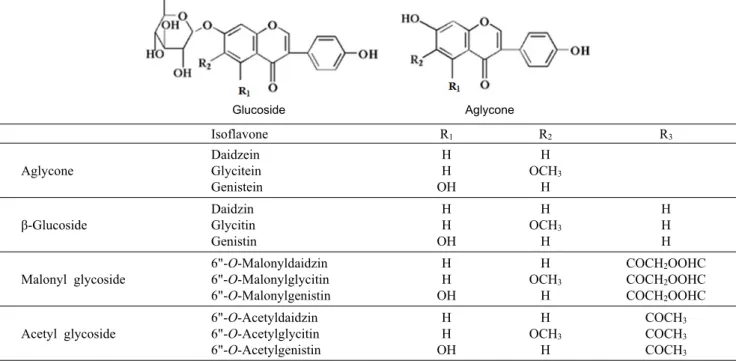
Fig. 2. Chemical structures of isofavones.
0 2 4 6 8 10 12
10 20 30 40 50 60
Fermetnation time (days)
β-Glucosidase activity (units/g) . Control
KACC 15935 HJ 18-9
Fig. 1. Change in β-glucosidase activities during doenjang fer-
mentation by different Bacillus strains.1시간 방치 후 750 nm에서 흡광도를 측정하였다. 표준곡선 으로 환산하였고 표준물질로는 gallic acid(Sigma-Aldrich Co.)를 이용한 표준곡선에 따른 검량선을 작성하여 총페놀 함량을 계산하였다.
1,1-Diphenyl-2-picrylhydrazyl(DPPH) 라디칼 소거 활 성 분석
대표적인 항산화능의 지표로 이용되는 DPPH 라디칼 소 거 활성은 Tagashira와 Ohtake(17)의 방법을 변형하여 DPPH(Sigma-Aldrich Co.)에 대한 전자공여 효과로 각 시 료의 활성을 측정하였다. 0.1 mM DPPH를 함유한 에탄올 용액 2 mL에 100 mg/mL 농도의 시료용액 0.1 mL를 가해 vortex 하여 실온에서 10분간 반응시킨 다음 517 nm에서 흡광도를 측정하여 DPPH의 환원에 의한 흡광도의 감소를 측정하였다.
DPPH radical scavenging
activity (%) =1- A
B ×100 A: absorbance of sample at 517 nm
B: absorbance of control at 517 nm
통계처리
본 실험에서 얻어진 결과는 자료 처리는 SPSS program 12.0(SPSS Inc., Chicago, IL, USA)을 이용하여 시행하였 으며, 각 항목에 대한 평균(mean) 및 표준편차(standard deviation, SD)를 산출하였다. 처리구 간 유의적인 차이는
P
<0.05 수준에서 one-way ANOVA를 시행하였으며, Dun- can's multiple range test로 그 유의성을 검증하였다.결과 및 고찰
β-Glucosidase 활성 측정
발효기간에 따른 균주를 달리하여 제조한 된장의 β- glucosidase 활성 변화를 조사한 결과는 Fig. 1에 나타내었 다. 각 시료의 β-glucosidase 활성은 4.06±0.29~10.12±
0.89 unit/g 범위를 나타내었으며, 모든 처리구에서 발효 50 일에 가장 높은 효소 활성을 보였고 HJ18-9 처리구가 발효 초기부터 발효가 끝나는 시점까지 유의적으로 높은 효소 활 성을 나타내었다. β-Glucosidase는 isoflavone의 β-gly- cosidic bond 형태를 체내 이용률이 높은 비배당체 형태로 전환시켜주는 역할을 한다는 연구 결과가 보고된 바 있다 (18,19). 또한 Yang 등(20)은 고온이나 강산을 이용한 반응 의 경우 반응산물이 무작위적이고 부반응에 의해 효율이 저
Table 1. Change in isoflavone contents during doenjang fermentation by different Bacillus strains (µg/g dry basis)
Isoflavone Strains Fermentation time (days)
10 20 30 40 50 60
Daidzein
Control KACC15935 HJ18-9
13.60±4.24Be1) 20.45±1.34ABc 22.18±1.34Ad
21.40±0.99Ad 20.30±0.85Ac 30.23±8.10Ad
23.05±0.78Acd 26.85±7.00Abc 31.43±1.80Ad
27.45±0.64Bc 31.15±6.72Bb 96.80±0.94Ac
32.30±0.28Cb 34.10±0.14Bb 191.37±0.14Ab
45.55±0.35Ba 52.15±0.78Ba 302.04±4.29Aa
Genistein
Control KACC15935 HJ18-9
26.10±7.92Be 45.15±0.49Ad 38.80±1.65ABe
44.30±0.14Acd 44.80±1.41Ad 45.19±0.04Ade
43.35±0.21Bd 47.75±0.78Ad 50.67±1.58Ad
51.75±0.21Bbc 52.45±2.05Bc 109.66±0.78Ac
57.80±0.14Bab 59.85±1.77Bb 201.35±1.12Ab
65.30±1.13Ba 72.10±0.28Ba 326.68±5.92Aa
Glycitein
Control KACC15935 HJ18-9
4.95±2.33Ac 7.60±0.14Acd 7.56±0.20Ae
7.70±0.42Abc 7.40±0.85Ad 8.54±0.54Ae
8.05±0.35Bb 8.15±0.35Bcd 11.56±0.73Ad
9.50±1.27Bab 8.70±0.28Bbc 38.31±0.43Ac
10.50±0.71Bab 9.85±0.64Bb 65.02±2.28Ab
11.25±0.64Ca 13.55±0.07Ba 75.09±0.88Aa
Daidzin
Control KACC15935 HJ18-9
505.65±7.00Aa 509.40±8.63Aa 476.53±20.44Aa
508.95±5.30Aa 512.60±8.91Aa 477.59±28.80Aa
484.20±8.91Aa 511.10±6.36Aa 457.13±63.01Aa
496.25±10.82Aa 511.40±1.56Aa 413.26±41.04Bab
499.20±18.53Aa 502.30±4.24Aa 353.93±22.95Bb
488.50±9.19Aa 494.90±13.01Aa 210.76±26.16Bc
Genistin
Control KACC15935 HJ18-9
845.10±24.61Bc 912.75±5.30Aa 882.69±6.99ABb
917.50±2.97Aa 907.95±6.15Aab 914.89±4.88Aa
868.55±1.20Bbc 904.45±4.45Aab 907.87±13.29Aa
907.35±7.85Aa 905.40±11.03Aab 837.70±0.08Bc
920.80±1.84Aa 893.30±1.56Bb 742.83±2.55Cd
894.80±5.23Aab 899.40±0.42Aab 529.45±4.79Be
Glycitin
Control KACC15935 HJ18-9
115.05±3.61Aa 117.30±1.98Aa 106.00±11.56Aa
114.55±4.17Aa 113.95±5.16Aab 102.95±15.87Aa
108.00±4.10Aa 113.50±3.68Aab 88.83±31.90Aa
108.85±7.00Aa 113.95±2.62Aab 59.28±19.57Bab
106.90±10.47Aa 110.95±2.90Aab 34.12±9.93Bbc
105.70±5.52Aa 105.60±7.07Ab 9.49±13.42Bc
M-daidzin
Control KACC15935 HJ18-9
1.25±0.35Bab 4.60±1.27Aa 2.77±0.99ABb
2.10±1.56Aab 2.40±0.85Aa 1.69±1.15Ab
3.90±1.27Aa 0.40±0.57Aa 4.32±6.10Ab
0.85±1.20Ab 2.65±0.92Aa 3.64±5.15Ab
0.00±0.00Ab 3.15±4.45Aa 3.41±4.82Ab
0.85±1.20Bb 0.00±0.00Ba 14.90±0.64Aa
M-genistin
Control KACC15935 HJ18-9
0.00±0.00Aa 0.00±0.00Aa 7.99±8.65Aa
0.70±0.99Aa 0.00±0.00Aa 7.51±6.61Aa
0.00±0.00a 0.00±0.00a 0.00±0.00a
0.00±0.00Aa 1.60±2.26Aa 7.84±11.08Aa
0.00±0.00Aa 2.55±3.61Aa 0.00±0.00Aa
0.00±0.00a 0.00±0.00a 0.00±0.00a
M-glycitin
Control KACC15935 HJ18-9
ND2) ND ND
ND ND ND
ND ND ND
ND ND ND
ND ND ND
ND ND ND
A-daidzin
Control KACC15935 HJ18-9
45.65±1.06Ab 51.05±0.49Aa 47.05±10.05Aa
44.85±0.49Ab 47.25±0.07Aa 40.23±9.44Aab
59.90±1.84Aa 54.75±17.04Aa 30.54±0.59Abc
45.45±13.65Ab 42.20±0.42Aa 26.10±0.67Abc
35.30±0.00ABb 48.85±12.37Aa 22.98±0.28Bc
32.05±0.21Ab 35.25±4.31Aa 19.08±0.35Bc
A-genistin
Control KACC15935 HJ18-9
78.40±8.91Bb 102.15±0.92Aa 90.37±0.33ABa
93.45±0.21Aa 97.70±0.42Ab 86.80±2.55Ba
81.75±0.07Bb 92.70±2.12Ac 76.92±0.91Cb
79.75±0.64Bb 89.35±2.33Ac 74.23±0.83Cbc
77.95±0.49ABb 83.75±1.34Ad 71.79±3.44Bc
74.40±0.71Bb 83.50±0.28Ad 61.03±0.03Cd
A-glycitin
Control KACC15935 HJ18-9
13.95±0.07ABa 16.00±0.71Aa 13.55±0.97Ba
15.30±0.42Aa 15.50±1.13Aa 13.66±1.83Aa
14.60±0.57Aa 14.65±1.06Aa 12.50±1.59Aab
14.50±1.27Aa 12.90±4.38Aa 12.10±0.52Aab
14.65±0.21Aa 14.20±0.99ABa 12.36±0.66Bab
14.20±0.28Aa 13.70±1.27Aa 10.60±0.10Bb
1)Results are expressed as the means of three replications. Means with different lower case (row) and upper case (column) superscript letters are significantly different at P<0.05.
2)ND: not detected.
하될 수 있는 반면, 천연물 유래의 β-glucosidase 효소를 활용하는 경우 반응산물의 선택성을 증가시킬 수 있으며 유 해한 유기용매의 사용을 감소시킬 수 있다고 하였다. 따라서 본 연구 결과 β-glucosidase가 높게 나타난 HJ18-9 접종 구에서 체내 이용률이 높은 기능성 장류를 제조할 수 있을 것으로 기대된다.
Isoflavone 함량 변화
콩에 함유된 이소플라본은 genistein, daidzein, glyci- tein 3종류의 비배당체(aglycone)와 각각의 배당체인 daid- zin, genistin, glycitin 그리고 malonyl화 배당체, acetyl화
배당체의 12종류의 존재가 확인되었다(Fig. 2). 28°C에서 60일 동안 발효시킨 된장 12종의 isoflavone 함량은 Table 1에, 그리고 그 각각의 함량을 네 가지 형태로 나타낸 것을 Fig. 3에 나타내었다. 발효 종료시점인 60일에 대조구, KACC15935, HJ18-9 처리구의 isoflavone 비배당체 함량 은 각각 122.10±0.11, 137.78±1.12 및 703.80±11.09 μg/
g으로 나타났다. 이는 발효 10일 차 된장의 비배당체 함량이 44.66±14.43, 73.26±2.02 및 68.52±3.18 μg/g인 것에 비하여 각각 2.74, 1.88 및 10.27배 높은 전환율을 보인다.
또한 본 연구의 선행연구에서 HJ18-9 균주를 접종하여 청 국장을 제조하였을 때 isoflavone 비배당체 함량이 187.00
Control
0 400 800 1200 1600 2000
10 20 30 40 50 60
Fermetnation time (days)
Isoflavone contents (μg/g) .
β-Glucoside Malonyl glucoside Acetyl glucoside Aglycone Total
KACC 15395
0 400 800 1200 1600 2000
10 20 30 40 50 60
Fermetnation time (days)
Isoflavone contents (μg/g) .
β-Glucoside Malonyl glucoside Acetyl glucoside Aglycone Total
HJ 18-9
0 400 800 1200 1600 2000
10 20 30 40 50 60
Fermetnation time (days)
Isoflavone contents (μg/g) .
β-Glucoside Malonyl glucoside Acetyl glucoside Aglycone Total
Fig. 3. Change in isoflavone contents during doenjang fermenta-
tion by different Bacillus strains.μg/g으로 나타나 본 연구에서는 이보다 3.34배 높은 결과를 나타냈다(21). 이는 청국장에 비해 발효기간이 길어지면서 다양한 미생물의 활성이 높아진 것으로 사료된다. 일반적으 로 앞에서 언급한 바와 같이 대두의 isoflavone은 glyco- sided conjugate(malonyl glycoside, β-glycosides 및 acetyl glycosides 형태)의 isoflavone isomer와 비배당체 형태로 존재하는데 대두의 수침이나 가열 등의 가공처리를 하면 용출된 β-glycosidase의 작용에 의해 비배당체로 전 환되는 것으로 알려졌다(22). 뿐만 아니라 발효과정 중에 관여하는 미생물이 가지고 있는 β-glucosidase에 의해 배 당체가 가수분해 되는 것으로 생각한다. 따라서 본 연구에서 는 발효에 사용되는
B. subtilis
를 접종하는 데 있어 β-glu- cosidase 활성과 cellulase 등의 효소 활성이 있는 균주 HJ18-9를 접종하여 된장을 제조함으로써 isoflavone 비배 당체 함량을 유의적으로 증가시키는 결과를 얻었으며, 이는 항산화 항암 등의 기능성을 갖는 장류를 제조하는 데 기초자 료가 될 것으로 생각한다.Phenolic acid 및 flavanol 함량 변화
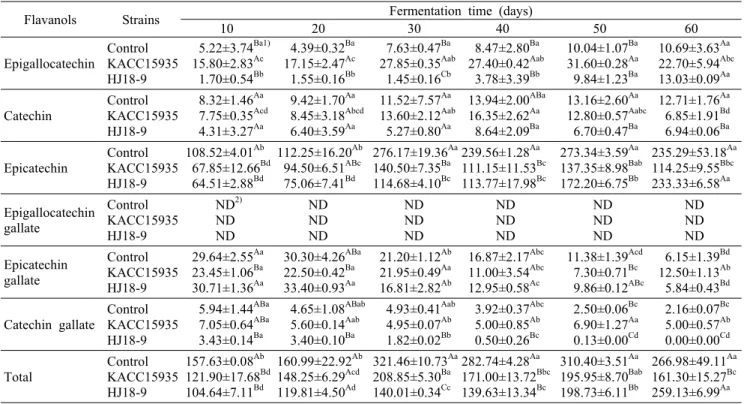
28°C에서 60일 동안 발효시킨 된장의 phenolic acid 및 flavanol 함량은 Table 2 및 3에 나타내었다. 식물에 존재하 는 phenolic acid는 항산화 활성과 자유 라디칼 소거능을 가지고 있어 인간의 건강에 잠재적으로 많은 이점을 가지고 있으므로 많은 관심을 얻고 있다(23). 그중에서도 gallic acid, protocatechuic acid,
p
-coumaric acid 및 ferulic acid는 콩에 존재하는 주요 phenolic acid이며 이는 강한항산화 활성을 나타낸다. 본 연구의 총 phenolic acid 함량 은 Control과 HJ18-9 처리구는 40일, KACC 15935 처리 구는 발효 30일에 가장 높은 함량을 나타냈으며 그 이후로 는 감소하는 경향을 나타냈고, 7가지 phenolic acid 중 pro- tocatechuic acid와 hydroxybenzoic acid에서 가장 높은 비율을 나타내었다(Table 2).
대조구, KACC15935, HJ18-9 처리구의 flavanol 함량 은 발효시간의 경과에 따라 gallate 형태는 감소하였으며 epigallocatechin, catechin, epicatechin은 증가하는 경향 을 나타내었다. 몇몇 연구에 따르면 esterase나 tannase 활 성에 flavanol gallate가 flavanols로 전환된다고 하였다 (24). Cho 등(25)에 따르면 청국장 발효기간이 증가하면서 esterase 활성이 증가함에 따라 flavanols gallate 함량이 감소한 반면, flavanols 중 catechin의 함량이 7.86~59.6 μg/g, epicatechin 함량이 12.3~54.8 μg/g으로 나타나 cat- echin 함량은 본 연구 결과보다 더 높게, epicatechin 함량 은 더 낮게 나타났다. 이와 같은 차이는 접종된 각각의 미생 물의 특성과 온도, 기간 등의 발효조건에 따른 미생물의 효 소 활성에 의한 차이에 기인한 것으로 생각한다.
총페놀 함량 변화
발효기간에 따른 균주를 달리하여 제조한 된장의 총페놀 함량을 조사한 결과는 Table 4에 나타내었다. 대조구와 KACC 15935에서는 50일차에 가장 높은 함량을, HJ18-9 는 발효 종료 시점인 60일차에 378.14 mg/100 g으로 유의 적으로 높은 페놀 함량을 나타내었다. 콩 등의 식물체에 포
Table 2. Change in total phenolic acid contents during doenjang fermentation by different Bacillus strains (µg/g dry basis)
Phenolic acid Strains Fermentation time (days)10 20 30 40 50 60 Gallic acid Control
KACC15935 HJ18-9
1.00±0.16Ab1) 0.45±0.04Bc 0.49±0.03Bd
1.79±0.33Aab 1.08±0.03Bb 0.62±0.01Bcd
2.34±0.43Aa 1.64±0.04ABa 1.14±0.12Bb
2.25±0.41Aa 1.01±0.01Bb 1.80±0.08Aa
1.67±0.35Aab 1.14±0.19ABb 0.68±0.07Bc
1.61±0.47Aab 1.12±0.34Ab 0.64±0.03Acd Hydroxybenzoic
acid
Control KACC15935 HJ18-9
7.49±0.40Bcd 10.29±0.07Aa 0.99±0.03Cc
6.64±0.08Bd 8.84±0.14Aa 3.55±0.49Cb
10.21±0.13Ab 10.58±0.87Aa 6.73±0.95Ba
13.25±0.23Aa 8.88±1.17Ba 4.49±0.10Cb
9.38±2.42Abc 4.25±0.75Bb 3.23±1.10Bb
8.12±0.42Abcd 4.66±1.10Bb 4.53±0.26Bb Protocatechuic
acid
Control KACC15935 HJ18-9
2.34±0.54Bb 3.57±0.19Aa 1.13±0.15Cbc
2.41±0.35Ab 2.70±0.33Aab 1.06±0.24Bbc
3.66±0.13Aab 2.47±0.49Bb 0.86±0.28Cc
4.16±1.20Aab 2.35±0.13Ab 2.77±0.47Aa
4.77±0.93Aa 2.79±0.58ABab 2.37±0.06Ba
3.62±0.82Aab 2.87±0.43ABab 1.55±0.13Bb
Vanillic acid
Control KACC15935 HJ18-9
0.28±0.01Ab 0.78±0.06Aab 0.43±0.38Ac
0.51±0.04ABb 0.73±0.16Aab 0.31±0.11Bc
1.00±0.15Aa 1.31±0.53Aa 0.40±0.16Ac
0.92±0.16Ba 0.62±0.11Bb 3.25±0.11Aa
1.17±0.12ABa 0.91±0.04Bab 1.28±0.06Ab
0.99±0.27ABa 0.58±0.13Bb 1.68±0.23Ab
p-Coumaric acid
Control KACC15935 HJ18-9
0.66±0.06Abc 0.70±0.14Aab 0.46±0.02Ac
0.49±0.00Bd 0.75±0.11Aab 0.20±0.07Ce
0.91±0.04Aa 0.78±0.11ABa 0.57±0.01Bb
0.71±0.07Ab 0.64±0.01Aab 0.43±0.06Bcd
0.74±0.06Ab 0.68±0.10Aab 0.71±0.03Aa
0.57±0.04Acd 0.45±0.18Ab 0.35±0.02Ad Caffeic acid Control
KACC15935 HJ18-9
0.66±0.16Aab 0.31±0.00Bb 0.08±0.01Bde
0.62±0.12Aab 0.54±0.06Aa 0.04±0.01Be
0.31±0.10Ab 0.38±0.16Aab 0.11±0.01Acd
0.80±0.06Aa 0.55±0.07Ba 0.15±0.04Cbc
0.72±0.12Aab 0.51±0.02Aab 0.18±0.03Bb
1.00±0.33Aa 0.50±0.06ABab 0.27±0.03Ba
Ferulic acid
Control KACC15935 HJ18-9
2.62±0.18Ba 3.82±0.00Aa 2.20±0.01Cc
1.95±0.24Bb 2.91±0.27Aab 2.40±0.16ABc
1.14±0.00Bc 2.69±0.04Aab 2.54±0.15Ac
1.78±0.29Bb 3.65±1.26ABa 4.40±0.14Aa
0.87±0.25Cc 2.05±0.21Bb 3.15±0.04Ab
0.33±0.04Cd 2.21±0.23Ab 1.54±0.24Bd
Total Control KACC15935 HJ18-9
15.02±0.07Bc 19.91±0.21Aa 5.76±0.30Cd
14.41±0.43Bc 17.53±0.49Ab 8.16±0.27Cc
19.57±0.45Ab 19.83±0.02Aa 12.34±0.78Bb
23.87±0.57Aa 19.69±0.64Ba 22.05±1.88ABa
19.30±1.52Ab 12.33±0.01Bc 11.59±1.18Bb
16.25±1.45Ac 12.38±1.48Bc 10.54±0.16Bbc
1)Results are expressed as the means of three replications. Means with different lower case (row) and upper case (column) superscript letters are significantly different at P<0.05.
Table 3. Change in flavanol contents during doenjang fermentation by different Bacillus strains (µg/g dry basis)
Flavanols Strains Fermentation time (days)
10 20 30 40 50 60 Epigallocatechin Control
KACC15935 HJ18-9
5.22±3.74Ba1) 15.80±2.83Ac 1.70±0.54Bb
4.39±0.32Ba 17.15±2.47Ac 1.55±0.16Bb
7.63±0.47Ba 27.85±0.35Aab 1.45±0.16Cb
8.47±2.80Ba 27.40±0.42Aab 3.78±3.39Bb
10.04±1.07Ba 31.60±0.28Aa 9.84±1.23Ba
10.69±3.63Aa 22.70±5.94Abc 13.03±0.09Aa Catechin Control
KACC15935 HJ18-9
8.32±1.46Aa 7.75±0.35Acd 4.31±3.27Aa
9.42±1.70Aa 8.45±3.18Abcd 6.40±3.59Aa
11.52±7.57Aa 13.60±2.12Aab 5.27±0.80Aa
13.94±2.00ABa 16.35±2.62Aa 8.64±2.09Ba
13.16±2.60Aa 12.80±0.57Aabc 6.70±0.47Ba
12.71±1.76Aa 6.85±1.91Bd 6.94±0.06Ba Epicatechin Control
KACC15935 HJ18-9
108.52±4.01Ab 67.85±12.66Bd 64.51±2.88Bd
112.25±16.20Ab 94.50±6.51ABc 75.06±7.41Bd
276.17±19.36Aa 140.50±7.35Ba 114.68±4.10Bc
239.56±1.28Aa 111.15±11.53Bc 113.77±17.98Bc
273.34±3.59Aa 137.35±8.98Bab 172.20±6.75Bb
235.29±53.18Aa 114.25±9.55Bbc 233.33±6.58Aa Epigallocatechin
gallate
Control KACC15935 HJ18-9
ND2) ND ND
ND ND ND
ND ND ND
ND ND ND
ND ND ND
ND ND ND Epicatechin
gallate
Control KACC15935 HJ18-9
29.64±2.55Aa 23.45±1.06Ba 30.71±1.36Aa
30.30±4.26ABa 22.50±0.42Ba 33.40±0.93Aa
21.20±1.12Ab 21.95±0.49Aa 16.81±2.82Ab
16.87±2.17Abc 11.00±3.54Abc 12.95±0.58Ac
11.38±1.39Acd 7.30±0.71Bc 9.86±0.12ABc
6.15±1.39Bd 12.50±1.13Ab 5.84±0.43Bd
Catechin gallate
Control KACC15935 HJ18-9
5.94±1.44ABa 7.05±0.64ABa 3.43±0.14Ba
4.65±1.08ABab 5.60±0.14Aab 3.40±0.10Ba
4.93±0.41Aab 4.95±0.07Ab 1.82±0.02Bb
3.92±0.37Abc 5.00±0.85Ab 0.50±0.26Bc
2.50±0.06Bc 6.90±1.27Aa 0.13±0.00Cd
2.16±0.07Bc 5.00±0.57Ab 0.00±0.00Cd
Total
Control KACC15935 HJ18-9
157.63±0.08Ab 121.90±17.68Bd 104.64±7.11Bd
160.99±22.92Ab 148.25±6.29Acd 119.81±4.50Ad
321.46±10.73Aa 208.85±5.30Ba 140.01±0.34Cc
282.74±4.28Aa 171.00±13.72Bbc 139.63±13.34Bc
310.40±3.51Aa 195.95±8.70Bab 198.73±6.11Bb
266.98±49.11Aa 161.30±15.27Bc 259.13±6.99Aa
1)Results are expressed as the means of three replications. Means with different lower case (row) and upper case (column) superscript letters are significantly different at P<0.05.
2)ND: not detected.
Table 4. Change in total phenolic contents and effect of radical scavenging activity during the doenjang fermentation by different Bacillus strains
Strains Fermentation time (days)
10 20 30 40 50 60 DPPH radical
scavenging activity (%)
Control KACC15935 HJ18-9
18.38±1.01Ac1) 18.16±0.40Ad 16.03±0.05Bd
21.92±2.01Abc 18.72±1.66ABd 15.76±1.55Bd
24.97±1.39ABab 28.59±1.93Ab 22.62±1.70Bc
26.86±1.50Ba 32.69±1.13Aa 28.91±2.36ABb
26.52±1.82Ba 24.35±0.93Bc 33.74±1.61Aa
26.19±1.68Aa 20.29±1.63Bd 29.08±0.90Ab Total phenolic
contents (mg/100 g)
Control KACC15935 HJ18-9
279.18±20.65Ac 214.47±4.86Bc 225.99±5.34Be
286.76±15.71Ac 223.47±8.23Cb 250.46±4.40Bd
354.15±20.23Ab 244.93±4.52Ca 301.59±13.58Bc
421.23±22.73Aa 247.14±3.68Ca 288.97±6.26Bc
427.07±18.01Aa 249.35±0.99Ca 362.36±0.95Bb
274.76±16.01Bc 248.41±4.74Ca 378.14±13.96Aa
1)Results are expressed as the means of three replications. Means with different lower case (row) and upper case (column) superscript letters are significantly different at P<0.05.
함된 페놀성 화합물은 대사산물의 하나로 특히 phenolic hydroxyl 기가 항산화 생리활성을 가진다고 알려졌다(26).
Min(27)의 보고에 따르면 된장의 총폴리페놀 함량은 전통 된장에서 269.6 mg%, 황기를 첨가한 된장에서 332.4 mg%
로 측정되었다고 보고하였는데, 본 연구에서 HJ18-9를 접 종한 된장에서 더 높은 함량을 나타내었다. 또한 Park 등 (28)의 보고에 따르면 폴리페놀화합물을 많이 함유한 연근 분말을 15% 첨가하여 발효하였을 때 총페놀 함량이 대조구 보다 1.25배 높은 함량을 나타내었다고 하였다. 따라서 본 연구에서 사용된 균주 HJ18-9와 같이 기능성이 확인된 균 주와 황기나 연근과 같은 폴리페놀을 함유한 첨가물을 넣어 된장을 제조함으로써 항산화 기능성이 높은 발효식품을 제 조할 수 있을 것으로 생각한다.
DPPH 라디칼 소거 활성의 변화
발효기간에 따른 균주를 달리하여 제조한 된장의 DPPH 라디칼 소거 활성은 Table 4에 나타내었다. 각 처리구의 DPPH 소거 활성이 대조구는 18.38~26.86%, KACC15935 는 18.16~32.69%, HJ18-9는 16.03~33.74% 범위를 나타 내었으며, 대조구와 KACC15935에서는 40일차에, HJ18- 9는 50일차에 가장 높은 활성을 나타내었다가 감소하는 경 향을 나타내었다. Ku 등(29)의 보고에 따르면 총 DPPH 라 디칼 소거 활성은 숙성 1년과 2년 된장이 평균 10.0%, 숙성 3년이 26.8%로 20배 이상 증가하는 결과를 보였으며, 그 후 지속적으로 증가하는 경향을 나타냈다고 하여 본 연구 결과와 차이가 있었다.
항산화 활성 증가는 총페놀 함량과 상관관계가 있다는 결 과가 수차례 발표된 바 있으나, 실험방법이나 외부 환경에 따라 DPPH 라디칼 소거능과 페놀 함량의 상관성이 없다는 일부 연구 결과도 발표된 바 있다(30). 본 연구에서는 된장 제조, 발효과정 및 균주 활성 등의 다양한 원인으로 인해 DPPH 라디칼 소거능과 페놀 함량의 상관관계가 관찰되지 않은 것이라 사료된다.
요 약
본 연구는 된장 제조 시 자연 발효시킨 대조구와
Bacillus
subtilis
KACC15935,B. subtilis
HJ18-9 균주를 starter 로 접종하여 발효시킨 된장의 품질 특성과 isoflavone의 함 량과 항산화 활성을 측정하였다. β-Glucosidase 활성은 발 효 50일에 가장 높은 효소 활성을 보였으며, HJ18-9 처리구 가 발효 35일부터 발효가 끝나는 시점까지 유의적으로 높은 효소 활성을 나타내었다. 발효종료시점인 60일에 된장의 체 내 이용률이 높은 isoflavone 비배당체 함량은 대조구, KACC15935, HJ18-9 처리구가 각각 122.10±0.11, 137.78±1.12 및 703.80±11.09 μg/g으로 나타났다. 이는 발효 10 일차 된장의 비배당체 함량에 비하여 각각 2.74, 1.88 및 10.27배 높은 전환율을 보였다. 또한 발효 60일 차에 HJ18 -9 처리구가 DPPH 라디칼 소거 활성은 29.08%, 총페놀 함량은 378.14 mg/100 g으로 다른 처리구보다 유의적으로 높은 함량을 나타내었다. 이러한 결과로 본 연구를 통해 β -glucosidase 활성이 있는 HJ18-9 균주를 starter로 접종 하여 체내흡수율이 높은 isoflavone 비배당체 함량이 높으 며 총페놀 함량과 DPPH 라디칼 소거능이 우수한 기능성 된장을 제조함으로써, 기능성 장류 가공품 개발의 기초연구 가 되고자 하였다.
감사의 글
본 논문은 농촌진흥청 AGENDA 연구사업(ATIS 과제번호:
PJ01175403)의 지원에 의해 이루어진 것임.
REFERENCES
1. Kim BS, Rhee CH, Hong YA, Woo CJ, Jang CM, Kim YB, Park HD. 2007. Changes of enzyme activity and physio- logical functionality of traditional Doenjang during fermen- tation using Bacillus sp. SP-KSW3. Korean J Food Preserv 14: 545-551.
2. Kim DH, Kim SH. 1999. Biochemical characteristics of whole soybean cereals fermented with Mucor and Rhizopus strains.
Korean J Food Sci Technol 31: 176-182.
3. Lee GG, Lee HD, Lee CH. 2003. Changes in sensory charac- teristics during salt aging of Doenjang (fermented soybean paste) made by different starters. Food Eng Prog 7: 13-19.
4. Rho JD, Choi SY, Lee SJ. 2008. Quality characteristics of soybean pastes (doenjang) prepared using different types of
microorganisms and mixing ratios. Korean J Food Cook Sci 24: 243-250.
5. Park JW, Lee YJ, Yoon S. 2007. Total flavonoids and phe- nolics in fermented soy products and their effects on anti- oxidant activities determined by different assays. Korean J
Food Cult 22: 353-358.
6. Kim DH, Lim DW, Bai S, Chun SB. 1997. Fermentation characteristics of whole soybean meju model system in- oculated with 4 Bacillus strains. Korean J Food Sci Technol 29: 1006-1015.
7. Brouns F. 2002. Soya isoflavones: a new and promising in- gredient for the health foods sector. Food Res Int 35: 187- 193.
8. Yeo KE, Kim WJ. 2002. Effects of acid hydrolysis on iso- flavone of defatted soybean flour. Korean J Food Sci Tech-
nol 34: 916-918.
9. Choi YB, Woo JG, Noh WS. 1999. Hydrolysis of β-glycosi- dic bonds of isoflavone conjugates in the lactic acid fermen- tation of soy milk. Korean J Food Sci Technol 31: 189-195.
10. Shon MY, Seo KI, Park SK, Cho YS, Sung NJ. 2001. Some biological activities and isoflavone content of chungkugjang prepared with black beans and Bacillus strains. J Korean
Soc Food Sci Nutr 30: 662-667.
11. Lee DH, Kim JH, Yoon BH, Lee GS, Choi SY, Lee JS. 2003.
Changes of physiological functionalities during the fermen- tation of medicinal herbs doenjang. Korean J Food Preserv 10: 213-218.
12. Lee SY, Kim JY, Baek SY, Yeo SH, Koo BS, Park HY, Choi HS. 2011. Isolation and characterization of oligotro- phic strains with high enzyme activity from buckwheat sok-
seongjang. Korean J Food Sci Technol 43: 735-741.
13. Choi YB, Kim KS, Rhee JS. 2002. Hydrolysis of soybean isoflavone glucosides by lactic acid bacteria. Biotechnol Lett 24: 2113-2116.
14. Wang G, Kuan SS, Francis OJ, Ware GM, Carman AS. 1990.
A simplified HPLC method for the determination of phy- toestrogens in soybean and its processed products. J Agric
Food Chem 38: 185-190.
15. Cho KM, Lee JH, Yun HD, Ahn BY, Kim H, Seo WT. 2011.
Changes of phytochemical constituents (isoflavones, flava- nols, and phenolic acids) during cheonggukjang soybeans fermentation using potential probiotics Bacillus subtilis CS90. J Food Compos Anal 24: 402-410.
16. Singleton VL, Orthofer R, Lamuela-Raventós RM. 1999.
Analysis of total phenols and other oxidation substrates and antioxidants by means of folin-ciocalteu reagent. Methods
Enzymol 299: 152-178.
17. Tagashira M, Ohtake Y. 1998. A new antioxidative 1,3-ben- zodioxole from Melissa officinalis. Planta Med 64: 555-558.
18. Champagne CP, Tompkins TA, Buckley ND, Green-Johnson JM. 2010. Effect of fermentation by pure and mixed cultures
of Streptococcus thermophilus and Lactobacillus helveticus on isoflavone and B-vitamin content of a fermented soy beverage. Food Microbiol 27: 968-972.
19. Marazza JA, Nazareno MA, de Giori GS, Garro MS. 2012.
Enhancement of the antioxidant capacity of soymilk by fer- mentation with Lactobacillus rhamnosus. J Funct Foods 4:
594-601.
20. Yang S, Wang L, Yan Q, Jiang Z, Li L. 2009. Hydrolysis of soybean isoflavone glycosides by a thermostable β-gluco- sidase from Paecilomyces thermophila. Food Chem 115:
1247-1252.
21. Lee KH, Choi HS, Hwang KA, Song J. 2015. Changes in isoflavone content and quality characteristics of Cheongguk-
jang prepared by some different strains. Korean J Int Agric
27: 481-488.22. Lee KH, Choi HS, Choi YH, Park SY, Song J. 2014. Changes in isoflavone content and quality characteristics of Cheong-
gukjang prepared with Bacillus subtilis HJ18-3 and KACC
15935. Korean J Food Preserv 21: 121-128.23. Choi JS, Kim HY, Seo WT, Lee JH, Cho KM. 2012. Roasting enhances antioxidant effect of bitter melon (Momordica
charantia L.) increasing in flavan-3-ol and phenolic acid
contents. Food Sci Biotechnol 21: 19-26.24. Du Q, Li M, Cheng Q, Zhang TY, Ito Y. 1994. Purification of (-)-epigallocatechin from enzymatic hydrolysate of its gallate using high-speed counter-current chromatography. J
Chromatogr A 687: 174-177.
25. Cho KM, Hong SY, Math RK, Lee JH, Kambiranda DM, Kim JM, Asraful Islam SM, Yun MG, Cho JJ, Lim WJ, Yun HD. 2009. Biotransformation of phenolics (isoflavones, fla- vanols and phenolic acids) during the fermentation of cheong-
gukjang by Bacillus pumilus HY1. Food Chem 114: 413-
419.26. Gramza A, Khokhar S, Yoko S, Gliszczynska-Swiglo A, Hes M, Korczak J. 2006. Antioxidant activity of tea extracts in lipids and correlation with polyphenol content. Eur J Lipid
Sci Technol 108: 351-362.
27. Min SH. 2006. Quality characteristics of doenjang contain- ing Astragalus membranaceus water extracts. Korean J Food
Cookery Sci 22: 514-520.
28. Park IB, Park JW, Kim JM, Jung ST, Kang SG. 2005. Quality of soybean paste (Doenjang) prepared with lotus root pow- der. J Korean Soc Food Sci Nutr 34: 519-523.
29. Ku KH, Park K, Kim HJ, Kim Y, Koo M. 2014. Quality characteristics of Doenjang by aging period. J Korean Soc
Food Sci Nutr 43: 720-728.
30. de Oliveira AMF, Pinheiro LS, Pereira CKS, Matias WN, Gomes RA, Chaves OS, de Souza MFV, de Almeida RN, de Assis TS. 2012. Total phenolic content and antioxidant activity of some Malvaceae family species. Antioxidants 1:
33-43.