38
유산균의 분류 및 보존관리
이정숙*
한국생명공학연구원 생명자원센터
Management for Lactic Acid Bacteria
Jung-Sook Lee*
Korean Collection for Type Cultures (KCTC), Biological Resource Center (BRC), Korea Research Institute of Bioscience and Biotechnology, Daejeon 305-806, Korea
Abstract: The lactic acid bacteria are Gram-positive, non spore-forming, catalase-negative, of nonaerobic habit but aero- tolerant, fastioius, acid-tolerant, nonrespiring cocci or rods, which produce lactic acid as a major sole end product of the fermentation of sugar. They consist of more than 20 genera including Aerococcus, Alloiococcus, Carnobacterium, Dolosi- granulum, Enterococcus, Globicatella, Lactobacillus, Lactococcus, Lactosphaera, Leuconostoc, Oenococcus, Pediococ- cus, Streptococcus, Tetragenococcus, Vagococcus, Weissella, and etc. It is difficult to differentiate lactic acid bacteria based on physiological and biochemical characteristics because they grow on the same selection medium, MRS medium and have similar characteristics in traditional taxonomic test. Today, we have the means to examine macromolecules of the cell such as nucleic acids, believed to be more accurate in defining relationships and phylogenetic positions. Fortunately, nature has provided us with different kinds of nucleic acids for different types of taxonomic studies. Close relations (at species and subspecies level) can be determined with DNA-DNA homology studies. Based on analysis of 16S rRNA sequence for lactic acid bacteria, new genera have been reported and some species have transferred to other genera. With this technique, a clearer picture of the phylogeny of lactic acid bacteria is emerging. It is difficult to do long-term preservation of lactic acid bacteria because of their weak viability. We usually use the methods of lyophilization and cryopreservation with skim milk for long-term preservation of lactic acid bacteria.
Keywords: lactic acid bacteria, taxonomy, management
유산균이란?
유산균은 포자를 형성하지 않으며, 카탈라아제 음성이고, 산에 대해 내성을 가지며, 당 발효의 산물로 유산을 만드 는 그람양성 간균이나 구균인 통성혐기성 세균으로 젖산균 이라고 한다. 현재까지 Carnobacterium, Dolosigranulum, Enterococcus, Globicatella, Lactobacillus, Lactococcus, Lac- tosphaera, Leuconostoc, Oenococcus, Pediococcus, Strepto- coccus, Tetragenococcus, Vagococcus, Weissella 등 20여개 의 속(genus)이 유산균에 속하는 것으로 알려져 있다. 유산 균은 1873년 J. Lister에 의해 처음으로 순수 배양되었고,
유산균의 형태, 당 발효 특성, 최적 배양온도, 당 이용성 등 유산균의 특징에 대해서는 Orla-Jenson(1919)에 의해 최초 보고되었다. 유산균은 형태에 따라 Lactobacillus와 Carno- bacterium 속 등과 같은 간균과 그 외 속이 속하는 구균으 로 나누어진다. 그러나 간균과 구균이 혼재되어 있는 Weis- sella 속도 보고되고 있다(Collins et al., 1993). 유산균 분 류의 주요 특징 중 하나는 포도당의 발효 모드인데, 동형 발효(homo-fermentation)와 이형발효(hetero-fermenation)로 크게 구분될 수 있다. 동형발효는 포도당이 유산으로 완전 히 발효되는 것이고, 이형발효는 포도당이 유산, 에탄올, 아 세트산, 이산화탄소 등으로 발효되는 것인데, Leuconostoc, Oenococcus, Weissella 속 및 일부 Lactobacillus 속 유산균 은 이형발효를 하며, 나머지 유산균은 동형발효를 한다. 당 발효를 기준으로 한 분류는 그 한계성에 대한 논란이 있지 만 여전히 유산균 분류에서는 주요한 특성 중 하나로 이용 되고 있다. 1986년에 출간된 Bergey’s Manual에 따르면 대 표적인 유산균에는 Aerococcus, Lactobacillus, Leuconostoc, Pediococcus, Streptococcus 속 등이 포함되어 있다. Bifido-
*Corresponding author: Jung-Sook Lee, Korean Collection for Type Cultures, Biological Resource Center, Korea Research Institute of Bioscience and Biotechnology, Daejeon 305-806, Korea.
Tel: 82-42-860-4618, Fax: 82-42-860-4625 E-mail: [email protected]
Received October 9, 2012; Revised November 30, 2012;
Accepted December 5, 2012
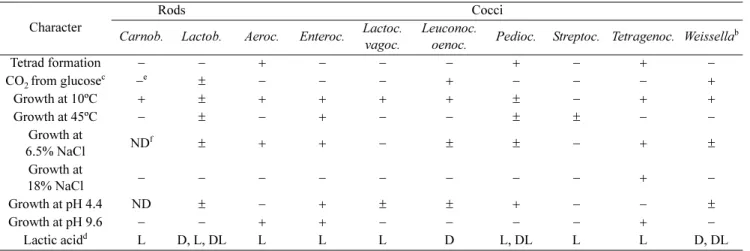
bacterium 속은 역사적으로 유산균으로 간주되어 왔지만, 앞서 언급된 대표적인 유산균과는 달리 방선균그룹에 속한 다. 분자분류학의 발전으로 Streptococcus 속은 Enterococcus, Lactococcus, Streptococcus 등 3개의 속으로 나누어졌다 (Schleifer, 1987; Schleifer and Kilpper-Balz, 1984; Schleifer et al., 1985). 운동성을 가진 유산균으로는 1989년에 Vago- coccus 속이 보고되었다(Collins et al., 1989). 유산균 분류 초기부터 현재까지 남아 있는 속은 Lactobacillus, Leuco- nostoc, Pediococcus 속을 들 수 있다. 그러나 일부 Lacto- bacillus 속은 Carnobacterium(Collins et al., 1987)으로 재 분류되었고, Pediococcus halophilus는 Tetragenococcus(Co- llins et al., 1990) 속으로 균주명이 변경되었다. 와인에서 분 리된 Leuconostoc oenos는 Oenococcus(Dicks et al., 1995) 속으로 재분류되었다. 그 외 Alloiococcus, Dolosigranulum, Globicatella, Lactosphaera 속 등 새로운 유산균 속도 분 자분류를 포함한 다상분류를 기준으로 계속적으로 보고되 고 있다(Aguirre et al., 1993; Collins et al., 1992; Janssen et al., 1995). 대표적인 유산균 속의 특징을 Table 1에 나 타내었다.
유산균의 양면
유산균은 오랫동안 발효식품과 밀접한 관련을 가져왔고, 오늘날에는 식품산업에서 매우 중요한 역할을 담당하는 균 주이다. 요구르트, 사우어크림, 치즈, 버터 등과 같은 유제 품 발효의 주 균주로서 스타터로 사용될 뿐만 아니라, 소 시지, 피클 등과 같은 다양한 발효 식품의 제조에서도 중 요한 역할을 담당하고 있다. 또한 우리 고유의 전통식품 인 김치발효에서도 주 균주로서 발효 전 과정에서 유산균
의 분포가 그 풍미에 영향을 미치고 있다. 이처럼 발효식 품에서는 유산균발효를 통해 식품에 풍미를 주며, 저장성 을 높여주는 유익한 균주로서 잘 알려져 있다.
그러나 유산균은 식품변성을 일으키는 원인균으로서 유 해한 균주의 역할도 하는 양면성을 지니고 있다. 우유의 산 패, 육류의 변성 등에서 나타나는 신맛과 시큼한 풍미 등 은 유산균과 깊은 관련이 있으며 식품을 변질시키는 주요 요인이 되고 있다.
유산균 분류의 어려움
오늘날 세균의 분류는 전통적인 분류기법인 형태 및 생 리생화학적 특징과 더불어 화학분류학적 분석 및 분자분 류학적 분석 등이 포함되는 다상분류를 통해 이루어지고 있다. 특히 16S rRNA gene sequence 분석을 기준으로 하 는 분자계통분류(molecular taxonomy)는 신속한 동정의 출 발점이 되고 있다(Johnson, 1984; Lane et al., 1985). 16S rRNA gene은 모든 세균에 존재하고, variable region과 conserved region이 분산 존재하고 있어 universal primer를 이용한 분석이 가능하며, 특히 많은 세균의 염기서열이 결 정되어 NCBI, EMBL, DDBJ 등과 같은 데이터베이스에 등록되어 있어서 동정하고자 하는 균주와 쉽고 빠르게 비 교할 수 있는 장점을 가지고 있다. 이런 분자계통분류를 기 반으로 앞에서 살펴본 것처럼 많은 균주의 분류가 연구되 어 왔고, 이를 통하여 많은 새로운 종(species)과 속(genus) 이 보고되고 있으며, 또한 속 간의 재분류가 빈번히 이루 어지고 있다. 분자계통분류는 배양조건 등과 같은 환경적 요인에 영향을 받지 않아 많은 세균분류 연구의 기준이 되 고 있다.
Table 1. Differential characteristics of lactic acid bacteriaa
Character
Rods Cocci
Carnob. Lactob. Aeroc. Enteroc. Lactoc.
vagoc.
Leuconoc.
oenoc. Pedioc. Streptoc. Tetragenoc. Weissellab
Tetrad formation − − + − − − + − + −
CO2 from glucosec −e ± − − − + − − − +
Growth at 10ºC + ± + + + + ± − + +
Growth at 45ºC − ± − + − − ± ± − −
Growth at
6.5% NaCl NDf ± + + − ± ± − + ±
Growth at
18% NaCl − − − − − − − − + −
Growth at pH 4.4 ND ± − + ± ± + − − ±
Growth at pH 9.6 − − + + − − − − + −
Lactic acidd L D, L, DL L L L D L, DL L L D, DL
a+, positive; −, negative; ±, response varies between species; ND, not determined.
bWeissella strains may also be rod-shaped.
cTest for homo- or heterofermentation of glucose; negative and positive denote homofermentative and heterofermentative, respectively.
dConfiguration of lactic acid produced from glucose. Production of D-, L- or DL-lactic acid varies among species.
eSmall amounts of CO2 can be produced, depending on media.
fNo growth in 8% NaCl has been reported.
세균분류에서의 종(species)이란 분류학에서의 정의가 가 능한 기본 단위이다. 1987년에 국제세균분류위원회에서 발 표한 기준에 따르면, DNA-DNA 상동성이 70% 이상인 균 주로 정의되고 있다(Wayne et al., 1987). Stackebrandt와 Goebel은 16S rRNA gene sequence 상동성이 97% 이하인 경우 DNA-DNA 상동성이 60% 이하라는 결과를 보고하 였다(Stackebrandt & Goebel, 1994). 이에 따라 16S rRNA sequence 상동성이 97% 이하인 경우는 다른 종으로 간주 되고 있다.
그러나 16S rRNA gene은 Salmonella 속과 같이 유연관 계가 가까운 균주들간에는 유사도가 높아서 상호 비교하 기에 적합하지 않다는 문제점도 보고되고 있다. 또 DNA- DNA 상동성 실험은 실험상의 어려움 등 단점이 보고되고 있다. 최근에는 이를 보완하기 위하여 다양한 유전자를 분 류체계에 적용하려는 많은 시도가 보고되고 있는데, atpD, dnaK, gap, glnA, gltA, gyrB, pnp, recA, rpoB, thrC 등과 같은 housekeeping genes을 이용한 multilocus sequence analysis(MLSA) 연구를 통하여 근연종의 분류체계를 좀 더 명확히 하려는 연구보고가 이루어지고 있다(Naser et al., 2005; Materns et al., 2008). 그러나 현재까지는 16S rRNA sequence와 달리 모든 세균에 다 적용할 수 있는 보편된 housekeeping genes을 찾지는 못하고 있으며, 향후 대상 gene을 찾아내는 연구도 활발히 이루어져야 할 것으로 보 인다. 또한 세균의 게놈분석(full genome sequence)이 활발 해지면서 많은 세균의 표준균주(type strain)들의 게놈분석 이 이루어지고 있고, 그 결과가 등록되어 쉽게 비교분석할 수 있는 시대가 도래되었다. 향후에는 알려진 모든 세균의 표준균주들은 모두 게놈분석이 될 시기에 도달할 것이고, 그 때에는 새로운 종으로 보고하기 위해서는 반드시 게놈 분석을 해야 하는 때가 올 수도 있을 것이다.
이러한 분류연구는 기존의 분류체계를 더 체계화할 수도 있고, 분리균주에 대해 좀 더 정확한 동정을 할 수 있는 기 준을 정립해 줄 수도 있다. 또한 이런 체계화된 분류연구 를 통해서 미지의 새로운 유용한 미생물을 발굴하는 데도 크게 기여할 수 있다.
유산균의 분류동정도 세균의 분류동정과 마찬가지로 다 상분류로 이루어진다. 유산균은 MRS라는 동일한 선택 배 지에서 생육하며 생리생화학적 특성에 따른 명확한 구분이 어려워서 전통적인 형태적 생리학적 분류방법으로는 정확 한 분류 동정이 어렵다. 그래서 유산균의 분류는 16S rRNA sequence 분석을 기반으로 한 분자계통분류학적 결과를 기 반으로 다양한 생리생화학적 분석, 형태학적 분석, 화학분 류학적 분석 및 분자분류학적 분석 결과가 포함되는 다상 분류를 통하여 이루어진다. 이와 같은 연구 결과를 통하 여 유산균의 몇몇 속에서는 분류학적 혼재성이 관찰되었 고, 그 결과 새로운 속의 탄생 또는 전이 양상이 계속적으 로 보고되고 있다. 이런 맥락은 세균분류의 역사와도 일맥
상통한다고 할 수 있다. 세균분류와 마찬가지로 향후 유 산균의 분류체계를 더 명확히 하기 위해서는 새로운 기준 (key marker)을 발굴하는 연구도 확대되어야 하며, 아울러 보고된 유산균의 표준균주의 게놈분석 결과의 축적도 필 수적이라 할 수 있다.
유산균의 장기안전보존관리
일반적으로 미생물을 보존하는 목적은 크게 3가지로 볼 수 있다. 첫째는 자원의 제반 성질이 변화되지 않게 안정 적으로 보존하는 것이고, 둘째는 연구자들이 잘 활용할 수 있도록 보존된 자원을 제공하는 것이며, 마지막으로 셋째 는 다른 미생물과의 비교연구가 가능하도록 정확히 동정 된 자원을 이용할 수 있도록 하는 것이다. 미생물을 장기 적으로 안전하게 보존하는 방법에는 여러 가지 방법이 이 용되고 있다. 동결건조법, glycerol 보존법 및 액체질소보 존법 등 동결보존법, 액상건조법(L-drying), glass bead 보 존법, paraffin 보존법, DMSO 보존법 및 gelatin discs 보 존법 등이 포함되는데, 전 세계적으로는 동결건조법, 동결 보존법, 액상건조법 등이 널리 이용되고 있다.
유산균의 장기보존에는 동결건조법과 동결보존법이 널 리 이용되고 있다. 유산균은 계대배양이나 장기보존 시 생 존율이 높지 않아 장기보존 관리가 까다로운 균주그룹으 로 알려져 있다.
유산균의 동결건조법에는 10%의 탈지분유(skim milk)를 주로 사용하며 균주의 특성에 따라 다른 보존제를 첨가하 거나 보존제의 농도를 조절한다. 동결건조법은 다음과 같 다. ① 보존대상 유산균을 적정한 배지와 온도에서 배양 한다. ② 균주정보가 기록된 라벨을 유리앰플(ampoule) 속 에 넣고 면전한 후 멸균한다. ③ 10% 탈지분유는 10 mL을 나사형시험관(cap tube)에 3 mL씩 분주하여, 110oC에서 15 분간 2회 멸균한다. ④ 순수 배양된 유산균 균체를 모아 서 멸균된 탈지분유에 현탁한 후 멸균된 앰플 속에 0.3 mL 정도씩 분주한다. ⑤ 분주한 앰플은 −70-−80oC에서 30분
Fig. 1. Freeze-dried preservation of lactic acid bacteria.
이상 동결한 후 동결건조기에서 하룻밤 동안 건조시킨다.
⑥ 건조된 앰플은 즉시 진공밀봉하여 진공도를 확인한 후 냉장보관한다. 동결건조법은 Fig. 1에 나타내었다.
보통은 세균의 동결보존에는 글리세롤(glycerol)이 널리 사용되지만, 유산균의 동결보존에는 글리세롤 대신 10%의 탈지분유를 사용하며, 균주의 특성에 따라 다른 보존제를 첨가하거나 보존제의 농도를 조절한다. 특히 유산균의 동 결보존에 글리세롤을 사용할 경우 보존율이 현저히 저하 되므로 적절한 보존제의 선택은 매우 중요하다. 유산균의 동결보존법은 다음과 같다. ① 보존대상 유산균을 적정한 배지와 온도에서 배양한다. ② 10% 탈지분유는 동결튜브 (cryotube)에 1 mL씩 분주하여, 110oC에서 15분간 2회 멸 균한다. ③ 동결튜브 표면에 자원정보를 기재한다. ④ 순 수 배양된 유산균 균체를 백금이로 모아서 멸균된 탈지분 유에 현탁한 후 초저온냉동고(deep freezer, −80oC)나 액체 질소탱크(liquid nitrogen tank, −196oC)에 보존한다. 동결보 존법은 Fig. 2에 나타내었다.
유용한 유산균의 지속적인 연구와 산업적 이용을 위해서 는 적절한 방법으로 장기안전 보존할 수 있는 시스템을 구 축하는 것이 매우 중요하다. 모든 유산균이 똑같은 조건으 로 배양되거나 보존되지는 않으므로 연구자들은 대상 유산 균의 특성을 잘 파악하여 그에 합당한 보존시스템을 만들 어야 한다. 또한 정기적으로 보존율 점검, 순수배양 확인 등 보존된 상태의 점검도 병행되어야 하며, 균주의 기능성 을 잃어버리지 않기 위하여 새로운 보존을 수행할 때마다 배치(batch) 앰플이나 바이알을 잘 관리하는 것도 필요하다.
요 약
유산균은 포자를 형성하지 않으며, 카탈라아제 음성이고, 산에 대해 내성을 가지며, 당 발효의 산물로 유산을 만드 는 그람양성 간균이나 구균인 통성혐기성 세균으로 젖산균
이라고 한다. 현재까지 Carnobacterium, Dolosigranulum, Enterococcus, Globicatella, Lactobacillus, Lactococcus, Lac- tosphaera, Leuconostoc, Oenococcus, Pediococcus, Strepto- coccus, Tetragenococcus, Vagococcus, Weissella 등 20여개 의 속이 유산균에 속하는 것으로 알려져 있다. 유산균은 MRS라는 동일한 선택 배지에서 생육하고 생리생화학적 특성에 따른 명확한 구분이 어려워서 전통적인 형태적 생 리학적 분류방법으로는 정확한 분류 동정이 어렵다. 그래 서 유산균의 분류는 16S rRNA sequence 분석을 기반으로 한 분자계통분류학적 결과를 기반으로 다양한 생리생화학 적 분석, 형태학적 분석, 화학분류학적 분석 및 분자분류 학적 분석 결과가 포함되는 다상분류를 통하여 이루어진 다. 이와 같은 연구 결과를 통하여 유산균의 몇몇 속에서 는 분류학적 혼재성이 관찰되었고, 그 결과 새로운 속의 탄생 또는 전이 양상이 계속적으로 보고되고 있다. 이와 같은 특징 때문에 유산균의 분류동정은 간단하지 않으며, 새로운 분류기준(key marker) 발굴 등 후속 연구의 확대 가 필요하다. 유산균은 계대배양이나 장기보존 시 생존율 이 높지 않아 장기보존 관리가 까다로운 균주그룹으로 알 려져 있다. 유산균의 보존에는 동결건조법과 동결보존법이 널리 이용되는데 주로 탈지분유를 보존제로 사용한다.
참고문헌
Aguirre M, Morrison D, Cookson BD, Gay FW, and Collins MD (1993) Phenotypic and phylogenetic characterization of some Gemella-like organisms from human infections: Description of Dolosigranulum pigrum gen. nov., sp. nov. J. Appl. Bacte- riol. 75, 95-107.
Collins MD, Aguirre M, Facklam RR, Shallcross J, and Williams AM (1992) Gobicatella sanguis gen. nov., sp. nov., a new Gram- positive catalase-negative bacterium from human sources. J.
Appl. Bacteriol. 73, 433-437.
Collins MD, Ash C, Farrow JAE, Wallbanks S, and Williams AM (1989) 16S ribosomal ribonucleic acid sequence analysis of lactococci and related taxa. Description of Vagococcus fluvi- alis gen. nov., sp. nov. J. Appl. Bacteriol. 67, 453-460.
Collins MD, Farrow JAE, Phillips BA, Ferusu S, and Jones D (1987) Classification of Lactobacillus divergens, Lactobacil- lus piscicola and some catalase-negative, asporogenous, rod- shaped bacteria from poultry in a new genus, Carnobacte- rium. Int. J. Syst. Bacteriol. 37, 310-316.
Collins MD, Samelis J, Metaxopoulos J, and Wallbanks S (1993) Taxonomic studies on some leuconostoc-like organisms from fermented sausages: Description of a new genus Weissella for the Leuconostoc paramesenteroides group of species. J. Appl.
Bacteriol. 75, 595-603.
Collins MD, Williams AM, and Wallbanks S (1990) The phylogeny of Aerococcus and Pediococcus as determined by 16S rRNA sequence analysis: Description of Tetragenococcus gen nov.
FEMS Microbiol. Lett. 70, 255-262.
Dicks LMT, Dellaglio F, and Collins MD (1995) Proposal to recla- Fig. 2. Freeze preservation of lactic acid bacteria.
ssify Leuconostoc oenos as Oenococcus oeni [corrig.] gen.
nov., comb. nov. Int. J. Syst. Bacteriol. 45, 395-397.
Hardie JM (1986) Genus Streptococcus Rosenbach. In: Bergey’s Manual of Systematic Bacteriology, Vol. 2, Sneath PHA, Mair NS, Sharpe ME, and Holt JD (eds), Williams and Wilkins, Baltimore, pp. 1043-1047.
Janssen PH, Evers S, Rainey FA, Weiss N, Ludwig W, Harfoot CG, and Schink B (1995) Lactosphaera gen. nov., a new genus of lactic acid bacteria, and tranfer of Ruminococcus pasteyrii Schink 1984 to Lactosphaera pasteurii comb. nov.
Int. J. Syst. Bacteriol. 45, 565-571.
Johnson JL (1984) Bacterial classification III. Nucleic acids in bacterial classification. In: Bergey’s Manual of Systematic Bacteriology, Vol. 1, Krieg NR and Holt JG (eds), Williams and Wilkins, Baltimore, pp. 8-11.
Lane DJ, Pace B, Olsen GJ, Stahl DA, Sogin ML, and Pace NR (1985) Rapid determination of 16S ribosomal RNA sequences for phylogenetic analysis. Proc. Natl. Acad. Sci. USA 82, 6955-6959.
Matens M, Dawyndt P, Coopman R, Gills M, De Vos P, and Wil- lems A (2008) Advantages of multilocus sequence analysis for taxonomic studies: A case study using 10 housekeeping genes in the genus Ensifer (including former Sinorhizobium).
Int. J. Syst. Evol. Microbiol. 58, 200-214.
Naser SM, Thompson FL, Hoste B, Gevers D, Dawyndt P, Van- canney M, and Swing J (2005) Application of multilocus se- quence analysis (MLSA) for rapid identification of Entero- coccus species based on rpoA and pheS genes. Microbiol.
151, 2141-2150.
Orla-Jensen S (1919) The Lactic Acid Bacteria. Host and Son, Copenhagen.
Schleifer KH (1986) Gram-positive cocci. In: Bergey’s manual of systematic bacteriology, Vol. 2, Sneath PHA, Mair NS, Sharpe ME, and Holt JG (eds), Williams and Wilkins, Baltimore, pp.
999-1103.
Schleifer KH (1987) Recent changes in the taxonomy of lactic acid bacteria. FEMS Microbiol. Rev. 46, 201-203.
Schleifer KH and Kilpper-Balz R (1984). Transfer of Streptococ- cus faecalis and Streptococcus faecium to the genus Entero- coccus nom. rev. as Enterococcus faecalis comb. nov. and Enterococcus faecium comb. nov. Int. J. Syst. Bacteriol. 34, 31-34.
Schleifer KH, Kraus J, Dvorak C, Kilpper-Balz R, Collins MD, and Fischer W (1985) Transfer of Streptococcus lactis and related streptococci to the genus Lactococcus gen. nov. Syst. Appl.
Microbiol. 6, 183-195.
Stackebrandt E and Goebel BM (1994) Taxonomic note: A place for DNA-DNA reassociation and 16S rDNA sequence anal- ysis in the present species identification in bacteriology. Int.
J. Syst. Bacteriol. 44, 846-849.
Wayne LG, Brenner DJ, Colwell RR, Grimont PAD, Kandler O, Krichevsky MI, Moore LH, Moore WEC, Murray RGE, Sta- ckebrandt E, Starr MP, Truper HG (1987) International Com- mittee on Systematic Bacteriology. Report of the ad hoc com- mittee on reconciliation of approaches to bacterial systemat- ics. Int. J. Syst. Bacteriol. 37, 463-464.