한국지하수토양환경학회 춘계학술발표회 2013년 4월 11일-12일 한화리조트 제주
저온 열탈착 처리에 따른 미생물 개체수 변화
천미희1*․김민철2․이상화2
1울산과학대학교, 2한국농어촌공사 (*e-mail: [email protected])
요 약 문
The change in population of soil bacteria after thermal treatment of the fuel oil contaminated soil using a low temperature thermal desorption technology. It was found there was no significant increase nor decrease in population of both aerobic and oil-degrading bacteria.
Key words : low temperature thermal desorption, soil-bacteria number, TPH, PAHs
1. 연구 목적
국내에서 이루어지고 있는 유류오염토양의 정화처리 중에서 고농도 오염의 경우에 로타리킬른 방식의 열처리가 일반적으로 적용되고 있으며, 지난 2010년부터 수행되고 있는 반환미군기지의 정 화처리에도 열처리 공정이 사용되었다. 1) 그러나 국내에서 열처리에 따른 토양미생물 변화에 대 한 검토가 거의 이루어지지 않았다. 따라서 본 연구는 현장에서 적용된 열탈착 처리 전후의 토양 미생물 개체수 변화를 검토하는 것을 목적으로 하였다.
2. 실험 재료 및 방법
2.1 실험 시료 : 저온열탈착 처리 전후 토양 각 20개 (40개)
2.2 실험 방법 (1) 이화학 분석
가. pH, 함수율, TPH : 토양오염공정시험기준(환경부) 나. PAHs 분석: EPA Method 3580A 및 8270C
(2) 미생물 실험
가. 호기성 세균수 측정
토양시료의 호기성 균수는 시료 2g를 멸균 PBS(phosphate buffer solution) 18mL에 넣고 30 분간(30℃) 220rpm으로 혼합한 후 상등액을 10배수로 순차적으로 희석하였다. 10배수 희석수 중
(105~107)의 희석수를 각각 1㎖ 취하여 R2A배지(2매 1조)를 붓고 20℃, 72시간 배양하여 집락수 를 계수하였다. 2) 3)
나. 유류분해 미생물수 측정
호기성 세균수 측정을 위해 준비한 10배수 희석수(10~107) 100㎕를 각 희석배수별로 8개씩 2mL Bushnell-Haas medium에 주입한 후 반환미군기지(Camp Pa.)에서 수확한 유종인 JP-8을 20
㎕씩 넣고 20℃, 14일 배양하였다. 배양 후 INT formazan 50㎕를 넣어 red 또는 pink 변하는 배 지를 양성으로 판정하고 MPN법으로 집락수를 계수하였다. 4)5)
3. 결과 및 고찰 3.1 시료 특성 구 분 공극율
(%) 진비중 (g/㎤)
수분함량 (%)
토양pH CEC
(cmol/kg) EC (μS/cm)
유기탄소 (%)
유기물함량 (%)
(mg/kg)T-N TKN
(mg/kg) T-P (mg/kg)
유효인산 (mg/kg) Camp St. 43.9 2.57 17.4 6.0 12.8 69.1 1.38 1.79 302.8 210.0 4.4 20.1 Camp Pa. 52.2 2.61 20.9 6.5 12.0 64.7 1.68 3.43 290.0 490.0 65.8 209.8
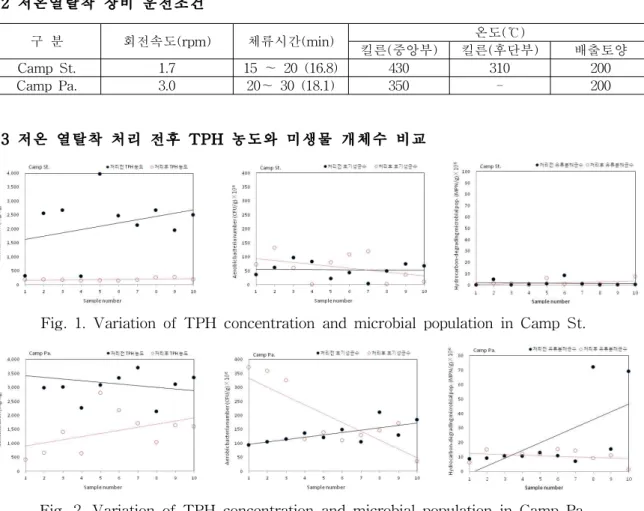
3.2 저온열탈착 장비 운전조건
구 분 회전속도(rpm) 체류시간(min) 온도(℃)
킬른(중앙부) 킬른(후단부) 배출토양
Camp St. 1.7 15 ~ 20 (16.8) 430 310 200
Camp Pa. 3.0 20~ 30 (18.1) 350 - 200
3.3 저온 열탈착 처리 전후 TPH 농도와 미생물 개체수 비교
Fig. 1. Variation of TPH concentration and microbial population in Camp St.
Fig. 2. Variation of TPH concentration and microbial population in Camp Pa.
4. 결론
저온 열탈착 전후의 토양 시료에서 TPH 농도에 관계 없이 호기성세균수 및 유류분해 미생물 수는 큰 변화가 없는 것으로 나타났다.
참고문헌
1. 반환미군기지 환경오염 정화사업 실시설계 보고서, 한국농촌공사, 2009 2. 양창술, 김종식 역, 토양미생물실험법, p16~17, 월드사이언스, 2002 3. 먹는물수질공정시험기준, p669~674, 환경부, 2010
4. JR Haines, BA Wrenn, EL Holder, KL Strohmeier, RT Herrington and AD Venosa, Measurement of hydrocarbon-degrading microbial populations by a 96-well plate most-probable-number procedure, Journal of Industrial Microbiology, 16, 36~41, 1996 5. R. ROWE, R. TODD and J. WAIDE, Microtechnique for most-probable-number analysis,
Applied and Environmental Microbiology, 33(3), 675~680, 1977