
IEG 환경지질연구정보센터
9
0
0
전체 글
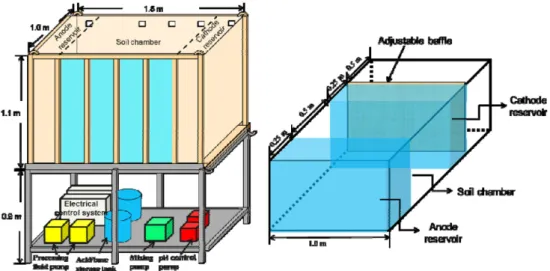
(2) Remediation of Electroplating Contaminated Soil by a Field Scale Electrokinetic System with Stainless Steel Electrodes. 27. al. (2012) conducted an EK field test with stainless steel. was classified as loamy sand (85.2% sand, 7.8% silt and. electrode for 100 day and achieved 63.8% removal for Pb. 7.0% clay) by particle size analysis. A soil organic matter. and 39.5% removal for Cu. Kim et al. (2013) reported. content of 3.1% was determined by the combustion method. effective circulation might enhance the performance of EK. (Matamoros et al. 2009). A soil pH of 8.2 was measured in. process because of a constant pH within the system. The. water suspensions with a 1 : 1 volume ratio of soil to solu-. removal efficiency was 43.2% for As, 17.7% for Cu and. tion, and a soil pHZPC of 2.7 was determined using a zeta. 81.2% for Pb with stainless electrode for 28 days. The. potential instrument (Pen Kem-Laser Zee 3.0, USA). A soil. removal efficiency of metals in field did not as good as. solid density of 2.41 g/cm3 was determined according to the. expected because many geo-environmental factors should. method of ASTM D854-92 method. The hydraulic conduc-. be considered.. tivity of the soil sample was 7.5 × 10⁻⁵ cm/ measured by a. Before field test, research data from a scale-up system is. falling-head permeameter.. much more important to find the optimum in-situ electroki-. After removing debris and plants from soil, the soil sam-. netic parameters. Additionally, some contaminated sites are. ple was microwave-digested with mixed acid solution (HF:. limited to in-situ remediation works. In this study, a 1.5 m ×. HBO3 : HCl = 1 : 4 : 1) and quantified by ICP (Perkin Elmer. 1.0 m × 1.1 m field scale electroniketic system was designed. Optima 2000DV, USA). A biodegradable lactic acid was. to fit the needs, which can also move to the site to remedi-. selected as processing fluid because of (1) preventing from. ate the excaved contaminated soil. This study was aimed to. second pollution of soil matrix; and (2) keeping the soil/res-. examine removal performance of metals by the field scale. ervoir pH less than 8.0 to hinder the clogging of most metal. EK system coupled with stainless steel electrodes applied. oxides (Zhou et al., 2006).. 0.2-0.35 V/cm potential gradient and 0.05-0.5 M lactic acid for 20 day. The electrokinetic behavior and soil/reservoir. 2.2. The field scale EK system. temperature will be also discussed in this study.. A polypropylene (PP) field scale electroniketic system with 1.5 m (L) × 1.0 m (W) × 1.1 m (H) was designed to. 2. Materials and Methods. conduct EK experiments, as shown in Fig. 1. The field scale EK system includes three units: anode reservoir (L × W ×. 2.1. Soil and processing fluid. H = 1.0 m × 0.25 m × 1.1 m), cathode reservoir (L × W × H =. Tested soils were sampled from a wasted electroplating. 1.0 m × 0.25 m × 1.1 m), and soil chamber (L × W × H =. factory in southern Taiwan. The texture of the soil sample. 1.0 m × 1.0 m × 0.9 m). Two hundred and fifty liter process-. Fig. 1. (a) The front view of field scale electrokinetic system; (b) side view of soil chamber. J. Soil Groundw. Environ. Vol. 19(5), p. 26~34, 2014.
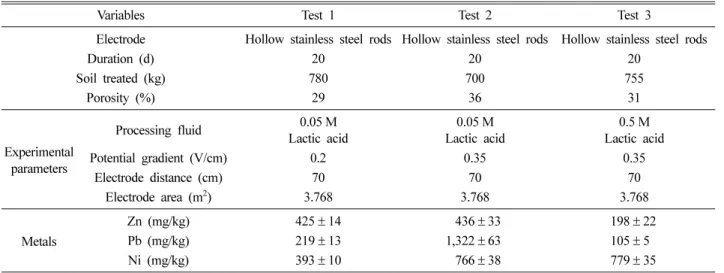
(3) 28. Ching Yuan·Chia-Ren Tsai·Chung-Hsuang Hung. Fig. 2. Sample collection for (a) soil current and soil temperature; (b) residue metal in soils.. ing fluid could be contained in the reservoir. The reservoir. potential gradient and 0.05-0.5 M lactic acid for 20 day, as. pH and temperature were real-time monitored and the digi-. summarized in Table 1. The amount of soil treated per. tal data were collected by the monitoring system. The res-. batch test was around 700-780 kg and the major pollutant. ervoir pH was maintained at pH 7.0 ± 1.0 preventing from. was Zn, Pb, and Ni, as shown in Table 1.. clogging of most metal oxides. During the experiments, the electroosmotic flow (Qe) was collected from both the anode. 3. Results and Discussion. and cathode reservoirs; hence, the average permeability was investigated throughout the field scale EK system. The soil. 3.1. Electrokinetic behavior. temperature and the current across the soil chamber were. In electrokinetic processes, the movement of an electro-. th. th. manually measured at the 10 day and the 20 day. Owing. lyte solution driven by an electrical field, which carries the. to the heterogeneity of soil, the soil was horizontally sec-. soluble pollutants toward the electrodes, is considered to be. tioned to three layers, 30 cm height per layer, and nine. one of the treatment mechanisms. The movement of the. evenly divided per sectional layer, as shown in Fig. 2a.. electrolyte solution, i.e., electroosmotic flow, Qe (cm3/s), for. Total 27 samples were collected per sampling time. Similar-. a soil chamber is directly proportional to the applied elec-. ity, the sample collection for the metal residue in soil was. tric potential gradient, ie (V/cm):. similar as that for soil current and soil temperature, except 25 evenly divided per sectional layer, as shown in Fig 2b.. Qe = ke × ie × A. (1). Totally, 75 soil samples were collected for metal residual. where A (cm2) is the cross-section area of the soil chamber. quantification per sampling time and the concentration con-. and ke (cm2/V-s) is the average electroosmosis permeability.. tour plotted using SURFER software would be shown in. The results, shown in Table 2, indicated that 2.4 × 10⁻² −. this study.. 7.5 × 10⁻² cm3/s of electroosmosis flow were collected for. Three electrickinetic experiments were conducted in the. Tests 1-3. The ke value of Test 2 was 4.8 × 10⁻⁵ cm2/V-s,. above-mentioned field scale EK system coupled with 24. which was greater than that of Test 1. It might because a. stainless steel electrodes (3 cm (Φ) × 120 cm (L)) to exam-. higher potential gradient of 0.35 V/cm applied in Test 2 and. ine metal removal performance applied 0.2-0.35 V/cm. resulted in vigorous electrolysis reaction. As increased con-. J. Soil Groundw. Environ. Vol. 19(5), p. 26~34, 2014.
(4) Remediation of Electroplating Contaminated Soil by a Field Scale Electrokinetic System with Stainless Steel Electrodes. 29. Table 1. Experimental design for the field scale electrokinetic system Variables. Test 1. Electrode Duration (d) Soil treated (kg) Porosity (%). Test 3. Hollow stainless steel rods Hollow stainless steel rods Hollow stainless steel rods 20 20 20 780 700 755 29 36 31. Potential gradient (V/cm) Electrode distance (cm) Electrode area (m2). 0.05 M Lactic acid 0.2 70 3.768. 0.05 M Lactic acid 0.35 70 3.768. 0.5 M Lactic acid 0.35 70 3.768. Zn (mg/kg) Pb (mg/kg) Ni (mg/kg). 425 ± 14 219 ± 13 393 ± 10. 436 ± 33 1,322 ± 63 766 ± 38. 198 ± 22 105 ± 5 779 ± 35. Processing fluid Experimental parameters. Test 2. Metals. Table 2. Summary results of the field scale electrokinetic experiments Test Electrode No.. Potential Lactic acid Electrode gradient (M) area (m2) (V/cm). Qe (cm3/s). ke (cm /V-s) 2. Power consumption (kwh/m3). Residue in soil Metal. %. Removal efficiency (%). Mass balance (%). Stainless steel (SUS 316). 0.2. 0.05. 3.768. 2.4 × 10⁻² 2.6 × 10⁻⁵. 9.8. Zn Pb Ni. 58.2 67.2 64.4. 39.1 28.3 32.7. 97.3 95.5 97.1. Stainless 2 steel (SUS 316). 0.35. 0.05. 3.768. 7.5 × 10⁻² 4.8 × 10⁻⁵. 74.5. Zn Pb Ni. 17.6 9.8 55.1. 78.4 84.3 40.1. 96.0 94.1 95.2. Stainless steel (SUS 316). 0.35. 0.5. 3.768. 3.5 × 10⁻² 2.2 × 10⁻⁵. 44.4. Zn Pb Ni. 38.4 64.4 56.4. 57.5 31.0 41.0. 95.9 95.4 97.4. 1. 3. centration of lactic acid to 0.5 M, the color of concentrated lactic acid became much milky white and the fluidity was quite different from the diluted solution. Further, the higher concentration of lactic acid should decrease the soil pH, then the acidification decrease EOF. As a consequence, lower ke was found (2.2 × 10⁻⁵ cm2/V-s) for Test 3. A smooth electric current transfer through the soil chamber represents no clogging occurred inside and pollutants would successfully migrate with electroosmosis flow to cathode reservoir. The electric current was monitored during the experiment period and the result of current density was shown in Fig. 3. For Test 1, the current density increased. Fig. 3. The current density vs. time in the field scale EK system.. with time and kept at 0.45-0.46 mA/cm2 after the 5th day. As increased potential gradient to 0.35 V/cm (Test 2), the. lactic acid concentration to 0.5 M (Test 3), the current den-. current density significantly increased to 3.7 mA/cm2 at Day 5. sity did not increase as expected. It was found that 0.5 M. 2. and then gradually decreased to 2.8 mA/cm . As increased. lactic acid turned to milky white color and was very visJ. Soil Groundw. Environ. Vol. 19(5), p. 26~34, 2014.
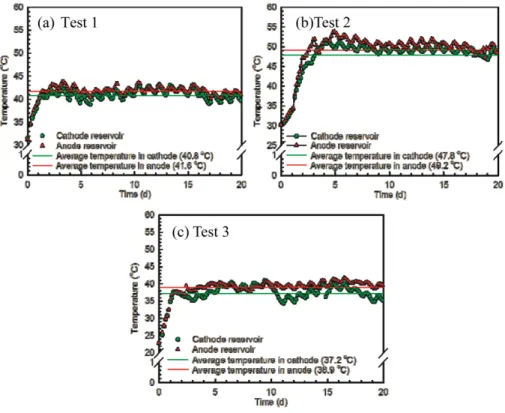
(5) 30. Ching Yuan·Chia-Ren Tsai·Chung-Hsuang Hung. Fig. 4. The reservoir pH vs. time in the field scale EK system.. cous. The higher viscosity of lactic acid would hinder the migration of electroosmosis flow.. 3.3. The variation of temperature in reservoirs and soils The temperature increase in EK system is highly related. 3.2. The variation of reservoir pH. to the total energy consumption as well as the safety of. As applied direct current on EK systems, the H+ and OH−. human and building. The variation of reservoir temperature. was produced at the anode and cathode, respectively, due to. was shown in Fig. 5. The initial reservoir temperature was. water electrolysis reaction. The metal oxides will form as. set at 31.5oC. Results showed that the average reservoir. the case of higher pH near the cathode. Therefore, control. temperature in the cathode and in the anode was 40.8-. mild reservoir pH is very important to keep migration of. 47.8oC and 41.6-49.2oC for Tests 1-2, respectively, which. electroosmosis flow. The variation of reservoir pH in inves-. was higher than that for Test 3. It might largely because. tigated systems was shown in Fig. 4. Results showed that. both Test 1 and Test 2 were operated in summer and Test 3. the anode and cathode reservoir pH were kept at the range. was operated in winter. Owing to higher potential gradient. of 6.30-7.37 and 5.48-7.10, respectively, which was met the. applied, a highest reservoir temperature was found for Test. target range of 7.0 ± 1.0. As increased potential gradient and. 2, which was agreed with the highest power consumption. lactic acid concentration (Test 2 and Test 3), the fluctuation. shown in Table 2. No significant variation of temperature. of pH became more significant. It might reasonably due to. between anode and cathode reservoirs was found.. (1) vigorous electrolysis reaction caused by higher poten+. −. The soil temperature profile along the field scale EK sys-. tial gradient and resulted in more H and OH released; (2). tem was showed in Fig. 6. The average soil temperatures. the higher viscosity of concentrated lactic acid resulted in. were 39.0 ± 0.4oC, 44.5 ± 0.4oC, and 38.8 ± 1.7oC for Test. difficult to control reservoir pH. The fluctuation of reser-. 1, Test 2, and Test 3, respectively, which resulted in 4-16oC. voir pH could abate by using more delicate pH controller.. higher than room temperature. It found that the higher. J. Soil Groundw. Environ. Vol. 19(5), p. 26~34, 2014.
(6) Remediation of Electroplating Contaminated Soil by a Field Scale Electrokinetic System with Stainless Steel Electrodes. 31. Fig. 5. The reservoir temperature vs. time in the field scale EK system.. Fig. 6. The soil temperature profile in the field scale EK system.. potential gradient applied, the greater different between soil. ods or using variable-frequency drive power supply might. temperature and room temperature. It might result from vig-. be a solution way. How to compensate soil temperature and. orous electrolysis reaction. It was also found that the sec-. removal efficiency will become a potential issue as applied. tional soil temperature decreased from anode to cathode. To. EK process in the fields to keep the safety of human activ-. conquer high soil temperature, extending remediation peri-. ities and building. J. Soil Groundw. Environ. Vol. 19(5), p. 26~34, 2014.
(7) 32. Ching Yuan·Chia-Ren Tsai·Chung-Hsuang Hung. Fig. 7. The residual concentration profile of Zn.. Fig. 8. The residual concentration profile of Pb.. Fig. 9. The residual concentration profile of Ni.. 3.4. Removal performance of metals. tively. The horizontal and vertical migrations of the three. The residue concentration profiles of Zn, Pb, and Ni for. metals along the field scale EK system were clearly indi-. EK remediation of 20 days were shown in Figs. 7-9, respecJ. Soil Groundw. Environ. Vol. 19(5), p. 26~34, 2014. cated in the concentration contours..
(8) Remediation of Electroplating Contaminated Soil by a Field Scale Electrokinetic System with Stainless Steel Electrodes. 33. 3.4.1. Zn. 3.4.3. Ni. At natural pH, Zn(OH)2 precipitate would formed, which. The hydroxide precipitate of Ni would form at pH greater. might hinder the migration of Zn along the field scale EK. than 11 and, at the natural pH, only Nickel hydroxide com-. system. In Fig. 3, no sharp variance of current density was. plex would form. Applied 0.2 V/cm (Test 1), the total removal. found, which indicated the clogging by Zn(OH)2 precipi-. efficiency of Ni was 32.7% and the highest removal of. tate was insignificant. As applied 0.2 V/cm (Test 1), Zn. 39.6% was found in the top layer (Layer A). The vertical. migrated from anode to cathode horizontally but insignifi-. migration of Ni was similar as Zn and Pb. Some soils with. cant in vertically. The removal efficiency of Zn was only. high concentrated Ni were found in Layer B and C, which. 40.4%, 42.7%, and 24.3% in the layers A, B, and C, respec-. might result from the slowest migration velocity of Ni. tively, which resulted in total removal of 39.1%. The low. (0.09-0.18 m/s) in soil compared with other metals. The. removal efficiency could be enhanced by higher potential. horizontal migration was also more significant than vertical. gradient. Applied potential gradient of 0.35 V/cm (Test 2),. migration. Applied higher potential gradient of 0.35 V/cm. the total removal efficiency increased to 78.4% and the. (Test 2), the total removal efficiency of Ni increased to. removal efficiency of Zn in the top layer (layer A) was. 40.1% only. The highest removal efficiency of Ni of 76.5%. greater than that in the layer B and C. It indicated that the. was found in the top layer (layer A), which meant the ver-. vertical migration of Zn became more significant (Fig. 7).. tical migration of Ni was more significant than that of Zn. The reason might be temperature increase in soil (Fig. 6). and Pb. Applied concentrated lactic acid in EK system (Test. transported pore water from bottom to top layer, which co-. 3), the total removal efficiency of Ni was 41.0%, which was. transported Zn to the topsoil. This result was agreed with. similar as Test 2. That indicated the concentrated lactic acid. Alshawabkeh et al. (2005) and Kim et al. (2012). The total. would largely hinder the migration of Ni.. removal efficiency decreased to 57.5% as applied a concentrated lactic acid in EK system (Test 3). It was inferred that. 4. Conclusion. the low electroosmosis permeability might result from the high viscosity and low pH (Fig. 4c) of the concentrated pro-. A field scale electrokinetic system with 1.5 m (L) × 1.0 m (W) × 1.1 m (H) was successfully designed and conducted. cession fluid.. EK experiments. The important conclusions can be drawn from this study as follows:. 3.4.2. Pb The hydroxide precipitate of Pb would form at pH greater +. 1. The reservoir pH controlled at 7.0 ± 1.0 has been effec-. than 11 and, at the natural pH, complex of Pb(OH) would. tively avoided the extreme high soil pH near the cathode. It. formed instead of Pb2+. Applied 0.2 V/cm (Test 1), the total. diminished the metal oxide clogging and resulted in a bet-. removal efficiency of Pb was 28.3% and the highest removal. ter migration of pollutants.. of 36.6% was found in the layer B, which was lower than. 2. The reservoir and soil temperatures were majorly. that of Zn. The horizontal migration was more significant. related to potential gradient and room temperature. A 4-. than vertical migration (Fig. 8). Applied potential gradient. 16oC above room temperature was found in the investi-. of 0.35 V/cm (Test 2), the total removal efficiency of Pb. gated system. How to compensate soil temperature and. largely increased to 84.3%. The vertical migration of Pb in. removal efficiency will become a potential issue as applied. Test 2 was more significant than that on Test 1, which was. EK process in the fields to keep the safety of human activ-. similar as that of Zn. Applied concentrated lactic acid in EK. ities and building.. system (Test 3), the total removal efficiency of Pb was. 3. The best removal efficiency of Zn, Pb, and Ni was. largely decreased to 31.0%. That indicated the effect of low. 78.4%, 84.3%, and 40.1% in the EK system applied 0.35 V/. fluidity of processing fluid on Pb removal was more signif-. cm and 0.05 M lactic acid for 20 days. Increasing potential. icant than on Zn removal.. gradient would more effectively enhance metal removal than increasing concentration of processing fluid. J. Soil Groundw. Environ. Vol. 19(5), p. 26~34, 2014.
(9) 34. Ching Yuan·Chia-Ren Tsai·Chung-Hsuang Hung. 4. A significant vertical migration was found for metals along the field scale electrokinetic system, which is very helpful for the remediation of deep polluted site. It confirmed that the electro current applied push the metals from the bottom to the top soil and, then, deep excavation might be no more needed.. Acknowledgement This research was funded by the Soil and Groundwater Pollution Remediation Fund Management Board, Environmental Protection Administration, Executive Yuan, ROC. The authors are grateful to the reviewers for their valuable comments.. References Acar, Y.B. and Alshawabkeh, A.N., 1993, Principles of electrokinetic remediation, Environ. Sci. Technol., 27, 2638-2647. Alshawabkeh, A., Bricka, R., and Gent, D., 2005, Pilot-scale electrokinetic cleanup of lead-contaminated soils, J. Geotech. Geoenviron. Eng., 131, 283-291. Chang, I.S. and Kim, B.H., 2007, Effect of sulfate reduction activity on biological treatment of hexavalent chromium [Cr(VI)] contaminated electroplating wastewater under sulfaterich condition, Chemosphere, 68, 218-226. Dutra, A.J.B., Rocha, G.P., and Pombo, F.R., 2008, Copper recovery and cyanide oxidation by electrowinning from a spent copper-cyanide electroplating electrolyte, J. Hazard. Mater., 152, 648-655. Hang, X., Wang, H., Zhou, J., Du, C., and Chen, X., 2009, Char-. J. Soil Groundw. Environ. Vol. 19(5), p. 26~34, 2014. acteristics and accumulation of heavy metals in sediments originated from an electroplating plant, J. Hazard. Mater., 163, 922930. Jordao, C.P., Fialho, L.L., Neves, J.C.L., Cecon, P.R., Mendonca, E.S., and Fontes, R.L.F., 2007, Reduction of heavy metal contents in liquid effluents by vermicomposts and the use of the metal-enriched vermicomposts in lettuce cultivation, Bioresour. Technol., 98, 2800-2813. Kim, B.K., Park, G.Y., Jeon, E.K., Jung, J.M., Jung, H.B., Ko, S.H., and Beak, K., 2013, Field application of in situ electrokinetic remediation for As-, Cu-, and Pb-comtaminated paddy soil, Water Air Soil Pollut., 224, 1698. Kim, W.S., Park, G.Y., Kim, D.H., Jung, H.B., Ko, S.H., and Beak, K., 2012, In situ field scale electrokinetic remediation of multi-metals contaminated paddy soil: Influence of electrode configuration, Electrochim. Acta, 86, 89-95. Lee, K.Y., Kim, H.A., Lee, W.C., Kim, S.O., Lee, J.U., Kown, Y.H., and Kim, K.W., 2012, Ex-situ field application of electrokinetic for remediation of shooting-range soil. Environ. Geochem. Health, 34, 151-159. Matamoros, V., Arias, C., Brix, H., and Bayona, J.M., 2009, Preliminary screening of small-scale domestic wastewater treatment systems for removal of pharmaceutical and personal care products, Water Res., 43, 55-62. Ouki, S.K. and Neufeld, R.D., 1997, Use of activated carbon for the recovery of chromium from industrial wastewaters, J. Chem. Technol. Biotechnol., 70, 3-8. Panayotova, T., Dimova-Todorova, M., and Dobrevsky, I., 2007, Purification and reuse of heavy metals containing wastewaters from electroplating plants, Desalination, 206, 135-140. Zhou, D.M., Cang, L., Akram, N., and Alshawabkeh, A., 2006, Pilot-scale electrokintic treatment of a Cu contaminated red soil, Chemosphere, 63, 964-971..
(10)
수치

관련 문서
The effects of recycling on the tensile bond strength of new and clinically used stainless steel orthodontic brackets: an in vitro study. Material testing of
Technologies that can be applied to decontaminate radioactive materials such as cesium from contaminated soil can be largely classified into soil washing,
Hirose, Relationship between intermetallic compound layer thickness with deviation and interfacial strength for dissimilar joints of aluminum alloy and stainless
Field : Spatial distribution of scalar and vector quantity Electric field and magnetic field.. 3-1
7 Effect of annealing temperature on the tensile properties of high manganese austenitic stainless steel with two phases of reversed austenite and
Advancement of Clay and Clay-based Materials in the Remediation of Aquatic Environments Contaminated with Heavy Metal Toxic Ions and Micro-pollutants..
Studies on the stabilization mechanism of metal(loid)s in contaminated soil with different calcareous wastes Waste..
In this context, this study compared and analyzed a variety of soil decontamination methods used to evaluate the wide-area soil contaminated with Cs:
