• 검색 결과가 없습니다.

Effect of Sacchromyces cerevisiae-Fermented Artemisiae Argi Folium on Nitric oxide Production of Macrophage Treated with Toxicants

N/A
N/A
Protected

Academic year: 2021

Share "Effect of Sacchromyces cerevisiae-Fermented Artemisiae Argi Folium on Nitric oxide Production of Macrophage Treated with Toxicants"

Copied!
5
0
0

로드 중.... (전체 텍스트 보기)

전체 글

(1)

Effect of Sacchromyces cerevisiae -Fermented Artemisiae Argi Folium on Nitric oxide Production of Macrophage Treated

with Toxicants

Wan Su Park*

Department of Pathology, College of Oriental Medicine, Kyungwon University

The effects of Sacchromyces cerevisiae -Fermented Artemisiae Argi Folium Water extract (AFS) on Nitric oxide production from mouse macrophage Raw 264.7 cells treated with EtOH, gallic acid, Nicotine, Acetaminophen, and Acetaldehyde were investigated through this study. AFS (0, 10, 50, 100, 200, 400 ug/mL) was simultaneously treated with EtOH (100 uM), gallic acid (100 uM), Nicotine (1 mM), Acetaminophen (2 mM), and Acetaldehyde (200 uM). And Nitric oxide production from Raw 264.7 cells was measured by Griess reagent method. AFS restorated the cellular production of Nitric oxide reduced by EtOH, gallic acid, Nicotine, and Acetaminophen in Raw 264.7 cells. AFS could be supposed to have the immuno-modulating activity concerned with macrophage's production of Nitric oxide.



Key words : macrophage, Sacchromyces cerevisiae , artemisiae argi folium, fermentation, nitric oxide

* To whom correspondence should be addressed at : Wan Su Park, Department of Pathology, College of Oriental Medicine, Kyungwon University, Bokjeong-dong, Sujeong-gu, Seongnam-si, Gyeonggi-do, Korea

․E-mail : [email protected], ․Tel : 031-750-8821

․Received : 2009/06/24 ․Revised : 2009/07/17 ․Accepted : 2009/08/03

Introduction

Artemisiae Argi Folium (AAF), the dried leaf of Artemisia argyi Levl. et Vanf. (family Compositae), has been used to cure various diseases such as irregular menstruation, vaginal bleeding during pregnancy, pain with a cold feeling in the lower abdomen, menorrhagia, sterility related with uterine malfunction, and leukorrhagia in Korean traditional medicine

1,2)

. And the medicinal decoction of Artemisiae Argi Folium is tried to care skin ailments

3)

(skin eczema and itching).

Saccharomyces cerevisiae is used in fermentation of starch during making bread, giving a favourable taste and produces a variety of vitamins and proteins

5)

.

Nitric oxide (NO) is a reactive radical molecule produced from guanidino nitrogen of L-arginine, which is oxidized by NO synthase (NOS)

6)

. NO is produced by a variety of cell types including macrophage and monocyte and essential for host innate immune response to pathogens such as bacteria, viruses, fungi, and parasites

7)

.

Macrophages are important leukocytes for removing pathogens such as bacteria, virus, fungi, and protozoa through

secreting NO, cytokines (IL-1a, IL-6, IL-12, and TNF-α), chemokines (KC and RANTES), growth factors (GM-CSF and VEGF), and various enzymes

8)

.

Although many studies have been reported pharmacological activities of AAF

9-12)

, immunological effects of Sacchromyces cerevisiae -fermented Artemisiae Argi Folium is not yet studied sufficiently.

In this study, we fermented Artemisiae Argi Folium by Sacchromyces cerevisiae and investigated effects of Sacchromyces cerevisiae-fermented Artemisiae Argi Folium(AFS) on NO production of mouse macrophage impaired by EtOH, Acetaldehyde(AC), Acetaminophen(AAP), Nicotine, and gallic acid(GA).

Materials and Methods

1. Preparation of AFS

AAF was obtained from the Kyung-Dong Herbal Market in Seoul, Korea in October 2008. A voucher specimen (No.

2008-10-0015) was deposited at the College of Oriental

Medicine, Kyungwon University Herbarium. AAF (50 g) was

extracted with 1000 mL of boiling water for 150 min, filtered,

and then lyophilized (yield: AAF, 12%). These water extracts

(3.0 g; pH 5.44) were suspended in 2.2 mL of water including

α -herbzyme (3 g, Hankuk Hyoso, Korea) and incubated for 96

h at 30℃ with Sacchromyces cerevisiae STV89. Following an

(2)

additional incubation for 20 min at 60℃, extracts were concentrated under vacuum. The powdered extract (AFS; pH 5.55) was dissolved in normal saline and then filtered through a 0.22 um syringe filter before use.

2. Cell line

RAW 264.7 mouse macrophage cell line was purchased from the Korea Cell Line Bank (Seoul, Korea).

3. Cell culture

Cells were cultured in DMEM (Sigma, USA) supplemented with 10% FBS (Sigma, USA) containing 100 U/mL of penicillin and 100 ug/mL of streptomycin. Cells incubated at 37℃ in a 5% CO

2

humidified incubator. Briefly, cells (1×10

4

cells/well) were seeded in a 96-well plate and treated with toxicants (GA, EtOH, Nicotine, AAP, and AC) and AFS for 24 hours. Subsequently, 60 uL of supernatant from each well were taken for examination of NO production.

4. NO production

NO concentration in the cultured medium was determined via the Griess reaction

13)

. Specifically, 60 uL of supernatant from each well was taken after 24 h incubation and mixed with 60 uL of Griess reagent (1% sulfanilamide in 5% phosphoric acid and 0.1% naphthylethylenediamine dihydrochloride in water) in a separate 96 well plate. After 15 min at room temperature, the optical density was determined at 540 nm with a microplate reader.

5. Statistical analysis

The results shown are summarized from at least five independent experiments and presented as the mean ± S.D.

Significant differences were examined using an analysis of variance (ANOVA) and a Student's t-test with SPSS (version 11.0).

Results

1. Effect of AFS on NO production of Raw 264.7 cells impaired by EtOH

AFS at the concentration of 200 and 400 ug/mL increased significantly (P<0.05) NO production of Raw 264.7 cells reduced by EtOH (100 uM)(Fig. 1).

2. Effect of AFS on NO production of Raw 264.7 cells impaired by AC

AFS at the concentration of 50, 100, 200, and 400 ug/mL increased significantly (P<0.05) NO production of Raw 264.7

cells reduced by AC (200 uM)(Fig. 2).

AFS (ug/mL) 0 0 10 50 100 200 400

EtOH (100 uM) - + + + + + +

Mean 126.25 100 97.03 98.60 104.19 118.5 170.68 SD 14.31 10.39 4.35 5.63 7.26 10.43 16.43 Fig. 1. Effect of AFS on Nitric oxide production of Raw 264.7 cells treated with EtOH (100 uM). Cells were incubated with AFS for 24 h with EtOH. Results are represented as mean ± S.D. AFS : Water extract of Artemisiae Argi Folium Fermented with Sacchromyces cerevisiae. Normal : Not treated with EtOH. Control : Treated with EtOH only. # represents P < 0.05 compared to the normal. * represents P < 0.05 compared to the control.

AFS (ug/mL) 0 0 10 50 100 200 400

Acetaldehyde

(200 uM) - + + + + + +

Mean 117.85 100.00 110.26 116.12 113.37 119.42 180.59 SD 9.90 7.42 12.93 15.02 11.19 11.95 15.10 Fig. 2. Effect of AFS on Nitric oxide production of Raw 264.7 cells treated with Acetaldehyde (200 uM). Cells were incubated with AFS for 24 h with Acetaldehyde. Results are represented as mean ± S.D. AFS : Water extract of Artemisiae Argi Folium Fermented with Sacchromyces cerevisiae.

Normal : Not treated with Acetaldehyde. Control : Treated with Acetaldehyde only.

# represents P < 0.05 compared to the normal. * represents P < 0.05 compared to the control.

3. Effect of AFS on NO production of Raw 264.7 cells impaired by AAP

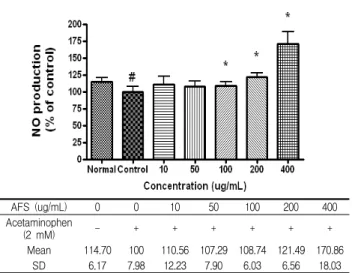
AFS at the concentration of 100, 200, and 400 ug/mL increased significantly (P<0.05) NO production of Raw 264.7 cells reduced by AAP (2 mM)(Fig. 3).

4. Effect of AFS on NO production of Raw 264.7 cells impaired by Nicotine

AFS at the concentration of 200 and 400 ug/mL increased

significantly (P<0.05) NO production of Raw 264.7 cells

(3)

reduced by Nicotine (1 mM)(Fig. 4).

AFS (ug/mL) 0 0 10 50 100 200 400

Acetaminophen

(2 mM) - + + + + + +

Mean 114.70 100 110.56 107.29 108.74 121.49 170.86

SD 6.17 7.98 12.23 7.90 6.03 6.56 18.03

Fig. 3. Effect of AFS on Nitric oxide production of Raw 264.7 cells treated with Acetaminophen (AAP; 2 mM). Cells were incubated with AFS for 24 h with AAP. Results are represented as mean ± S.D. AFS : Water extract of Artemisiae Argi Folium Fermented with Sacchromyces cerevisiae. Normal : Not treated with AAP. Control : Treated with AAP only. # represents P < 0.05 compared to the normal. * represents P < 0.05 compared to the control.

AFS (ug/mL) 0 0 10 50 100 200 400

Nicotine (1 mM) - + + + + + +

Mean 117.31 100 111.31 104.59 112.19 119.79 170.85 SD 9.81 9.46 23.52 18.05 17.47 7.99 16.36 Fig. 4. Effect of AFS on Nitric oxide production of Raw 264.7 cells treated with Nicotine (1 mM). Cells were incubated with AFS for 24 h with Nicotine. Results are represented as mean ± S.D. AFS : Water extract of Artemisiae Argi Folium Fermented with Sacchromyces cerevisiae. Normal : Not treated with Nicotine. Control : Treated with Nicotine only. # represents P < 0.05 compared to the normal. * represents P < 0.05 compared to the control.

5. Effect of AFS on NO production of Raw 264.7 cells impaired by GA

AFS at the concentration of 400 ug/mL increased significantly (P<0.05) NO production of Raw 264.7 cells reduced by GA (100 uM)(Fig. 5).

Discussion

In recent researches, pharmacochemical activities of Artemisia species including Artemisia argyi were much reported

14-20)

. But studies for effect of Sacchromyces cerevisiae-

AFS (ug/mL) 0 0 10 50 100 200 400

GA (100 uM) - + + + + + +

Mean 108.57 100 92.09 98.61 93.75 107.08 153.19

SD 15.12 9.24 5.09 7.12 8.52 7.05 11.66

Fig. 5. Effect of AFS on Nitric oxide production of Raw 264.7 cells treated with Gallic acid (GA; 100 uM). Cells were incubated with AFS for 24 h with GA. Results are represented as mean ± S.D. AFS : Water extract of Artemisiae Argi Folium Fermented with Sacchromyces cerevisiae. Normal : Not treated with GA. Control : Treated with GA only. # represents P < 0.05 compared to the normal. * represents P < 0.05 compared to the control.

fermented Artemisiae Argi Folium (AFS) on macrophage's immuno activity is not elucidated completely.

Instead of pathologic organisms, Various toxicants such as ethanol, AC, AAP, Nicotine, and GA could make macrophage's immune function weaken through decreasing NO production of macrophage. Impaired NO production of macrophage is regarded as the first step for a living system to be threatened by dangerous pathogens such as viruses, bacteria, fungi, protozoa, helminths, and tumor cells

7,21)

. As a result, Various toxicants such as ethanol, AC, AAP, Nicotine, and GA can make human body weaken and develop diseases related with the disrupted immunity. Thus, preserving NO production of macrophage is important for preserving host against invading pathogens.

In this experiments, AFS at the concentration of 200 and 400 ug/mL increased significantly (P<0.05) NO production of Raw 264.7 cells reduced by EtOH (100 uM) (Fig. 1). AFS at the concentration of 50, 100, 200, and 400 ug/mL increased significantly (P<0.05) NO production of Raw 264.7 cells reduced by AC (200 uM) (Fig. 2). At the concentration of 100, 200, and 400 ug/mL, AFS increased significantly (P<0.05) NO production of Raw 264.7 cells reduced by AAP (2 mM) (Fig. 3).

AFS at the concentration of 200 and 400 ug/mL increased significantly (P<0.05) NO production of Raw 264.7 cells reduced by Nicotine (1 mM) (Fig. 4). And, at the concentration of 400 ug/mL, AFS increased significantly (P<0.05) NO production of Raw 264.7 cells reduced by GA (100 uM) (Fig. 5). Though mostly at high concentrations (200 and 400 ug/mL), AFS showed restoring effects on mouse macrophage cell's NO production decreased by AC, AAP, ethanol, Nicotine, and GA.

These results mean that AFS could be developed as one

(4)

of the immune-enhancing herbal medicines related with preserving NO production of macrophage.

Conclusion

In this study, we investigated effects of AFS, Sacchromyces cerevisiae-fermented Artemisiae Argi Folium, on NO production of mouse macrophage impaired by EtOH, AC, AAP, Nicotine, and GA. AFS at the concentration of 200 and 400 ug/mL increased significantly NO production of Raw 264.7 cells reduced by EtOH and Nicotine. AFS at the concentration of 50, 100, 200, and 400 ug/mL increased significantly NO production of Raw 264.7 cells reduced by AC.

At the concentration of 100, 200, and 400 ug/mL, AFS increased significantly NO production of Raw 264.7 cells reduced by AAP. And, at the concentration of 400 ug/mL, AFS increased significantly NO production of Raw 264.7 cells reduced by GA. These results indicate that AFS could be developed as the immune-enhancing herbal meterial with preserving NO production of macrophage. The precise mechanism for restoring effect of AFS on mouse macrophage cell's NO production decreased by AC, AAP, ethanol, Nicotine, and GA deserves to be researched by continuing studies.

Acknowledgements

This research was supported by the Kyungwon University Research Fund in 2009.

References

1. Editorial Committee for Collaborative Text of Oriental Medical College in the Whole Country. Bon-Cho-Hak.

Seoul, Korea, A book concern of Young-Lim, pp 405-407, 1991.

2. Heo, J. Dong-Ui-Bo-Gam. Seoul, Korea, A book concern of You-Gang, p 2758, 1994.

3. Zhang, E.Q. The Chinese Materia Medica in A Practical English-Chinese Library of TCM. Shanghai, Chinal, Publishing House of Shanghai College of Traditional Chinese Medicine, p 284, 1990.

4. Oboh, G., Oladunmoye, M.K. Biochemical changes in micro-fungi fermented cassava flour produced from low- and medium-cyanide variety of cassava tubers. Nutrition and Health. 18: 355-367, 2007.

5. Beiroti, A., Hosseini, S.N. Production of baker's yeast using date juice. Sheng Wu Gong Cheng Xue Bao. 23(4):746-750, 2007.

6. Nathan, C.F., Hibbs, J.B. Role of nitric oxide synthesis in macrophage antimicrobial activity. Curr Opin Immunol. 3:

6570, 1991.

7. MacMicking, J., Xie, Q.W., Nathan, C. Nitric oxide and macrophage function. Annu Rev Immunol. 15: 323-350, 1997.

8. Goldsby, R.A., Kindt, T.J., Osborne, B.A., Kuby, J.

Immunology (5th ed.). New York, USA, W.H. Freeman and Company. pp 38-39, 2003.

9. Kim, M.J., Kim, D.H., Lee, K.W., Yoon, D.Y., Surh, Y.J.

Jaceosidin induces apoptosis in ras-transformed human breast epithelial cells through generation of reactive oxygen species. Ann N Y Acad Sci. 1095: 483-495, 2007.

10. Jeong, M.A., Lee, K.W., Yoon, D.Y., Lee, H.J. Jaceosidin, a pharmacologically active flavone derived from Artemisia argyi, inhibits phorbol-ester-induced upregulation of COX-2 and MMP-9 by blocking phosphorylation of ERK-1 and -2 in cultured human mammary epithelial cells. Ann N Y Acad Sci. 1095: 458-466, 2007.

11. Shoemaker, M., Hamilton, B., Dairkee, S.H., Cohen, I., Campbell, M.J. In vitro anticancer activity of twelve Chinese medicinal herbs. Phytother Res. 19(7):649-651, 2005.

12. Lee, H.G., Yu, K.A., Oh, W.K., Baeg, T.W., Oh, H.C., Ahn, J.S., Jang, W.C., Kim, J.W., Lim, J.S., Choe, Y.K., Yoon, D.Y.

Inhibitory effect of jaceosidin isolated from Artemisiaargyi on the function of E6 and E7 oncoproteins of HPV 16. J Ethnopharmacol. 98(3):339-343, 2005.

13. Weissman, B.A., Gross, S.S. Measurement of NO and NO synthase. Current Protocols in Neuroscience. 7: 13, 2001.

14. Adams, M., Efferth, T., Bauer, R. Activity-guided isolation of scopoletin and isoscopoletin, the inhibitory active principles towards CCRF-CEM leukaemia cells and multi-drug resistant CEM/ADR5000 cells, from Artemisia argyi. Planta Med. 72(9):862-864, 2006.

15. Lee, S.H., Kim, H.K., Seo, J.M., Kang, H.M., Kim, J.H., Son, K.H., Lee, H., Kwon, B.M., Shin, J., Seo, Y. Arteminolides B, C, and D, new inhibitors of farnesyl protein transferase from Artemisia argyi. J Org Chem. 67(22):7670-7675, 2002.

16. Tan, R., Jia, Z. Eudesmanolides and Other Constituents from Artemisia argyi. Planta Med. 58(4):370-372, 1992.

17. Yin, Y., Gong, F.Y., Wu, X.X., Sun, Y., Li, Y.H., Chen, T., Xu, Q. Anti-inflammatory and immunosuppressive effect of flavones isolated from Artemisia vestita. J Ethnopharmacol. 120(1):1-6, 2008.

18. Lv, W., Sheng, X., Chen, T., Xu, Q., Xie, X. Jaceosidin

induces apoptosis in human ovary cancer cells through

mitochondrial pathway. J Biomed Biotechnol. 2008: 394802,

(5)

2008.

19. Lee, S.H., Kim, H.K., Seo, J.M., Kang, H.M., Kim, J.H., Son, K.H., Lee, H., Kwon, B.M., Shin, J., Seo, Y. Arteminolides B, C, and D, new inhibitors of farnesyl protein transferase from Artemisia argyi. J Org Chem. 67(22):7670-7675, 2002.

20. Tan, R., Jia, Z. Eudesmanolides and Other Constituents from Artemisia argyi. Planta Med. 58(4):370-372, 1992.

21. Bogdan, C., Röllinghoff, M., Diefenbach, A. The role of

nitric oxide in innate immunity. Immunol Rev. 173: 17-26,

2000.

수치

Fig. 5. Effect of AFS on Nitric oxide production of Raw 264.7 cells treated with Gallic acid (GA; 100 uM)

참조

관련 문서

- A novel lactic acid bacterium for the production of high purity l-lactic acid, Lactobacillus paracasei subspL. helveticus - Production of Lactic Acid from Water Hyacinth

The Study on the Changes of Bacterial Inorganic Phosphate Metabolism in Interactions between Nitric Oxide and Salmonlla enterica serovar Typhimurium..

Consequently, the present study was designed to investigate the effect of adding 60 mg of raloxifene hydrochloride daily to women treated with GnRH-a for severe endometriosis

Methanol extracts from watermelon peels dramatically reduced inducible Nitric Oxide Synthase(iNOS) expression at various concentration and

The stereoscopic microscope image of gold particles in the leaching residue from Geumsan sample as a function of nitric acid concentration on the filter papers by lead

4 &gt; Effects of Taro on COX-2 expression and iNOS expression(hot water) in human thyroid cancer cells. The cells were pretreated for 48hours with either

And Western Blotting was used to see the effects of Cnidium officinale MAKINO extracts on inducible Nitric Oxide Synthase (iNOS) and cyclooxygenase-2 (COX-2) expression..

In the present study we investigated the proliferation effect of human oral cancer KB cell treated with pulsatilla koreana extract.. We analyzed the effects of this