• 검색 결과가 없습니다.

The Effect of an 8-week Shoulder Strengthening Exercise on Shoulder Muscle Strength of Caregivers

N/A
N/A
Protected

Academic year: 2021

Share "The Effect of an 8-week Shoulder Strengthening Exercise on Shoulder Muscle Strength of Caregivers"

Copied!
8
0
0

로드 중.... (전체 텍스트 보기)

전체 글

(1)

| Abstract |

Purpose: This study examined the effects of a shoulder-strengthening exercise on muscle strength of shoulder flexors and extensors of caregivers.

Methods: The study consisted of 19 caregivers (2 males and 17 females) employed by Medical Center B. All the participants took part in an 8-week shoulder muscle strengthening exercise, based on previous studies. In the first week, the subjects took part in a stretching exercise enhance the range of motion. In the second week, they participated in an exercise aimed at improving shoulder blade stability. From the third to seventh weeks, a resistance exercise of different intensities was applied in a phased manner. Finally, in the eight week, the subjects took part in plyometric exercise. Peak torque, average power, and total work of shoulder flexors and extensors in both sides were measured before and after the exercise at an angular speed of 120deg/sec using an isokinetic device. Wilcoxon’s singed-ranks test was conducted to analyze differences in muscle strength before and after the intervention.

Results: After the exercise, there was a significant improvement in peak torque and average power of flexors of the right arm.

After the exercise, peak torque, total work, and average power showed a significant improvement in the flexors of the left arm (p<0.05). However, there was no statistically significant difference in extensor muscle strength in either arm after the exercise.

Conclusion: Shoulder flexors of caregivers are utilized frequently in the workplace. Implementation of extensor-strengthening exercises, in addition to flexor-strengthening exercises, can contribute to reducing the incidence rate of shoulder injuries among caregivers.

Key Words: Shoulder strength, Caregivers, Shoulder exercise

†Corresponding Author : Seung-Min Lee ([email protected])

Original Article Open Access

8주간의 어깨 강화 운동이 요양보호사들의 어깨 근력에 미치는 영향
신재욱⋅이승민 ⋅정대윤⋅김동인⋅박재성⋅이병수⋅송세희⋅박이대⋅김문정⋅김노용⋅이광훈⋅김재용

1)

부산공공의료연구소

The Effect of an 8-week Shoulder Strengthening Exercise on Shoulder Muscle Strength of Caregivers

Jae-Wook Shin⋅Seung-Min Lee ⋅Dae-Youn Jung⋅Dong-In Kim⋅Jae-Sung Park⋅Byeong-Soo Lee Se-Hee Song⋅Lee-Dae Park⋅Moon-Jeong Kim⋅No-Yong Kim⋅Kwang-Hoon Lee⋅Jae-Yong Kim

Busan Research Institute of Public Health and Service Received: November 7, 2017 / Revised: December 6, 2017 / Accepted: December 6, 2017

ⓒ 2018 Journal of Korea Proprioceptive Neuromuscular Facilitation Association

This is an Open Access article distributed under the terms of the Creative Commons Attribution Non-Commercial License

(http://creativecommons.org/licenses/by-nc/3.0) which permits unrestricted non-commercial use, distribution, and reproduction

in any medium, provided the original work is properly cited.

(2)

Ⅰ. 서 론

최근 통계청 자료에 따르면 2016년 우리나라의 65 세 인구 비율은 13.2%로 2000년 고령화 사회에 접어든 후 꾸준히 그 비율이 증가하고 있는 추세이고 , 2026년 에는 20%로 초고령사회에 진입할 것으로 보고했다 (Population Census Division, 2016). 특히 우리나라는 세계에서 유래없는 고령화 추세를 보이고 있어 이러 한 노인 문제에 대한 사회적 인식이 확대됨에 따라 노인수발의 제도화에 대한 논의가 확산되었고 이에 정부가 고령화 사회에 대한 대응책으로 2008년 7월 1일부터 노인장기요양보험법을 실시하였다(Kim et al., 2012).

요양보호사는 노인장기요양보험법을 시행하면서 발생한 새로운 직업군으로 65세 이상의 노인 혹은 65 세 미만의 치매 등 노인성 질환을 가진 자 중 장기요양 등급 판정위원회에서 1∼3등급으로 인정받은 자에게 전문적 요양보호 서비스를 제공하여 신체기능 증진 및 삶의 질 향상에 기여하는 역할을 한다(Sin, 2010).

고령화에 따른 노인성질환자수 증가로 요양보호사의 수요가 증가하고 있고 그에 따라 요양보호사는 2013 년 말 기준으로 233,459명에서 252,663명으로 전년대 비 8.2%증가하였다(Seong, 2015; Seong, 2016). 법정근 로시간 주 40시간을 초과하는 근무형태가 66.4%, 주야 2교대 근무와 24시간 격일근무가 73%를 차지하였고 요양보호사들의 47.7%가 근무 중 휴식시간이 없다 (Lee, 2011a). 이러한 요양보호사의 과도하고 불규칙한 업무의 특성상 다른 직종에 비해서 다양한 근골격계 질환에 노출될 가능성이 높고 근골격계 질환에 대한 진단과 치료를 받기가 어려운 실정이다(Park, 2012a).

요양보호사의 근골격계 질환 자각 증상을 조사한 결과 2011년 시설 요양보호사에서 88.8%가 자각 증상 이 있다고 응답하였고(Lee, 2011a), 2012년 재활요양병 원에서 근무한 경력이 있는 요양보호사를 대상으로 조사한 결과 71.5%가 근골격계 질환 자각 증상이 있다 고 보고하였으며, 특히 어깨에 43.6%로 높은 발병 비 율을 차지하는 것으로 나타났다(Seo et al., 2012). 이러

한 반복적인 동작들은 어깨 근육 힘줄의 허혈 (ischemia)이나 미세손상을 일으켜 염증이 유발되는 데, 이로 인한 통증이 움직임을 감소시키게 되며 근 손상이 진행되어 근골격계 질환으로 발전하게 된다 (Kim & Gong, 2008). 이를 예방하고 근골격계 증상을 개선하기 위해서는 규칙적인 운동이 효과적이나 대부 분의 병원에서 직원들에게 예방관리프로그램을 의무 사항으로 시행하고 있지만, 요양보호사는 제외되고 있다. 따라서 요양보호사를 위한 예방관리프로그램이 필요한 실정이다 (Chung et al., 2013; Ki, 2012; Park, 2012b).

Lee (2011b)는 요양보호사들에게 요부 안정화 운동 프로그램을 적용하였고 Shin 등(2016)은 요양보호사 들의 요통에 대한 요통장애지수와 근지구력에 관한 연구를 하였다. 이와 같이 요양보호사들의 근골격계 질환에 대한 연구가 진행되고 있지만 어깨에 관한 연 구가 미흡하다. 따라서 본 연구에서는 요양보호사들 에게 8주간 어깨근육 강화 운동을 적용하였을 때 어깨 굽힘과 폄에 관여하는 근육의 근 활성도 변화에 대해 알아보고자 한다.

Ⅱ. 연구 방법

1. 연구 대상

본 연구는 부산시 소재 B의료원에 근무 중인 요양

보호사 19명(남 2명, 여 17명)을 대상으로 실시하였으

며 , 요양보호사 업무를 최소 1년 이상 수행한 대상자를

선정하였다 . 대상자에게 본 연구의 목적에 대해 충분

히 설명하고 참여에 대해 사전 동의를 얻은 후 연구를

진행하였다 . 대상자들은 간병업무 수행 시 상지와 하

지 및 허리에 신경학적⋅정형외과적 질환으로 통증이

없는 자를 선정하였다.

(3)

2. 측정방법 및 도구

본 연구에서 어깨 근력 변화에 대한 운동 전, 후 측정을 위하여 등속성 장비(Biodex medical system, NY, USA)를 사용하였고, 선행 연구에 근거하여 각속 도는 120deg/sec로 설정하였다(Kovaleski et al., 1995).

양측 어깨관절 굽힘 , 폄 동작에 대한 근력 측정을 시행 하였고, 등속성 장비를 활용한 근력측정은 Biodex system의 protocol에 따라 다른 근육의 대상작용을 최 소화하기 위하여 앉은 자세에서 시행하였다.

3. 실험 절차

19명의 요양보호사들을 대상으로 선행연구를 통해 검증된 스트레칭 및 근력 강화 운동을 8주간 적용하였 다 (Duzgun et al., 2011). 1주차는 관절 가동범위를 증진 하기 위하여 다양한 근육에 대한 스트레칭을 적용하 였고, 2주차는 어깨뼈 안정성을 증진하기 위한 운동 을, 3주차-7주차는 단계별 저항 운동을 실시하였고, 8주차는 고강도 저항운동인 플라이오메트릭 운동 (plyometric exercise)을 시행하였고(Table 1), 모든 저항 운동은 근 피로와 어깨 통증이 유발되지 않는 범위 내에서 한 동작에 15회 3sets로 실시하였다.

4. 자료 분석

본 연구에서 수집된 자료는 SPSS 22.0 for Windows 프로그램으로 분석하였다. 대상자의 일반적 특성은 기술통계로 하였으며, 각 측정항목들이 정규분포 하 는지 알아보고자 단일표본 콜모고르프-스미노프 (Kolmogorov-Smirnov) 검정을 실시하였다. 그 결과 정 규분포 가정을 만족하지 못하여 운동 전과 후의 차이 에 대한 변화는 윌콕슨 부호 순위검정(Wilcoxon’s singed-ranks test)으로 분석하였다. 통계학적 유의성을 검증하기 위해 유의수준 α는 0.05로 설정하였다.

Ⅲ. 연구 결과

1. 연구 대상자의 일반적인 특성

본 연구는 19명의 대상자(남성 2명, 여성 17명)로 평균연령은 60.3±5.1세, 키는 157.1±4.3cm, 몸무게는 60.3±7.3kg으로 나타났다(Table 2).

Week Exercise Repetition

1 weeks Standing passive flexion, abduction near the table Sleeper stretch

10 repeat × 3 sets 2 weeks

Scapular clock wall ball stabilization Active shoulder flexion, abduction until at 90°

Wall shoulder push-up plus 3 weeks Resistive biceps, triceps, with light thera-band

Supine serratus anterior strengthening

4 weeks Shoulder abduction, in / external rotation with light thera-band

5 weeks Resistive PNF pattern

Scaption thumb-up with moderate thera-band

6 weeks Wall shoulder push-up

Quadripedal core exercise

7 weeks Shoulder abduction, in / external rotation with moderate thera-band

8 weeks Plyometric exercise for shoulder gym ball overhead throw exercise

Table 1. Shoulder exercise program for 8 weeks

(4)

Characteristics Male (n=2)

Female (n=17) Age (years) 63.00±1.41 60.00±5.34 High (cm) 156.00±5.66 157.18±4.29 Weight (Kg) 61.00±5.66 60.18±7.64 Table 2. General characteristics of subjects

(n=19)

2. 운동치료에 따른 어깨관절 근력 변화

1) 어깨관절 굽힘근(굴근)의 근력변화

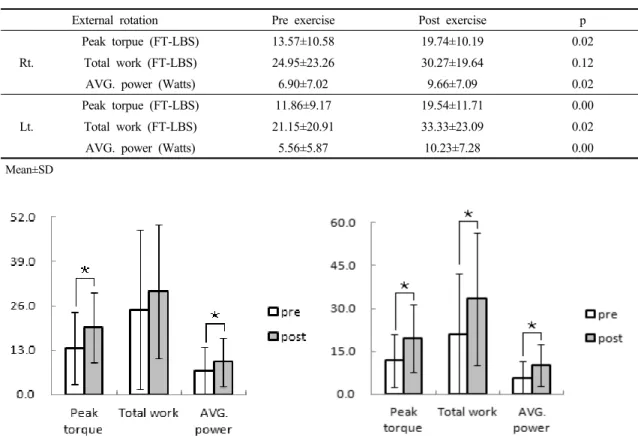
윌콕슨 부호 순위검정결과 오른팔에서는 peak torque, AVG. power, 왼팔에서는 peak torque, total work, AVG. power 모두 유의한 차이가 있었다(p<0.05). 그러

나 오른팔의 total work 값은 전보다 증가하는 양상을 보였으나, 통계학적 유의한 차이는 없었다(Table 2).

2) 어깨관절 폄근(신근)의 근력변화

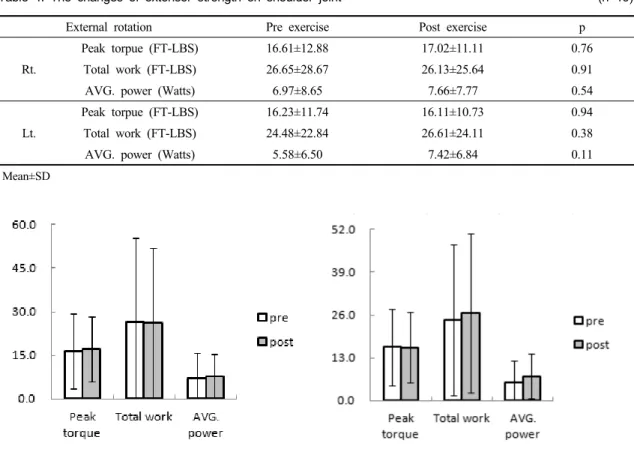
윌콕슨 부호 순위검정결과 오른팔에서는 peak torque, AVG. power에서 전보다 증가하는 양상을 보 였고 total work는 전과 비슷한 양상을 보였으나 모두 통계학적으로 유의한 차이는 없었다. 왼팔에서는 peak torque에서 전보다 비슷한 양상을 보였고 total work, AVG. power에서 전보다 증가하는 양상을 보였 으나, 모두 통계학적으로 유의한 차이는 없었다 (Table 3).

External rotation Pre exercise Post exercise p

Rt.

Peak torpue (FT-LBS) 13.57±10.58 19.74±10.19 0.02

Total work (FT-LBS) 24.95±23.26 30.27±19.64 0.12

AVG. power (Watts) 6.90±7.02 9.66±7.09 0.02

Lt.

Peak torpue (FT-LBS) 11.86±9.17 19.54±11.71 0.00

Total work (FT-LBS) 21.15±20.91 33.33±23.09 0.02

AVG. power (Watts) 5.56±5.87 10.23±7.28 0.00

Mean±SD

Table 3. The changes of flexor strength on shoulder joint (n=19)

Fig. 1. The changes of flexor strength on right shoulder joint.

*p<0.05

Fig. 2. The changes of flexor strength on left shoulder joint.

*p<0.05

(5)

Ⅳ. 고 찰

본 연구는 요양보호사에게 8주간 어깨관절 관리프 로그램을 적용하여 요양보호사의 어깨관절 근력 변화 에 어떠한 영향을 미치는지에 대해 알아보고자 하였 다. 연구 결과 양측 어깨 굽힘 근력은 유의한 차이가 나타났지만 어깨 폄근의 근력은 유의한 차이가 없 었다.

근력 강화운동은 근의 비대, 모세혈관 밀도 증가, 운동단위(motor unit)의 활성화를 초래하며, 근의 비대 는 곧 근 질량의 증가로서 근력이 향상한다고 보고하 였다 (Kim & Hong, 1995). 선행연구에서 근력 강화 없 이 신장 운동만으로는 통증의 완화가 어려우며 근골 격계 증상을 경감시키기 위해 운동 프로그램이 단계 적으로 제공되어야 한다고 하였다(Yu, 2008). 이에 본

연구에도 스트레칭에서 단계별 저항운동 등 단계별 다양한 각도와 방향에 대한 운동프로그램으로 구성하 였다.

Ludewig와 Borstad (2003)는 어깨충돌증후군과 통 증이 있는 건설공사 근로자들에게 8주간 어깨 스트레 칭과 근력강화운동을 적용하여 어깨 등급 설문 (shoulder rating questionnaire, SRQ)와 어깨 만족 점수 (shoulder satisfaction score)를 조사한 결과 중재 후 어깨 등급 설문과 어깨 만족 점수 모두 향상된 결과를 보고 하였다 . 선행 연구와 본 연구의 연구 설계는 유사하나 선행 연구에서는 대상자의 주관적인 느낌과 일상생활 에서 수행 가능한 기능 수준을 점수화 하였고 , 본 연구 에서는 중재 전, 후 객관적인 근력을 평가할 수 있는 등속성 장비(Biodex)를 활용하여 연구를 진행하였다.

만성 어깨 질환을 가진 중년 여성 집단에게 스트레

External rotation Pre exercise Post exercise p

Rt.

Peak torpue (FT-LBS) 16.61±12.88 17.02±11.11 0.76

Total work (FT-LBS) 26.65±28.67 26.13±25.64 0.91

AVG. power (Watts) 6.97±8.65 7.66±7.77 0.54

Lt.

Peak torpue (FT-LBS) 16.23±11.74 16.11±10.73 0.94

Total work (FT-LBS) 24.48±22.84 26.61±24.11 0.38

AVG. power (Watts) 5.58±6.50 7.42±6.84 0.11

Mean±SD

Table 4. The changes of extensor strength on shoulder joint (n=19)

Fig. 3. The changes of extensor strength on right shoulder joint. Fig. 4. The changes of extensor strength on left shoulder joint.

(6)

칭과 함께 밴드와 덤벨을 이용한 저항운동을 병행한 프로그램을 적용한 결과 저항운동만 실시한 집단에 비해 어깨 통증 및 근력 증가에 더욱 효과가 있다고 보고하였다(Shin & Lee, 2006). 본 연구의 대상자인 요양보호사는 대부분 중년 여성들로 구성되어 선행 연구와 본 연구의 대상자 특성이 유사하지만 본 연구 에서는 속도, 방향등이 일정한 등속성 장비를 활용하 여 객관적인 근력 변화를 측정 할 수 있었다고 생각된 다. 본 연구 결과 양측 굽힘 근육에 대한 중재 전, 후 통계학적 유의한 차이를 보였지만 폄 근육에 대해서 는 유의한 차이를 보이지 않았다 . 이는 8주간의 운동프 로그램중 어깨 폄 동작보다 굽힘 동작에 대한 근육 강화 운동이 많았기 때문이라 생각된다.

어깨 굽힘 시 위등세모근 , 앞 어깨세모근, 위팔두갈 래근 순으로 근활성도가 크게 나타났다(Kim et al., 2010). 앞 어깨세모근은 인체 중심선을 따라 팔을 위로 올리는 동작에서 주된 활성화가 일어나며 어깨벌림 시에는 보조적인 역할을 한다(Korea anatomy faculty council, 2015; Pearl et al., 1992). 본 연구에 적용된 운동 프로그램 중 PNF 상지 패턴의 굽힘, 벌림, 가쪽돌림은 어깨 굽힘, 벌림 동작이 결합된 패턴으로 앞 어깨세모 근의 기능적 수축이 수반된다(Sullivan & Portney, 1980). 이러한 동작 또한 앞 어깨세모근의 활성화를 일으키는 운동 동작이며 어깨 굽힘근력의 유의한 증 가를 보인 것으로 생각된다. 회전근개 손상이 있는 대상자의 어깨의 굽힘과 벌림 시 위팔두갈래근의 긴 갈래는 유의한 근 활성도를 보였고(Park & Eun, 2001), 청년층의 어깨 움직임에서 주동근과 근육 사용단계를 분석한 연구 결과 어깨 굽힘 시 위팔두갈래근의 근활 성도를 보였다고 보고하였다 (Kim et al., 2010). 본 연구 에서도 팔꿉 굽힘 운동 등 위팔두갈래근이 활성화되 는 동작들이 많았고 이는 어깨 굽힘 근력에 향상에 영향을 미쳤다고 생각된다.

앞톱니근은 어깨 굽힘의 기능적 향상을 동반한다 (Korea anatomy faculty council, 2015). 앞톱니근은 어깨 관절 바깥벌림동안 가장 먼저 활성화 되어야 하는 근 육이고 어깨 굽힘동안 어깨세모근, 가시위근에 의해

생산된 어깨뼈 하방회전 힘보다 더 큰 상방회전의 힘 을 발생시킨다 (Neumann, 2010). 어깨 굽힘 근육 간 근 활성도를 비교한 연구에서 앞톱니근이 등세모근 위섬 유, 큰가슴근보다 유의하게 높은 활성도를 보였다 (Moon, 2010). 이러한 결과는 어깨 굽힘 시 앞톱니근의 역할이 크다는 것을 의미한다 . 본 연구의 scapular clock wall ball stabilization exercise, ball overhead throws exercise등의 운동은 앞톱니근의 기능적 역할이 동반 되어(Chung et al., 2013) 어깨 굽힘의 기능적 향상을 야기했다고 사료된다.

위와 같은 연구 결과를 종합해 볼 때 어깨 굽힘근력 향상으로 요양보호사들의 어깨 질환 예방 및 기능적 업무 수행력 향상을 기대할 수 있다 . 본 연구의 제한점 으로는 중도 탈락으로 인한 연구 대상자의 표본수가 적다는 점과 동일 기관 내 한 집단의 중재 전, 후에 대한 연구로서 모든 요양보호사들에게 일반화하기에 는 어려움이 있다. 이러한 제한점을 바탕으로 추후 연구에서는 표본수를 늘려서 연구를 진행하고, 대상 자의 유해 위험 요인을 분석하여 그에 맞는 운동 프로 그램을 적용하며, 이에 따른 운동 프로그램 적용이 대상자의 근력증가와 만족도에 미치는 영향을 검증하 는 추가적인 연구도 필요할 것으로 사료된다 . 증가하 는 요양보호사 근골격계 질환의 예방을 위해 지속적 인 유해 요인 분석과 기관차원의 적극적이고 지속적 인 운동 프로그램 적용이 필요하며 이는 요양보호사 들의 근무환경 개선에 중요하다고 생각한다.

Ⅴ. 결 론

본 연구는 현재 요양보호사로 활동 중인 19명의 대

상자를 선정하여 8주간 어깨관절 근력강화 운동을 실

시하고 등속성 장비를 활용하여 어깨관절 굽힘, 폄 근

육에 대한 객관적인 근력 측정을 시행하였다 . 연구 결

과 요양보호사들의 업무 특성상 어깨관절 , 팔꿉 관절을

굽히는 동작들이 많아 굽힘 근육에 대한 유의한 차이를

보였으나, 폄 근육에 대한 유의한 차이는 나타나지 않

(7)

았다. 본 연구 결과를 바탕으로 요양보호사 재활에 있 어 어깨관절 굽힘 근력과 길항작용을 하는 폄 근육에 대한 근력 강화를 병행한다면 요양보호사의 어깨 질환 예방에 도움이 될 수 있을 것으로 생각된다.

Acknowledgement

본 연구는 부산공공의료연구소 지원에 의해 수행 되었음.

References

Chung KH, Duk SW, Lee YK, et al. Gender impact assessment on long-term care insurance. Seoul. Korea Institute for Health and Social Affairs. 2013.

Duzgun I, Baltaci G, Atay OA. Comparison of slow and accelerated rehabilitation protocol after arthroscopic rotator cuff repair: pain and functional activity. Acta Orthopaedica Traumatologica Turcica. 2011; 45(1):

23-33.

Ki EJ. Comparison of factors related to the stages of change in care workers’ exercise behavior. Daejeon University. Dissertation of Master’s Degree. 2012.

Kim HJ, Hong YS. An effect of muscle strength training program on muscle strength, muscle endurance, instrumental activities of daily living and quality of life in the institutionalized elderly. Journal of Korean Academy of Community Health Nursing. 1995;6(1):55-73.

Kim JH, Hong JS, Chun KJ, et al. An analysis of the shoulder isokinetic (flexion, extension, abduction, adduction) electromyography in young-aged. International Journal of Precision Engineering and Manufacturing.

2010;11:997-998.

Kim SH, Nam HE, Park SJ. Effects of care workers’ job satisfaction on the quality of their stay-at-home aged welfare service. International Journal of Contents.

2012;12(4):282-291.

Kim SS, Gong WT. The effects of elastic resistance exercise of limbo-pelvic region and upper limbs muscle on equilibrium ability and shoulder pain of the elderly.

Korean Journal of Orthopedic Manual Therapy.

2008;14(1):15-23.

Korea anatomy faculty council. Human anatomy, 4th ed. Seoul.

Hyunmoonsa. 2015.

Kovaleski JE, Heitman RH, Trundle TL, et al. Isotonic preload versus isokinetic knee extension resistance training.

Medicine and Science in Sports and Exercise.

1995;27(6):895-899.

Lee EJ. Musculoskeletal symptoms of nursing caregivers in elderly nursing homes. Yeungnam University.

Dissertation of Master’s Degree. 2011a.

Lee JM. The effect of lumbar stabilization exercise for caregivers with chronic low back pain. Yonsei University.

Dissertation of Master’s Degree. 2011b.

Ludewig PM, Borstad JD. Effects of a home exercise programme on shoulder pain and functional status in construction workers. Occupational and Environmental Medicine.

2003;60(11):841-849.

Moon SJ. A comparison of the serratus anterior muscle activity according to the shoulder flexion angles in a closed kinetic chain exercise and an open kinetic chain exercise. Hanseo University. Dissertation of Master’s Degree. 2010.

Neumann DA. Kinesiology of the musculoskeletal system : Foundations for rehabilitation, 2nd ed. St. Louis.

Mosby/Elsevier. 2010.

Park JG. Characteristics of shoulder pain and ultrasonographic findings in caregivers of stroke patients. Dong-A University. Dissertation of Master’s Degree. 2012a.

Park JH, Eun JS. An emg analysis of long head of the biceps function in shoulders with rotator cuff tears. Kosin Medical Journal. 2001;16(1):7-13.

Park KJ. Effect of exercise program on musculoskeletal

(8)

symptoms in hairdressers. Yeungnam University.

Dissertation of Master’s Degree. 2012b.

Pearl ML, Perry J, Torburn L, et al. An electromyographic analysis of the shoulder during cones and planes of arm motion. Clinical Orthopaedics and Related Research. 1992;(284):116-127.

Population Census Division. Complete enumeration results of the 2016 population and housing census. Deajeon.

Statistics Korea. 2016.

Seo YJ, Kim BW, Song YE, et al. Difference in musculoskeletal symptoms and health perception and health promotion behavior of caregivers by rehabilitation hospital.

Journal of Wellness. 2012;7(4):25-34.

Seong SC. 2014 long term care insurance statistical yearbook.

Seoul. National Health Insurance Service. 2015.

Seong SC. 2015 long term care insurance statistical yearbook.

Gangwon-do. National Health Insurance Service.

2016.

Shin HS, Lee KS. Effects of combined resistance exercise on range of motion (rom), grip strength and pain

in middle-aged women with shoulder disorder. The Korean Journal of Sport Science. 2006;15(1):

569-577.

Shin JW, Lee SM, Jung DY, et al. The effects of management program of musculoskeletal disorders on back pain, back pain disability, and back muscular endurance for caregivers with low back pain. Journal of Korean Physical Education Association for Girls and Women.

2016;30(4):399-413.

Sin MS. A study on care giver’s job satisfaction in long-term care insurance. Mokwon University. Dissertation of Master’s Degree. 2010.

Sullivan PE, Portney LG. Electromyographic activity of shoulder muscles during unilateral upper extremity proprioceptive neuromuscular facilitation patterns.

Physical Therapy. 1980;60(3):283-288.

Yu JH. The effect of exercise program to ease the

musculoskeketal symptoms among the people

working in a hotel. Korean Journal of Occupational

Health Nursing. 2008;17(2):138-145.

수치

Fig. 1. The changes of flexor strength on right shoulder joint.
Table 4. The changes of extensor strength on shoulder joint            (n=19)

참조

관련 문서

The purpose and necessity of this study was to investigate the effect of the 8-week GX complex exercise program on the stress index, blood lipid and APG

Results after 4 weeks showed that both deep neck bending muscle exercise+general neck strengthening exercise group showed decreased pain and improved functional status

Seung Soo Jang Sung Gyun Shin Min Jae Lee Sang Soo Han Chan Ho Choi Sungkyum Kim Woo Sung Cho and Song Hyun Kim POSTECH Yeong Rok Kang Wol Soon Jo Soo Kyung Jeong and

In contrast, Chiropractic has shown better result than sports massage in the range of motion of the shoulder joint, Thoracic Scapular rhythm test, and the

12 weeks of combined exercise (body strength exercise and aerobic exercise) was applied to measure health fitness (muscle strength, muscular endurance,

In exercise group, change in physical strength after measurement showed significant increase in muscular strength, muscle endurance, cardiovascular endurance, agility,

Chang Goo Kang, Ah Hyun Park, Jang Ho Ha, Young Soo Kim, Joon-Ho Oh, Jeong Min Park, Soo Mee Kim, Seung-Jae Lee, Seung Hee Lee, and Han Soo Kim(KAERI). Fabrication

The purpose of this study is to investigate how participation in 8-week swimming and resistance exercise programs affects changes in health fitness and