약용식물 메탄올 추출물의 항산화 및 항당뇨 활성
이연리1․윤나라2
1대전보건대학교 식품영양과
2충북대학교 식품생명공학과
Anti-Oxidative and Anti-Diabetic Effects of Methanol Extracts from Medicinal Plants
Youn Ri Lee
1and Nara Yoon
21
Department of Food and Nutrition, Daejeon Health Sciences College
2
Department of Food Science and Biotechnology, Chungbuk National University
ABSTRACT The purpose of this study was to measure total phenolic compounds as a measure of antioxidant activity as well as α-amylase inhibitory and α-glucosidase inhibitory activities as a measure of anti-diabetic efficacy in methanol extracts from 23 kinds of medicinal plants. Extracts of three medicinal plant species showing high total polyphenol contents were selected (Euonymus alatus stem, Taxus cuspidata fruit, and Eucommia ulmoides leaf). Extracts of six medicinal plant species showing over 60% DPPH radical scavenging activity were also selected [Eucommia ulmoides barks (80.10%), Lycium chinense roots (64.25%), Euonymus alatus stem (73.59%), Lespedeza cuneata (78.20%), Taxus cuspidata fruits (70.52%), and Tilia taquetii leaf and stem (67.81%)]. Regarding α-glucosidase and α-amylase inhibitory activities acarbose showing approximately 80% inhibitory activity was selected as a control group, and six species (Eucommia ulmoides heartwood, Eucommia ulmoides bark, Euonymus alatus stem, Dioscorea batatas, Coix lachryma-jo- bi, and Phaseolus radiatus) showed greater than 80% α-glucosidase inhibitory activity. Extracts of nine medicinal plant. species showing over 80% α-amylase inhibitory activity (Pueraria thunbergiana root, Eucommia ulmoides bark, Eucommia ulmoides leaf, Lycium chinense fruits, Euonymus alatus leaf and stem, Euonymus alatus stem, Sasa borealis whole, Dioscorea batatas leaf and stem, and Tilia taquetii leaf and stem). Based on these results, medicinal plants showing high antioxidant and antidiabetic activities can be used as fundamental products in developing new medicines, as well as functional foods to prevent adult disease.
Key words: total phenolic compounds, DPPH radical scavenging activity, α-glucosidase inhibition activity, α-amylase inhibition activity
Received 8 January 2015; Accepted 1 April 2015
Corresponding author: Youn Ri Lee, Department of Food and Nutrition, Daejeon Health Sciences College, Daejeon 300-711, Korea E-mail: [email protected], Phone: +82-42-670-9246
서 론
당뇨병은 우리나라의 5대 사망원인 중 하나로 비만과 운 동부족의 증가로 인해 전 세계적으로 유병률이 증가하고 있 다. 우리나라에서도 2003년 전 인구의 5.9%에 불과했던 당 뇨병 유병률이 2030년 10.85%로 급격히 증가할 것으로 예 상된다(1).
당뇨병은 췌장 베타세포의 인슐린 분비량이 부족하거나 결핍되어 발생하는 대사성 질환으로 열량원의 대사를 변형 시키며, 이러한 대사이상은 고혈압, 고지혈증, 비만 및 동맥 경화성 혈관 장애를 일으킨다(2,3). 이러한 증상 외에도 망 막증, 신증, 신경장애, 감염증 등이 당뇨 합병증으로 나타날 수 있다. 면역체계에도 영향을 주게 되어 세포매개성 면역에
더 큰 영향을 미치는 것으로 알려져 있다(4).
당뇨병을 근원적으로 치료할 수 있는 치료법은 아직 개발 되어 있지 않는 실정이며, 혈당이 정상적인 수준으로 유지되 도록 하는 것이 최선의 치료법으로 알려져 있다(5). 당뇨병의 개선을 위한 방안으로는 식이요법, 운동요법을 기본으로(6), 경구 혈당 강하제와 인슐린이 주로 사용되고 있는데(7), 임 상에서 사용되고 있는 경구 혈당 강하제로는 sulfonylurea 제제 및 biguanide 제제가 있다. 그러나 이 약제들은 저혈당 의 위험이 높고 체증증가, 오심, 구토, 소화불량 등의 소화기 장애와 같은 부작용을 발생시킬 수 있음이 보고되었다(8).
따라서 최근 천연물 의약품 및 기능성식품에 관한 시장이 확대됨에 따라 천연소재에 대한 연구가 활발히 진행되고 있 다(9). 기능성 소재물질에 관한 탐색 연구는 주로 민간요법 이나 한방에서 이미 효능이 검증된 소재를 활용하고 있으며, 식이가 가능하고 부작용이 적은 천연물을 대상으로 다양한 형태의 건강기능성 식품과 의약품들이 개발되는 추세이다 (10). 천연 항산화제의 대부분은 식물 기원의 페놀성 항산화
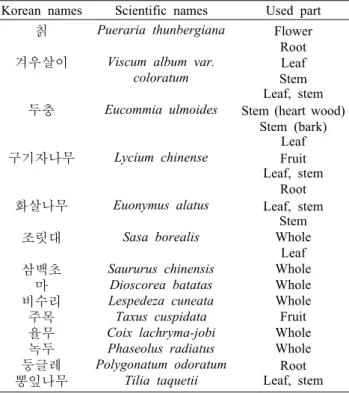
Table 1. Medicinal plants and herbs used for experiments
Korean names Scientific names Used part칡 겨우살이
두충
구기자나무
화살나무 조릿대 삼백초
마 비수리
주목 율무 녹두 둥글레 뽕잎나무
Pueraria thunbergiana Viscum album var.
coloratum Eucommia ulmoides
Lycium chinense
Euonymus alatus Sasa borealis Saururus chinensis
Dioscorea batatas Lespedeza cuneata
Taxus cuspidata Coix lachryma-jobi Phaseolus radiatus Polygonatum odoratum
Tilia taquetii
Flower Root Leaf Leaf, stemStem Stem (heart wood)
Stem (bark) Leaf Fruit Leaf, stem
Root Leaf, stem
Stem Whole
Leaf Whole Whole Whole Fruit Whole Whole Root Leaf, stem 성 화합물로 나무, 줄기, 잎, 열매, 뿌리, 꽃, 씨앗 등의 모든 부분에 존재하며, 이들 성분은 유리 라디칼의 생성을 지연시 키거나 활성을 저해하는 항산화물질로 작용한다(11,12).
이에 본 연구는 약용식물 23종을 선정하여 총 폴리페놀 함량을 측정한 후 DPPH 라디칼 소거능을 측정하고 항당뇨 활성으로는 α-amylase 저해 활성, α-glucosidase 저해 활 성을 검정하여 혈당강하 활성을 나타낼 수 있는 약용식물을 선발하고자 한다.
재료 및 방법
실험재료
23종의 소재들은 한국식물추출은행(Daejeon, Korea)에 분양받아 시료로 사용하였다. 칡(꽃/뿌리), 겨우살이(잎/줄 기/잎과 줄기), 두충(줄기심재/줄기수피/잎), 구기자나무(열 매/잎과 줄기/뿌리), 화살나무(줄기와 잎/줄기), 조릿대(지 상부/잎) 삼백초, 마, 비수리, 주목열매, 율무, 녹두, 둥굴레, 뽕잎나무(잎줄기)를 부위별로 선정하였다(Table 1).
총 폴리페놀 함량 측정
총 폴리페놀 함량은 Dewanto 등(13)의 방법에 따라 측정 하였다. 메탄올 추출물 100 μL에 2% Na2CO3 용액 2 mL를 가한 후 50% Folin-Ciocalteu reagent(Sigma-Aldrich Co., St. Louis, MO, USA) 100 μL를 첨가하여 실온에서 30분간 방치 후 반응액의 흡광도 값을 750 nm에서 측정하였다. 표 준물질로 gallic acid(Sigma-Aldrich Co.)를 5, 10, 25 및 50배로 희석하여 사용하였으며, 검량선 작성 후 총 폴리페
놀 함량은 시료 1 g 중의 mg gallic acid로 나타내었다.
DPPH radical 소거능 측정
DPPH radical 소거능은 Hwang 등(14)의 방법을 변형하 여 측정하였다. 메탄올 추출물 0.2 mL에 0.2 mM DPPH (Sigma-Aldrich Co.) 용액 0.8 mL를 가하여 실온에서 60 분간 방치한 후 520 nm에서 흡광도를 측정하였다.
α-Glucosidase 저해 활성 측정
α-Glucosidase 저해 활성은 Tibbot과 Skadsen(15)의 방법에 따라 측정하였다. α-Glucosidase(0.35 U/mL)와 ρ- nitrophenyl-α-D
-
glucopyranoside(1.5 mM, PNPG)는 0.1 M sodium phosphate buffer(pH 7.0)에 용해하여 사용하였 으며, 각각의 추출물 50 μL를 0.35 unit/mL α-glucosidase 효소액 100 μL와 혼합하여 37°C에서 10분간 전배양한 후 1.5 mM PNPG 50 μL를 가하여 37°C에서 20분간 반응시켰 다. 1 M Na2CO3 1 mL를 가하여 반응을 정지시킨 후 ELISA (UV-1650PC, Shimadzu, Kyoto, Japan)를 사용하여 405 nm에서 흡광도를 측정하고 저해율(%)을 계산하였으며, 양 성대조군으로 acarbose(Sigma-Aldrich Co.)를 사용하였다.α-Amylase 저해 활성
α-Amylase 저해 활성은 Stirpe과 Corte(16)의 방법을 변형하여 측정하였다. 추출물 125 μL에 12 unit/mL pan- creatin 기원의 α-amylase 효소액 62.5 μL, 200 mM po- tassium phosphate buffer(pH 6.8) 62.5 μL와 혼합하여 37°C에서 10분간 전배양한 후 1% starch를 125 μL 가하여 37°C에서 5분간 반응시켰다. 반응액에 48 mM 3,5-dini- trosalicylic acid(DNS, 30% sodium potassium tartrate in 0.5 M NaOH) 발색시약 125 μL를 넣고 100°C에서 15분간 끓여 발색을 시킨 후 충분히 냉각시키고, 이 반응액에 3배량 의 증류수를 가한 후 ELISA(UV-1650PC, Shimadzu)를 사용 하여 540 nm에서 흡광도를 측정하고 저해율을 계산하였다.
통계처리
실험에서 얻어진 결과의 통계적 유의성은 SPSS(Statis- tical Package for Social Sciences, version 12.0, SPSS Inc., Chicago, IL, USA)를 이용하여 평균±표준오차로 나 타내었고, 각 농도의 평균치의 통계적 유의성을
P
<0.05 수 준에서 Duncan's multiple range test에 의해 검정하였다.항산화 및 항당뇨 활성 간의 상관관계는 Pearson's corre- lation analysis를 통하여 분석하였다.
결과 및 고찰
약용식물의 총 폴리페놀 함량
식물의 2차 대사산물로서 하나 이상의 수산기가 치환된 벤젠환을 가지고 있는 phenolic acid, flavonoid, antho-
Table 2. Total phenolic contents of the methanol extracts from medicinal plants
Korean names Scientific names Used part Total polyphenol (mg GAE1)/extract g) 칡
겨우살이
두충
구기자나무
화살나무 조릿대 삼백초
마 비수리
주목 율무 녹두 둥글레 뽕잎나무
Pueraria thunbergiana Viscum album var. coloratum
Eucommia ulmoides
Lycium chinense
Euonymus alatus Sasa borealis Saururus chinensis
Dioscorea batatas Lespedeza cuneata
Taxus cuspidata Coix lachryma-jobi Phaseolus radiatus Polygonatum odoratum
Tilia taquetii
Flower Root Leaf Stem Leaf, stem Stem (heart wood)
Stem (bark) Leaf Fruit Leaf, stem
Root Leaf, stem
Stem Whole
Leaf Whole Whole Whole Fruit Whole Whole Root Leaf, stem
6.05±0.05h2)3) 5.59±0.01i 5.35±0.03j 5.32±0.03j 5.10±0.06K 4.02±0.01o 3.57±0.03q 14.24±0.08b 3.25±0.02s 7.51±0.02g 7.83±0.03f 4.92±0.03l 15.12±0.03a 4.68±0.09m 3.72±0.01p 3.19±0.02s 13.47±0.02d 13.69±0.06c 15.25±0.08a 3.45±0.01r 4.31±0.02n 1.50±0.08t 12.50±0.12e
1)GAE gallic acid equivalents. 2)Mean±SD (n=3).
3)Different superscripts (a-t) in a column indicate significant differences at P<0.05 by Duncan's multiple range test.
cyanin, condensed tannin과 같은 다양한 구조의 화합물을 폴리페놀 화합물이라고 하며(17,18), 이러한 페놀성 분자들 은 체내에서 항산화, 항비만 및 항염증 등과 같은 생리활성 을 가지고 있는 것으로 알려져 있다(19,20). 특히 페놀성 화합물에 존재하는 hydroxyl group은 ROS를 제거하는 역 할과 동시에 ROS의 생성에 기여하는 금속이온을 흡착하는 특별한 구조를 가지기 때문에 높은 항산화 활성을 가지는 것으로 알려져 있다(21,22).
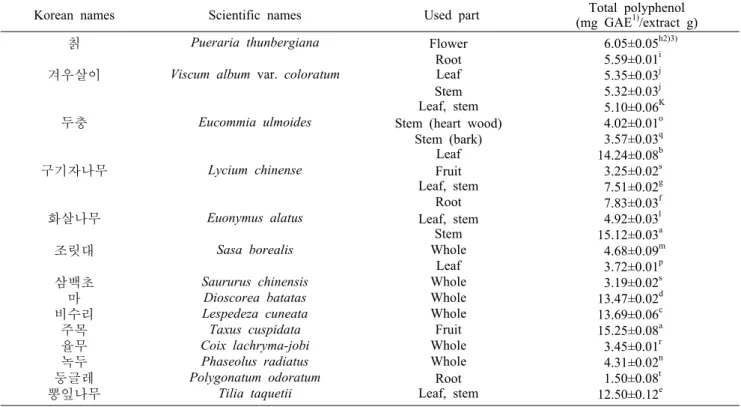
약용식물 23종의 총 폴리페놀 함량은 Table 2와 같다.
총 폴리페놀 함량은 gallic acid를 표준용액으로 하여 작성 한 검정곡선으로부터 약용 추출물의 폴리페놀 함량을 분석 한 결과 1.50~15.25 mg gallic acid equivalent(GAE)/g의 함량 범위로 나타났다. 10~15 mg GAE/g 함량 범위로는 두충잎, 화살나무 줄기, 마, 비수리, 주목열매, 뽕잎나무 잎 줄기 부위로 나타났다. Shin 등(23)은 한약재 열수 추출물의 총 폴리페놀 함량 측정 결과 황금 추출액(2.25 mg GAE/
mL)과 금은화 추출액(2.21 mg GAE/mL)이 가장 높은 함량 을 보였으며, 의이인 추출액(0.01 mg GAE/mL), 백복령 추 출액(0.01 mg GAE/mL), 길경 추출액(0.02 mg GAE/mL), 총백 추출액(0.02 mg GAE/mL)이 낮은 함량의 연구 결과를 나타냈다.
약용식물류를 이용한 항산화 물질의 검정 결과 시료 중의 총 폴리페놀 함량이 약용식물의 종류에 따라 매우 상이한 것으로 나타났다. 본 연구에서 총 폴리페놀 함량이 높은 약 용식물 부위로는 화살나무 줄기, 마, 주목열매, 뽕잎나무 잎
줄기로 기능성 소재로써의 이용 가능성이 높을 것으로 예상 된다.
약용식물의 DPPH radical 소거능 측정
특유의 자색을 나타내는 DPPH는 분자 내에 free radical 을 가지고 있어 항산화 작용을 나타내는 ascorbate, toco- pherol, BHA, Maillard형 갈변생성물질 등에 의해 환원되 어 탈색이 되는 특성을 가지고 있다(17). DPPH 라디칼 소거 법은 DPPH의 짙은 자색이 탈색되는 정도에 따라 그 물질의 항산화능을 나타내는 방법으로 일반적으로 많이 사용되고 있다(24).
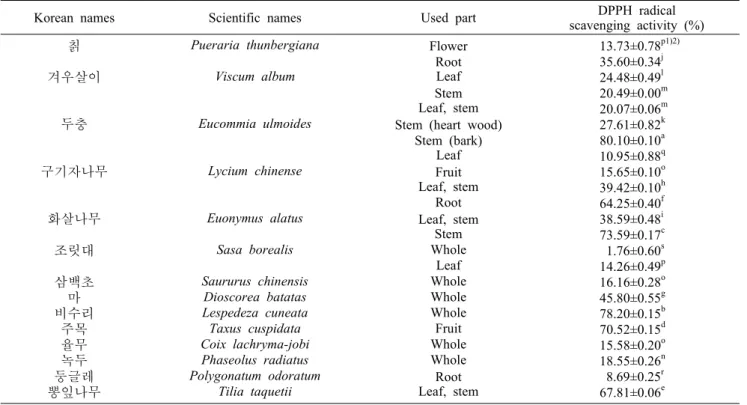
Ascorbic acid를 양성 대조군으로 하여 23종 약용식물 메탄올 추출물(4 mg/mL)의 DPPH radical 소거능에 대한 결과는 Table 3과 같다. 60% 이상의 DPPH 라디칼 소거능 을 보인 약용식물로는 두충 줄기수피(80.10%), 구기자나무 뿌리(64.25%), 화살나무 줄기(73.59%), 비수리(78.20%), 주목열매(70.52%), 뽕잎나무 잎줄기(67.81%) 부위로 나타 났다.
Nam과 Kang(25)은 130여종의 식물성 한약재 열수 추출 물의 항산화 활성을 검증한 결과 25종이 대조군에 비해 80%
이상의 전자공여능을 나타내었으며 항변이원성 효과를 동 시에 가지는 한약재도 12종이라고 보고하였다. Jung 등(26) 은 한약재의 식물체가 그 사용 부위에 따라 전자공여능의 차이를 나타내기도 한다고 보고하였다. Kang 등(27)의 보 고에 의하면 전자공여능이 phenolic acids와 flavonoids 및
Table 3. DPPH radical scavenging activity of medicinal plant methanol extracts
Korean names Scientific names Used part DPPH radical
scavenging activity (%) 칡
겨우살이
두충
구기자나무
화살나무 조릿대 삼백초
마 비수리
주목 율무 녹두 둥글레 뽕잎나무
Pueraria thunbergiana Viscum album
Eucommia ulmoides
Lycium chinense
Euonymus alatus Sasa borealis Saururus chinensis
Dioscorea batatas Lespedeza cuneata
Taxus cuspidata Coix lachryma-jobi Phaseolus radiatus Polygonatum odoratum
Tilia taquetii
Flower RootLeaf Stem Leaf, stem Stem (heart wood)
Stem (bark) Leaf Fruit Leaf, stem
Root Leaf, stem
Stem Whole
Leaf Whole Whole Whole Fruit Whole Whole Leaf, stemRoot
13.73±0.78p1)2) 35.60±0.34j 24.48±0.49l 20.49±0.00m 20.07±0.06m 27.61±0.82k 80.10±0.10a 10.95±0.88q 15.65±0.10o 39.42±0.10h 64.25±0.40f 38.59±0.48i 73.59±0.17c 1.76±0.60s 14.26±0.49p 16.16±0.28o 45.80±0.55g 78.20±0.15b 70.52±0.15d 15.58±0.20o 18.55±0.26n 8.69±0.25r 67.81±0.06e
1)Mean±SD (n=3).
2)Different superscripts (a-s) in a column indicate significant differences at P<0.05 by Duncan's multiple range test.
기타 phenol성 물질에 대한 항산화 작용의 지표라고 하였으 며, 이러한 물질은 환원력이 큰 것일수록 전자공여능이 높다 고 하였다. 본 연구에서도 약용식물 추출물들의 폴리페놀 함량의 결과와 일치하는 경향으로 DPPH 라디칼 소거능을 가지는 것을 확인하였다.
약용식물의 α-glucosidase 및 α-amylase 저해 활성 측정
당뇨병 환자의 경우 급격히 상승하는 과도한 혈당 및 고혈 당증이 지속됨에 따라 발생하는 활성산소(reactive oxygen species; ROS)들로 인해 당뇨병의 복합증세인 신경장애, 신 장해, 그리고 망막증 등과 같은 질병이 발생하게 된다(28).따라서 효율적인 당뇨병의 관리를 위해서는 α-glucosidase 및 α-amylase 저해 활성과 활성산소를 제거할 수 있는 항산 화 활성을 갖는 소재가 필요하다.
α-Glucosidase 저해제는 소장점막의 미세융모막에 존재 하는 이당류의 분해효소를 가역적으로 억제하여 탄수화물 의 흡수를 지연시키는 역할을 하며, 소장 전체에 포도당이 흡수되어 식후 혈당 상승을 완만하게 한다(29).
본 연구에서는 약용식물 23종을 대상으로 α-glucosidase 저해 활성을 측정하여 향후 혈당상승 억제제로 활용될 수 있는 소재를 선발 및 탐색하였다. 실험 결과(Table 4) 대조 구인 acarbose는 80% 정도의 α-glucosidase 저해 활성을 나타냈으며, 이에 약용식물 23종을 대상으로 제조한 메탄올 추출물(5 mg/mL)의 소재도 역시 80% 이상의 α-glucosi- dase 저해 활성을 나타내는 소재들로 선발하게 되었다. 약
용식물 메탄올 추출물에서 두충 줄기심재, 두충 줄기수피, 화살나무 줄기, 마, 율무, 녹두 6종이 80% 이상의 우수한 α-glucosidase 저해 활성을 나타내었다. 두충은 astragalin, isoquercitrin, qeurcetin 3-O-β-D-xylopyranosyl(1-2)- β-D-glucopyranoside 3종의 flavonoid 화합물을 가지고 있으며, lignan과 iridoid 등의 생리활성물질을 지니는 것으 로 보고되고 있다(30).
α-Amylase는 탄수화물의 α-D-(1,4)-glucan 결합을 분 해하는 효소이고, α-glucosidase 소장 상피세포의 brush- border membrane에 존재하는 효소로 소장에서 음식물 중 의 전분을 포도당과 같은 단당으로 분해하여 흡수시킨다 (31). 따라서 소장의 α-amylase와 α-glucosidase를 저해 함으로써 포도당의 흡수를 지연시킬 수 있어 α-amylase와 α-glucosidase의 저해 활성은 혈당수치 상승 억제의 지표로 사용된다(31,32).
23종의 메탄올 추출물 5 mg/mL의 농도로 대조구인 acarbose의 저해 활성과 같은 α-amylase를 80% 이상 저 해한 약용식물로는 칡뿌리, 두충 줄기수피, 두충잎, 구기자 열매, 화살나무 잎줄기, 화살나무 줄기, 조릿대 지상부, 마, 뽕잎나무 잎줄기 부위 추출물 9종이 선발되었다(Table 4).
특히 α-amylase 90% 이상 저해 활성을 나타내는 약용식물 로는 두충잎 추출물, 뽕잎나무 잎줄기 추출물, 화살나무 줄 기 추출물로 나타났다.
이와 같이 약용식물에는 탄수화물의 소화효소를 억제하 는 성분들이 풍부하게 분포되어 α-glucosidase, α-amylase
Table 4. α-Glucosidase and α-amylase inhibition activity of medicinal plant methanol extracts
Korean names Scientific names Used part α-Glucosidase inhibitionactivity (%) α-Amylase inhibition activity (%) 칡
겨우살이
두충
구기자나무
화살나무 조릿대 삼백초
마 비수리
주목 율무 녹두 둥글레 뽕잎나무
Pueraria thunbergiana Viscum album
Eucommia ulmoides
Lycium chinense
Euonymus alatus Sasa borealis Saururus chinensis
Dioscorea batatas Lespedeza cuneata
Taxus cuspidata Coix lachryma-jobi Phaseolus radiatus Polygonatum odoratum
Tilia taquetii
Acarbose (5 mg/mL)Flower Root Leaf Stem Leaf, stem Stem (heart wood)
Stem (bark) Leaf Fruit Leaf, stem
Root Leaf, stem
Stem Whole
Leaf Whole Whole Whole Fruit Whole Whole Leaf, stemRoot
41.50±0.231)n2) 61.84±0.16i 2.49±0.09p 78.45±0.23d 58.28±0.09j 82.13±0.28c 83.50±0.23b 43.65±0.58m 77.43±0.33e 77.14±0.44e 44.90±0.53l 73.70±0.47g 82.06±0.19c 74.72±0.55f 57.88±0.38j 40.94±0.30n 88.71±0.51a 48.45±0.32k 57.88±0.23j 83.22±0.69b 83.67±0.29b 57.94±0.26i 62.78±0.51h 80.28±0.02
42.20±0.23o 83.02±0.36f 3.49±0.28r 74.56±0.65g 57.63±0.65k 72.07±0.36i 89.92±0.70c 92.52±0.40b 87.97±0.73d 61.17±0.44j 73.24±0.47h 84.63±0.43e 92.26±0.43b 82.65±0.43f 6.84±0.28q 40.94±0.30p 89.91±0.76c 48.45±0.32m 51.76±0.73l 41.54±0.57op 57.15±0.57k 44.96±0.49n 96.66±0.37a 80.88±0.02
1)Values are mean±SE (n=3).
2)Different superscripts (a-r) in a column indicate significant differences at P<0.05 by Duncan's multiple range test.
Table 5. Correlation coefficients among total polyphenol con-
tents, DPPH radical scavenging activity, α-glucosidase and α- amylase inhibition activity of medicinal plant methanol extracts
DPPH radical scavenging
activity
α-Glucosidase inhibition
activity
α-Amylase inhibition
activity Total polyphenol
content 0.618** 0.333 0.334**
DPPH radical scavenging activity
0.165 0.326**
α-Glucosidase inhibition activity
0.710**
**
P<0.01.
효소 저해물질을 찾아낼 필요성이 있으며 본 실험 결과 활성 이 우수했던 약용식물들은 추가적으로 세포실험 및 동물실 험을 통해 항당뇨 관련 효능 검증을 실시하고 활성이 검증된 약용식물들은 향후 새로운 의약품개발 및 성인병 예방의 건 강기능식품으로 경쟁력을 확보할 수 있을 것으로 기대된다.
상관관계
약용식물 메탄올 추출물의 항산화 활성 및 항당뇨 활성 간의 상관관계를 분석한 결과는 Table 5와 같다. 총 폴리페 놀 함량은 DPPH 라디칼 소거능 및 α-amylase 저해 활성과 양의 상관관계를 보였으며, 상관계수는 각각 0.618과 0.334
로 나타났다(
P
<0.01). DPPH 라디칼 소거 활성 역시 α- amylase 저해 활성과 양의 상관관계를 보였다(0.326,P
<0.01). α-Glucosidase 저해 활성과 α-amylase 저해 활성 은 0.710으로 높은 양의 상관관계를 나타내었다(
P
<0.01).요 약
약용식물 23종 메탄올 추출물의 폴리페놀 함량을 측정한 후 항산화 활성을 측정하고, 항당뇨 활성으로는 α-amylase 저해 활성, α-glucosidase 저해 활성을 검정하여 혈당강하 활성을 나타낼 수 있는 약용식물을 선발하고자 한다. 약용식 물의 폴리페놀 함량을 분석한 결과 1.50~15.25 mg GAE/g 의 다양한 함량 범위로 나타났으며 가장 높은 함량은 주목열 매(15.25 mg GAE/g), 화살나무줄기(15.12 mg GAE/g), 두 충잎(14.24 mg GAE/g)으로 3종이 나타났다. 60% 이상 DPPH 라디칼 소거능을 본 약용식물로는 두충 줄기수피 (80.10%), 구기자나무 뿌리(64.25%), 화살나무 줄기(73.59
%), 비수리(78.20%), 주목열매(70.52%), 뽕잎나무 잎줄기 (67.81%) 부위 추출물로 6종이 선발되었다. α-Glucosi- dase를 80% 이상 저해한 약용소재로는 두충 줄기심재, 두 충 줄기수피, 화살나무 줄기, 마, 율무, 녹두 6종이 선발되었 다. α-Amylase를 80% 이상 저해한 약용식물로는 칡뿌리, 두충 줄기수피, 두충잎, 구기자 열매, 화살나무 잎줄기, 화살 나무 줄기, 조릿대 지상부, 마, 뽕잎나무 잎줄기 추출물 등
9종이 선발되었다. 항산화 및 항당뇨 활성이 우수했던 약용 식물들은 향후 새로운 의약품 개발 및 성인병 예방의 건강기 능식품으로 개발하는 데 있어 좋은 기초자료로 활용될 것으 로 기대된다.
감사의 글
이 논문은 2014년도 대전보건대학교 교내연구비 지원에 의 한 논문으로 이에 감사드립니다.
REFERENCES
1. Task Force Team for Basic Statistical Study of Korean Diabetes Mellitus of Korean Diabetes Association, Park IB, Kim J, Kim DJ, Chung CH, Oh JY, Park SW, Lee J, Choi KM, Min KW, Park JH, Son HS, Ahn CW, Kim H, Lee S, Lee IB, Choi I, Baik SH. 2013. Diabetes epidemics in Korea: Reappraise nationwide survey of diabetes “Diabetes in Korea 2007”. Diabetes Metab J 37: 233-239.
2. Ido W, Siegal S, Raphael C, Avraham K, Bella K. 2005.
Diabetes mellitus and breast cancer. Lancet Oncol 6: 103- 111.
3. Torres N, Torre-Villalvazo I, Tovar AR. 2006. Regulation of lipid metabolism by soy protein and its implication in disease mediated by lipid disorders. J Nutr Biochem 17:
365-373.
4. Zhao G, Kan J, Li Z, Chen Z. 2005. Structural features and immunological activity of a polysaccharide from Dioscorea
opposita Thumb roots. Carbohydr Polym 61: 125-131.
5. Park HR, Cho JS. 2007. Effects of natural medicinal multi- plant extract on blood glucose, insulin levels, and serum malondialdehyde concentrations in streptozotocin-induced diabetic rats. J East Asian Soc Dietary Life 17: 205-212.
6. Koivisto VA. 1993. Insulin therapy on type Ⅱ diabetes.
Diabetes Care 16: 29-39.
7. Lee HA, Sim HS, Choi KJ, Lee HB. 1998. Hypoglycemic action of red ginseng components (Ⅱ): Investigation of ef- fect of fat soluble fraction from red ginseng on enzymes related to glucose metabolism in cultured rat hapatocytes.
Korean J Ginseng Sci 22: 51-59.
8. Dillmann WH. 1980. Diabetes mellitus induced changes in cardiac myosin of the rat. Diabetes 29: 579-582.
9. Katsube T, Tabata H, Ohta Y, Yamasaki Y, Anuurad E, Shiwaku K, Yamane Y. 2004. Screening for antioxidant ac- tivity in edible plant products: Comparison of low-density lipoprotein oxidation assay, DPPH radical scavenging assay, and Folin-Ciocalteu assay. J Agric Food Chem 52: 2391- 2396.
10. Wang Q, Kuang H, Su Y, Sun Y, Feng J, Guo R, Chan K.
2013. Naturally derived anti-inflammatory compounds from Chinese medicinal plants. J Ethnopharmacol 146: 9-39.
11. Pyo YH, Lee TC, Logendra L, Rogen RT. 2004. Antioxidant activity and phenolic compounds of Swiss chard (Beta vul-
garis subspecies cycla) extracts. Food Chem 85: 19-26.
12. Elzaawely AA, Xuan TD, Koyama H, Tawata S. 2007.
Antioxidant activity and contents of essential oil and phe- nolic compounds in flowers and seeds of Alpinia zerumbet (Pers.) B.L. Burtt. & R.M. Sm. Food Chem 104: 1648-1653.
13. Dewanto V, Wu X, Liu RH. 2002. Processed sweet corn has higher antioxidant activity. J Agric Food Chem 50: 4959- 4964.
14. Hwang IG, Woo KS, Kim TM, Kim DJ, Yang MH, Jeong HS. 2006. Change of physicochemical characteristics of Ko- rean pear (Pyrus pyrifolia Nakai) juice with heat treatment conditions. Korean J Food Sci Technol 38: 342-347.
15. Tibbot BK, Skadsen RW. 1996. Molecular cloning and char- acterization of a gibberellin-inducible, putative α-glucosi- dase gene from barley. Plant Mol Biol 30: 229-241.
16. Stirpe F, Corte ED. 1969. The regulation of rat liver xan- thine oxidase. J Biol Chem 244: 3855-3863.
17. Braca A, De Tommasi N, Di Bari L, Pizza C, Politi M, Morelli I. 2001. Antioxidant principles from Bauhinia ter-
apotensis. J Nat Prod 64: 892-895.
18. Kim MJ, Park E. 2011. Feature analysis of different in vitro antioxidant capacity assays and their application to fruit and vegetable samples. J Korean Soc Food Sci Nutr 40: 1053- 1062.
19. Yu MH, Im HG, Lee HJ, Ji YJ, Lee IS. 2006. Components and their antioxidative activities of methanol extracts from sarcocarp and seed of Zizyphus jujuba var. inermis Rehder.
Korean J Food Sci Technol 38: 128-134.
20. Kang MH, Cho CS, Kim ZS, Chung HK, Min KS, Park CG, Park HW. 2002. Antioxidative activities of ethanol extract prepared from leaves, seed, branch and aerial part of Crota-
laria sessiflora L. Korean J Food Sci Technol 34: 1098-1102.
21. Lee SY, Shin YJ, Park JH, Kim SM, Park CS. 2008. An analysis of the Gyungokgo's ingredients and a comparison study on anti-oxidation effects according to the kinds of extract. Kor J Herbology 23: 123-136.
22. Kalt W, Hanneken A, Milbury P, Tremblay F. 2010. Recent research on polyphenolics in vision and eye health. J Agric
Food Chem 58: 4001-4007.
23. Shin YJ, Hwang JM, Lee SC. 2013. Antioxidant and xan- thine oxidase inhibitory activities of hot water extracts of medicinal herbs. J Korean Soc Food Sci Nutr 42: 1712-1716.
24. Carmela L, Davide F. 2011. Silybin and the liver: From basic research to clinical practice. World J Gastroenterol 17:
2288-2301.
25. Nam SH, Kang MY. 2000. Screening of antioxidative activ- ity of hot-water extracts form medicinal plants. J Korean
Soc Agric Chem Biotechnol 43: 141-147.
26. Jung SJ, Lee JH, Song HN, Seong NS, Lee SE, Baek NI.
2004. Screening for antioxidant activity of plant medicinal extracts. J Korean Soc Appl Biol Chem 47: 135-140.
27. Kang YH, Park YK, Oh SR, Moon KD. 1995. Studies on the physiological functionality of pine needle and mugwort extracts. Korean J Food Sci Technol 27: 978-984.
28. McDougall GJ, Stewart D. 2005. The inhibitory effects of berry polyphenols on digestive enzymes. Biofactors 23:
189-195.
29. Kim HY, Lim SH, Park YH, Ham HJ, Lee KJ, Park DS, Kim KH, Kim S. 2011. Screening of α-amylase, α-glucosi- dase and lipase inhibitory activity with Gangwon-do wild plants extracts. J Korean Soc Food Sci Nutr 40: 308-315.
30. Watanabe J, Kawabata J, Kurihara H, Niki R. 1997. Isolation and identification of α-glucosidase inhibitors from Tochu- cha (Eucommia ulmoides). Biosci Biotechnol Biochem 61:
177-178.
31. Lee BB, Park SR, Han CS, Han DY, Park E, Park HR, Lee SC. 2008. Antioxidant activity and inhibition activity against α-amylase and α-glucosidase of Viola mandshurica extracts.
J Korean Soc Food Sci Nutr 37: 405-409.
32. Oh S, Hong SS, Kim YH, Koh SC. 2008. Screening of bio- logical activities in fern plants native to Jeju Island. Korean