Korean J. Soil Sci. Fert. 40(1), 83-84(2007)
Global climate change is the crucial environmental issue of the twenty first century for all of the countries in the world (Intergovernmental Panel on Climate Change [IPCC], 2001). Temperature change has already been reported from the many observations (Lal, 2004). IPCC (2001) reported that global temperature increased 0.6 ℃ during the twentieth century. The carbon cycle is involved in the cause and remediation of the global climate change (Scholes and Noble, 2001). Carbon dioxide concentration in atmosphere has rapidly increased for the last century mainly because of fast increasing in fossil fuel consumption (Lal, 2004). There is no absolute solution to address global warming problem except stopping use of fossil fuel. Unfortunately, current technology doesn't provide enough alternative energy source, that can replace the fossil fuels. Reduced consumption of fossil fuels may be the long-term goal for mitigating global climate change and other solutions could be temporary or short-term (Lal et al., 2004). Prior to industrial development, deforestation and land cultivation were the main sources of carbon dioxide (CO
2) emission (West and Post, 2002). Numerous studies found that plant and soil could be either sources or storages of carbon dioxide in atmosphere (Robert, 2006). Kyoto protocol addressed that carbon sequestration in agricultural soils was accepted to store carbon into the soils (Lal, 2004). What does carbon plays in the soils? Organic carbon originally comes from plant residues and returning capacity is depending on moisture, temperature, and nutrients. Micro organism decomposes fresh organic materials and emits carbon dioxide into atmosphere through respiration (Bernoux, 2006). In natural ecosystem, atmospheric carbon dioxide concentration and soil organic carbon may sustain a natural equilibrium without any external impacts.
Paddy is a predominant (i.e., greater than 55% of agricultural land) land-use type in Korean agriculture because rice has long been cultivated as a staple crop.
Paddy soils are usually kept under flooded condition for over 90% of growing period because paddy rice plant requires lots of water during the growth. Flooded paddy soils are in reduced condition because of limited aeration.
Despite chemical fertilizer application rate has been significantly reduced for a past decade, annual tillage, puddling in the saturated paddy soil, and transplanting have generally been considered as a standard rice farming practice in Korea. In addition, paddy field is left in bare soil after harvest for almost half a year. Much of rice straws are removed out of paddy field to feed cattle. Plant roots are the only source of carbon in the paddy soils expecting external input of organic materials. Numerous studies have recommended that conservation practices, such as soil erosion control, reduced tillage, no-till, increasing of plant residues, changing of cropping systems, and judicious soil management may contribute to increase organic carbon into the soils and to mitigate emission of green house gases to atmosphere (Halvorson et al., 2002; Hooker et al., 2005; Kimble et al., 2002). A few studies reported soil organic carbon dynamics on Korean soils (Jung and Kim, 2006a; 2006b).
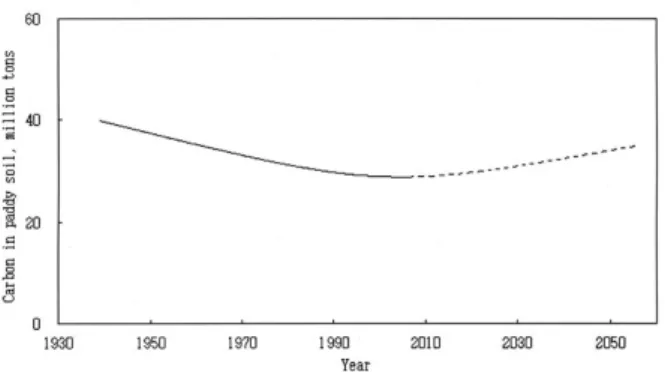
Korean paddy area has increased until to 1990, to a peak and tended to decrease thereafter. Soil organic carbon in Korean paddy soils have continually decreased since 1940' and slightly increased after hitting the bottom in 1999. This trend could be explained by adoption of environment friendly agriculture, which is the agricultural practice based on judicious soil management, and transition of an agricultural paradigm from yield-oriented agriculture to quality-oriented agriculture. Carbon amount in Korean paddy field, which was estimated from the paddy area and soil organic carbon content at the top 0.15-m soil depth from the surface (National Institute of Agricultural Science and Technology [NIAST], 2003), has been significantly decreased since 1940's. But recently soil organic carbon content tended to increase (i.e., 0.11 g kg
-1yr
-1at top 0.15 m soil on mass base) slightly since 1999.
Assuming a scenario that soil organic carbon will increase by 1.1% in gravimetric annually (Fig. 1) since
Received : 23 January 2007 Accepted : 16 February 2007*Corresponding author: Phone : +82312900276, E-mail : [email protected]
Short communication
Storing Carbon in Paddy Land
Won-Kyo Jung
National Institute of Agricultural Science and Technology, RDA, Suwon, 441-707, Korea
Won-Kyo Jung
84
1999, four million and nine million tons of carbon might be sequestrated into the paddy soils in 2030 and 2050, respectively. Possibly, soil organic carbon may sustain or decrease from the current level in the paddy soil.
Obviously storing carbon into the soil highly depends on its management. Previous studies suggested that adoption of conservation farming and judicious soil management could accelerate storing carbon into the soil.
Therefore, I suggest that carbon oriented paddy soil management studies, such as, changing of soil tillage practices and returning of plant residues into the soil, cover cropping systems and other related technologies, are immediately started with collaboration of diverse areas of researchers. In conclusion, storing carbon in paddy field with judicious soil management may contribute to mitigate global warming, at least partially.
References
Bernoux, M., C. Feller, C.C. Cerri, V. Eschenbrenner, and C.E.
Cerri. 2006. Soil carbon sequestration. p. 13-22. In E.J. Roose et al. (ed.) Soil erosion and carbon dynamics. CRC press, Boca Ranton, FL, USA.
Halvorson, A.O., B.J. Wienhold, and A.L. Black. 2002. Tillage, Nitrate, and cropping system effects on soil organic sequestration.
Soil Sci. Soc. Am. J. 66:906-912.
Hooker, B.A., T.F. Morris, R. Peters, and Z.G. Gardon. 2005. Long- term effects oftillage and corn stalk return on soil carbon dynamics. Soil Sci. Soc. Am. J. 69:188-196.
IPCC. 2001. The third assessment report, Climate Change 2001, Cambridge University Press, Cambridge.
Jung, W.K. and Y.H. Kim. 2006a. Soil organic carbon determination for calcareous soils. Korean J. Soil Sci. Fert. 39:396- 402.
Jung, W.K. and S.K. Kim. 2006b. Soil organic carbon dynamics in Korean paddy soils. Korean J. Soil Sci. Fert. 40:36-42.
Kimble, J.M., L.R. Everett, R. Follett, and R. Lal. 2002. Carbon sequestration and the integration of science, farming, and policy. p.
3-11. In J.M. Kimble et al. (ed.) Agricultural practices and policies for carbon sequestration in soil. CRC press LLC, Boca Raton, FL, USA.
Lal, R. 2002. Why carbon sequestration in agricultural soils. p. 21- 31. In J.M. Kimble et al. (ed.) Agricultural practices and policies for carbon sequestration in soil. CRC press LLC, Boca Raton, FL, USA.
Lal, R. 2004. Soil carbon sequestration impact on global climate change and food security. Science. 304:1623-1626.
Lal, R., M. Griffin, J. Apt, L. Lave, and M.G. Morgan. 2004.
Managing soil carbon. Science. 304:393.
NIAST. 2003. Annual report of the monitoring project on agricultural environment. NIAST-RDA, Suwon, KOREA Robert, M. 2006. Global change and carbon cycle: the position of
soils and agriculture. p. 3-12 In E.J. Roose et al. (ed.) Soil erosion and carbon dynamics. CRC press, Boca Ranton, FL, USA.
Scholes, R.J. and I.R. Noble. 2001. Storing carbon on land. Science.
294:1012-1013.
West, T.O. and W.M. Post. 2002. Soil organic carbon sequestration rates by tillage and crop rotation: a global data analysis. Soil Sci.
Soc. Am. J. 66:1930-1946.
Fig. 1. Carbon storage trend on Korean paddy soils is estimated from the soil testing data obtained by NIAST in nationwide scale from 1940's to 2003. Solid line represents the trend of soil organic carbon dynamics with consideration of paddy area and soil organic carbon content at the top 0.15 m of soil depth. Dotted line represents an estimation of soil carbon storage changes in paddy soils with assuming of 1.1%
of soil organic carbon increase annually.