• 검색 결과가 없습니다.

The Metabolic Effects of FGF21: From Physiology to Pharmacology

N/A
N/A
Protected

Academic year: 2021

Share "The Metabolic Effects of FGF21: From Physiology to Pharmacology"

Copied!
11
0
0

로드 중.... (전체 텍스트 보기)

전체 글

(1)

The Metabolic Effects of FGF21: From Physiology to Pharmacology

Parkyong Song*

Department of Convergence Medicine, Pusan National University School of Medicine, Yangsan 50612, Korea Received April 8, 2020 /Revised June 23, 2020 /Accepted July 9, 2020

Fibroblast growth factor 21 (FGF21) is an atypical member of the FGF protein family which is highly synthesized in the liver, pancreas, and adipose tissue. Depending on the expression tissue, FGF21 uses endo- or paracrine features to regulate several metabolic pathways including glucose metabolism and energy homeostasis. Different physiologically stressful conditions such as starvation, a ketogenic diet, extreme cold, and mitochondrial dysfunction are known to induce FGF21 synthesis in various tissues to exert either adaptive or defensive mechanisms. More specifically, peroxisome proliferator-activated receptor gamma and peroxisome proliferator-activated receptor alpha control FGF21 expression in adi- pose tissue and liver, respectively. In addition, the pharmacologic administration of FGF21 has been reported to decrease the body weight and improve the insulin sensitivity and lipoprotein profiles of obese mice and type 2 diabetes patients meaning that FGF21 has attracted huge interest as a ther- apeutic agent for type 2 diabetes, obesity, and non-alcoholic fatty liver disease. However, under- standing FGF21 remains complicated due to the paradoxical condition of its tissue-dependent expression.

For example, nutrient deprivation largely increases hepatic FGF21 levels whereas adipose tissue-de- rived FGF21 is increased under feeding condition. This review discusses the issues of interest that have arisen from existing publications, including the tissue-specific function of FGF21 and its action mechanism. We also summarize the current stage of a clinical trial using several FGF21 analogs.

Key words : β-klotho (KLB), energy metabolism, FGF (Fibroblast growth factor) 21, metabolic disease, thermogenesis

*Corresponding author

*Tel : +82-51-510-8061, Fax : +82-51-510-8526

*E-mail : [email protected]

This is an Open-Access article distributed under the terms of the Creative Commons Attribution Non-Commercial License (http://creativecommons.org/licenses/by-nc/3.0) which permits unrestricted non-commercial use, distribution, and reproduction in any medium, provided the original work is properly cited.

서 론

서구화된 식습관 및 체질 변화로 인해 비만(obesity), 인슐 린 저항성(insulin resistance), 고지혈증(hyperlipidemia)과 같 은 대사 증후군(Metabolic syndrome) 의 발병률은 꾸준히 증 가하고 있다. 보건복지부와 질병관리본부의 2017년 국민 건강 통계에 따르면, 19세 이상 성인 가운데 비만 척도인 체질량지 수(BMI)가 25 이상인 비만 유병률은 2005년 31.3%에서 2016년 34.8%로 증가했고, 전 세계적으로도 30% 이상이 과체중이나 비만과 관련한 건강 문제를 안고 있다는 결과 역시 존재한다 [13]. 따라서 이와 같은 대사 질환을 대상으로 체내 안정성이 확보된 신약 개발이 지속적으로 요구되고 있으며, 호르몬 fi- broblast growth factor (FGF)21은 이러한 요구들을 해결할 수 있는 물질로 최근 주목받고 있다[28, 46, 53].

호르몬 FGF21은 섬유아세포 성장인자(fibroblast growth factor)군에 속해 있으며, 체내 대사 조직으로 알려진 간(liver), 지방(adipose tissue), 근육(skeletal muscle) 및 췌장(pancreas)

에서 발현되고 있다[25]. 일반적으로 FGFs들은 heparin bind- ing domain의 존재로 인해 세포에서 분비 된 후, 세포외기질 (extracellular matrix)과 결합하여 autocrine 혹은 paracrine manner로 작용하지만, 이와 대조적으로 FGF21은 heparin binding domain이 결여되어 있어 ECM을 통과하여 체내에서 순환하여 작용하는 endocrine호르몬의 성질도 동시에 가지고 있다[23, 53]. 표적 세포에 도달하게 되면 세포 표면의tyrosine kinase FGF receptor (FGFR) 와 co-receptor β-klotho (KLB) complex에 결합하여 다양한 신호전달 과정을 일으키게 되는 데, 특히 FGFR의 isoform들 중 FGFR1c와 KLB의 복합체가 FGF21의 작용에 중요한 역할을 하고 있음이 밝혀졌다[17]. 지 난 10년간의 연구들을 통해FGF21의 처리 혹은 유전적 과발현 은 diet-induced obese mouse 모델에서 체중 감소, 당내인성 (glucose tolerance) 및 인슐린 민감도(insulin sensitivity)를 증 가시키는 효과를 나타냈고, 또한 지방간 발병 억제 현상을 보 임으로써 대사 증후군 치료제로 주목을 받아 왔다[15, 49, 52, 54]. 하지만 이와 같은 gain-of-function에서 보여지는 에너지 항상성 조절 작용과는 다르게, FGF21 knockout mice의 경우 비만 모델에서 체중 및 혈당 수치에 큰 차이점이 발견되지 않았고, 이와 같은 결과들을 종합해 볼 때 FGF21의 생리적, 약학적 역할에 대한 이해는 여전히 부족한 단계에 있음을 알 수 있다. 따라서 본 총설에서는 생리학적 혹은 약리학적 FGF21 역할을 조직 상호간의 cross-talk을 통한 에너지 대사 조절 측면에서 고찰해 보고 현재 개발중인 FGF21 mimetic 효

- Review -

(2)

A

B C

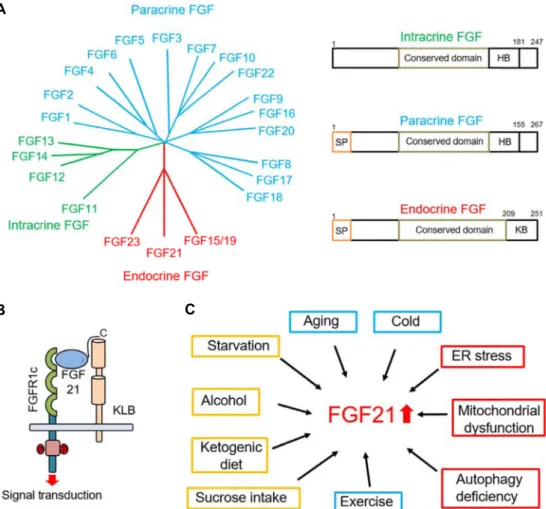
Fig. 1. (A) Phylogenetic analysis of human FGFs. Branch lengths indicate the evolutionary distance between each FGFs. FGFs can be classified into three class, paracrine, intracrine, and endocrine FGF. SP-secreted signal sequence; HB-heparin binding do- main; KB- KLB binding domain. (B) Mechanism of fibroblast growth factor 21 (FGF21). The interaction between FGF receptor (FGFR) and KLB on the cell surface results in formation of the FGF21 receptor complex. Briefly, the FGF21 has a high binding affinity to KLB, and this interaction allows the access of FGF21 to FGFR. Binding of FGF21 to the FGFR/KLB complex results in increased kinase activity and phosphorylation of FGFR. (C) Various physiologic condition for FGF21 expression.

Yellow box means nutrients stimuli and red indicates stress stimuli, involved in protein quality control. Blue means others.

과를 비교 분석함으로써 FGF21의 생체 내 서로 다른 역할들을 이해하는 데 필요한 단서를 제공하고자 한다.

FGF21의 일반적인 특성 및 발현 조건

앞서 언급한 것처럼 FGF21은 fibroblast growth factor 군에 속하지만 다른 FGFs와는 다르게 endocrine 호르몬으로 정의 할 수 있으며(Fig. 1A), 세포 성장이나 분열을 촉진시키지 않는 성질을 가지고 있다[39]. FGF21이 결합하는 FGF receptor는 tyrosine kinase domain을 가지고 있는 single transmembrane 단백질로써 현재까지 4가지 종류의 동위체가 밝혀졌고 FGF21 은 이들 중 주로 FGFR1c 형태에 결합한다고 알려져 있다[2, 24]. 하지만 다른 FGFs들과는 다르게 FGF21의 수용체 결합 친화력은 매우 약하다는 사실이 밝혀졌고(K

d

=2.52 μM) [29],

이를 토대로 FGF21의 정상적인 작용을 위해서는 또 다른

co-receptor의 존재가 필요할 것이라는 추측이 이루어졌다. 이

에 genetic screening 및 또 다른 endocrine 호르몬인 FGF23의

기전을 바탕으로, β-klotho (KLB)라고 하는 단백질이 FGF21

과 높은 친화력으로 결합한다는 사실이 밝혀졌다. 실제적으로

KLB가 존재하지 않는 세포에 KLB를 과발현 시키게 되면

FGF21 처리 후 FGFR의 인산화 및 하위 신호전달 체계가 급격

히 활성화 되었고, 반대로 siRNA를 이용한 KLB의 발현 억제

는 FGF21의 반응성을 심각히 훼손시키는 결과를 나타내었다

[38]. 이와 더불어 후속 연구를 통해 실제 KLB knockout mice

에서도 아래에서 살펴볼 FGF21에 의한 다양한 효과들이 완벽

하게 사라지는 것이 확인되었다[1, 17]. 즉 FGF21이 정상적인

기능을 발휘하기 위해서는 signaling module을 담당하는

FGFR1c와 함께 FGF21을 수용체에 강하게 결합시켜 주는 KLB

(3)

두 단백질이 동시에 필요하다는 것을 알 수 있다(Fig. 1B). 흥미 롭게도 FGFR의 발현은 대부분의 조직에서 관찰 되지만 KLB 는 대사 조직으로 알려진 간, 지방 및 뇌와 같은 한정된 곳에 존재하고 있기 때문에[25], 이와 같은 KLB를 발현하는 장소가 궁극적으로 FGF21이 작용하는 조직이라는 것이 알 수 있다.

보고된 바에 따르면 FGF21의 발현은 주로 간, 갈색 지방, 백색 지방, 근육 및 췌장에서 주로 관찰되고 있다. 비만 환자에 선 혈중 FGF21 양이 증가해 있는 것을 바탕으로 인슐린 저항 성과 비슷하게 FGF21 저항성의 개념이 제시되고 있고[20], 고 지방식 식이와 더불어 다양한 자극에서 위와 같은 조직 내 FGF21의 발현이 증가하고 있음이 밝혀졌다(Fig. 1C). 이 같은 환경들은 대사적인 측면에서 보았을 때 공통적으로 채내 다양 한stress를 유발하는 것을 알 수 있고, 이렇게 증가한 FGF21은 여러 조직에서 stress를 감소시키기 위한 방어적인 기능을 수 행하는 것으로 사료된다. 다음에선 각각의 stress 상황에서 FGF21의 서로 다른 생리학적 역할에 대해 조직 별로 살펴보기 로 한다.

FGF21의 생리학적 기능

Liver

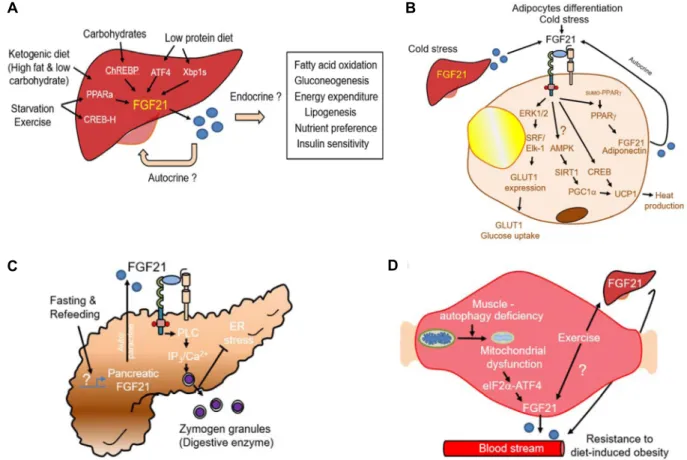
기존 연구에 따르면 정상적인 조건에서 간 조직 특이적 FGF21 knockout mice는 혈중 FGF21의 양이 검출되지 않았고 [49], 이를 통해서 채내 순환하는 FGF21의 주요 공급원은 간이 라는 것을 밝혔다. 최초 간에서 FGF21의 발현 및 분비는 fast- ing 상황에서 증가함이 보고되었고, 특히 starvation 및 keto- genic diet에 의해 증가한 FGF21은 간 조직에서 지방산 산화 및 ketogenesis, 그리고 당신생합성을 촉진하게 되는데[6, 34, 54], 이를 통해 FGF21은 에너지를 생성시켜 결과적으로 항성 성을 유지하는 작용을 하고 있다. FGF21 knockout mice의 경 우 starvation 상황에서 정상적인 혈당 유지에 필요한keto- genesis 및 당신생합성이 일어나지 않아서 저 혈당 상태가 보 다 쉽게 관찰되었고[47], 고지방과 저탄수화물로 구성된 keto- genic diet상황에서는 FGF21에 의한 지방산 산화가 일어나지 않아서 결과적으로 심각한 지방간 혹은 steatosis 현상이 보고 되었다[5]. 특히 starvation 상황 및 ketogenic diet 상황에서 FGF21의 발현 조절은 전사 인자인 peroxisome proliferator- activated receptor α (PPARα)가 관여하고 있음이 밝혀졌다 (Fig. 2A). 하지만 독립적인 연구자의 결과에 따르면, keto- genic diet 상황에서 WT과 FGF21 knockout mice간에 지방 산화 및 간 무게에 큰 차이가 발견되지 않았고 energy ex- penditure의 차이도 크게 관찰되지 않았다[59]. 이러한 차이점 들이 관찰되는 이유는 정확하지 않지만 각각의 실험에서 ke- togenic diet에 얼마나 노출이 되었는지, 혹은 각 mice의 ge- netic background 차이를 고려해야 할 것으로 판단된다.

또한 최근 연구에 따르면 저단백질 식이 상황에서도 liver

특이적으로 FGF21의 발현이 증가하였고, 이는 아미노산 결핍 상황에서 나타나는 체중 감소 및 간 조직 내 지방 합성 억제와 전반적인food intake 혹은 단백질 선호도 증가를 매개하는 것 으로 밝혀졌다[30, 45]. 또 다른 FGF21 발현 유도 환경인ER stress와 마찬가지로 이 과정에선 activating transcription fac- tor 4 (ATF4) 혹은 IRE1α-XBP1 pathway가 관련되어 있고[14, 35, 42], carbohydrate-responsive element-binding protein (ChREBP) 역시 sucrose 및 fructose에 의해 증가하는 FGF21의 발현과 관계 있음이 밝혀졌다[21](Fig. 2A). 마지막으로 알콜 의 섭취는 밝혀지지 않은 기전을 통해 굉장히 빠른 시간 내에 hepatic FGF21의 발현을 올렸고[58], 독립적인 다른 연구 결과 에 의하면 이렇게 증가한 FGF21은 알콜에 의한 지방간 발병을 억제하는 것이 확인되었다[15]. 이렇듯 다양한 환경에서 증가 하는 hepatic FGF21에 의한 대사적인 결과들, 특히 간 지방산 산화 증가 및 지방 합성 감소들이 간에 직접 작용해 나타나는 autocrine 효과인지 혹은 뇌를 비롯한 다른 조직을 경유한 간 접적인 효과인지는 아직 불분명하기 때문에 이를 밝히기 위해 선 간 조직 특이적KLB knockout mice를 사용한 in vivo 평가 가 필수적이라 생각된다.

Adipose tissue

흥미롭게도 지방 조직에서 FGF21의 발현은 간과는 다르게 peroxisome proliferator-activated receptor γ (PPARγ)를 경유 하여 fasting 이후 refeeding과정에서 증가함이 관찰되었다 [51]. 지방 조직 유래 FGF21의 생리학적 기능을 평가하기 위해 연구자들은 ap2 및 adiponectin cre를 이용한 지방 조직 특이 적FGF21을 제작하였고, 결과적으로 global FGF21 knockout mice와 유사하게 정상적인 인슐린 민감도 및 adiposity가 관 찰 되었으며 이를 바탕으로 FGF21은 일반적인 지방세포 발달 및 분화에 큰 영향을 주지 않음이 밝혀졌다. 하지만 PPARγ 길항제인 (thiazolidinedione, rosiglitazone) 처리 환경에서는 백색 지방의 분화 및 양 증가에 FGF21이 중요한 역할을 하고 있음이 밝혀졌고, 이 때 FGF21이 PPARγ stability를 감소시키 는 inactive modification인 K107 sumoylation을 억제하는 현 상이 그 원인으로 제시되었다[3, 19]. 흥미롭게도 PPARγ K107R mutant mice를 사용한 후속 연구에서 증가한 인슐린 민감도 와 함께, 지방 조직 내 FGF21의 발현이 증가한 결과를 고려해 볼 때[37], FGF21과 PPARγ 간에 양성 조절 관계성이 있는 것 으로 판단된다(Fig. 2B).

흥미롭게도 지방 조직에서 FGF21의 발현이 증가하는 또다

른 조건으로 추위 노출이 있는데[10, 32], 이때 FGF21의 잠재

적인 기능에 대한 결론을 찾고자 FGF21 knockout mice를 사

용하였고, 추위에 노출된 상황에서 FGF21 KO mice는 체온

유지에 중요한 유전자들의 발현 및 실제 체온이 현저히 감소

해 있었다. 후속 연구들을 통해 cold induced FGF21은 ther-

mogenic gene의 발현을 조절하는 PGC1α 양을 증가시켜서

(4)

A B

C D

Fig. 2. (A) Hepatic FGF21 expression is regulated by environmental stress. Different nutritional stimuli, such as ketogenic diet, carbohydrate intake, and low protein diet, result in increased hepatic FGF21 expression. Recent evidence further suggests that starvation and ER stress regulate FGF21 expression through different transcription factors in the liver. Generally, liv- er-derived FGF21 targets both peripheral tissues and the brain for restoring energy homeostasis. (B) FGF21 physiology in adipose tissue. FGF21 induces recruitment of ETS like-1 protein (Elk-1) and serum response factor (SRF) on the promoter region of GLUT1 through extracellular signal-regulated kinase (ERK1/2) phosphorylation. During thermogenic regulation by FGF21, the AMPK-PGC1α as well as the cAMP response element binding protein (CREB) pathway are involved in un- coupling protein 1 (Ucp1) expression. The PPAR-γ-mediated FGF21 expression suppresses sumoylation in PPAR-γ, which contributes to increased PPAR-γ stability. (C) Compared to the liver, pancreatic FGF21 is induced by fasting/refeeding conditions. Pancreatic FGF21 acts in an auto/paracrine manner to stimulate the PLCγ/Ca

2+

pathway and digestive enzyme secretion. FGF21 knockout mice do not secrete zymogen granules under nutrient overload, and are susceptible to pancreatic ER stress. (D) Mitochondrial dysfunction by autophagy deficiency induces muscle-derived FGF21 expression and secretion.

Subsequently, the circulating FGF21 decreases body weight and increases insulin sensitivity in diet-induced obesity.

결과적으로 백색 지방의 browning을 유도하는 데 핵심적인 역할을 하는 cytokine CCL11 발현을 올리는 작용을 하였다 [22, 33]. 이 과정에서 FGF21이 어떻게 PGC1α 양을 증가시키 는지 그 상위 조절자에 대해선 아직 논란이 있지만, 생체 내 에너지 대사 조절 효소인 AMP-activated protein kinase (AMPK) 과 SIRT1의 활성 조절이 관계할 것이라는 연구 결과 가 존재한다[11](Fig. 2B).

갈색 지방 유래 FGF21역시 전신적 단계에서 에너지 항상성 조절에 기여하고 있고, 특히 지속된 고지방식 식단 환경에서 증가한 FGF21은 갈색 지방으로의 포도당 흡수를 촉진시켜 결 과적으로 인슐린 민감도의 증가를 나타나게 한다. In vitro 실 험을 통해 FGF21에 의한 지방 조직으로 포도당 흡수 증가는

ERK1/2 및 ELK-1 신호 전달 과정을 경유해 glucose trans-

porter의 합성 증가 및 세포막 이동이 향상된 결과로 밝혀졌다

[27, 43](Fig. 2B). 또한30일 정도의 장기적인 추위 노출 상황에

서 백색 지방과 마찬가지로 갈색 지방에서FGF21의 발현이 40

배 정도 증가를 보이게 되고, 직접적으로 갈색 지방에 작용해

서 thermogenic gene 발현을 올림으로써 체온 유지에 기여하

게 된다[10]. 하지만 또다른 연구 결과에 따르면 추위 노출 상

황에서 채내 순환하는 FGF21의 양은 hepatic FGF21 knockout

mice에서 관찰되지 않았고, 따라서 체온 유지에 심각한 문제

가 발생하게 되었으며 이 결과들을 종합해 볼 때, 추위 상황에

서 체온 유지에 필요한 FGF21의 source는 간과 갈색 지방 모

두임을 의미하고 있다[4]. 흥미롭게도 Potthoff group의 연구

(5)

결과에 따르면 갈색 지방 특이적 KLB knockout mice를 이용 해 FGF21이 signaling을 억제하였을 때도 정상적인 체온 유지 가 관찰되었기 때문에 in vivo에서 FGF21의 지방 조직 내ther- mogenesis증가는 다른 조직을 경유한 간접적인 결과물이라는 의견도 존재한다[8]. 이와 관련해선 FGF21의 약리학적 기능을 논의할 때 추가적으로 다루어 보고자 한다.

Pancreas and skeletal muscle

외분비 췌장은 여러 종류의 소화 효소를 합성하고 분비하는 조직으로, 특히 외분비 췌장을 구성하고 있는 acinar cell에서 이러한 소화 효소의 합성과 함께 높은 수준의FGF21의 발현이 관찰되고 있다. 지방 조직과 마찬가지로 pancreatic FGF21의 합성은 fasting 후 refeeding 단계에서 뚜렷한 증가를 보이고 있고, 증가한 FGF21는 혈중으로 노출되지 않고 췌장에 auto- crine으로 작용하여 영양소의 소화에 필요한 효소들의 분비를 촉진하는 역할을 수행한다[12](Fig. 2C). 이 연구에 따르면 fasting 후 refeeding 단계에서 FGF21 knockout mice의 외분 비 췌장에선 분비되지 못한 zymogen granules의 축적이 관찰 됨과 동시에 심각한 endoplasmic reticulum (ER) stress 현상 이 나타났고 recombinant FGF21을 처리해 주면 ER stress의 감소가 나타났다. 또한 췌장암 환자에서 혈액 내FGF21의 양이 증가해 있고[36, 57] 췌장암 발병에 중요한 기전 중 하나가 ER stress임을 고려해 볼 때, FGF21이 ER stress를 억제하여 pan- creatitis를 완화시킬 수 있는 가능성이 있다고 사료된다.

앞서 언급했듯이 정상적인 상황에서 채내 순환하는 FGF21 의 주요 source는 간이지만 특정 병리학적인 조건에선 췌장과 함께 근육 역시 FGF21을 분비한다고 알려져 있다. 특히 근육 에서는 미토콘드리아 기능 이상에 따라 FGF21의 발현 및 분비 가 증가하게 되는데[41, 62], 이 연구들에 따르면 근육 특이적 autophagy 결손 상황에서 mitochondrial stress가 유도되고 eIF2α-ATF4 pathway 의존적으로 FGF21의 발현 및 분비가 증 가함이 관찰되었다. 결과적으로 이는 systemic하게 작용하여 고지방식이 유도 비만 및 인슐린 저항성을 감소시키는 결과를 나타내었다(Fig. 2D). 이와 같이 여러 생리학적 환경에서 어떻 게 FGF21이 조직 별로 autocrine (지방, 췌장) 혹은 endocrine (간, 근육) 기전으로 작용하는지에 대해선 아직 명확히 제시된 바가 없기 때문에 앞으로 연구가 필요한 부분이라 사료된다.

FGF21의 약리학적 기능

앞서 살펴본 바와 같이 FGF21은 다양한 stress 환경에서 발현이 증가하여 궁극적으로 adaptive response를 활성화 시 키게 된다. 이러한 생리학적 기능과 비교해서 FGF21의 약리학 적 기능은 주로 비만 및 다양한 대사 질환들을 완화시키는 결과들을 나타내고 있다[26, 40]. Diet-induced obese혹은 db/

db mice model에 FGF21의 단일 처리는 빠른 혈당 강하 효과

를 나타냄과 동시에 hyperinsulinemic-euglycemic clamp 실 험에서 증가한 인슐린 민감도를 나타내었다. 또한 장기간의 FGF21의 처리는 energy expenditure 및 인슐린 민감도의 증 가, 체중의 감소, 지방간 억제 및 혈중 triglyceride의 감소를 보여 주었다[7, 8, 66]. 하지만 이 과정에서 food intake에 변화 가 있는가에 대한 물음과 adiponectin의 존재가 필수적인가에 대한 의견엔 상반된 연구가 존재하고 있다. 이와 더불어 제 2형 당뇨병 환자를 대상으로 한 임상 시험에서도 체중 감소 및 혈중 인슐린 농도의 변화를 포함해 다양한 대사 지표의 개선이 보고되었다[26, 60].

Adipose tissue

이렇듯 처리 기간에 따른 다양한 FGF21의 효과에 있어, FGF21의 co-receptor인 KLB가 발현하고 있는 지방 조직의 기 여도를 확인하기 위해 지방 조직 특이적 KLB mice를 이용하 여 각각의 대사 지표를 비교 분석 해 보았다. 결과적으로 3T3- L1 adipocytes에서 FGF21이 포도당 흡수를 증가시킨 연구 결 과와 연관성 있게 지방 조직에서의 FGF21의 signaling은 혈당 강하 효과와 더불어 insulin-sensitizing 효과를 나타내는 데 중요함을 밝혀냈고, 이 과정에서 특히 brown adipose tissue로 의 상당한 glucose uptake가 일어나는 것이 확인되었다[8, 17].

이와 같은 효과는 지방 조직에 KLB를 과발현시킨 transgenic mice에서도 관찰되었는데[55], 비만 및 염증 유도 모델에서 지방세포 내 KLB의 양이 감소되는 결과와 더불어[16] 지방 조직이 FGF21의 중요한 작용점이라 사료된다. 흥미롭게도 FGF21의 혈당 강하 효과에 있어 지방 조직 유래 adiponectin 이 필요한가에 대해선 상반된 연구 결과가 존재한다. Scherer group 연구에 따르면 FGF21의 처리에 의해 지방 조직에서의 adiponectin의 합성 및 분비가 증가하고, adiponectin knock- out mice를 사용하였을 때 FGF21에 의한 insulin-sensitizing 효과가 억제됨이 밝혀졌다[31, 48]. 이를 바탕으로 FGF21-adi- ponectin의 axis가 FGF21에 의한 혈당 강하에 중요하다고 제 안했지만, 동일 adiponectin knockout mice를 사용한 Potthoff group 연구결과에 따르면 FGF21의 처리 후 수 시간 내에 나타 나는 insulin sensitizing 효과는 WT와 Adipoq KO mice가 유 사함을 알 수 있다[8].

In vitro 연구를 통해 FGF21의 처리는 brown adipocytes에
서 추위 노출 상황과 유사하게 thermogenic gene의 발현을

향상시키고 있음이 밝혀졌다. 이 과정에서 FGF21은 대표적인

Ucp1의 발현을 조절하는 전사 인자인 cAMP response ele-

ment binding protein (CREB)의 인산화를 증가시킴과 동시에

mitochondrial respiration을 조절하는 signal transducer and

activator of transcription 3 (STAT3)의 활성을 향상시켰다

[65]. 이 같은 결과들을 바탕으로 연구자들은 약리학적으로

FGF21을 처리하게 되면 갈색 지방 조직에 직접적으로 작용하

여 thermogenesis를 조절한다는 가설을 확립하게 되었다. 이

(6)

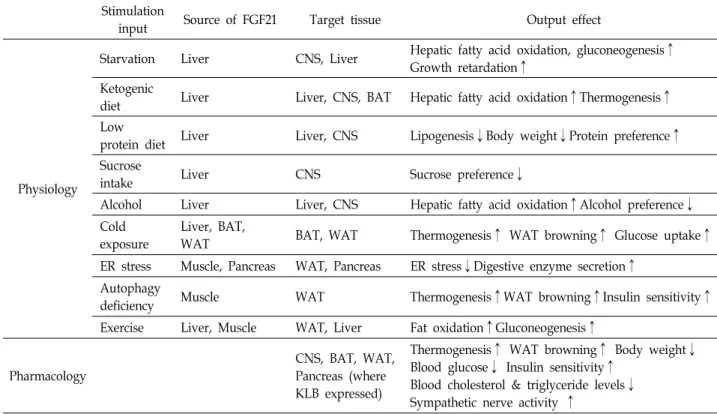
Table 1. Physiologic and Pharmacologic functions of FGF21 Stimulation

input Source of FGF21 Target tissue Output effect

Physiology

Starvation Liver CNS, Liver Hepatic fatty acid oxidation, gluconeogenesis↑

Growth retardation↑

Ketogenic

diet Liver Liver, CNS, BAT Hepatic fatty acid oxidation↑Thermogenesis↑

Low

protein diet Liver Liver, CNS Lipogenesis↓Body weight↓Protein preference↑

Sucrose

intake Liver CNS Sucrose preference↓

Alcohol Liver Liver, CNS Hepatic fatty acid oxidation↑Alcohol preference↓

Cold exposure

Liver, BAT,

WAT BAT, WAT Thermogenesis↑ WAT browning↑ Glucose uptake↑

ER stress Muscle, Pancreas WAT, Pancreas ER stress↓Digestive enzyme secretion↑

Autophagy

deficiency Muscle WAT Thermogenesis↑WAT browning↑Insulin sensitivity↑

Exercise Liver, Muscle WAT, Liver Fat oxidation↑Gluconeogenesis↑

Pharmacology

CNS, BAT, WAT, Pancreas (where KLB expressed)

Thermogenesis↑ WAT browning↑ Body weight↓

Blood glucose↓ Insulin sensitivity↑

Blood cholesterol & triglyceride levels↓

Sympathetic nerve activity ↑ 를 in vivo에서 증명하기 위해 지방 조직 특이적 KLB obese

mice에 2 주간의 FGF21의 처리에서 체중 감소가 어떻게 되는 지 살펴 보았으나, 흥미롭게도 혈당 강하 효과와의 결핍과는 다르게 지방 조직에 FGF21이 작용하지 않아도 체중 감소 및 thermogenesis는 정상적으로 일어났다[8]. 즉 이러한 결과들 은 in vivo에서 acute한 FGF21의 처리에 의한 혈당 강하 현상 에 지방 조직이 필수적이지만 장기 처리 후 나타나는 체중 감소 및 thermogenesis 증가에는 지방 외에 다른 조직이 필요 하다는 결론을 도출하게 되었다.

Central Nerve System (CNS)

중추 신경계는 표적 기관에서 알려주는 여러가지 정보들을 바탕으로 feeding behavior 및 에너지 항상성을 조절하고 있 으며, 특히 뇌 속에 있는 hypothalamus와 nucleus solitary tract (NTS) 부분은 체내 다양한 대사 조절에 중요한 역할을 하고 있다. In situ hybridization을 이용한 연구 결과에 따르면 KLB의 발현이 hypothalamus 및 hindbrain에서 관찰되었고 [9], FGF21이 blood-brain barrier를 통과하여 최척수액에서 발 견됨을 바탕으로[61] FGF21의 chronic한 효과들, 특히 체중 감소가 나타남에 있어 뇌의 필요성을 탐색하게 되었다. 이를 위해 연구자들은 CamK2a cre를 이용하여 neuron 특이적 KLB knockout mice를 제작하였고, FGF21혹은 FGF21 mim- etics 처리에 의한 체중 감소 효과가 중추 신경계에 KLB를 결 손 시켰을 때 완벽하게 사라지는 것이 확인되었다[8, 52]. 기전 연구를 통해 diet-induced obese mice에서 FGF21은 hypothal-

amus 내 paraventricular nucleus (PVN)에서corticotrophin- releasing hormone (CRH)의 발현을 올리고 갈색 지방 내sym- pathetic nerve activity (SNA)를 증가시켜 thermogenic gene 의 발현을 유도하는 것을 알아냈고, 이 과정에서 CRH re- ceptor의 억제제를 사용하면 FGF21 유래 SNA 활성이 억제됨 을 추가적으로 보여 주었다. 연관하여 FGF21에 의한 백색 지 방의 browning 현상이 β-adrenergic receptor antagonist에 의 해 억제됨을 보임으로써[18], brain을 경유한 SNA 활성화 및 β-adrenergic receptor mediated thermogenesis 모두가 FGF21 에 의한 체중 감소를 위해 작용한다고 사료된다. 앞서 언급하 였듯이, FGF21이 갈색 지방 내 직접 작용하여 thermogenic gene 발현을 올리는 가와, FGF21 에 의한 체중 감소에서Ucp1 의 필요성에 대해선 상충되는 결과들이 존재하고 있다[44, 56, 63]. 이에 대한 정확한 원인은 아직 규명되지 않았으나 mice사 육 환경 온도의 차이와 같은 외부 요인에 그 가능성이 있다고 판단된다. 또한 FGF21이 뇌에서 어느 neuron을 활성화 시키 는 지에 관한 단서를 얻기 위해서 single neuron sequencing을 통해 KLB 발현을 확인해봐야 할 필요가 있다고 사료된다. 지 금까지 살펴 본 FGF21의 생리학적, 약리학적 기능 및 각 조직 에서의 역할을 Table 1에 요약 정리하였다.

FGF21 mimetics 개발 현황

현재까지 FGF21 signaling을 활성화 시키는 여러가지 mim-

etics가 개발이 되었다. 가장 큰 이유는 native한 FGF21이 혈액

(7)

내에서 30분에서 1시간 정도의 안정성을 보이는 문제로 인해 임상 적용이 가능한 제형으로 개발하기 위해서 half life를 증 가시킬 필요가 있었다[64]. 따라서 그간 여러 modification을 통하여 FGF21의 생체 이용률을 증가시키려는 시도가 있었고, LY2405319는 FGF21 N terminal의 4개 아미노산 서열의 결손 및 Leu118과 Ala134을 Cysteine으로 치환하여 disulfide bond- ing을 강화하여 혈액 내에서 안정성을 확보하였다[26]. 또한 BMS사에 의해 개발된 FGF21의 PEGylation 형태인 PEG30- Q108 역시 native한 FGF21과 비교해서 향상된 약물동태학적 특성을 보임으로써 혈당 및 간 에서 지방 감소 등과 같은 대사 질환 치료 효과를 보여 주었다[50]. 하지만 위와 같은 FGF21 mimetics는 FGF21 자체에 modification을 통해 개발되었기 때문에 낮은 molecular weight을 가지고 있고 여전히 신장을 통한 clearance 문제가 대두 되었다. 이를 해결하고자 Pfizer에 서는 2개의 FGF21을 antibody scaffold에 부착시켜 약 190 kDa의 분자량을 가지는 PF05231023를 개발하였고[60], 4주동 안 일주일에 2번 투약하는 양으로 LY2405319의 daily in- jection을 통해 나타나는 생체 내 효과와 비슷한 결과를 보여 주었다. 마지막으로 BFKB8488A와 NGM313은 FGFR1과 KLB 를 동시에 인식하는 bispecific antibody로써 현재 clinical trial 을 진행 중에 있다.

결 론

그 동안의 많은 연구로 인해 mice model에서 FGF21은 강력 한 체중 감소 및 인슐린 민감도 향상 효과가 검증 되었고, 이에 여러 종류의 FGF21 mimetics가 임상 시험을 위해 개발되었다.

현재 human study에서도 FGF21 analog 처리시 의미 있는 대사 질환 완화 효과가 보고 되었지만, 혈당 조절 지표상 mim- etics간의 각기 다른 결과들로 인해 아직Phase III로 진행되지 않고 있다. 따라서 mice study와 비교해서 환자에서도 FGF21 에 의한 대사 질환 치료 효과에 있어 각 mimetics별로 어느 조직이 중요한 것인지에 대한 정확한 기전 연구가 향후에 필 요하다고 사료 된다. 더불어 최근 개발된 long-acting GLP-1/

FGF21 dual agonist와 같이 혈당 조절 기능을 하는 또 다른 therapeutics와 결합된 형태의 analogs 형태도 T2D 환자들 대 상으로 좋은 치료법이 될 수 있을 것이라 생각된다. 마지막으 로 일부 연구에서 FGF21에 의한 부작용으로 일주기 생체리듬 의 변화 및 혈압 상승의 결과가 보고 되었기 때문에, 임상 시험 에서도 각각의 mimetics에 따라 위와 같은 생체 지표들의 변 화 여부를 검증하는데 주의를 기울어야 할 것으로 판단된다.

감사의 글

이 논문은 2019~2021년도 부산대학교 기본연구비지원사업 (2년)에 의하여 연구 되었음.

The Conflict of Interest Statement

The authors declare that they have no conflicts of interest with the contents of this article.

References

1. Adams, A. C., Cheng, C. C., Coskun, T. and Kharitonenkov, A. 2012. FGF21 requires betaklotho to act in vivo. PLoS One 7, e49977.

2. Adams, A. C., Yang, C., Coskun, T., Cheng, C. C., Gimeno, R. E., Luo, Y. and Kharitonenkov, A. 2012. The breadth of FGF21's metabolic actions are governed by FGFR1 in adi- pose tissue. Mol. Metab. 2, 31-37.

3. Ahmadian, M., Suh, J. M., Hah, N., Liddle, C., Atkins, A.

R., Downes, M. and Evans, R. M. 2013. PPARgamma signal- ing and metabolism: the good, the bad and the future. Nat.

Med. 19, 557-566.

4. Ameka, M., Markan, K. R., Morgan, D. A., BonDurant, L.

D., Idiga, S. O., Naber, M. C., Zhu, Z., Zingman, L. V., Grobe, J. L., Rahmouni, K. and Potthoff, M. J. 2019. Liver derived FGF21 maintains core body temperature during acute cold exposure. Sci. Rep. 9, 630.

5. Badman, M. K., Koester, A., Flier, J. S., Kharitonenkov, A.

and Maratos-Flier, E. 2009. Fibroblast growth factor 21-defi- cient mice demonstrate impaired adaptation to ketosis.

Endocrinology 150, 4931-4940.

6. Badman, M. K., Pissios, P., Kennedy, A. R., Koukos, G., Flier, J. S. and Maratos-Flier, E. 2007. Hepatic fibroblast growth factor 21 is regulated by PPARalpha and is a key mediator of hepatic lipid metabolism in ketotic states. Cell Metab. 5, 426-437.

7. Berglund, E. D., Li, C. Y., Bina, H. A., Lynes, S. E., Michael, M. D., Shanafelt, A. B., Kharitonenkov, A. and Wasserman, D. H. 2009. Fibroblast growth factor 21 controls glycemia via regulation of hepatic glucose flux and insulin sensitivity.

Endocrinology 150, 4084-4093.

8. BonDurant, L. D., Ameka, M., Naber, M. C., Markan, K.

R., Idiga, S. O., Acevedo, M. R., Walsh, S. A., Ornitz, D.

M. and Potthoff, M. J. 2017. FGF21 Regulates Metabolism Through Adipose-Dependent and -Independent Mechanisms.

Cell Metab. 25, 935-944. e934.

9. Bookout, A. L., de Groot, M. H., Owen, B. M., Lee, S., Gautron, L., Lawrence, H. L., Ding, X., Elmquist, J. K., Takahashi, J. S., Mangelsdorf, D. J. and Kliewer, S. A. 2013.

FGF21 regulates metabolism and circadian behavior by act- ing on the nervous system. Nat. Med. 19, 1147-1152.

10. Chartoumpekis, D. V., Habeos, I. G., Ziros, P. G., Psyrogian- nis, A. I., Kyriazopoulou, V. E. and Papavassiliou, A. G.

2011. Brown adipose tissue responds to cold and adrenergic stimulation by induction of FGF21. Mol. Med. 17, 736-740.

11. Chau, M. D., Gao, J., Yang, Q., Wu, Z., and Gromada, J.

2010. Fibroblast growth factor 21 regulates energy metabo- lism by activating the AMPK-SIRT1-PGC-1alpha pathway.

Proc. Natl. Acad. Sci. USA. 107, 12553-12558.

(8)

12. Coate, K. C., Hernandez, G., Thorne, C. A., Sun, S., Le, T.

D. V., Vale, K., Kliewer, S. A. and Mangelsdorf, D. J. 2017.

FGF21 is an exocrine pancreas secretagogue. Cell Metab. 25, 472-480.

13. Collaborators, G. B. D. O., Afshin, A., Forouzanfar, M. H., Reitsma, M. B., Sur, P., Estep, K., Lee, A., Marczak, L., Mokdad, A. H., Moradi-Lakeh, M., Naghavi, M., Salama, J. S., Vos, T., Abate, K. H., Abbafati, C., Ahmed, M. B., Al- Aly, Z., Alkerwi, A., Al-Raddadi, R., Amare, A. T., Amber- bir, A., Amegah, A. K., Amini, E., Amrock, S. M., Anjana, R. M., Arnlov, J., Asayesh, H., Banerjee, A., Barac, A., Baye, E., Bennett, D. A., Beyene, A. S., Biadgilign, S., Biryukov, S., Bjertness, E., Boneya, D. J., Campos-Nonato, I., Carrero, J. J., Cecilio, P., Cercy, K., Ciobanu, L. G., Cornaby, L., Damtew, S. A., Dandona, L., Dandona, R., Dharmaratne, S.

D., Duncan, B. B., Eshrati, B., Esteghamati, A., Feigin, V.

L., Fernandes, J. C., Furst, T., Gebrehiwot, T. T., Gold, A., Gona, P. N., Goto, A., Habtewold, T. D., Hadush, K. T., Hafezi-Nejad, N., Hay, S. I., Horino, M., Islami, F., Kamal, R., Kasaeian, A., Katikireddi, S. V., Kengne, A. P., Kesava- chandran, C. N., Khader, Y. S., Khang, Y. H., Khubchandani, J., Kim, D., Kim, Y. J., Kinfu, Y., Kosen, S., Ku, T., Defo, B. K., Kumar, G. A., Larson, H. J., Leinsalu, M., Liang, X., Lim, S. S., Liu, P., Lopez, A. D., Lozano, R., Majeed, A., Malekzadeh, R., Malta, D. C., Mazidi, M., McAlinden, C., McGarvey, S. T., Mengistu, D. T., Mensah, G. A., Mensink, G. B. M., Mezgebe, H. B., Mirrakhimov, E. M., Mueller, U.

O., Noubiap, J. J., Obermeyer, C. M., Ogbo, F. A., Owolabi, M. O., Patton, G. C., Pourmalek, F., Qorbani, M., Rafay, A., Rai, R. K., Ranabhat, C. L., Reinig, N., Safiri, S., Salomon, J. A., Sanabria, J. R., Santos, I. S., Sartorius, B., Sawhney, M., Schmidhuber, J., Schutte, A. E., Schmidt, M. I., Sepanlou, S. G., Shamsizadeh, M., Sheikhbahaei, S., Shin, M. J., Shiri, R., Shiue, I., Roba, H. S., Silva, D. A. S., Silverberg, J. I., Singh, J. A., Stranges, S., Swaminathan, S., Tabares-Seisdedos, R., Tadese, F., Tedla, B. A., Tegegne, B. S., Terkawi, A. S., Thakur, J. S., Tonelli, M., Topor-Madry, R., Tyrovolas, S., Ukwaja, K. N., Uthman, O. A., Vaezghasemi, M., Vasankari, T., Vlassov, V. V., Vollset, S. E., Weiderpass, E., Werdecker, A., Wesana, J., Westerman, R., Yano, Y., Yonemoto, N., Yonga, G., Zaidi, Z., Zenebe, Z. M., Zipkin, B. and Murray, C. J. L. 2017. Health effects of overweight and obesity in 195 countries over 25 years. N. Engl. J. Med. 377, 13-27.

14. De Sousa-Coelho, A. L., Relat, J., Hondares, E., Perez-Marti, A., Ribas, F., Villarroya, F., Marrero, P. F. and Haro, D. 2013.

FGF21 mediates the lipid metabolism response to amino acid starvation. J. Lipid Res. 54, 1786-1797.

15. Desai, B. N., Singhal, G., Watanabe, M., Stevanovic, D., Lundasen, T., Fisher, F. M., Mather, M. L., Vardeh, H. G., Douris, N., Adams, A. C., Nasser, I. A., FitzGerald, G. A., Flier, J. S., Skarke, C. and Maratos-Flier, E. 2017. Fibroblast growth factor 21 (FGF21) is robustly induced by ethanol and has a protective role in ethanol associated liver injury. Mol.

Metab. 6, 1395-1406.

16. Diaz-Delfin, J., Hondares, E., Iglesias, R., Giralt, M., Caelles, C. and Villarroya, F. 2012. TNF-alpha represses beta-Klotho

expression and impairs FGF21 action in adipose cells: in- volvement of JNK1 in the FGF21 pathway. Endocrinology 153, 4238-4245.

17. Ding, X., Boney-Montoya, J., Owen, B. M., Bookout, A. L., Coate, K. C., Mangelsdorf, D. J. and Kliewer, S. A. 2012.

betaKlotho is required for fibroblast growth factor 21 effects on growth and metabolism. Cell Metab. 16, 387-393.

18. Douris, N., Stevanovic, D. M., Fisher, F. M., Cisu, T. I., Chee, M. J., Nguyen, N. L., Zarebidaki, E., Adams, A. C., Kharito- nenkov, A., Flier, J. S., Bartness, T. J. and Maratos-Flier, E.

2015. Central fibroblast growth factor 21 browns white fat via sympathetic action in male mice. Endocrinology 156, 2470-2481.

19. Dutchak, P. A., Katafuchi, T., Bookout, A. L., Choi, J. H., Yu, R. T., Mangelsdorf, D. J. and Kliewer, S. A. 2012. Fibroblast growth factor-21 regulates PPARgamma activity and the an- tidiabetic actions of thiazolidinediones. Cell 148, 556-567.

20. Fisher, F. M., Chui, P. C., Antonellis, P. J., Bina, H. A., Kharitonenkov, A., Flier, J. S. and Maratos-Flier, E. 2010.

Obesity is a fibroblast growth factor 21 (FGF21)-resistant state. Diabetes 59, 2781-2789.

21. Fisher, F. M., Kim, M., Doridot, L., Cunniff, J. C., Parker, T. S., Levine, D. M., Hellerstein, M. K., Hudgins, L. C., Maratos-Flier, E. and Herman, M. A. 2017. A critical role for ChREBP-mediated FGF21 secretion in hepatic fructose metabolism. Mol. Metab. 6, 14-21.

22. Fisher, F. M., Kleiner, S., Douris, N., Fox, E. C., Mepani, R.

J., Verdeguer, F., Wu, J., Kharitonenkov, A., Flier, J. S., Mara- tos-Flier, E. and Spiegelman, B. M. 2012. FGF21 regulates PGC-1alpha and browning of white adipose tissues in adap- tive thermogenesis. Genes Dev. 26, 271-281.

23. Fisher, F. M. and Maratos-Flier, E. 2016. Understanding the Physiology of FGF21. Annu. Rev. Physiol. 78, 223-241.

24. Foltz, I. N., Hu, S., King, C., Wu, X., Yang, C., Wang, W., Weiszmann, J., Stevens, J., Chen, J. S., Nuanmanee, N., Gupte, J., Komorowski, R., Sekirov, L., Hager, T., Arora, T., Ge, H., Baribault, H., Wang, F., Sheng, J., Karow, M., Wang, M., Luo, Y., McKeehan, W., Wang, Z., Veniant, M. M. and Li, Y. 2012. Treating diabetes and obesity with an FGF21- mimetic antibody activating the betaKlotho/FGFR1c re- ceptor complex. Sci. Transl. Med. 4, 162ra153.

25. Fon Tacer, K., Bookout, A. L., Ding, X., Kurosu, H., John, G. B., Wang, L., Goetz, R., Mohammadi, M., Kuro-o, M., Mangelsdorf, D. J. and Kliewer, S. A. 2010. Research re- source: Comprehensive expression atlas of the fibroblast growth factor system in adult mouse. Mol. Endocrinol. 24, 2050-2064.

26. Gaich, G., Chien, J. Y., Fu, H., Glass, L. C., Deeg, M. A., Holland, W. L., Kharitonenkov, A., Bumol, T., Schilske, H.

K. and Moller, D. E. 2013. The effects of LY2405319, an FGF21 analog, in obese human subjects with type 2 diabetes.

Cell Metab. 18, 333-340.

27. Ge, X., Chen, C., Hui, X., Wang, Y., Lam, K. S. and Xu, A.

2011. Fibroblast growth factor 21 induces glucose trans-

porter-1 expression through activation of the serum re-

sponse factor/Ets-like protein-1 in adipocytes. J. Biol. Chem.

(9)

286, 34533-34541.

28. Giralt, M., Gavalda-Navarro, A. and Villarroya, F. 2015.

Fibroblast growth factor-21, energy balance and obesity.

Mol. Cell. Endocrinol. 418 Pt 1, 66-73.

29. Goetz, R., Ohnishi, M., Kir, S., Kurosu, H., Wang, L., Pastor, J., Ma, J., Gai, W., Kuro-o, M., Razzaque, M. S. and Moham- madi, M. 2012. Conversion of a paracrine fibroblast growth factor into an endocrine fibroblast growth factor. J. Biol.

Chem. 287, 29134-29146.

30. Hill, C. M., Laeger, T., Dehner, M., Albarado, D. C., Clarke, B., Wanders, D., Burke, S. J., Collier, J. J., Qualls-Creekmore, E., Solon-Biet, S. M., Simpson, S. J., Berthoud, H. R., Munz- berg, H. and Morrison, C. D. 2019. FGF21 signals protein status to the brain and adaptively regulates food choice and metabolism. Cell Rep. 27, 2934-2947. e2933.

31. Holland, W. L., Adams, A. C., Brozinick, J. T., Bui, H. H., Miyauchi, Y., Kusminski, C. M., Bauer, S. M., Wade, M., Singhal, E., Cheng, C. C., Volk, K., Kuo, M. S., Gordillo, R., Kharitonenkov, A. and Scherer, P. E. 2013. An FGF21-adipo- nectin-ceramide axis controls energy expenditure and in- sulin action in mice. Cell Metab. 17, 790-797.

32. Hondares, E., Rosell, M., Gonzalez, F. J., Giralt, M., Iglesias, R. and Villarroya, F. 2010. Hepatic FGF21 expression is in- duced at birth via PPARalpha in response to milk intake and contributes to thermogenic activation of neonatal brown fat. Cell Metab. 11, 206-212.

33. Huang, Z., Zhong, L., Lee, J. T. H., Zhang, J., Wu, D., Geng, L., Wang, Y., Wong, C. M. and Xu, A. 2017. The FGF21- CCL11 axis mediates beiging of white adipose tissues by coupling sympathetic nervous system to Type 2 immunity.

Cell Metab. 26, 493-508. e494.

34. Inagaki, T., Dutchak, P., Zhao, G., Ding, X., Gautron, L., Parameswara, V., Li, Y., Goetz, R., Mohammadi, M., Esser, V., Elmquist, J. K., Gerard, R. D., Burgess, S. C., Hammer, R. E., Mangelsdorf, D. J. and Kliewer, S. A. 2007. Endocrine regulation of the fasting response by PPARalpha-mediated induction of fibroblast growth factor 21. Cell Metab. 5, 415- 425.

35. Jiang, S., Yan, C., Fang, Q. C., Shao, M. L., Zhang, Y. L., Liu, Y., Deng, Y. P., Shan, B., Liu, J. Q., Li, H. T., Yang, L., Zhou, J., Dai, Z., Liu, Y. and Jia, W. P. 2014. Fibroblast growth factor 21 is regulated by the IRE1alpha-XBP1 branch of the unfolded protein response and counteracts endoplas- mic reticulum stress-induced hepatic steatosis. J. Biol. Chem.

289, 29751-29765.

36. Johnson, C. L., Mehmood, R., Laing, S. W., Stepniak, C. V., Kharitonenkov, A. and Pin, C. L. 2014. Silencing of the Fibroblast growth factor 21 gene is an underlying cause of acinar cell injury in mice lacking MIST1. Am. J. Physiol.

Endocrinol. Metab. 306, E916-928.

37. Katafuchi, T., Holland, W. L., Kollipara, R. K., Kittler, R., Mangelsdorf, D. J. and Kliewer, S. A. 2018. PPARgamma- K107 SUMOylation regulates insulin sensitivity but not adiposity in mice. Proc. Natl. Acad. Sci. USA. 115, 12102- 12111.

38. Kharitonenkov, A., Dunbar, J. D., Bina, H. A., Bright, S.,

Moyers, J. S., Zhang, C., Ding, L., Micanovic, R., Mehrbod, S. F., Knierman, M. D., Hale, J. E., Coskun, T. and Shanafelt, A. B. 2008. FGF-21/FGF-21 receptor interaction and activa- tion is determined by betaKlotho. J. Cell. Physiol. 215, 1-7.

39. Kharitonenkov, A. and Shanafelt, A. B. 2009. FGF21: a novel prospect for the treatment of metabolic diseases. Curr. Opin.

Investig. Drugs 10, 359-364.

40. Kharitonenkov, A., Shiyanova, T. L., Koester, A., Ford, A.

M., Micanovic, R., Galbreath, E. J., Sandusky, G. E., Ham- mond, L. J., Moyers, J. S., Owens, R. A., Gromada, J., Brozi- nick, J. T., Hawkins, E. D., Wroblewski, V. J., Li, D. S., Mehrbod, F., Jaskunas, S. R. and Shanafelt, A. B. 2005. FGF- 21 as a novel metabolic regulator. J. Clin. Invest. 115, 1627- 1635.

41. Kim, K. H., Jeong, Y. T., Oh, H., Kim, S. H., Cho, J. M., Kim, Y. N., Kim, S. S., Kim, D. H., Hur, K. Y., Kim, H.

K., Ko, T., Han, J., Kim, H. L., Kim, J., Back, S. H., Komatsu, M., Chen, H., Chan, D. C., Konishi, M., Itoh, N., Choi, C.

S. and Lee, M. S. 2013. Autophagy deficiency leads to pro- tection from obesity and insulin resistance by inducing Fgf21 as a mitokine. Nat. Med. 19, 83-92.

42. Kim, S. H., Kim, K. H., Kim, H. K., Kim, M. J., Back, S.

H., Konishi, M., Itoh, N. and Lee, M. S. 2015. Fibroblast growth factor 21 participates in adaptation to endoplasmic reticulum stress and attenuates obesity-induced hepatic metabolic stress. Diabetologia 58, 809-818.

43. Kurosu, H., Choi, M., Ogawa, Y., Dickson, A. S., Goetz, R., Eliseenkova, A. V., Mohammadi, M., Rosenblatt, K. P., Kliewer, S. A. and Kuro-o, M. 2007. Tissue-specific expre- ssion of betaKlotho and fibroblast growth factor (FGF) re- ceptor isoforms determines metabolic activity of FGF19 and FGF21. J. Biol. Chem. 282, 26687-26695.

44. Kwon, M. M., O'Dwyer, S. M., Baker, R. K., Covey, S. D.

and Kieffer, T. J. 2015. FGF21-mediated improvements in glucose clearance require uncoupling protein 1. Cell Rep. 13, 1521-1527.

45. Laeger, T., Albarado, D. C., Burke, S. J., Trosclair, L., Hedge- peth, J. W., Berthoud, H. R., Gettys, T. W., Collier, J. J., Munzberg, H. and Morrison, C. D. 2016. Metabolic respons- es to dietary protein restriction require an increase in FGF21 that is delayed by the absence of GCN2. Cell Rep. 16, 707-716.

46. Lewis, J. E., Ebling, F. J. P., Samms, R. J. and Tsintzas, K.

2019. Going back to the biology of FGF21: New insights.

Trends Endocrinol. Metab. 30, 491-504.

47. Liang, Q., Zhong, L., Zhang, J., Wang, Y., Bornstein, S. R., Triggle, C. R., Ding, H., Lam, K. S. and Xu, A. 2014. FGF21 maintains glucose homeostasis by mediating the cross talk between liver and brain during prolonged fasting. Diabetes 63, 4064-4075.

48. Lin, Z., Tian, H., Lam, K. S., Lin, S., Hoo, R. C., Konishi, M., Itoh, N., Wang, Y., Bornstein, S. R., Xu, A. and Li, X.

2013. Adiponectin mediates the metabolic effects of FGF21 on glucose homeostasis and insulin sensitivity in mice. Cell Metab. 17, 779-789.

49. Markan, K. R., Naber, M. C., Ameka, M. K., Anderegg, M.

(10)

D., Mangelsdorf, D. J., Kliewer, S. A., Mohammadi, M. and Potthoff, M. J. 2014. Circulating FGF21 is liver derived and enhances glucose uptake during refeeding and overfeeding.

Diabetes 63, 4057-4063.

50. Mu, J., Pinkstaff, J., Li, Z., Skidmore, L., Li, N., Myler, H., Dallas-Yang, Q., Putnam, A. M., Yao, J., Bussell, S., Wu, M., Norman, T. C., Rodriguez, C. G., Kimmel, B., Metzger, J.

M., Manibusan, A., Lee, D., Zaller, D. M., Zhang, B. B., DiMarchi, R. D., Berger, J. P. and Axelrod, D. W. 2012.

FGF21 analogs of sustained action enabled by orthogonal biosynthesis demonstrate enhanced antidiabetic pharmacol- ogy in rodents. Diabetes 61, 505-512.

51. Oishi, K., Konishi, M., Murata, Y. and Itoh, N. 2011. Time- imposed daily restricted feeding induces rhythmic expre- ssion of Fgf21 in white adipose tissue of mice. Biochem.

Biophys. Res. Commun. 412, 396-400.

52. Owen, B. M., Ding, X., Morgan, D. A., Coate, K. C., Bookout, A. L., Rahmouni, K., Kliewer, S. A. and Mangelsdorf, D.

J. 2014. FGF21 acts centrally to induce sympathetic nerve activity, energy expenditure, and weight loss. Cell Metab.

20, 670-677.

53. Owen, B. M., Mangelsdorf, D. J. and Kliewer, S. A. 2015.

Tissue-specific actions of the metabolic hormones FGF15/19 and FGF21. Trends Endocrinol. Metab. 26, 22-29.

54. Potthoff, M. J., Inagaki, T., Satapati, S., Ding, X., He, T., Goetz, R., Mohammadi, M., Finck, B. N., Mangelsdorf, D.

J., Kliewer, S. A. and Burgess, S. C. 2009. FGF21 induces PGC-1alpha and regulates carbohydrate and fatty acid me- tabolism during the adaptive starvation response. Proc. Natl.

Acad. Sci. USA. 106, 10853-10858.

55. Samms, R. J., Cheng, C. C., Kharitonenkov, A., Gimeno, R.

E. and Adams, A. C. 2016. Overexpression of beta-Klotho in adipose tissue sensitizes male mice to endogenous FGF21 and provides protection from diet-induced obesity.

Endocrinology 157, 1467-1480.

56. Samms, R. J., Smith, D. P., Cheng, C. C., Antonellis, P. P., Perfield, J. W., 2nd, Kharitonenkov, A., Gimeno, R. E. and Adams, A. C. 2015. Discrete aspects of FGF21 in vivo phar- macology do not require UCP1. Cell Rep. 11, 991-999.

57. Shenoy, V. K., Beaver, K. M., Fisher, F. M., Singhal, G., Dushay, J. R., Maratos-Flier, E. and Flier, S. N. 2016. Elevated serum fibroblast growth factor 21 in humans with acute pancreatitis. PLoS One 11, e0164351.

58. Song, P., Zechner, C., Hernandez, G., Canovas, J., Xie, Y., Sondhi, V., Wagner, M., Stadlbauer, V., Horvath, A., Leber, B., Hu, M. C., Moe, O. W., Mangelsdorf, D. J. and Kliewer, S. A. 2018. The hormone FGF21 stimulates water drinking in response to ketogenic diet and alcohol. Cell Metab. 27, 1338-1347. e1334.

59. Stemmer, K., Zani, F., Habegger, K. M., Neff, C., Kotzbeck, P., Bauer, M., Yalamanchilli, S., Azad, A., Lehti, M., Martins, P. J., Muller, T. D., Pfluger, P. T. and Seeley, R. J. 2015.

FGF21 is not required for glucose homeostasis, ketosis or tumour suppression associated with ketogenic diets in mice.

Diabetologia 58, 2414-2423.

60. Talukdar, S., Zhou, Y., Li, D., Rossulek, M., Dong, J., Somayaji, V., Weng, Y., Clark, R., Lanba, A., Owen, B. M., Brenner, M. B., Trimmer, J. K., Gropp, K. E., Chabot, J. R., Erion, D. M., Rolph, T. P., Goodwin, B. and Calle, R. A.

2016. A long-acting FGF21 molecule, PF-05231023, decre- ases body weight and improves lipid profile in non-human primates and type 2 diabetic subjects. Cell Metab. 23, 427-440.

61. Tan, B. K., Hallschmid, M., Adya, R., Kern, W., Lehnert, H. and Randeva, H. S. 2011. Fibroblast growth factor 21 (FGF21) in human cerebrospinal fluid: relationship with plasma FGF21 and body adiposity. Diabetes 60, 2758-2762.

62. Tyynismaa, H., Carroll, C. J., Raimundo, N., Ahola-Erkkila, S., Wenz, T., Ruhanen, H., Guse, K., Hemminki, A., Peltola- Mjosund, K. E., Tulkki, V., Oresic, M., Moraes, C. T., Pietilai- nen, K., Hovatta, I. and Suomalainen, A. 2010. Mitochondrial myopathy induces a starvation-like response. Hum. Mol.

Genet. 19, 3948-3958.

63. Veniant, M. M., Sivits, G., Helmering, J., Komorowski, R., Lee, J., Fan, W., Moyer, C. and Lloyd, D. J. 2015. Pharmaco- logic effects of FGF21 are independent of the "Browning"

of white adipose tissue. Cell Metab. 21, 731-738.

64. Weng, Y., Ishino, T., Sievers, A., Talukdar, S., Chabot, J. R., Tam, A., Duan, W., Kerns, K., Sousa, E., He, T., Logan, A., Lee, D., Li, D., Zhou, Y., Bernardo, B., Joyce, A., Kavosi, M., O'Hara, D. M., Clark, T., Guo, J., Giragossian, C., Stahl, M., Calle, R. A., Kriz, R., Somers, W. and Lin, L. 2018. Glyco-en- gineered long acting FGF21 variant with optimal pharma- ceutical and pharmacokinetic properties to enable weekly to twice monthly subcutaneous dosing. Sci. Rep. 8, 4241.

65. Wu, A. L., Kolumam, G., Stawicki, S., Chen, Y., Li, J., Zavala-Solorio, J., Phamluong, K., Feng, B., Li, L., Marsters, S., Kates, L., van Bruggen, N., Leabman, M., Wong, A., West, D., Stern, H., Luis, E., Kim, H. S., Yansura, D., Peterson, A. S., Filvaroff, E., Wu, Y. and Sonoda, J. 2011. Amelioration of type 2 diabetes by antibody-mediated activation of fibro- blast growth factor receptor 1. Sci. Transl. Med. 3, 113ra126.

66. Xu, J., Lloyd, D. J., Hale, C., Stanislaus, S., Chen, M., Sivits, G., Vonderfecht, S., Hecht, R., Li, Y. S., Lindberg, R. A., Chen, J. L., Jung, D. Y., Zhang, Z., Ko, H. J., Kim, J. K.

and Veniant, M. M. 2009. Fibroblast growth factor 21 re- verses hepatic steatosis, increases energy expenditure, and improves insulin sensitivity in diet-induced obese mice.

Diabetes 58, 250-259.

(11)

초록:생리, 약학적 관점에서 fibroblast growth factor 21 (FGF21)의 대사 효과 고찰

송박용*

(부산대학교 의과대학 의학과)

간, 췌장 및 지방 조직에서 많은 수준으로 합성되는 섬유 아세포 성장 인자 21(FGF21)은 FGF19과 FGF23와 함

께 FGF 패밀리의 비정형 구성원에 속해 있다. FGF21은 발현 조직에 따라 endo/paracrine특징을 보여주며, 포도

당 대사 및 에너지 항상성을 포함하는 많은 종류의 대사 경로를 조절하고 있다. 생리학적 조건 하에서 많은 종류

의 스트레스가 조직 별 FGF21의 합성을 유도한다고 알려져 있고, 이렇게 증가한 FGF21은 위와 같은 스트레스에

적응하거나 방어하기 위한 세포 내 기전을 활성화 시키게 된다. 이 과정에서 peroxisome proliferator-activated

receptor gamma (PPARγ) 및 peroxisome proliferator-activated receptor alpha (PPARα)가 지방 및 간 조직에서

FGF21의 발현을 조절하는 대표적인 전사 조절자로 알려져 있다. 지난 10년간의 연구를 통해 약리학적FGF21 투여

는 체중을 감소시키고 비만 마우스 및 2 형 당뇨병 환자에서 인슐린 감수성 및 지단백질 프로파일을 개선시키는

것으로 보고되었고, 이를 바탕으로 FGF21은 제 2 형 당뇨병, 비만 및 비 알콜 성 지방간 질환(NAFLD)의 치료제로

서 큰 주목을 받아 왔다. 그러나 조직 별 상이한 FGF21 발현의 역설적 조건 및 생리 약학적 기능의 차이로 인해

FGF21의 이해는 여전히 부족한 수준에 있다. 따라서 본 총설을 통해 FGF21의 조직 특정 기능 및 해당 동작 메커

니즘을 포함한 이전 연구들에서 발생하였던 흥미로운 문제를 논의하고, FGF21 아날로그를 이용한 임상 시험의

현 상황을 요약하고자 한다.

수치

Fig.  1.  (A)  Phylogenetic  analysis  of  human  FGFs.  Branch  lengths  indicate  the  evolutionary  distance  between  each  FGFs
Fig.  2.  (A)  Hepatic  FGF21  expression  is  regulated  by  environmental  stress.    Different  nutritional  stimuli,  such  as  ketogenic  diet,  carbohydrate  intake,  and  low  protein  diet,  result  in  increased  hepatic  FGF21  expression
Table  1.  Physiologic  and  Pharmacologic  functions  of  FGF21  Stimulation

참조

관련 문서

After first field tests, we expect electric passenger drones or eVTOL aircraft (short for electric vertical take-off and landing) to start providing commercial mobility

1 John Owen, Justification by Faith Alone, in The Works of John Owen, ed. John Bolt, trans. Scott Clark, "Do This and Live: Christ's Active Obedience as the

Concentration-Dependent inhibition of cell viability by adenosine in human oral fibroblast and FaDu human head and neck squamous cell carcinoma · · ·

The main effects of rooting medium composition, growth regulators and node parts of shoot on rooting and growth of plug plantlets using stem cuttings of

Objective :::: The neovascularization is an essential a factor for the growth of solid organ cancer, and especially vascular endothelial growth factor (VEGF)

It might also act in conjunction with a growth factor, such as bone morphogenic protein (BMP), insulin-like growth factor, or platelet-derived growth factor.

In this study, two experiments were conducted to understand the effects of additional charge on the detailed growth mechanism of Alq 3 and to determine the effect of

In this study, platelet-derived growth factors-BB (PDGF-BB), vascular endothelial growth factor (VEGF), and insulin-like growth factor-1 (IGF-1) were quantified in the PRF