• 검색 결과가 없습니다.

Fucoidan attenuates 6-hydroxydopamine-induced neurotoxicity by exerting anti-oxidative and anti-apoptotic actions in SH-SY5Y cells

N/A
N/A
Protected

Academic year: 2021

Share "Fucoidan attenuates 6-hydroxydopamine-induced neurotoxicity by exerting anti-oxidative and anti-apoptotic actions in SH-SY5Y cells"

Copied!
7
0
0

로드 중.... (전체 텍스트 보기)

전체 글

(1)

Korean J Vet Res(2017) 57(1) : 1~7 https://doi.org/10.14405/kjvr.2017.57.1.1

1

<Original Article>

Fucoidan attenuates 6-hydroxydopamine-induced neurotoxicity by exerting anti-oxidative and anti-apoptotic actions in SH-SY5Y cells

Myung-Hwan Kim

1

, Hoon Namgoong

1

, Bae-Dong Jung

1

, Myung-Sang Kwon

1

, Yeon-Shik Choi

2

, Taekyun Shin

3

, Hyoung-Chun Kim

4

, Myung-Bok Wie

1,

*

1

College of Veterinary Medicine and Institute of Veterinary Science, Kangwon National University, Chuncheon 24341, Korea

2

Department of Laboratory Animal Science, Korea Biopolytechnic College, Nonsan 32943, Korea

3

College of Veterinary Medicine, Jeju National University, Jeju 63243, Korea

4

College of Pharmacy, Kangwon National University, Chuncheon 24341, Korea (Received: October 11, 2016; Revised: November 25, 2016; Accepted: December 14, 2016)

Abstract: Parkinson’s disease (PD) is an irreversible neurological disorder with related locomotor dysfunction and is characterized by the selective loss of nigral neurons. PD can be experimentally induced by 6-hydroxydopamine (6- OHDA). It has been reported that reactive oxygen species, which deplete endogenous glutathione (GSH) levels, may play important roles in the dopaminergic cell death characteristic of PD. Fucoidan, a sulfated algal polysaccharide, exhibits anti-inflammatory and anti-oxidant actions. In this study, we investigated whether fucoidan can protect against 6-OHDA-mediated cytotoxicity in SH-SY5Y cells. Cytotoxicity was evaluated by using MTT and LDH assays.

Fucoidan alleviated cell damage evoked by 6-OHDA dose-dependently. Fucoidan reduced the number of apoptotic nuclei and the extent of annexin-V-associated apoptosis, as revealed by DAPI staining and flow cytometry. Elevation of lipid peroxidation and caspase-3/7 activities induced by 6-OHDA was attenuated by fucoidan, which also protected against cytotoxicity evoked by buthionine-sulfoximine-mediated GSH depletion. Reduction in the glutathione/glutathione disulfide ratio induced by 6-OHDA was reversed by fucoidan, which also inhibited 6-OHDA-induced disruption of mitochondrial membrane potential. The results indicate that fucoidan may have protective action against 6-OHDA- mediated neurotoxicity by modulating oxidative injury and apoptosis through GSH depletion.

Keywords: apoptosis, caspase-3/7, fucoidan, glutathione/glutathione disulfide ratio, 6-hydroxydopamine

Introduction

PD is known as one of chronic neurological disorders asso- ciated with oxidative damage to dopamine-producing neu- rons in human midbrain [17]. The neuronal death of this area is connected with various motor dysfunction, such as stiff- ness or slowness [19]. Although the precise etiology of neu- ronal injury remains unknown, accumulating evidence suggests that impairment in the ability of mitochondria to regulate the levels of lipid peroxides made by oxidative stress and inflam- matory processes may be critical [6, 14]. Glutathione (GSH) is an endogenous antioxidant that protects against various oxidative stressors by regulating reactive oxygen species (ROS) levels in PD patients [17]. GSH concentration is decreased in the nigral regions of PD patients [12, 20]. The antioxidant and neuroprotective characteristics of GSH have been amply demonstrated in various models of oxidative injury, includ- ing models in which GSH is depleted by the addition of L- buthionine-(S,R)-sulfoximine (BSO) [10, 20].

Fucoidan is a fucose-rich, sulfated polysaccharide derived from brown seaweeds and has been used as a component of foods, cosmetics, and dietary supplements for many centu- ries in Asian countries. The pharmacological actions of fucoidan include anti-inflammatory, anti-oxidant, and anti- thrombotic effects [9, 21]. However, fucoidan has not yet been shown to be neuroprotective.

6-hydroxydopamine (6-OHDA) acts as a dopamine deplet- ing agent which can occur toxicity to dopaminergic neurons.

Thus, it can be applicable to make an experimental form of PD [1, 16]. Recently, fucoidan has been shown to inhibit the toxicity of 1-methyl-4-phenyl-1,2,3,6-tetrahydropyridine (MPTP) by exerting anti-oxidant activities [11]. However, no report has yet proposed the neuroprotective effect of fucoidan on 6- OHDA-mediated toxicity in dopaminergic SH-SY5Y neuro- blastoma cells. Previously, we found that fucoidan protected against β-amyloid-mediated neuronal damage in rat neuronal cultures; fucoidan exerted potent anti-oxidant effects and inhibi- tory action of apoptosis [9]. In this study, we explored whether

*Corresponding author

Tel: +82-33-250-8676, Fax: +82-33-259-5625

E-mail: [email protected]

(2)

fucoidan protected against various oxidative injuries (includ- ing GSH deprivation) attributable to BSO, and mitochon- drial membrane dysfunction evoked by 6-OHDA.

Materials and Methods

Chemicals

Dulbecco’s modified Eagle’s medium (DMEM) and fetal bovine serum (FBS) were obtained from Gibco-BRL (USA).

Penicillin-streptomycin mixture antibiotic was obtained from Lonza (USA). Fucoidan (from Fucus vesiculosus), 6-OHDA, the 3-(4,5-dimethylthiazol-2-yl)-2,5-diphenyl tetrazolium bro- mide (MTT), NADH, and demethy sulfoxide (DMSO) were obtained from Sigma-Aldrich (USA).

Cell culture

The human dopaminergic SH-SY5Y cells were cultured in DMEM supplemented with 10% heat-inactivated FBS, 100 µg/mL of streptomycin, and 100 U/mL of penicillin. Cells were maintained at 37

o

C under an atmosphere of 95% air and 5% CO

2

. All experiments used cell monolayers at 70% con- fluence.

MTT assay

Cells were plated into 96-well culture plates (20,000 cells/

well) at 37

o

C and grown in an incubator under 5% CO

2

. After 24 h, cells were treated with 60 µM 6-OHDA in a vol- ume of 200 µL; incubation continued for 15 to 17 h. Fucoidan was pretreated 2 h prior to the exposure of 6-OHDA. The cells were incubated with MTT solution (final concentration, 5 mg/mL) for 3 h. Then, the media were removed, 200 µL of DMSO was added, and incubation continued for extra 30 min. The absorbance was measured at 570 nm (Molecular Devices, USA).

Lactate dehydrogenase (LDH) measurement

Cells were plated (2 × 10

5

cells/well) into 24-well plates, and treated with 60 µM 6-OHDA either alone or in combina- tion with fucoidan for 24 h. The cytotoxicity was analyzed by assessing the level of LDH released from destructed membrane into the surrounding media 20-24 h after expo- sure to 6-OHDA or fucoidan. LDH activities were measured at an absorbance of 340 nm (Molecular Devices).

Thiobarbituric acid-reactive substances (TBARS) assay Cellular levels of lipid peroxidation were analyzed using OXItek TBARS Assay Kits (Enzo Life Sciences, USA). Briefly, cultured cells were lysed with 2% (w/v) sodium dodecyl sul- fate. Harvested cells were sonicated in PBS for 5 sec at 40 V in an ice bath, and mixed with 100 µL of sodium dodecyl sulfate solution and 2.5 mL of TBS/Buffer reagent. The sam- ple mixtures were incubated at 95

o

C for 60 min, and cooled in an ice bath. The supernatants were obtained by centrifuga- tion (1,500 × g) for 30 min. The levels of TBARS were mea- sured at an absorbance of 532 nm. The results were calculated

by standard curve which made according to difference of malondialdehyde (MDA) concentration.

Glutathione (GSH) assay

GSH was analyzed according to the method of Chang et al. [3]. Cultured cells were detached using trypsin and har- vested with a cell scraper into 15-mL conical tubes, centri- fuged briefly. Cell washing with cold PBS was repeated twice. The cells were suspended in 5% (w/v) metaphospho- ric acid and sonicated in an ice bath. The cells were next cen- trifuged at 12,000 × g for 5 min at 4

o

C. Total GSH and glutathione disulfide (GSSG) levels were estimated by absor- bance at 405 nm using a GSH assay kit (Enzo Life Sciences) and expressed as GSH/GSSG (picomolar) ratios.

DAPI staining

Cells were seeded on coverglasses into bottom-culture dishes. After incubation for 24 h, the cells were treated with 6-OHDA or fucoidan, fixed in 70% (v/v) ethanol after wash- ing with PBS. Cells were stained with DAPI (1 µg/mL). Mor- phological changes in DNA were observed under an inverted fluorescence microscope (Carl Zeiss, Germany).

Caspase-3/7 assay

To assess caspase-3/7 activities, cells were plated at a den- sity of 0.5 × 10

6

cells/well. After treatment of cells with 60 µM 6-OHDA, either alone or with fucoidan for 12 h, caspase-3/

7 activity was evaluated by commercial kit (Millipore, USA).

The caspase-3/7 reagent was mixed with cell suspension.

After incubation, 7-amino-actinomycin D (7-AAD) reagent was added, and data were collected by Muse Cell Analyzer (Millipore).

Apoptosis assay

Flow cytometric assay on apoptosis quantitatively mea- sured using Annexin-V and 7-AAD kits (Millipore). Annexin V binds phosphatidylserine which translocated to the outer cell membrane during apoptotic process. 7-AAD is known as a fluorescent, DNA-intercalating agent. All assays were car- ried out conformity with the assay protocol. Briefly, after exposure to 6-OHDA alone or 6-OHDA with fucoidan for 24 h, the cells were collected and resuspended in assay buffer.

Stained cells were evaluated by the Muse Cell Analyzer.

Assay of mitochondrial membrane potential (MMP)

The diminution of cellular MMP is known as a disruption

of energy production and sign of early apoptosis. After treat-

ment with 60 µM 6-OHDA, either alone or with fucoidan for

12 h, MMP was analyzed using the Muse MitoPotential Kit

(Millipore). Briefly, harvested cell suspension was mixed

with the Muse MitoPotential reagent followed by incubation

at 37

o

C for 20 min. Finally, the 7-AAD reagent was added,

and data were collected using the Muse Cell Analyzer.

(3)

Statistics

Results were assessed by one-way ANOVA with Dunnett’s test. A value of p < 0.05 or p < 0.01 was considered statisti- cally significant. All data were expressed as means ± SEM.

Results

Fucoidan protects SH-SY5Y cells against 6-OHDA- mediated neurotoxicity

Treatment of cells with 6-OHDA (60 µM) triggered 50 to

60% neurotoxicity, as revealed by the MTT assay. Thus, we used 60 µM 6-OHDA as the control level in all experiments.

Fucoidan exerted significant protective effects at concentra- tions of 4, 20, 40, and 60 µg/mL (Fig. 1).

Phase contrast photomicrography and DAPI staining The protective effects of fucoidan were reflected morpho- logically, as shown in Figure 2A–C. In the control (vehicle- treated) group, most neurites and cell bodies were intact (Fig.

2A). However, the majority of cell bodies and neurites were damaged after exposure to 6-OHDA for 24 h (Fig. 2B).

Fucoidan mitigated 6-OHDA-induced neurotoxicity (Fig. 2C).

DAPI staining showed that 6-OHDA induced nuclear break- down and fragmentation (Fig. 2E), to a greater extent than occurred in control samples (Fig. 2D). Fucoidan prevented such cellular injuries (Fig. 2F).

Effects of fucoidan on TBARS levels, the glutathione redox system, and neurotoxicity mediated by glutathione deprivation

We used the TBARS assay to explore the effects of fucoidan on lipid peroxide formation. Likewise in Figure 3A, treatment of cells with 6-OHDA increased the TBARS lev- els by about two-fold (compared to control values). Fucoidan pretreatment significantly inhibited lipid peroxidation. We evaluated the action of fucoidan on GSH redox reaction, and markers of oxidative stress, by determining GSH/GSSG ratios.

Treatment of cells with 6-OHDA markedly diminished in GSH/GSSG ratio (Fig. 3B). Under such circumstances, fucoidan significantly inhibited the decline of the GSH/GSSG ratio induced by 6-OHDA, such that the values remained normal.

Prolonged exposure (48 h) of cells to a high concentration (3 mM) of L-buthionine-(S,R)-sulfoximine (BSO; an inhibitor Fig. 1. Protective effects of fucoidan on 6-hydroxydopamine (6-

OHDA)-induced neurotoxicity in SH-SY5Y cells. Cultures were pretreated with 2–60 µg/mL fucoidan for 2 h prior to exposure to 60 µM 6-OHDA for 24 h. Cell viability was determined using the 3-(4,5-dimethylthiazol-2-yl)-2,5-diphenyl tetrazolium bromide (MTT) assay. Optical density was measured at 570 nm.

Values are means ± SEM of three independent experiments, each performed in triplicate. *p < 0.05, **p < 0.01 compared to control, and

#

p < 0.05 compared to vehicle.

Fig. 2. Morphological evidence of protection afforded by fucoidan to cells exposed to 6-OHDA-induced neurotoxicity. (A-C) Phase-

contrast photomicrographs of cultured SH-SY5Y cells exposed to vehicle (A), 60 µM 6-OHDA (the control agent) (B), and 40 µg/mL

fucoidan and 6-OHDA (C). (D-F). Each group contains examples of cells exposed to vehicle (D), 60 µM 6-OHDA (E), and 60 µM

6-OHDA+40 µg/mL fucoidan (F). Red arrows indicate apoptotic cells (E). DAPI stain (D-F). 200× (A-C), 400× (D-F).

(4)

Fig. 3. Fucoidan inhibits 6-OHDA-induced reactive oxygen species (ROS) production in, and L-buthionine-(S,R)-sulfoximine (BSO)- induced neuronal injury to, SH-SY5Y cells. Fucoidan significantly inhibited the extent of lipid peroxidation, as measured by the thiobarbituric acid-reactive substances (TBARS) assay (A), and accelerated recovery as assessed by evaluation of the glutathione/glu- tathione disulfide (GSH/GSSG) ratio (B). Fucoidan significantly attenuated neuronal injury induced by glutathione deprivation of SH- SY5Y cells (C). All values are means ± SEM of three independent experiments, each performed in triplicate. *p < 0.05, **p < 0.01 compared to control, and

#

p < 0.05 compared to vehicle.

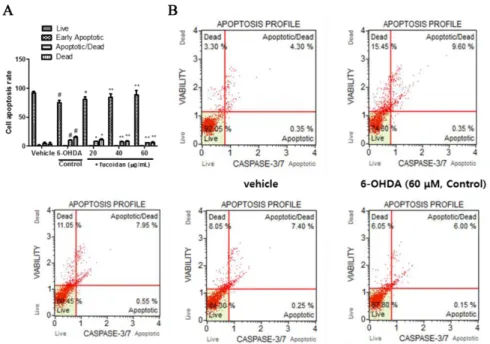
Fig. 4. Changes in cumulative apoptotic cell ratio (live, early apoptotic, apoptotic/dead, and dead) as determined by assay of apoptotic status based on caspase-3/7 activation of SH-SY5Y cells exposed to various concentrations of fucoidan and 6-OHDA, measured by flow cytometry (A). Representative flow cytometric data are shown in (B). Apoptotic cell ratio by caspase-3/7 activation was observed 24 h after exposure to 6-OHDA. All values are means ± SEM of three independent experiments, each performed in triplicate.

* p < 0.05, **p < 0.01 compared to control, and

#

p < 0.05 compared to vehicle.

(5)

of GSH biosynthesis) increased the extent of neuronal injury.

Fucoidan dose-dependently protected against BSO-induced neurotoxicity (Fig. 3C).

Effects of fucoidan on caspase-3/7 activities

We evaluated the anti-apoptotic activities of fucoidan by measuring caspase-3/7 activities using flow cytometry. Treat- ment of cells with 6-OHDA elevated apoptotic status (apop- totic/dead and dead cells) based on caspase-3/7 activation.

Among cumulative cell counts, the percentage of apoptotic/

dead and dead cells increased two- and five-folds compared to vehicle group, respectively. Fucoidan pretreatment signifi- cantly inhibited such elevations in both apoptotic/dead and dead cells induced by 6-OHDA (Fig. 4A). Representative flow cytometric profiles on apoptotic cell counts are shown in Figure 4B.

Effects of fucoidan on apoptosis

Treatment of cells with 6-OHDA increased the percent- age of early and late apoptosis by 13% and 12%, respec- tively. Fucoidan pretreatment (40 µg/mL) significantly decreased by 5 and 2% (Fig. 5A). Representative apoptotic flow cyto- metric profiles on apoptotic cell counts are shown in Fig- ure 5B.

Effects of fucoidan on MMP

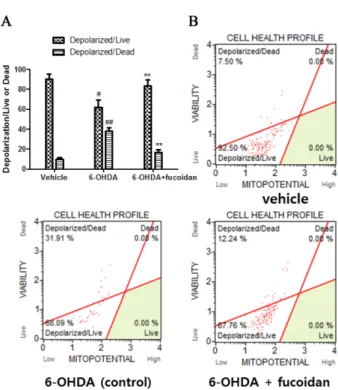
The 6-OHDA reduced the proportion of SH-SY5Y cells exhibiting a decrease in mitochondrial depolarization. The average percentage of depolarized dead cells in 6-OHDA- treated group increased from 9.6% to 38%. Pretreatment with fucoidan (40 µg/mL) significantly inhibited by 16.7% com- pared to 6-OHDA (control) group (Fig. 6A). Representative flow cytometric profiles of cumulative cell counts (Depolar- ized/live and depolarized/dead cells except live and dead cells were shown) are shown in Figure 6B.

Discussion

Although many researchers have sought to define the pathogenesis of PD, the mechanism underlying neurodegen- eration in the substantia nigra remains unclear. However, oxi- dative stress, including elevation of iron concentrations and reduced GSH levels, may be key in this context [15]. In accordance with these ideas, the elevation of TBARS and reduction of GSH/GSSG ratio evoked by 6-OHDA were well observed in same cell line [3]. Especially, reduction of glu- tathione level in nigral regions of brain is considered as a critical factor in PD pathogenesis and secondary to complex I inhibition [12]. In in vivo studies, fucoidan treatment has Fig. 5. Changes in cumulative apoptotic cell ratio (live, early

apoptotic, late apoptotic, and dead) determined using the Muse Annexin-V and dead cell assays after exposure to 40 µg/mL fucoidan and 6-OHDA, as measured by flow cytometry (A).

Representative flow cytometric data are shown in (B). All val- ues are expressed as means ± SEM of three independent exper- iments, each performed in triplicate. **p < 0.01 compared to control, and

##

p < 0.01 compared to vehicle.

Fig. 6. Changes in cumulative cell ratio (live, deplolarized/live, depolarized/dead, and dead) by changes of mitochondrial mem- brane potential (MMP) caused by 6-OHDA alone or 6-OHDA and fucoidan (40 µg/mL) in combination (A). Representative flow cytometric data are shown in (B). MMPs were measured using the Muse Mitopotential kit. All values are means ± SEM of three independent experiments, each performed in triplicate.

** p < 0.01 compared to control,

#

p < 0.05, and

##

p < 0.01 com-

pared to vehicle.

(6)

showed a distinct amelioration of neurodegenerative symp- toms in experimental PD models induced by MPTP and 6- OHDA, respectively [11, 22]. Hence, our results suggest that fucoidan may be one of the potential neuroprotective candi- dates derived from various natural antioxidants. Recently, fucoidan has been reported to suppress the microglial activa- tion via increase in ROS-generating enzyme, NADPH oxi- dase-1 (Nox 1) expression in dopaminergic neurons of rat substntia nigra region after 6-OHDA injection [22]. These results mean that fucoidan could be contributable to neu- ronal survival through modulatory action of nitric oxide, ROS and a key proinflammatory cytokine, such as tumor necrosis factor- α [4, 5]. Here, Cui et al. [5] have demon- strated that fucoidan remarkably inhibited an elevation of inducible nitric oxide synthase protein and microglial activa- tion induced by lipopolysaccharide at similar concentrations like us. Mitochondrial dysfunction caused by inhibition of complex I activity may correlate with the extent of injury to dopaminergic neurons in PD patients. Unfortunately, there have been few pharmacological reports on the ability of fucoidan to prevent PD. Previously, we screened some natu- ral medicines using an in vitro PD model (human dopaminer- gic SH-SY5Y neuroblastoma cells) [3].

In the present study, we found that fucoidan inhibited both lipid peroxidation, and the disturbance of GSH metabolism, induced by 6-OHDA in SH-SY5Y cells. These results sug- gest that fucoidan may serve as a useful, natural GSH-spar- ing agent that partially alleviates PD symptoms. Fucoidan inhibits the neuronal damage triggered by deprivation of endogenous GSH. Although source of fucoidan is somewhat different, the neuroprotective basis seems to be mainly attrib- utable to the anti-oxidant and anti-inflammatory action [4, 11, 13, 21, 22]. Previously, we showed that fucoidan pro- tected neuronal cells by inhibiting oxidative effects, as well as the stimulation of protein kinase C and caspase 3/9, which is required for β-amyloid-induced neurotoxicity [9]. Similarly, we now show that fucoidan inhibits the elevation of caspase 3/7 activity evoked by 6-OHDA and consequent apoptotic death. An earlier report showed that fucoidan inhibited the elevation of caspase-3 activity in a model of H

2

O

2

-induced neurotoxicity [7], and protected against MPTP-induced lipid peroxidation of, and 1-methyl-4-phenylpyridinium (MPP

+

)- induced neuronal injury to, MN9D cells [11]. Thus, fucoidan acts a neuroprotectant in experimental models of PD, such as MPTP or 6-OHDA. However, fucoidan has not yet been shown the capability to permeate the blood-brain barrier. The MMP decreases when the mitochondrial membrane is dam- aged or collapses after exposure to a 6-OHDA-induced auto- oxidation cascade [2, 8]. Fucoidan increased the number of cells in which depolarized mitochondria was apparent after 6-OHDA treatment. Recently, fucoidan has been shown to alleviate the mitochondrial dysfunction that develops after traumatic injury [18]. However, the exact pharmacological properties of fucoidan are difficult to conclude easily because sulfated polysaccharide is complex and possess broad spec-

trum therapeutic properties. Overall, our results suggest that fucoidan pretreatment improves neuronal survival by exert- ing anti-oxidative and anti-apoptotic effects when 6-OHDA induces neuronal damage to SH-SY5Y cells.

Acknowledgments

This study was supported by 2014 Research Grant from Kangwon National University (No. 120140291).

References

1. Blandini F, Armentero MT, Martignoni E. The 6- hydroxydopamine model: news from the past. Parkinsonism Relat Disord 2008, 14 (Suppl 2), S124-129.

2. Blum D, Torch S, Lambeng N, Nissou M, Benabid AL, Sadoul R, Verna JM. Molecular pathways involved in the neurotoxicity of 6-OHDA, dopamine and MPTP: contribution to the apoptotic theory in Parkinson’s disease. Prog Neurobiol 2001, 65, 135-172.

3. Chang GC, Kim HC, Wie MB. Neuroprotective effects of resveratrol on 6-hydroxydopamine-induced damage of SH- SY5Y cell line. Korean J Vet Res 2014, 54, 1-6.

4. Cui YQ, Jia YJ, Zhang T, Zhang QB, Wang XM.

Fucoidan protects against lipopolysaccharide-induced rat neuronal damage and inhibits the production of proinflam- matory mediators in primary microglia. CNS Neurosci Ther 2012, 18, 827-833.

5. Cui YQ, Zhang LJ, Zhang T, Luo DZ, Jia YJ, Guo ZX, Zhang QB, Wang X, Wang XM. Inhibitory effect of fucoidan on nitric oxide production in lipopolysaccharide- activated primary microglia. Clin Exp Pharmacol Phyiol 2010, 37, 422-428.

6. Dias V, Junn E, Mouradian MM. The role of oxidative stress in Parkinson’s disease. J Parkinsons Dis 2013, 3, 461- 491.

7. Gao Y, Dong C, Yin J, Shen J, Tian J, Li C. Neuroprotective effect of fucoidan on H

2

O

2

-induced apoptosis in PC12 cells via activation of the PI3K/Akt pathway. Cell Mol Neurobiol 2012, 32, 523-529.

8. Hanrott K, Gudmusen L, O’Neill MJ, Wonnacott S. 6- Hydroxydopamine-induced apoptosis is mediated via extra- cellular auto-oxidation and caspase-3 dependent activation of protein kinase C δ. J Biol Chem 2005, 281, 5373-5382.

9. Jhamandas JH, Wie MB, Harris K, MacTavish D, Kar S.

Fucoidan inhibits cellular and neurotoxic effects of β-amyloid (Aβ) in rat cholinergic basal forebrain neurons. Eur J Neurosci 2005, 21, 2649-2659.

10. Kaur D, Lee D, Ragapolan S, Anderson JK. Glutathione depletion in immortalized midbrain-derived dopaminergic neurons results in increases in the labile iron pool: implications for Parkinson’s disease. Free Radic Biol Med 2009, 46, 593- 598.

11. Luo D, Zhang Q, Wang H, Cui Y, Sun Z, Yang J, Zheng Y, Jia J, Yu F, Wang X, Wang X. Fucoidan protects against dopaminergic neuron death in vivo and in vitro. Eur J Pharmacol 2009, 617, 33-40.

12. Martin HL, Teismann P. Glutathione-a review on its role

and significance in Parkinson’s disease. FASEB J 2009, 23,

(7)

3263-3272.

13. Meenakshi S, Umayaparvathi S, Saravanan R, Manivasagam T, Balasubramanian T. Neuroprotective effect of fucoidan from Turbinaria decurrens in MPTP intoxicated Parkinsonic mice. Int J Biol Macromol 2016, 86, 425-433.

14. Orr CF, Rowe DB, Halliday GM. An inflammatory review of Parkinson’s disease. Prog Neurobiol 2002, 68, 325-340.

15. Owen AD, Schapira AHV, Jenner P, Marsden CD. Oxidative stress and Parkinson’s disease. Ann N Y Acad Sci 1996, 786, 217-723.

16. Schober A. Classic toxin-induced animal models of Parkinson’s disease: 6-OHDA and MPTP. Cell Tissue Res 2004, 318, 215-224.

17. Smeyne M, Smeyne RJ. Glutathione metabolism and Parkinson’s disease. Free Radic Biol Med 2013, 62, 13-25.

18. Wang T, Zhu M, He ZZ. Low-molecular-weight fucoidan attenuates mitochondrial dysfunction and improves neurological outcome after traumatic brain injury in aged mice: involve-

ment of Sirt3. Cell Mol Neurobiol 2016, 36, 1257-1268.

19. Widnell K. Pathophysiology of motor fluctuation in Parkinson’s disease. Mov Disord 2005, 20 (Suppl 11), S17-22.

20. Wüllner U, Löschmann PA, Schulz JB, Schmid A, Dringen R, Eblen F, Turski L, Klockgether T. Glutathione depletion potentiates MPTP and MPP+ toxicity in nigral dopaminergic neurons. Neuroreport 1996, 7, 921-923.

21. Yang JW, Yoon SY, Oh SJ, Kim SK, Kang KW.

Bifunctional effects of fucoidan on the expression of inducible nitric oxide synthase. Biochem Biophys Res Commun 2006, 346, 345-350.

22. Zhang FL, He Y, Zheng Y, Zhang WJ, Wang Q, Jia YJ, Song HL, An HT, Zhang HB, Qian YJ, Tong YL, Dong L, Wang XM. Therapeutic effects of fucoidan in 6- hydroxydopamine-lesioned rat model of Parkinson’s disease:

role of NADPH oxidase-1. CNS Neurosci Ther 2014, 20,

1036-1044.

수치

Fig. 2. Morphological evidence of protection afforded by fucoidan to cells exposed to 6-OHDA-induced neurotoxicity
Fig. 4. Changes in cumulative apoptotic cell ratio (live, early apoptotic, apoptotic/dead, and dead) as determined by assay of apoptotic status based on caspase-3/7 activation of SH-SY5Y cells exposed to various concentrations of fucoidan and 6-OHDA, measu
Fig. 6. Changes in cumulative cell ratio (live, deplolarized/live, depolarized/dead, and dead) by changes of mitochondrial  mem-brane potential (MMP) caused by 6-OHDA alone or 6-OHDA and fucoidan (40 µg/mL) in combination (A)

참조

관련 문서

interaction with anti-apoptotic Bcl-2 family members, we investigated whether Mcl-1 can inhibit the Noxa-induced cell death.. As expected, Mcl-1 significantly inhibits

Here, we found that TAMR-MCF-7 cells had undergone EMT, evidenced by mesenchymal-like cell shape, down-regulation of the basal E-cadherin expression

Glutamate excitotoxicity induced by excessive activation of NMDA receptor causes various damage to cells, which leads to cell death.. In previous studies, increased ROS

PI3K inhibition decreased antioxidants/GD-induced apoptosis in A549 cells, and PI3K inhibitor LY294002 had inhibitory effect on antioxidants/GD-induced caspase-3

These results suggest that the bilobalide inhibits the cell proliferation and induces the apoptotic cell death in FaDu human pharyngeal squamous cell carcinoma via both

The combination treatment of PBA and 6-gingerol induced the cleavage of caspase-3, caspase-4, PARP, GRP78, p-eIF2α, and CHOP in DU145 cells and Western blot analysis for

Activation of Autophagy by Mangiferin Protects Auditory Hair Cells from Oxidative stress Induced Ototoxicity.. Gyeongmin

Taken together, these results suggested that latex containing the ficin inhibited the cell growth and induced apoptosis by caspase and Bcl-2 family signaling pathway in