한국조경학회지 45(3): 41~53, 2017. 6.
J. KILA Vol. 45, No. 3, pp. 41~53, June, 2017
pISSN 1225-1755 eISSN 2288-9566 https://doi.org/10.9715/KILA.2017.45.3.041
한국조경학회지 제 45권 3호(2017년 6월)
41
†: 본 연구는 국립수목원 ‘정원문화 확산을 위한 우리 꽃 야생화의 활용에 관한 연구(과제번호: KNA1-2-22,14-6)’의 지원에 의해 이루어진 것입니다.
†:
인터뷰에 성실하게 답변해 주신 2016년 코리아가든쇼 9개 정원 작가에게 감사드립니다.
Corresponding author: Yu-Jin Song, Dept. of Gardens and Education, Korea National Arboretum, Pocheon 11186 Korea, Tel:
+82-31-540-1040, E-mail: [email protected]
2016년 코리아가든쇼 작가정원의 식물 의미에 관한 연구
이정희*․**․진혜영*․이유미*․송유진*
*
국립수목원․
**서울시립대학교 도시과학대학원 조경학과
A Study on the Meaning of Plant Material in the 2016 Korea Garden Show Designer’s Garden
Lee, Chung-Hee*․**․Jin, Hye-Young*․Lee, You-Mi*․Song, Yu-Jin*
*
Korea National Arboretum
**
Dept. of Landscape Architecture, Graduate School of Urban Sciences, The University of Seoul
ABSTRACT
This study was performed to determine what the plant material were selected to reflect in the 2016 Korea Garden Show designer’s garden. It was analyzed that plant material was used to display the theme of the garden and to create a specific space.
Under the given theme of ‘K-Garden, Shinhallyu Garden(new style garden culture) with the most Korean taste', the plants were used to highlight the theme in two types: ‘representation' and ‘expression'. There were two ‘representation’
gardens that imitate a particular space of Korean taste and four ‘expression’ gardens that showcase the designer's thoughts with abstract concepts and concrete objects. Three gardens included both types of garden. The way of revealing the subject with plants was used more for ‘expression' than for ‘representation'.
There were eleven spaces for ‘representation' of the Korean taste, a vegetable garden, faucet, pond, field, nature, a Hanok court garden, groves of bamboo, tile roof, stone wall, rock and backyard of a Hanok connected to the mountain.
The planting material was used in two ways: reflecting only the ecological characteristics of the plant, and considering the ecological and visual characteristics together. Vegetation plantings reflecting the ecological characteristics were observed in all eleven spaces. Nine of the spaces reflected the growth environment of the plants, but the other two did not reflect the ecological characteristics of the plants, unlike the designer's intention. In the case of the four spaces that considered the ecological and visual characteristics together, color and size were considered visual characteristics. The plants in the seven spaces that included ‘expression’ as the theme were selected to reflect the visual characteristics in the order of color, shape, texture, and size, rather than reflecting ecological characteristics. A group planting method was applied.
When the plants were used as materials for creating space, Norman(1989) analyzed three enclosure factors(overhead,
vertical, ground plane). Only two deciduous trees were used in the overhead plane while five species of evergreen shrubs
Journal of the Korean Institute of Landscape Architecture 181
이정희․진혜영․이유미․송유진42
한국조경학회지 제 45권 3호(2017년 6월)and thirty species of various deciduous plants were used in the vertical plane. There were forty-five species (nine trees and thirty-six herbaceous plants) forming the ground plane, and various herbaceous plants were utilized without duplication in each garden. The designer's garden of the Garden Show played a role in introducing new groundcover plants to the public.
Three of the nine gardens did not include ornamental plants, and the use of decorative plants in other gardens was few compared to the number of plantings. In the Korea Garden Show designer’s garden, most of the plants were being used with the intention of exposing the theme or architectural uses. In the 2016 Korea Garden Show designer’s garden, many species of plants were used as materials for showcasing themes rather than for creating spaces. Also, the method of ‘expression’ was used more than the method of ‘representation' in order to highlight the theme. This indicates that the planting materials reflect visual characteristics such as color, shape, texture, size rather than ecological characteristics.
Key Words: K-Garden, Thematic Plants, Representation & Expression, Architectural Plants
국문초록
본 논문은 2016년 코리아가든쇼의 9개 작가정원에서 식물 소재가 작가의 의도를 어떻게 반영하고 선택되는지 파악하 고자 하였다. 식물 소재는 정원의 주제를 전달하기 위한 경우와 공간을 구성하기 위해 사용된 것으로 분석되었다.
‘K-Garden, 가장 한국적인 멋을 담은 신한류 정원’이라는 주어진 주제 아래, 주제를 드러내기 위해 사용된 식물은
‘재현’과 ‘표현’의 두 가지 유형으로 쓰이고 있었다. 한국적인 멋이 담긴 특정 공간을 모방하는 ‘재현’은 2개 정원이, 작가의 생각을 추상적인 개념이나 사물의 형상으로 나타내는 ‘표현’은 4개 정원이, ‘재현’과 ‘표현’ 모두 사용한 정원은 3개 정원이다. 주제를 식물로 드러내는 방법은 ‘재현’보다 ‘표현’의 경향이 강했다. 한국적인 멋을 ‘재현’하는 공간은 채마밭, 수돗가, 연못, 들판, 자연, 한옥 중정, 대나무밭, 기와 지붕, 돌담, 바위, 산자락과 연결된 뒷마당 11개로 식재는 식물의 생태적 특성만을 반영하거나, 생태적 특성과 시각적 특성을 함께 고려한 2가지 경우로 나타났다. 생태적 특성을 반영한 식재는 11개 공간 모두에서 관찰되었는데, 9개 공간은 식물의 생육환경을 잘 반영한 반면, 나머지 2개는 작가의 의도와 달리 식물의 생태적 특성을 제대로 반영하지 못한 것으로 나타났다. 생태적․시각적 특성을 함께 고려한 4개의 공간의 경우, 시각적 특성으로 색상과 크기가 고려되었다. 주제를 ‘표현’한 7개 공간의 식물은 생태적 특성을 반영하기보다 는 색상, 형태, 질감, 크기 순으로 시각적인 특성을 반영하여 선정되었고, 군식의 배식법도 적용되고 있었다.
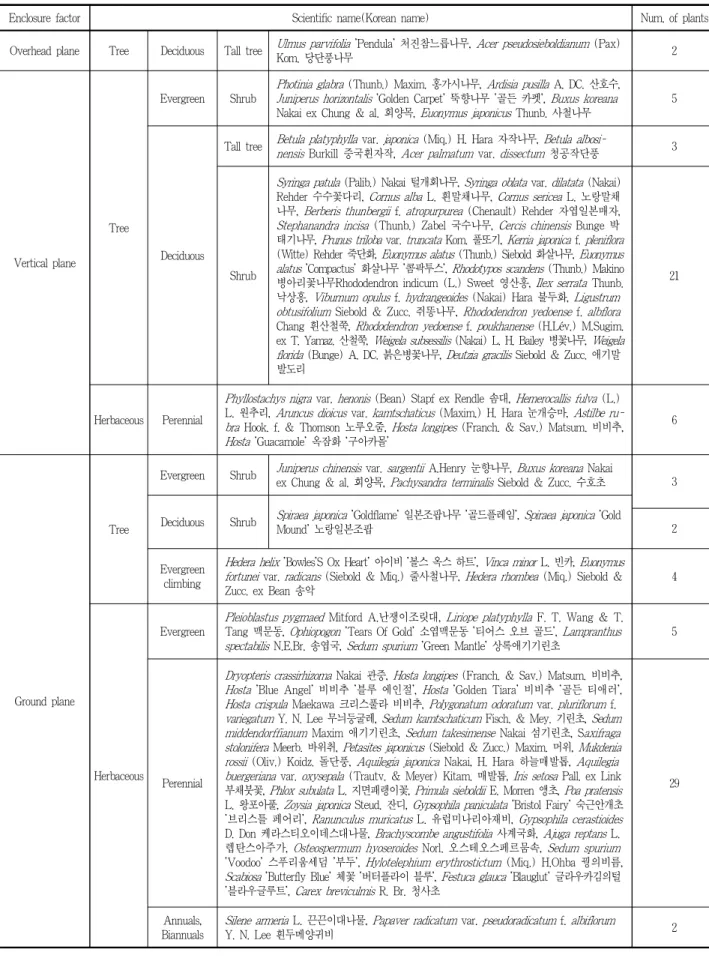
공간을 구성하는 소재로 식물을 활용한 경우, Norman(1989)이 제시한 공간 위요변수 3가지(관개면, 수직면, 지피면)를 기준으로 분석하였는데, 관개면에는 단 2종의 낙엽 교목이 사용되고 있었고, 수직면에는 상록성 관목이 5종, 낙엽성은 30종으로 낙엽성 식물이 다양하게 사용되었다. 바닥면을 형성하는 식물은 45종(목본 9종, 초본 36종)으로, 정원별로 중복되지 않고, 다양한 초본이 활용되고 있었다. 이것은 가든쇼의 작가정원이 새로운 지피식물 소재를 대중에게 소개하는 역할을 하고 있다는 것을 보여준다.
9개 정원 중 3개 정원은 그저 장식적으로 사용된 식물이 없었고, 다른 정원에서도 장식적인 식물의 사용은 식재종수에 비해 미약한 편으로 코리아가든쇼 작가 정원에서 식물은 대부분 주제를 드러내거나, 공간을 구성하는 의도를 가지고 활용되 고 있음을 알 수 있다. 2016년 코리아가든쇼 작가 정원에서 식물은 공간을 구성하기 보다는 주제를 드러내는 소재로 많은 수종이 활용되고 있었으며, 주제를 드러내는 방법은 ‘재현’보다는 ‘표현’의 방법을 사용한 정원이 많은 것으로 보아, 식물은 생태적 특성보다는 색상, 형태, 질감, 크기 등 시각적 특성을 보다 많이 반영하여 식재되고 있는 것으로 나타났다.
주제어: K-Garden, 주제 식물, 재현과 표현, 공간 구성 식물
Ⅰ. 서론
도시농업과 정원의 대중적인 관심이 높아지고 있다. 2013년 순천만 국제정원박람회의 성공적인 개최를 계기로 서울특별시,
부산광역시, 경기도 등 지방자치단체에서는 다양한 정원박람회
를 유치하고 있다. 더불어 2015년 7월 ‘수목원․정원의 조성 및
진흥에 관한 법률’이 시행됨에 따라 국가에서도 정원 산업을
체계적으로 육성하기 위해 다양한 정책을 펼치고 있다.
2016년 코리아가든쇼 작가정원의 식물 의미에 관한 연구
Journal of the Korean Institute of Landscape Architecture 181
한국조경학회지 제 45권 3호(2017년 6월)
43
Garden Designer Theme Planting concept Planting design type
Representation Expression Tiled roof garden(瓦庭) Jong-wan Park Korean traditional
tiled roof Planting plants grow in tile roof and vegetable garden. ○ The garden of Korean
poetry(韓時園) Ji-Dong Yoon Hanok backyard
scenery Plantng plants grow in stone wall, groves of bamboo, back-
yard of Hanok connected to the mountain. ○ Spring.Fun.[春興]-One
spring day of mirth Gyu-wan Choi Fun, mirth Fun and mirth is expressed various plants with various
shapes, colors, textures and heights. ○
Full of rice bowl(高捧) Jae-Soo Yang Did you eat? Full of rice bowl is expressed by white flowers. ○ Patch patch..plait a life Sin-Yae Hwang Korean grace inJogakbo Based in Jogakbo pattern, each pattern contains one series
color, Obangsaek(blue, yellow, red, white, black), plants. ○
Deep in the mountain Yong-Jun Cha Korean mountainridge
Korean mountain and river landscape is expressed to Obangsaek (five-color) flowers and Bibo(planting that place with cone shape tree), The fog between the valleys is expressed to white weeping shape tree.
○
Priming water Hwan-Ki Yoon Modern, retro styleGarden
Planting plants grow in faucet. ○
The modern feeling is expressed to green leaf’s grouping plant-
ing, tap water is expressed to ivy. ○
A paramour's promise Young-Ju Yoon Lyric, Pungryu garden
Plantng plants grow in stone wall, stepping stone, pond, rock,
field. ○
Hanbok skirt wrinkles are expressed to white small flowers. ○ Gorgeousness inner side
-Dancheong Soo-Hyun Seo Harmony of grace and gorgeousness
Planting plants grows in nature, Hanok court garden. ○
Artificial feeling is expressed by pruning and colorful flowers. ○ Table 1. Theme and planting design method in 2016 Korea Garden Show’s designer gardens
2016년에 3회를 맞는 ‘코리아가든쇼’는 산림청과 고양시가 주최하는 한국의 대표적인 가든쇼로 정원 디자이너를 발굴하 고, 정원 문화를 확산하고자 2014년부터 고양꽃박람회와 함께 하고 있다. 영국의 대표적 가든쇼인 첼시플라워쇼는 단순한 전 시를 넘어 사회와 경제, 문화에 미치는 파급효과가 대단히 큰 문화 콘텐츠의 한 부분이며, 정원디자인의 경향을 연속적으로 보여주고 있다(Yoon, 2008). 이와 마찬가지로 2014년 시작한 코리아가든쇼는 역사는 짧지만, 동시대 한국 정원디자인이 지 향하는 면을 살펴볼 수가 있다. 코리아가든쇼는 매년 주최측에 서 특정 주제를 제시하며, 작가들은 주어진 주제를 주관적으로 해석하여 정원에 담는다.
정원에서 식물은 가장 중요한 소재이고, 식물이 갖고 있는 많은 잠재적 기능에도 불구하고, 아직까지도 많은 사람들 또는 설계 전문가들까지도 여전히 ‘식물은 그저 장식적으로만 쓰인 다’는 타성적인 사고방식을 갖고 있다(Norman, 1989). 식물선 택과 식재의 중요성에 대해 Yoon(2008)은 450년의 역사와 전 통을 자랑하는 첼시 플라워쇼의 모델 정원의 심사기준에서 식 재에 대한 점수가 30점으로 가장 중요한 부분을 차지하고 있다 고 했고, Park(2013)은 식재설계는 그 시대의 문화와 소재의 영향을 많이 받으며, 정원 복원의 중요한 요소라고 하였다. 따 라서 우리도 정원을 감상하거나, 평가할 때 식물재료와 식재방 법에 대한 탐구가 필요하다.
정원은 인간의 생각을 표현하는 공간으로, ‘작가정원에서 식
물은 작가의 의도와 주제를 담고 있다’는 것이 이 논문의 시작 이다. 본 논문은 2016 코리아가든쇼 작가정원에서 식물 소재가 정원의 주제를 표현하는데 어떻게 활용되고 있는지, 공간을 구 성하는 소재로써 어떻게 사용되는지를 고찰해 보고자 한다.
Ⅱ. 연구방법
1. 연구대상
2016년 코리아가든쇼의 주제는 ‘K-Garden, 가장 한국적인 멋을 담은 신한류 정원’이었다. 33개 정원 조성계획서가 2월 26 일에 접수되었고, 1차 심사를 통해 10개 정원이 선발되어 행사 장에 8×13m 크기로 조성된 정원을 2차 심사하여 수상작을 선 정하였다. 일반인에게 정원은 4월 29일부터 5월 15일까지 17 일간 공개되었다. 연구대상은 2016년 코리아가든쇼에 전시된 10개 정원 중 설문과 인터뷰에 참여한 9개 정원이다(Table 1 참조).
2. 연구방법
옥외공간에서 식물재료가 갖는 기능은 학자마다 약간씩 다
르게 분류하는데, Gary(1972)는 건축적, 공학적, 기후조절적,
미적 기능으로, Norman(1989)은 구조적, 환경적, 시각적 기능
Journal of the Korean Institute of Landscape Architecture 181
이정희․진혜영․이유미․송유진44
한국조경학회지 제 45권 3호(2017년 6월)으로, Oh(2015)는 예술적인 표현과 기능적인 쓰임으로 분류하 고 있다. 예술적인 표현으로 식물을 사용하는 것은 식물 자체 를 감상하기 위해 심는 것으로 식물 자체가 가지고 있는 형태, 색상, 질감 등을 고려하여 배치하는 것을 말한다. 이때 식물은 특별한 기능을 위해서가 아니라, 마치 그림을 감상하듯이 식물 자체의 색감, 질감, 형태의 미를 보기 위해서 예술적으로 심는 것을 말한다(Oh, 2015). 기능적인 쓰임으로써 식물은 건축적이 고 구조적인 기능을 말하는데, 식물재료가 벽, 천정, 바닥과 같 이 경관 내에서 공간을 한정짓고 구성하며, 조망에 영향을 주 고, 동선의 방향성에 관여하는 것을 말한다(Norman, 1989). 본 논문에서는 Oh(2015)의 기준을 변형하여 적용하였는데, 가든 쇼에서 식물을 주제를 드러내는 소재로써 사용한 경우와 공간 을 구성하는 소재로써 사용한 2가지 경우로 분석하였다.
작가들이 제출한 정원 조성계획서를 바탕으로 정원의 주제 와 식재개념을 파악하였다. 시공된 정원을 5회 방문하여 정원 에 식재된 식물이 어떻게 활용되었는지 조사하였고, 이를 기초 로 3가지 유형으로 분석하였다. 첫째, 주제와 관련있는 식물, 둘째, 공간을 구성하는 식물, 셋째, 단지 장식적으로 사용된 경우 이다. 한 가지 식물이 두 가지 유형으로 동시에 사용된 경우는 작가와 인터뷰를 통해 작가의 의도를 정확히 파악한 후, 한 가 지로 분류하였다. 조성된 정원에서 식재된 수종을 파악하여 산 림청 국가표준식물목록(www.nature.go)과 재배식물도감(Korea National Arboretum of Korea Forest Service, 2011)에서 식물 명을 확인하고, 작가 인터뷰를 통해 정원에 식재된 식물의 정확 성을 재확인한 후 종(species) 단위에서 식물을 파악하였다.
Ⅲ. 결과 및 고찰
1. 주제를 드러내는 소재로써 식물
식물 재료가 가지는 기능을 예술적 표현과 기능적인 쓰임으 로 분류한 Oh(2015)의 기준에서 예술적 표현으로써 식물을 정원의 주제를 드러내는 소재로써 식물을 사용한 경우로 보 았다. 2016년 코리아가든쇼의 주제는 ‘K-Garden, 가장 한국적 인 멋을 담은 신한류 정원’이었다. 작가들은 K-Garden을 주 관적으로 해석하여 한국적인 멋을 정원에 담고 있었다. 식물 역시 주제를 반영하여, 선택․배치되었는데, 주제를 드러내 는 소재로써 사용된 식물은 재현(represectation)과 표현(ex- pression)의 두가지 유형으로 나뉜다.
재현은 어떠한 것을 모방하는 것으로 본 논문은 Zoh and Kim(2001)이 언급한 재현의 3가지 방식(직설적, 추상적, 해체 적 재현) 중 전통을 그대로 모방하지 않고, 원상의 모습을 판 단할 수 있으며, 작가의 주관에 의해 변형된 추상적 재현 방 식을 적용하였다. 본 논문에서 언급하는 식물 소재의 재현은
한국적인 멋을 담은 특정 공간에 식재되었던 식물을 모방하되, 작가의 의도대로 변형하여 식재한 경우이고, 표현은 특정 공간 이 없으며, 팔레트로 물감을 선택하여 그림의 주제를 표현하듯 식물을 사용한 경우이다.
9개 정원 중 와정(瓦庭) 과 韓時園_한시원 2개 정원은 한국적 공간을 식물로 재현하고 있었고, 표현은 춘.흥.[春興]- 어느 봄날의 흥겨움 , 고봉(高捧) , 조각조각…삶을 엮다 , 첩첩산중 4개 정원이, 재현과 표현 두 가지 방법을 모두 사용 한 정원은 마중물 , 어느 情人의 약속 , 내 안의 화려함-단 청 3개였다(Table 1 참조). 주제를 식물로 드러내는 방법은 5 개 정원에서 사용한 ‘재현’보다 7개 정원에서 나타나는 ‘표현’의 경향이 강했다.
1) 주제를 재현하는 정원과 식물
한국적인 멋을 재현하는 공간은 채마밭, 수돗가, 연못, 들판, 자연
1), 한옥 중정, 대나무밭, 기와 지붕, 돌담, 바위, 산자락과 연결된 뒷마당 등 11개로 5개 정원에서 나타났다. 이 중 채마 밭, 연못, 돌담은 2개 정원에서 중복되어 나타났다(Table 2 참 조). 재현하는 공간의 서식 환경에 적합한 식물을 식재한 경우, 생태적 특성을 반영한 식물로 분류하였고, 크기․색상․형태 등 식물의 시각적 특성 때문에 서식 환경에 적합하지 않은 식 물을 재현하는 공간에 식재한 경우, 시각적 특성을 반영한 식 물로 분류하였다. 한국적인 멋을 식물로 재현한 공간은 식물의 생태적 특성 또는 생태적 특성과 시각적 특성을 함께 고려한 공간
2)으로 나뉜다. 생태적 특성을 반영하여 식재된 공간은 채 마밭, 수돗가, 연못, 들판, 자연, 한옥 중정, 대나무밭 7개 공간 이고, 생태적 특성과 시각적 특성을 반영하여 식물을 혼식한 공간은 기와지붕, 돌담, 바위, 산자락과 연결된 뒷마당 등 4개 공간으로 나뉜다. 11개 공간은 모두 생태적 특성을 반영하는 것으로 나타났는데, 이 중 9개 공간은 재현된 공간에서 생육환 경을 잘 반영하여 식물을 식재하고 있었지만, 내 안의 화려함- 단청 에서 재현된 ‘자연’과 ‘한옥 중정’ 2개 공간은 작가의 의도 와 달리 식물의 생태적 특성이 제대로 반영되지 못하는 것으로 나타났다. 생태적 특성과 시각적 특성을 함께 고려한 ‘기와지 붕’, ‘돌담’, ‘바위’, ‘산자락과 연결된 뒷마당’의 4개 공간은 시각 적 특성 중 색상과 크기가 식재요인으로 나타났다. 즉, 색상으 로는 한국을 상징하는 흰색(Kim and Kim, 2006)을 사용한 ‘돌 담’, ‘바위’, ‘산자락과 연결된 뒷마당’ 등 3개 공간이, 크기로는 키가 작은 식물을 사용한 ‘기와지붕’, ‘돌담’ 2개의 공간이 있었 다(Table 2 참조).
생태적 특성을 반영해서 식재한 11개 공간의 식물을 자세히
살펴보면 다음과 같다. 채마밭을 재현한 와정(瓦庭) 과 韓時
園_한시원 에서는 7종의 텃밭식물(고추, 딸기, 상추, 호박, 토
마토, 방울양배추, 실부추)이 관찰되는데, 고추, 딸기, 상추는
2016년 코리아가든쇼 작가정원의 식물 의미에 관한 연구
Journal of the Korean Institute of Landscape Architecture 181
한국조경학회지 제 45권 3호(2017년 6월)
45
Representedspace Planting
characteristics Reflective factor Scientific name(Korean name) Garden
Vegetable
garden Ecological Plants grow in vegetable garden
Capsicum annuum L. 고추, Fragaria ananassa Duch. 딸기, Lactuca sat- iva L. 상추
Tiled roof garden(瓦庭), The garden of Korean poetry_韓時園 Allium anisopodium Ledeb. 실부추, Brassica oleracea var. gemmifera Zenker
방울양배추 Tiled roof garden(瓦庭)
Cucurbita moschata Duchesne 호박, Lycopersicon esculentum Mill. 토마토 The garden of Korean poetry_韓時園 Faucet
(70~80’s) Ecological Plants grow in wet Acer palmatum Thunb. 단풍나무, Mukdenia rossii(Oliv.) Koidz. 돌단풍 Priming water
Pond Ecological Plants grow in wetland Nymphaea tetragona Georgi 수련, Iris setosa Pall. ex Link 부채붓꽃 A paramour's promise Eichhornia crassipes(Mart.) Solms 부레옥잠 Gorgeousness inner side
-Dancheong Field Ecological Plants grow in field Hordeum vulgare var. hexastichon 보리 A paramour's promise Nature Ecological Plants grow in
forest and field
Taraxacum coreanum Nakai 흰민들레, Acer palmatum ‘Shojo Nomura' 단풍나무 ‘쇼조노무라', Prunus mume f. alba(Carr.) Rehder 흰매실나무, Argyranthemum frutescens ‘Summer Melody’ 분홍겹마가렛
Gorgeousness inner side -Dancheong
Hanok
court garden Ecological Plants plantng in Hanok garden
Paeonia suffruticosa Andrews 모란, Hemerocallis fulva(L.) L. 원추리, Allium schoenoprasum L. 골파, Ligularia fischeri(Ledeb.) Turcz. 곰취, Potentilla anemonefolia Lehm. 가락지나물, Angelonia angustifolia Benth. 신선초, Angelica acutiloba(Siebold & Zucc.) Kitag. 왜당귀, Dicentra spectabilis(L.) Lem.
금낭화,Fragaria ananassa Duch. 딸기, Argyranthemum frutescens ‘Summer Melody’ 분홍겹마가렛, Zantedeschia elliottiana(L.) Spreng 노랑꽃칼라, Freesia laxa subsp. azurea 후리지아락사, Lavandula heterophylla 스위트 라벤더,Viburnum plicatum 'Sawtooth' 설구화 ‘소투스', Hydrangea macro- phylla spp. 수국류
Gorgeousness inner side -Dancheong
Groves of
bamboo Ecological Plants plantng in
groves of bamboo Phyllostachys nigra var. henonis(Bean) Stapf ex Rendle 솜대 The garden of Korean poetry_韓時園
Tile roof
Ecological Plants grow on tile roofs
Orostachys japonica(Maxim.) A. Berger 바위솔, Leucobryum glaucum(Hedw.) Aongstr 흰털이끼,Mukdenia rossii(Oliv.) Koidz. 돌단풍, Pteridium aquili- num var. latiusculum(Desv.) Underw. ex A. Heller 고사리
Tiled roof garden(瓦庭) Visual
(size) Groundcover plants that grow low
Pleioblastus viridi-striatus Makino 노랑무늬사사, Saxifraga stolonifera Meerb. 바위취, Ligularia fischeri(Ledeb.) Turcz. 곰취, Allium micro- dictyon Prokh. 산마늘, Ophiopogon ‘Tears Of Gold' 소엽맥문동 ‘티어스 오브 골드', Trachelospermum asiaticum ‘Variegatum' 무늬마삭줄, Hosta
‘Allan P. Mcconnell' 비비추 ‘앨런 피 매코널', Epimedium koreanum Nakai 삼지구엽초,Liriope platyphylla F. T. Wang & T. Tang 맥문동, Armeria maritima ‘Laucheana' 마리티마너도부추 ‘라우케아나', Festuca glauca
‘Blauglut' 글라우카김의털 블라우글루트',Vinca minor L. 빈카, Dryopteris crassirhizoma Nakai 관중
Stone wall
Ecological Plants grow in wetland
Mukdenia rossii(Oliv.) Koidz. 돌단풍 A paramour's promise, The garden of Korean poetry_韓時園 Euonymus fortunei var. radicans(Siebold & Miq.) Rehder 줄사철나무,
Parthenocissus tricuspidata(Siebold & Zucc.) Planch. 담쟁이덩굴 A paramour's promise Orostachys japonica(Maxim.) A. Berger 바위솔, Hierochloe odorata(L.) P.
Beauv. 향모 The garden of Korean
poetry_韓時園 Visual
(color) White flower
(Korean symbol) Deutzia gracilis Siebold & Zucc. 애기말발도리, Clethra alnifolia L. 알니폴
리아매화오리 A paramour's promise
Visual
(size) Grow low Viola papilionacea Pursh 종지나물, Trigonotis peduncularis(Trevir.) Benth.
ex Hemsl. 꽃마리,Sedum dasyphyllum L. 다시필룸세덤 The garden of Korean poetry_韓時園
Rock
Ecological Plants grow in rock Pinus densiflora Siebold & Zucc. 소나무, Dicentra spectabilis(L.) Lem.
금낭화 A paramour's promise
Visual
(color) White flower
(Korean symbol) Lamprocapnos spectabilis ‘Alba' 흰금낭화 Table 2. Plants used as a material of represented Korean space
Journal of the Korean Institute of Landscape Architecture 181
이정희 진혜영 이유미 송유진�������� �� 45�� 3호(2017�� 6월)
2016�� ������� ������ ��� ���� ��� 연구
Journal of the Korean Institute of Landscape Architecture 181
�������� �� 45�� 3호(2017�� 6월�� �
Journal of the Korean Institute of Landscape Architecture 181
이정희 진혜영 이유미 송유진�������� �� 45�� 3호(2017�� 6월)
Journal of the Korean Institute of Landscape Architecture 181
이정희 진혜영 이유미 송유진�������� �� 45�� 3호(2017�� 6월)
2016�� ������� ������ ��� ���� ��� 연구
Journal of the Korean Institute of Landscape Architecture 181
�������� �� 45�� 3호(2017�� 6월�� �
Journal of the Korean Institute of Landscape Architecture 181
이정희 진혜영 이유미 송유진�������� �� 45�� 3호(2017�� 6월)
Journal of the Korean Institute of Landscape Architecture 181
이정희 진혜영 이유미 송유진�������� �� 45�� 3호(2017�� 6월)
2016년 코리아가든쇼 작가정원의 식물 의미에 관한 연구
Journal of the Korean Institute of Landscape Architecture 181
한국조경학회지 제 45권 3호(2017년 6월)
51
Enclosure factor Scientific name(Korean name) Num. of plants
Overhead plane Tree Deciduous Tall tree Ulmus parvifolia 'Pendula' 처진참느릅나무, Acer pseudosieboldianum (Pax)Kom. 당단풍나무 2
Vertical plane
Tree
Evergreen Shrub Photinia glabra (Thunb.) Maxim. 홍가시나무, Ardisia pusilla A. DC. 산호수, Juniperus horizontalis 'Golden Carpet' 뚝향나무 '골든 카펫', Buxus koreana
Nakai ex Chung & al. 회양목,Euonymus japonicus Thunb. 사철나무 5
Deciduous
Tall tree Betula platyphylla var. japonica (Miq.) H. Hara 자작나무, Betula albosi-nensis Burkill 중국흰자작, Acer palmatum var. dissectum 청공작단풍 3
Shrub
Syringa patula (Palib.) Nakai 털개회나무, Syringa oblata var. dilatata (Nakai) Rehder 수수꽃다리,Cornus alba L. 흰말채나무, Cornus sericea L. 노랑말채 나무,Berberis thunbergii f. atropurpurea (Chenault) Rehder 자엽일본매자, Stephanandra incisa (Thunb.) Zabel 국수나무, Cercis chinensis Bunge 박 태기나무,Prunus triloba var. truncata Kom. 풀또기, Kerria japonica f. pleniflora (Witte) Rehder 죽단화,Euonymus alatus (Thunb.) Siebold 화살나무, Euonymus alatus 'Compactus' 화살나무 '콤팍투스', Rhodotypos scandens (Thunb.) Makino 병아리꽃나무Rhododendron indicum (L.) Sweet 영산홍,Ilex serrata Thunb.
낙상홍,Viburnum opulus f. hydrangeoides (Nakai) Hara 불두화, Ligustrum obtusifolium Siebold & Zucc. 쥐똥나무, Rhododendron yedoense f. albflora Chang 흰산철쭉,Rhododendron yedoense f. poukhanense (H.Lév.) M.Sugim.
ex T. Yamaz. 산철쭉,Weigela subsessilis (Nakai) L. H. Bailey 병꽃나무, Weigela florida (Bunge) A. DC. 붉은병꽃나무, Deutzia gracilis Siebold & Zucc. 애기말 발도리
21
Herbaceous Perennial
Phyllostachys nigra var. henonis (Bean) Stapf ex Rendle 솜대, Hemerocallis fulva (L.) L. 원추리,Aruncus dioicus var. kamtschaticus (Maxim.) H. Hara 눈개승마, Astilbe ru- bra Hook. f. & Thomson 노루오줌, Hosta longipes (Franch. & Sav.) Matsum. 비비추, Hosta 'Guacamole' 옥잠화 ‘구아카몰’
6
Ground plane
Tree
Evergreen Shrub Juniperus chinensis var. sargentii A.Henry 눈향나무, Buxus koreana Nakai
ex Chung & al. 회양목,Pachysandra terminalis Siebold & Zucc. 수호초 3
Deciduous Shrub Spiraea japonica 'Goldflame' 일본조팝나무 '골드플레임', Spiraea japonica 'Gold
Mound' 노랑일본조팝 2
Evergreen climbing
Hedera helix 'Bowles'S Ox Heart' 아이비 '볼스 옥스 하트', Vinca minor L. 빈카, Euonymus fortunei var. radicans (Siebold & Miq.) 줄사철나무, Hedera rhombea (Miq.) Siebold &
Zucc. ex Bean 송악 4
Herbaceous
Evergreen Pleioblastus pygmaed Mitford A.난쟁이조릿대, Liriope platyphylla F. T. Wang & T.
Tang 맥문동,Ophiopogon 'Tears Of Gold' 소엽맥문동 '티어스 오브 골드', Lampranthus
spectabilis N.E.Br. 송엽국, Sedum spurium 'Green Mantle' 상록애기기린초 5
Perennial
Dryopteris crassirhizoma Nakai 관중, Hosta longipes (Franch. & Sav.) Matsum. 비비추, Hosta 'Blue Angel' 비비추 '블루 에인절', Hosta 'Golden Tiara' 비비추 '골든 티애러', Hosta crispula Maekawa 크리스풀라 비비추, Polygonatum odoratum var. pluriflorum f.
variegatum Y. N. Lee 무늬둥굴레, Sedum kamtschaticum Fisch. & Mey. 기린초, Sedum middendorffianum Maxim 애기기린초, Sedum takesimense Nakai 섬기린초, Saxifraga stolonifera Meerb. 바위취, Petasites japonicus (Siebold & Zucc.) Maxim. 머위, Mukdenia rossii (Oliv.) Koidz. 돌단풍, Aquilegia japonica Nakai, H. Hara 하늘매발톱, Aquilegia buergeriana var. oxysepala (Trautv. & Meyer) Kitam. 매발톱, Iris setosa Pall. ex Link 부채붓꽃,Phlox subulata L. 지면패랭이꽃, Primula sieboldii E. Morren 앵초, Poa pratensis L. 왕포아풀,Zoysia japonica Steud. 잔디, Gypsophila paniculata 'Bristol Fairy' 숙근안개초 '브리스틀 페어리',Ranunculus muricatus L. 유럽미나리아재비, Gypsophila cerastioides D. Don 케라스티오이데스대나물,Brachyscombe angustifolia 사계국화, Ajuga reptans L.
렙탄스아주가, Osteospermum hyoseroides Norl. 오스테오스페르뭄속, Sedum spurium 'Voodoo' 스푸리움세덤 '부두',Hylotelephium erythrostictum (Miq.) H.Ohba 꿩의비름, Scabiosa 'Butterfly Blue' 체꽃 '버터플라이 블루', Festuca glauca 'Blauglut' 글라우카김의털 '블라우글루트',Carex breviculmis R. Br. 청사초
29
Annuals,
Biannuals Silene armeria L. 끈끈이대나물, Papaver radicatum var. pseudoradicatum f. albiflorum
Y. N. Lee 흰두메양귀비 2
Table 4. Plants as a material that creats space
Journal of the Korean Institute of Landscape Architecture 181
이정희․진혜영․이유미․송유진52
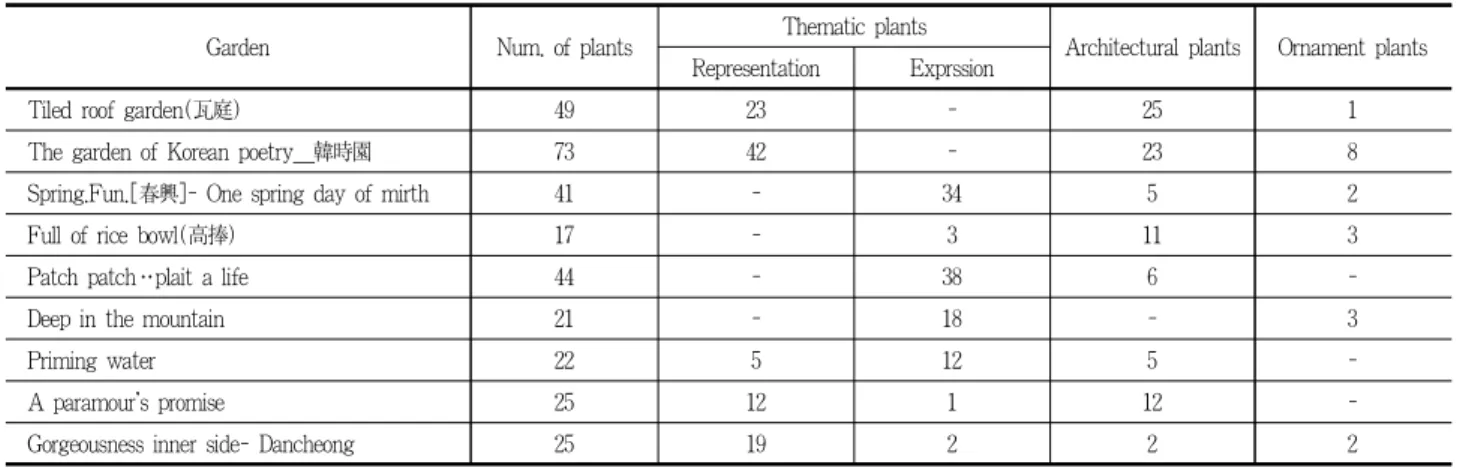
한국조경학회지 제 45권 3호(2017년 6월)Garden Num. of plants Thematic plants
Architectural plants Ornament plants Representation Exprssion
Tiled roof garden(瓦庭) 49 23 - 25 1
The garden of Korean poetry_韓時園 73 42 - 23 8
Spring.Fun.[春興]- One spring day of mirth 41 - 34 5 2
Full of rice bowl(高捧) 17 - 3 11 3
Patch patch‥plait a life 44 - 38 6 -
Deep in the mountain 21 - 18 - 3
Priming water 22 5 12 5 -
A paramour's promise 25 12 1 12 -
Gorgeousness inner side- Dancheong 25 19 2 2 2
Table 5. The trends of using plant material in 2016 Korea Garden Show designer’s garden
더 많은 식물종이 사용되고 있었다. ‘재현’의 경우, 식물은 생태 적 특성만 반영하거나, 생태적 특성 혹은 시각적 특성이 함께 반영되었는데, 올해 주제가 K-Garden이었음에도 가든쇼라는 특성상 자생식물보다는 화려한 재배식물이 보다 많이 사용되 고 있었다. 자생식물에 대한 생태적인 이해와 활용으로 한국적 인 멋을 지닌 섬세한 정원 연출이 필요할 것으로 생각된다. ‘표 현’의 경우, 식물은 시각적 특성을 주로 고려하고 있었다. 2016 년 코리아가든쇼 작가정원에서는 ‘표현’의 경향을 드러낸 정원 이 보다 많았던 것으로 보아, 식물은 생태적 특성보다는 시각 적 특성을 더 많이 고려하여 식재되고 있는 것으로 나타났다 (Table 5 참조).
Ⅳ. 결론
자연을 바탕으로 한 정원에서 식물은 그 시대의 문화를 담고 있는 가장 중요한 재료이지만, 아직도 많은 사람 혹은 전문가 들까지도 식물은 그저 장식적으로, 공간을 채우기 위해 사용된 다는 인식을 갖고 있는 경우가 많다.
본 논문의 바탕에는 정원은 인간이 조성한 공간으로, 조성한 사람의 의도가 담겨 있고, 식물 역시 그저 장식적으로 쓰이고 있지 않다는 가정이 있었다. 따라서 본 논문은 주제가 명확하 게 주어지고, 작가의 생각이 담겨 있을 코리아가든쇼 작가정원 을 대상으로 식물 소재를 주제와의 연관성과 공간을 구성하는 기능적인 관점에서 분석하였다. ‘K-Garden, 가장 한국적인 멋 을 담은 신한류 정원’이라는 주어진 주제 아래, 작가들은 식물 소재를 다음과 같이 활용하고 있었다.
첫째, 주제를 드러내기 위해 사용된 식물은 한국적인 멋을 지닌 특정 공간을 모방하는 ‘재현’과 작가의 생각을 ‘표현’하는 두 가지 식재 유형으로 나타나는데, 5개 정원은 특정 공간을
‘재현’하고 있었고, 7개 정원은 생각을 ‘표현’하고 있어, 주제를 나타내는데 ‘재현’보다 ‘표현’이 더 주도적이었고, ‘표현’에 더
많은 식물종이 사용되고 있었다.
둘째, 한국적인 멋을 ‘재현’한 11개 공간인 ‘채마밭, 수돗가, 연못, 들판, 자연, 한옥 중정, 대나무밭, 기와 지붕, 돌담, 바위, 산자락과 연결된 뒷마당’에서는 식물의 생태적 특성을 모두 반 영하고 있었고, 시각적 특성을 함께 고려한 경우도 있었다. 주 제를 ‘표현’한 7개 공간에서 식물은 색상, 형태, 질감, 크기 순 으로 식물의 시각적인 특성을 주로 고려하고 있어, 가든쇼에서 식물은 지속적 관리보다는 관상적 가치에 더 중점을 두고 있 다는 것을 알 수 있었다.
셋째, 공간을 구성하는 소재로 식물을 활용한 경우, 관개면 에는 주로 낙엽 교목이, 수직면에는 상록성 관목과 낙엽성 교 목․관목․초본이 다양하게 활용되고 있었고, 바닥면에는 낮은 수고의 관목과 초화류가 주로 식재되어 있었다. 즉, 기능에 따 라 식물의 크기와 잎의 유형(상록성, 낙엽성)이 고려된 것을 볼 수 있다. 바닥면을 형성하는 식물은 45종(목본 9종, 초본 36 종)으로, 정원별로 중복되지 않고, 다양한 초본이 활용되고 있 었다. 이것은 가든쇼의 작가정원이 정원 소재로 활용 가능한 새 로운 지피식물 소재를 대중에게 소개하는 역할을 하고 있다는 것을 보여준다.
넷째, 코리아가든쇼 작가정원에서 식물은 장식적으로 쓰이 기보다는 대부분 주제를 드러내거나, 공간을 구성하는 의도를 가지고 활용되고 있음을 파악할 수 있었다.
본 논문은 동시대 정원디자인 경향을 보여주는 가든쇼에서
국내 정원 작가가 봄에 어떤 식물을 어떤 의도로 사용하고 있
는지 주제와의 연관성, 공간을 구성하는 기능적인 소재의 관점
에서 분석하여, 식물은 그저 장식적으로 쓰이지 않고, 작가들이
의도를 가지고 사용하고 있다는 것을 보여주었다는 것에 의의
가 있다. 또한 ‘K-Garden, 가장 한국적인 멋을 담은 신한류 정
원’이라는 2016년 코리아가든쇼 주제 아래 작가가 어떻게 한
국성을 해석하고, 식재에 반영하고 있는지를 분석한 것에도
의미가 있을 것이다. 하지만 9명의 작가가 생각하는 한국적인
멋에 대한 생각과 표현이 다양하여 한국적인 공간과 식재수종
2016년 코리아가든쇼 작가정원의 식물 의미에 관한 연구
Journal of the Korean Institute of Landscape Architecture 181
한국조경학회지 제 45권 3호(2017년 6월)
53 을 일반화하는데 한계가 있었다. 향후 자생식물을 활용하여 한
국성을 표현하는 정원에 관한 연구가 필요할 것이다.
---
주 1. 작가가 한국적 멋을 담은 공간으로 설정한 “자연”은 사전적 의미의
“사람의 힘이 더해지지 않고, 저절로 생겨난 산, 강, 바다, 식물 등”
이 아니라, “인위적으로 만든 정원의 공간이 아닌 울타리 밖의 공간”
이라는 의미로 작가는 정원에 산과 들에서 자라는 식물을 식재하고 자 하였다.
주 2. 생태적 특성은 식물의 생육 환경을 반영하여 식재한 것이고, 시각적 특성은 식물 자체가 가진 형태, 색상, 질감 등을 고려하여 식재한 경 우이다.
References
1. Gary, O. R.(1972) Plants, People, and Environmental Quality: A Study of Plants and Their Environmental Functions. U.S. Dept. of the Interior, National Park Service, USA.
2. Kim, E. K. and Y. I. Kim(2006) The Korean symbolic meaning of
white. Journal of Korea Society of Color Studies 20(4): 25-39.
3. Korea National Arboretum of Korea Forest Service(2011) Garden Plants in Korea. Ridrik, Seoul, Korea.
4. Norman K. B.(1989) Basic Elements of Landscape Architectural Design.
Waveland Press, IL, USA.
5. Oh, K. A.(2015) Design Plants?! Trends and Principles of Plants Design. Ecoscape. pp. 72-77.
6. Park, E. Y.(2013) A study on Karl Foerster's Garden from the viewpoint of planting design. Journal of the Korean Institute of Traditional Landscape Architecture 31(3): 38-44.
7. Yoon, S. J.(2008) Flower show and garden culture in UK. namudosi, Paju, Korea, Choi, S. H. 2001. A review of Korea’s native plants in- dustry. Korean Journal of Agricultural Management and Policy 28(4):
757-773.
8. Zoh, K. J. and C. H. Kim(2001) Characteristics of representing traditional gardens in landscape design through analyzing the entry plans of Seoul Park in Paris. Journal of the Korean Institute of Landscape Architecture 28(6): 84-95.
9. http://www.nature.go.kr.(Korea Forest Service, Korean plant names index committee)
Received Revised
Accepted 3인익명 심사필 : :
:
27 February, 2017 21 March, 2017 25 April, 2017 08 May, 2017 08 May, 2017
(1st) (2nd) (3rd)