174
Copyright © 2020 The Korean Society of Fisheries and Aquatic Science pISSN:0374-8111, eISSN:2287-8815
서 론
패류는이동성이거의없고먹이활동을여과섭식방법으로부 유하는플랑크톤등을섭취하며살아간다
.
이과정에서패류는 식물성플랑크톤이생산하는독소를체내에축적하게되며,
우 리나라를비롯한전세계연안국에서패류독소발생이매년보 고되고있다(Hall, 1991; Tuner et al., 2019; Park et al., 2000).
이들패류독소에는
Alexandrium spp., Gymnodinium sp.
등 이생산하는것으로중독시마비를유발하는마비성패류독소(paralytic shellfish poison),
와편모조류인Dinophysis spp.
와Prorocentrum spp.
에의해생산되는것으로설사를유발하는 설사성패류독소(diarrhetic shellfish poison), Pseudonitzschia
spp.
가생산하는것으로신경계장애를유발하는기억상실성 패류독소(amnestic shellfish poison)
등이대표적이며,
이외에 도다수의독소성분이알려져있다(Noguchi, 2003; Mok et al., 2012; Lee et al., 2017).
마비성패류독소는열에안정하여가 열조리한패류를섭취한후중독된사고가보고되어있다(No- guchi, 2003; Toyofuku, 2006; Mok et al., 2012).
마비성패류 독소로인한최초의사망사고는알래스카에서1790
년러시아 의탐험대가홍합(Mytilus californianus)
을먹고100
여명이사 망한사례이며,
그후캐나다의대서양과태평양연안에서발 생하였고,
우리나라의이웃나라인일본,
중국또한이로인한 사망사고가보고되어있다(Noguchi, 2003).
우리나라의경우에 는1986
년부산감천만에서진주담치(Mytilus edulis)
를섭취LC-MS/MS를 이용한 패류 및 피낭류 중 마비성 패류독소 분석법의 유효성 검증
조성래·김동욱·유헌재·조성해·류아라·이가정·목종수*
국립수산과학원 식품위생가공과
Validation of LC-MS/MS Method for Analysis of Paralytic Shellfish Toxins in Shellfish and Tunicates
Sung Rae Cho, Dong Wook Kim, Hean Jae Yu, Seong Hae Cho, Ara Ryu, Ka Jeong Lee and Jong Soo Mok*
Food Safety and Processing Research Division, National Institute of Fisheries Science, Busan 46083, Korea
The mouse bioassay has been used widely for the monitoring of paralytic shellfish toxins (PSTs) in many countries.
However, this method shows low sensitivity and high limit of detection (LOD), as well as it cannot confirm toxic pro- files. Recently, LC-MS/MS method was studied for the quantitative of PSTs, however, the method has any problems with unstable retention times by ionization suppression caused by high salt concentration in shellfish extracts. To establish an alternative method for PSTs analysis, we tried to original LC-MS/MS methods adding desalting opera- tion using amorphous graphitized polymer carbon solid-phase extraction cartridges. The method validation was con- ducted to determine linearity, limit of detection, limit of quantification (LOQ), accuracy, and precision in quantifying PSTs. The correlation coefficients for all tested PSTs maintained over 0.999. The LODs and LOQs for all PSTs were about 0.19-1.05 μg/kg and 0.58-3.18 μg/kg, respectively. The accuracies for PSTs were 95.4-107.7% for saxitoxin group, 97.1-100.9% for gonyautoxin group, 99.0-100.8% for N-sulfocarbamoyl toxin group, and 96.8-104.6% for decarbamoyl toxin group. These results indicate that the modified LC-MS/MS method was appropriate for analyzing the PSTs in shellfish and tunicates.
Keywords: Paralytic shellfish toxin, Solid-phase extraction, LC-MS/MS, Shellfish, Tunicate
*Corresponding author: Tel: +82. 51. 720. 2820 Fax: +82. 51. 720. 2619 E-mail address: [email protected]
This is an Open Access article distributed under the terms of the Creative Commons Attribution Non-Commercial Licens (http://creativecommons.org/licenses/by-nc/3.0/) which permits unrestricted non-commercial use, distribution, and reproduction in any medium, provided the original work is properly cited.
Received 19 December 2019; Revised 13 January 2020; Accepted 18 February 2020 저자 직위: 조성래(석사 후 연구원), 김동욱(연구사), 유헌재(연구원), 조성해 (연구원), 류아라(석사 후 연구원), 이가정(연구사), 목종수(연구관)
https://doi.org/10.5657/KFAS.2020.0174
Korean J Fish Aquat Sci 53(2), 174-180, April 2020
하고
2
명이사망한사고가최초의기록이며,
이후에도경남연 안의진해만등에서는매년반복적으로마비성패류독소가검 출되고있다(Chang et al., 1989; Mok et al., 2013).
우리나라를 비롯한세계여러나라에서는소비자에게안전한패류제공을 위해마우스복강주사법을이용한동물시험법을채택하여사 용하고있으며,
우리나라식품공전(KMFDS, 2019a)
에서는마 비성패류독소의허용기준치를0.8 mg/kg
으로정하여관리하 고있다(Chang et al., 1987; Murakami et al., 2000; Jang et al., 2005; Toyofuku, 2006; Mok et al., 2013; KMFDS, 2019b).
동 물시험법은검출한계가약40 μg STX eqivalent/100 g
로알 려져있으며(Hall, 1991),
비교적높은검출한계에도불구하고 다수의시료를신속하게분석가능하고시료중총독소량분 석에적합한방법으로1965
년AOAC
에채택된이후약50
년 이상지속적으로 이용되어오고있다(Barbera-Sanchez et al.,
2004).
그러나실험동물사용을최소화하자는국제적압력이높아지고있으며
,
각각의독소조성에대한정보를얻을수없 는단점이부각되고있다(Mok et al., 2013).
실제마비성패류 독소는20
종류이상의성분으로구성되어있다(Oshima, 1995;
Luckas et al., 2003; Song et al., 2013).
많은연구자들은동물 시험법을대체할수있으며각각의독성성분을한번에정량가 능한액체크로마토그래프형광검출법(pre-column oxidation, post-column oxidation)
을주목하였으나(Turner et al., 2019),
이방법들은높은감도를가지지만시료전처리및장비분석시 간이긴단점을가지고있다(Dell’Aversano et al., 2005; Song et al., 2013; Yang et al., 2017;).
한편, hydrophilic interaction liquid chromatography-mass spectrometry
법은짧은분석시간 과동시분석이가능하다는점에서많은연구가이루어지고있 지만(Quilliam et al., 1989; Dell’Aversano et al., 2005),
높은염 에의해이온화가저해된다는문제점이있다고보고되었으며,
이에따라고상추출방법을통하여염을제거한후분석하는 방법이연구되고있다(Turner et al., 2015; Yang et al., 2017).
본연구에서는우리나라마비성패류독소의공인시험법인동 물시험법을대체할수있는최적기기분석법을확립하기위하 여
liquid chromatograph-tandem mass spectrometry (LC-MS/
MS)
를이용한분석법에대한선행연구를검토하여최적의분 석조건을제시하였다(Quilliam et al., 1989; Song et al., 2013;
Turner et al., 2015).
그리고이분석법에대한유효성을검정하 고,
우리나라연안주요패류및피낭류의생산품종특성에부합 하는지그타당성을검토하고자하였다.
재료 및 방법
시약 및 표준독소
마비성패류독소분석을위한표준독소는인증표준물질
(cer- tified reference material)
등급의saxitoxin (STX), decarbam- oyl-saxitoxin (dcSTX), gonyautoxin (GTX) 1 & 4, GTX 2 &
3, GTX 5, decarbamoyl-gonyautoxins (dcGTX) 2 & 3, neo- saxitoxin (NEO)
및protogonyautoxin (C) 1 & 2
를National Research Council (NRC; Halifax, Canada)
에서구입하여분 석에사용하였다.
그리고실험에사용된모든시약은analytical
또는LC grade
를사용하였으며,
마비성패류독소추출용매는acetic acid (Merck, Darmstadt, Germany), 25% ammonium hydroxide (Sigma, St. Louis, MO, USA)
을사용하였다.
고상 추출(solid phase extraction, SPE)
카트리지(cartridge)
는EN- VI-Carb SPE cartridge (250 mg/3 mL, Sigma, St. Louis, MO, USA)
를사용하였고,
카트리지는활성화시킨후추출물을흡 착시켜염을정제하는과정에사용되었다.
정제에사용된용매 는acetic acid, acetonitrile (Merck, Darmstadt, Germany)
및ammonium hydroxide (Sigma, St. Louis, MO, USA)
을사용하 였다.
이동상제조에는formic acid (Fluka, Buchs, Germany), ammonium hydroxide (Sigma, St. Louis, MO, USA), aceto- nitrile (Merck, Darmstadt, Germany)
을사용하였으며,
탈이 온수는Milli-Q water purification system (Millipore, Bedford, MA, USA)
에서정제하여사용하였다.
추출 및 정제
균질화된패류시료
5 g
을50 mL
폴리프로필렌시험관에넣 고, 5 mL 1% acetic acid
을가하여혼합한후water bath
에서100°C, 5
분간가열추출하였고,
실온에서냉각하였다.
추출한 시료는5,000 rpm (2,750 g)
에서5
분간원심분리하였다.
분리 된상등액1 mL
을취한후5 μL 25% ammonium hydroxide
을 더해pH 5.0-6.0
으로중화시켜사용하였다.
고상추출카트리지는
3 mL
의20% acetonitrile (0.1% acetic acid
함유)
와3 mL
의0.025% ammonium hydroxide
을순차적 으로흘려활성화하였다.
시료추출액400 μL
을활성화된카트 리지에3 mL/min
로흘린후700 μL
의증류수로세척하였다.
그리고2 mL
의20% acetonitrile (0.1% acetic acid
함유)
로용 출하여시험용액으로사용하였다.
LC-MS/MS 분석조건
LC-MS/MS
를이용한마비성패류독소분석법확립을위하여
Xevo TQ-S tandem quadrupole mass spectrometer (Wa- ters, Milford, MA, USA)
와Acquity UPLC H-class (Waters, Milford, MA, USA)
를사용하였고, column
은Acquity BEH Amide UPLC column (1.7 μm, 2.1 mm×50 mm; Waters, Milford, MA, USA)
을 사용하였다.
이동상으로A
용액은0.015% formic acid
와0.06% ammonium hydroxide
가되도 록제조하여사용하였고, B
용액은70% acetonitrile
와0.01%
formic acid
가되도록제조하여사용하였다.
마비성패류독소 의질량분석은electrospray ionization (ESI)
법의positive
또는negative ion mode
를사용하였으며, multiple reaction moni-
toring (MRM)
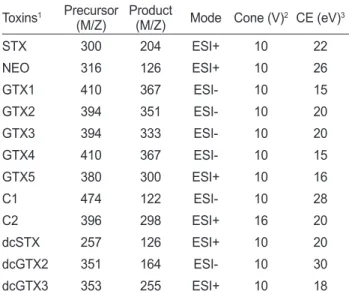
조건으로분석하였다(Table 1, 2).
분석법 검증
LC-MS/MS
분석법의유효성검증을위하여직선성(linear- ity),
검출한계(limit of detection, LOD),
정량한계(limit of quantitation, LOQ),
정확성(recovery),
정밀성(precision)
등을Codex Alimentarius Commission (2014)
의지침에따라검토 하였다.
정확성과정밀성은패류(
담치)
에총12
종의마비성패 류독소표준물질[NRC, CRM (certified reference material)]
을3
가지농도로조제후첨가하여위와동일한방법으로추출한다음일내
(intra-day)
정밀성을1
일5
회및일간(inter-day)
정밀 성실험을3
일5
회반복측정하였다.
검출한계와정량한계는표 준용액을5
회반복측정한검량선을작성하여검량선의기울기 와y
절편의표준편차를이용하여구하였으며,
검량선y
절편값 의표준편차에3.3
배를곱한값을기울기평균값으로나눈값을 검출한계, 10
배를곱한값에기울기평균값나눈값을정량한계 로설정하여평가하였다.
또한
, LC-MS/MS
분석법이우리나라연안주요패류및피낭 류생산품종특성에부합하는지이에따른타당성을검토하기 위해독이없는것으로확인된담치(Mussel Mytilus gallopro- vinciallis),
굴(Oyster Crassostrea gigas),
바지락(Short-necked clam Ruditapes philippinarum),
개조개(Butter clam, Saxido- mus purpuratus),
키조개(Comb pen shell Atrina pinnata),
가리 비(Scallop Argopecten irradians),
새조개(Ark shell Scapharca broughtonii)
등패류7
종과,
멍게(Sea squirt Halocynthia ror- etzi),
미더덕(Warty sea squirt Styela clava)
등피낭류2
종의시 료에총12
종의마비성패류독소표준물질을첨가하여위와동 일한방법으로추출한후회수율을확인하였다.
결과 및 고찰
LC-MS/MS 분석법 유효성 검정
확립된
LC-MS/MS
분석법유효성검증을 위하여표준물질12
종을섞은mixture
를6
개의농도범위로제조하여직선성을 검토하였다.
시험시오차범위를확인하기위해5
회반복분석 한결과12
종의모든표준물질의상관계수(R
2)
는0.99
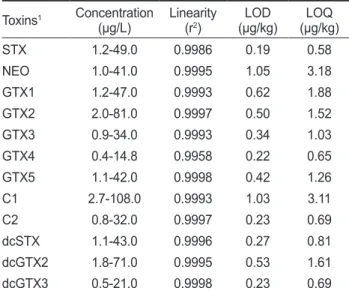
이상을 유지하는높은직선성을나타내었다(Table 3).
STX group (STX, NEO)
의검출한계는 각각0.19
및1.05 μg/kg,
정량한계는0.58
및3.18 μg/kg
이었으며, GTX group (GTX1, 2, 3, 4)
의검출한계는각각0.62, 0.50, 0.34
및0.22 μg/
kg,
정량한계는1.88, 1.52, 1.03
및0.65 μg/kg
이었다. N-sulfo- carbamoyl toxin group (GTX5, C1, C2)
의검출한계는0.42, 1.03
및0.23 μg/kg,
정량한계는1.26, 3.11
및0.69 μg/kg
이었으 며, decarbamoyl toxin group (dcSTX, dcGTX2, 3)
의검출한계 는0.27, 0.53
및0.23 μg/kg,
정량한계는0.81, 1.61
및0.69 μg/
kg
으로나타났다(Table 3).
또한Rey et al. (2017)
는HPLC
를 이용하여pre-column oxidation, post-column oxidation
방법으 로검출한계,
정량한계를분석한결과pre-column oxidation
에 서검출한계가7.31-51.08 μg/kg,
정량한계는13.23-102.03 μg/
kg
이었으며,
그리고post-column oxidation
에서는검출한계가0.91-29.92 μg/kg,
정량한계는1.47-64.77 μg/kg
이었다.
이를 보았을때본시험의결과는양호한수준으로확인되었다.
시험법의정확성을확인하기위해우리나라대표이매패류중 하나인담치를선택하였고독이없음을확인하고실험을진행
Table 1. Mass spectrometry parameters Toxins1 Precursor
(M/Z) Product
(M/Z) Mode Cone (V)2 CE (eV)3
STX 300 204 ESI+ 10 22
NEO 316 126 ESI+ 10 26
GTX1 410 367 ESI- 10 15
GTX2 394 351 ESI- 10 20
GTX3 394 333 ESI- 10 20
GTX4 410 367 ESI- 10 15
GTX5 380 300 ESI+ 10 16
C1 474 122 ESI- 10 28
C2 396 298 ESI+ 16 20
dcSTX 257 126 ESI+ 10 20
dcGTX2 351 164 ESI- 10 30
dcGTX3 353 255 ESI+ 10 18
1STX, saxitoxin; NEO, neosaxitoxin; GTX, gonyautoxin; C, pro- togonyautoxin, dcSTX, decarbamoyl-saxitoxin; dcGTX, decar- bamoyl-gonyautoxin. 2Cone (V), cone voltage in volts. 3CE (eV), collision energy in electron volts.
Table 2. LC-MS/MS operating condition for the analysis of para- lytic shellfish toxins
Parameter Condition
Column Amide column (2.1 mm I.d.×50 mm, 1.7 μm)
Column temp. 60°C
Injection volume 2 μL
Time
(min) Flow
(mL/min) Mobile phase A (%) B (%)
Gradient initial 0.4 5 95
4.0 0.4 5 95
7.5 0.4 50 50
9.0 0.5 50 50
9.5 0.5 95 5
9.8 0.8 95 5
10.6 0.8 95 5
11.0 0.4 95 5
Ionization Electrospray ionization mode
Desolvation temp. 450°C
Capliary voltage 3 kV
Table 3. Linearity, limits of detection (LOD) and limits of quantita- tion (LOQ) of paralytic shellfish toxins (n=5)
Toxins1 Concentration
(μg/L) Linearity
(r2) LOD
(μg/kg) LOQ (μg/kg)
STX 1.2-49.0 0.9986 0.19 0.58
NEO 1.0-41.0 0.9995 1.05 3.18
GTX1 1.2-47.0 0.9993 0.62 1.88
GTX2 2.0-81.0 0.9997 0.50 1.52
GTX3 0.9-34.0 0.9993 0.34 1.03
GTX4 0.4-14.8 0.9958 0.22 0.65
GTX5 1.1-42.0 0.9998 0.42 1.26
C1 2.7-108.0 0.9993 1.03 3.11
C2 0.8-32.0 0.9997 0.23 0.69
dcSTX 1.1-43.0 0.9996 0.27 0.81
dcGTX2 1.8-71.0 0.9995 0.53 1.61
dcGTX3 0.5-21.0 0.9998 0.23 0.69
1 STX, saxitoxin; NEO, neosaxitoxin; GTX, gonyautoxin; C, pro- togonyautoxin; dcSTX, decarbamoyl-saxitoxin; dcGTX, decar- bamoyl-gonyautoxin.
하였다
. 3
가지농도의표준용액을첨가하여5
회반복측정하 였고일내(intra-day)
및일간(inter-day)
실험을통해정확성과 정밀성을확인하였다. STX group
의일내정확성과정밀성은 각각95.4-107.7%
및1.34-3.30%
의범위를나타내었고, GTX group
의일내정확성과정밀성은각각97.1-100.9%
및0.78- 4.47%
를나타내었다. N-sulfocarbamoyl toxin group
의 일내 정확성과 정밀성은99.0-100.8%
및0.86-3.53%
를 나타내었 고, decarbamoyl toxin group
에서의일내정확성과정밀성은96.8-104.6%
및0.58-2.20%
의결과를나타내었다(Table 4).
또 한,
일간정확성및정밀성은3
일간5
회반복측정하여나타내었 다. STX group
의일간정확성과정밀성은각각96.7-106.6%
의 정확성과1.89-3.85%
의정밀성을나타내었고, GTX group
의 일간정확성과정밀성은각각96.6-101.3%
의정확성과1.40- 5.23%
의정밀성을나타내었다. N-sulfocarbamoyl toxin group
의 일간 정확성과 정밀성은98.7-100.5%
의 정확성과1.06- 3.53%
의정밀성을 나타내었고, Decarbamoyl toxin group
에서의일간정확성과정밀성은
98.1-103.5%
의정확성그리고1.04-2.93%
의정밀성의 결과를나타내었다(Table 4). Codex Alimentarius Commission (2014)
과AOAC (2013)
의표준물 질첨가농도에따른정확성및정밀성의권장기준을확인하였 을때,
정확성은10 μg/kg
에서60-115%
그리고100 μg/kg
에 서80-110%
을요구하고있으며,
정밀성의경우10 μg/kg
에서21%
보다낮은정밀성을요구하며그리고100 μg/kg
는15%
보 다낮은정밀성을요구하고있다.
따라서본시험방법은이에부 합하는결과를나타내었다.
Table 4. Accuracy, intra-day repeatability and inter-day reproduc- ibility of analytical method for paralytic shellfish toxins (n=5)
Toxins1 Spiked concentration
(μg/kg)
Intra-day Inter-day Accuracy
(%) RSD2
(%) Accuracy (%) RSD
(%)
STX
49.0 95.4 1.34 96.7 2.13
24.5 104.6 2.11 102.6 2.18
12.3 107.6 2.36 106.6 1.89
NEO
41.0 95.9 2.34 98.1 2.36
20.5 103.7 3.30 102.2 2.77
10.3 107.7 3.30 104.8 3.85
GTX1
47.0 99.9 1.93 98.8 3.43
23.5 99.6 1.98 98.9 1.85
11.8 100.9 2.90 100.5 2.34
GTX2
81.0 100.1 0.78 100.4 1.40
40.5 99.1 1.50 99.1 1.76
20.3 100.8 2.33 100.5 2.55
GTX3
34.0 100.7 1.68 100.8 2.37
17.0 99.1 1.71 99.0 2.53
8.5 97.2 2.36 99.6 3.24
GTX4
14.8 100.4 3.21 100.5 3.71
7.4 97.1 4.34 96.6 4.06
3.7 99.5 4.47 101.3 5.23
GTX5
42.0 100.8 0.86 100.2 1.85
21.0 99.0 0.93 99.3 1.06
10.5 99.1 0.96 99.5 1.49
C1
108.0 100.2 1.13 100.5 2.46
54.0 99.0 3.53 98.7 2.38
27.0 100.5 3.36 99.2 3.53
C2
32.0 100.3 1.12 100.2 1.38
16.0 100.0 1.33 99.4 1.52
8.0 99.3 1.23 99.8 1.33
dcSTX
43.0 96.8 1.63 98.1 2.75
21.5 103.4 0.87 102.1 1.77
10.8 104.6 1.95 103.5 1.65
dcGTX2
71.0 98.8 1.10 99.8 2.93
35.5 101.8 1.06 99.6 2.53
17.8 101.5 2.20 101.2 2.44
dcGTX3
21.0 101.0 0.58 100.7 1.46
10.5 98.9 1.06 98.9 1.04
5.3 99.1 1.36 99.6 1.98
1STX, saxitoxin; NEO, neosaxitoxin; GTX, gonyautoxin; C, pro- togonyautoxin; dcSTX, decarbamoyl-saxitoxin; dcGTX, decar- bamoyl-gonyautoxin. 2RSD, relative standard deviation.
패류 및 피낭류에 대한 시료 적용성
우리나라연안주요패류
7
종및피낭류2
종에대하여확립된
LC-MS/MS
를이용한마비성패류독소분석법을적용하여그타당성을검토하였고
,
일정농도의표준용액제조후시료 에첨가하여위와같은방법으로추출한후5
회반복측정하 여품종별회수율을확인하였다.
패류7
종중담치의회수율은91-115%,
굴에서46-126%,
바지락에서82-117%,
새꼬막에서74-112%,
키조개에서75-116%,
개조개에서70-106%,
가리비 에서는77-115%
의결과를보였다(Table 5).
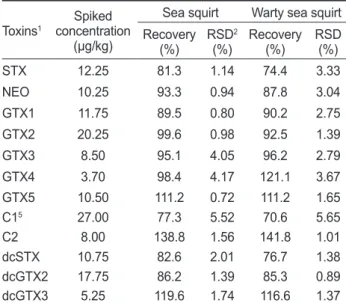
피낭류2
종중멍 게의회수율은77-138%,
미더덕에서는70-141%
의결과를나 타냈다(Table 6).
본실험결과에따르면굴에서C1
값이46%
로 낮은회수율을보였으며,
피낭류2
종에서C2
값이138-141%
로 높은회수율을보였다. Turner et al. (2015)
은패류시료를SPE cartridge
를이용해염을제거하여LC-MS/MS
로분석한결과C1
의값은45%, NEO
의값은155%
이었다고보고하여본연 구결과와유사하였다.
하지만, Turner et al. (2015)
에서PSP
구 성독소의비독성은STX group
중STX, NEO
각각1.00, 1.00
이었고, GTX group
중GTX 1, 2, 3, 4
에서각각1.00, 0.40, 0.60, 0.70
이었고, N-sulfocarbamoyl toxin group
중GTX 5
에서0.10, C1, 2
에서각각0.01, 0.10
이었으며, decarbamoyl toxin group
중dcSTX
에서1.00,
그리고dcGTX 2, 3
에서각각0.20, 0.40
이었다.
상대비독성을고려하였을때, C1, C2
의상 대비독성은각각0.01, 0.10
이었고,
나머지마비성패류독소구 성성분과비교해상대적으로낮은값을나타내고있었으며굴 에서C1
의회수율이비교적낮았고,
피낭류2
종에서C2
의회수 율이비교적높았지만전체독량을대비하여보았을때큰영향 을미치지않을것으로보인다.
따라서본연구에서확립한LC-
MS/MS
를이용한마비성패류독소분석법은우리나라주요패류및피낭류분석에있어서문제가없을것으로판단된다
.
또한
, LC-MS/MS
를이용한마비성패류독소분석법은비교적낮은검출한계와약
12
가지의마비성패류독소성분을동시에정 량할수있다는장점이있다.
나아가우리나라시기또는해역 에따른마비성패류독소구성성분의양상확인등에활용될수 있을것으로판단된다.
Table 5. Recovery of paralytic shellfish toxins in shellfish (n=5)
Toxins1 Spiked conc.
(μg/kg)
Mussel Oyster Short neck clam Ark Shell Comb pen shell Butter clam Scallop Recovery
(%) RSD2
(%) Recovery
(%) RSD
(%) Recovery (%) RSD
(%) Recovery (%) RSD
(%) Recovery (%) RSD
(%) Recovery (%) RSD
(%) Recovery (%) RSD
(%) STX 12.25 103.4 1.43 112.3 2.50 105.3 0.95 87.5 2.32 100.7 1.58 103.8 3.07 100.6 1.06 NEO 10.25 115.7 2.20 126.8 2.88 117.5 2.73 95.6 1.02 116.5 3.48 106.9 4.68 107.5 0.76 GTX1 11.75 95.7 2.05 86.3 1.12 88.0 2.01 88.5 0.68 86.1 2.46 88.0 2.01 85.4 3.04 GTX2 20.25 94.7 0.93 91.2 2.50 94.9 1.13 93.0 1.97 89.7 1.33 91.1 1.19 94.0 0.95 GTX3 8.50 96.9 1.84 85.9 1.68 91.1 2.52 84.5 3.02 77.4 3.47 83.3 3.37 77.4 3.29 GTX4 3.70 103.8 2.33 107 3.83 104.3 1.42 91.9 2.08 100.5 3.50 106.5 5.26 93.5 2.59 GTX5 10.50 106.5 0.75 99.4 1.29 110.5 2.02 112.0 1.14 112.4 0.60 104.8 4.22 115.0 1.08 C15 27.00 91.5 4.02 46.8 3.19 82.4 2.94 74.9 5.49 77.3 3.73 70.0 2.34 81.1 4.21 C2 8.00 110.5 1.72 97.3 2.11 106.5 0.98 97.3 1.68 75.5 1.48 84.3 1.33 84.3 1.33 dcSTX 10.75 105.7 2.89 112 1.26 108.7 1.12 85.2 1.24 106.8 1.43 108.7 1.12 97.7 0.67 dc-GTX2 17.75 95.2 1.73 87.2 2.26 91.5 1.77 89.0 1.42 84.2 1.02 88.5 2.11 85.8 1.42 dc-GTX3 5.25 110.1 0.77 103.6 1.64 115.0 0.91 108.2 1.93 99.8 1.71 96.4 2.25 99.4 3.15
1STX, saxitoxin; NEO, neosaxitoxin; GTX, gonyautoxin; C, protogonyautoxin; dcSTX, decarbamoyl-saxitoxin; dcGTX, decarbamoyl- gonyautoxin. 2RSD, relative standard deviation.
Table 6. Recovery of paralytic shellfish toxins in tunicates (n=5)
Toxins1 Spiked concentration
(μg/kg)
Sea squirt Warty sea squirt Recovery
(%) RSD2
(%) Recovery (%) RSD
(%)
STX 12.25 81.3 1.14 74.4 3.33
NEO 10.25 93.3 0.94 87.8 3.04
GTX1 11.75 89.5 0.80 90.2 2.75
GTX2 20.25 99.6 0.98 92.5 1.39
GTX3 8.50 95.1 4.05 96.2 2.79
GTX4 3.70 98.4 4.17 121.1 3.67
GTX5 10.50 111.2 0.72 111.2 1.65
C15 27.00 77.3 5.52 70.6 5.65
C2 8.00 138.8 1.56 141.8 1.01
dcSTX 10.75 82.6 2.01 76.7 1.38
dcGTX2 17.75 86.2 1.39 85.3 0.89
dcGTX3 5.25 119.6 1.74 116.6 1.37
1STX, saxitoxin; NEO, neosaxitoxin; GTX, gonyautoxin; C, pro- togonyautoxin; dcSTX, decarbamoyl-saxitoxin; dcGTX, decar- bamoyl-gonyautoxin. 2RSD, relative standard deviation.
사 사
이논문은국립수산과학원수산과학연구사업수출패류생산 해역및수산물위생조사
(R2019050)
의지원으로수행된연구 이며연구비지원에감사드립니다.
References
AOAC (Association of Official Methods of Analysis). 2013.
Appendix K: Guidelines for dietary supplements and botan- icals. AOAC International, Gaithersburg, MS, U.S.A, 8-9.
Barbera-Sanchez AL, Soler JF, Astudillo LR and Chang-Yen I.
2004. Paralytic shellfish poisoning (PSP) in Margarita is- land, Venezuela. Rev Biol Trop 52, 89-98.
Chang DS, Shin IS, Pyeun JH and Park YH. 1987. A study on paralytic shellfish poison of sea mussel, Mytilus edulis-food poisoning accident in Gamchun Bay, Pusan, Korea, 1986.
Bull Kor Fish Soc 20, 293-299.
Chang DS, Shin IS, Kim JH, Pyeun JH and Choe WK. 1989.
Detoxification of PSP and relationship between PSP toxic- ity and Protogonyaulax sp. Bull Kor Fish Soc 22, 177-188.
Codex Alimentarius Commission. 2014. Principle for the es- tablishment of Codex methods of analysis. In: Procedural manual, twenty-first edition. Rome, Italy, 63-73.
Dell’Aversano CD, Hess P and Quilliam MA. 2005. Hydro- philic interaction liquid chromatography-mass spectrometry for the analysis of paralytic shellfish poisoning (PSP) toxins.
J Chromatogr A 1081, 190-201. https://doi.org/10.1016/j.
chroma.2005.05.056.
Hall S. 1991. Natural toxins. In: Microbiology of marine food products. Ward DR and Hackney CR, eds. Van Nostrand Reinhold, New York, NY, U.S.A., 301-330.
Jang JH, Yun SM and Lee JS. 2005. Paralytic shellfish poison profile in commercial shellfishes. J Korean Soc Food Sci Nutr 34, 924-928. https://doi.org/10.3746/jkfn.2005.34.6.924.
KMFDS (Korea Ministry of Food and Drug Safety). 2019a. Ko- rea food code. Retrieved from https://www.foodsafetykorea.
go.kr/portal/safefoodlife/food/foodRvlv/foodRvlv.do on Sep 24, 2019.
KMFDS (Korea Ministry of Food and Drug Safety). 2019b. Ko- rea food code. Retrieved from https://www.foodsafetykorea.
go.kr/foodcode/01_03.jsp?idx=12 on Sep 27, 2019.
Lee KJ, Kwon SJ, Jung YJ, Son KT, Ha KS, Mok JS and Kim JH. 2017. Comparison of analytical methods for the detec- tion of paralytic shellfish toxins. Korean J Fish Aquat Sci 50, 669-674. https://doi.org/10.5657/KFAS.2017.0669.
Luckas B, Hummert C and Oshima Y. 2003. Analytical methods for paralytic shellfish poisons. In: Manual on harmful ma- rine microalgae, Hallegfaeff GM, Andersen DM, Cembella DA and Enevoldsen HO, eds. UNESCO, Paris, France, 191- 209.
Mok JS, Oh EG, Son KT, Lee TS, Lee KJ, Song KC and Kim
JH. 2012. Accumulation and depuration of paralytic shell- fish poison in marin organisms. Korean J Fish Aquat Sci 45, 465-471. http://dx.doi.org/10.5657/KFAS.2012.0465.
Mok JS, Song KC, Lee KJ and Kim JH. 2013. Validation of precolumn HPLC oxidation method for analysis of para- lytic shellfish poison. Korean J Fish Aquat Sci 46, 147-153.
https://doi.org/10.5657/KFAS.2013.0147.
Murakami R and Noguchi T. 2000. Paralytic shellfish poison. J Food Hyg Soc Jan 41, 1-10. https://doi.org/10.3358/shokue- ishi.41.1.
Noguchi T. 2003. Marine toxins. Nippon Suisan Gakkaishi 69, 895-909. https://doi.org/10.2331/suisan.69.895.
Oshima Y. 1995. Post-column derivatization liquid-chro- matograpic method for paralytic shellfish toxins. J AOAC Int 78, 528-532.
Park MJ, Lee HJ, Son KT, Byun HS, Park JH and Jang DS.
2000. Comparison of paralytic shellfish poison contents and components in the different bivalve species. J Fd Hyg Safe 15, 293-296.
Quilliam MA, Thomson BA, Scott GJ and Siu KW. 1989. Ion spray mass spectrometry of marine neurotoxins. Rapid Com- mun Mass Spectrom 3, 145-150. https://doi.org/10.1002/
rcm.1290030508.
Rey V, Botana AM and Botana AM. 2017. Quantification of PSP toxins in toxic shellfish matrices using post-column oxidation liquid chromatography and pre-column oxidation liquid chromatography methods suggests post-column oxi- dation liquid chromatography as a good monitoring method of choice. Toxicon 129, 28-35. https://doi.org/10.1016/j.
toxicon.2017.02.003.
Song KC, Lee KJ, Yu HS, Mok JS, Kim JH, Lim KS and Lee MA. 2013. Paralytic shellfish poisoning (PSP) analysis us- ing liquid chromatography-tandem mass spectrometry. Ko- rean J Fish Aquat Sci 46, 154-159. https://doi.org/10.5657/
KFAS.2013.0154.
Toyofuku H. 2006. Joint FAO/WHO/IOC activities to provide scientific advice on marine biotoxins(research report). Mar Pol Bull 52, 1735-1745. https://doi.org/10.1016/j.marpol- bul.2006.07.007.
Turner AD, Hatfield RG, Maskrey BH, Algoet M and Lawrence JF. 2019. Evaluation of the new European Union reference method for paralytic shellfish toxins in shellfish: A review of twelve years regulatory monitoring using pre-column oxida- tion LC-FLD. Trend Anal Chem 113, 124-139. https://doi.
org/10.1016/j.trac.2019.02.005.
Turner AD, McNabb PS, Harwood DT, Selwood AI and Boundy MJ. 2015. Single-laboratory validation of a multitoxin ultra performance LC-hydrophilic interaction LC-MS/MS meth- od for quantitation of paralytic shellfish toxins in bivalve shellfish. J AOAC Int 98, 609-621. https://doi.org/10.5740/
jaoacint.14-275.
Yang X, Zhou L, Tan Y, Shi X, Zhao Z, Nie D, Zhou C and Liu
H. 2017. Development and validation of a liquid chroma- tography-tandem mass spectrometry method coupled with dispersive solid-phase extraction for simultaneous quantifi- cation of eight paralytic shellfish poisoning toxins in shell- fish. Toxins 9, 206. https://doi.org/10.3390/toxins9070206.