EMG 신호로 반신불수 환자의 보행 보조로봇 제어에 관한 연구
A Study on Control of Walking Assistance Robot for Hemiplegia Patients with EMG Signal
신대섭*, 이동훈 D. S. Shin, D. H. Lee
요 약
본 논문은 편마비 환자나 장애인의 보행을 지원하는 외골격 로봇에 대해 연구하였다. 2축 자유도를 가진 외골격 로봇 개발 및 관절 운동에 대해 테스트 하였다. 정상적인 사람으로부터 얻어진 EMG 신호를 분석하 고, 편마비 환자를 정상적인 사람처럼 보행 할 수 있도록 보조 로봇을 편리하고 자동화된 보행이 되도록 제 어신호를 추출 하였다. 편마비 환자의 보행을 위한 기능적 전기 자극(FES)를 사용하는 목적이 손상된 기능 을 복원하는 것이다. 그러나 이것은 사용을 잘못하면 환자에게 치명적인 전기 충격을 줄 수 있거나 지속적 인 자극으로 근육피로의 원인이 될 수 있다. 최소한의 근육 피로도로 편마비 환자의 편리한 걸음은 제어 신 호로 외골격 보조 로봇의 조작을 통해 가능성을 제시하였다. 보행 보조 외골격로봇은 FES 자극기를 사용하 는 것보다 보다 효율적으로 동작할 수 있음을 보였다. 본 연구 실험은 앉아, 서, 걷기같이 우리의 생활에 보 통의 움직임을 수행하고, 버튼스위치, 피에조 센서와 특별히 피드백 제어 시스템은 부드러운 보행 모션이 되 도록 하였다. 그리고 실험결과도 건강한 다리의 근전도 신호를 편마비 환자의 손상된 다리의 보조로봇 시스 템의 동작신호로 이용하여 편리하게 이동할 수 있음을 보여준다.
ABSTRACT
The exoskeleton robot to assist walking of hemiplegia patients or disabled persons has been studied in this paper. The exoskeleton robot with degrees of freedom of 2 axis has been developed and tested for joint motion. The obtained EMG signal from normal person was analyzed and the control signal was extracted from it for convenient and automotive performance of assistance robot to help hemiplegia patient walks as normal person does. the purpose of using FES(Functional Electrical Stimulation) for hemiplegia patient's walk is to restore damaged body function by this, but this could give fatal electrical shock to patients by wrong use or cause quick fatigue in muscle by continuous stimulation.
The convenient movement of hemiplegia patients with minimum muscle fatigue was looked possibly by operation of assistance robot exoskeleton using control signal. and the walking assistance exoskeleton robot seemed works more efficiently than using FES stimulator. The experiment in this study was performed based on usual motion in our life like walking, standing-up, sitting-down, and particularly feedback control system using Piezo sensor along with button switch was applied for smooth swing motion in walking. The experiment also shows that hemiplegia patients can move conveniently by using electromyogram signal of healthy leg for the operation signal of assistance robot system attached at damaged symmetrical leg.
Keyword : Actuator, FES, Two-legged Robot, Hemiplegia, EMG, Exoskeleton
접 수 일 : 2013.11.29 심사완료일 : 2013.12.11 게재확정일 : 2013.12.20
* 신대섭 : 한양대학교 전기공학과 박사과정
[email protected] (주저자) 이동훈 : 동명대학교 의용공학과 교수
[email protected] (교신저자)
1. Introduction
Patients with damage on central nerve system are getting increased due to rise of industrial disaster and traffic accidents while the high industrialization is proceeded. Most of the patients with damage on central nerve system have problem with walking and use assistance device like wheel chair, but still have difficulties in daily life as their families are also in pain. The FES(Functional Electrical Stimulation) is under the study by many researchers to restore the function of damaged body parts for the purpose of helping hemiplegia patients[1]. The study on exoskeleton which assist the patients' walking is under the process. Also, the study on muscle strengthening robot which helps normal people to strengthen their muscle or enable them to carry heavy stuffs is under the research. The exoskeleton robot which would be applied to various field is thought to bring convenience in daily life of hemiplegia patients if it is applied to them[2-4]. So, Study on exoskeleton robot to assist walking of hemiplegia patients or disabled persons has been performed in this study. The exoskeleton robot with the degree of freedom of 2 axis for joint motion has been developed and tested. The EMG signal has been obtained from the body of normal person and analyzed to extract control signals for walking assistance robot, then this control signal used as a input to the robot for automotive walking of hemiplegia patients walk as normal persons do. The study to find out the efficient method to help hemiplegia patient's walking has been carried out for years and brought lots of outcomes in this field. The FES(Functional Electrical Stimulation) system has been generally studied and continued to be studied to restore the function of the damaged body by giving signal to the damaged leg of hemiplegia patients[5-7]. The purpose of this method is to restore the function of damaged body parts, but it also could give fatal electrical shock to the patients or easily cause muscle fatigue since paralyzed muscle could be tired quickly than normal muscle when it was
continuously contracted by electrical signal while walking. Because of limitation of FES system in actual application with this reason, the transmission of the control signal to walking assistance exoskeleton robot is the better way to help hemiplegia patient’s move conveniently with minimum muscle fatigue. So it looks clear that walking with aid of exoskeleton operating by control signal is more efficient than walking by FES system. The experiment in this study has been performed based on usual motion in our life like walking, standing-up, sitting-down, particularly feedback control system using piezo sensor along with button switch was applied for smoother swing motion in the case of walking.
The experiment also performed that hemiplegia patient can move conveniently by using electromyogram signal extracted from healthy leg for the operation signal of assistance robot system attached at damaged symmetrical leg.
2. Measurement of EMG and Control Signal
As mentioned in introduction, FES system has been applied for rehabilitation or walking assistance of hemiplegia patients. Nathaniel Mayer of Moss Rehabilitation Hospital in U.S. and Psuhel of ljubljana university in yugoslavia mainly used surface electrode method. The problem of this method is that it is so difficult to find out exact position and pick up correct nerve from muscles for stimulation. This method also has problem of load impedance change due to attaching condition of electrodes to leg. and the muscle which is continuously stimulated by surface electrode could be tired faster than normal muscle which is activated by self nerve.
Instead of using FES system which gives direct electrical signal to muscles, the function of walking assistance exoskeleton robot has been studied for convenient movement of paralyzed leg with transmission of control signal to the robot, which was extracted from moving muscle's EMG signal by using piezo sensor and switch sensor.
The model appling for assistance robot control
was composed after the process of EMG signal which was obtained from vastus medialis of a normal leg. The signal process to find out most suitable leg part and signal to control assistance robot was performed with the EMG signal which was extracted from various parts of the leg by Biopac MP100.
Fig. 1. Modeling of EMG signal of leg and the signal obtained from vastus medialis
Fig. 1 shows the position of the leg muscle for measurement of EMG signal and the experiment shows that if the control signal from extracted EMG is used for the control of assistance robot that would be most suitable. The assistance leg joint, exoskeleton and 4 degrees of freedom with 4 digital servo motors were manufactured to help leg joint movement and assistance servo exoskeleton was manufactured after development of main control system and servo motor. The ionic equilibrium between inner and outer space of a muscle cell forms a resting potential at muscle fiber membrane when the muscle is not used. The EMG signal is generated while the human muscle repeats contraction and expansion during motion and it is based on action potential at muscle fiber membrane in the process of polarization and re-polarization. The signal has very irregular pattern and there are two problems to get EMG signal. One is that it is very difficult to get EMG signal because of the complexity of contraction and expansion of the muscle, and the other is that the pattern of signal is different from the shape of motion. So, EMG signal is close to random process as gaussian distribution.
The probability of generating EMG signal is as
formula (1) shown below.
(1)
M(t) is EMG signal and E[M(t)] is average of EMG signals. The robot control requires 3 components consisted with HMM. The state number N, transition probability which determines change related to time and output probability of each state. HMM is defined as M=(T, N, S, Y, A, B, ,π, F)by 8 elements as shown below in Table 1
T The length of observation row N State numbers
S The finite set of a state ;
Y The set of output symbols ;
A
The set of a transition probability
aij is a transition probability from si to sj.
B The set of a output probability;
π The set of a initial state probability ; F The set of a final state
Table 1. HMM elements
The effective application of HMM here needs to solve one problem. This is method to get P(Y|M), output probability of observation on model when M is given. We can get sum of probabilities of all states which could take place.
(2)
So,
(3)
Formula (2) and (3) are the process mentioned above. The amount of calculated value is large, and usage of forward-backward algorithm suggested by Baum Welch is usually required.
Forward-backward algorithm is defined in two parts, Forward probability formula (4) and formula (5) which gives output probability P(Y|M). The amount of calculated value and complex of calculation can be reduced with this algorithm.
(4)
(5)
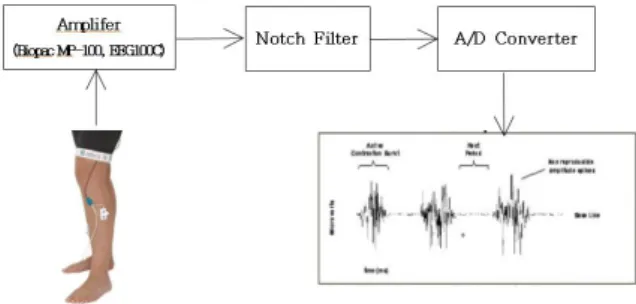
So, human motion could be predicted by studying EMG signal which is generated by related muscle. We amplified personal EMG signal and analyzed particular frequency range with Biopac software after digital processing. Fig. 2 shows overall process mentioned above.
Fig. 2. The process of EMG measurement
Then parameters were extracted from EMG signals and sent to neural network of robot.
Because recorded personal EMG signal provided only limited amount of information, the motion of user was predicted and motion of robot was controlled by parameters extracted from EMG signal. Fig. 3 shows the position of electrodes.
Fig. 3. The position of electrodes
3. Experimental Details
The walking assistance exoskeleton robot was developed to help hemiplegia patient's walking, the EMG signal obtained from muscles of normal person was analyzed respect to each walking motion of leg and the characteristic points of EMG signal were extracted for control of the assistance robot. The effective extraction points of EMG signal for the function of walking assistance robot was also confirmed. The control of walking was performed by transmitting extracted EMG signal to the developed exoskeleton robot.
3.1 Analysis of EMG
The EMG signal was extracted from muscles in leg using Biopac MP 100 and measured by Biopac EEG 100C for extraction of robot control signal as signal process and applied to the assistance robot for the function as its walking motion was predicted.
3.1.1 EMG signal measurement
Surface electrodes were attached to the leg muscles using Biopac experimental measuring device. The signal was extracted from the muscle and processed by digital signal processor.
Fig. 4. Biopac MP 100 experimental device used in this experiment.
Fig. 5. Electrodes attached to vastus medialis
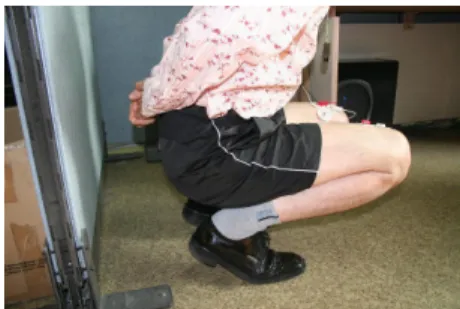
Fig. 6. Stand-up posture of a subject.
Fig. 7. Sit-down posture of a subject.
The measured signal must be amplified 1,000 times for processing at DSP because the EMG signal obtained by surface electrodes is minute electrical signal. 1,000 times amplified signal was
gone through rectification process which change the minus(-) EMG signal into plus amplitude.
The average value of raw EMG signal before the rectification is '0' but the average value of EMG signal could be used as useful information for analysis of the signal after the rectification.
The formula (6) to get the average value is shown below.
Sn N
N nk n EMG k for (6)
RMS value is most simple way to extract envelope information and includes the information related to energy or power about EMG. The low pass filter was used for filtering after obtaining of RMS signal because the information which needs for human surface EMG signal distributes generally between 8∼500Hz.
Fig. 8. EMG signal at sit-down posture
Fig. 9. The signal when the muscle was strengthened during the motion of standing up from sit-down posture.
Fig. 10. The signal at the motion of standing up from sit-down, sitting down from stand-up and standing up from sit-down.
Fig. 11. Power spectrum density(FFT) of original signal.
Fig. 12. Power spectrum density of the signal which was filtered by low pass filter(LPF)
3.2 Assistance Robot System
Robot control device was developed to confirm control signal for walking assistance robot by analyzing EMG respect to various human leg motion and 2 DC servo motors for degrees of freedom of 2 joint were used at each leg joint to control. Each servo motor was developed to be controled by using characteristic points of EMG signal extracted from normal leg of hemiplegia patient.
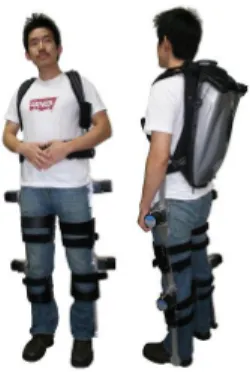
Fig. 13. Walking-assistance device
Fig. 13 shows walking assistance robot which was developed for hemiplegia patient.
(a) Contents of the backpack : CPU control device, battery pack, wireless control device and other control devices.
(b) Operation part : Joint control motor included speed reducer and sensor for joint angle.
(c) Sensor module : EMG detection sensor, piezo sensor and encoder sensor for angle recognizing sensor.
The experiment was performed with hemiplegia patients whose one leg was paralyzed and the other leg is normal. So, walking is possible but inconvenient and patients with two paralyzed legs or hemiplegia patients with serious condition to walk were excluded from the experiment. EMG signal extracted from normal leg was used as control signal to move paralyzed leg. The EMG signal only can not provide enough information for walking. The piezo sensor was attached to sole of the robot, so feedback signal from piezo sensor which recognized the pressure of sole was used as a control signal of walking mode.
The developed servo motor turns 180 degree and designed to operate well in assisting hemiplegia leg to walk since included speed reducer has high torque power of 100kg and FES system used for electrical stimulation of rehabilitation of hemiplegia leg was developed and applied. It is so difficult to get satisfying motion from paralyzed leg with electrical signal only using assistance robot. So wireless control system for assistance robot was designed by inserting
Zigbee module into servo motor and remote operation of servo motor by central control system was performed. and piezo sensor was attached to the sole of the robot to get natural walking.
Fig. 14. Piezo sensor
Fig. 15. Piezo sensor circuit
Fig. 16. EMG detecting board
Piezo sensor generates electron when it was pressed as squeezed sponge release water. The
safety matter was first concern for us when we design walking assistance robot with piezo sensor on the front and back part of the sole for signal feedback to control the operation of robot for walking motion. Fig. 17 shows standing-up motion from sit-down posture by help of assistance robot, Fig. 18 shows gait motion of subject who is wearing assistance robot.
Fig. 17. The scene of stand up motion
Fig. 18. The scene of gait motion
4. Conclusion
The hemiplegia patient could walk as normal person does by attaching or inserting electrodes to the motor position of each muscle and
contracting muscles by application of patterned electrical stimulation composed based on EMG signal information which was extracted from normal person's muscle while they are walking.
But the walking by electrical stimulation could quickly cause muscle fatigue of hemiplegia patient. To reduce muscle fatigue phenomenon, new method to generate proper pattern of stimulation at paralyzed muscle and stimulate by this pattern is recently under the consideration.
We reviewed data to compare contraction strength and duration time after change of a few parameters of stimulation frequency and application to patient's muscle.
We also developed stimulating device which enables application of EMG signal to the muscle of hemiplegia patient and designed walking assistance device which could help patient's walking by control signal since continuous signal from stimulating device could cause muscle fatigue. We have studied algorithm which generate various stimulating pattern using PC to perform target motion of hemiplegia patient. We have constructed hardware system which choose proper pattern with respect to hemiplegia patient's motion and developed walking assistance device which helps to reduce muscle fatigue.
Furthermore, we used state of patient as control signal by using piezo sensor to send feedback signal to assistance robot at walking mode. This experiment was performed with partly paralyzed hemiplegia patients and the experiment with more serious patients is needed for the future study.
References
[1] Milan Ilic, Dragam vasiljevic, Dejan B.
Popovic, "A Programmable Electronic Stimulator for FES System", IEEE Trans, On BME, Vol. 2, No. 4, Dec., 1994.
[2] Kota Kasaoka, Yoshiyuki Sankai, "Predictive control Estimating Operator's Intention for Stepping-up Motion by Exo-Sckeleton Type Power Assist System HAL" Proc, of the 2001 IEEE/RSJ. pp 1578-1583, 2001.
[3] Stephen M Cain, Keith E Gordon and Daniel P Ferris, " Locomotor Adaptation to a Powered Ankle-foot Orthosis depends on Control Method", Journal of Neuro Engineering and Rehabilitation, 2007.
[4] Line Birkedal, "Patern Recognition of Upper-Body Electromyography for Control of Lower-Limb Prostheses", June, 2002.
[5] Andre Ferreira, "Human-Machine Interfaces based on EMG and EEG applied to Robotic Systems" Journal of Neuro Engineering and Rehabilitation, June, 2008.
[6] Kyoungchul Kong and Doyoung Jeon, "Fuzzy Control of a New Tendon-Driven Exoskeletal Power Assistive Device", Proc, of the 2005 IEEE/ASME.
[7] De Luca, C.J.: Surface Electromyography:
Detection and Recording. White paper, DelSys Inc., 2002.
신 대 섭
1996년 호원대학교 전자공 학과 (학사)
1998년 인하대학교 전자공 학과 (석사)
2005년 8월 ~한양대학교 전
기공학과 (박사과
정)
관심분야 : 영상처리, 신경망, 적응제어,
신호처리, 임베디드제어, 재활로봇
이 동 훈
1987년 인하대학교 전자공 학과 (학사)
1993년 인하대학교 전자공 학과 (석사)
2001년 인하대학교 전자공 학과 (박사)
1988년~2006년 원자력의학 원 책임연구원
2006년~현재 동명대학교
의용공학과 부교수
관심분야 : 생체신호처리, HMI, 의료용 가속기 응용