지지면에 따른 마비 측 한 발 서기 훈련이 만성 편마비 환자의 보행속도와 균형에 미치는 효과
김명철
1이홍준
2ǂ1
을지대학교 물리치료학과 교수,
2ǂ을지대학교 보건대학원 물리치료학과 학생
Effect of Single Leg Stance Training According to Different Support Surfaces on Walking Speed and Balance in Patients with Chronic Hemiplegia
Kim Myungchul, PT, Ph.D
1Lee Hongjun, PT
2ǂ1
Dept of Physical Therapy, Eulji University, Professor
2ǂ
Dept of Physical Therapy, Graduate School of Health Science, Eulji University, Student
Abstract
Purpose: This study aimed to investigate the effect of single-leg stance training according to different support surfaces on walking speed and balance in patients with chronic hemiplegia.
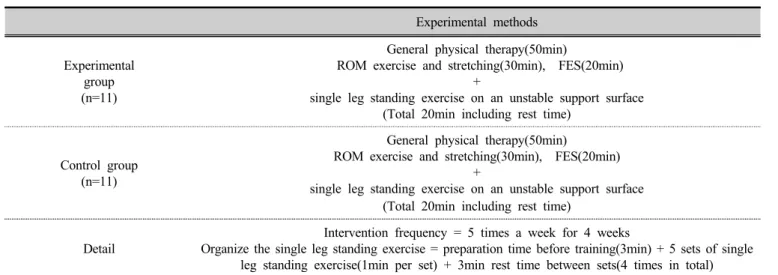
Methods: Twenty-two patients with chronic stroke were randomly categorized into an experimental group (11 patients) and a control group (11 patients). In the experimental group, single-leg stance training was performed on an unstable surface after 50 min of general physical therapy. In the control group, single-leg stance training was performed on a stable surface after 50 min of general physical therapy. All participants performed five sets of single-leg stance exercises per minute and rested for 3 min. The intervention was performed 5 times a week for 4 weeks, and each patient was evaluated using the Berg Balance Scale (BBS), Fugl-Meyer Assessment Scale (FMA), and difference in walking speed between the first and last day of the intervention.
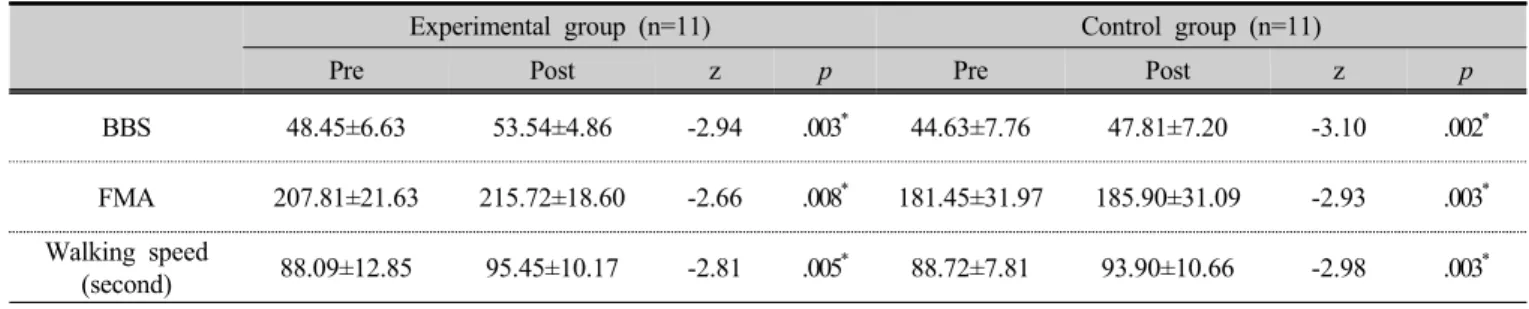
Results: Compared to baseline measurements, both study groups showed significant increases in FMA, BBS, and walking speed (p<.05) after the intervention. However, there was no statistically significant difference (p>.05) between the experimental and control groups. However, in the experimental group, the increases in FMA, BBS, and walking speed were 3.36 %, 9.50 %, and 7.71 %, respectively. In the control group, the increases in FMA, BBS, and walking speed were 2.39 %, 6.65 %, and 7.64 %.
Conclusion: Single-leg stance training on different support surfaces could help improve walking ability and balance in patients with chronic hemiplegia
Key Words : BBS, FMA, single-legged standing, unstable support surface, walking speed
ǂ
교신저자 : 이홍준, [email protected]
1)