• 검색 결과가 없습니다.

Effect of surface-treatments on flexibility and guided bone regeneration of titanium barrier membrane

N/A
N/A
Protected

Academic year: 2021

Share "Effect of surface-treatments on flexibility and guided bone regeneration of titanium barrier membrane"

Copied!
7
0
0

로드 중.... (전체 텍스트 보기)

전체 글

(1)

http://dx.doi.org/10.6111/JKCGCT.2015.25.3.098

Effect of surface-treatments on flexibility and guided bone regeneration of titanium barrier membrane

Jin-Tae Kim, Byoung Soo Kim, Hee Seok Jeong, Young Ku Heo, Sang-Wan Shin*, Jeong-Yol Lee*, Young Ho Shim* and Deuk Yong Lee**

,†

Dental Materials Research Center, Neobiotech Co., Ltd., Seoul 152-582, Korea

*Institute for Clinical Dental Research, Korea University, Seoul 136-701, Korea

**Department of Biomedical Engineering, Daelim University, Anyang 431-715, Korea (Received April 7, 2015)

(Revised May 6, 2015) (Accepted May 8, 2015)

Abstract Titanium barrier membranes are prepared to investigate the effect of surface-treatments, such as machining, electropolishing, anodizing, and electropolishing + TiN coating, on the biocompatibility and physical properties of the membranes. The surface roughness (Ra) of the membrane decreases from machining (0.37 ± 0.09 µm), TiN coating (0.22 ± 0.09 µm), electropolishing (0.20 ± 0.03 µm), to anodizing (0.15 ± 0.03 µm). The highest ductility (24.50 %) is observed for the electropolished Ti membrane. No evidence of causing cell lysis or toxicity is found for the membranes regardless of the surface-treatments. Cell adhesion results of L-929 and MG-63 show that the machined Ti membrane exhibits the highest cell adhesion while the electropolished membrane is the best membrane for the L-929 cell proliferation after 7 days. However, no appreciable difference in MG-63 cell proliferation among variously surface-treated membranes is detected, suggesting that the electropolished Ti membrane is likely to be the best membrane due to the synergic combination of tailored flexibility and excellent fibroblast proliferation.

Key words Pure titanium, Surface-treatment, Roughness, Biocompatibility, Cytotoxicity, Cell proliferation

1. Introduction

Commercially pure titanium ( Cp Ti) has been consid- ered as the biocompatible metallic materials for orthope- dic and dentistry implants because of its excellent mechanical properties, corrosion resistance, and biocom- patibility [1-3]. The excellent biocompatibility of Ti is associated with its stable and inert oxide layer, leading to low level of electronic conductivity, high corrosion resistance, thermodynamic state at physiological pH val- ues, and low ion-formation tendency in aqueous envi- ronment [1]. Ti has been widely used for the implant devices replacing failed hard tissue.

When tooth extraction is required it typically results in additional bone loss in buccal or lingual cortical plate.

The guided bone regeneration (GBR) using the barrier membrane is useful in bone augmentation [4-6]. The GBR and the implant fixation at an infected site are fre- quently complicated by soft-tissue dehiscence, mem- brane exposure, and implant failure due to deficient

mature bone mass and quality to support the implant.

The principle of the GBR is the creation and mainte- nance of sufficient space underneath the barrier.

The mechanical properties of the membranes should avoid collapse of the membrane and provide a constant volume underneath it. The porous areas are small enough to prevent soft tissue penetration through the membrane with no compromise in diffusion of interstitial fluid [4- 6]. The non-absorbable or the resorbable barrier mem- branes are likely to collapse due to improper mechani- cal properties, resulting in insufficient space underneath the membrane for new bone to form [4]. The barriers should be left in place for up to 6 months for bone regeneration. Among the membranes, a Ti membrane with microperforation is used as the barrier because of the rigidity of Ti membrane. It makes the barrier suit- able to maintain the space and cells and fluids necessary for nourishment can be passed through the perforated holes. The porous membranes are attributed to their osteoconductive properties to facilitate the migration of osteoblasts from surrounding bone into the implant site [7, 8]. However, the Ti barrier membranes need a sec- ondary surgery to remove the barrier. In addition, it is difficult to insert the Ti membrane than flexible mem-

Corresponding author

Tel: +82-31-467-4835

Fax: +82-31-467-4432

E-mail: [email protected]

(2)

2. Materials and Methods 2.1. Materials

Ti specimens with a dimension of 10( φ) × 0.15(t) mm

2

are prepared from grade 2 titanium [1]. The specimens for in-vitro test are then surface-treated (electropolishing, anodizing, electropolishing + TiN coating) to investigate the effect of surface roughness on the biocompatibility of the Ti membrane. The samples without any surface treatments are used as control group. Prior to the test, the specimens are γ-ray sterilized [9,10].

The electrolyte for electropolishing is prepared by mixing H

2

SO

4

, H

3

PO

4

, and distilled water. The speci- mens are then electropolished for 20~40 s at 75~85

o

C with a voltage of 7 V and currents of 40~50 A. Then, they are thoroughly rinsed with distilled water and neu- tralized with NaOH, followed by rinsing with distilled water and drying. Prior to anodizing, the specimens are cleaned by dipping in trichloroethylene for 15 min, fol- lowed by surface activation in a solution mixture of HF and HNO

3

for 30 s. The Ti specimen is then anodized for 20~30 s in potentiostatic mode (4~5 V and 3~5 A) at room temperature in the electrolytes (H

3

PO

4

, H

2

SO

4

, H

2

O). After anodizing, the specimens are neutralized with NaOH and then dried. For TiN coating, the as-elec- tropolished specimens are first surface cleaned by soni- cating for 10 min using ethanol and acetone, followed by Ar plasma treatment for 10 min under vacuum (3 × 10

−5

torr). Then, the TiN coated specimens are obtained for 5 min at 300

o

C in N

2

gas atmosphere (10~20 mtorr).

2.2. Surface roughness and tension test

The laser surface roughness tester (Lext OLS4100, Olympus, Japan) and the electron microscopy (CX-100S, Coxem, Korea) are employed to evaluate the roughness of the surface-treated Ti specimens. The specimens with a dimension of 2 × 25 × 0.15(t) mm

3

are surface-treated and then mechanical properties are examined by using a tension tester (E3000, Instron, UK).

2
is supplemented with 10 % of fetal bovine serum (Gibco- BRL, Life Tech., New Zealand), 1 × antibiotic-antimy- cotic solution (contains 10,000 units of penicillin(base), 10,000 μg/ml of streptomycin), and 25 g of amphoteri- cin (Gibco-BRL, Life Tech., New Zealand) [11]. After 80 % of cell proliferation, cell detachment is done with trypsin-EDTA (0.25 % trypsin and 0.1 % glucose dis- solved in 1 mM of DETA-saline, Invtrogen Co., USA), followed by subculture.

2.3.2. Cell adhesion

The 25 cm

2

culture flasks are seeded with 8 × 10

4

cells/ml and incubated for 3 h to evaluate the bond strength between the surface-treated specimens and the cells. The detached cells are excluded. The cells are stained by immersing in the solution of 0.2 % crystal violet (Georgiachem., Japan) dissolved in 10 % ethanol for 5 min at room temperature. After immersing the stained cells in 95 % ethanol for 15 min, the change of absorption at 595 nm is examined by using the ELISA analyzer (Spectra MAX 250s, Molecular Devices Co., USA).

2.3.3. Cell proliferation

The culture flasks are seeded with 2 × 10

4

cells/ml and incubated for 3 or 7 days. The specimens are added to each flask. The cell proliferation is evaluated by using the XTT assay kit (Cell Proliferation Kit II, Roche Applied Science, Germany). After incubation, XTT labeling reagent of 250 μl is added to each culture and the cultures are incubated for 2 h at 37

o

C in the pres- ence of 5 % CO

2

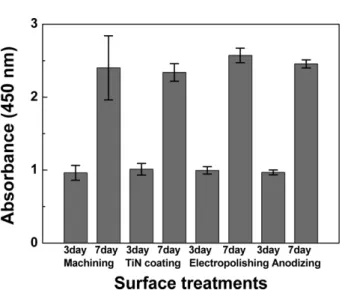
. The change of absorption at 450 nm is examined by using the ELISA analyzer.

2.3.4. Cell cytotoxicity

The extract test method is conducted to evaluate the potential of cytotoxicity on the basis of the Interna- tional Organization for Standardization (ISO 10993-5).

The test samples are used within 24 h after completion

of the preparation. The test extract is placed onto two

(3)

separate confluent monolayers of L-929 mouse fibro- blast cells (1 × 10

5

cells/ml) propagated in 5 % CO

2

. After incubation, XTT labeling reagent of 250 μl is added to each culture and the cultures are incubated for 2 h at 37

o

C in the presence of 5 % CO

2

. The change of absorption at 450 nm is examined by using the ELISA analyzer. For analyses of results, statistical calculations such as t-test (p < 0.05) and one-way analysis of vari- ance (ANOVA, p < 0.001) are employed to analyze the results [10, 11]. And the Dunnett test (p < 0.05) is done for the verification after test [12, 13].

3. Results

3.1. Surface roughness and strength

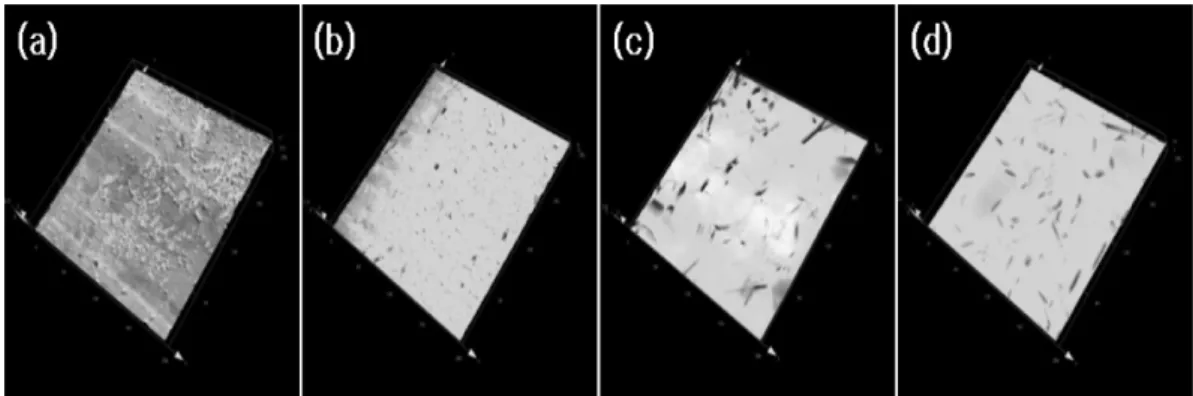
The surface roughness (arithmetic mean deviation of the profile, Ra) is examined by the laser surface rough- ness tester to investigate the effect of surface roughness on the degree of GBR and the biocompatibility between the Ti membrane surface and the gingival tissue. The surface-treated Ti barrier membranes are reported to replace the deficient and infected alveolar bone and pro- vide the sufficient space underneath the membrane. The

experimental results are shown in Figs. 1-3, indicating that the surface roughness (Ra) decreases as the treat- ment is changed from machining (0.37 ± 0.09 μm), TiN coating (0.22 ± 0.09 μm), electropolishing (0.20 ± 0.03 μm), to anodizing (0.15 ± 0.03 μm). The smoothest sur- face is observed for the anodized specimens.

The uniaxial tensile tests of the Ti membranes are per- formed. The specimens, surface-treated with electropol- Fig. 1. 3D laser microscopic images of Ti surfaces treated by (a) machining, (b) TiN coating, (c) electropolishing, and (d) anodizing,

respectively.

Fig. 2. SEM images of Ti surfaces treated by (a) machining, (b) TiN coating, (c) electropolishing, and (d) anodizing, respectively.

Fig. 3. A comparison of surface roughness (Ra) in various

surface-treated Ti membranes.

(4)

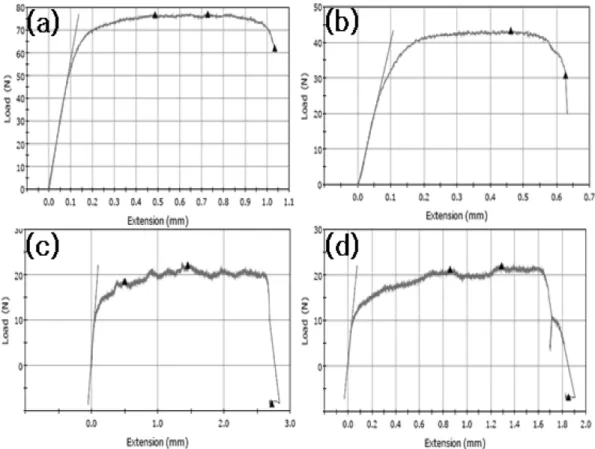
ishing or anodizing, exhibit better performance of deformation relatively at a low load as compared to the specimens treated with machining or TiN coating, as shown in Fig. 4. Although it is hard to compare the duc- tility (strain at break, %) due to different scale of x-axis, the ductility increased from machining (6.26 %), TiN coating (7.29 %), anodizing (16.82 %), to electropolish- ing (24.50 %). The ductility is deteriorated after machin- ing and TiN coating as compared to electropolishing probably due to accumulation of residual stress. It is concluded that the electropolished specimen is likely to deform due to excellent ductility.

3.2. Biocompatibility

3.2.1. Cell adhesion and proliferation

The L-929 cell adhesion results are shown in Fig. 5, suggesting that no dramatic difference is detected. How- ever, the electropolished specimen exhibits the lowest adhesion. The results are significant with a 95 % confi- dence level (p > 0.05). The cell proliferation results of L-929 cell are shown in Fig. 6, indicating that all the results are very similar and the 7-day proliferation is twice larger than the 3-day proliferation. The results are

significant with a 95 % confidence level (p > 0.05).

3.2.2. Osteoblast-like cell (MG-63) adhesion and prolif- eration

The results are exactly the same as those of L-929 cell adhesion and proliferation, as displayed in Figs. 7 and 8. The 7-day proliferation, as shown in Fig. 8, Fig. 4. Load-extension curves for the Ti membranes that are surface-treated: (a) machining, (b) TiN coating, (c) electropolishing, and

(d) anodizing, respectively.

Fig. 5. L-929 cell adhesion results of surface-treated Ti

membranes.

(5)

increases 2.5 times larger than the 3-day proliferation.

The results are significant with a 95 % confidence level (p > 0.05).

3.2.3. L-929 Cell cytotoxicity

All the results reveal that the test (Fig. 9) shows no evidence of causing cell lysis or toxicity. The results are significant with a 95 % confidence level (p > 0.05).

4. Discussion

GBR using barrier membranes is useful in bone augmentation. Commonly used polytetrafluoroethylene (PTFE) and Ti are the typical non-resorbable membranes.

Although they need a secondary surgery to remove the membrane, the ingrowth of osteogenetic cells is not dis- turbed by competing non-osteogenetic soft tissue cells due to the superior stability of barrier membrane. They are likely to create and maintain sufficient space under- neath the membrane for up to 6 months [1, 4, 5].

Immediate implant placement after tooth extraction may lead to early implant failure caused by insufficient mature bone mass and quality to adequately support the implant, and difficulty in obtaining complete coverage of the extraction socket by bone and soft tissue. Early membrane exposure by epithelial dehiscence may result in membrane exposure and infection, which can jeopar- dize bone augmentation. Kfir et al. [14] suggested that no apparent infection or problem is reported even though early Ti membrane exposure occurs between 2 and 6 weeks in 7 patients (47 %) out of 15 patients.

Immediate bone augmentation using the Ti membrane after infected tooth extraction is found to be feasible and Fig. 6. L-929 cell proliferation test results of surface-treated Ti

membranes.

Fig. 7. MG-63 cell adhesion results of surface-treated Ti membranes.

Fig. 8. MG-63 cell proliferation test results of surface-treated Ti membranes.

Fig. 9. Cell viability of surface-treated Ti membranes.

(6)

brane exposure and the related inflammation. In onlay grafts, it is essential to insert the membrane carefully to avoid the crumpling, when the surgeon is trying to bend it around two axes. Bending it around one axis is tolera- ble and the smooth surface is preserved. Careful soft tis- sue management is important to reduce the number of exposed membranes.

Experimental results revealed that surface roughness of the membrane was attributed to the surface treat- ments. The roughness decreased from 0.37 μm to 0.15 μm (machining (0.37 μm), TiN coating (0.22 μm), elec- tropolishing (0.20 μm), anodizing (0.15 μm)). Strength and ductility decreased and increased with decreasing the surface roughness, respectively. In the present study, the electropolished specimen is determined to be the best membrane due to excellent ductility (24.50 %). A cytotoxicity test determines whether a product will have a toxic effect on living cells. Under the conditions of this study, the test extract showed no evidence of caus- ing cell lysis or toxicity (Fig. 9) regardless of surface roughness, suggesting that the surface-treated speci- mens are suitable for the barrier membrane due to the absence of cytotoxicity. Cell adhesion results of L-929 and MG-63 (Figs. 5 and 7) indicated that the machined Ti membrane exhibited the highest cell adhesion while the electropolished membrane was determined to be the best membrane for the L-929 cell proliferation after 7 days. However, no appreciable difference in MG-63 cell proliferation between the surface-treated membranes was noticed.

In general, Ti membrane needs a secondary surgery to remove the barrier after sufficient bone formation under- neath the Ti membrane. However, early exposure or dis- location of the membrane is possible especially at the interface between the Ti membrane and the incision, resulting in prevention of new bone growth caused by bacterial contamination (infection, contact between saliva and the grafted material). In that case, the elec- tropolished Ti membrane is believed to be the best membrane due to excellent L-929 cell proliferation, as

cluded that the electropolished Ti membrane is likely to be the best membrane due to tailored flexibility and excellent L-929 cell proliferation.

5. Conclusion

The Ti barrier membranes are prepared to evaluate the effect of surface-treatments, such as machining, elec- tropolishing, anodizing, and electropolishing + TiN coat- ing, on guided bone regeneration and flexibility of the membranes. The surface roughness (Ra) of the mem- brane decreases from machining (0.37 μm) to anodizing (0.15 μm). Strength and ductility decreased and increased with decreasing the surface roughness, respectively. No cytotoxicity causing cell lysis is observed regardless of the surface-treatments. Cell proliferation results of L- 929 and MG-63 show that the electropolished mem- brane is the best membrane for the L-929 cell prolifera- tion after 7 days. However, no appreciable difference in MG-63 cell proliferation between the surface-treated membranes was detected. It can be concluded that the surface-treated Ti specimens are suitable under the rele- vant circumstances that can arise from this experiment.

References

[ 1 ] C.N. Elias, J.H.C. Lima, R. Valiev and M.A. Meyers,

“Biomedical applications of titanium and its alloys”, JOM, 46 (March 2008).

[ 2 ] Y. Okazaki, “A new Ti-15Zr-4Nb-4Ta alloy for medical applications”, Curr. Opinion Solid State Mater. Sci. 5 (2001) 45.

[ 3 ] C.E. Wen, Y. Yamada, K. Shimojima, Y. Chino, T. Asa- hina and M. Mabuchi, “Processing and mechanical properties of autogenous titanium implant materials”, J.

Mater. Sci.: Mater. Med. 13 (2002) 397.

[ 4 ] F. Watzinger, J. Luksch, W. Millesi, C. Schopper, J.

Neugebauer, D. Moser and R. Ewers, “Guided bone regeneration with titanium membranes: A clinical study”, British J. Oral. Mixillofac. Surg. 38 (2000) 312.

[ 5 ] E. Kfir, V. Kfir and E. Kaluski, “Immediate bone aug-

(7)

mentation after infected tooth extraction using titanium membranes”, J. Oral. Implantol. 33 (2007) 133.

[ 6 ] B.S. McAllister and K. Haghighat, “Bone augmentation techniques”, J. Periodontol. 78 (2007) 377.

[ 7 ] M. Hong, Y.H. Kim, D. Ganbat, D. Kim, C. Bae and D.S. Oh, “Capillary action: Enrichment of retention and habitation of cells via micro-channeled scaffolds for massive bone defect regeneration”, J. Mater. Sci.: Mater.

Med. 25 (2014) 1991.

[ 8 ] D.S. Oh, Y.H. Kim, D. Ganbat, M. Han, P. Lim, J.

Back, F.Y. Lee and H. Tawfeek, “Bone marrow absorp- tion and retention properties of engineered scaffolds with micro-channels and nano-pores for tissue engineer- ing: A proof of concept”, Ceram. Intl. 39 (2013) 8401.

[ 9 ] N.S. Turker, A.Y. Ozer, B. Kutlu, R. Nohutcu, A. Sun- gur, H. Bilgili, M. Ekizoglu and M. Ozalp, “The effect of gamma radiation sterilization on dental biomateri- als”, Tissue Eng. Regen. Med. 11 (2014) 341.

[10] J. Kim and H. Kim, “Rat defect models for bone grafts and tissue engineered bone constructs”, Tissue Eng.

Regen. Med. 10 (2013) 310.

[11] J. Kim, D.Y. Lee, T. Kim, Y. Song and N. Cho, “Bio- compatibility of hyaluronic acid hydrogels prepared by

porous hyaluronic acid microbeads”, Met. Mater. Intl.

20 (2014) 555.

[12] K. Chae, H. Choi, J. Ahn, Y. Song and D.Y. Lee,

“Application of taguchi method and orthogonal arrays for characterization of corrosion rate of IrO

2

-RuO

2

film”, J. Mater. Sci. 37 (2002) 3515.

[13] Y. Song, Y. Nam, K. Lee and D.Y. Lee, “Microstruc- ture and chemical properties of c-BN films prepared by ME-ARE”, Mater. Sci. Forum 449-452 (2004) 465.

[14] E. Kfir, V. Kfir and E. Kaluski, “Immediate bone aug- mentation after infected tooth extraction using titanium membranes,” J. Oral. Implantol. 33 (2007) 133.

[15] J. Torres, F. Tamimi, M.H. Alkhraisat, A. Manchon, R.

Linares, J.C. Prados-Frutos, G. Hernandez and E.L.

Cabarcos, “Platelet-rich plasma may prevent titanium- mesh exposure in alveolar ridge augmentation with anorganic bovine bone,” J. Clin. Periodontol. 37 (2010) 943.

[16] W. Zhong, G. Ma, Y. Wang, R. Tamamura and J. Xiao,

“Augmentation of peri-implant bone defects with differ-

ent bone grafts and guided bone regeneration: a pilot

experimental study in the dog”, J. Hard. Tissue Bio. 15

(2006) 82.

수치

Fig. 2. SEM images of Ti surfaces treated by (a) machining, (b) TiN coating, (c) electropolishing, and (d) anodizing, respectively.
Fig. 5. L-929 cell adhesion results of surface-treated Ti membranes.
Fig. 7. MG-63 cell adhesion results of surface-treated Ti membranes.

참조

관련 문서

It considers the energy use of the different components that are involved in the distribution and viewing of video content: data centres and content delivery networks

After first field tests, we expect electric passenger drones or eVTOL aircraft (short for electric vertical take-off and landing) to start providing commercial mobility

1 John Owen, Justification by Faith Alone, in The Works of John Owen, ed. John Bolt, trans. Scott Clark, &#34;Do This and Live: Christ's Active Obedience as the

The purpose of this study was to evaluate the effect of these substances on bone regeneration by applying these materials to bone defects after cyst

The data are corrected for temperature error due to solar radiation and the effect of low temperature on the anerod capsule and curvature of the surface of

최적 용접 조건 선정에 관한 연구 ( A Study on the Optimum Welding Conditions for Reducing the Depth of Indentation of Surface in

The effects of the acceleration voltage, the probe current and the travel speed on the formation, the ingredient variation and the surface roughness of the deposited

The aim of this study was to compare the effect on bone regeneration relative to maintenance period of PTFE membrane in rabbit calcarial defects.. Eight adult