Effect of Fatigue on Force-Matching in the Quadriceps Muscle
Young-hee Song, Ph.D., P.T.
Su-young Lee, Ph.D., P.T.
Dept. of Rehabilitation Therapy, The Graduate School, Yonsei University Oh-yun Kwon, Ph.D., P.T.
Dept. of Physical Therapy, College of Health Science, Yonsei University Institute of Health Science, Yonsei University
Abstract
1)This study examined the ability of human subjects to match a force in their quadriceps muscle during fatigue. Twenty subjects (mean age: 23.4 yrs, mean height: 167.8 ㎝, mean weight, 62.6 ㎏) were enrolled in the experiment. In the force-matching task, the quadriceps muscle generated 50% of the MVIC (maximum voluntary isometric contraction) torque under visual control and then without visual feedback.
After inducing fatigue in the quadriceps muscle, the subjects were required to match 50% of the MVIC torque without visual feedback. The perceived magnitude of the force and force-matching errors were measured. 50% of the MVIC torque was perceived from 39.96 Nm in the pre-fatigue condition to 44.95 Nm in the post-fatigue condition. 50% of the MVIC torque-matching errors increased significantly from .55% in the pre-fatigue condition to 9.6% in the post-fatigue condition (p<.001). in addition, there were significantly more force-matching errors in women than in men (p<.01). In conclusion muscle fatigue can interfere with a subject's ability to match a force. This suggests that muscle fatigue may contributes to the sensitization of the proprioception.
Key Words: Fatigue; Force-matching; Proprioception.
Introduction
Recently, researchers have widely assumed that joint proprioception plays an important role in main- taining the functional stability of a joint (Swanik et al, 2001; Tsuda et al, 2001). Proprioception is defined as the cumulative neural input to the central nervous system from specialized nerve endings known as mechanoreceptors (Lee et al, 2003). It is a specialized variation of the sensory modality of touch and en- compasses the sensation of the joint motion and joint position (Grigg, 1993). The sensory receptors for proprioception are located in the skin, muscles, ten- dons, and joint capsule as well as in the ligaments.
Mechanoreceptors function as transducers that con- vert a mechanical load in the joint to afferent impulses. This information is finally integrated for
the motor programming required for precision move- ments and contributes to reflex muscle contraction, providing dynamic joint stability. Miura et al (2004) reported that muscle fatigue has been shown to ad- versely alters joint proprioception and impairs neuro- muscular control in the lower extremities. Muscle fa- tigue is a complex phenomenon that has been de- fined as a decrease in the force-generating capacity regardless of the task performed. Muscular fatigue is an inevitable phenomenon in physical and daily ac- tivities (Vuillerme et al, 2002). Therefore, deterio- ration in proprioception as a result of physical or mental fatigue may increase the risk of knee liga- mentous injuries. For example, the incidence of in- jury to skiers and football players is higher in the afternoon (Tuggy and Ong, 2000) and the third quarter, respectively (Zempher, 1989). This suggests Corresponding author: Su-young [email protected]
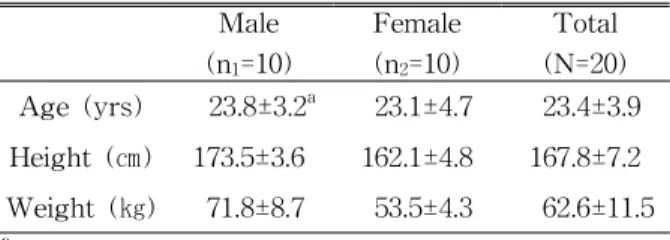
Male (n1=10)
Female (n2=10)
Total (N=20) Age (yrs) 23.8±3.2a 23.1±4.7 23.4±3.9 Height (㎝) 173.5±3.6 162.1±4.8 167.8±7.2 Weight (㎏) 71.8±8.7 53.5±4.3 62.6±11.5
aMean±SD.
Table 1. Subjects characteristics that fatigue in athletes might produce a decrease in
knee proprioception and is one of the risk factors for knee ligament injury.
Limb position or muscle force-matching task are used to measure the reduced proprioception during a fatiguing contraction. The sense of force is compli- cated in that it actually incorporates two senses, a peripherally derived sense of force and a centrally derived sense of effort (McCloskey et al, 1983). The sense of force is mediated by the skin and joint or muscle afferent fibers. In particular, the Golgi tendon organ detects the original muscle force (Gandevia and Burke, 1992). It has also been proposed that the Ia muscle spindle afferents are capable of signalling the intramuscular tension (Cafarelli, 1988).
McCloskey et al (1974) suggested a contralateral limb-matching method to match force. In this meth- od, the participants are required to generate a speci- fied level of force by contracting the muscles of the reference limb in the presence of external feedback, and then to match the subjective magnitude of this force, using the muscles of the contralateral match- ing limb without the assistance of feedback. The in- dividuals were required to reproduce a force applied during sustained fatiguing isometric contractions, by generating a brief matching contraction using the contralateral limb.
Generally, there is a monotonic increase in the perceived magnitude of the reference force when subjects are required to reproduce a force (Cafarelli and Layton-Wood, 1986; Gandevia and McCloskey, 1978; Jones and Hunter, 1983a, 1983b). Therefore, any decrease in force-generating capacity due to fa- tigue should therefore be perceived as a proportional increase in effort. Weerakkody et al (2003) proposed that fatigue altered the relationship between sense of effort creating a the sense of tension. However, Carson et al (2002) suggested that the motor com- mand is associated with the sense of effort. The mechanism of force-matching errors by a monotonic
increase in the perceived magnitude of force is controversial.
This study examined the relationship between the perceived magnitude of force and the force matching errors after the quadriceps muscle was fatigued.
Therefore, it was assumed that fatigue would affect the sensitization of proprioception.
Methods Subjects
A total of 20 subjects (10 males, and 10 females) were enrolled in this study. The subjects were re- quired to have no existing musculoskeletal abnormal- ities, or be involved in any regular leg resistance exercise programs. All the subjects provided in- formed consent after being explained the purpose and method of the study. The mean age, was 23.4 years, and height 167.8 ㎝, weight 62.6 ㎏ (Table 1).
Equipment2)3)
Torque sensor
A torque sensor1) was connected with an N-K table2) along the axis of rotation coincident with the knee joint.
The subjects were comfortably seated with their trunk, and their leg and ankle were strapped by a belt and they were able to grip both handles. The torque sensor was fixed with 110° to generate the maximum voluntary isometric contraction (MVIC) in the quadriceps muscle.
The torque traces were acquired using Acqknowledge 1) YDN-50K, SETech Instrument Co., Korea.
2) Preston, NJ, U.S.A.
MVIC The perceived 50% of the MVIC torque
45~55% Pre-fatigue Post-fatigue
Male (n1=10) 45.78~55.96 52.79 57.22
Female (n2=10) 23.59~28.84 27.14 32.67
Total (N=20) 34.69~42.40 39.96 44.95
Table 2. Changes in the perceived magnitude 50% of the MVIC torque (Unit: Nm) 3.7.3 software for the subsequent analysis. The sampling
rate in the torque sensor was 100 ㎐.
Procedures
Pre-fatigue testing
The participants extended their knee joints to maximum extension for 5 seconds with the knee joint 70° in order to estimate the maximum voluntary isometric contraction (MVIC) torque in their quad- riceps muscle. Three MVICs of 5 seconds duration were carried out and averaged. This value was taken as the MVIC. The target torque was 50% of the MVIC torque (the range 45~55% of the MVIC). The subjects were able to see a computer monitor that provided visual feedback of the torque level gen- erated by the quadriceps muscle. They were asked to generate 50% of the MVIC torque under visual control. Once the subjects had satisfactorily achieved 50% of the MVIC torque, they were asked to match it without displaying the torque output. The subjects were instructed to say "now" when they believed 50% of the MVIC torque in the leg had been match- ed, at which point the level was recorded. A verbal cue to correct the level of torque. was used. Three force-matching sessions of 5 seconds duration were carried out and the results were averaged. This val- ue was taken as the force-matching errors.
Induced fatigue
The participants extended maximally with knee joint 90° to the maximum extenasion to estimate the MVIC in their quadriceps muscle. They maintained 80±5% of the MVIC torque under visual feedback until they could not last for more than 10 seconds.
Post-fatigue testing
After inducing fatigue in the quadriceps muscle, the torque sensor angle was changed to 70°. The subjects were asked to generate 50% of the MVIC torque un- der visual control again. And then they were required to match 50% of the MVIC torque without displaying a torque output. Three force-matching sessions of 5 seconds duration were carried out and the value great- er than 45~55% of the MVIC torque was averaged.
This value was taken as the force-matching error.
Statistical Analysis
A paired sample t-test was performed to test the significance in 50% of the MVIC torque-matching errors produced by the quadriceps muscle. The col- lected materials were coded and analyzed by SPSS version 12.0 for Windows.
Results
The perceived magnitude of 50% of the MVIC torque
50% of the MVIC torque was perceived to be 39.96 Nm in pre-fatigue and 44.95 Nm in post-fatigue (Table 2).
50% of the MVIC torque-matching errors 50% of the MVIC torque-matching errors were significantly increased from .55% in the pre-fa- tigue state to 9.6% in the post-fatigue state (p<.001) (Table 3). In addition, the force-matching errors were significantly higher in women than in men (p<.01) (Table 3).
Force-matching errors
Pre-fatigue Post-fatigue t p
Male (n1=10) 0 5 -2.014 .037
Female (n2=10) 1 14* -6.406 .000
Total (N=20) .55 9.6 -4.933 .000
*Significant difference in post-fatigue between male and female.
Table 3. Changes in 50% of the MVIC torque-matching errors (Unit: %)
Discussion
It is essential that the sense of joint position should be detected in order to control muscle and have precise timing. Muscle fatigue can produce the disturbances in the proprioception, changes in the perception of the muscle and limb position and movement, which can generate errors in the tracking force and limb position after exercise (Brockett et al, 1997). Vuillerme et al (2002) reported that subjects sway more under fatigue conditions than in the non-fatigue conditions as indexed by the increased range, mean speed, and dispersion of COP displace- ments with fatigue. Skinner et al (1986) reported a decrease in knee proprioception, with a 15% decrease in knee flexion and extension work output after a general fatigue load. Miura et al (2004) reported that a general fatigue load had a statistically significant effect on knee proprioception.
This might be a central processing deficiency in the proprioception signal by the central fatigue process. Central fatigue reduces accuracy in motor control and disturbs the voluntary muscle-stability ac- tivity to endure stress loading at the joint. Finally, it increases the risk of ligament injury at the knee joint.
This study showed that 50% of the MVIC tor- que-matching errors were increased significantly from .55% in the pre-fatigue condition to 9.6% in the post-fatigue condition. Force-matching errors in women were increased significantly from 1% in the pre-fatigue condition to 14% in the post-fatigue condition. In men, the force-matching errors in- creased significantly from 0% in the pre-fatigue con- dition to 5% in the post-fatigue condition. The force-matching errors were significantly higher in
women than in men. This suggests that the per- ceived forces for the required force in magnitude were either increased or decreased by muscle fatigue.
50% of the MVIC torque perceived in women was 27.14 Nm in the pre-fatigue condition and 32.67 Nm in the post-fatigue condition. In man, the perceived forces increased from 52.79 Nm to 57.22 Nm in the pre-and post-fatigue condition. Stevens and Cain (1970) reported that when subjects are asked to evaluate the magnitude of the force exerted by fa- tigued muscles, there was a uniform ratio increase in the perceived amplitude of the forces. Teghtsoonian et al (1977) reported that muscle fatigue was asso- ciated with a substantial change in the exponent of the force power function, and the absolute threshold for detecting a force might increase with increasing muscle fatigue. An the normal circumstances, the motor command provides a reasonable representation of the sense of effort. However, after tensile ex- ercise, when the contractile elements are disturbed by muscle fatigue, there are several fatigue-related mechanisms involved at different levels of the nerv- ous system that can affect the regulation of these small forces. At the peripheral level, pre- and post-synaptic mechanisms and sites are potentially implicated, which include a failure in the trans- mission of the neural signal or a failure of the mus- cle to respond to neural excitation (Bigland-Ritchie and Woods, 1984). In the central system level, to maintain constant force level, the motor cortex in- creases a complex series of excitability and produces more efforts in order to maintain a constant force (Carson et al, 2002; Jones, 1995).
Proske et al (2004) suggested that after a series of eccentric contractions there are large force matching
errors due to three causes. First, there was greater effort required to achieve a given force, as a result of fatigue and muscle damage. Second, there is an in- crease in the central neural drive, presumably accom- panied by an increase in effort, which lasts for up to 48 hours. Third, there is the influence of DOMS (delayed onset muscle soreness), which does not be- gin to exert a significant effect until 24 hours after the exercise, and which lasts for least four days.
It is not known if the frequent failure in exercise performance due to muscle fatigue is due to impaired proprioception or to other factors. However, there is some evidence that the output of the muscle re- ceptors changes in fatigue (Christakos and Windhorst, 1986). In addition, stretch reflexes, which can indirectly reflect the output of proprioceptors, have been reported to increase (Hakkinen and Komi, 1983), decrease (Balestra et al, 1992), or remain un- changed (Darling and Hayes, 1983).
The aim of this study was to test the perceived magnitude of force and force-matching errors, as well as to demonstrate that proprioception is sensi- tized by muscle fatigue. The sense changes related to maintaining a constant force was examined in or- der to determine the perceived magnitude of force constantly at various times. However, further study will be needed to determine the different joint levels associated with the force level associated with force-length relationship. In addition, a training pro- gramme through force-matching is recommended for patients with a musculoskeletal injury.
Conclusion
This study examined the ability of human subjects to match a force in their quadriceps muscle during fatigue. The perceived 50% MVIC torque was 39.96 Nm in the pre-fatigue condition and 44.95 Nm in the post-fatigue condition. 50% of the MVIC tor- que-matching errors increased significantly from .55% in the pre-fatigue condition to 9.6% in the
post-fatigue condition (p<.001). There were larger force-matching errors in women than in men (p<.01). In conclusion, muscle fatigue can interfere with a subject's ability to match a force. This sug- gests that muscle fatigue can contribute to the sen- sitization of proprioception.
References
Balestra C, Duchateau J, Hainaut K. Effects of fa- tigue on the stretch reflex in a human muscle. Electroencephalogr Clin Neurophysiol.
1992;85:46-52.
Bigland-Ritchie B, Woods JJ. Changes in muscle contractile properties and neural control during human muscular fatigue. Muscle Nerve.
1984;7:691-699.
Brockett C, Warren N, Gregory JE, et al. A compar- ison of the effects of concentric versus eccentric exercise on force and position sense at the hu- man elbow joint. Brain Res. 1997;771:251-258.
Cafarelli E. Force sensation in fresh and fatigued human skeletal muscle. Exerc Sport Sci Rev.
1988;16:139-168.
Cafarelli E, Layton-Wood J. Effect of vibration on force sensation in fatigued muscle. Med Sci Sports Exerc. 1986;18:516-521.
Carson RG, Riek S, Shahbazpour N. Central and pe- ripheral mediation of human force sensation fol- lowing eccentric or concentric contractions. J Physiol. 2002;539(Pt 3):913-925.
Christakos CN, Windhorst U. Spindle gain increase during muscle unit fatigue. Brain Res.
1986;365:388-392.
Darling WG, Hayes KC. Human servo responses to load disturbances in fatigued muscle. Brain Res.
1983;267:345-351.
Gandevia SC, Burke D. Does the nervous system depend on kinesthetic information to control natural limb movements? Behav Brain Sci.
1992;15:614-632.
This article was received September 20, 2006, and was accepted October 21, 2006.
Gandevia SC, McCloskey DI. Interpretation of per- ceived motor commands by reference to afferent signals. J Physiol. 1978;283:493-499.
Grigg P. Peripheral neural mechanism in proprioception. J Sport Rehab. 1992;3:2-17.
Hakkinen K, Komi PV. Electromyographic and me- chanical characteristics of human skeletal muscle during fatigue under voluntary and reflex conditions. Electroencephalogr Clin Neurophysiol.
1983;55:436-444.
Jones LA. The senses of effort and force during fa- tiguing contractions. In: Gandevia RM, Enoka AJ, McComas DG, et al, eds. Fatigue: Neural and muscular mechanism. New York, Plenum, 1995;384:305-313.
Jones LA, Hunter IW. Perceived force fatiguing iso- metric contractions. Percept Psychophys.
1983a;33:369-374.
Jones LA, Hunter IW. Effect of fatigue on force sensation. Exp Neurol. 1983b;81:640-650.
Lee HM, Liau JJ, Cheng CK, et al. Evaluation of shoulder proprioception following muscle fatigue.
Clin Biomech (Bristol Avon). 2003;18:843-847.
McCloskey DI, Ebeling P, Goodwin GM. Estimation of weights and tensions and apparent involve- ment of a 'sense of effort'. Exp Neurol.
1974;42:220-232.
McCloskey DI, Gandevia S, Potter EK, et al. Muscle sense and effort: Motor commands and judge- ments about muscular contractions. In: Desmedt JE, ed. Motor Control Mechanisms in Health and Disease. New York, Raven, 1983:151-167.
Miura K, Ishibashi Y, Tsuda E, et al. The Effect of local and general fatigue on knee proprioception.
Arthroscopy. 2004;20(4):414-418.
Proske U, Gregory JE, Morgan DL, et al. Force matching errors following eccentric exercise.
Hum Mov Sci. 2004;23:365-378.
Skinner HB, Wyatt MP, Hodgdon JA, et al. Effects of fatigue on joint position sense of the knee. J Orthop Res. 1986;4:112-118.
Stevens JC, Cain WS. Effort in isometric muscular
contractions related to force level and duration.
Percept Psychophys. 1970;8:240-244.
Swanik CB, Harner CD, Kinkiewicz J, et al.
Neurophysiology of the Knee: Surgery of the knee. 3rd ed. New York, Churchill Livingstone, 2001:175-189.
Teghtsoonian R, Teghtsoonian M, Karlsson JG. The effects of fatigue on the perception of muscular effort. In: Borg G, ed. Physical Work and Effort.
Oxpord, Pergamon Press, 1977:157-180.
Tsuda E, Okamura Y, Otsuka H, et al. Direct evi- dence of the anterior cruciate ligament-ham- string reflex arc in humans. Am J Sports Med.
2001:29:83-87.
Tuggy ML, Ong R. Injury risk factors among tele- mark skiers. Am J Sports Med. 2000;28:83-89.
Vuillerme N, Forestier N, Nougier V. Attentional de- mands and postural sway: The effect of the calf muscles fatigue. Med Sci Sports Exerc.
2002;34(12):1907-1912.
Weerakkody N, Percival P, Morgan DL, et al.
Matching different levels of isometric torque in elbow flexor muscles after eccentric exercise.
Exp Brain Res. 2003;149:141-150.
Zempher ED. Injury rates in a national sample of college football teams: A 2 years retrospective study. Physician Sports Med. 1989;11:104-113.