• 검색 결과가 없습니다.

Performance Analysis of NOMA with Symmetric Superposition Coding

N/A
N/A
Protected

Academic year: 2021

Share "Performance Analysis of NOMA with Symmetric Superposition Coding"

Copied!
4
0
0

로드 중.... (전체 텍스트 보기)

전체 글

(1)

(314)

Performance Analysis of NOMA with Symmetric Superposition Coding

Kyuhyuk Chung *

Abstract

Recently, the symmetric superposition coding (SSC) [3] is proposed for a solution for the error propagation (EP) due to the non-perfect successive interference cancelation (SIC) in non-orthogonal multiple access (NOMA). We analyze the performance of NOMA with the SSC. It is shown that the performance of the SSC NOMA is the same as that of NOMA with the normal superposition coding (NSC) for the power allocation factor less than 20%, the SSC NOMA performance is better than the NSC NOMA performance up to the power allocation factor 80%, and the SSC NOMA performs worse than the NSC NOMA for the power allocation factor greater than 80%. As a result, the SSC should be used with consideration of the power allocation.

Key words:Non-orthogonal multiple access, successive interference cancelation, power allocation, maximum likelihood, binary phase shift keying

* Dept. of Software Science, Dankook University

★ Corresponding author

E-mail:[email protected], Tel:+82-32-8005-3237

Manuscript received Mar. 5, 2019; revised Mar. 20, 2019; accepted Mar. 21, 2019.

This is an Open-Access article distributed under the terms of the Creative Commons Attribution Non-Commercial License (http://creativecommons.org/licenses/by-nc/3.0) which permits unrestricted non-commercial use, distribution, and reproduction in any medium, provided the original work is properly cited.

Ⅰ. Introduction

Non-orthogonal multiple access (NOMA) is the superposition based multi-user access technique for the fifth generation (5G) mobile networks, to provide high system capacity and low latency [1], [2]. In NOMA, the performance is greatly dependent on the successive interference cancelation (SIC). Recently, the symmetric superposition coding (SSC) [3] is proposed for a solution for the error propagation (EP). However, in [3], only the simulation results are presented without the derivation of analytical expressions. In this paper, the SSC NOMA is compared to NOMA with the normal superposition coding (NSC). The paper is organized as follows. Section II defines the system model. In Section III, the performance of the SSC NOMA is derived. In Section IV, the

results are presented and discussed. The paper is concluded in Section V.

Ⅱ. System and Channel Model

Assume that the total transmit power is  , the power allocation factor is  with  ≤  ≤ , and the channel gains are  and  with     .

Then  and    are allocated to the user-1 signal  and the user-2 signal  , with unit power. The superimposed signal is expressed by

             (1) Before the SIC is performed on the user-1 with the better channel condition, the received signals of the user-1 and the user-2 are represented as

                 (2) ISSN:1226-7244 (Print)

ISSN:2288-243X (Online) j.inst.Korean.electr.electron.eng.Vol.23,No.1,314∼317,March 2019

논문번호 19-01-46 http://dx.doi.org/10.7471/ikeee.2019.23.1.314

314

(2)

Performance Analysis of NOMA with Symmetric Superposition Coding 315

(315)

               

where  and  ~   are additive white Gaussian noise (AWGN) with zero mean and variance    and  is one-sided power spectral density. In the standard NOMA, the SIC is performed only on the user-1. Let the information bits for the user-1 and the user-2 be  

    with the binary phase shift keying (BPSK) modulation   ∈      . Normal superposition coding (NSC) is given by

                     (3) However, symmetric superposition coding (SSC) is represented as

                             (4)

         

Ⅲ. SSC NOMA Performance

In the SSC NOMA, it is interesting that if no power is allocated to the user-2 (  ), then the user-1 cannot receive any information from the base station. However, if there exists the inter user-1 interference, the user-1 can receive the information for   . In effect, the perfect SIC is achieved for   . This effective perfect SIC is achieved by the maximum likelihood (ML) decoding of the user-1, not by decoding of the inter user-1 interference and subtracting the inter user-1 interference signal from the received signal, i.e., not by the standard SIC. So the ML decoding of the user-1 is required. Now, we derive the ML receiver for the SSC NOMA. The likelihoods are expressed as



      

 





      (5)

  

 





     

  

   π

 





   

    

  

   π 

 





   

    

and



      

 





      (6)

  

 





     

  

    

 





   

    

  

    

 





   

    

where   is the probability density function (PDF). The ML detection is made as

   arg 



   (7)

∈

The equal likelihood equation is given by


     



    (8)

For   , the equal likelihood equation has the two decision boundaries as follows; The first approximate decision boundary,  ≃        , is obtained from

 

    

   





   

     

 (9)

 

    

   





   

     

where we use the following observation, at  =

      , for   ,

 

    

   





   

     

≃  (10)

 

    

   





   

     

≃ 

(3)

316 j.inst.Korean.electr.electron.eng.Vol.23,No.1,314∼317,March 2019

(316) Similarly, the second approximate decision boundary,  ≃        , is obtained. The decision region for    is given by

                  (11) if   

For   , we similarly derive the decision region for   , as

              if    (12) Then the probability of errors for the user-1 with the SSC ML decoding is given by, for

  ,

   ≃   

    

(13)

  

   

            

  

   

            

and for   ,

   ≃    

      

(14)

  

   

            

  

   

            

For comparison, we present the probability of errors for the user-1 with the NSC ML decoding in [4] as follows, for   ,

  

≃  

    

           

(15)

  

   

            

and for   ,

   ≃    

    

(16)

  

    

            

  

    

            

  

   

            

  

    

            

Ⅳ. Results and Discussions

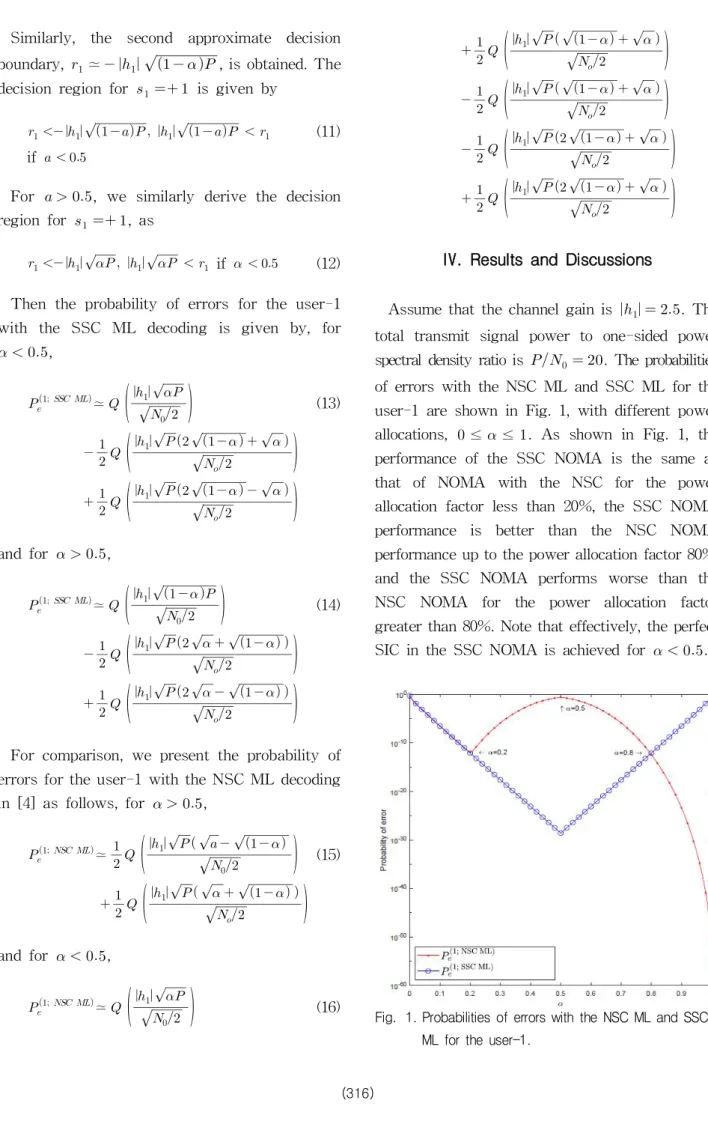
Assume that the channel gain is    . The total transmit signal power to one-sided power spectral density ratio is   . The probabilities of errors with the NSC ML and SSC ML for the user-1 are shown in Fig. 1, with different power allocations,  ≤  ≤ . As shown in Fig. 1, the performance of the SSC NOMA is the same as that of NOMA with the NSC for the power allocation factor less than 20%, the SSC NOMA performance is better than the NSC NOMA performance up to the power allocation factor 80%, and the SSC NOMA performs worse than the NSC NOMA for the power allocation factor greater than 80%. Note that effectively, the perfect SIC in the SSC NOMA is achieved for   .

Fig. 1. Probabilities of errors with the NSC ML and SSC

ML for the user-1.

(4)

Performance Analysis of NOMA with Symmetric Superposition Coding 317

(317)

Ⅴ. Conclusion

We analyzed the performance of NOMA with the SSC. It was shown that the performance of the SSC NOMA is better or worse than that of NOMA with the NSC, according to the power allocation factor. In result, the SSC should be used with consideration of the power allocation.

References

[1] Y. Saito, Y. Kishiyama, A. Benjebbour, T.

Nakamura, A. Li, and K. Higuchi, “Non-orthogonal multiple access (NOMA) for cellular future radio access,” in Proc. IEEE 77th Vehicular Technology Conference (VTC Spring), pp. 1-5. 2013.

DOI: 10.1109/VTCSpring.2013.6692652

[2] Z. Ding, P. Fan, and H. V. Poor, “Impact of user pairing on 5G nonorthogonal multiple-access downlink transmissions,” IEEE Trans. Veh. Technol., vol. 65, no. 8, pp. 6010-6023, 2016.

DOI: 10.1109/TVT.2015.2480766

[3] H. Li, Z. Huang, Y. Xiao, S. Zhan, and Y. Ji,

“Solution for error propagation in a NOMA-based VLC network: symmetric superposition coding,”

Opt. Exp., vol. 25, no. 24, pp. 29856-29863, 2017.

DOI: 10.1364/OE.25.029856

[4] K. Chung (in press Mar. 2019), “Performance

analysis on non-SIC ML receiver for NOMA strong

channel user,” J. KICS, vol. 44, no. 3. Accepted

for publication.

수치

Fig. 1. Probabilities of  errors with  the  NSC  ML  and  SSC  ML  for  the  user-1.

참조

관련 문서

• Using the method of superposition, the separate M/EI diagrams for the redundant reaction B y and the load P are shown in Fig...

with the experimental C versus t data. If the fit is unsatisfactory, another rate equation is guessed and tested. Integral method is especially useful for fitting simple

Any combination of voltage sources, current sources, and resistors with two  terminals is electrically equivalent to a single voltage source V

“With the MySQL Query Analyzer, we were able to identify and analyze problematic SQL code, and triple our database performance. More importantly, we were able to accomplish

The “Asset Allocation” portfolio assumes the following weights: 25% in the S&P 500, 10% in the Russell 2000, 15% in the MSCI EAFE, 5% in the MSCI EME, 25% in the

1 John Owen, Justification by Faith Alone, in The Works of John Owen, ed. John Bolt, trans. Scott Clark, "Do This and Live: Christ's Active Obedience as the

Besides, a kernelized version of our proposed CSCC, namely kernel constrained sparse concept coding (KCSCC), is developed to deal with nonlinear data, which leads to

3.13 Measured grain boundary energies for symmetric tilt boundaries in Al (a) When the rotation axis is parallel to (100), (b) when the rotation axis is parallel to (110).