http://doi.org/10.14347/kadt.2017.39.1.1
대한치과기공학회지 제39권 제1호 2017년 대한치과기공학회지 제39권 제1호 2017년
김원영, 정인성, 전병욱
부산가톨릭대학교 보건과학대학 치기공학과
http://doi.org/10.14347/kadt.2017.39.4.253
한국 백삼의 치아우식균에 관한 항균 및 항산화효과에 관한 캐나다 백삼과의 비교 연구
한민수, 권은자, 최에스더, 한진경*
혜전대학교 치기공과, 권치과의원*
Comparison of anticariogenic and antioxidant effects of
Korean and Canadian white ginseng against a dental cariogenic microorganism
Min-Soo Han, Eun-Ja Kwon, Esther Choi, Jin-Kyoung Han*
Dept. of Dental Laboratory Technology, Hyejeon College Kwon Dental Clinic*
[초록]
목적: 이 실험의 목적은 한국 백삼과 캐나다 백삼의 일반 성분 분석, 항산화력 측정 및 치아 우식 유발균에 미치는 항 균 효과를 비교 분석하는데 있다.
방법: 한국 백삼과 캐나다 백삼의 일반 성분은 수분정량, 조지방, 조단백질, 그리고 조회분의 분야에서 측정되었다. 두 백삼을 60% 에탄올에 추출시켜 환원당과 DPPH-scavenging assay를 통해 항산화력을 측정했다. 동일 추출물을 이용, 치아 우식균인 streptococcus mutans에 대해 디스크 확산법과 최소저해농도 측정을 실시해 항균력을 측정 및 비교했다.
결과: 실험 결과, 한국 백삼과 캐나다 백삼은 유사한 조지방, 조단백질, 조회분 성분을 갖고 있었으나 수분정량에서 캐 나다백삼이 우세했다. 항산화력 실험에서는 캐나다 백삼이 DPPH- scavenging 능력에서 더 높았으나 환원당 실험과 총 페놀 함량에서는 한국 백삼의 수치가 더 높았다. 디스크 확산법을 통한 항균력 실험에서는 한국 백삼이 캐나다 백삼 보다 더 넓은 clearing zone을 형성하고 더 낮은 최소저해농도를 달성해 항균력에서 우세했다.
결론: 한국 백삼과 캐나다 백삼은 비슷한 일반성분과 항산화력을 가졌다. 하지만 한국백삼이 치아 우식 유발균인 streptococcus mutans에 대한 항균력에서 더 우세했다.
Key words: Antibaterial effect, Canadian ginseng, Korean ginseng , streptococcus mutans
Corresponding author
Name 한 민 수 Tel. 041-630-5307 E-mail [email protected]
Address 충남 홍성군 홍성읍 혜전대학교 치기공과 연구실
* 본 논문은 2017년도 혜전대학교 연구비의 지원을 받아 수행한 연구과제입니다.
Ⅰ. Introduction
Dental caries is a common oral infection throughout the world. Understanding of causes and treatment methods of the caries have been immensely improved (Badria & Zidan, 2004).
Nonetheless, the number of dental caries patients increasing word widely (Bargramian et al. 2009).
Many treatments have been used to control oral diseases like dental cavities, or periodontal disease. Especially, the synthetic anti-cariogenic- preventing development of tooth decay-drugs such as Fluoride, Tetracycline, Minocyclines, Ciprofloxacin, and so forth, are contained in toothpaste, water, prescribed drops, and other dentifrices. The synthetic chemicals are certainly effective against cariogenic agents. Nevertheless, those synthetic compounds can induce side effects such as tooth erosion, tooth discolouration, staining(Watts & Addy, 2001), and even decrease in salivary secretion(Tredwin et al., 2005).
Researchers have been investigating to find natural antibacterial agents against dental caries from plant extracts that can be the alternatives for synthetic treatments to reduce side effects and the development of new infections(Alviano et al., 2008). Then they have found the natural materials that possess anticariogenic abilities against cariogenic pathogens, microorganisms causing dental cavities: Pomegranate (Vasconcelos et al., 2006) fáfia(Moura et al., 2011). Evening Primrose (Matsumoto-Nakano et al., 2011), Oolong tea, Chitosan, Licorice bark extract(Choi et al, 2003), Pine needle and twig extracts(Choi et al.,2007).
Ginseng is one of commonly used traditional pharmaceuticals all over the world not only in Asia: China, Korea, or Japan where the ginseng was used for the earliest, but also, western
various bioactive contents such as ginsenosides, polyacetylenes, acidic polysaccharides, peptides, phenolic compounds and so forth. Current studies support that the ginseng has pharmacological abilities of anticancer, angiogenic, antioxidative, vasorelax, hypoglycemic, antihyperlipidemic, Central Nervous Systemic (CNS) activities(Chen et al., 2008), and even anti-agings(Kitts and Hu, 2007). Plus, studies have suggested that, ginseng’s primary component, ginsenosides were effective against both fungal infection (Nicol et al. 2002) and bacterial infection(Son et al. 2009).
Despite of excellent pharmacological evidences of the ginsengs, the studies on antibacterial effects of ginseng on dental cavity causative bacteria are rarely done, even for in those studies, only Korean ginseng (Panax ginseng) has been done.
This study is going to investigate and compare proximate composition, antioxidant properties and the antibacterial effect of Canadian ginseng(Panax Quiquefolius) on cariogenic-tooth decaying agent- to Korean ginseng (Panax ginseng). Therefore, this study will enhance understanding of those ginsengs to be used for dental caries control to allow both public and researchers to properly administrate the ginsengs effectively and safely.
Discovering new antibacterial effects of the ginseng on dental caries bacteria is going to help public to reach another way for controlling dental caries more easily and safely to improve public oral health better.
The aim of the following experiment was to evaluate proximate composition, antioxidant power and to compare anticariogenic potency of Korean ginseng(P.ginseng) and Canadian Ginseng (P.quinquefolium) on the prominent cariogenic- dental caries causative-agent, S. mutans.
Ⅱ. Materials and methods 1. Materials
1) Ginseng samples
Each of 5 years old Korean ginseng(Panax g i n s e n g ) a n d C a n a d i a n g i n s e n g ( P a n a x quequifolius) were purchased at Geumsan ginseng market(Geumsan, Korea) and Chai-Na-Ta, Corp, Ltd. (Langley, Canada) respectively. Korean ginseng was powdered when purchased, however the Canadian white ginseng was dried at 50℃ for 7 days by using the heat dryer(HB-502 MP, Han Baek Co., Korea), and powdered by using a home grinder(FM-681, Hanil, Korea) to be ready for the experiment. The chemicals used were purchased from Sigma(St. Louis, USA).
2) Microorganism
The microorganism used in the experiment was a cariogenic bacterium, streptococcusmutans
(KCTC 3065). It was purchased from Korean collection for type cultures(Jeongeup, Korea) and cultivated on Becton Dickinson’s Brain Heart Infusion(BHI) agar.
2. Comparative study methods
1) Proximate contents
Proximate contents of Korean and Canadian ginseng were evaluated in terms of moisture content, crude fat, protein and ash by using the standard methods of the Association of American Chemists(AOAC).
2) Antioxidant properties
Antioxidant properties of the ginseng samples are explored in manner of total phenolic contents,
DPPH radical-scavenging activity, and reducing power assay. Initially, using the method of Son et al.(2009), Ginseng extracts were blended with a 60% ethanol, and concentrated using a rotatory vacuum evaporator(N-1110 series, EYELA, Tokyo Rikakikai Co., Japan). The total phenolic contents were assayed using the Folin-Ciocalteu colorimeteric method (Norajit et al. 2011). 0.1 ml of each ginseng extract solution was added to 1.5 ml 10-fold diluted Folin-Ciocalteu’s reagent. The solutions were reacted for 5 mins and then 1.5 ml of 6% Sodium carbonate(Na2CO3) was lastly added. The solutions were placed in dark for 90 mins. Afterward, the absorbance of the solutions was measure at 725 nm (Libra S35 UV/Vis- spectrophotometer, Bio chrom Ltd. UK). Distilled water was used to set the reference absorbance of the blank. The extract solutions were evaluated for three times.
DPPH radical-scavenging activity was measured, following the method of Norajit et al (2011), to evaluate the hydrogen-donating ability of the sample by using the stable radical DPPH. 5 ml of a 0.1 mM ethanol solution of DPPH was primarily prepared and 0.5 ml of the sample solution was added immediately afterward. The solution was reacted for 30 minutes at room temperature, and was measured or absorbance against a blank at 517 nm. It was repeated for three times, and the results were calculated by using the equation below.
(Acontrol refers to the absorbance of the blank control; Asample refers to the sample.
Disk diffusion method and Minimal Inhibitory Concentration(MIC) of the extracts on S. mutans were measured to understand anticariogenic potency of the ginsengs. For the disk diffusion method, s.mutans was cultured on BHI(Brain Heart Infusion). Then the results were compared by measuring the parameter of clear zone for med around the disc. The cultures of s.mutans are going to be injected to BHI broth. Then the extract samples at different dilution were injected to the cultures, and incubated for 24 hours at 37℃.
Subsequently, a spectrophotometer was used to observe growth of bacterial cultures. Negative control was a culture without extract injection.
The blanks for sample and control were measure immediately.
3. Results
1) Proximate contents
Comparisons of the general components of the two white ginseng samples were measured in units of moisture, crude ash, crude fat, and crude protein. As Table 1 presents, moisture of Korean white ginseng was 5.97±0.05% when of Canadian white ginseng (CWG) was 9.22±0.24 %.
It displayed CWG contained higher moisture than KWG. The samples were similar in crude fat, crude ash and protein contents. KWG fat was 0.86±0.13%
whereas CWG contained 0.93±0.10%. Crude ash of KWG was 4.14±0.02% whilst CWG was 3.94±
0.07%. Crude Protein of KWG was 10.65±0.21%.
Table 1. Proximate compositions
Sample Moisture(%) Fat(%) Ash(%) Protein(%) KWG 5.97±0.05 0.86±0.13 4.14±0.02 10.65±0.21 CWG 9.22±0.24 0.93±0.10 3.94±0.07 8.8±0.99
Antioxidant properties of Korean white inseng and Canadian white ginseng were evaluated based on total phenolic content, DPPH- Scavenging assay, and reducing power assay.
As a result, KWG indicated significantly higher total phenolic content and reducing power than CWG whereas CWG displayed greater power in DPPH-Scavenging assay. Total phenolic content was performed three times and the results were displayed as mg of galic acid equivalents (GAE) per gram of the sample.
Table 2. Total Phenolic Content, DPPH-Scavenging assay, and Reducing power assay results of Korean and Canadian ginseng.
Experiment
Total Phenolic Content (mg GAE1)/g)
DPPH2)- Scavenging
assay (%)
Reducing power assay3)
KWG 0.50±0.01 21.79±0.79 0.71±0.06 CWG 0.33±0.03 37.08±0.08 0.28±0.01 Each value is evaluated as mean±SD (n=3).
1) GAE, gallic acid equivalents.
2) DPPH, 2,2-diphenyl-1-picrylhydrazyl. DPPH value expressed as % of dry sample.
3) Reducing Power value expressed as absorbance at 700 nm.
3) Antibacterial effects
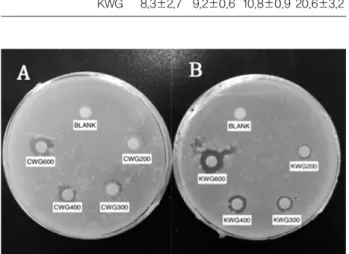
The result shows(Fig. 1) both samples were effective against the s.mutans. As it was shown in Table 3, at 100 μg/ml, the Canadian ginseng showed zone of inhibition at average of 8.0 mm when Korean ginseng cleared 8.3 mm. At 200 μ g/ml was 8.4 mm when of the Korean was 9.2 mm. At 400 μg/ml, the Canadian had the average zone of 10.5 mm, and the Korean had 10.8 mm. At 600 μg/ml, the average clearing zone of Canadian ginseng was 20.4 mm when of the Korean was 20.6 mm. Korean ginseng was more effective than the Canadian against s. mutans as zones of inhibition was broader with the Korean.
In the Minimal Inhibitory Concentration(MIC)
experiments(Table 4), Korean ginseng displayed the MIC at 150 μg/ml whereas the Canadian had its MIC at 200 μg/ml.
Table 3. Antibacterial effect of P.quinquefolius and P.ginseng extracts against S.mutans
Microorganism Sample
Zone of inhibition(mm) by concentration (μg/ml)
100 200 400 600
S. mutans
CWG 8.0±0.4 8.4±2.1 10.5±2.7 20.4±0.4 KWG 8.3±2.7 9.2±0.6 10.8±0.9 20.6±3.2
Fig. 1. Clearning zone formed around paper discs of ginseng extracts on s.mutans after cultivating 24 hours.
A: Antibacterial activity of ethanol extracts of P.quinquefolius on S.mutans via paper disk method; B: Antibacterial activity
of ethanol extracts of P.ginseng on S.mutans
Table 4. Minimal inhibitory concentration of p.ginseng and p.quinquefolius against S.mutans.
Test
bacteria Sample Growth at various concentration (μg/ml) MIC (μg/ml) 100 150 200 250 300 400 500 700 1000
S.mutans KWG + - - - - - - - - 150
CWG + + - - - - - - - 200
4. Discussion
Ginsengs are the ingredients commonly used as food and herbal medicine globally. Many researchers are studying to find its pharmaceutical benefits from the major contents of ginseng, Saponin and non-Saponin substances. Yet, two commonly used
ginsengs, Korean ginseng and Canadian ginsengs rarely discussed to compare their differences. From the proximate content examination, the Korean and Canadian ginseng were similar in terms of the crude fat, protein and ash contents but the Canadian was higher in moisture. Crude Saponin was higher in Canadian ginseng when reducing sugar content was higher in Korean ginseng. They were similar in physical appearance but Korean ginseng had higher Total phenolic content. Interestingly, for antioxidant property tests, Korean ginseng was higher in reducing power assay whereas Canadian ginseng displayed better performance in DPPH- Scavenging assay.
As potency of herbal products varies from manufacturer to manufactorer, and from farm to farm,(Yuan et al., 2002) the difference in samples, even their age difference (Court et al., 1996), could cause various results in experiments. For example, effects of drying method could change expression of porosity-volume of pores in ginseng surface(Purnama et al., 2010)-and ginsenosides in ginseng tissue. (Reynolds, 1998) Freeze-drying method could be most favorable to pull the best antibacterial effects from the samples (Popovich et al., 2005), but in this experiment, condition of drying method was not controlled. Canadian ginseng was air-dried at room temperature whereas Korean ginseng’s drying method was not clear. Therefore, the antioxidant properties will need further evaluation after acquiring same moisture contents in the samples.
Korean white ginseng and Canadian white ginseng both performed significant antibacterial activities against cariogenic bacteria, Streptococcus mutans MIC of p.ginseng was 150μg/ml and of p.quinquefolius was 200 μg/ml. Lower MIC of p.ginseng indicated that Korean ginseng
s.mutans than p.quinquefolius. Yet, comparison of ginsenosides components of both ginsengs were not conducted to compare their elementary compositions. The Saponin and non-Saponin as polyphenols contained will be required to be measured in the two white ginsengs to understand their antibacterial effectiveness. Next, further experiments on different microorganisms like fungi will be required in the future.
As well as conducting additional comparitive experiments with Vietnames ginseng (Panax vietnamensis), Japanese ginseng (Panax Japonicus), Dwarf ginseng (Panax trifolius) and so forth to increase knowledge of the ginseng’s to adopt their pharmaceutical efficacy and safety in dental field.
5. Conclusion
This experiment was designed to compare proximate composition, antioxidant property and the antibacterial effects of the Korean and Canadian ginseng. From the experiments, the following conclusions were obtained.
1. The Korean and Canadian ginseng contained similar Crude fat, protein and ash elements but the moisture content was higher in the Canadian.
2. The total phenolic content and reducing power was higher in the Korean ginseng, yet the DPPH-scavenging property was higher in the Canadian.
3. The Korean ginseng performed better antibacterial effect on s.mutans than the Canadian ginseng.
REFERENCES
Alviano WS, Alviano DS, Diniz CG, Antoniolli AR, Alviano CS, Farias LM, Carvalho MAR, Souza MG, Bolognese AM. In vitro antioxidant potential of medicinal plant extracts and their activities against oral bacteria based on Brazilian folk medicine.
Arch oral biol, 53(6), 545-552, 2008.
Badria AF, Zidan OA. Natural Products for Dental Caries Prevention. J Med Food, 7(3), 381- 384, 2004.
Bagramian RA, Garcia-Goody F, Volpe AR. The global increase in dental caries. A pending public health crisis. Am J Dent, 22(1), 3-8, 2009.
Chen C, Chiou W, Zhang J. Comparison of the pharmacological effects of Panax ginseng and Panax quinquefolium. Acta Pharmacol Sin, 29(9), 1103–1108, 2008.
Choi H, Koh Y, Choi I, Kim Y, Park Y. Anticariogenic activity and glycosyltransferase inhibitory effects of extracts from pine needle and twig. Korean J Food Sci Technol. 39(3), 336-341, 2007.
Choi I, Jung C, Park Y. Anticariogenic activities of various plant extracts. Korean J Food Sci Technol, 35(6), 1221-1225, 2003.
Court WA, Reynolds LB, & Hendel JG. Influence of root age on the concentration of ginsenosides of American ginseng (Panax Quinquefolim). Can J Plant Sci, 76(4), 853- 855. 1996
Kitts DD, Hu C. Efficacy and safety of ginseng.
Public Health Nutr, 3 (4a), 473-485. 2000 Matsumoto-Nakano M, Nagayama K, Kitagori
H, Fujita K, Inagaki S, Takashima Y, Tamesada M, Kawabata S, Ooshimaa T.
Inhibitory Effects of oenotherabiennis(even ingprimrose) seed extract on streptococcus mutans and S.mutans -induced dental cariesin rats. Caries Res, 45(1), 56-63, 2011.
Moura CL, Casemiro LA, Martins CH, Cunha WR, Silva ML, Cury AHV. Evaluation of the antimicrobial activity of the plant species Pfaffia glomerata against oral pathogens.
INVESTIGAÇÃO, 11(2), 24-28, 2011.
Norajit K, Kim KM, Ryu GH. Comparative studies on the characterization and antioxidant properties of biodegradable alginate films containing ginseng extract. J Food Eng, 98(3), 377-384. 2010.
Nicol RW, Traquair JA, Berards MA. Ginsenosides as host resistance factors in American ginseng(Panaxquinquefolius). Can J Bot, 80(5), 557-562, 2002.
Popovich DG, Chun H, Durance TD, Kitts DD.
Retention of ginsenosides in dried ginseng root: Comparison of drying methods. J Food Sci, 70 (6), s355-s358. 2005.
Purnama M, Yaghmaee P, Durance TD, and Kitts DD. Porosity changes and retention of ginsenosides in North American ginseng root using different dehydration processes.
J Food Sci, 75(7), E487-E492. 2010
Reynolds B. Effects of drying on chemical and physical characteristics of American ginseng (Panax quinquefolius L.). J Herb, Spices Med, 6 (2), 9-21, 1998.
Son HJ, Han MS, Ryu GH. Antibacterial activities of Et-OH extrat from extruded white ginseng on tooth decay bacteria. J Korean Soci Food Sci Nutr, 38(3), 951-957, 2009.
Tredwin CJ, Scully C, Bagan-Sebastian JV. Drug- induced disorders of teeth. J Dent Res, 84(7), 596-602, 2005.
Vasconcelos LC, Sampaio FC, Sampaio MC, Pereira MV, Higino JS, Peixoto MHP. Minimum inhibitory concentration of adherence of Punica granatum Linn(Pomegranate) gelagainst S.mutans, S.mitis and C.albicans.
Braz Dent J, 17(3), 223-227, 2006.
Watts A, Addy M. Tooth dicolouration and staining. a review of the literature Br Dent J, 190(6), 309-316, 2001.
Yuan CS, Wu JA, Osinski J. Ginsenoside variability in American ginseng samples.
Am J Clin Nutr. 75(3), 600-601, 2002.