기저동맥 분지부 동맥류의 치료결과
*
울산대학교 의과대학 서울중앙병원 신경외과학교실
안재성·김정훈·권 양·권병덕
= Abstract =
Management Outcomes of Basilar Bifurcation Aneurysms
Jae Sung Ahn, M.D., Jung Hoon Kim, M.D., Yang Kwon, M.D., Byung Duk Kwun, M.D.
Department of Neurological Surgery Asan Medical Center, College of Medicine, University of Ulsan, Seoul, Korea
bjective: : : :The authors analyzed the results of management outcomes for basilar bifurcation aneurysms treated with transcranial surgery and endovascular surgery.
Methods: : : :At the authors’ institution between May 1989 and December 1998, 47 aneurysms with 45 patients were treated with transcranial surgery including surgical clipping/wrapping and endovascular surgery for basilar bifurcation aneurysms. The medical records and neuroimaging studies of the patients were reviewed retrospectively.
Results: : : :Of the 45 patients, 87 percent of the aneurysms were ruptured and 13% unruptured. Forty six percent of the patients had multiple aneurysms including basilar bifurcation aneurysm. Of the 39 patients with subarachnoid hemorrahge, 77% were in good neurological status(Hunt Hess grade Ⅰ-Ⅲ), 23% were in poor grade(H-H grade
Ⅳ-Ⅴ).
Thirty two patients were treated with transcranial surgery and 15 patients were treated with endovascular surgery.
Two patients who had treated with wrapping surgery later bled during follow-up period and treated with endovascular surgery. The management outcome of the transcranial surgery was:Glasgow outcome scale(GOS) Ⅰ 66%, GOS
Ⅱ 12.5%, GOS Ⅲ 6.3%, GOS Ⅳ 6.3% and GOS Ⅴ(death) 9.4%. The major causes of morbidity related to transc- ranial surgery were perforator occlusion, vasospasm and retraction injury.
The management outcome of the endovascular surgery was:GOS Ⅰ 66.7%, GOS Ⅱ 6.7%, and GOS Ⅴ 26.7%.
The major causes of mortality related to endovascular surgery were related to intraoperative aneurysmal bleeding.
Conclusion: : : :This report documents that more than 75% of patients undergoing treatment either transcranial or endovascular surgery can expect good clinical outcomes. Treatment modality in management of basilar bifurcation aneurysm must be carefully selected based on various considering factors.
KEY WORDS:Basilar bifurcation aneurysm・Transcranial surgery・Endovascular surgery.
기저동맥 분지부에 위치하는 뇌동맥류(basilar bifurca- tion aneurysm)는 후순환계에 발생하는 뇌동맥류의 약 1/2 과 전체 동맥류의 약 5~8%를 차지하는 동맥류이다
20)29). 그 러나 이 부위에서의 수술은 해부학적인 구조가 복잡하고, 공 간이 좁고 깊어 수술 시야가 불량하고, 주위의 천공동맥 (perforators)들이 동맥류에 밀착되어 있어 수술후 신경학 적 결손을 초래하기도 한다. 이 동맥류의 치료는 동맥류의
경부결찰(clipping)이 전통적인 치료방법으로 이를 위해 여 러 가지 접근법이 소개되었으나 아직 한가지로 정립된 방법 은 없다
5)8)10)12-14)22)25))30). 그러나 최근에 도입된 혈관내 수 술(endovascular surgery)의 경우 동맥류 경부결찰 수술시 발생할 수 있는 합병증을 피할 수 있고, 치료결과도 좋아 기 저동맥 분지부 동맥류의 치료에 활발히 시술되고 있다
2)9)27).
본 연구에서는 본원에서 시행한 기저동맥 분지부 동맥류 의 개두술과 혈관내 수술의 치료 결과를 보고하고자 한다.
OOOO
*본 논문은 1999년 가을학술대회에 주요 연제로 발표되었음.
대상 및 방법
대상은 1989년 5월부터 1998년 12월까지 본원에서 치 료를 받은 기저동맥 분지부 동맥류 환자 45명으로, 치료결과 는 이들의 병록지, 방사선 검사를 후향적으로 분석하였다. 수 술전의 신경학적 등급은 Hunt-Hess grade(H-H grade) 로 구분을 하였으며, 치료 결과는 퇴원시의 신경학적 검사 를 기준으로 하였고, 신경학적 결손이 있는 경우는 술후 6개 월과 12개월의 외래 추적 결과중 양호한 결과를 Glasgow outcome scale(GOS)로 구분하였다. 개두술을 시행한 환자 에서는 환자 상태가 가능한 경우 술후 7일경에 혈관조영술 을 시행하였으며, 혈관내 수술 환자의 경우는 시술후 3개월, 6개월에 자기공명 혈관조영으로 추적, 관찰하였다. 치료방 법의 선택은 동맥류의 모양이나 경부의 넓이, 동맥류와 후 부 사대부와의 상대적인 위치, 수술자의 선호도, 환자의 상 태 등을 고려하여 결정하였다.
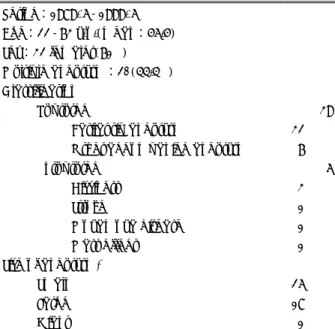
발생빈도는 같은 기간의 전체 뇌동맥류 환자 1,260명중 45명으로 3.4%를 차지하였으며, 환자의 평균 연령은 56.5 세(22~73세)였고, 남녀비는 각각 13명과 32명으로 여자 가 71%를 차지하였다. 다발성인 경우가 20례(44.4%)였 다(Table 1). 이 중 2명에서는 첫 번째 출혈 당시 개두술 및 wrapping을 시행한 후 회복하여 정상적인 생활을 하다 가 다시 같은 동맥류가 출혈을 하여 혈관내 수술을 받았다.
45명의 환자 중 뇌지주막하 출혈로 인한 증상이 39명 (86.7%)이었으며, 뇌지주막하 출혈 이외의 증상으로 내원
한 경우가 6명이었다. 뇌지주막하 출혈 환자 39명 중 기저 동맥 분지부 동맥류가 파열한 경우가 32명(82.1%)이었고, 동반된 다른 뇌동맥류의 파열로 인한 뇌지주막하 출혈 환자 가 7명이었다. 출혈로 입원한 환자 39명에서 수술 직전의 의식상태는 H-H grade Ⅰ 4명, grade Ⅱ 19명, grade Ⅲ 7명, grade Ⅳ 8명, grade Ⅴ 1명이었다. 뇌지주막하 출혈 이외의 증상으로 입원한 환자 6명은 동맥류의 종괴효과로 인한 폐쇄성 뇌수두증의 증상을 보인 1명과 뇌졸중의 검사 도중 발견된 1명, 현훈의 검사결과 발견된 3명, 그리고 모 야모야 병의 검사결과 발견된 1명이었다. 동맥류의 크기는 작은 경우(>10mm)가 26명, 큰 동맥류(10~24mm)가 18 명이었고 거대동맥류(>25mm)가 1명이었다. 45명의 환자 에서 32례에서 개두술과 15례의 혈관내 수술을 시행하였다.
개두술을 시행한 32례 중 클립을 이용한 경부결찰을 시 행한 경우가 23례, wrapping을 시행한 경우가 9례였다 (Table 2). 2례에서는 체외순환과 저체온을 이용하여 클립을 이용한 경부결찰을 시행하였다. 수술은 출혈후 평균 11일(0
~51일)에 시행하였으며, 조기 수술(출혈 후 3일 이내)을 시 행한 환자는 12례였다. 수술방법은 subtemporal approach 를 시행한 경우가 10례였고, trans-sylvian approach가 22 례였으며, 이중 orbitozygomatic approach가 7례였다. 개 두술을 시행한 32례의 환자의 수술전 신경학적 등급은 비 파열 뇌동맥류가 4례, H-H grade Ⅰ이 5례, grade Ⅱ가 14례, grade Ⅲ가 6례, grade Ⅳ가 3례였다.
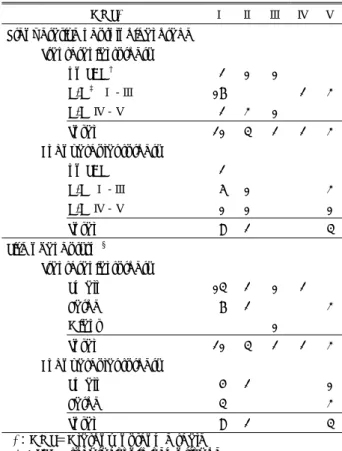
개두술을 시행한 환자의 수술 결과는 GOS Ⅰ이 21례, GOS Ⅱ가 4례, GOS Ⅲ가 2례였고, GOS Ⅳ가 2례, GOS
Ⅴ가 3례였다(Table 3). 술후 사망한 환자 3명의 원인은 2 례의 기저핵 및 시상의 다발성 뇌경색과 1례의 폐색전증 및 간기능부전이었다(Table 4). 이환율의 원인은 기저핵 및 시 상의 다발성 뇌경색 3례와 혈관연축 3례, 뇌견인으로 인한 좌상 1례였다. 술후 동반된 동안신경마비의 경우 일과성과 지속성을 합하여 27례(85%)에서 있었다. 출혈한 환자에서
Table 1. Profile of 45 patients with basilar tip aneurysm Period:1989. 6-1999. 6
Age:22-73 y.o.(mean:56.5) Sex:32 females(71%) Multiple aneurysm:20(44.4%)
Classification
Ruptured 39
Basilar tip aneurysm 32 Other accompanied aneurysm 7
Unruptured 6
Dizziness 3
Stroke 1
Moyamoya disease 1 Mass effect 1 Size of aneurysm*
Small 26 Large 18
Giant 1
*:small=>10 mm;large=10-24mm;giant=≥25mm
Table 2. Treatment modalities of the aneurysms(n=47) Transcranial surgery 32
Method of aneurysm treatment
Clipping 23 (with extracorporeal circulation:2)
Wrapping 9 Approach
Subtemporal 10 Transsylvian 22
Orbitozygomatic 7
Endovascular coiling(GDC*) 15
*:GDC=Guglielmi detachable coil
개두술을 시행한 28례 중 혈관연축으로 인한 뇌경색 소견 은 5례(17.9%)에서 발생했고, 뇌수두증으로 뇌실 복강 단 락술을 시행한 경우가 7례였다. 체외순환과 저체온을 이용 한 수술 방법에 따른 부작용은 없었다.
혈관내 수술은 총 15례를 시행하였으며 출혈을 한 동맥류 가 13례, 비파열 동맥류가 2례였다. 시술시기는 출혈후 평균 9일(1~17일)에 시행하였으며, 시술후 3일간 heparin을 이 용하여 항응고 처치를 하였으며, 이후 일반 병실에서 관찰 후 퇴원하였다. 혈관내 수술을 시행한 15례 환자의 수술전 신경학적 등급은 비파열 뇌동맥류가 2례, H-H grade Ⅰ-
Ⅲ가 10례, grade Ⅳ-Ⅴ가 3례였다. 동맥류의 크기는 작은
동맥류가 8례, 큰 동맥류가 7례였다.
혈관내 수술의 결과는 총 15례중 GOS Ⅰ이 10례, GOS
Ⅱ가 1례, GOS Ⅴ가 4례였다. 사망한 4례의 원인으로는 시술중 재출혈이 3례였으며, 1례는 입원 당시의 의식이 H-H grade Ⅴ인 환자로 시술은 성공적으로 시행되었으나 시술후 3일만에 발생한 혈관연축으로 인한 후두와의 뇌부 종으로 사망하였다. 이환율의 원인으로는 편측성 후대뇌동 맥의 폐색이 1례, 소뇌 경색이 1례였고, 무증상의 추골동 맥 박리(dissection)가 1례였다. 혈관내 수술을 시행한 환 자에서는 혈관연축으로 인한 뇌경색소견을 보인 환자는 1 명이었다.
개두술 및 wrapping을 시행후 재출혈을 일으킨 2명의 환 자에서 혈관내 수술을 시행하였는데 이 중 1명은 시술중 출 혈로 사망하였고, 1명은 성공적인 시술후 정상 생활이 가능 하였다.
고 찰
기저동맥 분지부 동맥류 치료에 있어서 개두술은 다른 부위의 뇌동맥류에서와 같이 표준적인 치료로 알려져 왔고, 이에 대한 많은 보고가 있었다. 그러나 해부학적인 위치가 깊고, 수술공간이 좁아 뇌견인 좌상, 주위의 천공동맥의 손 상 등으로 수술 결과가 전순환계 동맥류의 결과보다 좋지 못하다. 치료결과도 보고하는 기관에 따라 차이가 많은데, Samson 등
26)의 보고에 따르면 303명의 환자에서 81%의 good outcome을 보고하였고, Peerless 등
21)도 8%의 사망 률과 25%의 이환률을 보고하였으며, 최근의 다른 보고들도 사망률이 6~10% 정도인 것으로 보고되고 있다
3)9)11)24)30). 본원에서의 경우 약 78%의 환자에서 good outcome의 결 과를 얻을 수 있었다.
기저동맥 분지부 동맥류의 수술적 치료에 있어 가장 중 요한 요소는 천공동맥의 보존이다
3)11)21). 이 천공동맥의 보존을 위해서는 뇌의 상태를 느슨하게 하여 뇌견인을 최 소화하면서 수술시야를 충분히 확보를 해야 하고, 일시적 인 근위부 동맥의 결찰(temporary clipping) 등을 이용하 여 동맥류 주변의 박리시에 동맥류의 파열을 방지하고, 클 립을 동맥류의 경부 크기에 적당한 크기를 사용하여 남은 부분이 수술시야 반대편에 위치한 천공동맥을 막는 것을 예방하여야 한다
17). 천공동맥 손상이 예상되는 경우 동맥 류 결찰을 포기하거나 wrapping 등으로 치료하기도 하는 데
20), 본원에서의 예와 같이 wrapping의 재출혈 방지효과 는 만족스럽지 못하다.
뇌동맥류 치료에 Guglielmi 코일이 도입된 이후 혈관내
Table 3. Results of management(n=47)
GOS* Ⅰ Ⅱ Ⅲ Ⅳ Ⅴ Preoperative neurological grade
Transcranial surgery no SAH
†2 1 1 H-H
‡Ⅰ-Ⅲ 17 2 3 H-H Ⅳ-Ⅴ 2 3 1
Total 21 4 2 2 3 Endovascular surgery
no SAH 2
H-H Ⅰ-Ⅲ 6 1 3 H-H Ⅳ-Ⅴ 1 1 1 Total 9 2 4 Size of aneurysm
§Transcranial surgery Small 14 2 1 2 Large 7 2 3
Giant 1 Total 21 4 2 2 3 Endovascular surgery Small 5 2 1
Large 4 3 Total 9 2 4
*:GOS=Glasgow outcome scale
†:SAH=subarachnoid hemorrhage
‡:H-H=Hunt & Hess grade
§:small=<10mm;large=10-24mm;giant=≥25mm
Table 4. Comparison of mojor causes of morbidity & mortality between transcranial and endovascular surgery
Transcranial surgery Endovascular surgery Mortality Perforator occlusion Intraoperative bleeding
medical problem preoperative poor neurological grade Morbidity Perforator occlusion Intraoperative bleeding
vasospasm retraction inadvertent vascular
contusion occlusion
수술이 활발히 이루어지고 있다
6)16)19)23)28). 기저동맥 분지 부 동맥류의 치료에서는 수술적 치료법으로는 접근이 어 려운 경우가 많고, 또한 뇌신경 장애, 뇌견인 좌상 등의 합병증이 없어 치료에 활발히 이루어지고 있으며, 평균 재 원기간이 짧고, 조기 회복이 가능하다는 장점이 있다
9). 초 기에는 수술에 부적합한 전신 상태를 가진 환자나 수술적 접근이 어려운 후순환계 동맥류, 신경학적 등급이 나쁜 뇌 지주막하 출혈 환자, 이전의 수술에서 재발한 뇌동맥류의 경우 등에서 주로 시행되어져 왔으나 최근에는 일반적인 급성기 동맥류 파열에 의한 뇌지주막하 출혈 환자의 치료 에서도 대체 치료로 활발히 사용되고 있다
1)6)7)15)18). 그러 나 동맥류 내의 완전한 패색(complete occlusion)이 50~67%에 그치고, 동맥류의 재발율 또한 16~32%에 이르고, 특히 크기가 큰 동맥류의 경우 57%에 이른다는 보고도 있다
2)4).
저자들의 경우 개두술 및 wrapping을 시행후 재출혈을 일으킨 환자에서 혈관내 수술을 시행하였는데 비록 시술 중 1명이 사망하였지만 이런 경우에서의 경부 결찰 수술 은 합병증이 동반될 가능성이 높고, 또한 체외순환 등의 보조적인 치료방법 등이 동원되어야 하지만 혈관내 수술 의 경우 별다른 부가적인 처치없이 성공적인 수술이 가능 하여, 유용한 대체 치료 방법이라 할 수 있다. 그리고 기 존의 치료의 적응적이던 수술을 거부하는 경우나 수술에 부적합한 경우 이외의 일반적인 급성기의 동맥류 파열에 의한 뇌지주막하 출혈 환자의 치료에서도 좋은 성적을 보 여주고 있다. 그러나 시술중 재출혈로 인한 사망률이 높 으므로 이에 대한 예방 및 치료대책이 요구된다고 할 수 있다.
결 론
본원에서의 기저동맥 분지부의 동맥류 치료 결과 개두술 및 혈관내 수술의 경우 약 74%의 환자에서 good outcome 을 얻을 수 있었다. 또한 개두술의 치료 결과는 동맥류의 크 기와 관련이 있고, 혈관내 수술의 치료 결과는 시술중의 동 맥류 파열과 관련이 있음을 알 수 있었다. 혈관내 수술은 기 저동맥 분지부의 동맥류 치료에 있어서 경부결찰 수술의 보 조치료 또는 대체치료로 사용할 수 있는 가능성이 높다고 할 수 있다. 그러나 수술중의 출혈이 사망의 직접적인 원인 이 되므로 이에 대한 적극적인 치료와 예방이 필요하다 할 수 있으며, 치료 결과에 대한 보다 장기적인 추적 관찰이 필 요하다고 할 수 있다.
•
논문접수일:2000년 1월 16일•
심사완료일:2000년 5월 10일•
책임저자:권 병 덕138-736 서울 송파구 풍납동 388-1
울산대학교 의과대학 서울중앙병원 신경외과학교실 전화:02) 2224-3550, 전송:02) 476-6738 E-mail:[email protected]
References
1) Bavinzski G, Talazoglu V, Killer M, Gruber A, Richling B, al- Shameri R:Coiling of recurrent and residual cerebral aneur-
ysms after unsuccessful clipping. Minim Invasive Neurosurg 42
:22-26, 1999
2) Bavinzski G, Killer M, Gruber A, Reinprecht A, Gross CE, Richling B:Treatment of basilar artery bifurcation aneurysms
by using Guglemi detachable coils
:a 6-year experience. J Neurosurg 90
:843-852, 1999
3) Batjer HH, Samson DS:Causes of morbidity and mortality
from surgery of aneurysms of the distal basilar artery. Neuro- surgery 25
:904-916, 1989
4) Connolly ES, Solomon RA:Management of symptomatic
and asymptomatic unruptured aneurysm, in Le Roux PD, Winn HR
(eds
):Neurosugery Clinics of North America. Curr- ent management of cerebral aneurysms, part 1
:evaluation and perioperative care. Philadelphia
:WB Saunders, 1998, pp509-524
5) Drake CG:Surgical treatment of ruptured aneurysms of the
basilar artery
:Experience with 14 cases. J Neurosurg 23
:457-473, 1965
6) Eskridge JM, Song JK:Endovascular embolization of 150
basilar tip aneurysms with Guglielmi detachable coils
:results of the Food and Drug Administration multicenter clinical trial.
J Neurosurg 89
:81-6, 1998
7) Ezura M, Takahashi A, Ogasawara K, Yoshimoto T:Intra-
aneurysmal GDC embolization followed by intrathecal tPA administration for poor-grade basilar tip aneurysm. Surg Ne- urol 47
:144-147, 1997
8) Fujitsu K, Kuwabara T:Zygomatic approach for lesions in
the interpeduncular cistern. J Neurosurg 62
:340-343, 1985
9) Gruber DP, Zimmerman GA, Tomsick TA, van Loveren HR,Link MJ, Tew JM Jr.:A comparison between endovascular
and surgical management of basilar artery apex aneurysm. J Neurosurg 90
:868-874, 1999
10) Hakuba A, Liu S, Nishimura S:The orbitozygomatic infra-
temporal approach
:A new surgical technique. Surg Neurol 26
:271-276, 1986
11) Hernesniemi J, Vapalahti M, Niskanen M, Kari A:Manage-
ment outcome for vertebrobasilar artery aneurysms by early surgery. Neurosurgery 31
:857-862, 1992
12) Heros RC, Lee SH:The combined pterional/anterior tempo-
ral approach for aneurysms of the upper basilar complex
:Technical report. Neurosurgery 33
:244-251, 1993
13) Ikeda K, Yamashita J, Hashimoto M, Futami K:Orbitozygo-matic temporopolar approach for high basilar tip aneurysm associated with a short intracranial internal carotid artery
:A new surgical approach. Neurosurgery 28
:105-110, 1991
14) Jane JA, Park TS, Pobereskin LH, Winn HR, Butler AB:Thesupraorbital approach
:Technical note. Neurosurgery 11
:537-542, 1982
15) Kallmes DF, Kallmes MH, Cloft HJ, Dion JE:Guglielmi
detachable coil embolization for unruptured aneurysms in no- nsurgical candidates
:a cost-effectiveness exploration. Am J Neuroradiol 19
:167-76, 1998
16) Klein GE, Szolar DH, Leber KA, Karaic R, Hausegger KA:
Basilar tip aneurysm
:endovascular treatment with Guglielmi detachable coils-midterm results. Radiology 205
:191-196, 1997
17) Le Roux PD, Winn HR:Surgical approaches to basilar bifu-
rcation aneurysm. in Le Roux PD, Winn HR
(eds
):Neurosug- ery Clinics of North America. Current management of cerebral aneurysms, part 2
:techniques of aneurysm occlusion. Phila- delphia
:WB Saunders, 1988
:pp835-849
18) Morrison SR:Guglielmi detachable coils:
an alternative th- erapy for surgically high-risk aneurysms. J Neuroscience Nu- rsing 29
:232-237, 1997
19) Nichols DA, Brown RD Jr., Thielen KR, Meyer FB, Atkinson JL, Piepgras DG:Endovascular treatment of ruptured poste-
rior circulation aneurysm using electrolytically detachable coils. J Neurosurg 87
:374-380, 1997
20) Ogilvy CS, Crowell RM, Heros RC:Basilar and posterior
circulation aneurysm. In Mitchell CW
(ed
):Surgical manage- ment of neurovascular disease. Baltimore
:Williams & Willk- ins, 1995, pp269-290
21) Peerless SJ, Hernesniemi JA, Gutman FB, Drake CG:Early
surgery for ruptured vertebrobasilar aneurysms. J Neurosurg 80
:643-649, 1994
22) Pitelli SD, Almeida GG, Nakagawa EJ, Marchese AJ, Cabral ND:Basilar aneurysm surgery:
The subtemporal approach with section of the zygomatic arch. Neurosurgery 18
:125- 128, 1986
23) Raymond J, Roy D, Bojanowski M, Moumdjian R, L’Es- perance G:Endovascular treatment of acutely ruptured and
unruptured aneurysms of the basilar bifurcation. J Neurosurg 86
:211-219, 1997
24) Redekop GJ, Durity FA, Woodhurst WB:Management-related
morbidity in unselected aneurysms of the upper basilar artery.
J Neurosurg 87
:836-842, 1997
25) Samson DS, Hodosh RM, Clard WK:Microsurgical evaluat-
ion of the pterional approach to aneurysms of the distal basilar circulation. Neurosurgery 3
:135-141, 1978
26) Samson D, Batjer HH, Kopitnik TA:Current results of the
surgical management of aneurysms of the basilar apex. Neur- osurgery 44
:697-704, 1999
27) Solander S, Ulhoa A, Vinuela F, Duckwiler GR, Gobin YP, Martin NA, et al:Endovascular treatment of multiple intrac-
ranial aneurysms by using Guglemi detachable coils. J Neuro- surg 90
:857-864, 1999
28) Vinuela F, Duckwiler G, Mawad M:Guglielmi detachable
coil embolization of acute intracranial aneurysm
:periopera- tive anatomical and clinical outcome in 403 patients. J Neur- osurg 86
:475-482, 1997
29) Wascher TM, Spetzler RF:Saccular aneurysms of the basilar
bifurcation. In Spetzler RF, Carter LP
(eds.
):Neurovascular surgery. New York
:McGraw-Hill, 1996, pp729-752
30) Yasargil MG, Antic J, Laciga R, Jain KK, Hodosh RM, SmithRD:Microsurgical pterional approach to aneurysms of the