Korean J Intern Med 2013;28:72-80 http://dx.doi.org/10.3904/kjim.2013.28.1.72
Clinical outcomes between different stent designs with the same polymer and drug:
comparison between the Taxus Express and Taxus Liberte stents
Jang-Won Son1, Ung Kim2, Jong-Seon Park2, Young-Jo Kim2, Jae-Sik Jang3, Tae-Hyun Yang3,
Dong-Soo Kim3,Dong-Kie Kim4, Sang-Hoon Seol4, Doo-Il Kim4, Chang-Wook Nam5, Seung-Ho Hur5, and Kwon-Bae Kim5
1Division of Cardiology,
Department of Internal Medicine, Severance Hospital, Yonsei University College of Medicine, Seoul; 2Division of Cardiology, Department of Internal Medicine, Yeungnam University Medical Center, Daegu; 3Division of Cardiology, Department of Internal Medicine, Inje University Busan Paik Hospital, Busan; 4Division of Cardiology, Department of Internal Medicine, Inje University Haeundae Paik Hospital, Busan; 5Division of Cardiology, Department of Internal Medicine, Keimyung University Dongsan Medical Center, Daegu, Korea
Received : July 5, 2012 Revised : August 3, 2012 Accepted : August 21, 2012 Correspondence to Jong-Seon Park, M.D.
Division of Cardiology, Department of Internal Medicine, Yeungnam
University Medical Center, 170 Hyeonchung-ro, Nam-gu, Daegu 705-717, Korea Tel: +82-53-620-3313 Fax: +82-53-621-3310 E-mail: [email protected]
Background/Aims: The Taxus Liberte stent (Boston Scientific Co.) evolved from the Taxus Express stent, with enhanced stent deliverability and uniform drug delivery. This study was designed to compare angiographic and clinical outcomes in real-world practice between the Taxus Liberte and Taxus Express stents.
Methods: Between 2006 and 2008, 240 patients receiving the Taxus Liberte stent at three centers were registered and compared to historical control patients who had received the Taxus Express stent (n = 272). After propensity score matching, 173 patients treated with the Taxus Liberte stent and the same number of patients treated with the Taxus Express stent were selected. The primary outcome was a composite of major adverse cardiac events (MACE), including cardiac death, myo- cardial infarction (MI), ischemia driven target vessel revascularization (TVR), and stent thrombosis (ST) at 1 year. An additional angiographic assessment was con- ducted at 9 to 12 months.
Results: The study showed no significant difference between the Taxus Express and Taxus Liberte stents (death, 1.73% vs. 2.31%, p = 1.000; MI, 0% vs. 1.73%, p = 0.2478; TVR, 2.31% vs. 1.16%, p = 0.6848; and ST, 0% vs. 1.16%, p = 0.4986). The to- tal MACE rate at 1 year did not differ between the groups (4.05% in Taxus Express vs. 4.05% in Taxus Liberte, p = 1.000). In addition, the binary restenosis rate did not differ (2.25% in Taxus Express vs. 1.80% in Taxus Liberte, p = 0.6848).
Conclusions: In real-world experience with the two Taxus stent designs, both stents showed similarly good clinical and angiographic outcomes at 1 year. A long-term follow-up study is warranted.
Keywords: Angioplasty; Drug-eluting stents; Polymers
INTRODUCTION
Drug-eluting stents have shown great efficacy in the reduction of restenosis as compared with bare-metal stent (BMS) by suppressing neointimal growth [1-5].
The second-generation Taxus Liberte stent (paclitaxel- eluting stent, Boston Scientific Co., Natick, MA, USA) evolved from the Taxus Express stent in order to en- hance stent deliverability and uniform drug delivery.
However, there is little comparative data from real- world daily clinical practice with these stents. The aim of this study was to compare angiographic and clinical outcomes between the new Taxus Liberte stent and the old Taxus Express stent in real-world clinical practice.
METHODS
Device descriptionThe Taxus Liberte-SR stent consists of a balloon- expandable Liberte stent with a polymer coating containing 1 μg/mm2 of paclitaxel in a slow-release formulation. Drug dosing and release kinetics are identical to that of the Taxus Express-SR stent. Both stents are made from 316 L stainless steel, but the Lib- erte platform has a more uniform strut pattern and thinner struts (0.097 mm) than the Express platform (0.132 mm) [6].
Study population
From May 2006 to June 2008, 240 patients receiving the Taxus Liberte stent at three qualified centers in South Korea (Yeungnam University Medical Center, Keimyung University Dongsan Medical Center, Inje University Busan Paik Hospital, and Inje University Haeundae Paik Hospital) were registered and com- pared with Taxus Express historical control patients that were treated from January 2005 to April 2006 (n = 272). After performing propensity matching, we were able to successfully match 173 Taxus Express patients with 222 lesions to 173 Taxus Liberte patients with 222 lesions. Patients with a left main lesion and a bifurca- tion lesion requiring two stents in both the mother and side branch were excluded.
Procedures and medications
Percutaneous coronary intervention (PCI) was per-
formed using standard techniques. All patients re- ceived aspirin 325 mg orally and a loading dose of 300 mg of clopidogrel before coronary angiography (CAG) or after PCI in emergency cases. After PCI, the pa- tients were treated routinely with aspirin 100 mg/day, clopidogrel 75 mg/day, and/or cilostazol 200 mg/day at the operator’s discretion. The patients were advised to maintain life-long aspirin therapy. The duration of taking clopidogrel was at the operator’s discretion, which depended on the complexity of the lesion and procedure.
Quantitative coronary analysis
Intracoronary nitroglycerin (0.2 mg) was administered before and after each intervention to achieve maximal dilatation. Quantitative CAG was performed immedi- ately before and after stenting by an experienced tech- nician who was blinded to the type of stent deployed.
Angiographic measurements included proximal and distal reference, minimum lumen diameter (MLD), percentage of lesion diameter stenosis, and lesion length. Acute gain was measured and defined as the difference between the MLD after stent deployment and baseline MLD. Late lumen loss was calculated as the difference in MLD immediately after the proce- dure and at angiographic follow-up. All measurements were performed for both the stented segment (in-stent) and 5-mm proximal and distal margins of the stented segment (in-segment). Quantitative coronary angio- graphic analysis was performed using the computer- assisted automated edge detection method (Centricity, Cardiology CA1000, GE Healthcare, Milwaukee, WI, USA) in the angiography analysis core laboratory at Yeungnam University Medical Center.
Study outcomes and definitions
The study outcome was a composite of major adverse cardiac events (MACE), including cardiac death, myo- cardial infarction (MI), ischemia-driven target vessel revascularization (TVR), and stent thrombosis (ST).
MI was defined as a recurrent ischemic symptom and/
or ECG change with creatine kinase-myocardial band fraction elevation up to twice the upper limit of nor- mal. Ischemia-driven TVR was defined as emergency or elective CABG or repeat PCI in the target vessel for chest pain or a positive test for ischemia [7]. ST was
defined as acute (< 24 hours), sub-acute (< 30 days), or late (> 30 days) after the index procedure, and was de- fined as 1) definite: an acute coronary syndrome with angiographic documentation of either vessel occlu- sion or thrombus within or adjacent to a previously successfully stented vessel or autopsy evidence of ST;
2) probable: acute MI in the distribution of the treated vessel or unexplained death < 30 days; or 3) possible:
unexplained death > 30 days [8]. Angiographic reste- nosis was defined as a ≥ 50% diameter stenosis within the target lesion. Death was regarded as cardiac except for those of proven non-cardiac origin.
Follow-up
Clinical follow-up was performed at 30 days, 3 months, 6 months, and 1 year after PCI according to our rou- tine practice. Angiographic follow-up was recom- mended in all living patients and performed at 9 to 12 months after PCI. The 1-year clinical follow-up data were collected by chart review or telephone interview.
Statistical analysis
Data are expressed as means ± standard deviation (SD) for continuous variables, and as frequencies for categorical variables. Categorical data were analyzed with the chi-square test and continuous variables were evaluated with Student’s t tests. To decrease the effect of selection biases and potential confounding, propen- sity score matching was performed on patient baseline characteristics [9]. For the entire cohort comparison, a separate propensity score for Taxus Liberte versus Taxus Express was derived. The following variables were used to calculate the propensity score: age, sex, hypertension, current smoking, diabetes mellitus, dyslipidemia, previous PCI, previous CABG, renal fail- ure, left ventricular ejection fraction, clinical diagno- sis, disease vessel number, medications, target vessel, type of lesion, bifurcation lesion, procedure on infarct related artery, procedure-related MI, stent number, mean stent diameter, total stent length, maximal in- flation pressure, and post-stenting adjunctive balloon inf lation. After all of the propensity score matches were performed, angiographic and clinical outcomes were compared. The p values < 0.05 were considered to indicate statistical significance. Data were analyzed using the SPSS for Windows version 12.0 (SPSS Inc.,
Chicago, IL, USA).
RESULTS
Baseline characteristics and angiographic outcomes Baseline characteristics (Table 1), angiographic and procedural outcomes (Table 2), and quantitative coro- nary angiography outcomes in (Table 3) were well matched and comparable between groups. Baseline characteristics and angiographic findings including restenosis rate (3.15% in Taxus Express vs. 1.80% in Taxus Liberte, p = 0.3597) and the mean duration of dual antiplatelet therapy (13.2 months in Taxus Ex- press vs. 12.7 months in Taxus Liberte, p = 0.7582) were not different between the groups.
Clinical outcomes after propensity matching
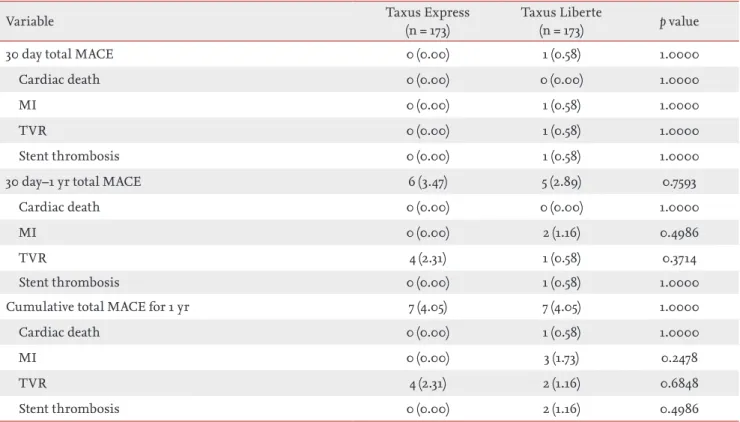
Table 4 shows clinical outcomes of patients. In the 30-day-outcome, the frequency of MACE was not dif- ferent between the groups (0% in Taxus Express group vs. 0.58% in Taxus Liberte group; p = 1.000). From 30 days to 1 year after the index PCI, the frequency of MACE also did not differ (3.47% in Taxus Express group vs. 2.89% in Taxus Liberte group; p = 0.7593).
Overall cumulative MACE rate for 1 year was 4.05% for the Taxus Express group and 4.05% for the Taxus Lib- erte group (p = 1.000). No acute ST was observed. Sub- acute ST was observed in one case in the Taxus Liberte group. One late ST was observed in the Taxus Liberte group. No death occurred in the Taxus Express group and one patient died due to a cardiac cause in the Tax- us Liberte group (p = 1.000). The MACE-free survival rate at 1 year is indicated in Fig. 1; there was no signifi- cant difference between the groups (p = 0.808).
DISCUSSION
The main findings of this study suggest that both Tax- us stents, with the same polymer and the same drug on different stent designs, had similarly good 1-year clinical and angiographic outcomes in real-world use.
The Taxus Express stent shows polymer-regulated de- livery of paclitaxel from the Boston Scientific/Medinol NIR and Boston Scientific EXPRESS stent platforms [10]. The Taxus stent consists of three components: 1) the metallic stent, 2) paclitaxel, an antiproliferative
agent that inhibits neointimal formation, and 3) the polymer, a drug-carrier vehicle [11,12]. The Taxus Ex- press stent was approved in March 4, 2004 by the Food
& Drug Administration for marketing and sale in the United States, and thereafter various clinical data were
released. Taxus stents have been shown to be superior to BMSs in reducing restenosis rates and target lesion revascularization [4,5,13-15].
Stent design is recognized as an important deter- minant of stent performance [16]. Strut thickness, Table 1. Baseline characteristics of the study patients
Variable Taxus Express
(n = 173)
Taxus Liberte
(n = 173) p value
Age, yr 65.4 ± 10.4 64.2 ± 10.5 0.2877
Men 114 (65.90) 116 (67.05) 0.8198
Hypertension 80 (46.24) 81 (46.82) 0.9142
Current smoker 67 (38.73) 65 (37.57) 0.8248
Diabetes mellitus 43 (24.86) 45 (26.01) 0.8050
Previous PCI 24 (13.87) 23 (13.29) 0.8753
Previous CABG 4 (2.31) 2 (1.16) 0.6848
Dyslipidemia 59 (34.10) 58 (33.53) 0.9095
Renal failurea 15 (8.67) 15 (8.67) 1.0000
Clinical diagnosis 0.7230
Stable angina 59 (34.10) 52 (30.06)
Unstable angina 35 (20.23) 43 (24.86)
STEMI 40 (23.12) 38 (21.97)
NSTEMI 39 (22.54) 40 (23.12)
LVEF, % 55.3 ± 12.0 55.0 ± 11.6 0.8168
Multivessel disease 67 (38.73) 62 (35.84) 0.5783
Medications
Aspirin 71 (98.84) 173 (100) 0.4986
Clopidogrel 166 (95.95) 168 (97.11) 0.5568
Cilostazol 83 (47.98) 75 (43.35) 0.3879
Statin 104 (60.12) 102 (58.96) 0.9027
ACEI 103 (59.54) 132 (76.30) 0.8756
ARB 25 (14.45) 28 (16.18) 0.6543
B-blocker 131 (75.72) 99 (57.23) 0.8998
Ca-blocker 34 (19.65) 39 (22.54) 0.7924
Duration of dual antiplatelet 13.2 ± 3.7 12.7 ± 4.2 0.7582
Values are presented as mean ± SD or number (%).
PCI, percutaneous coronary intervention; CABG, coronary artery bypass graft; STEMI, ST-segment elevation myocardial infarction; NSTEMI, non-ST-segment elevation myocardial infarction; LVEF, left ventricular ejection fraction; ACEI, angiotensin converting enzyme inhibitor; ARB, angiotensin receptor blocker.
aCreatinine > 1.5 mg/dL.
metal composition, and radial strength can each inf luence short- and long-term outcomes [17,18]. The second-generation Taxus Liberte stent was designed to provide enhanced deliverability, better conform- ability, uniform vessel coverage, and a lower profile as compared with the Taxus Express. Although most of the Taxus stents are similar, the struts of the Taxus Liberte are thinner (0.0038 inches vs. 0.0052 inches) and the strut distribution is more uniform than those of the Taxus Express. The continuous cell design and smaller open cell area (2.75 mm2 vs. 2.84 mm2) of the Taxus Liberte provides more uniform vessel coverage than that of the Taxus Express.
The pivotal Taxus “ATLAS” trial compared the Taxus Liberte with the Taxus Express. This study showed that the Taxus Liberte was not inferior to the Taxus Express, despite the treatment of more complex lesions with the Taxus Liberte. The authors concluded
that successful transfer of the proven Taxus technol- ogy to the more advanced Taxus Liberte platform was demonstrated [19]. The latter study focused mainly on stable angina patients (52.8% in Taxus Express vs.
60.2% in Taxus Liberte; p = 0.0015); however, our study mostly included patients with unstable angina and MI (65.9% in Taxus Express vs. 68% in Taxus Liberte). The MACE rate in the Taxus ATLAS study was 12.3% in the Taxus Express group and 12.5% in the Taxus Liberte group, driven mainly by an increased TVR rate (8.9%
in Taxus Express vs. 9.2% in Taxus Liberte; p = 0.833).
Our study showed that the MACE rate was 4.05% in each group and TVR rate was 2.31% in Taxus Express and 1.16% in Taxus Liberte (p = 0.684). The reason for the better results is unknown. However, longer treat- ment duration with the dual antiplatelet regimen may be a cause. In the Taxus ATLAS study, the incidence of the dual antiplatelet regimen at 9 months was only Table 2. Baseline angiographic and procedural data
Variable Taxus Express
(n = 222)
Taxus Liberte
(n = 222) p value
Ta rget artery 0.9545
Left anterior descending artery 77 (34.68) 78 (35.14)
Left circumflex artery 59 (26.58) 61 (27.48)
Right coronary artery 86 (38.74) 83 (37.39)
Type of lesiona 0.8550
A 9 (4.05) 9 (4.05)
B1 74 (33.33) 69 (31.08)
B2 50 (22.52) 46 (20.72)
C 89 (40.09) 98 (44.14)
Bifurcation lesion (side branch ≥ 2.5 mm) 33 (14.86) 36 (16.22) 0.6943
Procedure on infarct related artery 91 (40.99) 89 (40.09) 0.8467
Procedure-related myocardial infarction 23 (10.36) 20 (9.01) 0.6302
Number of stents used 1.21 ± 0.46 1.22 ± 0.47 0.9192
Mean stent diameter, mm 3.08 ± 0.33 3.08 ± 0.38 0.9494
Total stent length, mm 28.82 ± 15.05 29.27 ± 15.07 0.7481
Maximal inflation pressure, atm 11.85 ± 3.30 12.00 ± 3.34 0.6273
Post-stenting adjunctive balloon inflation 32 (14.41) 35 (15.77) 0.6908
Values are presented as number (%) or mean ± SD.
aAccording to the American Heart Association and/or American College of Cardiology.
62.6% in the Taxus Liberte and 54.2% in the Taxus Express patients. In our study, although the duration of dual antiplatelet was at the operator’s discretion, the mean duration was 12.7 months in the Liberte group and 13.2 months in the Express group.
Several previous studies have demonstrated that thinner strut stents are associated with a significant reduction of clinical and angiographic restenosis as compared with thicker-strut stents [17,18,20]. Another study comparing two Taxus stents, the Taxus ATLAS small vessel (2.25 mm stent) and long lesion (38 mm stent) multicenter studies, showed that the Taxus Lib-
erte stent improved MACE rates as compared with the earlier Taxus Express stent in both small vessels and long lesions [6].
Although the mechanism for this improved out- come remains unclear, thinner strut thickness and the more uniform and denser distribution of struts in the Taxus Liberte may be related to reduced deep ves- sel injury during implantation or improved healing, beyond simply improving deliverability [17].
Our study is a real-world clinical study, compar- ing the new-generation Taxus Liberte stent with the Taxus Express. At first, we thought the later-developed Table 3. Quantitative coronary angiography data
Variable Taxus Express Taxus Liberte p value
Pre-procedure
Total stent number 222 222 1.0000
Lesion length, mm 24.29 ± 14.33 24.76 ± 14.20 0.7306
Reference diameter, mm 2.94 ± 0.43 2.95 ± 0.47 0.8715
Minimal luminal diameter, mm 0.34 ± 0.28 0.35 ± 0.27 0.8101
Diameter stenosis, % 88.46 ± 8.93 88.24 ± 8.88 0.7876
After procedure
Reference diameter, mm 2.97 ± 0.42 3.00 ± 0.43 0.4754
Minimal luminal diameter, mm 2.87 ± 0.40 2.87 ± 0.42 0.9287
Diameter stenosis, % 3.22 ± 3.44 4.19 ± 3.18 0.0022
Acute gain, mm 2.54 ± 0.44 2.52 ± 0.46 0.7185
Acute gain index 0.87 ± 0.13 0.86 ± 0.12 0.6714
Follow-up coronary angiography
Follow-up number 99 (57.23) 93 (53.76) 0.9171
Total stent number at follow-up 119 (53.60) 101 (45.50) 0.0875
Reference diameter, mm 2.91 ± 0.47 2.89 ± 0.49 0.7251
Minimal luminal diameter, mm 2.27 ± 0.66 2.30 ± 0.68 0.7310
Diameter stenosis, % 22.23 ± 18.62 21.21 ± 16.92 0.6753
Late loss, mm 0.60 ± 0.52 0.55 ± 0.52 0.4801
Net gain, mm 1.95 ± 0.66 1.95 ± 0.75 0.9790
Net gain index 0.66 ± 0.21 0.66 ± 0.23 0.8743
Loss index 0.24 ± 0.22 0.23 ± 0.22 0.8001
Binary angiographic restenosis (> 50%) 7 (3.15) 4 (1.80) 0.3597 Values are presented as mean ± SD or number (%).
stent (Taxus Liberte) may have better clinical and an- giographic outcomes than the earlier version (Taxus Express). However, our study did not show any clinical difference at 1 year. First, this may be due to the rela-
tively short follow-up duration and a longer follow-up might reveal differences. Second, the potential impact of reduced strut thickness on late lumen loss may be overcome by the relative impact of drug and polymer.
This study has some limitations. First, the study population was relatively small. Second, this was a retrospective, observational, non-randomized study.
However, we performed propensity score matching to minimize these shortcomings. Third, after propensity score matching, 69 patients in the Liberte group and 99 patients in the Express group were excluded. Exclu- sion of such large numbers of patients may weaken the representativeness of the target population. Fourth, as we mentioned, there was no follow-up beyond 1 year.
With further long-term follow-up data, we cannot ex- clude the possibility that the final results may be dif- ferent. Fifth, we did not use imaging modalities, such as intravascular ultrasound, in most patients to more precisely determine differences and the underlying mechanisms between the two stents.
In conclusion, in this real-world study of experi- Table 4. Clinical outcomes after propensity score matching
Variable Taxus Express
(n = 173)
Taxus Liberte
(n = 173) p value
30 day total MACE 0 (0.00) 1 (0.58) 1.0000
Cardiac death 0 (0.00) 0 (0.00) 1.0000
MI 0 (0.00) 1 (0.58) 1.0000
TVR 0 (0.00) 1 (0.58) 1.0000
Stent thrombosis 0 (0.00) 1 (0.58) 1.0000
30 day–1 yr total MACE 6 (3.47) 5 (2.89) 0.7593
Cardiac death 0 (0.00) 0 (0.00) 1.0000
MI 0 (0.00) 2 (1.16) 0.4986
TVR 4 (2.31) 1 (0.58) 0.3714
Stent thrombosis 0 (0.00) 1 (0.58) 1.0000
Cumulative total MACE for 1 yr 7 (4.05) 7 (4.05) 1.0000
Cardiac death 0 (0.00) 1 (0.58) 1.0000
MI 0 (0.00) 3 (1.73) 0.2478
TVR 4 (2.31) 2 (1.16) 0.6848
Stent thrombosis 0 (0.00) 2 (1.16) 0.4986
Values are presented as number (%).
MACE, major adverse cardiac events; MI, myocardial infarction; TVR, target vessel revascularization.
1.00
0.98
0.96
0.94
0.92
Days
Express 98%
Liberte p = 0.808 96%
MACE-free survival
0 30 60 90 120 150 180 210 240 270 300 330 360
Figure 1. Major adverse cardiac events (MACE)-free survival rate at 1 year. There was no difference between the Taxus Express and Taxus Liberte groups (p = 0.808).
ence with the two Taxus stents, both showed similarly good clinical and angiographic outcomes. A long-term follow-up study is warranted.
Conflict of interest
No potential conflict of interest relevant to this article is reported.
REFERENCES
1. Morice MC, Serruys PW, Sousa JE, et al. A randomized comparison of a sirolimus-eluting stent with a stan- dard stent for coronary revascularization. N Engl J Med 2002;346:1773-1780.
2. Moses JW, Leon MB, Popma JJ, et al. Sirolimus-eluting stents versus standard stents in patients with stenosis in a native coronary artery. N Engl J Med 2003;349:1315- 1323.
3. Schofer J, Schluter M, Gershlick AH, et al. Sirolimus- eluting stents for treatment of patients with long ath- erosclerotic lesions in small coronary arteries: double- blind, randomised controlled trial (E-SIRIUS). Lancet 2003;362:1093-1099.
4. Colombo A, Drzewiecki J, Banning A, et al. Randomized study to assess the effectiveness of slow- and moderate-
release polymer-based paclitaxel-eluting stents for coronary artery lesions. Circulation 2003;108:788-794.
5. Stone GW, Ellis SG, Cox DA, et al. A polymer-based, paclitaxel-eluting stent in patients with coronary artery disease. N Engl J Med 2004;350:221-231.
6. Turco MA, Ormiston JA, Popma JJ, et al. Reduced risk of restenosis in small vessels and reduced risk of myocar- dial infarction in long lesions with the new thin-strut TAXUS Liberte stent: 1-year results from the TAXUS ATLAS program. JACC Cardiovasc Interv 2008;1:699- 709.
7. Kim U, Seol SH, Kim DI, et al. Clinical outcomes and the risk factors of coronary artery aneurysms that de- veloped after drug-eluting stent implantation. Circ J 2011;75:861-867.
8. Cutlip DE, Windecker S, Mehran R, et al. Clinical end points in coronary stent trials: a case for standardized definitions. Circulation 2007;115:2344-2351.
9. D’Agostino RB Jr. Propensity score methods for bias reduction in the comparison of a treatment to a non- randomized control group. Stat Med 1998;17:2265-2281.
10. Halkin A, Stone GW. Polymer-based paclitaxel-eluting stents in percutaneous coronary intervention: a review of the TAXUS trials. J Interv Cardiol 2004;17:271-282.
11. Laarman GJ, Suttorp MJ, Dirksen MT, et al. Paclitaxel- eluting versus uncoated stents in primary percutaneous coronary intervention. N Engl J Med 2006;355:1105-1113.
12. Kitahara H, Kobayashi Y, Yamaguchi M, et al. Dam- age to polymer of paclitaxel-eluting stent. Circ J 2008;72:1907-1908.
13. Grube E, Silber S, Hauptmann KE, et al. TAXUS I: six- and twelve-month results from a randomized, double- blind trial on a slow-release paclitaxel-eluting stent for de novo coronary lesions. Circulation 2003;107:38-42.
14. Stone GW, Ellis SG, Cox DA, et al. One-year clinical re- sults with the slow-release, polymer-based, paclitaxel- eluting TAXUS stent: the TAXUS-IV trial. Circulation 2004;109:1942-1947.
15. Schwalm JD, Ahmad M, Velianou JL, Pericak D, Nata- rajan MK. Long-term outcomes with paclitaxel-eluting stents versus bare metal stents in everyday practice: a Canadian experience. Can J Cardiol 2010;26:e40-e44.
16. Rogers CD. Optimal stent design for drug delivery. Rev Cardiovasc Med 2004;5 Suppl 2:S9-S15.
17. Briguori C, Sarais C, Pagnotta P, et al. In-stent resteno- sis in small coronary arteries: impact of strut thickness.
KEY MESSAGE
1. The second generation paclitaxel-eluting Taxus Liberte stent consists of same polymer and drug with the Taxus Express stent, but has different stent design and evolved to enhance stent deliv- erability and uniform drug delivery.
2. Stent design is recognized as an important de- terminant of stent performance, and previous study showed that Taxus Liberte stent improved major adverse cardiac event rates compared with the earlier Taxus Express stent in both small vessels and long lesions.
3. Although both stents showed similarly good clinical and angiographic outcomes, there was no clinical differences at 1 year in this real- world clinical study.
J Am Coll Cardiol 2002;40:403-409.
18. Kastrati A, Mehilli J, Dirschinger J, et al. Intracoronary stenting and angiographic results: strut thickness effect on restenosis outcome (ISAR-STEREO) trial. Circula- tion 2001;103:2816-2821.
19. Turco MA, Ormiston JA, Popma JJ, et al. Polymer- based, paclitaxel-eluting TAXUS Liberte stent in de
novo lesions: the pivotal TAXUS ATLAS trial. J Am Coll Cardiol 2007;49:1676-1683.
20. Hausleiter J, Kastrati A, Mehilli J, et al. Impact of lesion complexity on the capacity of a trial to detect differences in stent performance: results from the ISAR-STEREO trial. Am Heart J 2003;146:882-886.