Comparison of Transaxial Source Images and 3-Plane, Thin-Slab Maximal Intensity Projection Images for the Diagnosis of
Coronary Artery Stenosis with Using ECG-Gated Cardiac CT
Objective: We wanted to compare the transaxial source images with the opti- mized three plane, thin-slab maximum intensity projection (MIP) images from electrocardiographic (ECG)-gated cardiac CT for their ability to detect hemody- namically significant stenosis (HSS), and we did this by means of performing a receiver operating characteristic (ROC) analysis.
Materials and Methods: Twenty-eight patients with a heart rate less than 66 beats per minute and who were undergoing both retrospective ECG-gated car- diac CT and conventional coronary angiography were included in this study. The contrast-enhanced CT scans were obtained with a collimation of 16 0.75-mm and a rotation time of 420 msec. The transaxial images were reconstructed at the mid-diastolic phase with a 1-mm slice thickness and a 0.5-mm increment. Using the transaxial images, the slab MIP images were created with a 4-mm thickness and a 2-mm increment, and they covered the entire heart in the horizontal long axis (4 chamber view), in the vertical long axis (2 chamber view) and in the short axis. The transaxial images and MIP images were independently evaluated for their ability to detect HSS. Conventional coronary angiograms of the same study group served as the standard of reference. Four radiologists were requested to rank each image with using a five-point scale (1 = definitely negative, 2 = proba- bly negative, 3 = indeterminate, 4 = probably positive, and 5 = definitely positive) for the presence of HSS; the data were then interpreted using ROC analysis.
Results: There was no statistical difference in the area under the ROC curve between transaxial images and MIP images for the detection of HSS (0.8375 and 0.8708, respectively; p > 0.05). The mean reading time for the transaxial source images and the MIP images was 116 and 126.5 minutes, respectively.
Conclusion: The diagnostic performance of the MIP images for detecting HSS of the coronary arteries is acceptable and this technique’s ability to detect HSS is comparable to that of the transaxial source images.
ith the arrival of multi-detector row technology that’s combined together with subsecond rotation and retrospective electrocardiographic (ECG) gating, computed tomography (CT) has become a clinically important, noninvasive diagnostic technique for performing cardiac imaging (1 5). Multi-detector row CT (MDCT) has proven to be a promising technique for detecting high-grade coronary artery stenosis and coronary artery occlusion, and this technique has a sensitivity of 73 86% and a specificity of 93-98% (3, 4, 6 8). CT angiography has been evolving rapidly, yet visualizing the coronary arteries with sufficient image Jin Woo Choi, MD1
Joon Beom Seo, MD1 Kyung-Hyun Do, MD1 Sang Il Choi, MD2 Whal Lee, MD2 Sung Min Ko, MD1 Soo Hyun Lee, MD1 Jin Seong Lee, MD1 Jae-Woo Song, MD1 Koun-Sik Song, MD1 Tae-Hwan Lim, MD1
Index terms :
Computed tomography (CT), maximum intensity projection Coronary vessels
CT Coronary vessels, stenosis or obstruction
Diagnostic radiology, observer performance
Korean J Radiol 2006 ; 7 : 20-27 Received July 20, 2005; accepted after revision September 27, 2005.
1Department of Radiology, Research Institute of Radiology, University of Ulsan College of Medicine, Asan Medical Center, Seoul 138-736, Korea;
2Department of Radiology, Seoul National University College of Medicine, Seoul 110-744, Korea
This study was supported by a grant (2003-337) from the Asan Institute for Life Sciences, Seoul, Korea.
Address reprint requests to : Joon Beom Seo, MD, Department of Radiology, Asan Medical Center University of Ulsan, College of Medicine, 388-1, Pungnap-2dong, Songpa-gu, Seoul 138-736, Korea.
Tel. (822) 3010-4383 Fax. (822) 476-0090 e-mail: [email protected]
W
quality and an adequate postprocessing technique still remains as a challenge (9 13). The transaxial images of the coronary arteries are difficult to interpret because of the tortuous course of these vessels, and so several reconstruction techniques such as multiplanar reconstruc- tion (MPR), maximum intensity projection (MIP), volume rendering technique (VRT) and shaded surface display (SSD) have been developed for evaluating 3D MR or CT angiography data sets (6, 8, 14 17). However, the 3D rendering techniques require manual input prior to reconstruction, such as segmentation, image cutting and thresholding, and this input can be time-consuming and the process is prone to error (16, 17). In contrast, MIP
reconstructions do not necessarily require thresholding or image cutting, and they can be done quickly. Moreover, the MIP algorithm is now widely available, in the same form as it is employed on the most commonly used workstations. Various 2D and 3D techniques have been for the postprocessing of CT angiography of the other organs, and several studies have investigated their diagnostic accuracy as compared with the evaluation of the transaxial images (12, 18, 19). To date, with respect to coronary artery imaging, the comparison between MIP and source images has been done with using MR coronary angiogra- phy (20), and only one study has reported that the source images were more accurate than the other visualization techniques for detecting coronary artery stenosis on MDCT (6). To the best of our knowledge, there have been no reports that have focused on the issue of image data volume and that have compared the relative diagnostic values of “thin-slab MIP” to those of the original transaxial images for detecting hemodynamically significant stenosis (HSS) of the coronary arteries. Therefore, the goal of this study is to compare, by means of receiver operating characteristic (ROC) analysis, the original transaxial images with the technically optimized “3-plane, thin-slab MIP”
images to determine their usefulness for detecting HSS.
MATERIALS AND METHODS
Our hospital’s institutional review board approved the research protocols, and all patients gave us their informed written consents.
Patients
We retrospectively studied 42 patients who had consecu- tively undergone MDCT as well as having undergone invasive coronary angiography over a 4-month period. All the examinations were done for the patients with signs of ischemic heart disease. For the patients with a heart rate greater than 65 bpm, 100 mg of the beta-blocker (Betaloc
[metoprolol tartrate]; Yuhan Corporation, Seoul, Korea) was administered one hour prior to the CT examination. If after the administration of the beta-blocker the patients still had heart rates higher than 66 bpm during the CT scan, then they were excluded from this study. Finally, 28 patients comprised our study group. There were 19 men and nine women (age range: 40 72 years, mean age: 56.2 years). The average time between the two examinations was 1.8 days (range: 0 14 days). The mean patient heart rate was 54.7 bpm (range: 31 65.0 bpm).
Conventional Coronary Angiography
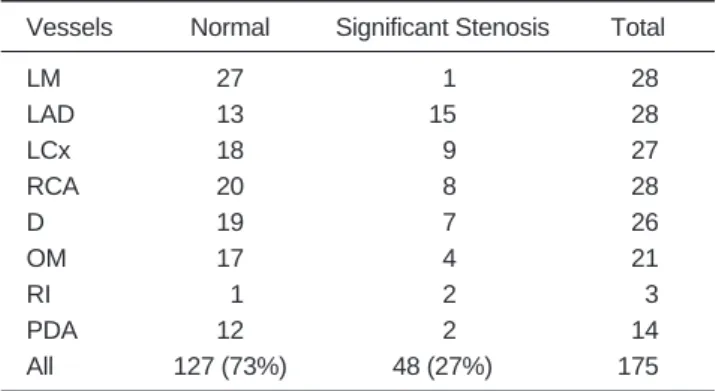
Coronary angiography was performed with different technical systems and with using Judkin’s technique. At least four views of the left coronary arterial (LCA) system and two views of the right coronary arterial (RCA) system were obtained and stored on a CD-ROM. One cardiac radiologist (J.B.S.) evaluated the angiogram for the presence of HSS by performing quantitative analysis of the coronary angiograms, and the locations of the lesions were systemically recorded. The result served as the standard of reference. Coronary arteries 1.5 mm or greater in size were included in the analysis, and 175 coronary arteries of 28 patients were interpreted. There were 28 left main coronary arteries, 28 left anterior descending arteries, 27 left circumflex coronary arteries, 28 right coronary
arteries, 26 diagonal branches, three ramus intermedius, 21 obtuse marginal arteries and 14 posterior descending arteries. HSS was defined as a degree of stenosis 50% or greater than the expected internal luminal diameter of the coronary artery; a degree of stenosis less than 50% was
Table 1. The Number of Normal and Abnormal Coronary Arteries on Conventional Coronary Angiography as a Standard of Reference
Vessels Normal Significant Stenosis Total
LM 27 01 028
LAD 13 15 028
LCx 18 09 027
RCA 20 08 028
D 19 07 026
OM 17 04 021
RI 01 02 003
PDA 12 02 014
All 127 (73%) 48 (27%) 175
Note. Significant stenosis indicates a vessel with the same or greater than 50% narrowing of the expected internal diameter of the arterial lumen.
LM = left main coronary artery, LAD = left anterior descending coronary artery, LCx = left circumflex coronary artery, RCA = right coronary artery, D = diagonal branch, OM = obtuse marginal branch, RI = ramus intermedius, PDA = posterior descending coronary artery.
considered to be negative for HSS. Among the coronary arteries that we analyzed, there were 127 (73%) normal coronary arteries and 48 (27%) coronary arteries with HSS (Table 1).
CT Coronary Angiography
Data acquisition
Each patient’s heart rate (HR) was measured prior to the examination. The patients with a pre-scan HR 65 bpm were given 100 mg of metoprolol per os one hour before the scan. The scanning parameters for the MDCT coronary angiography (Sensation 16; Siemens, Forchheim,
Germany) were: 12 detectors (because the retrospectively electrocardiographically gated protocol did not allow the use of all 16 rows), individual detector width: 0.75 mm, gantry rotation time: 420 ms, 120 kVp, 500 mAs, feed/rotation 2.8 mm, and scanning was done in the cranio-caudal direction. 100 ml of contrast agent
(Ultravist370 ; Schering, Berlin, Germany) were injected
intravenously in a rate of 4 mL/s, and this was followed by 50 ml of saline at the same rate. Early scanning started with real-time bolus tracking (CARE bolus; Siemens, Forchheim, Germany) using an ROI in the ascending aorta for monitoring a threshold of +100 HU above the baseline attenuation.
Image reconstruction
The images were reconstructed retrospectively with a slice thickness of 1 mm and an interval of 0.5 mm with using a medium smooth kernel (B30f). The position of the reconstruction window within the cardiac cycle was individually optimized to minimize the motion artifacts.
Image post-processing
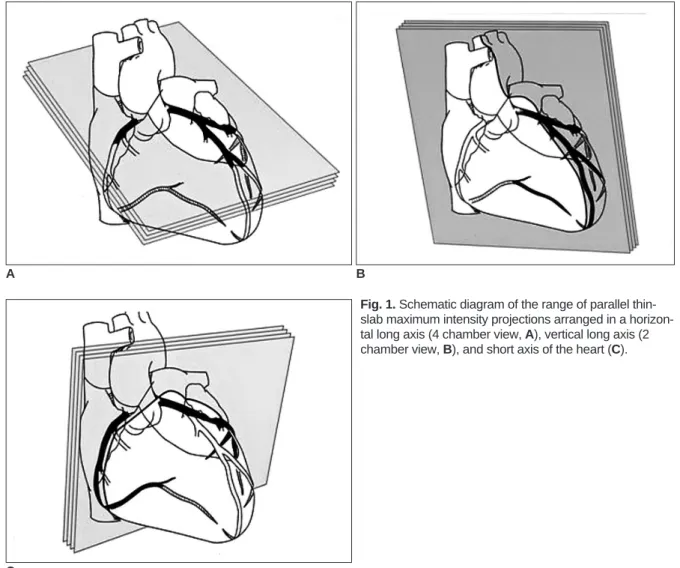
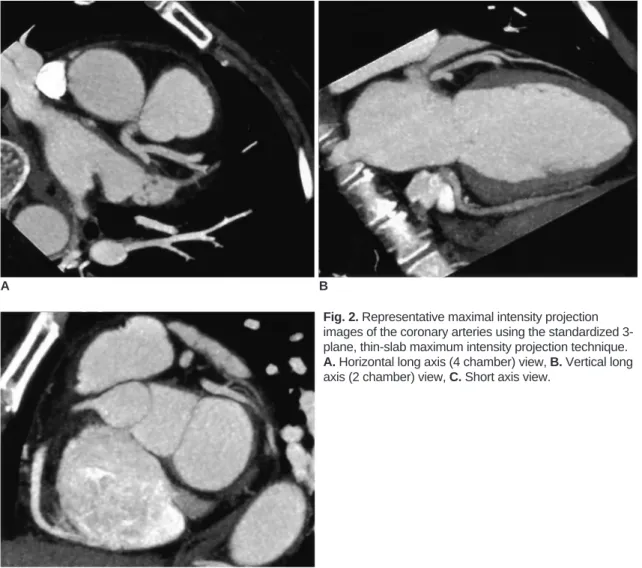
The post-processing was performed on a commercially available workstation (Wizard; Siemens) and all of it was done by one radiologist (J.B.S.). We created three planes of parallel 4-mm, thin-slab, MIP images (Figs. 1, 2) at 2- mm increments to cover the entire heart in the horizontal
A B
Fig. 1. Schematic diagram of the range of parallel thin- slab maximum intensity projections arranged in a horizon- tal long axis (4 chamber view, A), vertical long axis (2 chamber view, B), and short axis of the heart (C).
C
long axis (4 chamber view) from the superior surface to the diaphragmatic surface of the left ventricle, in the vertical long axis (2 chamber view) from the left ventricle to the right ventricle, and in the short axis of the heart across the atrioventricular groove (10). All the transaxial and MIP images were displayed on a 512 512 matrix. All the images were sent to a picture archiving and communication system (PACS).
Image Evaluation
Our study consisted of three sessions: 1) teaching and pre- interpretation, 2) interpretation of transaxial images, and 3) interpretation of the thin-slab MIP images. In the teaching and pre-interpretation session, the task was explained to each observer. We emphatically emphasized that as only a degree of stenosis of 50% or greater was considered to be hemodynamically significant, a degree of stenosis less than 50%, e.g. 30% or 45%, had to be scored as Grade 1 (normal). Each observer had a pre-interpretation session that simulated real interpretation with employing three
patients who were not included in this study. After that session, the observers were questioned whether or not they correctly understood the definition of hemodynamically significant stenosis. Any uncertainty was thoroughly discussed with the radiologist who designed this study (J.B.S.). The next session included interpretation of the transaxial or MIP images. The images in each set were randomly ordered. All the image interpretations were performed on a PACS monitor by four Board-certified radiologists (S.I.C., K-H.D., S.M.K. and W.L.); they were all accustomed to using the PACS viewer. Each radiologist was blinded to the patient histories and the results of their conventional coronary angiograms; during each session the radiologists worked independently and they were separated from each other. Two readers first interpreted the transaxial images while the other two readers first interpreted the MIP images. To diminish the learning effects, a minimum of one week was allowed to elapse between each reading session.
To simulate the routine clinical interpretation environment, the readers were allowed to interactively adjust the bright-
A B
Fig. 2. Representative maximal intensity projection images of the coronary arteries using the standardized 3- plane, thin-slab maximum intensity projection technique.
A. Horizontal long axis (4 chamber) view, B. Vertical long axis (2 chamber) view, C. Short axis view.
C
ness and contrast of the images. According to reader’s preference, they used a ruler from the PACS tool or they examined the images with the naked eye to evaluate HSS without the aid of PACS tools. The use of other tools such as magnification and contrast adjusting was also allowed.
All digital operations were performed using a computer mouse. As is done in conventional coronary angiography, the left circumflex coronary arteries, right coronary arteries, diagonal branch, ramus intermedius, obtuse marginal arteries and posterior descending arteries having a diameter of 1.5 mm or greater were evaluated. A degree of stenosis
50% was considered to represent HSS. For the ROC curves, the likelihood of the presence of significant stenosis was assessed by using the following five-grade scoring system; 1 = definitely negative, 2 = probably negative, 3 = indeterminate, 4 = probably positive, and 5 = definitely positive. These responses were recorded and re-sorted by each system for the statistical analysis. The time required for each observer to interpret with using each method was also recorded.
Statistical Analysis
The observer performance for the detection of HSS of the coronary artery with using the two visualization techniques was determined by means of ROC analysis of the individual and averaged reader data. To allow for generalization to our article readers and their cases, we used a multireader-multicase ROC approach (LABMRMC;
Chicago University, Charles, E. Metz). The statistical significance of the results for each technique was reported as a 95% confidence interval (CI) for the mean difference in the area under the ROC curve (Az value) for the observer performance. Mean differences were regarded as being statistically significant at the 5% level when the corresponding CI did not encompass zero. The diagnostic accuracies of the two visualization techniques were evaluated by averaging each sensitivity, specificity and accuracy in two ways; first, when Grade 3 (indeterminate)
or higher was regarded as being positive, and second when Grade 4 (probably positive) or higher was regarded as being positive. We compared the differences in the time needed for reading during each session for the transaxial and MIP images with using the Wilcoxon-Signed Ranks test.
RESULTS
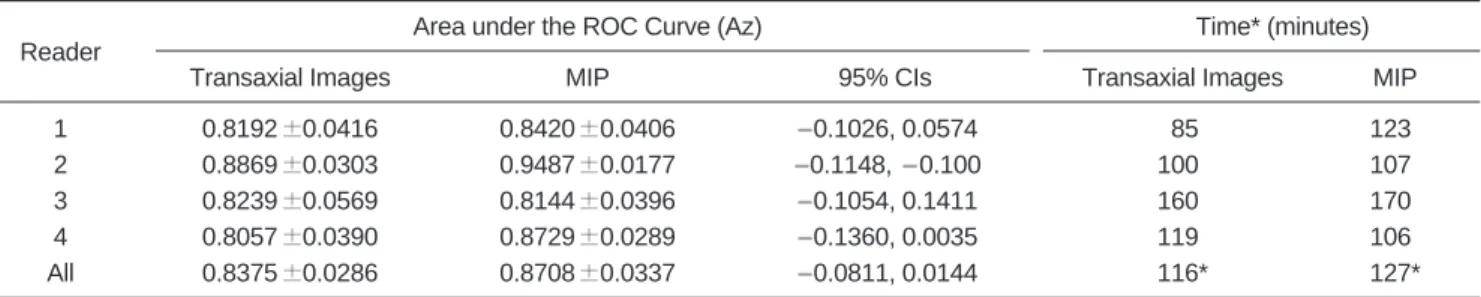
The mean Az values, which indicate the performance of each reader, are given in Table 2. The 95% CIs for the mean differences in the Az values between the two image sets and the reading time of each session are also provided.
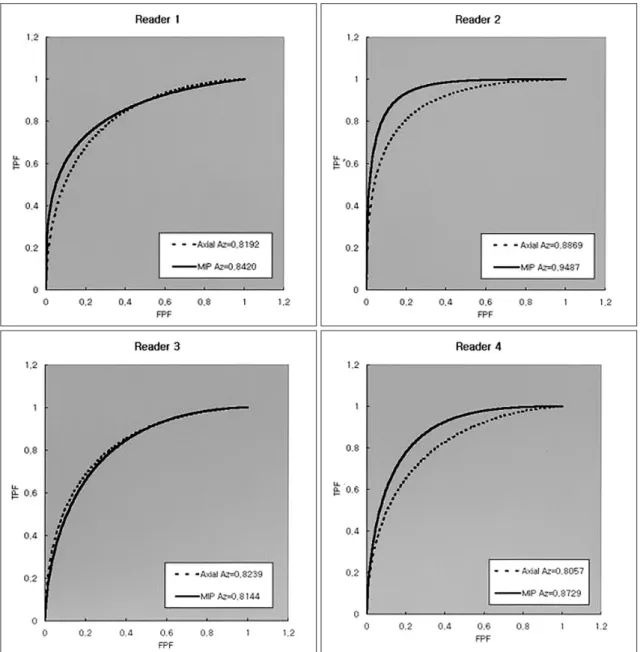
We found that for all three radiologists, the Az values from the MIP images were higher than those Az values from the transaxial images (Fig. 3), however, the difference was significant for only one reader. Overall, the Az values from both image sets were not significantly different. When Grade 3 (indeterminate) or higher were regarded as positive, the sensitivities, specificities, and accuracies were 65%, 86%, and 80% for the transaxial images and 71%, 84%, and 80% for the MIP images, respectively. When Grade 4 (probably positive) was used as the cut-off point, the sensitivities, specificities and accuracies were 47%, 92%, and 80% for the transaxial images and 54%, 92%, and 81% for the MIP images. The mean reading times for the transaxial images and the MIP images were 116 and 126.5 minutes, respectively; these findings were not statisti- cally significant (Wilcoxon-Signed Ranks test, p value = 0.465). The mean numbers of the transaxial and MIP images per patient were 238 and 162, respectively.
DISCUSSION
To the best of our knowledge, this is the first study to use ROC analysis to compare the usefulness of standardized, 3- plane, thin-slab MIP, which is easily processed in a
relatively short time, with the transaxial images in terms of
Table 2. Comparison of Observer Performance for Detecting Hemodynamically Significant Stenosis of the Coronary Artery, and the Average Reading Time for the Transaxial Images and the Maximum Intensity Projection Images
Area under the ROC Curve (Az) Time* (minutes)
Reader
Transaxial Images MIP 95% CIs Transaxial Images MIP
1 0.8192 0.0416 0.8420 0.0406 0.1026, 0.0574 085* 123*
2 0.8869 0.0303 0.9487 0.0177 0.1148, 0.100 100* 107*
3 0.8239 0.0569 0.8144 0.0396 0.1054, 0.1411 160* 170*
4 0.8057 0.0390 0.8729 0.0289 0.1360, 0.0035 119* 106*
All 0.8375 0.0286 0.8708 0.0337 0.0811, 0.0144 116* 127*
Note. Data are Az values standard error; The 95% confidence intervals represent the mean difference Az value.
* Mean reading time of all readers.
their ability to detect HSS. In this study, no significant difference in the observer performance was noted between their interpretation of the transaxial and the MIP images.
Even though it was not statistically significant, the MIP images were slightly superior to the transaxial images for the detection of HSS of the coronary arteries. Although the transaxial images normally represent the clinical reference standard for conducting detailed image analysis, the diagnostic value of the coronary imaging is restricted by the small vascular diameters and the 3-dimensional spreading of the vessels. Consequently, the vascular sections are often displayed at an unfavorable cutting angle or they are affected by the partial volume effect. Therefore, we studied the effective image post-processing modalities for their
ability to visualize the coronary arteries, including MPR, MIP, 3D-VRT and virtual endoscopy (VE), which is a derivate of 3D-VRT (6, 8, 16). Vogl et al. (6) have
concluded that transverse scanning is the superior technique for evaluating CT coronary angiography. They have also hypothesized that the transaxial imaging revealed the highest sensitivities for detecting atherosclerotic wall changes and it was less susceptible to motion artifacts.
Mahnken et al. (8) stated that 3D-VRT is a promising tool for assessing cardiac MDCT data sets, and its sensitivity and specificity for detecting coronary artery stenoses are comparable to those of other visualization techniques.
Previous reports have demonstrated that the disadvantages of MIP are that it uses only a fraction of the available data
Fig. 3. Receiver operating characteristic curves for the transaxial images and the MIP images from each reader. The Az values of the MIP images were larger than those of the transaxial images except for reader 3. However, the difference was statistically significant only for reader 2. Axial = Transaxial image, TPF = true positive fraction, FPF = false positive fraction.
and that the algorithm results in the overestimation of the stenoses (13). Furthermore, many artifacts are known to exist on the MIP images, and no 3D depth can be obtained.
The MIP images also have the problem that an eccentric stenosis cannot be detected due to the overlapping artifact.
To overcome these problems, we used three planes of parallel, 4-mm, thin-slab MIPs with 2-mm increments.
These slabs were moved through the volume, with the slab movement distance smaller than the slab thickness, and we using three planes so that the previously mentioned disadvantages could be overcome. We used three planes of MIP images for evaluating coronary arteries. The underesti- mation of eccentric stenosis could be avoided because for the interpretation, we used three almost perpendicular imaging planes. In addition, because the imaging planes used in this study were similar to those of cardiac MRI or transthoracic echocardiography, other cardiac abnormalities such as myocardial thinning, chamber enlargement and pericardial effusion could easily be assessed.
The inevitability of reconstruction with sub-millimeter section thickness and increments for the evaluation of coronary artery results in a large number of axial images.
Moreover, in those cases with motion artifact, multiple sets of transaxial images should be reconstructed in different cardiac phases in order to identify the optimal cardiac phase for viewing each coronary vessel. This results in a continuous increase in digital data volume, and this is a serious challenge to implement with PACS (21). Although the cost of PACS and the data storage devices is rapidly decreasing, it is important to be able to manage a large amount of data with using the existing systems more effectively, and this is especially important for those clinics and hospitals that cannot afford new systems. As shown in our study, the number of images for each patient can be reduced from 238 to 162 by using the MIP images, and this means there is a smaller digital data volume.
In our study, the mean average reading-time for the transaxial and the MIP images was not significantly differ- ent. This is probably because the interpreters might have evaluated the MIP images more carefully and they might have unintentionally noticed that the MIPs would be more useful than the transaxial images for detecting HSS when the task was explained to each observer during the teaching session. Furthermore, not all of our readers are as accustomed to the MIP images as they are to the transaxial images, even though we offered a brief teaching session for interpretation. Finally, because the MIP images consist of three image sets with different image planes, the readers might have used additional time to compare the coronary lesions in the three-plane images. The reconstruction method we used in this study is quite easy and it can be
performed by a technician if he/she knows the basic anatomy of the heart. Therefore, we did not regard the time needed for generating the MIP images as additional time spent by the radiologists.
There are several limitations to our study. The first is that those patients with heart rates greater than 66 bpm were excluded. Although a recent study (3) with 16-slice multidetector CT demonstrated an 86% specificity and a 95% sensitivity for the detection of HSS, this result was confined to the patients who had a lower heart rate. Even if we had used a beta-blocker to decrease the heart rate in some patients, it was impossible for some patients to obtain a rate of 65 bpm or less, and so they were excluded from this study. With the advent of the 64-section CT scanner and the rapid gantry rotation technique, more reliable cardiac imaging might be acquired from those patients with higher heart rates, and cardiac arrhythmia and the limitation of a high heart rate may be overcome in the near future. Because the aim of the present study is to compare the usefulness of two techniques in patients with optimally obtained CT, we believe that our strategy is justified. The second limitation is that not all the coronary vessels are included in this study. However, because of the intrinsic limitation in the temporal resolution, even when using a current state-of-the-art CT scanner, most studies on the detection of coronary stenosis have been focused on the evaluation of the coronary artery segments that are larger than 1.5 or 2 mm in diameter. We have attempted to include in our study a greater number coronary artery segments and side branches that had a vessel diameter approximately 1.5 mm that can be evaluated on conventional coronary angiography, which is a standard of reference. This approach is also practical in terms of the clinical setting because those stenoses in vessels with a diameter < 1.5 mm are rarely included as being targets for revascularization. The third limitation is that we did not use thinner reconstructed 3-plane images to evaluate HSS.
If we had been able to afford a larger data storage device or the most up-to-date PACS, we could have reconstructed three plane images with a thinner slice. It could have improved the diagnostic performance of the MIP images for detecting HSS. Lastly, although only 28 patients were included in our study, the 175 segments we evaluated in our study are a sufficient number to perform ROC analysis.
CONCLUSION
For the clinical purpose of detecting HSS of the coronary arteries, the thin-slab MIP images are comparable to the transaxial images. The digital data volume of the MIP images is significantly lower than that of the transaxial
images. Therefore, to evaluate coronary artery stenosis, it is acceptable to use thin slab MIP images without referring to the transaxial images.
Acknowledgements
We thank Bonnie Hami, Department of Radiology, University Hospitals of Cleveland, OH, for her editorial assistance.
References
1. Rumberger JA. Noninvasive coronary angiography using computed tomography: ready to kick it up another notch [editorial]. Circulation 2002;106:2036-2038
2. Nieman K, Oudkerk M, Rensing BJ, van Ooijen P, Munne A, van Geuns RJ, et al. Coronary angiography with multislice computed tomography. Lancet 2001;357:599-603 3. Nieman K, Cademartiri F, Lemos PA, Raaijmakers R,
Pattynama PM, de Feyter PJ. Reliable noninvasive coronary angiography with fast submillimeter multislice spiral computed tomography. Circulation 2002;106:2051-2054
4. Kopp AF, Schroeder S, Kuettner A, Baumbach A, Georg C, Ohnesorge B, et al. Non-invasive coronary angiography with high resolution mutidetector-row computed tomography: results in 102 patients. Eur Heart J 2002;23:1714-1725
5. Kopp AF, Schroeder S, Kuettner A, Heuchmid M, Georg C, Ohnesorge B, et al. Coronary arteries: retrospectively ECG- gated multi-detector row CT angiography with selective optimization of the image reconstruction window. Radiology 2001;221:683-688
6. Vogl TJ, Adolmaali ND, Diebold T, Engelmann K, Ay M, Dogan S, et al. Techniques for the detection of coronary athero- sclerosis: multi-detector row CT coronary angiography.
Radiology 2002;223:212-220
7. Gerber TC, Kuzo RS, Lane GE, O’Brien PC, Karstaedt N, Morin RL, et al. Image quality in a standardized algorithm for minimally invasive coronary angiography with multislice spiral computed tomography. J Comput Assist Tomogr 2003;27:62-69 8. Mahnken AH, Wildberger JE, Sinha AM, Dedden K, Stanzel S,
Hoffmann R, et al. Value of 3D-volume rendering in the assess- ment of coronary arteries with retrospectively ECG-gated multislice spiral CT. Acta Radiol 2003;44:302-309
9. Addis KA, Hopper KD, Lyriboz TA, Liu Y, Wise SW, Kasales CJ, et al. CT angiography: in vitro comparison of five
reconstruction methods. AJR Am J Roentgenol 2001;177:1171- 1176
10. Hirai T, Korogi Y, Ono K, Murata Y, Takahashi M, Suginohara K, et al. Maximum stenosis of extracranial internal carotid
artery: effect of luminal morphology on stenosis measurement by using CT angiography and conventional DSA. Radiology 2001;221:802-807
11. Rubin G, Dake MD, Napel S, Jeffrey RB, McDonnell CH, Sommer FG, et al. Spiral CT of renal artery stenosis: compari- son of three-dimensional rendering techniques. Radiology 1994;190:181-189
12. Berg MH, Manninen HI, Vanninen RL, Vainio RA, Soimakallio S. Assessment of renal artery stenosis with CT angiography:
usefulness of multiplanar reformation, quantitative stenosis measurement, and densitometric analysis of renal parenchymal enhancement as adjuncts to MIP film rendering. J Comput Assist Tomogr 1998;22:533-540
13. Heath DG, Soyer PA, Kuszyk BS, Bliss DF, Calhoun PS, Bluemke DA, et al. Three-dimensional spiral CT during arterial portography: comparison of three rendering techniques.
RadioGraphics 1995;15:1001-1011
14. Lu Bin, Dai RP, Jiang SL, Bai H, He S, Zhuang N, et al. Effects of window and threshold levels on the accuracy of three- dimensional rendering techniques in coronary artery electron- beam CT angiography. Acad Radiol 2001;8:754-761
15. Rensing BJ, Bongaerts A, van Geuns RJ, van Ooijen P, Oudkerk M, de Feyter PJ. Intravenous coronary angiography using electron beam computed tomography. Prog Cardiovasc Dis 1999;42:139-148
16. Peter MA, van Ooijen P, Ho KY, Dorgelo J, Oudkerk M.
Coronary artery imaging with multidetector CT: visualization issues. RadioGraphics 2003 Aug. Available from: URL:
http://radiographics.rsnajnls.org/cgi/content/full/e16v1 17. Pannu HK, Flohr TG, Corl FM, Fishman EK. Current concepts
in multi-detector row CT evaluation of the coronary arteries:
principles, techniques, and anatomy. RadioGraphics 2003;23:s111-125
18. Soto JA, Munera F, Cardoso N, Guarin O, Medina S. Diagnostic performance of helical CT angiography in trauma to large arteries of the extremities. J Comput Assist Tomogr 1999;23:188-196
19. Sugahara T, Korogi Y, Hirai T, Hamatake S, Komohara Y, Okuda T, et al. CT angiography in vascular intervention for steno-occlusive diseases: role of multiplanar reconstruction and source images. Br J Radiol 1998;71:601-611
20. Regenfus M, Ropers D, Achenback S, Schlundt C, Kessler W, Laub G, et al. Diagnostic value of maximum intensity projec- tions versus source images for assessment of contrast-enhanced three-dimensional breath-hold magnetic resonance coronary angiography. Invest Radiol 2003;38:200-206
21. Bae KT, Whiting BR. CT data storage reduction by means of compressing projection data instead of images: feasibility study.
Radiology 2003;219:850-855