Print ISSN: 2288-4637 / Online ISSN 2288-4645 doi:10.13106/jafeb.2021.vol8.no1.471
The Effect of Compensation and Career on Turnover Intention:
Evidence from Indonesia
Nico Alexander VIZANO
1, Ahmad Hidayat SUTAWIDJAYA
2, Endri ENDRI
3Received: September 30, 2020 Revised: November 22, 2020 Accepted: December 05, 2020
Abstract
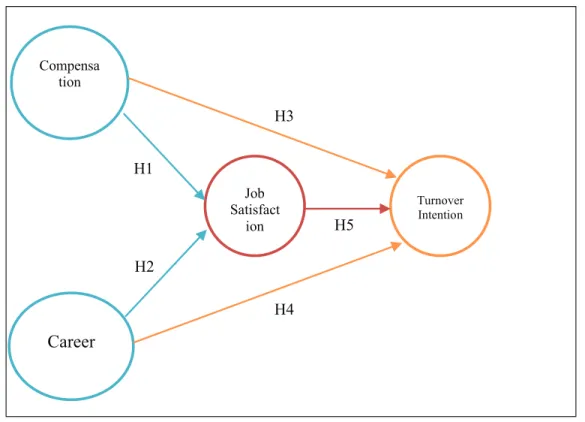
This study aims to investigate the determinants of turnover intention among company managers in Indonesia. Based on the literature, this research hypothesizes that job satisfaction is a mediator in the relationship between compensation, career and turnover intention of companies in Indonesia. Respondents as research samples are grouped into middle managers from two industries, namely, manufacturing and services. A total of 215 questionnaires were returned from middle managers. Data analysis used Structural Equation Model - Linear Structural Relationship (SEM LISREL). The research results prove that compensation and career have a positive effect on job satisfaction.
Compensation, career, and job satisfaction have a negative impact on turnover intention. Compensation is known to be one of the motivating drivers of workers around the world. From this study it can be said that, if middle manager teachers are well compensated, they will be encouraged, persuaded and will have positive feelings toward their work, and this will result in staying put. It works also with career and job satisfaction. If both variables are considered carefully, intention to move tends to be low. These findings provide new insights into the field of international human resources in developing multinational companies and service businesses.
Keywords: Turnover Intentions, Career, Compensation, Job Satisfaction JEL Classification Code: J28, J30, J45
compete for the recruitment and retention of talented employees. Employee turnover can affect financial and non- financial aspects of a company (Ingsih, Prayitno, Waluyo, &
Suhana, 2020). According to Islam, Bangish, Muhammad, and Jehan, (2016), the expenditure costs included are the costs of recruiting, training and apprenticeship, loss of productivity, reduced engagement, and disruptions in service that have a negative influence on company culture.
Researchers have identified factors that influence employee turnover intentions (Lee, 2017). These factors can be categorized into individual characteristics such as gender, worker age, length of work (Cho & Lewis 2012; Jung, 2010; Pitts, Marvel,
& Fernandez, 2011; Wynen & Op de Beeck, 2014; Endri et al., 2020), the category of managerial practice in companies such as work involvement, work performance and salary, and company policy (Kim, Tam, Kim, and Rhee, 2017; Lee, Huang, & Zhao, 2012; Moynihan & Landuyt, 2007), job satisfaction categories with different determinants such as the type of work itself, compensation and other benefits (Jin, McDonald, & Park, 2016;
Lewis, 1991; Wang, Tao, Ellenbecker, & Liu, 2012; Nguyen et al., 2020), categories related to superiors and coworkers (Pitts et al., 2011; Wynen et al., 2013), and compatibility to organizations (employee-organization fit) related to the
1
First Author. Doctoral Student, Graduate Program, Universitas Mercu Buana, Jakarta, Indonesia. Email: [email protected]
2
Associate Professor, Universitas Mercu Buana, Jakarta, Indonesia.
Email: [email protected]
3