시내버스 실내공기질 IAQ 종합지수 개발
전보일* · 곽민정** · 강상현*** · 김종철*** · 윤현준*** · 김호현*
,****
†*평택대학교 생활 및 산업 환경R&D 센터, **평택대학교 데이터정보학과,
***(주)코웨이 환경기술연구소, ****평택대학교 ICT융합학부 ICT환경융합전공
Development of IAQ Index for Indoor Air Quality in City Buses
Bo-Il Jeon*, Min-Jeong Kwak**, Sang-Hyeon Kang***, Jong-Cheol Kim***, Hyun-Jun Yun***, and Ho-Hyun Kim*
,****
†*Life & Industry Environmental R&D Center, Pyeongtaek University
**Department of Data Information and Staistics, Pyeongtaek University
***The Environment Technology Institute, Coway Co., Ltd., Korea
****Department of Information, Communication and Technology Convergence, ICT Environment Convergence, Pyeongtaek University
ABSTRACT
Objectives: This study developed an index for the indoor air quality management of city buses to allow the provision of indoor air quality information to city bus users.
Methods: Nine city buses in Seoul were measured for PM
10, PM
2.5, CO
2, temperature, and relative humidity through IoT sensors. Big data collected through the sensors was analyzed to identify indoor air quality on city buses and graded through the index.
Results: As a result of dividing the measured city bus data into five grades through the IAQ index, PM
10was rated “good” for 30.4% of the total measured values, and 9.2% were rated “risky”. For PM
2.5, 67.7 percent were rated “good” and 0.4 percent were rated “risky”. For CO
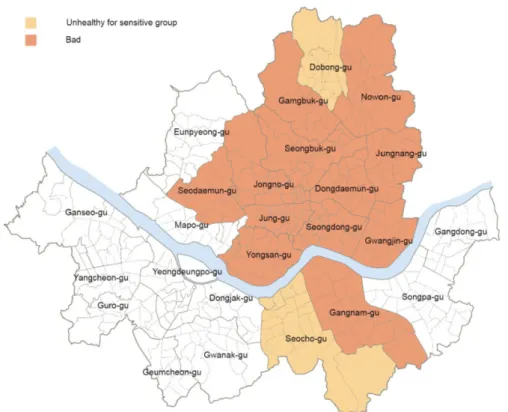
2, 0.9% were ‘good’ and 1.1% were ‘risky’. The results of the classification through the IAQ index for city buses showed that the impact of good, normal, sensitive, bad, and dangerous were 2.7, 38.8, 46.0, 12.4, and 0.1%, respectively. According to the analysis by measurement area, Seocho-gu, Gangnam-gu, Seongdong-gu, Gwangjin-gu, and Dobong-gu are “normal” and other areas (Seodaemoon-gu, Jongno-gu, Yongsan-gu, Jung-gu, Seongbuk-gu, Dongdaemun-gu, Junggye-gu, Gangbuk-gu, and Nowon-gu) are all rated “sensitive”.
Conclusions: When analyzing cases where PM
10and CO
2indices are in the “bad” zone, the concentration is generally found to increase during rush hour, during which there are a large number of passengers. It is expected that indoor air quality management in vehicles will be necessary during rush hour.
Key words: City bus, health management, index, indoor air quality, IoT sensor
I. 서 론
현대 사회는 도시화로 인하여 녹지가 감소하고, 산 업화로 인하여 지속적으로 공기질이 나빠지고 있다.
이를 개선하기 위해 다양한 공기질 개선 정책을 추 진하고 있다. 공기질 개선을 위해 자가용 승용차 대 신 대중교통수단을 권장하고 있으며, 그에 따라 대 중교통을 이용하는 승객의 건강을 위해 대중교통수
†