능소화 잎 및 줄기 추출물의 Human Immunodeficiency Virus Type I 억제활성
유영법*
남부대학교 한방제약개발학과
Inhibitory Effects of Campsis grandiflora on HIV-1 reverse Transcriptase, HIV-1 Protease and α-glucosidase
Young-Beob Yu*
Department of Herbal Pharmaceutical Development, Nambu University, Gwangju 506-706, Korea
Abstract - For the elucidation of action mechanism on anti-HIV of natural resources, the extracts of Campsis grandiflora were tested for their inhibitory effects on HIV-1 replication and its essential enzymes as the reverse transcriptase (RT), protease and α- glucosidase. In the assay of HIV-1-infected human T-cell line, water extracts of stem inhibited the HIV-1-induced cytopathic effects with IC (inhibitory concentration) of 100 ㎍/ml. Moreover water extracts (100 ㎍/ml) of stem showed strong activity of 37.9% on anti-HIV-1 RT using Enzyme Linked Oligonucleotide Sorbent Assay (ELOSA) method. In the HIV-1 protease inhibition assay, methanol extracts of stem and leaf extract showed 33.6% and 31.5%
inhibition of the enzyme activity to cleave an oligopeptide resembling one of the cleavage sites in the viral polyprotein which can only be processed by HIV-1 protease, but did not exhibited glucosidase inhibitory activities. From these results, it is suggested that the inhibition of the viral replication in vitro is due to the inhibition of reverse transcriptase by water extracts of stem of Campsis grandiflora.
Key words - Campsis grandiflora, Anti HIV-1, Reverse transcriptase, Protease, α-glucosidase
*교신저자(E-mail) : [email protected]
서 언
한약 및 천연산물의 항 에이즈 치료제에 대한 연구가 지 속적으로 이루어져 오고 있다(Yu et al., 2007; Yang et al., 2001; Taraporewala et al., 1992; Nakashima et al., 1992; Kusumoto et al., 1995). 본 연구에서는 에이 즈의 원인 바이러스인 HIV-1의 주요 효소와 그 바이러스 를 대상으로 한국산 식물들의 복제억제 효능을 살펴보았으 며 그 중 능소화 줄기와 잎 추출물의 활성효능이 관찰되어 보고하고자 한다. 능소화(Campsis grandifolia K. Schum) 는 능소화과(Bignoniaceae)에 속하는 길이 10 m의 낙엽활 협 덩굴성 식물로 내한성이 약하여 중국 중부이남이 원산 지이다. 잎은 마주나기하며 달걀모양이고 기수 1회 우상복
엽으로 가장자리에 톱니가 있다. 열매는 삭과이고 꽃은 8-9월에 피고, 지름 6-8 cm 주홍색으로 능소화라 한다.
한방에서는 잎을 능소화 혹은 자위화(紫葳花), 근(根)을 자 위근(紫葳根), 경엽(莖葉)은 자위경엽(紫葳莖葉)이라하여 약용으로 사용한다. 능소화는 7-9월에 꽃을 채취한 것을 사용하며 혈(血)의 열을 낮추는 량혈(凉血), 혈의 정체를 제거하는 거어(祛瘀)의 효능이 있어 혈체, 월경불순, 토혈 등의 치료에 사용한다. 자위근은 량혈(凉血), 거풍(祛風), 산어(散瘀)의 효능이 있어 피부 소양(瘙痒), 통풍(痛風)등 의 치료에 사용되어 오고 있다(Kim et al., 2004).
능소화의 화학성분으로는 acetoside, oleanolic acid, ulsolic acid, beta-sitosterol, daucosterol 등 지용성 성분들이 밝혀져 있으며(Zhang et al., 2011; Kim et al., 2004), 잎에서는 cachinol과 1-O-methyl cachinol등 iridoid
성분이 보고되어 있다(Jin et al., 2005). 약리활성으로는 cholesterol acyltransferase inhibitors로서 maslinic acid, corosolic acid, 23-hydorxyursolic acid, arjunolic acid 성분이 알려져 있으며(Kim et al., 2005), 능소화의 에탄올 추출물의 항산화, 항염증활성이 보고되었으며(Cui et al., 2006), oleanolic acid, hederagenin, ursolic acid, tormentic acid, myrianthic acid 등 triterpenoid 성분들의 항혈전 작용이 보고되어 있다(Jin et al., 2004). 또한 ursolic acid의 인슐린수용체 활성화 관한 보고가 있으나(Jung et al., 2007)능소화의 줄기 및 잎으로부터 HIV 억제 활성에 관한 연구는 아직까지 보고되지 않고 있다.
본 연구에서는 능소화의 잎, 줄기의 물 및 메탄올 엑스 를 이용하여 HIV-1 기원 효소인 reverse transcriptase 억제활성을 ELOSA(Enzyme Linked Oligonucleotide Sorbent Assay) 방법으로, HIV-1 protease 억제활성을 HPLC 검출법으로, 그리고 α-glucosidase의 억제활성은 spectrophotometer 측정법으로 평가를연구를 실시하였 고, HTLV -1에 감염된 MT-4 cell line을 이용하여 바이 러스 복제 억제력을 살펴 본 결과 유의적 활성이 관찰되어 보고하고자 한다.
재료 및 방법
식물재료
시료로 사용한 능소화 전남 순천시 난봉산에서 채취한 후 순천대학교 한약자원학과에서 동정한 후 잎, 줄기를 통풍이 잘되는 곳에서 음건 세절하여 추출용 시료로 사용하였다.
시약 및 기기
용매는 특급 및 1급 시약을 사용하였다. Microplate washer 는 Immunowash model 1250(Biorad, Nippon Biorad KK, Tokyo, Japan)을, microplate reader는 Biorad 3550-UV (Biorad, Nippon Biorad KK, Tokyo, Japan)를, HPLC 는 [System controller: Shimadzu SCL-6B, Pump:
Shimadzu LC-9A, Detector: Shimadzu SPD-6A(UV spectrophotometric detector), Recorder & integrator:
Shimadzu C-R6A Chromatopac.]을 각각 이용하였다.
시료의 추출
시료 5 g을 각각 물(100 ml) 또는 메탄올(100 ml)로
3시간씩 열수 추출한 후 감압 농축하여 메탄올의 최종농도 가 2%가 넘지 않게 동결건조하여 활성 실험의 재료로 사용 하였다. 시료는 활성 실험 시에 멸균된 증류수나 DMSO에 100 μg/ml의 농도로 희석하여 사용하였다.
HIV-1 reverse transcriptase 억제 활성
Reverse transcriptase(RT) 억제활성 실험은 Dupont 사로부터 구입한 RT-DetectTM kit NEK-070A (Dupont medical products, Boston, MA, USA)를 이용한 ELOSA 방법으로 4℃ 이하에서 저장하면서 assay 조건을 설정하 였다. 효소는 유전자 재조합에 의해 생산된 HIV-1 RT (10 U/μl, 100 mM potassium phosphate, pH 7.1, 1 mM dithiothreitol, 50% glycerol)를 효소완충액[100 mM Tris -HCl, pH 8.0, 160 mM KCl, 1 mM EDTA, 3 mM di- thiothreitol, 0.3% (v/v) Triton X-100, and 10% (v/v) glycerol]에 0.005 U/μl로 희석하여 사용하였고 반응혼합 물(reaction mixture)은 primer가 부착된 RNA template 와 triphosphate-DNA nucleosides를 반응혼합물 완충액 (reaction buffer: 200 mM Tris-HCl, pH 8.0, 40 mM MgCl2)에 희석하여 사용하였다. 10 μl 반응혼합물 완충액, 20 μl 반응혼합물, 4 μl 식물 추출물, 5.2 μl 효소완충액을 500 μl test tube (ependorf)에 넣고 37oC에서 4분간 예 비배양한 후 효소 0.8 μl를 가해 37oC에서 1시간동안 역전 사시키고 90℃에서 1분간 반응을 정지시켰다. 반응을 마친 RNA template를 알카리용액(5.62% potassium hydroxide, 94.38% water)으로 37℃ 에서 15분간 가수분해한 후, 완 충액(13.6% sodium phosphate, monobasic monohydrate, 86.4% water)으로 중화하였다. ELOSA 반응을 위해 중화 시킨 반응액 50 μl를 streptavidin-coated microplate well에 옮기고, horseradish peroxidase(HRP)-labeled detector probe와 biotin-labeled capture probe를 포함 하는 ELOSA 용액 50 μl 첨가하여 37oC에서 2시간동안 배 양하였다(Weber et al., 1989). 반응을 마치고 microplate well에 남은 시약이나 가수분해된 RNA를 제거하기 위해 세척액(2-chloroacetamide 용액 20X)을 D.W로 희석하 여 3회 세척하였다. 세척한 microplate에 형광검출액(3, 3',5,5'- tetramethylbenzidine substrate 용액) 100 μl 를 첨가하여 실온에서 1시간동안 반응시킨 후 정지액(2.2%
citric acid, 1.5% HCl, 1.5% sulfuric acid and 94.8%
water) 100 μl를 첨가하여 반응을 정지시켰다. 반응액은
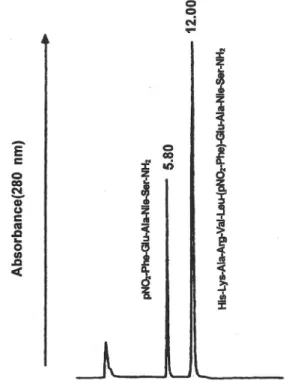
Fig. 1. HPLC profile of the reaction mixture of HIV-1 protease. The substrate and its hydrolysate were detected at 280 nm and their retention times were 12.00 and 5.80 min, respectively.
spectrophotometer로 450 nm에서 흡광도를 측정하였으 며 억제율의 계산은 다음과 같이 하였다.
Inhibition(%) = (Activitycontrol-Activitysample) / Activitycontrol × 100
HIV-1 protease 억제 활성
유전자 재조합으로 생산된 HIV-1 protease에 의한 기 질의 cleavage를 HPLC로 측정하였고 효소원은 Otake et al. (1994)의 방법에 의해준비하였다. 즉 HIV-1 protease (PR)의 DNA를 나타내는 JM 105 Escherichia coli 에서 생산된 HIV-1 protease를 {[50 mM NaOAc(pH 5.0), 1 mM EDTA-2Na, 2mM 2-Mercaptoethanol]:Glycerol}
=75:25 용액에 희석하여 사용하였고, 기질은 oligopeptide {His-Lys-Ala-Arg-Val-Leu-(pNO2-Phe)-Glu-Ala - Nle-Ser-NH2 (M.W. 1315 )}를 (주)단백질 연구소 (Osaka, Japan)로부터 구입하여 완충액 (50 mM NaOAc, pH 5.0)에 2 mg/ml 농도로 희석하여 사용하였다. 항 HIV -1 protease 반응은 완충액 1 μl, 기질 1.0 μl, 식물 추출 물 1 μl, 효소용액 2 μl을 각각 가하여 전량 5 μl의 반응혼 합물을 조제하고 37℃에서 1시간 반응시킨 후 90℃에서 60 초간 가열하여 효소 반응을 정지시켰다. 반응혼합물을 증 류수 35 μl로 희석한 후 HPLC 분석을 행하였으며 HPLC 분석 조건으로 column은 LiChrospher 100 RP-18 (column size, 250 × 4 mm, Merck, Darmstadt, FRG)을, 용매는 0.1% TFA와 acetonitrile(20%-50% gradient)로 하였으 며, 유속은 1.0 ml/min로 하면서 UV 280 nm에서 분석하 였다(Fig. 1).
α-glucosidase 억제 활성
α-glucosidase에 의한 p-nitrophenyl-α-D-glucoside 의 cleavage를 spectrophotometer로 측정하는 방법을 이 용하였다. 실험에 사용한 효소원은 Saccharomyces sp.에 서 얻은 α-glucosidase(Toyobo Company, Osaka, Japan) 를 완충액(10 mM sodium phosphate, pH 7.0, 20%
glycerol)에 0.5 U/ml가 되도록하여 사용하였으며, 기질 은 p-nitrophenyl-α-D-glucopyranoside(Nacalai Tesque Inc., Osaka, Japan)를 멸균 증류수에 10 mM이 되도록하 여 사용하였다. 항 α-glucosidase 반응액의 조성은 50 μl 완충액(100 mM Sodium phosphate, pH 7.0), 100 μl 기
질용액과 20 μl 식물 추출물로 하고 37 ℃에서 5분간 예비 배양한 후 30 μl 효소를 첨가하여 37℃에서 10분간 배양하 였다. 그리고 140 μl 정지액(0.2 M sodium carbonate)으 로 반응을 정지시킨 후 microplate well에 옮겨 405 nm에 서 흡광도를 측정하였고 억제율의 계산은 다음과 같이 하 였다.
Inhibition(%) = (Activitycontrol-Activitysample) / Activitycontrol × 100
HIV-1 복제 억제
HIV-1 복제억제활성 실험은 Otake et al. (1994)의 방 법에 의해 행하여 졌다. 실험에 사용된 세포는 HTLV-1 에 감염된 MT-4 cell line으로 penicillin G 100 U/ml (Banyu Pharmaceutical, Tokyo, Japan)와 streptomycin 100 μg/ml(Meiji Seika, Tokyo, Japan) 그리고 10% fetal calf serum(FCS, Flow Laboratories, North Ryde, Au- stralia)을 포함하는 RPMI-1640배지(Flow Laboratories,
100 μg/ml
Inhibition rate (%)
0 20 40 60 80 100
N.E.
Leaf (wate r ex.)
Leaf (M eOH e
x.) Stem(W
ater ex.) Stem
(MeO H ex.)
a a
b
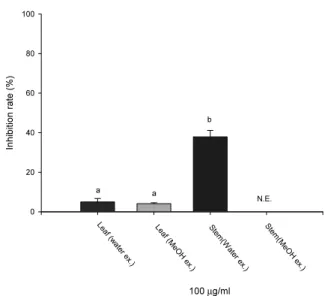
Fig. 2. Inhibition rates of stem water extracts of Campsis grandiflora on HIV-1 reverse transcriptase. The results are the mean ± S.E. from three replication. Different letters indicate a significant difference by Duncan’s multiple range test at p < 0.05. Water extracts were dissolved in distilled water, and methanol extracts were dissolved in DMSO or 10% DMSO in water. NE, not effective.
Irvine, Scotland)를 이용하여 5% CO2와 37℃의 조건하에 서 배양하여 실험에 사용하였다. 바이러스는 MOLT-4/HTLV -3ⅢB 세포로부터 얻은 HIV-1 (strain HTLV-ⅢB)을 이 용하였다. 항 HIV-1 활성은 MT-4 세포를 50%-tissue culture infective dose(TCID50)에서 1시간 동안 HIV-1 (HTLV-ⅢB)에 감염시켰다. 그리고 RPMI-1640배지에서 1 × 10⁵ cells/ml로 재현탁시키고 현탁된 세포를 200 μl /well씩 96-well culture plate에 식물엑스와 함께 처리 하고 5일간 배양하였다. 식물엑스의 MT-4세포에 대한 HIV-1 유도 세포변성(CPE, cytopathic effect)을 완전히 억제하는 농도(IC, inhibitory concentration)를 광학현미 경으로 관찰하였으며 세포독성(CC, cytotoxic concentration) 은 MT-4 세포의 생존력 감소로 측정하였다. 대조군은 HIV-1에 감염시킨 세포와 시키지 않은 세포에 식물엑스를 넣지 않고 측정하였다. 양성대조군은 AZT와 DS8000을 각 각 이용하였다.
결과 및 고찰
RNA를 유전적 모태로 하는 레트로바이러스의 한 종인 HIV-1(human immunodeficiency virus type Ⅰ)은 에 이즈(acquired immune deficiency syndrome, AIDS)의 병인학적 원인으 로 알려져 있다(Kaminchik et al., 1994; Peliska et al., 1992). HIV-1은 RNA를 숙주 세포 에 전이하고 이는 reverse transcriptase (RT)(Prasad and Goff, 1989)에 의해 viral DNA로 전사되어 host chromosome에 proviral DNA형태로 존재한다. 숙주세포 에서 잠복기를 거쳐 protease(PR)에(Katz and Skalka, 1994), glucosidase (GL)등의 작용으로(Taylor et al., 1994; Mohan, 1992) 성숙된 virion으로 budding된다.
HIV-1 바이러스는 복제 과정에서 host cell을 파괴함으로 써 인간의 면역기전에 심각한 장애를 유발하는 것으로 알 려져 있다. 다수의 연구자에 의해 항 HIV-1 활성을 갖는 천연물질에 대한 연구들이 보고되고 있다. gossypol과 그 합성 유도체(Prusoff et al., 1993), 해양 천연 알카로이드인 pyrido[4,3,2- mn]thiazolo [5,4-b]acridine (Taraporewala et. al., 1992), 탄닌 (Nakashima et al., 1992), 플라보 노이드 (Kusumoto et al., 1995) 등의 항 HIV-1 억제활 성이 보고되었고, 또한 천연물엑스의 광범위한 screening 이 행해지고 있다 (Yu et al., 2007; Kusumoto et al.,
1995).
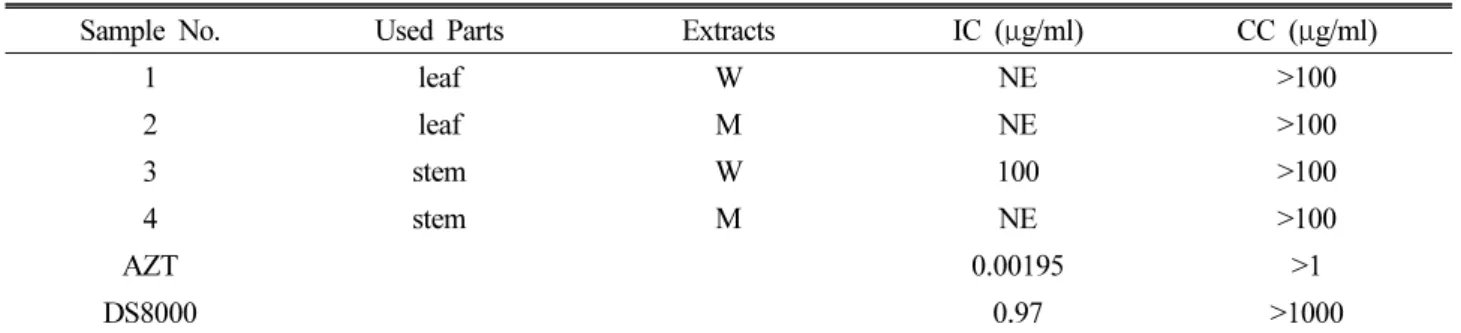
본 연구에서는 능소화 추출물의 HIV-1 억제활성을 실 험하였고, 그 결과 능소화 잎, 줄기의 MeOH 추출물은 역 전사 효소 억제 활성이 낮거나 거의 없었으며, 능소화 줄기 의 물 추출물에서 100 ㎍/㎖ 농도에서 37.9%의 HIV 역전 사 효소 억제 활성을 나타내었다(Fig. 2). 그리고 재조합 HIV-1 프로테아제 억제활성 실험에서는 능소화 잎과 줄기 메탄올 추출물이 100 ㎍/㎖의 농도에서 각각 33.6%와 31.5%의 억제 활성이 관찰되었다(Fig. 3). 능소화 잎과 줄 기의 물 추출물에서는 글루코시다제 억제 활성을 나타내지 않았지만 줄기의 메탄올 추출물에서는 10.5%의 경미한 억 제활성을 나타내었다(Fig. 4). 능소화 추출물의 HIV-1 바 이러스 증식을 완전히 억제하는 최소농도는 줄기의 물 추 출물이 100 ㎍/㎖로 나타났으며, 줄기의 메탄올 추출물, 잎의 물 및 메탄올 추출물에서는 활성이 관찰되지 않았다 (Table 1). 또한, 능소화 추출물을 농도별로 처리하여 배양 하였을 때 세포독성을 나타내는 최소농도는 모든 추출물에 서 100 ㎍/㎖ 이상으로 나타나 세포독성을 거의 일으키지 않음을 알 수 있었다(Table 1).
100 μg/ml
Inhibition rate (%)
0 20 40 60 80 100
Leaf (w ater ex.)
Leaf (Me OH ex.)
Stem (Water ex.)
Stem(M eOH e
x.) a
a
b b
Fig. 3. Inhibition rates of leaf methanol extracts of Campsis grandiflora on HIV-1 protease. The results are the mean
± S.E. from three replication. Different letters indicate a significant difference by Duncan’s multiple range test at p < 0.05. Water extracts were dissolved in distilled water, and methanol extracts were dissolved in DMSO or 10%
DMSO in water.
100 μg/ml
Inhibition rate (%)
0 20 40 60 80 100
Leaf (w ater ex.)
Leaf (M eOH ex.)
Stem(W ater ex.)
Stem (MeOH
ex.)
a a a
b
Fig. 4. Inhibition rates of stem methanol extracts of Campsis grandiflora on α-glucosidase. The results are the mean ± S.E. from three replication. Different letters indicate a significant difference by Duncan’s multiple range test at p < 0.05. Water extracts were dissolved in distilled water, and methanol extracts were dissolved in DMSO or 10%
DMSO in water.
Table 1. Inhibitory effects of extracts of Campsis grandiflora against HIV-1 viral replication
Sample No. Used Parts Extracts IC (μg/ml) CC (μg/ml)
1 leaf W NE >100
2 leaf M NE >100
3 stem W 100 >100
4 stem M NE >100
AZT 0.00195 >1
DS8000 0.97 >1000
W, water extract; M, methanol extract. Water extracts were dissolved in distilled water, and methanol extracts were dissolved in DMSO or 10% DMSO in water. IC, the minimum concentration for complete inhibition of HIV-1 induced CPE(cytopathic effect) in MT-4 cells by microscopic observation. CC, the minimum concentration for appearance of MT-4 cell toxicity by microscopic observation.
NE, not effective.
이상의 결과로 보아 능소화 줄기의 물 추출물이 높은 항 역전사효소 활성을 가짐과 동시에 바이러스의 복제억제에 도 기여하는 것을 알 수 있었으며 이는 능소화의 HIV-1 복 제 억제활성이 역전사효소 억제와 상관관계가 있는 것으로 추정된다. 또한 잎과 줄기의 메탄올 추출물은 유전자 재조 합 HIV-1 protease 억제활성에서도 높은 활성을 나타냄 으로써 바이러스 복제 억제에 일부 기여하는 것으로 추정
된다. 반면 거의 모든 추출물에서는 글루코시다제 억제활 성에서는 유의한 활성을 보이지 않았다. 줄기의 물 추출물 에서 효소억제나 바이러스 복제억제에 활성을 나타내는 것 은 식물 중 고분자 활성 물질인 tannin, polysaccharide, protein 등이 물 추출물에 다량 함유되어 있어 효소결합능 력이 탁월하고, 바이러스 표면의 당단백에 결합이 용이하 므로 강한 활성을 보이는 것으로 추정된다 (Kakiuchi et
al., 1985, Batinic and Robey, 1992). 또한 능소화 엑스 의 활성요인은 다양한 복합분자들이 분포되어 있어 효소 억제 작용, virus-cell 융합 억제(Balzarini et al., 1992;
Mayaux et al., 1994), 감염된 세포로부터 virus분자의 방출억제(Rossmann, 1988) 등에도 관여하는 것으로 생각 되어 진다. 능소화 추출물의 HIV-1활성에 관여하는 화합 물 탐색을 위하여 active guided fractionation을 실시하 고 있으며, 향후 NMR등 분광학적 방법을 통해 활성화합물 의 구조를 동정할 것이다.
적 요
능소화 추출물의 HIV-1에 대한 항바이러스 효과를 복 제 관련 효소에 대한 억제실험과 바이러스 복제억제 실험 을 통하여 살펴보았다. 역전사효소 억제활성을 ELOSA 방 법으로 실험한 결과 능소화 줄기의 물 추출물이 100 ㎍/㎖
농도에서 각각 37.9%의 활성을 나타내었고, 능소화 잎과 줄기의 메탄올 추출물에서 33.6% 및 31.5%의 HIV-1 pro- tease 억제활성 나타 내었다. 그리고 HIV-1 복제 억제활 성은 MT-4 세포에 대한 HIV-1 유도 세포변성억제를 광 학현미경으로 관찰하여 살펴본 결과 줄기의 물 추출물이 100 ㎍/㎖ 농도에서 HIV-1 바이러스 증식을 완전히 억제 하였다.
인용문헌
Balzarini. J., J. Neyts., D. Schols., M. Hosoya., E. Van Damme., W. Peumans and E. De clercq. 1992. The mannose-specific plants lectins from Cymvidium hybrid and Epipactis helleborine and the (N-acetylglucosamine) n-specific plant lectin from Urtica dioica are potent and selective inhibitors of human immunodeficiency virus and cytomegalovirus replication in vitro. Antiviral Res. 18:1 91-207.
Batinic. D. and R.A. Robey. 1992. The V3 region of the envelope glycoprotein of human immunodeficiency virus type 1 binds sulfated polysaccharides and CD4-derived synthetic peptides. J. Bio. Chem. 267:6664-6671.
Cui. X.Y., J.H. Kim., X. Zhao., B.Q. Chen., B.C. Lee., H.B.
Pyo., Y.P. Yun and Y.H. Zhang. 2006. Antioxidative and acute anti-inflammatory effects of Campsis grandiflora flower. J. Ethnopharmacol. 103(2):223-228.
Jin. JL., S. Lee., Y.Y. Lee., J.E. Heo., J.M. Kim and H.S.
Yun-Choi. 2005. Two new non-glycosidic iridoids from the leaves of Campsis grandiflora. Planta Med. 71(6):
578-580.
Jin. J.L., Y.Y. Lee., J.E. Heo., S. Lee., J.M. Kim and H.S.
Yun-Choi. 2004. Anti-platelet pentacyclic triterpenoids from leaves of Campsis grandiflora. Arch. Pharm. Res.
27(4): 376-380.
Jung. S.H., Y.J. Ha., E.K. Shim., S.Y. Choi., J.L. Jin., H.S.
Yun-Choi and J.R. Lee. 2007. Insulin-mimetic and insulin -sensitizing activites of a pentacyclic triterpenoid insulin receptor activator. Biochem. J. 403(2):243-250.
Kakiuchi. N., M. Hattori and T. Namba. 1985. Inhibitory effect of tannins on reverse transcriptase from RNA tumor virus. J. Nat. Prod. 48(4):614-621.
Kaminchik. J., R. Margalit., S. Yaish., H. Drummer., B.
Amit., N. Saver., M. Gorecki and A. Panet. 1994. Cellular distribution of HIV type Ⅰ nef protein: Identification of domains in nef required for association with membrane and detergent-insoluble cellular matrix. Aids Res. and Human Retrovir. 10:1003-1010.
Katz. R.A. and A.M. Skalka. 1994. The retroviral enzymes.
Annu. Rev. Biochem. 63: 133-173.
Kim. D.H., K.M. Han., I.S. Chung., S.H. Kim., B.M.
Kwon., T.S. Jeong., M.H. Park., E.M. Ahn and N.I.
Beaek. 2005. Triterpenoids from the flower of Campsis grandiflora K. Schum. as human acly-COA: chlesterrol.
Arch. Pharm. Res. 28(5):550-556.
Kim. D.H., M.C. Song., K.M. Han., M.H. Bang., B.M.
Kwon., S.H. Kim., D.K. Kim., I.S. Chung., M.H. Park and N.I. Baek. 2004. Development of biologically active compounds from edible plant sources-X isolation of lipids from the flower of Campsis grandiflora K. Schum. and their inhibitory effect on FPTase. J. Korean Soc. Appl.
Biol. Chem. 47(3):357-360.
Kusumoto. I.T., T. Nakabayashi., H. Kida., H. Miyashiro., M. Hattori., T. Namba and K. Shimotohno. 1995.
Screening of various plant extracts used in ayurvedic medicine for inhibitory effects on human immunodeficiency virus type 1 (HIV-1) protease. Phytotherpy Res. 9:180-184.
Mayaux. J.F., A. Bousseau., R. Pauwels., T. Huet., Y.
Henin., N. Dereu., M. Evers., F. Soler., C. Poujade., E.
De Clercq and J.B. Le Pecq. 1994. Triterpene derivatives that block entry of human immunodeficiency virus type 1 into cells. Proc. Natl. Acad. Sci. 91:3564-3568.
Mohan. P. 1992. Anti-AIDS drug development: challenges and strategies. Pharmaceutical Res. 9 (6):703-714.
Nakashima. H., T. Murakami., N. Yamamoto., H. Sakagami., S. Tanuma., T. Hatano., T. Yoshida and T. Okuda. 1992.
Inhibition of human immunodeficiency viral replication by tannins and related compounds. Antiviral Res. 18:91 -103.
Otake. T., H. Mori., M. Morimoto., N. Ueba and I..T. Kusumoto.
1994. Anti-human immunodeficiency virus activity of some tropical medicinal plants. J. Traditional Med. 11:
188-193.
Peliska. J.A. and S. J. Benkovic. 1992. Mechanism of DNA strand transfer reactions catalyzed by HIV-1 reverse tran- scriptase. Science 258:1112-1118.
Prasad. V.R. and S.P. Goff. 1989. Linker insertion mut- agenesis of human immunodeficiency virus reverse tran- scriptase expressed in bacteria: definition of the minimal polymerase domain. Proc. Natl. Acad. Sci. 86:3104-3108.
Prusoff. W., T.S. Lin., A. Pivazyan., A.S. Sun and E. Birks.
1993. Empirical and rational approaches for development of inhibitors of the human immunodeficiency virus--HIV -1. Pharmacol. Ther. 60(2):315-329.
Rossmann. M.G. 1988. Antiviral agents targeted to interact with viral capsid proteins and a possible application to human immunodeficiency virus. Proc. Natl. Acad. Sci.
85:4625-4627.
Taraporewala. I.B., J.W. Cessac., T.C. Chanh., A.V. Delgado and R.F. Schinazi. 1992. HIV-1 neutralization and tumor
cell proliferation inhibition in vitro by simplified analogues of pyrido[4,3,2-mn]thiazolo[5,4-b]acridine marine alkaloids.
J. Med. Chem. 35(15):2744-2752.
Taylor. D.L., M.S. Kang., T.M. Brennan., C.G. Bridges., P.S. Sunkara and A.S. Tyms. 1994. Inhibition of α -glucosidase I of the glycoprotein-processing enzymes by 6-O-butanoyl castanospermine (MDL 28,574) and its consequences in human immunodeficiency virus-infected T cells. Antimicrobacterial Agents and Chemother. 38(8):
1780-1787.
Weber. P.C., D.H. Ohlendorf., J.J. Wendoloski and F.R.
Salemme. 1989. Structural origins of high-affinity biotin binding to streptavidin. Science 243: 85-88.
Yang. S.S., G.M. Cragg., D.J. Newman and J.P. Bader.
2001. Natural product-based anti-HIV drug discovery and development facilitated by the NCI developmental thera- peutics program. J. Nat. Prod. 64(2):265-277.
Yu. Y.B., H. Miyashiro., N. Nakamura., M. Hattori and J.C.
Park. 2007. Effects of triterpenoids and flavonoids isolated from Alnus firma on HIV-1 viral enzymes. Arch.
Pharm. Res. 30(7):820-826.
Zhang. Q., J. Shen., Y. Liu., Y. Bi., Z. Wang and W. Xiao.
2011. Simultaneous determination of acteoside, oleanolic acid and ursolic acid in flower of Campsis grandiflora by HPLC. Zhongguo Zhong Yao Za Zhi 36(8):1043-1045.
(접수일 2012.1.5; 수정일 2012.1.19; 채택일 2012.2.10)