• 검색 결과가 없습니다.

Pak1/LIMK1/Cofilin Pathway Contributes to Tumor Migration and Invasion in Human Non-Small Cell Lung Carcinomas and Cell Lines

N/A
N/A
Protected

Academic year: 2022

Share "Pak1/LIMK1/Cofilin Pathway Contributes to Tumor Migration and Invasion in Human Non-Small Cell Lung Carcinomas and Cell Lines"

Copied!
7
0
0

로드 중.... (전체 텍스트 보기)

전체 글

(1)

159 http://dx.doi.org/10.4196/kjpp.2012.16.3.159

ABBREVIATIONS: SCC, squamous cell carcinoma; AC, adenocarci- noma; NSCLC, non small cell lung carcinoma; Pak, p21-associated kinase; LIMK, p-Lin-11/Isl-1/Mec-3 kinase.

Received December 15, 2011, Revised April 20, 2012, Accepted May 12, 2012

Corresponding to: Gu Seob Roh, Department of Anatomy, Gyeongsang National University School of Medicine, 816, Beongil 15, Jinju-daero, Jinju 660-290, Korea. (Tel) 82-55-772-8035, (Fax) 82-55-772-8039, (E-mail) [email protected]

This is an Open Access article distributed under the terms of the Creative Commons Attribution Non-Commercial License (http://

creativecommons.org/licenses/by-nc/3.0) which permits unrestricted non-commercial use, distribution, and reproduction in any medium, provided the original work is properly cited.

Pak1/LIMK1/Cofilin Pathway Contributes to Tumor Migration and Invasion in Human Non-Small Cell Lung Carcinomas and Cell Lines

Inseok Jang

2

, Byeong Tak Jeon

1

, Eun Ae Jeong

1

, Eun-Jin Kim

3

, Dawon Kang

3

, Jong Sil Lee

4

, Baek Geun Jeong

5

, Jin Hyun Kim

6

, Bong Hoi Choi

6

, Jung Eun Lee

2

, Jong Woo Kim

2

, Jun Young Choi

2

, and Gu Seob Roh

1

1

Department of Anatomy,

2

Department of Thoracic and Cardiovascular Surgery,

3

Department of Physiology,

4

Department of Pathology,

5

Department of Preventive Medicine, Institute of Health Sciences, Gyeongsang National University School of Medicine, and

6

Clinical Research Institute, Gyeongsang National University Hospital, Jinju 660-290, Korea

Squamous cell carcinoma (SCC) and adenocarcinoma (AC) are the major histological types of non-small cell lung carcinoma (NSCLC). Although both SCCs and ACs have been characterized histologically and clinically, the precise mechanisms underlying their migration and invasion are not yet known. Here, we address the involvement in NSCLC of the p21-associated kinase1 (Pak1)/LIM kinase1 (LIMK1)/cofilin pathway, which recently has been reported to play a critical role in tumor migration and invasion. The Pak1/LIMK1/cofilin pathway was evaluated in tumors from SCC (n=35) and AC (n=35) patients and in SCC- and AC-type cell lines by western blotting, immunohistochemistry, and in vitro migration and invasion assays. The levels of phosphorylated Pak1, LIMK1, and cofilin in lung tumor tissues from SCC patients were increased as compared to normal tissues. In addition, immunohistochemistry showed greater expression of phosphorylated cofilin in SCC tissues. Expression of phosphorylated Pak1 and LIMK1 proteins was also significantly higher in SCC-type cells than in AC-type cells. Moreover, migration and invasion assays revealed that a higher percentage of SCC type cells exhibited migration and invasion compared to AC type cells. Migration was also decreased in LIMK1 knockdown SK-MES-1 cells. These findings suggest that the activation of the Pak1/LIMK1/

cofilin pathway could preferentially contribute to greater tumor migration and invasion in SCC, relative to that in AC.

Key Words: Pak1, LIMK1, Cofilin, Lung cancer

INTRODUCTION

Non-small cell lung cancer (NSCLC) is the leading cause of cancer-related mortality worldwide. Early stage NSCLC can be cured surgically, but despite the potential benefits of surgical resection, patients with the same pathologic stage of disease display marked variability in recurrence and sur- vival [1]. Squamous cell carcinoma (SCC) and adenocarci- noma (AC), the principal subtypes of NSCLC, exhibit differ- ent geographical prevalence, clinical behaviors, and re- currence patterns. Tumor invasion and metastasis predict a poor prognosis in lung cancer, and are the main causes of treatment failure and lung cancer-related death [2].

Tumor cell migration is important in the formation of sol- id tumors and necessary for the spread of cells to distant organs [3]. The process of cancer migration and invasion involves changes in cytoskeletal signaling pathways, in- creased directional motility, and enhanced cell survival.

Thus, the actin cytoskeleton is an important determinant of tumor cell migration and invasion [4]. It has been re- ported that p21-associated kinases (Paks) play an evolutio- narily conserved role in regulating the actin cytoskeleton during cell motility and invasion [5]. An increase in Pak protein levels has been observed in several human tumors [6]. Among the identified targets of Pak are p-Lin-11/Isl-1/

Mec-3 kinase (LIMK), myosin light chain, and cofilin [7-9].

The phosphorylation of both LIMK and cofilin is greatly

enhanced in the presence of active Pak [10]. Furthermore,

the level and activity of LIMK are higher in invasive breast

and prostatic cancer cell lines than in less invasive cells

[11]. Cofilin, which is the only known substrate for LIMK1,

regulates the actin cytoskeleton [12]. Suppression of cofilin

activity by LIMK overexpression abolishes lamellipodium

formation and polarized cell migration [13]. In contrast,

(2)

Table 1. Patient characteristics

Characteristics SCC AC p value

Numbers of patients 35 35

Age (y) 63.9±6.0 62.3±10.0 0.444

Gender 0.484

Male 27 (77%) 29 (83%)

Female 8 (23%) 6 (17%)

Stage 0.059

I 16 (46%) 21 (60%)

II 14 (40%) 14 (40%)

III 5 (14%) 0 (0%)

T stage 0.227

T1 16 (46%) 22 (63%)

T2 17 (48%) 10 (28%)

T3 2 (6%) 3 (9%)

Lymph node 0.044

Positive 16 (46%) 8 (23%)

Negative 19 (54%) 27 (77%)

Smoking 29 (83%) 23 (66%) 0.101

Smoking pack years 45.7±25.8 25.0±9.4 0.000 overexpression of cofilin inhibits the invasiveness of human lung cancer H1229 cells by disrupting the actin cytoskele- ton at the leading edge of the cell [14]. Therefore, it is likely that the expression status of the Pak1/LIMK1/cofilin path- way is sufficient to determine the migratory and invasive properties of lung tumor cells.

In the present study, we examined altered expressions of Pak1, LIMK1, and cofilin proteins in SCC and AC cell types of human lung cancers and cell lines. In addition, we investigated the migratory and invasive activity in SCC- and AC-type cell lines.

METHODS Patients and tissue samples

All patients were referred to the Gyeongsang National University Hospital (Jinju, South Korea) and underwent surgery, conducted by the same surgeon (Jang I), between May 2005 and July 2009. Tumor samples from a total of 70 patients with SCC (n=35) and AC (n=35) were collected intraoperatively, snap-frozen, and stored at -80

o

C. Diag- noses were based on a pathological examination of tissue samples. The characteristics of the patients and tumor sam- ples are detailed in Table 1. Patients ranged in age from 31 to 77 y; 14 were female, and 56 were male. For western blot analysis, tumor tissue and adjacent normal lung tissue were collected from SCC and AC samples. All uses of hu- man tissue samples and experimental procedures described in this study were reviewed and approved by the Ethics Committee of Gyeongsang National University Hospital.

Cell culture

Four human lung cancer cell lines HCC-1588 (SCC), HCC-1171 (AC), SK-MES-1 (SCC), and A549 (AC) were used in this study. HCC-1588 and HCC-1171 were pur- chased from the Korean Cell Line Bank (Seoul, South Korea). SK-MES-1 and A549 were purchased from the

American Type Culture Collection (Manassas, VA, USA).

SK-MES-1 cells were maintained in Eagle’s minimal essen- tial medium (EMEM), and HCC-1588, HCC-1171, and A549 cells in Dulbecco’s modified Eagle’s medium (DMEM), sup- plemented with 5∼10% fetal bovine serum (FBS), pen- icillin, and streptomycin (Sigma, St. Louis, MO, USA).

Inhibition of LIMK1 by siRNA transfection into SK- MES-1 and A549 cells

LIMK1 siRNA and control siRNA were purchased from Santa Cruz Biotechnology (CA, USA). To determine the ef- fectiveness of the LIMK1 siRNA, SK-MES-1 and A549 cells were transfected using Lipofectamine 2,000 (Invitrogen, CA, USA). After transfection, the cells were used for Western blot and migration assay. LIMK1 levels were determined with an antiLIMK1 antibody. Migration assay were per- formed after a similar transfection with LIMK1 siRNA or control siRNA.

Antibodies

The following primary antibodies were used in this study.

Rabbit anti-phospho (p)-Pak1 (ser144, 68∼74 kDa), rabbit anti-Pak1 (68 kDa), rabbit anti-p-LIMK1 (72 kDa), and rab- bit anti-LIMK1 (70 kDa) were obtained from Cell Signaling Technology; rabbit anti-p-cofilin (19∼21 kDa) and goat an- ti-cofilin (19 kDa) were obtained from Santa Cruz Biotech- nology (Santa Cruz, CA, USA).

Migration (wound-healing) assay

For two-dimension migration assays, cells were seeded at a density of 1×10

5

cells/well in a 6-well culture dish. After the cultures reached confluence, a 600-μm wide scratch in the monolayer was produced with the tip of a sterile plastic pipette. Cell monolayers were washed with phosphate-buf- fered saline (PBS) and then incubated in fresh medium, and photomicrographs were taken at specific time points during incubation. Relative cell migration distance (wound closure) was determined by measuring the wound width, observed microscopically (Axiovert 40C, Carl Zeiss MicroImaging, Göttingen, Germany), and subtracting this value from the initial wound width at 0 h. The data acquired from three scratches in each well were converted to percentage of wound closure.

Transwell migration assay

Three-dimension cell migration was assayed on poly- carbonate membrane inserts (8-μm pore size) using the CytoSelect

TM

Cell Migration Assay Kit (Cell Biolabs, Inc., CA, USA), according to the manufacturer’s instructions. In brief, a cell suspension containing 0.5×10

5

cells/ml in se- rum-free medium was added to the upper chamber of each insert. The lower chamber contained medium with 10%

FBS (which acts as a chemotactic stimulus). The cultures were incubated for 6 h at 37

o

C in a humidified 5% CO

2

/95%

air environment to allow cell migration through the mem- branes, toward the lower face of the transwell inserts.

Nonmigrating cells on the inner side of the inserts were gently removed with a cotton-tipped swab. Cells that had migrated to the bottom surface were stained with 0.5%

crystal violet for 10 min at room temperature. Photomicro-

graphs were taken (Axiovert 40C microscope) of five in-

(3)

dividual fields per insert, the cells that had migrated were enumerated, and the number of migratory cells per well was calculated. The stained insert was washed thoroughly and stained adherent cells were removed by incubation for 10 min in extraction solution (1% Triton X-100). The ex- tracted cell samples were transferred to a 96-well microtiter plate and the absorbance at 560 nm was measured in a plate reader (Infinite

F200, Tecan, Männedorf, Switzer- land).

Invasion assay

The invasiveness of SK-MES-1 and A549 cells was tested using the quantitative CytoSelectTM 96-well Cell Invasion Assay (Cell Biolabs), according to the manufacturer’s instructions. The experimental apparatus and assay proto- col are fundamentally similar to those used for the trans- well migration assay. In brief, SK-MES-1 and A549 cells, suspended in serum-free medium at a density of 0.5×10

5

cells/ml, were seeded onto the culture inserts, which had been coated with a uniform layer of dried basement mem- brane matrix solution. The cells were allowed to invade the basement membrane layer for 24 h. After removing the non-invasive cells on the upper surface of the membrane by swabbing, the cells that invaded through the membrane were stained with 0.5% crystal violet, then viewed micro- scopically and counted. Invasiveness was quantitatively ex- pressed as the average number of cells that had invaded.

Western blot analysis

For protein extraction from tissue, frozen lung tissues were transferred to sterile 1.5 ml-microcentrifuge tubes, each containing 200 μl of lysis buffer (15 mM 4-[2-hydro- xyethyl]-1-piperazineethanesulfonic acid [HEPES] pH 7.9, 0.25 M sucrose, 60 mM KCl, 10 mM NaCl, 1 mM ethylene glycol tetraacetic acid, 1 mM phenyl methyl sulfonyl fluo- ride, and 2 mM NaF). Homogenized tissues were incubated for 10 min on ice and then disrupted by sonication. The disrupted samples were clarified by centrifugation at 14,240×g for 30 min at 4

o

C, and then the supernatants were transferred to clean vials. For protein extraction from cells, the cells were washed twice with PBS and then lysed in lysis buffer. The samples were stored at -80

o

C until analysis. Protein concentrations in tissue extracts and cell lysates were measured using the Bio-Rad Protein Assay (Bio-Rad, USA). For western blots, lung lysates (30 μg per lane) were separated by sodium dodecyl sulfate-polyacryla- mide gel electrophoresis and electrophoretically transferred onto a polyvinylidene difluoride membrane (Millipore, MA, USA). The membranes were probed with each antibody (diluted 1:1000), and the bound antibody was visualized using an enhanced chemiluminescence substrate (Pierce, Rockford, IL, USA). The membrane was reprobed with an antibody against β-actin as a control for equivalent protein loading.

Immunohistochemistry

For immunohistochemical analysis, paraffin-embedded lung tissues were cut into 5-μm sections that were then placed on gelatin-coated slides. Sections were deparaffi- nized, rehydrated with graded alcohol solutions, and then processed using the avidin-biotin immunoperoxidase method. In brief, sections on the slides were incubated with

rabbit anti-p-cofilin antibody (diluted 1:500; Santa Cruz Biotechnology) overnight at 4

o

C. After incubation, sections were washed three times with 0.1 M PBS, and then in- cubated with secondary biotinylated antibodies (1:200) for 1 h at room temperature. After three additional washes with 0.1 M PBS, sections were incubated with avidin-bio- tin-peroxidase complex solution (ABC solution, Vector Labo- ratories, CA, USA), and then developed in a solution of 0.05% diaminobenzidine (Sigma) containing 0.05% H

2

O

2

. The sections were counterstained with hematoxylin, dehy- drated through graded alcohols, cleared in xylene, and then mounted on coverslips with Permount (Sigma). The sections were visualized by magnification with a BX51 light micro- scope (Olympus, Tokyo, Japan), and digital images were captured and documented.

Statistics

Differences between measurements of SCC and AC tumor tissues or cell lines were determined using two-tailed Student t-tests. Values are expressed as the mean±stand- ard error of the mean (SEM). The relationships of stage, T stage, relapse, death, and smoking in the cases of SCC and AC were analyzed by Fisher’s exact test. The lymph node and pack-years were compared using the χ

2

- and t-tests, respectively. A p-value<0.05 was considered stat- istically significant.

RESULTS Patient characteristics

The clinicopathological characteristics of the 70 patients who underwent surgery for SCC or AC are summarized in Table 1. The SCC type is most commonly found in men (77%), and it is closely correlated with a smoking history (83%). Of these, 46% (n=16) and 23% (n=8) of SCC or AC patients had lymph node-positive tumors, respectively.

Expression of Pak1 and LIMK1 phosphorylation in human lung tissues and cell lines of SCC and AC To evaluate the phosphorylated proteins of Pak1 and LIMK1, protein extracts of representative tissue samples from matched pairs (tumor and adjacent normal tissue) of surgically resected SCC and AD lungs were examined (Fig.

1A). All tumor samples from SCC were found to have in-

creased expression of p-Pak1 and p-LIMK1 proteins com-

pared with samples of the corresponding adjacent normal

lung tissue (Fig. 1A). In addition, there was increased ex-

pression of both total Pak1 and LIMK1 in tumor tissues

compared with normal tissues. In the tumor samples from

AC, western blot analyses revealed p-Pak1 was not ex-

pressed in AC tumor tissues except in one sample. Total

Pak1 and LIMK1 protein levels were highly increased in

AC tissues compared with normal tissues. These findings

showed that Pak1/LIMK1 signaling pathway is not domi-

nant in AC as compared to SCC. In parallel with studies

on human lung cancer tissues, we evaluated the expression

of Pak1 and LIMK1 proteins in corresponding SCC

(HCC1588 and SK-MES-1)- and AC (HCC1711 and A549)-

type cell lines by western blot analysis (Fig. 1B). Consistent

with results from human lung tissues, SCC type cells were

found to have increased expression of p-Pak1 and total

(4)

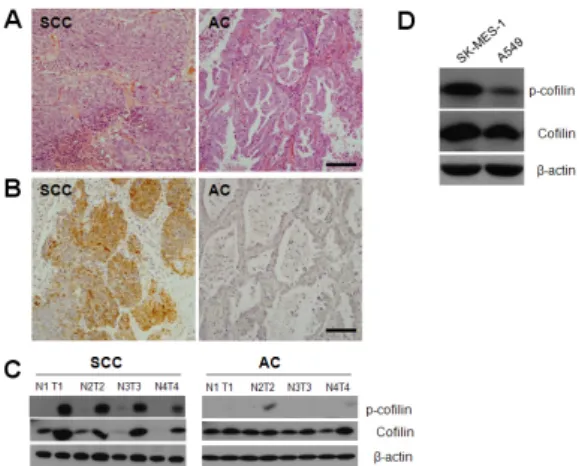
Fig. 2. Expression of cofilin phosphorylation in human lung tissues and cell lines. (A) Comparison of hematoxylin and eosin staining from lung sections of patients with SCC and AC. (B) Representative images of p-cofilin immunostaining in lung sections from patients with SCC and AC. Immunostaining is focal and predominantly detected in SCC lung tissue. (C) Western blot analysis from 4 representative pairs of normal human lung tissues (N) and tumors (T) from patients with SCC and AC. β-actin was used as a loading control. (D) Western blot analysis from SK-MES-1 and A549 cell lines. Scale bars=100 μm.

Fig. 1. Expression of Pak1 and LIMK1 phosphorylation in human lung tissues and cell lines. (A) Western blot analysis from 5 representative pairs of normal human lung tissues (N) and tumors (T) from patients with SCC and AC. (B) Western blot analysis from SCC (HCC1588 and SK-MES-1) and AC (HCC1171 and A549) cell lines. β-actin was used as a loading control. Samples were separated by electrophoresis on 10% (w/v) sodium dodecyl sulfate-polyacry- lamide gels, and transblotted proteins were probed with the respective antibodies. Arrows indicate 70 kDa.

Pak1 proteins compared with AC type cells. However, there was no significant difference of p-LIMK1 and total LIMK1 expression in between HCC1588 and HCC1711 (Fig. 1B).

Expression of cofilin phosphorylation in human lung tissues and cell lines of SCC and AC type

Fig. 2A depicts SCC lung tissues, showing squamous cell differentiation with keratinization features, and AC tis- sues, showing poorly differentiated adenoma features with gland-like structures. To observe localization of p-cofilin in lung sections of SCC and AC, we performed immunohisto- chemistry. Immunohistochemical staining revealed increa- sed p-cofilin immunoreactivity in sections of SCC lung tis- sues (Fig. 2B). Positive staining for p-cofilin was restricted almost exclusively to tumor cells in sections from SCC, and was localized in the cytoplasm; p-cofilin immunostaining was not detected in AC tissues. In addition to immunohis- tochemical study, we evaluated the expression of p-cofilin and total cofilin protein by western blot analysis (Fig. 2C).

All tumor samples from SCC were found to have increased expression of p-cofilin and total cofilin proteins compared with samples of the corresponding adjacent normal lung tis- sue (Fig. 2C). However, p-cofilin was not expressed in AC tumor tissues except in one sample and there was no differ- ence of total cofilin expression in between normal and ACC tissues. Consistent with results from human lung tissues, SK-MES-1 cells were found to have increased expression of p-cofilin protein compared with A549 cells (Fig. 2D).

Migration is enhanced in SK-MES-1 cells compared to A549 cells

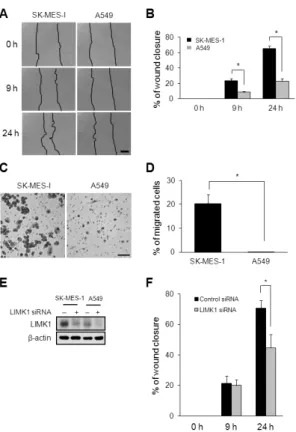
To investigate possible differences in cell migration be- tween SCC and AC cell types, we used wound-healing and transwell migration assays (Fig. 3). As shown in Fig. 3A and B, wound closure at 24 h was significantly (p<0.05)

more robust in SK-MES-1 cells (65.5±8.6%) than in A549 cells (22.8±9.3%). Because wound healing is a complex proc- ess involving many cellular activities, including cell migra- tion and proliferation, we also performed a three-dimen- sional migration assay to confirm the greater migratory ca- pacity of SK-MES-1 cells (Fig. 3C, D). Using a transwell assay to monitor cell migration towards a chemotactic stim- ulus (10% FBS), as described in Methods, we found that the percentage of cells that migrated was significantly high- er for SK-MES-1 cells (20.3±6.6%) than for A549 cells (0.06±

0.02%). The migration of SK-MES-1 cells also increased by approximately 20% compared to that of A549 cells (Fig. 3D).

To better assess the mechanism by which Pak1/LIMK1/co- filin pathway contributes to cell migration, we examined the effect of knocking down LIMK1 expression on cell migration. SK-MES-1 or A549 cells were transfected with LIMK1 siRNA or control siRNA. The LIMK1 siRNA sub- stantially reduced the expression of LIMK1 in both SK-MES-1 and A549 cells, whereas the control siRNA had no effect (Fig. 3E). As shown in Fig. 1B, there was increased expression of LIMK1 in SK-MES-1 cells compared with A549 cells. Also, the LIMK1 siRNA, but not the control siRNA, dramatically decreased wound closure in SK-MES-1 cells (Fig. 3F).

Invasiveness is enhanced in SK-MES-1 cells compared to A549 cells

To investigate possible differences in cell invasion be-

tween SCC and AC cell types, we used a cell invasion assay

(Fig. 4). Many more SCC cells (visualized by crystal violet

staining) invaded through the membrane than did AC cells

(Fig. 4A). The invasiveness of SK-MES-1 cells also was ap-

proximately 50% higher than that of A549 cells (Fig. 4B).

(5)

Fig. 3. Migration in SCC (SK-MES-1) and AC (A549) cell lines. (A) Migration of human lung cancer cells in a two-dimensional cell migration assay system. Phase-contrast images of wound areas 0, 9, and 24 h after wounding of SK-MES-1 and A549 monolayers.

(B) Wound-healing measurements are shown (percentages), where each bar is the mean±SEM of three independent experiments. (C) Migration of human lung cancer cells in a three-dimensional cell migration assay system. Representative microscopic images of migrating cells. (D) Migration measurements (percentages) are shown, where each bar represents the mean±SEM of four independent experiments. (E) Western blot analysis for LIMK1 from SK-MES-1 and A549 cells with LIMK1 siRNA or control siRNA. β-actin was used as a loading control. (F) Histogram shows that wound-healing was measured 0, 9, and 24 h after wounding of SK-MES-1 monolayers. Wound-healing measurements (percen- tages) are shown, where each bar is the mean±SEM of three in- dependent experiments. Asterisks indicate a significant difference from control siRNA-treated cells (p<0.05).

Fig. 4. Invasion in SCC-type (SK-MES-1) and AC-type (A549) cell lines. (A) Assay of SK-MES-1 and A549 cell invasiveness. The cells that invaded through to the bottom face of the membrane were stained for visualization. (B) Invasion measurements (percentages) are shown, where each bar represents the mean±SEM of three independent experiments. Asterisks indicate a significant diffe- rence from A549 cells (p<0.05). Scale bars=100 μm.

DISCUSSION

This is the first study showing that the Pak1/LIMK1/co- filin pathway is dominant in SCC compared to AC lung tu- mor tissues. These results were obtained from examination of lung tissue from SCC and AC patients, as well in SCC- and AC-type cell lines. In addition, migration and invasion were enhanced in SCC-type cells compared to AC type.

Paks are important regulators of the actin cytoskeleton and motility, and several studies have suggested that they are involved in cancer [15-17]. Pak1 gene amplication and increased Pak1 protein levels have been reported in ovar- ian, breast, and lung cancers [18-20]. Pak1 may also be in- volved in cancer cell survival and progression, leading to suggestions that Pak1 inhibitors may have potential as a novel oncologic therapy [6]. Ong et al. [20] demonstrated that antagonists of Pak1 or Pak1 knockdown with siRNA

oligonucleotides induces apoptosis of NSCLC cells and de- creases proliferation of tumor cells. Consistent with this ob- servation, exogenous expression of a Pak1 mutant with an inactivated kinase domain reduced the invasiveness of highly invasive breast cancer cells [21]. The increased p-Pak1 and total Pak1 protein levels in SCC tissue and SCC-type cells described here are in accord with results ob- tained from ovarian, breast, and lung tumors, reinforcing the view that Pak1 activity is associated with development of the SCC tumor type.

LIMK1 is upregulated in invasive carcinoma cells, and is the most abundant and dominant cofilin kinase in in- vasive carcinoma cells [11]. The level and activity of endog- enous LIMK1 are higher in invasive breast and prostate cancer cell lines than in less invasive cells. LIMK1 is phos- phorylated and activated by Pak1 [22]. The activation of LIMK1 represses cofilin activity and enhances cancer in- vasiveness [23]. As shown in Fig. 3, our results were con- sistent that the suppression of LIMK1 expression by small interfering RNA (siRNA) inhibited the motility of Jurkat cells, and the overexpression of LIMK1 increased the in- vasiveness of prostate epithelial cells in vitro [24]. However, there is some confusion about whether LIMK increases or decreases invasiveness. For example, other studies have re- ported that overexpression of LIMK suppresses motility in neuroblastoma, and dominant-negative LIMK increases motility [24]. Also, LIMK1-mediated increases in p-cofilin levels were shown to inhibit actin polymerization and mo- tility in mammary carcinoma cells in response to epidermal growth factor [25]. Our results are consistent with previous studies demonstrating that inhibition of LIMK1 expression by siRNA decreases tumor motility and invasion, and sug- gest that Pak1 activation might contribute to LIMK phos- phorylation in SCC.

Cofilin is well known to be important for cell motility by

enhancing actin dynamics at lamellopodia, a process that

is involved in cell invasion [26]. As for LIMK, however,

there is confusion about whether cofilin increases or de-

creases invasiveness. Cofilin is abundantly expressed in the

highly invasive C6 rat glioblastoma cell line and in human

(6)

pancreatic cancer cells [27,28]. A recent study demon- strated that NSCLC patients with high cofilin expression levels in tumors presented low overall survival rates [29].

However, other studies have found that cofilin is down- regulated in cancer and that overexpression antagonizes in- vasion [30]. Lee et al. [14] demonstrated that overexpres- sion of cofilin disrupts the actin cytoskeleton at the leading edge of the cell and decreases invasiveness of human H1299 cells. In MTLn3 cells, siRNA-mediated knockdown of cofilin results in cells that exhibit less directional change and higher migration velocities than control cells [31]. In the present study, we have found that Pak1/LIMK1-mediated phosphorylation of cofilin may be sufficient to determine migration and invasiveness of SCC cells, and thus confer oncogenic properties. However, it is unlikely that the ex- pression status of cofilin alone is sufficient to determine the motility and invasion tumor cells.

ACs have been reported to have strong migratory activity [32]. However, we have found that migration and invasion were enhanced in SKMES-1 cells compared to A549 cells.

The cancer cases in this study were preoperatively early stage SCC lung cancer patients with a higher percentage of lymph nodes. As shown in Table 1, AC patients had a lower percentage of lymph nodes. Our result is consistent with a recent study of ld1 expression, which belongs to the ld family of helix-loop-helix transcription factors, showing that Id1 is more highly upregulated in SCC compared to AC [33]. Expression of ld1 in NSCLS cells significantly in- creases tumor cell migration without affecting normal cell migration. In general, the rate of growth of an SCC-type tumor at its site of origin is usually more rapid than that of an ACC type [34]. It has been reported that the absolute levels of matrix metalloproteinase (MMP)-9 are increased in SCC, but not in AC, and subsequently it was suggested that the increased levels of MMP-9 correlate with a poor prognosis [35,36]. In addition, glypican-3, which is overex- pressed in lung carcinoma compared to normal lung, is more frequently detected in SCC than in AC [37,38]. In the present study, we observed 3 y after surgical resection that the recurrence or death associated with SCC tumors is higher than that with AC types. These data indicate that early stage SCC patients with higher percentage of lymph nodes may be prone to greater invasion and migration of their tumors compared to AC patients.

In the present study, we report for the first time that the Pak1/LIMK1/cofilin signaling pathway contributes to the migration and invasiveness of lung tumors, especially in SCC. Importantly, we found that the dominant Pak1/

LIMK1/cofilin signaling pathway in the SCC tumor type is correlated with higher frequencies of recurrence within 3 y after lung tumor resection at the early stage. Thus, this study supports the idea that a balance between the con- tribution of cofilin and upstream molecules in the cofilin pathway, including Pak1 and LIMK1, is required for migra- tion and invasiveness seen in tumor cells.

ACKNOWLEDGEMENTS

We thank Jeong Bin Kim for technical assistance. This research was supported by the Basic Science Research Program through the National Research Foundation (NRF) of Korea, funded by the Ministry of Education, Science and Technology (No. 2012-0000301), and it was partially sup- ported by a special clinical fund (2008) of the Gyeongsang

National University Hospital and the fund of the Research Promotion Program (RPP-2007-061) of Gyeongsang National University.

REFERENCES

1. Poleri C, Morero JL, Nieva B, Vázquez MF, Rodríguez C, de Titto E, Rosenberg M. Risk of recurrence in patients with surgically resected stage I non-small cell lung carcinoma:

histopathologic and immunohistochemical analysis. Chest.

2003;123:1858-1867.

2. Steeg PS. Metastasis suppressors alter the signal transduction of cancer cells. Nat Rev Cancer. 2003;3:55-63.

3. Stupack DG, Cho SY, Klemke RL. Molecular signaling mechanisms of cell migration and invasion. Immunol Res.

2000;21:83-88.

4. Ding Y, Milosavljevic T, Alahari SK. Nischarin inhibits LIM kinase to regulate cofilin phosphorylation and cell invasion.

Mol Cell Biol. 2008;28:3742-3756.

5. Bokoch GM. Biology of the p21-activated kinases. Annu Rev Biochem. 2003;72:743-781.

6. Kumar R, Gururaj AE, Barnes CJ. p21-activated kinases in cancer. Nat Rev Cancer. 2006;6:459-471.

7. Edwards DC, Sanders LC, Bokoch GM, Gill GN. Activation of LIM-kinase by Pak1 couples Rac/Cdc42 GTPase signalling to actin cytoskeletal dynamics. Nat Cell Biol. 1999;1:253-259.

8. Chew TL, Masaracchia RA, Goeckeler ZM, Wysolmerski RB.

Phosphorylation of non-muscle myosin II regulatory light chain by p21-activated kinase (gamma-PAK). J Muscle Res Cell Motil.

1998;19:839-854.

9. Vadlamudi RK, Kumar R. P21-activated kinases in human cancer. Cancer Metastasis Rev. 2003;22:385-393.

10. Daniels RH, Bokoch GM. p21-activated protein kinase: a crucial component of morphological signaling? Trends Biochem Sci.

1999;24:350-355.

11. Yoshioka K, Foletta V, Bernard O, Itoh K. A role for LIM kinase in cancer invasion. Proc Natl Acad Sci USA. 2003;100:7247- 7252.

12. Bamburg JR, McGough A, Ono S. Putting a new twist on actin:

ADF/cofilins modulate actin dynamics. Trends Cell Biol.

1999;9:364-370.

13. Zebda N, Bernard O, Bailly M, Welti S, Lawrence DS, Condeelis JS. Phosphorylation of ADF/cofilin abolishes EGF-induced actin nucleation at the leading edge and subsequent lamellipod extension. J Cell Biol. 2000;151:1119-1128.

14. Lee YJ, Mazzatti DJ, Yun Z, Keng PC. Inhibition of invasiveness of human lung cancer cell line H1299 by over-expression of cofilin. Cell Biol Int. 2005;29:877-883.

15. Sells MA, Chernoff J. Emerging from the Pak: the p21-activated protein kinase family. Trends Cell Biol. 1997;7:162-167.

16. Dummler B, Ohshiro K, Kumar R, Field J. Pak protein kinases and their role in cancer. Cancer Metastasis Rev. 2009;28:51-63.

17. Vadlamudi RK, Adam L, Wang RA, Mandal M, Nguyen D, Sahin A, Chernoff J, Hung MC, Kumar R. Regulatable expression of p21-activated kinase-1 promotes anchorage-inde- pendent growth and abnormal organization of mitotic spindles in human epithelial breast cancer cells. J Biol Chem. 2000;275:

36238-36244.

18. Schraml P, Schwerdtfeger G, Burkhalter F, Raggi A, Schmidt D, Ruffalo T, King W, Wilber K, Mihatsch MJ, Moch H.

Combined array comparative genomic hybridization and tissue microarray analysis suggest PAK1 at 11q13.5-q14 as a critical oncogene target in ovarian carcinoma. Am J Pathol. 2003;163:

985-992.

19. Balasenthil S, Sahin AA, Barnes CJ, Wang RA, Pestell RG, Vadlamudi RK, Kumar R. p21-activated kinase-1 signaling mediates cyclin D1 expression in mammary epithelial and cancer cells. J Biol Chem. 2004;279:1422-1428.

20. Ong CC, Jubb AM, Haverty PM, Zhou W, Tran V, Truong T,

Turley H, O’Brien T, Vucic D, Harris AL, Belvin M, Friedman

(7)

LS, Blackwood EM, Koeppen H, Hoeflich KP. Targeting p21-activated kinase 1 (PAK1) to induce apoptosis of tumor cells. Proc Natl Acad Sci USA. 2011;108:7177-7182.

21. Adam L, Vadlamudi R, Mandal M, Chernoff J, Kumar R.

Regulation of microfilament reorganization and invasiveness of breast cancer cells by kinase dead p21-activated kinase-1. J Biol Chem. 2000;275:12041-12050.

22. Maekawa M, Ishizaki T, Boku S, Watanabe N, Fujita A, Iwamatsu A, Obinata T, Ohashi K, Mizuno K, Narumiya S.

Signaling from Rho to the actin cytoskeleton through protein kinases ROCK and LIM-kinase. Science. 1999;285:895-898.

23. Ohashi K, Nagata K, Maekawa M, Ishizaki T, Narumiya S, Mizuno K. Rho-associated kinase ROCK activates LIM-kinase 1 by phosphorylation at threonine 508 within the activation loop. J Biol Chem. 2000;275:3577-3582.

24. Nishita M, Tomizawa C, Yamamoto M, Horita Y, Ohashi K, Mizuno K. Spatial and temporal regulation of cofilin activity by LIM kinase and Slingshot is critical for directional cell migration. J Cell Biol. 2005;171:349-359.

25. Zebda N, Bernard O, Bailly M, Welti S, Lawrence DS, Condeelis JS. Phosphorylation of ADF/cofilin abolishes EGF-induced actin nucleation at the leading edge and subsequent lamellipod extension. J Cell Biol. 2000;151:1119-1128.

26. DesMarais V, Macaluso F, Condeelis J, Bailly M. Synergistic interaction between the Arp2/3 complex and cofilin drives stimulated lamellipod extension. J Cell Sci. 2004;117:3499- 3510.

27. Sinha P, Hütter G, Köttgen E, Dietel M, Schadendorf D, Lage H. Increased expression of epidermal fatty acid binding protein, cofilin, and 14-3-3-sigma (stratifin) detected by two-dimensional gel electrophoresis, mass spectrometry and microsequencing of drug-resistant human adenocarcinoma of the pancreas. Electro- phoresis. 1999;20:2952-2960.

28. Gunnersen JM, Spirkoska V, Smith PE, Danks RA, Tan SS.

Growth and migration markers of rat C6 glioma cells identified by serial analysis of gene expression. Glia. 2000;32:146-154.

29. Castro MA, Dal-Pizzol F, Zdanov S, Soares M, Müller CB, Lopes FM, Zanotto-Filho A, da Cruz Fernandes M, Moreira JC, Shacter E, Klamt F. CFL1 expression levels as a prognostic

and drug resistance marker in nonsmall cell lung cancer.

Cancer. 2010;116:3645-3655.

30. Wang W, Eddy R, Condeelis J. The cofilin pathway in breast cancer invasion and metastasis. Nat Rev Cancer. 2007;7:429- 440.

31. Sidani M, Wessels D, Mouneimne G, Ghosh M, Goswami S, Sarmiento C, Wang W, Kuhl S, El-Sibai M, Backer JM, Eddy R, Soll D, Condeelis J. Cofilin determines the migration behavior and turning frequency of metastatic cancer cells. J Cell Biol. 2007;179:777-791.

32. Sagawa M, Saito Y, Takahashi S, Usuda K, Kamma K, Sato M, Ota S, Nagamoto N, Fujimura S, Nakada T, Hashimoto K, Suda H, Imai T, Saito H. Clinical and prognostic assessment of patients with resected small peripheral lung cancer lesions.

Cancer. 1990;66:2653-2657.

33. Bhattacharya R, Kowalski J, Larson AR, Brock M, Alani RM.

Id1 promotes tumor cell migration in nonsmall cell lung cancers. J Oncol. 2010;2010:856105.

34. Cotran RS, Kumar V, Robbins S. Robbins pathologic basis of disease. 4th ed. Philadelphia: W.B. Sanders Company; 1989.

797-804 p.

35. Shah SA, Spinale FG, Ikonomidis JS, Stroud RE, Chang EI, Reed CE. Differential matrix metalloproteinase levels in adenocarcinoma and squamous cell carcinoma of the lung. J Thorac Cardiovasc Surg. 2010;139:984-990.

36. Pinto CA, Carvalho PE, Antonângelo L, Garippo A, Da Silva AG, Soares F, Younes R, Beyruti R, Takagaki T, Saldiva P, Vollmer RT, Capelozzi VL. Morphometric evaluation of tumor matrix metalloproteinase 9 predicts survival after surgical resection of adenocarcinoma of the lung. Clin Cancer Res.

2003;9:3098-3104.

37. Peters MG, Farías E, Colombo L, Filmus J, Puricelli L, Bal de Kier Joffé E. Inhibition of invasion and metastasis by glypican-3 in a syngeneic breast cancer model. Breast Cancer Res Treat. 2003;80:221-232.

38. Aviel-Ronen S, Lau SK, Pintilie M, Lau D, Liu N, Tsao MS, Jothy S. Glypican-3 is overexpressed in lung squamous cell carcinoma, but not in adenocarcinoma. Mod Pathol. 2008;21:

817-825.

수치

Table 1.  Patient characteristics Characteristics SCC AC p value Numbers of patients 35 35 Age (y) 63.9±6.0  62.3±10.0 0.444 Gender 0.484  Male 27 (77%) 29 (83%)  Female  8 (23%)  6 (17%) Stage 0.059  I 16 (46%) 21 (60%)  II 14 (40%) 14 (40%)  III  5 (14%)
Fig. 2. Expression of cofilin phosphorylation in human lung tissues  and cell lines. (A) Comparison of hematoxylin and eosin staining  from lung sections of patients with SCC and AC
Fig. 4. Invasion in SCC-type (SK-MES-1) and AC-type (A549) cell  lines. (A) Assay of SK-MES-1 and A549 cell invasiveness

참조

관련 문서

Micro- and nano-sized pores were formed on the surface of the alloy using PEO and anodization methods, and the pore shape change according to the Zr

The expression levels of apoptotic related proteins and caspase dependent proteins by the ostreolysin purified from P.ostreatus on cell viability in FaDu human

In this study, the expression profiles of miRNAs were compared and analyzed for establishment of miRNAs related cancer cell growth inhibition in normal human oral

Concentration-Dependent inhibition of cell viability by adenosine in human oral fibroblast and FaDu human head and neck squamous cell carcinoma · · ·

Differential Expression of Desmoglein1, Desmoglein3, Epithelial Membrane Antigen, Ber-EP4 and CD10 in Basal Cell Carcinoma and Squamous Cell Carcinoma

1) Effects of methanol extracts of Capsella bursa-pastoris on cyclooxygenase-2 (COX-2) and Inducible Nitric oxide synthase (iNOS) expression in human prostate cancer cell

Inhibitory effects of classified methanol extracts of Smilax china L on the COX-2 and iNOS expression of human colorectal cancer cell lines... Inhibitory

Activated H-Ras expression in human fibroblast cell lines increases the activity of Ku80 to bind injuried DNA, reduces γ-H2AX expression by UV irradiation,