INTRODUCTION
Postoperative nausea and vomiting (PONV) is a common and unpleasant experience for surgical patients undergoing general
anesthesia.1,2 The incidence of PONV is approximately 20–30%, although it can be as high as 80% in patients with risk factors.1 PONV may result in adverse events such as prolongation of the recovery period, delay of discharge, and postsurgical complica- tions, and as such, it should be prevented by adequate man- agement.3,4
Selective 5-hydroxytryptamine type 3 (5-HT3) receptor an- tagonists have been widely researched and are currently used as the primary therapy for PONV prevention, as they have few- er side-effects such as sedation or extrapyramidal symptoms than other antiemetics.5-7 Although 5-HT3 receptor antago- nists have significantly reduced PONV, it is reported that over 35% of patients treated with ondansetron experience PONV.3 One reason for this unsatisfactory response may be individual differences in the biotransformation and disposition of 5-HT3
Association of 5-HT3B Receptor Gene Polymorphisms with the Efficacy of Ondansetron for Postoperative
Nausea and Vomiting
Min-Soo Kim1, Jeong-Rim Lee1, Eun-Mi Choi2, Eun Ho Kim1, and Seung Ho Choi1
1Department of Anesthesiology and Pain Medicine, Anesthesia and Pain Research Institute, Yonsei University College of Medicine, Seoul;
2Department of Anesthesiology and Pain Medicine, Kangnam Sacred Heart Hospital, Hallym University College of Medicine, Seoul, Korea.
Purpose: Postoperative nausea and vomiting (PONV) is a common problem after general anesthesia. Although 5-hydroxytrypta- mine type 3 (5-HT3) receptor antagonists have significantly reduced PONV, over 35% of patients treated with ondansetron can experience PONV. In this study, we investigated whether the Y129S and -100_-102AAG deletion polymorphisms of the 5-HT3B receptor gene affect the efficacy of ondansetron in preventing PONV.
Materials and Methods: Two hundred and forty-five adult patients who underwent laparoscopic cholecystectomy were enrolled.
Ondansetron 0.1 mg/kg was intravenously administered 30 minutes before the end of surgery. Genomic DNA was prepared from blood samples using a nucleic acid isolation device. Both the Y129S variant and the -100_-102AAG deletion variant were screened for using a single base primer extension assay and a DNA direct sequencing method, respectively. The relationship between ge- netic polymorphisms and clinical outcomes of ondansetron treatment was investigated.
Results: Among the 5-HT3B AAG deletion genotypes, the incidence of PONV was higher in patients with the homomutant than with other genotypes during the first 2 hours after surgery (p=0.02). There were no significant differences in the incidence of PONV among genotypes at 2–24 hours after surgery. In the Y129S variants of the 5-HT3B receptor gene, there were no significant differences in the incidence of PONV among genotypes during the first 2 hours and at 2–24 hours after surgery.
Conclusion: The response to ondansetron for PONV was significantly influenced by the -100_-102AAG deletion polymorphisms of the 5-HT3B gene. Thus, the -100_-102AAG deletion variants may be a pharmacogenetic predictor for responsiveness to ondan- setron for PONV.
Key Words: Postoperative nausea and vomiting, 5-HT3 receptor, ondansetron, genetic polymorphism Yonsei Med J 2015 Sep;56(5):1415-1420
http://dx.doi.org/10.3349/ymj.2015.56.5.1415 pISSN: 0513-5796 · eISSN: 1976-2437
Received: September 19, 2014 Revised: November 20, 2014 Accepted: December 9, 2014
Corresponding author: Dr. Seung Ho Choi, Department of Anesthesiology and Pain Medicine, Anesthesia and Pain Research Institute, Yonsei University College of Medicine, 50-1 Yonsei-ro, Seodaemun-gu, Seoul 120-752, Korea.
Tel: 82-2-2228-2429, Fax: 82-2-312-7185, E-mail: [email protected]
•The authors have no financial conflicts of interest.
© Copyright: Yonsei University College of Medicine 2015
This is an Open Access article distributed under the terms of the Creative Com- mons Attribution Non-Commercial License (http://creativecommons.org/ licenses/
by-nc/3.0) which permits unrestricted non-commercial use, distribution, and repro- duction in any medium, provided the original work is properly cited.
receptor antagonists due to gene polymorphisms related to pharmacokinetics.1,3 However, the variations in gene coding for the 5-HT3 receptor as a target structure of the drug may also affect the extent of PONV and the antiemetic effects of 5-HT3 receptor antagonists.8-11
In previous pharmacogenomic studies, Y129S and -100_
-102AAG deletion variants of the 5-HT3B receptor gene were found to be possibly associated with nausea induced by parox- etine and the clinical response of 5-HT3 receptor antagonists for chemotherapy-induced nausea and vomiting (CINV), re- spectively.9,10,12,13 We thus hypothesized that these polymor- phisms might have a relationship with the therapeutic failure of 5-HT3 receptor antagonists for PONV treatment. In this study, we investigated whether the Y129S and -100_-102AAG dele- tion polymorphisms as variants of the 5-HT3B receptor gene affect the efficacy of ondansetron in preventing PONV in pa- tients undergoing general anesthesia for laparoscopic surgery.
MATERIALS AND METHODS
After obtaining Institutional Review Board approval and writ- ten informed consent from all patients, 288 adult patients of the American Society of Anesthesiologists (ASA) physical sta- tus I or II and ages 18 to 65 years who were scheduled to un- dergo laparoscopic cholecystectomy were recruited in this study. Before the surgery, all patients were interviewed to de- termine their past medical history, including tobacco and al- cohol use, the presence of previous postoperative nausea or vomiting, and motion sickness. Patients with a history of drug abuse, a known prolongation of the QTc interval on electrocar- diography, morbid obesity (body mass index >31 kg/m2), anti- emetics use within 24 hours before the study, and significant hepatic or renal disease were excluded from the study.
Patients did not receive premedication. Upon arrival in the operating room, all patients were monitored with electrocardi- ography, noninvasive blood pressure, and pulse oximetry. An- esthesia was induced with thiopental 4–5 mg/kg, remifentanil 1.0 μg/kg, and rocuronium 0.6 mg/kg. After induction of anes- thesia, the patients’ lungs were ventilated with 50% oxygen.
Anesthesia was maintained with sevoflurane 1.5–2.0% and remifentanil 0.1–0.2 μg/kg/min. Patients were kept warm using a forced-air warming system (Bair-Hugger®, Augustine-Medi- cal, Eden Prairie, MN, USA) to maintain a body temperature of 36.0–37.0°C. Bispectral index (BIS) was measured continuously on a monitor (A-2000 BIS monitor, Aspect Medical Systems, Norwood, MA, USA) to maintain appropriate anesthetic depth throughout the operation. Thirty minutes before the end of sur- gery, ondansetron 0.1 mg/kg was administered intravenously, and ketorolac 60 mg was given for postoperative pain manage- ment. When the patients were able to obey commands, they were extubated. The total dose of remifentanil during anesthesia, and the pain score (0=no pain, 10=most extensive pain) upon
arrival in the post anesthesia care unit were assessed.
The intensity of PONV was assessed during the first 2 hours after surgery and at 2–24 hours after surgery using a 10-cm vi- sual analogue scale (0=no nausea, 10=most extensive nausea).
At the same time, patients were monitored to determine whether an episode of vomiting occurred and whether anti- emetics were administered. Episodes of retching were consid- ered to be vomiting. During each time period, the maximal de- gree of PONV experienced by the patient was recorded, and any episodes of nausea, retching or vomiting were defined as the presence of PONV. If a patient experienced no episodes of nausea or vomiting after the administration of ondansetron, he or she was allocated to the no-PONV group. When the patient vomited or requested a rescue antiemetic, metoclopramide 10 mg was administered intravenously. Patients who reported a pain score >4 or requested rescue analgesics were treated with intramuscular injection of tramadol 50 mg. The primary end- point of this study was the proportion of patients who did not ex- perience any episodes of PONV after the administration of on- dansetron for the prevention of PONV for each genotype group.
Genomic DNA was prepared from blood samples using a nucleic acid isolation device, QuickGene-mini80 (FUJIFILM, Tokyo, Japan). Genotyping for Y129S variants of the 5-HT3B re- ceptor gene was screened through a single base primer exten- sion assay using the ABI PRISM SNaPshot Multiplex kit (Applied Biosystem, Foster City, CA, USA) according to the manufactur- er’s recommendations. Analysis was performed using Gene- Mapper software (version 3.0; Applied Biosystems). Genotyp- ing of the -100_-102AAG deletion variants of the 5-HT3B receptor gene was carried out using a DNA direct sequencing method.
PCR was used to amplify one 5-HT3B fragment using UCSC In- Silico PCR. The PCR products were purified using a Multi- Screen384-PCR Filter Plate (Millipore, Billerica, MA, USA). The purified products were then sequenced using a BigDye Termi- nator Cycle Sequencing Kit and an ABI 3730xl automated se- quencer (Applied Biosystems). Mutation analyses were per- formed using the Phred, Phrap, Consed, and Polyphred 5.04 software packages (University of Washington, Seattle, WA, USA).
Considering that the expected frequency of the AAG deletion allele was 16.5% based on a previous study,14 we estimated that to achieve a power of 90% (α=0.05, β=0.1) when assuming a dif- ference of 20% in the failure rate for ondansetron treatment among the genotypes, 240 patients would be required. There- fore, we recruited 288 patients to compensate for excluded pa- tients. The frequencies of the single nucleotide polymorphisms (SNPs) were assessed for deviation from Hardy-Weinberg equi- librium using Fisher’s exact test. Frequency differences in geno- type, demographic data, severity of PONV, and incidence of PONV were compared by the chi-square test, Fisher’s exact test, the Kruskal-Wallis test, or an ANOVA with Bonferroni correc- tion as appropriate. Data were analyzed using SPSS version 15.0 (SPSS Inc., Chicago, IL, USA). A value of p<0.05 was considered significant.
RESULTS
Of the 288 patients assessed to participate in this study, 43 were excluded from the study due to refusal to participate or sam- pling error. Ultimately, a total of 245 patients were enrolled.
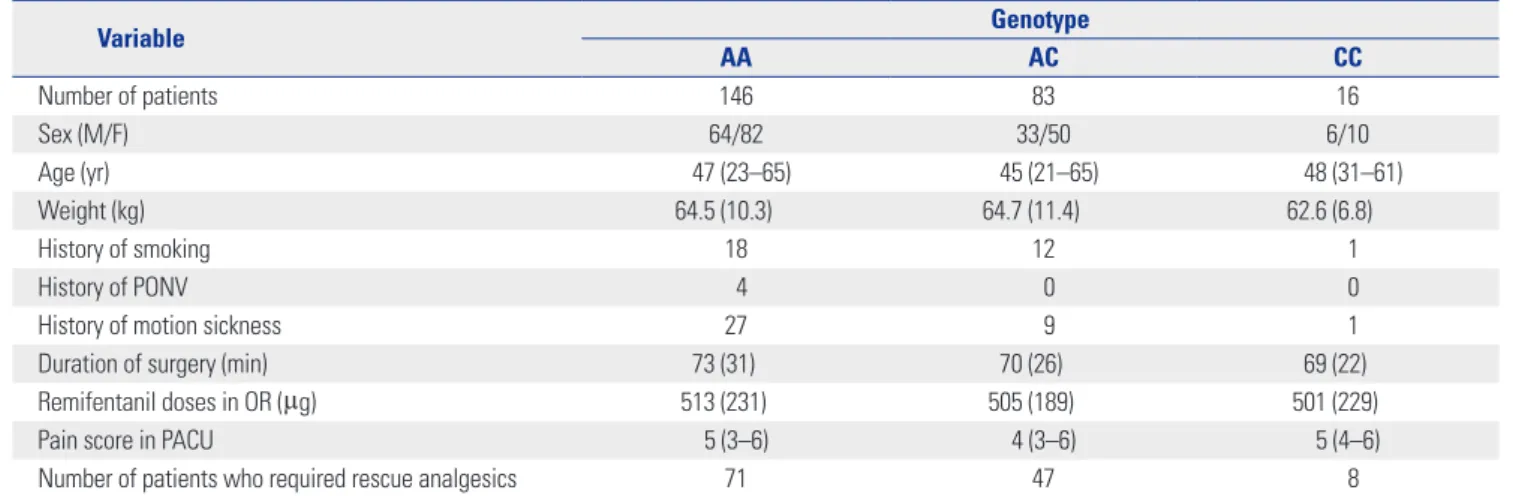
There were no significant differences in patient characteristics and clinical data among genotypes (Table 1 and 2).
The frequencies of all genotypes were in Hardy-Weinberg equilibrium (p>0.05). Frequencies of the 5-HT3B AAG deletion genotypes were as follows: 77.6% for wild type, 19.6% for het- eromutant, and 2.8% for homomutant. Among the 5-HT3B AAG deletion genotypes, the incidence of PONV was higher in pa- tients with a homomutant genotype than other genotypes dur- ing the first 2 hours after surgery (Codominant model, p=0.02) (Table 3). This difference was also statistically significant when analyzed between the patients with and without the Ins/ins (Dominant model, p=0.04) or the Del/del genotype (Recessive model, p=0.02), respectively. There were no significant differ- ences in the incidence of PONV among genotypes at 2–24
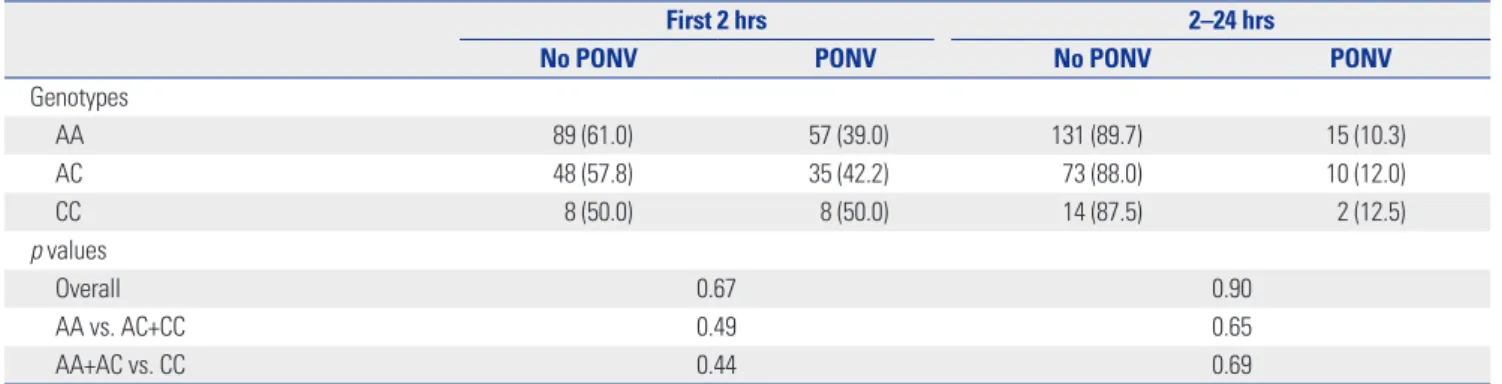
hours after surgery. In the Y129S variants of the 5-HT3B recep- tor gene, there were no significant differences in the incidence of PONV among genotypes during the first 2 hours or at 2–24 hours after surgery (Table 4).
The severity of nausea was significantly higher in patients with a homomutant genotype than other genotypes during the first 2 hours after surgery in the 5-HT3B AAG deletion geno- types (p=0.02) (Table 5). There were no significant differences in the severity of nausea among genotypes in the Y129S vari- ants of the 5-HT3B receptor gene (Table 6).
DISCUSSION
The present study revealed a significant association between the -100_-102AAG deletion polymorphism and the efficacy of ondansetron. The patients with a homomutant genotype of the -100_-102AAG deletion variant had a higher incidence of PONV than other genotypes during the first 2 hours after sur-
Table 1. Patients and Clinical Characteristics of the Patients According to 5-HT3B AAG Deletion Genotype
Variable Genotype
Ins/ins Ins/del Del/del
Number of patients 190 48 7
Gender (M/F) 80/110 20/28 3/4
Age (yr) 46 (21–65) 46 (23–65) 51 (45–57)
Weight (kg) 64.4 (10.3) 64.7 (11.2) 60.7 (10.9)
History of smoking 22 7 2
History of PONV 3 1 0
History of motion sickness 28 8 1
Duration of surgery (min) 72 (30) 70 (26) 74 (20)
Remifentanil doses in OR (µg) 505 (210) 504 (222) 656 (328)
Pain score in PACU 5 (3–6) 4 (3–6) 4 (3–4)
Number of patients who required rescue analgesics 93 30 3
Ins, insertion; Del, deletion; PONV, postoperative nausea and vomiting; OR, operation room; PACU, post-anesthesia care unit.
Values are presented as mean (range) for age, median (interquartile range) for pain score, mean (SD), or number of patients.
Table 2. Patients and Clinical Characteristics of the Patients According to Y129S Variants of the 5-HT3B Receptor Gene
Variable Genotype
AA AC CC
Number of patients 146 83 16
Sex (M/F) 64/82 33/50 6/10
Age (yr) 47 (23–65) 45 (21–65) 48 (31–61)
Weight (kg) 64.5 (10.3) 64.7 (11.4) 62.6 (6.8)
History of smoking 18 12 1
History of PONV 4 0 0
History of motion sickness 27 9 1
Duration of surgery (min) 73 (31) 70 (26) 69 (22)
Remifentanil doses in OR (µg) 513 (231) 505 (189) 501 (229)
Pain score in PACU 5 (3–6) 4 (3–6) 5 (4–6)
Number of patients who required rescue analgesics 71 47 8
PONV, postoperative nausea and vomiting; OR, operation room; PACU, post anesthesia care unit.
Values are presented as mean (range) for age, median (interquartile range) for pain score, mean (SD), or number of patients.
gery; however, the Y129S genotypes were not related to the clinical response to ondansetron.
The 5-HT3 receptor antagonists have been used effectively in order to prevent PONV.5,7 Unfortunately, all patients do not show a favorable outcome when the drug is administered.3 This therapeutic failure may be partially explained by other complex mechanisms of PONV, such as the effects of histamine, dopa- mine, and opioids other than 5-HT3.1,15 Considering the in- creased occurrence of PONV in several generations of the same family, considerable concordance of PONV in twins, and the established high risk of PONV in children with a family history of PONV, the individual variability of drug responses can also
be associated with inherited differences in genes modifying the drug’s actions.10 This variability in drug action may be pharma- cokinetic or pharmacodynamic.8 Genetic variations affecting the efficacy of 5-HT3 receptor antagonists have also been stud- ied from a pharmacokinetic and pharmacodynamic perspec- tive.10,13,16
The primary target in pharmacokinetic investigations in- cludes the CYP450 2D6 isoform (CYP2D6) associated with metabolic pathways of 5-HT3 receptor antagonists. Polymor- phic variations of the CYP2D6 system may induce ultra-rapid metabolism and subsequent therapeutic failure of 5-HT3 re- ceptor antagonists.10
Table 5. Effects of 5-HT3B AAG Deletion Genotype on the Efficacy of Ondansetron for Nausea Severity
First 2 hrs 2–24 hrs Genotypes
Ins/ins 0 (0–3) 0 (0–0)
Ins/del 0 (0–4) 0 (0–0)
Del/del 4 (2–5) 0 (0–0)
p values
Overall 0.03 0.43
Non-Del/del vs. Del/del 0.02 0.33
Ins/ins vs. Non-Ins/ins 0.05 0.26
Ins, insertion; Del, deletion.
Values are median (interquartile range).
Table 6. Effects of Y129S Variants of the 5-HT3B Receptor Gene on the Efficacy of Ondansetron for Nausea Severity
First 2 hrs 2–24 hrs Genotypes
AA 0 (0–4) 0 (0–0)
AC 0 (0–3) 0 (0–0)
CC 0 (0–4) 0 (0–0)
p values
Overall 0.67 0.53
AA+AC vs. CC 0.37 0.35
AA vs. AC+CC 0.81 0.36
Values are median (interquartile range).
Table 3. Effects of 5-HT3B AAG Deletion Genotype on the Efficacy of Ondansetron for Postoperative Nausea and Vomiting
First 2 hrs 2–24 hrs
No PONV PONV No PONV PONV
Genotypes
Ins/ins 119 (62.6) 71 (37.4) 167 (87.9) 23 (12.1)
Ins/del 25 (52.1) 23 (47.9) 44 (91.7) 4 (8.3)
Del/del 1 (14.3) 6 (85.7) 7 (100.0) 0 (0.0)
p values
Overall 0.02 0.49
Ins/ins vs. Non-Ins/ins 0.04 0.31
Non-Del/del vs. Del/del 0.02 1.00
Ins, insertion; Del, deletion; PONV, postoperative nausea and vomiting.
Values are number of patients (%).
Table 4. Effects of Y129S Variants of the 5-HT3B Receptor Gene on the Efficacy of Ondansetron for Postoperative Nausea and Vomiting
First 2 hrs 2–24 hrs
No PONV PONV No PONV PONV
Genotypes
AA 89 (61.0) 57 (39.0) 131 (89.7) 15 (10.3)
AC 48 (57.8) 35 (42.2) 73 (88.0) 10 (12.0)
CC 8 (50.0) 8 (50.0) 14 (87.5) 2 (12.5)
p values
Overall 0.67 0.90
AA vs. AC+CC 0.49 0.65
AA+AC vs. CC 0.44 0.69
PONV, postoperative nausea and vomiting.
Values are number of patients (%).
Variations in genes encoding the target molecule of a drug as pharmacodynamic factors are associated with an alteration of drug activity.8 As the primary target of 5-HT3 receptor antago- nists, the 5-HT3 receptor is a ligand-operated ion channel that includes five different receptor subunits (5-HT3A, B, C, D, and E) identified in humans.8,17 The 5-HT3A subunits are capable of forming a functional homomeric complex of the 5-HT3 recep- tor, whereas the 5-HT3B subunit forms a heteromeric complex through an association with the 5-HT3A subunit.8,16 The prima- ry differences between the homomeric 5-HT3A and hetero- meric 5-HT3A/3B complexes are biologic characteristics, con- ductance, and other slight differences in their pharmacological properties.8,17 The function and expression of the 5-HT3 recep- tor can be affected through variation of the genes coding its subunits; in particular, polymorphisms of the 5-HT3B subunit gene can modify the pharmacological and functional proper- ties of the 5-HT3 receptor.17,18 The Y129S and -100_-102AAG de- letions investigated in this study are the typical genetic varia- tions of the 5-HT3B subunit.9,10,16 Y129S is a substitution of an amino-acid located in the coding region of the 5-HT3B subunit gene. Sugai, et al.12 demonstrated that the Y129S polymorphism significantly affected the incidence of nausea induced by par- oxetine; however, in a previous study on the efficacy of 5-HT3 receptor antagonists in CINV, the Y129S polymorphism did not change the incidence of CINV.13 In this study, the Y129S poly- morphism also did not change the response to ondansetron for PONV. Although this inconsistency may be explained by differ- ences in factors such as paroxetine use, emetogenic chemo- therapy administration, and general anesthesia, the reason for the inconsistent results is not clear.12 The -100_-102AAG dele- tion is a 3-base pair deletion within the 5’untranslated region of the 5-HT3B subunit gene.10 Tremblay, et al.13 demonstrated that this deletion variant in the promoter region was significantly associated with a high incidence of CINV, whereas Rueffert, et al.9 did not confirm this specific result in patients with PONV.
The present study showed that patients who were homomutant for the AAG deletion genotype had a higher incidence of PONV than other genotypes. The discrepancy between Rueffert’s and our results may have been caused by differences in patient characteristics and study design.9
Despite our favorable result, the functional impact of the -100_-102AAG deletion on the 5-HT3B receptor subunit is not yet obvious, and an in vitro study on the functional aspects of polymorphisms related to the 5-HT3B receptor subunit is still lacking.13 Furthermore, various issues related to the interactions existing between the subunits that make up the 5-HT3 receptor have not been fully explained, even though the 5-HT3B recep- tor subunit is likely to play an important functional role, consid- ering the current knowledge about the 5-HT3 receptor.18 How- ever, a previous study using secondary structure prediction showed that this polymorphism can cause a structural modifi- cation of mRNA when compared with the wild type.19 Meineke, et al.20 demonstrated that the -100_-102AAG deletion increased
the promoter activity of the 5-HT3B receptor gene in vitro. In addition, this variant is a deletion of three nucleotides. There- fore, it could have a much greater impact on the receptor func- tion than other single nucleotide polyporphisms.13
We found that the response to ondansetron for PONV did not differ according to the 5-HT3B -100_-102AAG deletion geno- types at 2–24 hours after surgery; however, in this study, 89% or more patients did not suffer from PONV between 2 and 24 hours, which may explain the lack of association observed dur- ing this time period.
There are a variety of risk factors that can affect the develop- ment of PONV. It is well-documented that female gender, a pre- vious history of PONV or motion sickness, the use of intrave- nous opioids, and non-smoking status are the main predictors of PONV.15,21 In this study, we did not find any significant differ- ences in these predictors based on genotype. In order to mini- mize the influence of anesthetic and surgical factors on our re- sults, we enrolled patients who underwent an identical surgical procedure and performed general anesthesia using the same anesthetic agent while maintaining BIS values at a constant lev- el. Furthermore, our study confirmed that genotype distribu- tion of the Y129S SNP and -100_-102AAG deletion of the 5-HT3B receptor gene was in accordance with Hardy-Weinberg equilib- rium, suggesting that our finding involving this receptor gene is likely robust.
We concluded that the response to ondansetron for PONV was significantly influenced by the -100_-102AAG deletion polymorphisms of the 5-HT3B gene. Taking these results into account, the -100_-102AAG deletion variants may be a phar- macogenetic predictor of responsiveness to ondansetron for PONV. Further research is needed to clarify the functional role of this polymorphism in the 5-HT3B subunit and the interac- tion between the 5-HT3 receptor subunits.
ACKNOWLEDGEMENTS
This research was supported by the Basic Science Research Program through the National Research Foundation of Korea (NRF), funded by the Ministry of Education, Science, and Technology (No. 2010-0004868).
This study was registered with Clinicaltrials.gov (NCT0165 7786).
REFERENCES
1. Candiotti KA, Birnbach DJ, Lubarsky DA, Nhuch F, Kamat A, Koch WH, et al. The impact of pharmacogenomics on postopera- tive nausea and vomiting: do CYP2D6 allele copy number and polymorphisms affect the success or failure of ondansetron pro- phylaxis? Anesthesiology 2005;102:543-9.
2. Lunn DV, Lauder GR, Williams AR, Pickering RM, McQuillian PJ.
Low-dose droperidol reduces postoperative vomiting in paediat- ric day surgery. Br J Anaesth 1995;74:509-11.
3. Choi EM, Lee MG, Lee SH, Choi KW, Choi SH. Association of
ABCB1 polymorphisms with the efficacy of ondansetron for post- operative nausea and vomiting. Anaesthesia 2010;65:996-1000.
4. White H, Black RJ, Jones M, Mar Fan GC. Randomized compari- son of two anti-emetic strategies in high-risk patients undergoing day-case gynaecological surgery. Br J Anaesth 2007;98:470-6.
5. Bunce KT, Tyers MB. The role of 5-HT in postoperative nausea and vomiting. Br J Anaesth 1992;69(7 Suppl 1):60S-2S.
6. Moon YE, Joo J, Kim JE, Lee Y. Anti-emetic effect of ondansetron and palonosetron in thyroidectomy: a prospective, randomized, double-blind study. Br J Anaesth 2012;108:417-22.
7. Kim SI, Kim SC, Baek YH, Ok SY, Kim SH. Comparison of ramose- tron with ondansetron for prevention of postoperative nausea and vomiting in patients undergoing gynaecological surgery. Br J Anaesth 2009;103:549-53.
8. Kaiser R, Tremblay PB, Sezer O, Possinger K, Roots I, Brockmöller J. Investigation of the association between 5-HT3A receptor gene polymorphisms and efficiency of antiemetic treatment with 5-HT3 receptor antagonists. Pharmacogenetics 2004;14:271-8.
9. Rueffert H, Thieme V, Wallenborn J, Lemnitz N, Bergmann A, Rud- lof K, et al. Do variations in the 5-HT3A and 5-HT3B serotonin re- ceptor genes (HTR3A and HTR3B) influence the occurrence of postoperative vomiting? Anesth Analg 2009;109:1442-7.
10. Janicki PK, Sugino S. Genetic factors associated with pharmaco- therapy and background sensitivity to postoperative and chemo- therapy-induced nausea and vomiting. Exp Brain Res 2014;232:
2613-25.
11. Fasching PA, Kollmannsberger B, Strissel PL, Niesler B, Engel J, Kreis H, et al. Polymorphisms in the novel serotonin receptor sub- unit gene HTR3C show different risks for acute chemotherapy-in- duced vomiting after anthracycline chemotherapy. J Cancer Res Clin Oncol 2008;134:1079-86.
12. Sugai T, Suzuki Y, Sawamura K, Fukui N, Inoue Y, Someya T. The effect of 5-hydroxytryptamine 3A and 3B receptor genes on nau- sea induced by paroxetine. Pharmacogenomics J 2006;6:351-6.
13. Tremblay PB, Kaiser R, Sezer O, Rosler N, Schelenz C, Possinger K, et al. Variations in the 5-hydroxytryptamine type 3B receptor gene as predictors of the efficacy of antiemetic treatment in can- cer patients. J Clin Oncol 2003;21:2147-55.
14. Kato M, Fukuda T, Wakeno M, Fukuda K, Okugawa G, Ikenaga Y, et al. Effects of the serotonin type 2A, 3A and 3B receptor and the serotonin transporter genes on paroxetine and fluvoxamine effi- cacy and adverse drug reactions in depressed Japanese patients.
Neuropsychobiology 2006;53:186-95.
15. Watcha MF, White PF. Postoperative nausea and vomiting. Its eti- ology, treatment, and prevention. Anesthesiology 1992;77:162-84.
16. Krzywkowski K. Do polymorphisms in the human 5-HT3 genes contribute to pathological phenotypes? Biochem Soc Trans 2006;
34(Pt 5):872-6.
17. Dubin AE, Huvar R, D’Andrea MR, Pyati J, Zhu JY, Joy KC, et al. The pharmacological and functional characteristics of the serotonin 5-HT(3A) receptor are specifically modified by a 5-HT(3B) recep- tor subunit. J Biol Chem 1999;274:30799-810.
18. Davies PA, Pistis M, Hanna MC, Peters JA, Lambert JJ, Hales TG, et al. The 5-HT3B subunit is a major determinant of serotonin-re- ceptor function. Nature 1999;397:359-63.
19. Frank B, Niesler B, Nöthen MM, Neidt H, Propping P, Bondy B, et al. Investigation of the human serotonin receptor gene HTR3B in bipolar affective and schizophrenic patients. Am J Med Genet B Neuropsychiatr Genet 2004;131B:1-5.
20. Meineke C, Tzvetkov MV, Bokelmann K, Oetjen E, Hirsch-Ernst K, Kaiser R, et al. Functional characterization of a -100_-102delAAG deletion-insertion polymorphism in the promoter region of the HTR3B gene. Pharmacogenet Genomics 2008;18:219-30.
21. Apfel CC, Läärä E, Koivuranta M, Greim CA, Roewer N. A simpli- fied risk score for predicting postoperative nausea and vomiting:
conclusions from cross-validations between two centers. Anesthe- siology 1999;91:693-700.