Plasma total homocysteine and macrovascular complications are associated with food and nutrient intake in patients with Type II diabetes mellitus
Namsoo Chang 1§ , Ji-Myung Kim 1 , Hyesook Kim 1 and Yong Wook Cho 2
1 Department of Nutritional Sciences, Ewha Womans University, Seoul 120-750, Korea
2 Department of Internal Medicine, Pochon CHA University College of Medicine, Sungnam, Gyeonggi 463-836, Korea
Received May 1, 2007; Revised May 25, 2007; Accepted June 14, 2007
Abstract
The present study was conducted to document the association between plasma homocysteine levels and the presence of macrovascular angiopathy with food and nutrient intake patterns among patients with Type II diabetes mellitus in Korea. Plasma total homocysteine concentration was analyzed by HPLC-fluorescence detector method in 127 patients with non-insulin dependent diabetes mellitus. Logistic regression analyses were performed respectively to study the association of plasma homocysteine levels with clinical and dietary characteristics and macroangiopathy (MA). The average plasma homocysteine level of patients with MA was 14.2 μmol/l, which was significantly higher than that of patients without MA (11.4 μmol/l).
The proportions of patients with MA showed a significant difference, being 32.3% in hyperhomocysteinemic (>14.0 μmol/l) patients and 13.5%
in others with homocysteine levels lower than 14.0 μmol/l. Odds ratios for macroangiopathy by tertile increase of plasma homocysteine concentration were 1.633 (Q
2) and 4.831 (Q
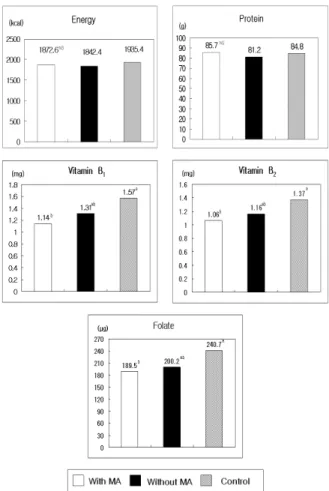
3), when adjusted for age, sex, and cigarette smoking. Patients with MA consumed reduced amounts of vitamin B
1, B
2, and folate. The results indicate that the plasma homocysteine levels are significantly increased in NIDDM patients who have macroangiopathy.
Dietary management such as increased fruits and vegetables and decreased potatoes and starches might be beneficial for the prevention of macroangiopathy in diabetic patients.
Key Words: Hyperhomocysteinemia, macroangiopathy, vitamin B, fruits; non-insulin dependent diabetes mellitus
Introduction 1)
Non-insulin dependent diabetes mellitus (NIDDM) and its vascular complications are markedly increasing in Korea (Park et al., 1997) due to rapid industrialization process and economic growth, which entail changes in lifestyle and food habits. The management of vascular complications associated with the NIDDM, therefore, is becoming one of the critical public health concerns and issues in Korea.
Hyperhomocysteinemia has been recently identified as an important risk factor for cardiovascular (Hoogeveen et al., 1998), cerebrovascular, and peripheral vascular diseases. Hyperhomo- cysteinemia is found in up to 30-50% of patients with coronary artery disease and/or cerebrovascular disease (Robinson et al., 1995). With regard to the attribution of plasma homocysteine levels to the coronary artery disease risk, it has been estimated that a 5 μmol/l increase in the plasma homocysteine level is equivalent to an approximately 0.52 nmol/l (20 mg/dl) increase in the total cholesterol level, and this will result in a 20% increase in the coronary artery disease risk (Rees & Rodgers, 1993).
Controlling the plasma levels of homocysteine thus becomes a critical step in the management of patients with NIDDM.
Numerous investigators have reported on homocysteine con- centrations among patients with atherosclerotic vascular diseases and diabetic patients. It has been reported that type II diabetic patients who had proteinuria and macrovascular disease (Araki
& Sako., 1993; Hoffman et al., 1998; Hultberg et al., 1991;
Munshi et al., 1996; Vaccaro et al., 1997) had higher fasting homocysteine levels than nondiabetic control subjects. Most of the studies however, were conducted on western population and such studies on the Asians such as Koreans who show an increasing trend in the prevalence of NIDDM are limited.
Fruits and vegetables contain various micronutrients such as folic acid and other anti-oxidant vitamins which are beneficial for the maintenance of plasma homocysteine levels within the optimum range. Several studies reported inverse relationships between plasma homocysteine with intakes of B vitamins such as folate (Hatzis et al., 2006) and of fruits and vegetables (Paterson et al., 2006).
The purpose of this paper is to report the prevalence of hyperhomocysteinemia in NIDDM patients according to their respective vascular health status, and to document an association between food and nutrient intake and plasma homocysteine levels in these patients.
§
Corresponding Author: Namsoo Chang, Tel. 82-2-3277-3468, Fax. 82-2-3277-2862, Email. [email protected]
Table 1. Clinical characteristics of diabetic patients
aDiabetic patients
MA (n=24) nMA (n=103) All (n=127)
Age(y) 59.5 ± 7.6 55.7 ± 12.9 56.5 ± 12.2
Sex(male:female) 33.3:66.7 42.4:57.6 40.7:59.3
BMI 24.1 ± 5.3 24.1 ± 3.3 24.1 ± 3.7
Fasting blood glucose(mg/dl) 150.8 ± 53.2 152.5 ± 47.2 152.2 ± 48.2 Duration of NIDDM(y) 8.6 ± 7.6 6.8 ± 5.9 7.2 ± 6.3 Total cholesterol(mg/dl) 202.9 ± 43.1 193.8 ± 46.7 195.7 ± 45.9 Triglycerides(mg/dl) 180.6 ± 72.2 188.6 ± 191.4 187.0 ± 174.1 Systolic blood
pressure(mmHg)* 138.9 ± 21.7 128.3 ± 22.1 130.5 ± 22.3 Diastolic blood
pressure(mmHg)** 84.0 ± 11.2 78.3 ± 10.5 79.4 ± 10.9 Homocysteine(umol/I)* 14.2 ± 5.8 11.4 ± 3.1 11.9 ± 4.5
a
Values are the mean ± SD
* Values with different alphabetical letters are significantly different from each other at p<0.05.
Methods
Subjects and dietary data collection
The study subjects were 127 NIDDM patients. We divided diabetic patients into two groups: (1) Those who have coronary artery disease, cerebrovascular disease, and peripheral vascular disease, were classified as patients with macroangiopathy(MA) complications, and (2) the rest, as patients with no macroan- giopathy. The 24-hour recall dietary data were collected by a well-trained interviewer and analyzed using a Can-Pro (Korean Nutrition Society 2006) for nutrient and food group intake. This study was approved by the CHA University College of Medicine Human Investigation Review Committee. We included age, gender and BMI matched control subjects in the study. Any patient or control subjects who had known renal or other metabolic diseases or on any medications that might influence plasma homocysteine levels were excluded.
Analysis of plasma homocysteine and other biochemical measurements
Blood samples were drawn from subjects after an overnight fast and were immediately centrifuged at 2,800rpm for 15 minutes at 4℃. The plasma was stored frozen at -70℃, and was analyzed for total homocysteine level. Plasma homocysteine was analyzed by the HPLC (Hitachi L-7100)-fluorescence detection method developed by Araki and Sako (1987). The plasma was thawed and treated with tri-n-butyl phosphine in dimethylfor- mamide (DMFA) to release protein-bound homocysteine and to accomplish the reduction of mixed disulfides. Protein was precipitated with trichloroacetic acid and EDTA. After centri- fugation at 3,000 × g for 5 minutes to remove protein, the supernatant was treated with ammonium 7-flurobenzo-2-oxa-1,3 diazole-4-sulfonate (SBD-F, Sigma, USA) to derivatize homocy- steine and plasma thiols. Derivatized thiols were separated on a Phenomenex Luna C 18 column (250 × 4.6 mm I.D., 5 μm particle size) and measured using a Waters 474 scanning fluorescence detector. The mobile phase was 0.1 M sodium phosphate buffer, pH 6.0 containing 5% methanol v/v). The plasma glucose and cholesterol concentrations were analyzed by an Autoanalyzer at the clinical laboratory.
Statistical Analysis
All the results were statistically processed using a SAS program (SAS Institute, Inc., Cary, NC, USA). Patients were divided into (1) those having macrovascular disease and (2) those not, and were compared for their differences. One-way analysis of variance followed by Duncan's multiple range tests was performed and probability values less than 0.05 were considered statistically significant. Logistic regression analyses were per-
formed to study the association of hyperhomocysteinemia with the risk of macroangiopathy. We calculated odds ratios (ORs) and 95% confidence intervals (CIs) by tertiles of plasma homocysteine levels with the lowest tertile as a reference category. Age, sex and cigarette smoking were all considered as potential covariates.
Results
Plasma homocysteine levels
Diabetes mellitus patients were divided into two groups: (1) those having macrovascular complications were designated MA group and (2) those not having macrovascular complications, nMA group.
In the diabetic patients without macroangiopathy, the plasma homocysteine level was 11.4 ± 3.1 μmol/l. In the diabetic patients with macroangiopathy, however, the plasma homocysteine level was 14.2 ± 5.8 μmol/l, which was significantly higher than the values of the patients with MA and the control by 23% and 25%, respectively (Table 1). Both systolic and diastolic blood pressures were increased in patients with MA compared to those without MA complications. There were no significant differences in the mean age, gender, BMI, fasting blood glucose, and the years of NIDDM between the two groups of diabetic patients.
The result of the logistic regression analysis on the association
between plasma homocysteine levels with the risk of macroan-
giopathy is shown in Table 2. We calculated odds ratios by
tertiles of plasma homocysteine with the lowest tertile as a
reference. When adjusted for age, gender, and cigarette smoking,
the odds ratios for MA were 1.633 (95% CIs = 0.606-4.398) and
4.831 (95% CIs = 1.676-7.933) for Q2 and Q3, respectively.
Fig. 1. Energy, protein, vitamins B
1, B
2and folate intake of subjects Table 2. Odds ratios for macroangiopathy by tertile increase of plasma homocysteine concentration in diabetic patients
Tertile
$Unadjusted
†Adjusted
‡Odds ratio 95% CI* Odds ratio 95% CI
Q1 (lowest) 1.0 1.0
Q2 2.211 0.879 -5.558 1.633 0.606-4.398
Q3 (highest) 2.763 1.130-6.760 4.831 1.676-7.922
P for trend 0.045 0.043
* CI, confidence interval
†
Except for other model variable
‡
Including terms for age, sex and cigarette smoking
$
Cutpoints (tertiles): 9.76, 12.53mmol/L
Table 3. Odds ratios for hyperhomocysteinemia by tertile increase of vitamin intake in diabetic patients*
Nutrient and tertile OR adjusted for energy
intake 95% CI
Folate
aTertile 1 (lowest) 1.0
Tertile 2 1.438 0.284-7.284
Tertile 3 (highest) 0.637 0.097-4.192
Vitamin B
1bTertile 1 (lowest) 1.0
Tertile 2 0.590 0.121-2.877
Tertile 3 (highest) 0.055 0.012-0.735
Vitamin B
2cTertile 1 (lowest) 1.0
Tertile 2 0.831 0.144-4.790
Tertile 3 (highest) 0.747 0.142-3.928
Vitamin C
dTertile 1 (lowest) 1.0
Tertile 2 1.339 0.250-7.170
Tertile 3 (highest) 0.539 0.089-3.255
* All models were adjusted for age, sex and smoking.
OR=odds ratio; CI=confidence interval
a
Cutpoints (tertiles): 87.73, 121.84 μg/4.184 MJ/d
b
Cutpoints (tertiles): 0.588, 0.706 mg/4.184 MJ/d
c
Cutpoints (tertiles): 0.510, 0.658 mg/4.184 MJ/d
d
Cutpoints (tertiles): 40.5, 57 mg/4.184 MJ/d
Table 4. Odds ratios for hyperhomocysteinemia of highest versus lowest tertile of food group intake in diabetic patients
‡Food groups Odds ratio 95% CI
Cereals and grain products 1.403 0.704-2.794
Potatoes and starches 2.804* 1.144-6.870
Sugars and sweets 1.934 0.795-4.704
Legumes and their products 1.596 0.734-3.467
Vegetables 0.646 0.295-1.417
Fruits 0.155* 0.057-0.422
Meats, poultry and their products 0.758 0.310-1.853
Eggs 0.428 0.157-1.170
Fish and shellfish 1.038 0.459-2.350
Milk and dairy products 0.632 0.232-1.718
‡