D I A B E T E S & M E T A B O L I S M J O U R N A L
This is an Open Access article distributed under the terms of the Creative Commons Attribution Non-Commercial License (http://creativecommons.org/licenses/by-nc/4.0/) which permits unrestricted non-commercial use, distribution, and reproduction in any medium, provided the original work is properly cited.
Factors Associated with Improved Glycemic Control by Direct-Acting Antiviral Agent Treatment in
Egyptian Type 2 Diabetes Mellitus Patients with Chronic Hepatitis C Genotype 4
Alaaeldin Abdelsalam Dawood1, Mohamed Zakarya Nooh1, Ayman Abdelhaleem Elgamal2
Departments of 1Internal Medicine, 2Tropical Medicine, Menoufia University Faculty of Medicine, Shebin Elkom, Egypt
Background: The association of chronic hepatitis C virus (HCV) infection with type 2 diabetes mellitus (T2DM) was first report- ed in 1994. Little is known about the effect of direct-acting antiviral agents (DAAs) on glycemic control in T2DM patients. The aim of the present study was to evaluate the factors associated with improved glycemic control (IGC) by DAA treatment in Egyp- tian T2DM patients with chronic HCV genotype 4 infection.
Methods: This study included 460 T2DM patients with chronic HCV genotype 4 infection. Four hundred patients received DAAs and 60 patients did not receive DAAs. Patients with sustained virological response after 3 months of DAAs (378 patients) were al- located into two groups: first group included 292 patients (77.2%) with IGC and second group included 86 patients (22.8%) with non-improved glycemic control (NIGC).
Results: In IGC group, 78 patients (26.7%) needed to decrease the dose of antidiabetic treatment. There were no significant differ- ences between IGC and NIGC groups as regards age, sex, and body mass index. The percentage of patients with positive family history of T2DM, those with Child B class and duration of T2DM were significantly higher in NIGC group compared to IGC.
Conclusion: Diabetic patients receiving DAAs should be closely monitored for reduction of antidiabetic drugs especially insulin and sulfonylurea to avoid hypoglycemic events. Improvement of glycemic control with DAAs is more in patients without family history of T2DM, short duration of diabetes mellitus, and mild liver disease.
Keywords: Diabetes mellitus; Direct-acting antiviral agents; Hepatitis C virus
Corresponding author: Alaaeldin Abdelsalam Dawood https://orcid.org/0000-0001-9442-6659
Department of Internal Medicine, Menoufia University Hospital, Al Ostaz Yassen Abd Al Ghafar St, Shebin Elkom 32511, Egypt
INTRODUCTION
Hepatitis C virus (HCV) is a major cause of chronic liver dis- ease, including cirrhosis and liver cancer. The World Health Organization has reported that 170 million people are chroni- cally infected with HCV globally [1]. The highest prevalence of HCV infection worldwide is in Egypt (15%) where 90% of HCV infection is genotype 4 [2].
Patients with chronic hepatitis C virus (ChHCV) infection have significantly increased prevalence of type 2 diabetes mel-
litus (T2DM), independent of liver disease stage compared with controls or hepatitis B virus (HBV)-infected patients.
T2DM is a common comorbid condition in approximately one-third of individuals with ChHCV infection [3].
However, the mechanism by which the increased risk of dia- betes occurs is not clear. HCV infection can trigger autoim- mune reactions against pancreatic β-cells in genetically sus- ceptible subjects leading to direct destruction of β-cells; there- by, causing type 1 diabetes [4]; or the mechanism may be relat- ed to increased insulin resistance (IR) [5].
https://doi.org/10.4093/dmj.2017.41.4.316 pISSN 2233-6079 · eISSN 2233-6087
Patients with ChHCV infection have significantly increased prevalence of T2DM, independent of liver disease stage com- pared with controls or HBV-infected patients. T2DM is a com- mon comorbid condition in approximately one-thirds of HCV- infected individuals, possibly due to a direct or indirect effect of the virus on insulin sensitivity [5].
Studies show that HCV impairs glucose metabolism directly via viral proteins and indirectly by altering proinflammatory cytokine levels. The direct effect is due to HCV core protein that prevents the insulin receptor substrate-1 (IRS-1) associa- tion with its insulin receptor by increasing IRS-1 degradation through upregulation of serine/threonine phosphorylation or increased activity of suppressor of cytokine signaling 3 (SOCS3) [6-8]. These direct actions on the insulin-signaling pathway impair downstream signalling and appropriate regulation of glucose metabolism [9]. An indirect effect of HCV on insulin sensitivity has also been suggested to be due to increased pro- duction of proinflammatory cytokines (interleukin 6 and tu- mor necrosis factor α) from sinusoidal liver cells that interferes with insulin-signaling pathways and leads to IR [10-12].
The realistic possibility of moving to interferon-free thera- pies offers avoidance of the autoimmune-mediated hypergly- cemic effects of interferon. Moreover, these therapies offer an oral, well-tolerated treatment regimen of shorter duration, helping to attain a greater sustained virological response (SVR) after 12 weeks and may help to reduce the development of IR [13].
The aim of this work was to evaluate the factors associated with improved glycemic control by direct-acting antiviral agents (DAAs) in Egyptian T2DM patients with ChHCV gen- otype 4 infection.
METHODS
This study was conducted on 460 T2DM patients with ChHCV from among the outpatients of the Departments of Internal Medicine and Tropical Medicine of Menoufia University Hos- pital between February 2016 and December 2016. All patients had HCV genotype 4, which is the most common genotype in Egypt. The study protocol was approved by the Ethics Com- mittee of the Menoufia University Faculty of Medicine, and the selected subjects gave prior consent to participate in the study.
All patients were subjected to detailed history taking includ- ing age, sex, body mass index (BMI), and duration and family history of T2DM. Four hundred patients received DAAs in the
form of sofosbuvir+daclatasvir with or without ribavirin for 12 weeks, while the remaining 60 patients did not receive DAAs and served as a control group. Before starting DAA therapy, laboratory tests were carried out that included fasting plasma glucose (FPG), glycosylated hemoglobin (HbA1c), qualitative HCV RNA polymerase chain reaction test, liver enzymes, se- rum bilirubin, serum albumin, and the international normal- ized ratio. FPG, HbA1c, and body weight were repeated after 3 months. The severity of liver disease was determined by using the Child-Pugh classification. Only class A and class B patients were included. During the study period, all patients were ad- vised to maintain their usual diet regimen and physical activity.
For better evaluation of the improvement in glycemic control, we used a composite end-point given by the reduction of FPG (of a minimum of 20 mg/dL) or HbA1c (of a minimum of 0.5%).
Patients with SVR after 3 months (378 patients, 94.5%) were divided into two groups according to the end-point of glyce- mic control; that is, the improved glycemic control (IGC) group, which comprised 292 patients (77.2%), and the non- improved glycemic control (NIGC) group, which included 86 patients (22.8%).
Statistical methodology
Data was analysed using SPSS version 15 (SPSS Inc., Chicago, IL, USA). Quantitative data were presented in mean±standard deviation. Qualitative data were presented in frequency and percentage. To compare between groups, we used Student t- test and chi-square test. Multivariate logistic regression was used to adjust the confounding factors. Significance level for P≤0.05.
RESULTS
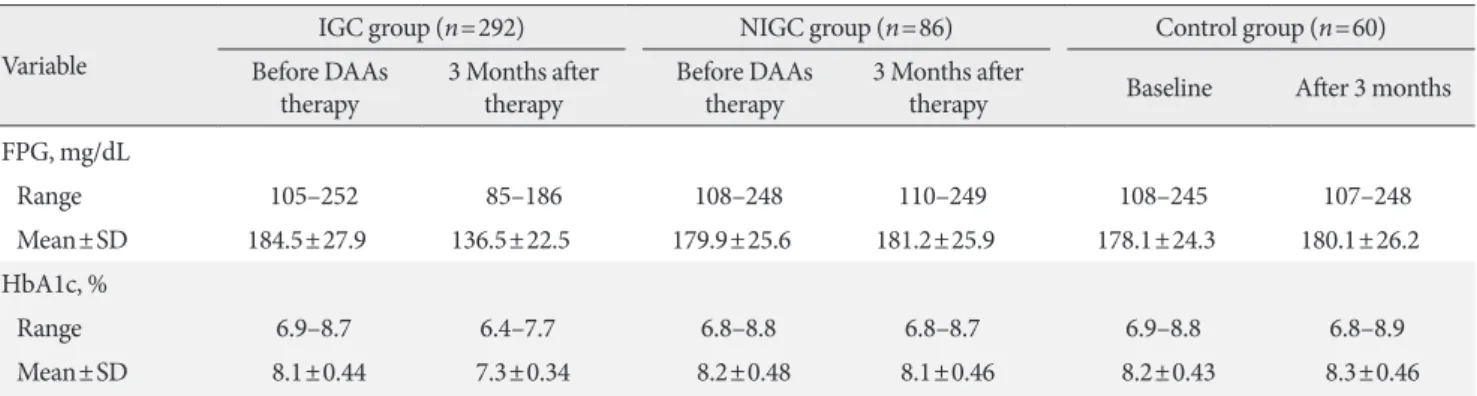
SVR after 3 months was obtained in 378 patients (94.5%). Ac- cording to the above-mentioned criteria of improvement in glycemic control, 292 patients (77.2%) achieved improvement in glycemic control after 3 months of DAA therapy compared with pretreatment levels (IGC group); the remaining 86 pa- tients (22.8%) and the control group (60 patients) did not achieve improvement in glycemic control during the period of study (Table 1).
In the IGC group, 78 patients (26.7%) needed to decrease the dose of antidiabetic treatment; 61 patients needed to de- crease the insulin dose and 17 patients needed to decrease the
gliclazide dose. None of the IGC patients needed to decrease the dose of metformin or dipeptidyl peptidase-4 (DPP4) in- hibitor.
After 3 months of DAA therapy, the mean value of reduction of FPG in the IGC group was 49.1 mg/dL with a maximum re- duction of 88 mg/dL (from 240 to 152 mg/dL) observed in one patient; the mean reduction of HbA1c was 0.8% with a maxi- mum reduction of 1.1% (from 8.7% to 7.6%) observed in one
patient (Table 1).
There were no significant differences between the IGC and NIGC groups regarding age, sex, and BMI (before and after therapy). However, the percentage of patients with positive fam- ily history of T2DM, longer T2DM duration and Child-Pugh class B was significantly higher in the NIGC group (Table 2).
To adjust for confounding factors, multivariate logistic re- gression analysis was performed, and the results showed that the following factors had a significant influence on improved glycemic control: family history of T2DM, duration of T2DM, and severity of liver disease according to Child-Pugh classifica- tion (Table 3).
In the IGC group, no patients experienced hypoglycemia, but three patients experienced deterioration in diabetic reti- nopathy; all of them had a history of diabetic retinopathy be- fore DAA therapy.
DISCUSSION
In the current study, 77.2% of SVR patients achieved improve- ment in glycemic control after 3 months of treatment. In the Table 1. Changes in FPG and HbA1c in IGC group before DAA, 3 months after therapy
Variable
IGC group (n=292) NIGC group (n=86) Control group (n=60)
Before DAAs
therapy 3 Months after
therapy Before DAAs
therapy 3 Months after
therapy Baseline After 3 months FPG, mg/dL
Range 105–252 85–186 108–248 110–249 108–245 107–248
Mean±SD 184.5±27.9 136.5±22.5 179.9±25.6 181.2±25.9 178.1±24.3 180.1±26.2
HbA1c, %
Range 6.9–8.7 6.4–7.7 6.8–8.8 6.8–8.7 6.9–8.8 6.8–8.9
Mean±SD 8.1±0.44 7.3±0.34 8.2±0.48 8.1±0.46 8.2±0.43 8.3±0.46
FPG, fasting plasma glucose; HbA1c, glycosylated hemoglobin; IGC, improved glycemic control; DAA, direct-acting antiviral agent; NIGC, non-improved glycemic control; SD, standard deviation.
Table 2. Comparison between IGC group and NIGC group as regards age, sex, BMI, duration of T2DM, family history of T2DM, and Child-Pugh classification
Variable IGC group
(n=292) NIGC group
(n=86) P valuea
Age, yr 53.25±4.6 52.34±4.9 0.113b
BMI before therapy, kg/m2 27.76±2.7 27.24±2.98 0.130b BMI after therapy, kg/m2 27.74±2.8 27.25±3.0 0.156b Duration of T2DM, yr 9.41±4.69 13.24±4.25 0.001b
Sex 0.632c
Male 141 (48.3) 39 (45.3)
Female 151 (51.7) 47 (54.7)
Family history of T2DM 0.001c
Positive 125 (42.8) 58 (67.4)
Negative 167 (57.2) 28 (32.6)
Child-Pugh classification 0.021c
A 254 (87.0) 66 (76.7)
B 38 (13.0) 20 (23.3)
Values are presented as mean±standard deviation or number (%).
IGC, improved glycemic control; NIGC, non-improved glycemic control; BMI, body mass index; T2DM, type 2 diabetes mellitus.
aProbability of statistical test is significant if ≤0.05, bt-test, cChi-square test.
Table 3. Multivariate logistic regression analysis for factors af- fected glycemic control with direct-acting antiviral agents
Factor B P value Odds ratio 95% CI
Duration of T2DM
(<7 years) 0.479 0.000 2.452 1.335–4.504 Child-Pugh classification
(child A) 0.407 0.001 2.025 1.106–3.711
Family history of T2DM
(negative) 0.916 0.000 2.767 1.667–4.595 CI, confidence interval; T2DM, type 2 diabetes mellitus.
IGC group, 78 patients (26.7%) needed to decrease their dose of antidiabetic treatment.
The evidence for the effect of DAA therapy on T2DM is con- flicting. One study suggested that the antiviral effects of dano- previr may decrease IR in patients with HCV genotype 1 [14].
Another study found that HCV suppression with DAA therapy produced a significant improvement in glycemic control re- gardless of genotype [15]. In contrast, a third study found that DAA therapy with sofosbuvir and ledipasvir led to the devel- opment of new-onset T2DM [16].
In the current study, the patients in the IGC group were on the following antidiabetic treatments: 251 patients on metfor- min, 56 on gliclazide, 101 on sitagliptin or linagliptin, and 153 on insulin. Some patients were on a combination therapy of two or three agents. In this group, 78 patients (26.7%) needed to decrease the dose of antidiabetic treatment (61 patients needed to decrease the insulin dose and 17 needed to decrease the gliclazide dose). Although the main side effect of sulfonyl- urea drugs such as gliclzide is hypoglycemia, none of IGC group experienced this because some patients on gliclazide had high HbA1c (>7%) at the start of antiviral treatment, so the decrease in plasma glucose did not lead to hypoglycemia.
Moreover, gliclazide is metabolized in the liver, so improving the liver condition may lead to improvement in gliclazide me- tabolism and clearance. None of the IGC patients needed to decrease their metformin or DPP4 inhibitor doses, which may be expected as hypoglycemia rarely occurs with metformin and DPP4 inhibitors.
BMI was not an important factor in improving glycemic control with use of DAA treatment. One case with a significant improvement in diabetic control after successful HCV treat- ment with DAA therapy has been reported [17]. This improve- ment in insulin requirements and HbA1c persisted following viral clearance despite an increase in the patient’s BMI.
The percentage of patients with positive family history of T2DM was significantly lower in the IGC group compared with the NIGC control group. In patients without family histo- ry of T2DM, the possibility of IR is likely due to HCV infection only, so the eradication of HCV infection helps to improve IR and glycemic control, unlike those with inherited IR. It might be useful to classify patients with hereditary IR or HCV-in- duced IR to define better the effect of HCV eradication on these distinct populations, but this is not always possible. Ab- sence of family history of T2DM may help in this differentia- tion.
The duration of T2DM was significantly longer in the NIGC group compared with the IGC control group. Prolonged dura- tion of T2DM may lead to more β-cell failure and so improve- ment in IR does not lead to marked improvement in glycemic control.
In the current study, 22.8% of SVR diabetic patients did not reach the end-point of glycemic improvement. This can be ex- plained by three factors. First, the severity of liver disease may play an important role as the percentage of Child-Pugh class B patients was significantly higher in the NIGC group. The eti- ology of T2DM in HCV-infected individuals has been postu- lated to result from either hepatogenous T2DM resulting from advanced liver disease or classical T2DM due to virally medi- ated IR [18]. Second, HCV infection may affect glucose level by an autoimmune mechanism on β-cells and is not related to IR. Third, some of the patients in the NIGC group already had normal FPG and HbA1c.
Because all the patients in this study had HCV genotype 4, we cannot determine if the glycemic improvement with DAAs was genotype-related or not. Most genotypes of HCV increase IR and can induce T2DM. A significant correlation was found between genotype 1 or 4 infection and IR, both in the presence and absence of T2DM [19]. The association between HCV genotype and IR has also been investigated with one study re- vealing an SVR-induced reduction in IR in patients with HCV genotype 1 [20].
In the current study, the patients with normal baseline FPG and HbA1c did not experience hypoglycemia, which excluded the direct hypoglycemic effect of DAAs.
Although studying the microvascular complications of dia- betes is outside the scope of this study, three patients showed deterioration in diabetic retinopathy in the IGC group. Al- though these patients had a history of diabetic retinopathy be- fore DAA treatment, the question is why did the improvement of liver condition by DAAs lead to a deterioration of retinopa- thy? In an Egyptian study [21], retinopathy was higher in T2DM patients without HCV infection (36%) compared with ChHCV T2DM patients (18%). The low prevalence of diabetic retinopathy in patients with ChHCV may be related to liver disease-induced abnormalities protecting the cardio-vascular system from atherosclerosis (hypotension, coagulation defect, thrombocytopenia, and decreased lipoprotein(a)). Lipoprotein(a) competes with plasminogen for binding to fibrin and impair- ing fibrinolysis. High lipoprotein(a) is associated with the de- velopment and progression of diabetic retinopathy. These ef-
fects of ChHCV infection may decrease diabetes-induced hy- percoagulation and premature atherosclerosis. Unlike ne- phropathy and neuropathy, diabetic retinopathy is not known to be one of the extrahepatic manifestations of HCV. The pro- tective effect of HCV chronic liver disease on retinopathy makes the prevalence of retinopathy lower [21]. Therefore, im- proving the liver condition by virus eradication may lead to a deterioration of retinopathy in diabetic patients. However, de- tailed studies are required to clarify this.
In conclusion, diabetic patients receiving DAAs should be closely monitored for reduction of antidiabetic drugs especial- ly insulin and insulin secretagogues to avoid hypoglycemic events. Improvement of glycemic control in HCV patients treated with DAAs is greater in patients without family history of T2DM, short duration of diabetes, and mild liver disease (Child-Pugh class A) but is not related to age, sex, and BMI.
Prospective studies should be conducted to define better the effect of DAAs on IR of HCV suppression, to evaluate the long-term effects of DAAs on diabetes control, and to deter- mine the sustained effects. In addition, studies are needed to detect the effect of improvement of liver condition after DAA therapy on the complications of T2DM, especially diabetic ret- inopathy.
CONFLICTS OF INTEREST
No potential conflict of interest relevant to this article was re- ported.
REFERENCES
1. World Health Organization: Hepatitis C. Available from: http://
www.who.int/mediacentre/factsheets/fs164/en/ (cited 2017 Jun 30).
2. Amer FA, Gohar M, Yousef M. Epidemiology of hepatitis C vi- rus infection in Egypt. Int J Trop Dis Health 2015;7:119-31.
3. Naing C, Mak JW, Ahmed SI, Maung M. Relationship between hepatitis C virus infection and type 2 diabetes mellitus: meta- analysis. World J Gastroenterol 2012;18:1642-51.
4. Atkinson MA, Eisenbarth GS. Type 1 diabetes: new perspec- tives on disease pathogenesis and treatment. Lancet 2001;358:
221-9.
5. Basaranoglu M, Basaranoglu G. Pathophysiology of insulin re- sistance and steatosis in patients with chronic viral hepatitis.
World J Gastroenterol 2011;17:4055-62.
6. Bose SK, Ray R. Hepatitis C virus infection and insulin resis- tance. World J Diabetes 2014;5:52-8.
7. Kawaguchi T, Yoshida T, Harada M, Hisamoto T, Nagao Y, Ide T, Taniguchi E, Kumemura H, Hanada S, Maeyama M, Baba S, Koga H, Kumashiro R, Ueno T, Ogata H, Yoshimura A, Sata M.
Hepatitis C virus down-regulates insulin receptor substrates 1 and 2 through up-regulation of suppressor of cytokine signal- ing 3. Am J Pathol 2004;165:1499-508.
8. Walsh MJ, Jonsson JR, Richardson MM, Lipka GM, Purdie DM, Clouston AD, Powell EE. Non-response to antiviral ther- apy is associated with obesity and increased hepatic expression of suppressor of cytokine signalling 3 (SOCS-3) in patients with chronic hepatitis C, viral genotype 1. Gut 2006;55:529-35.
9. Parvaiz F, Manzoor S, Tariq H, Javed F, Fatima K, Qadri I. Hep- atitis C virus infection: molecular pathways to insulin resis- tance. Virol J 2011;8:474.
10. Antonelli A, Ferrari SM, Giuggioli D, Di Domenicantonio A, Ruffilli I, Corrado A, Fabiani S, Marchi S, Ferri C, Ferrannini E, Fallahi P. Hepatitis C virus infection and type 1 and type 2 dia- betes mellitus. World J Diabetes 2014;5:586-600.
11. Elgouhari HM, Zein CO, Hanouneh I, Feldstein AE, Zein NN.
Diabetes mellitus is associated with impaired response to anti- viral therapy in chronic hepatitis C infection. Dig Dis Sci 2009;
54:2699-705.
12. Pattullo V, Heathcote J. Hepatitis C and diabetes: one treatment for two diseases? Liver Int 2010;30:356-64.
13. Das G, Bolusani H. Hepatitis C virus infection and diabetes.
Prac Diabetes 2016;33:123-8b.
14. Moucari R, Forestier N, Larrey D, Guyader D, Couzigou P, Benhamou Y, Voitot H, Vidaud M, Seiwert S, Bradford B, Zeu- zem S, Marcellin P. Danoprevir, an HCV NS3/4A protease in- hibitor, improves insulin sensitivity in patients with genotype 1 chronic hepatitis C. Gut 2010;59:1694-8.
15. Pavone P, Tieghi T, d’Ettorre G, Lichtner M, Marocco R, Mez- zaroma I, Passavanti G, Vittozzi P, Mastroianni CM, Vullo V.
Rapid decline of fasting glucose in HCV diabetic patients treat- ed with direct-acting antiviral agents. Clin Microbiol Infect 2016;22:462.
16. Premji R, Roopnarinesingh N, Qazi N, Nylen ES. New-onset diabetes mellitus with exposure to ledipasvir and sofosbuvir. J Investig Med High Impact Case Rep 2015;3:2324709615623300.
17. Pashun RA, Shen NT, Jesudian A. Markedly improved glycemic control in poorly controlled type 2 diabetes following direct acting antiviral treatment of genotype 1 hepatitis C. Case Re- ports Hepatol 2016;2016:7807921.
18. Vanni E, Bugianesi E, Saracco G. Treatment of type 2 diabetes mellitus by viral eradication in chronic hepatitis C: myth or re- ality? Dig Liver Dis 2016;48:105-11.
19. Chehadeh W, Abdella N, Ben-Nakhi A, Al-Arouj M, Al-Nakib W. Risk factors for the development of diabetes mellitus in chronic hepatitis C virus genotype 4 infection. J Gastroenterol Hepatol 2009;24:42-8.
20. Thompson AJ, Patel K, Chuang WL, Lawitz EJ, Rodriguez-Tor- res M, Rustgi VK, Flisiak R, Pianko S, Diago M, Arora S, Foster
GR, Torbenson M, Benhamou Y, Nelson DR, Sulkowski MS, Zeuzem S, Pulkstenis E, Subramanian GM, McHutchison JG;
ACHIEVE-1 and ACHIEVE-2/3 Study Teams. Viral clearance is associated with improved insulin resistance in genotype 1 chronic hepatitis C but not genotype 2/3. Gut 2012;61:128-34.
21. El-Kafrawy N, El-Najjar M, Dawood A, Al-Belehy O. Relation- ship between chronic HCV infection and diabetic microvascu- lar complications in Egyptian patients. Life Sci J 2011;8:344-50.