https://doi.org/10.15429/jkomor.2019.19.1.12 JKOMOR
pISSN 1976-9334, eISSN 2288-1522 Original Article
체중 감량에 따른 삶의 질 영향 평가를 위한 설문지 연구 동향 분석
노은영⋅김서영⋅임영우⋅박영배
1누베베한의원, 1누베베 미병연구소
Research Trend Analysis of Questionnaires for Evaluation of Weight Loss Effect on Health-Related Quality of Life
Eun-Young Noh, Seo-Young Kim, Young-Woo Lim, Young-Bae Park
1Nubebe Korean Medical Clinic,
1Nubebe Mibyeong Research Institute
Received:
Revised:
Accepted:
April 30, 2019 May 25, 2019 June 3, 2019
Objectives: Obesity is associated with a high mortality risk and impairment in health-related quality of life (HRQOL). The aim of this article is to examine the impact of weight loss on HRQOL and which questionnaires sensitively reflect weight loss effects on HRQOL.
Methods: PubMed, Scopus, Research Information Sharing Service, and Korean Studies Information Service System were searched for the studies related to weight loss and HRQOL, published from 2009 to 2018. A total of 28 studies were eligible for inclusion.
HRQOL results after weight loss from selected studies were classified and reported ac- cording to questionnaires.
Results: Twenty-two studies reported statistically significant HRQOL improvements after weight loss and especially, all of studies with weight loss of more than 5% reported HRQOL improvements. HRQOL questionnaires were classified as generic, obesity-related and de- pression questionnaires. The most commonly used questionnaires were Short-Form health survey 36 (SF-36), Impact of Weight on Quality Life-Lite (IWQOL-Lite) and Beck Depression Inventory (BDI) respectively. SF-36 had a tendency to reflect physical health. IWQOL-Lite score was tended to be changed sensitively according to weight change. Depression questionnaires including BDI reported improvement of depression while mental aspects of SF-36 not changed in same studies.
Conclusions: Improvements of HRQOL were noted in studies with weight loss of more than 5%. The main questionnaires for evaluating HRQOL were SF-36, IWQOL-Lite and BDI. It is suggested to use these questionnaires together for evaluating multiple aspects of impact of weight loss on HRQOL.
Key Words: Weight loss, Obesity, Quality of life
Correspondence to: Young-Bae Park
Nubebe Mibyeong Research Institute, Dongin Building 6F, 515, Seolleung-ro, Gangnam-gu, Seoul 06150, Korea Tel: +82-2-2052-3600
Fax: +82-2-3288-3700 E-mail: [email protected]
Copyright © 2019 by The Society of Korean Medicine for Obesity Research
서론
세계보건기구에서는 광의의 건강이란 삶의 질 영역까 지 포함하는 개념으로 ‘완전한 신체적⋅정신적⋅사회적 안녕 상태’라고 선언하며, 삶의 질을 객관적으로 평가할 수 있는 설문지를 개발하여 삶의 질을 파악하고, 증진시 키는데 적극적으로 노력해 왔다1). 이는 소득 수준이 높아 지며 보다 나은 삶에 대한 관심이 증가하는 사회적 분위
기와 함께, 만성 질환의 증가와 의료를 선택하고 결정하는 주체가 의사 중심에서 환자 중심으로 이동하는 등 의료 환경이 변화하였기 때문이다. 따라서 의료는 더 이상 병의 치료에만 머물지 않고, 보다 적극적으로 건강 증진과 삶의 질 개선을 목표로 해야 한다2).
보건 의료 분야에서 개인이 주관적으로 평가하는 건강 상태를 특별히 ‘건강 관련 삶의 질(Health-Related Quality of Life, HRQOL)’이라고 하며, 비만은 심혈관 질환, 당뇨 및
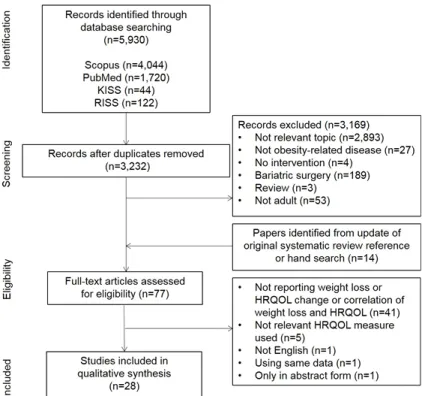
Fig. 1. Systematic review flow diagram. KISS: Korean Studies Information Service System, RISS: Research Information Sharing Service, HRQOL:
Health-Related Quality of Life.
암의 이환율을 증가시킬 뿐만 아니라 건강 관련 삶의 질에 도 부정적인 영향을 끼친다3). 이에 미국비만협회(American Obesity Association)와 유럽비만연구협회(European Association for the Study of Obesity) 등은 삶의 질 개선을 비만 치료의 최종적인 목표 중 하나로 두고 있다4). 이는 곧 비만 치료에 있어서도 환자의 건강 상태를 정량화하고 치료 효과를 입 증하기 위해 삶의 질을 보다 정확하고 객관적으로 측정해 야 할 필요성이 증가하였다는 것을 의미한다5).
이로 인해 비만 치료 전후의 삶의 질을 평가한 연구가 다수 진행되었으며6-8)이 중에서 Maciejewski 등6)은 체중 감량 후 삶의 질의 변화가 각 연구마다 일치하지 않는 이 유를 설문지에 따라 삶의 질에 미치는 체중 감량의 효과 를 상이하게 평가하고 있기 때문이라고 보고하였다. 이에 Accardi 등4)과 Lee9)는 고도 비만 환자의 비만 대사 수술 (bariatric surgery) 후의 삶의 질 변화를 보다 민감하게 반 영하는 삶의 질 설문지를 고찰하였다. 그러나 비만 대사 수술을 제외한 중재에서 삶의 질 변화에 미치는 영향을 평가하는 설문지에 대한 체계적인 연구는 아직 보고된 바 가 없었다. 따라서 본 연구에서는 수술을 제외한 중재에 서 비만 치료 후 건강과 관련한 삶의 질의 변화를 측정한
연구들을 분석하여 체중 감량 효과를 보다 더 민감하게 반영하는 삶의 질 설문지에는 어떤 것이 있는지 알아보고 자 한다.
재료 및 방법
1. 문헌 검색
국내 논문은 Research Information Sharing Service와 Korean Studies Information Service System을, 해외 논문은 PubMed와 Scopus에서 검색하였으며 기간은 2009년부터 2018년까지로 설정하였다. 검색어는 ‘비만’, ‘체중 감량’,
‘체중 감소’, ‘삶의 질’, ‘obesity’, ‘weight loss’, ‘weight change’,
‘weight reduction’, ‘quality of life’, ‘HRQOL’, ‘instrument(s)’,
‘questionnaire’, ‘measurement(s)’, ‘survey’, ‘Short Form’, ‘Short- Form’, ‘SF36’, ‘SF-36’, ‘SF12’, ‘SF-12’, ‘EQ-5D’, ‘Euroqol-5D’,
‘ORWELL’, ‘OWLQOL’, ‘IWQOL’, ‘OSQOL’, ‘KOQOL’,
‘OP-scale’, ‘OAS’, ‘WRSM’, ‘Lewin-TAG HSP’, ‘WHOQOL’,
‘Beck depression inventory’, ‘BDI’를 사용하였다. 주제와 관련된 연구를 효율적으로 찾고자 국내 논문은 ‘비만’, ‘체 중 감소’, ‘체중 감량’을 제목으로, ‘삶의 질’을 ‘All field’로
설정하고, 해외 논문은 모든 검색어를 ‘Title/abstract’로 검 색하였다(Fig. 1).
2. 선정 및 배제 기준
본 연구는 과체중 또는 비만인 성인을 대상으로 비만 대사 수술을 제외한 중재에서 Body Mass Index (BMI) 또 는 체중의 변화와 이에 따른 삶의 질 설문지 점수를 제시 한 연구를 포함하였다. 또한, 삶의 질에 영향을 미칠 수 있는 조현병, 암, 통증을 겪고 있는 환자 및 폐경 이후의 여성만을 대상으로 한 연구는 제외하였으며, 당뇨 등 비 만 합병증으로 알려진 질환은 포함하였다. 신뢰도와 타당 도가 검증되지 않거나 연구자가 임의로 작성한 설문지를 사용한 연구는 배제하였으며, 선행 연구에서6,7)비만 환자 의 정신적인 삶의 질을 측정하는 유효하고 신뢰성 있는 설문지로 Beck Depression Inventory (BDI)를 사용하여, 삶의 질을 측정하기 위해 개발된 설문지 이외에 BDI와 기타 우울증 설문지를 사용한 연구를 포함하였다.
3. 자료 분석
검색된 국내 논문 166편과 해외 논문 5,764편 중 28편 이 선택 기준을 충족하였으며 사용된 설문지의 종류에 따 라 분류하여 기술하고, 최종적으로 각각의 설문지별로 보 고된 체중 감량 후 삶의 질의 변화를 분석하였다.
결과 및 고찰
선정된 연구는 13개국에서 이뤄졌으며(미국 12, 캐나다 1, 영국 2, 프랑스 2, 이탈리아 1, 스웨덴 1, 독일 1, 노르웨 이 1, 스페인 1, 이스라엘1, 호주 1, 말레이시아 2, 한국 1, 네덜란드 1), 연구 대상자는 20,135명으로 평균 체질량지 수(BMI)는 28.6~47.9 kg/m2였고, 비교군으로 포함된 비만 대사 수술(bariatric surgery)을 제외하면 평균 체중 감량은 1.2~10.9 kg (1~9.3%)이었다.
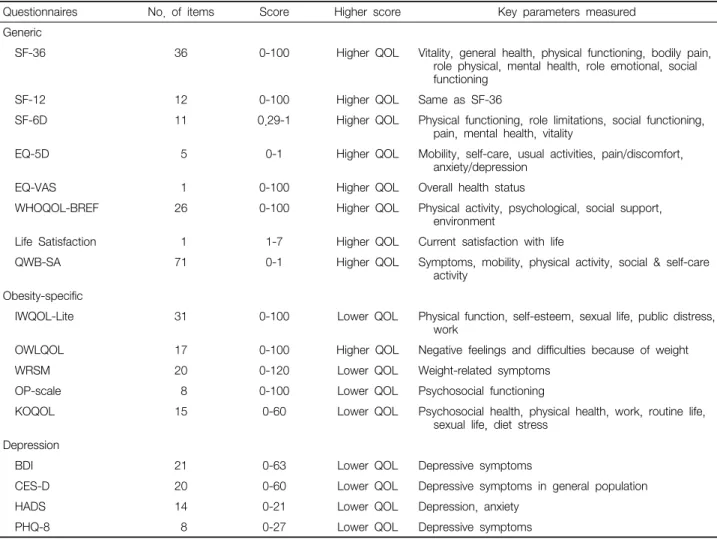
사용된 삶의 질 설문지는 건강 관련 삶의 질 설문지, 비만 관련 삶의 질 설문지 및 우울증 설문지로 분류할 수 있었으며, 이 중에서 가장 많이 활용된 설문지는 SF-36 (Short-Form health survey 36) (n=18), IWQOL-Lite (Impact of Impact in Weight on Quality of Life-Lite) (n=8), BDI (n=2)이었다. 선정된 연구에서 사용된 삶의 질 설문지의 특성은 Table 1에 요약 정리하였다.
검색된 연구들은 크게 건강 관련 삶의 질 설문지를 사 용한 연구(N=12), 비만 관련 삶의 질 설문지를 사용한 연 구(N=5), 건강 관련 삶의 질 설문지와 비만 관련 삶의 질 설문지를 함께 사용한 연구(N=6) 및 건강 관련 삶의 질 설 문지와 우울증 설문지를 함께 사용한 연구(N=5)로 분류하 여 정리하였다.
1. 건강 관련 삶의 질 설문지를 사용한 연구(Table 2)
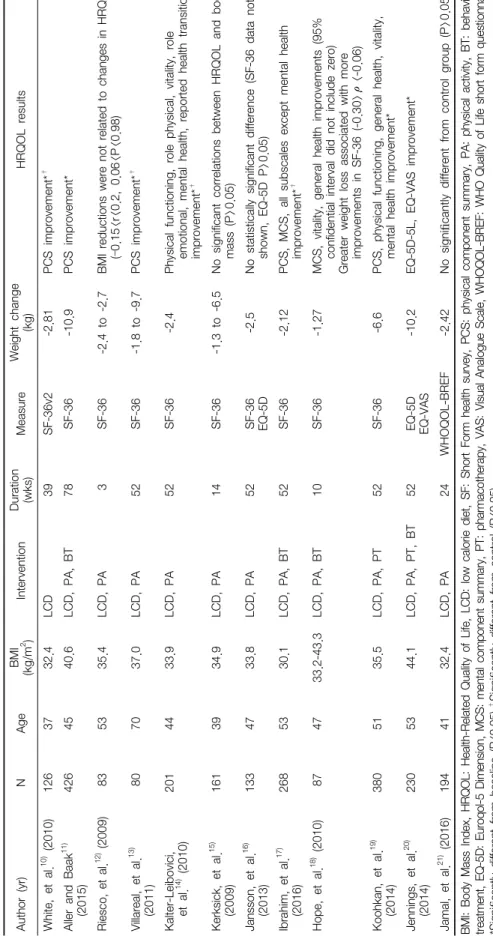
건강 관련 삶의 질 설문지만을 사용한 연구는 총 12편으 로 사용된 설문지에는 SF-36, EQ-5D (Euroqol-5 Dimension), WHOQOL-BREF (WHO Quality of Life short form ques- tionnaire) 등이 있었다.SF-36은 신체적 요소 요약(physical component summary, PCS) 점수와 정신적 요소 요약(mental component summary, MCS) 점수 및 8개의 하위 척도별로 점수가 보고된다(Table 1).
이로 인해 각 연구마다 PCS와 MCS 점수만 보고하거나10-13), 하위 척도의 점수만을 보고하는14)등 보고 방식이 일치하 지 않는 면이 있었다.
또한, 체중 감량 후 SF-36 점수 변화도 일치하지 않는 경향이 있었다. 체중 감량 후 SF-36의 점수에 유의한 변 화는 없다고 보고한 연구와12,15,16), SF-36의 PCS와 MCS가 모두 상승하였다고 보고한 연구가 있었다17). 또한, 체중 감량 후 SF-36의 PCS와 MCS가 모두 상승하나 통계적으 로 유의하게 증가한 것은 MCS라고 보고한 연구가18) 있는 반면, 체중 감량 후 SF-36의 PCS 점수는 유의하게 증가하 였으나, MCS 점수에는 차이가 없었다고 보고한 연구가 있었다10,11,13,19).
SF-36의 하위 척도 변화를 살펴보면, 체중 감량 후 활력 (vitality), 신체적 기능(physical functioning) 항목이 증가하 는 것으로 보고한 연구들이 있었으며14,17,19), 활력(vitality) 항목이 체중 변화의 정도와 가장 상관성이 높다고 보고한 연구가 있었다18). 정신적 건강(mental health) 항목의 경우 체중 감량 후 변화하지 않았다고 보고한 연구와14,17), 증가 하였다고 보고한 연구가 있었다19).
EQ-5D를 사용하여 체중 감량 후 삶의 질의 변화를 평 가한 연구는 2편으로 Jansson 등16)은 평균 2.5 kg의 체중 감량 후 EQ-5D가 유의한 변화가 없었다고 보고하였으며, Jennings 등20)은 평균 10.2 kg의 체중 감량 후 EQ-5D 점수 가 상승하였다고 보고하였다.
WHOQOL-BREF를 사용한 연구에서는 체중 감량 후
Questionnaires No. of items Score Higher score Key parameters measured Generic
SF-36 36 0-100 Higher QOL Vitality, general health, physical functioning, bodily pain, role physical, mental health, role emotional, social functioning
SF-12 12 0-100 Higher QOL Same as SF-36
SF-6D 11 0.29-1 Higher QOL Physical functioning, role limitations, social functioning, pain, mental health, vitality
EQ-5D 5 0-1 Higher QOL Mobility, self-care, usual activities, pain/discomfort, anxiety/depression
EQ-VAS 1 0-100 Higher QOL Overall health status
WHOQOL-BREF 26 0-100 Higher QOL Physical activity, psychological, social support, environment
Life Satisfaction 1 1-7 Higher QOL Current satisfaction with life
QWB-SA 71 0-1 Higher QOL Symptoms, mobility, physical activity, social & self-care activity
Obesity-specific
IWQOL-Lite 31 0-100 Lower QOL Physical function, self-esteem, sexual life, public distress, work
OWLQOL 17 0-100 Higher QOL Negative feelings and difficulties because of weight
WRSM 20 0-120 Lower QOL Weight-related symptoms
OP-scale 8 0-100 Lower QOL Psychosocial functioning
KOQOL 15 0-60 Lower QOL Psychosocial health, physical health, work, routine life, sexual life, diet stress
Depression
BDI 21 0-63 Lower QOL Depressive symptoms
CES-D 20 0-60 Lower QOL Depressive symptoms in general population
HADS 14 0-21 Lower QOL Depression, anxiety
PHQ-8 8 0-27 Lower QOL Depressive symptoms
SF: Short Form health survey, QOL: Quality of Life, EQ-5D: Euroqol-5 Dimension, VAS: Visual Analogue Scale, WHOQOL-BREF: WHO Quality of Life short form questionnaire, QWB-SA: Self-administered Quality of Well-Being index, IWQOL: Impact of Weight on Quality Life, OWLQOL:
Obesity and Weight-Loss Quality of Life, WRSM: Weight-Related Symptoms Measure, OP-scale: Obesity-related Problem-scale, KOQOL: Korean Obesity Quality of Life, BDI: Beck Depression Inventory, CES-D: Center for Epidemiologic Studies Depression Scale, HADS: Hospital Anxiety Depression questionnaire, PHQ: Patient Health Questionnaire.
Table 1. Characteristics of Health-Related Quality of Life Questionnaires in Included Studies
모든 항목이 상승하였으나 대조군과 차이는 없었다고 보 고하였다21).
2. 비만 관련 삶의 질 설문지를 사용한 연구(Table 3)
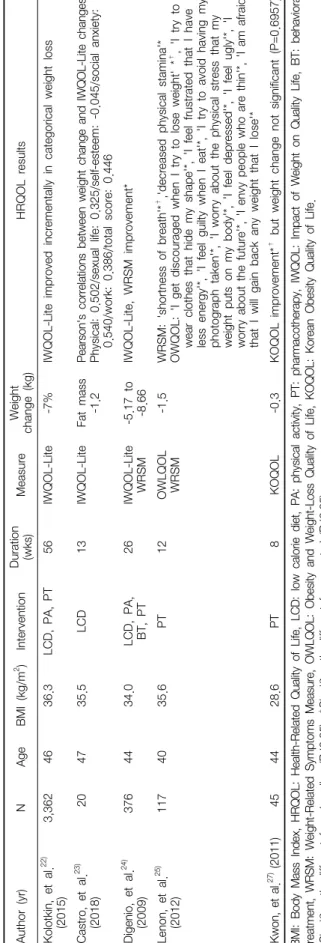
비만 관련 삶의 질 설문지만 사용한 연구는 총 5편이었 으며, 사용된 설문지에는 IWQOL-Lite, OWLQOL (Obesity and Weight-Loss Quality of Life), WRSM (Weight-Related Symptoms Measure) 및 KOQOL (Korean Obesity Quality of Life)이 있었다.IWQOL-Lite를 사용한 3편의 연구에서는 체중 감량 후 삶의 질이 모두 개선되었다22-24). 또한, 감소된 체중이 클수 록 IWQOL-Lite 점수가 증가하였는데22,23), 특히 Kolotkin
등22)은 초기 체중의 15% 이상을 감량한 그룹의 IWQOL-Lite 총 점수가 가장 높게 증가하였으며 이는 중재 방법과는 차이가 없었다고 보고하였다.
IWQOL-Lite의 하위 척도를 보고한 연구를 살펴보면, 체 중 감량 후 다섯 가지 하위 항목(physical function, self-es- teem, sexual life, public distress, work)이 고르게 증가하는 경향을 보였으나 자존감(self-esteem) 항목에는 차이가 있 었다. Kolotkin 등22)은 신체적 기능(physical function), 자 존감(self-esteem), 성생활(sexual life), 작업 능력(work) 등 에서 고르게 개선되었다고 보고하였으나 Castro 등23)은 IWQOL-Lite의 자존감(self-esteem)을 제외한 모든 항목에 서 체중 변화와 유의한 상관관계가 있었다고 보고하였다.
Au thor (yr ) N Age BM I (kg/m
2) Interven tion Du ra tion (wks) M easure Weigh t chan ge (kg) HRQOL resu lts Wh ite, et al.
10)(2010) 126 37 32.4 LCD 39 SF -36v2 -2.81 PCS im provem ent*
†Alle r an d Ba ak
11)(2015) 426 45 40.6 LCD , PA, BT 78 SF -36 -10.9 PCS im provem ent* Riesc o, et al.
12)(2009) 83 53 35.4 LCD , PA 3 SF -36 -2.4 to -2.7 BM I redu ctions were not rela ted to cha nges in H RQOL (– 0.15<r<0.2, 0.06<P <0.98) Villareal, et al.
13)(2011) 80 70 37.0 LCD , PA 52 SF -36 -1.8 to -9.7 PCS im provem ent*
†Kalte r-L eibovici, et al.
14)(2010) 201 44 33.9 LCD , PA 52 SF -36 -2.4
Physic al fun ctionin g, role physic al, vitality, role em otional, m en tal hea lth, re por te d health tran sition im provem ent*
†Kerksick, et al.
15)(2009) 161 39 34.9 LCD , PA 14 SF -36 -1.3 to -6.5 No signific ant correlation s be tween H RQOL and body m ass (P>0.05) Ja ns so n, et al .
16)(2013) 133 47 33.8 LCD , PA 52 SF -36 EQ-5D -2.5 No statistica lly sign ifica nt diffe re nce ( SF-36 data n ot sh own, EQ-5D P>0.05) Ibr ahim , et al.
17)(2016) 268 53 30.1 LCD , PA, BT 52 SF -36 -2.12 PCS , M C S, all subsca les exce pt m ental he alth im provem ent*
†Hope , et a l.
18)(2010) 87 47 33.2-43.3 LCD , PA, BT 10 SF -36 -1.27 M CS, vitality, gen eral hea lth im pr ove m ents (95% confide ntial inte rva l did not inc lude zero) Gr eater weight loss associa ted with m or e im provem ents in SF-36 (-0.30> ρ<-0.06) Koohkan , et al .
19)(2014) 380 51 35.5 LCD , PA, PT 52 SF -36 -6.6 PCS , ph ysical fu nction ing, gene ra l health , vita lity, m ental he alth im provem en t* Jenn ings, et al.
20)(2014) 230 53 44.1 LCD , PA, PT, BT 52
EQ-5D EQ- -10.2 EQ-5D -5L, EQ-VA S im pr ove m ent* VA S
21)Jam al, et al. (2016) 194 41 32.4 LCD , PA 24 W HOQOL-BRE F -2.42 No signi fican tly dif feren t from con trol group (P> 0.05) BM I: Bod y M ass Ind ex, H RQO L: H eal th- Rel at ed Qual ity of Li fe, LC D: low cal or ie di et , SF: S hort For m heal th survey, P C S: p hys ical co m ponent s um m ary, P A: p hy sical act ivi ty, B T: b ehav ioral treat m ent , EQ-5D : Euroq ol -5 D im ens ion, M CS: m ent al com po nent sum m ar y, P T: p har m acot her ap y, V AS : Vi sual A nal og ue Scal e, W H O Q O L-B RE F: W H O Qual ity of Li fe sho rt fo rm q ues tionnai re.
†*S ig ni ficant ly di fferent f ro m b asel ine (P <0. 05 ). Si gn ifi cant ly di ffer ent f ro m co nt ro l ( P< 0. 05 ).
Ta bl e 2. St ud ies on H eal th-R el at ed Qual ity o f Li fe C hanges Fo llo w ing W eight Loss b y G ener ic Quest ionnai res (N =12)
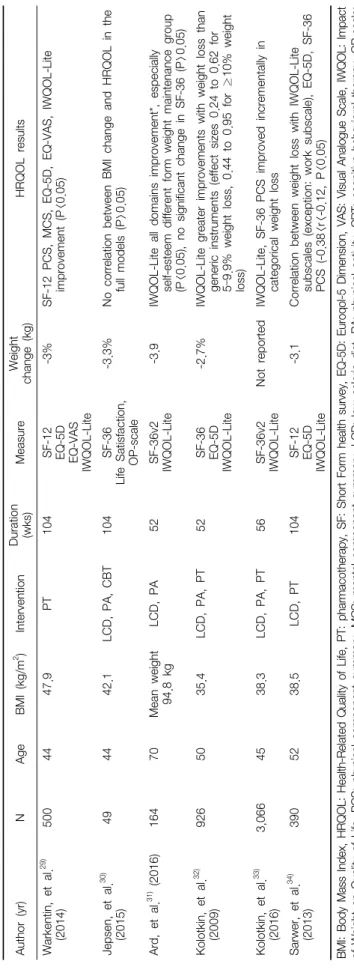
Digenio 등24)은 IWQOL-Lite와 WRSM 설문지를 같이 사용하였는데 체중 감량 후 두 설문지의 점수가 개선되었 고 중재 방법에 따른 차이는 나타나지 않았다고 보고하였 다. Lenon 등25)의 연구에서는 OWLQOL과 WRSM을 같이 사용하였는데, 체중 감량 후 WRSM의 ‘shortness of breath’
항목과 OWLQOL의 ‘I get discouraged when I try to lose weight’ 항목이 개선되었다.
KOQOL은 2003년에 개발된 한국형 비만 관련 삶의 질 측정도구로 15개 문항으로 구성되었으며 신뢰도와 타당 도가 검증되었으나26), KOQOL을 사용한 국내 연구가 대 부분 체중 감량 전의 초기 삶의 질을 보고하고 있다. 유일 하게 Kwon 등27)이 사용하였는데 평균 체중 변화가 0.3 kg 에 그쳐 체중 감량에 따른 삶의 질의 변화를 확인하기 어 려웠다. 최근 10년간 조사에서는 제외되었으나 2006년 발 표된 Lee 등28)의 논문에서 평균 6.3 kg의 체중 감량 후 KOQOL 점수가 상승하였으며 정신 사회적 건강, 직장 및 가사업무, 일상생활, 성관계 항목은 모두 향상되었으나 그 에 반해 식사 관련 삶의 질이 낮아지는 점을 보고하였다.
3. 건강 관련 삶의 질 설문지와 비만 관련 삶의 질 설문지 를 함께 사용한 연구(Table 4)
총 6편의 연구에서 건강 관련 삶의 질 설문지와 비만 관련 삶의 질 설문지가 함께 사용되었다.
설문지의 종류가 다르더라도 체중 감량 후 삶의 질의 변화 에 대한 결과는 일치하는 연구들이 있었는데, Warkentin 등29) 의 연구에서 체중 감량 후 건강 관련 삶의 질 설문지인 SF-12 (Short Form health survey-36, SF-36의 축약버전), EQ-5D (Euroqol-5D)와 비만 관련 삶의 질 설문지인 IWQOL-Lite 가 모두 증가하였고, Jepsen 등30)의 연구에서 건강 관련 삶 의 질 설문지인 SF-36, Life Satisfaction 설문지와 비만 관련 삶의 질 설문지인 OP-scale (Obesity-related Problem-scale)의 변화는 모두 통계적으로 유의하지 않았다.
그러나 설문지에 따라 체중 감량 후 삶의 질의 변화가 일치하지 않는 연구들도 존재하였다. Ard 등31)은 체중 감 량 후 건강 관련 삶의 질 설문지인 SF-36에는 유의한 변화 가 없었으나, 비만 관련 삶의 질 설문지인 IWQOL-Lite의 자존감(self-esteem) 항목은 개선되었다고 보고하였고, Kolotkin
등32,33)은 체중 감량률에 따라 IWQOL-Lite와 SF-36의 신체
적 요소 요약(PCS) 점수가 증가하였으나, SF-36의 정신적 요소 요약(MCS) 점수는 감소하였다고 보고하였다. 또한,
Au thor (yr ) N Age BM I (k g/ m
2) In tervention Du ra tio n (w ks ) M easu re Weigh t chan ge (kg) H RQOL re sults Kolotkin, et al.
22)(2015) 3,362 46 36.3 LCD , PA, PT 56 IW QOL-Lite -7% IW QOL-Lite im proved inc re m enta lly in c ategorica l we ight loss Ca str o, et al.
23)(2018) 20 47 35.5 LC D 13 IW QOL-Lite Fat m ass -1.2 Pe arso n's co rre la tion s betw een w ei ght cha ng e and IW QO L-L ite cha ng es Physic al: 0.502/sexu al life: 0.325/se lf-este em : -0.045/socia l anxiety: 0.540/ wor k: 0.386/total score: 0.446 D igenio, et al.
24)(2009) 376 44 34.0 LCD , PA, BT, PT 26 IW QOL-Lite WR SM -5.17 to -8.66 IW QOL-Lite , W RSM i m pr ove m ent* Le non, et al.
25)(2012) 117 40 35.6 PT 12 OWLQOL WR SM -1.5 WRSM : 'shortne ss of brea th'*
†,'dec re ased physic al stam ina '* OWQOL: 'I ge t disc ouraged whe n I try to lose weigh t' *
†, 'I try to we ar clothes tha t hide m y sh ape'* , 'I fee l fru str ated that I have le ss energy'*, 'I feel guilty whe n I ea t'*, 'I try to avoid ha ving m y ph otogr aph taken'* , 'I wor ry about the ph ysical stress that m y we ight puts on m y body'* , 'I fee l de pr essed'*, 'I feel ugly'* , 'I worry about th e fu ture'*, 'I en vy people wh o are thin '*, 'I am af ra id th at I will gain bac k an y we ight that I lose '* Kw on , et a l.
27)(2011) 45 44 28 .6 PT 8 KO QO L -0 .3 KO QO L im pr ov em en t*
†but weight chan ge not signific ant (P= 0.6957) BM I: Bod y M as s Ind ex, H RQO L: H eal th-R el at ed Q ual ity of Li fe, LC D: l ow cal ori e di et , PA: p hysi cal act ivi ty , PT: p harm acot herap y, I W QO L: I m pact of W ei ght on Q ual ity Li fe, B T: b ehav ioral treat m ent , W RSM : W ei ght -R elat ed S ym pt om s M easur e, O W LQO L: O besi ty and W ei ght -Lo ss Qual ity o f Li fe, K O QO L: K or ean O bes ity Qual ity of L ife . *S ig ni ficant ly di fferent f ro m b asel ine (P <0. 05 ).
†Si gni ficant ly di ffer ent f rom cont rol ( P<0 .05) .
Ta bl e 3. St ud ies on H eal th-R el at ed Qual ity o f Li fe C hanges Fo llo w ing W eight Loss b y O besi ty-Sp eci fic Quest ionnai res (N =5)
Au thor (yr ) N Age BM I (kg/m
2) In tervention Du ra tion (wks) Me as ur e We ig ht ch ange ( kg) HRQOL results Wa rken tin, et al.
29)(2014) 500 44 47.9 PT 104 SF-12 EQ-
5D EQ- VAS IWQOL-L ite
-3% SF-12 PCS , M C S, EQ-5D , EQ-V AS , IWQOL -Lite im provem en t (P<0.05) Jepsen , et al.
30)(2015) 49 44 42.1 LCD , PA, CBT 104 SF-36 Life S atisfa ction, OP -scale
-3.3% N o cor rela tion be tween BM I chan ge and HRQOL in the fu ll m ode ls (P>0.05) Ard, et al.
31)(2016) 164 70 M ea n weight 94.8 kg LCD , PA 52 SF-36v2 IWQOL-L ite -3.9 IWQOL -Lite all dom ain s im provem ent*, espe cially self -estee m dif feren t for m weigh t m ainten anc e gr ou p (P <0.05), no signif ican t chan ge in SF-36 (P >0.05) Kolotkin, et al.
32)(2009) 926 50 35.4 LCD , PA, PT 52
SF-36 EQ-
5D IWQOL-L ite
-2.7% IWQOL -Lite greate r im provem en ts with we ight loss th an gen eric instrum en ts (eff ect sizes 0.24 to 0.62 for 5– 9.9% weight loss, 0.44 to 0.95 for ≥10% weight loss) Kolotkin, et al.
33)(2016) 3,066 45 38.3 LCD , PA, PT 56 SF-36v2 IWQOL-L ite N ot reported IWQOL -Lite, SF -36 PCS im proved increm entally in ca tegorical weigh t loss Sa rwe r, et al.
34)(2013) 390 52 38.5 LC D, PT 104
SF-12 EQ-
5D IWQOL-L ite
-3.1 C or rela tion betwee n weight loss with IW QOL-Lite subsc ales (e xception : work su bscale ), EQ-5D , SF-36 PC S (-0.38<r<-0.12, P< 0.05) BM I: Bo dy M ass Ind ex, H RQO L: H eal th-R el at ed Qual ity of Li fe, P T: p harm acot herap y, SF: Sho rt For m heal th survey, EQ -5 D: E ur oq ol -5 Di m ensi on, VA S: Vi sual Anal ogue Scal e, IW QO L: Im pact of W ei ght on Qual ity of Li fe, P C S: p hy sical com ponent sum m ar y, M C S: m ent al com po nent s um m ary, LC D: low cal or ie di et , PA : physi cal act ivi ty , CB T: co gni tive behavi or al t her ap y, O P-scal e: O bes ity-r elat ed P ro bl em -scal e. *S ig ni ficant ly di fferent f ro m b asel ine (P <0. 05 ).
Ta bl e 4. St ud ies on H eal th-R el at ed Qual ity o f Li fe C hanges Fo llo w ing W eight Loss b y G ener ic and O besi ty -S peci fic Quest io nnai res ( N=6 )
Kolotkin 등32)의 연구에서 체중 감량률에 따른 비만 관련 삶의 질 설문지인 IWQOL-Lite의 변화는 건강 관련 삶의 질 설문지인 EQ-5D보다 효과가 더 컸으며, Sarwer 등34)의 연구에서 비만 관련 삶의 질 설문지인 IWQOL-Lite는 건 강 관련 삶의 질 설문지인 SF-36 및 EQ-5D와 동시에 사용 하였을 때 체중 변화와 상관성이 더 큰 것으로 나타났다.
4. 건강 관련 삶의 질 설문지와 우울증 설문지를 함께 사 용한 연구(Table 5)
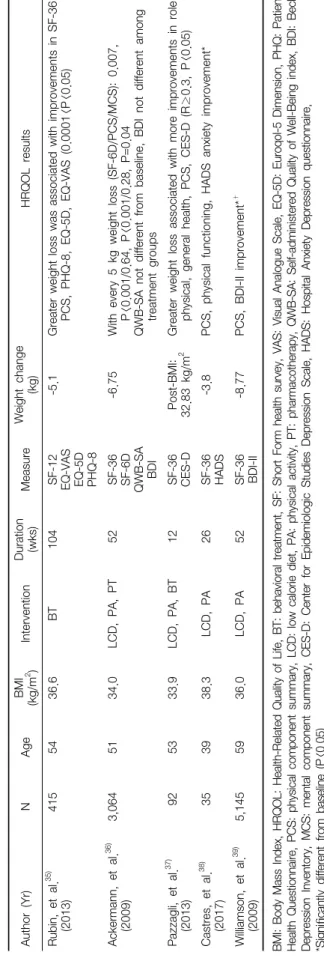
선정된 연구에서 사용된 우울증 설문지는 BDI, CES-D (Center for Epidemiologic Studies Depression Scale), HADS (Hospital Anxiety Depression questionnaire), PHQ-8 (Patient Health Questionnaire-8)이다. 그 중 BDI가 2편, 나머지는 각각 한 편으로 총 5편의 연구에서 우울증 설문지가 사용 되었으며, 이들은 모두 건강 관련 삶의 질 설문지인 SF-36 (또는 SF-12)와 함께 사용되었다.
우울증 설문지를 사용한 연구에서 모두 체중 감량 후 우울도가 개선되었다고 보고되었으나, 병용된 SF-36 (또 는 SF-12)의 결과와는 일치하지 않는 경향이 있었다. 체중 감량 후 SF-12 또는 SF-36의 정신적 요소 요약(MCS) 점수 와 각각 PHQ-8과 BDI로 측정된 우울도가 모두 개선된 것 으로 보고한 연구가 있었다35,36). 그러나 각각 CES-D, HADS 및 BDI-II로 측정된 우울도는 체중 감량 후 개선이 되었으 나 SF-36로 측정한 삶의 질의 정신적 측면에는 유의한 변 화가 나타나지 않은 연구 결과도 있었다37-39).
이상에서 체중 감량이 삶의 질 개선에 미치는 영향을 연구한 28편의 연구를 살펴본 결과, 이 중에서 22편이 체 중 감량 후 삶의 질이 개선되었다고 보고하였다10,11,13,14,17-20,
22-25,29,31-39). 그러나 사용된 설문지별로 체중 감량 후 삶의
질의 개선과 하위 척도(subscale)의 변화가 일치하지 않는 면이 있어 이를 간략하게 정리하여 분석하였다(Table 6).
일반적인 건강 관련 삶의 질 설문지에는 SF-36, SF-12, EQ-5D, WHOQOL-BREF, Life Satisfaction, QWB-SA (Self-ad- ministered Quality of Well-Being index) 등이 있었다. SF-36 또는 SF-12를 사용하여 체중 감량과 삶의 질 개선을 평가한 연구를 분석한 결과, 21편의 연구 중 16편에서 체중 감량 후 삶의 질이 개선되었다고 보고하였다. 하위 척도(subscale)를 분석한 결과에서는 신체적 요소 요약(PCS), ‘vitality’, ‘general health’, ‘physical functioning’, ‘role physical’의 점수가 증
가하여, 정신적인 측면보다 주로 신체적인 측면과 활력에
Au thor
(Yr) N Age BM I (kg/m
2) Inte rve ntion Du ra tio n (w ks ) Me as ur e Weigh t chan ge (kg) HRQOL results Ru bi n, et al .
35)(2013) 415 54 36.6 BT 104
SF-12 EQ- VAS EQ- 5D PHQ-8
-5.1 Greate r we ight loss wa s assoc iated with im provem en ts in SF-36 PCS , PHQ-8, EQ-5D , EQ-V AS ( 0.0001<P< 0.05) Ac ke rm ann, et al.
36)(2009) 3,064 51 34.0 LC D, PA , PT 52
SF-36 SF -6 D QWB-S A BD I
-6.75 With e very 5 kg we ight loss (SF-6D /P CS/ M CS) : 0.007, P<0.001/ 0.64, P<0.001/0.28, P= 0.04 QW B- SA n ot d iff er en t fro m b as el in e, B D I n ot d iff er en t a m on g tre atm en t groups Pa zzagli, et al.
37)(2013) 92 53 33.9 LCD , PA, BT 12
SF-36 CE Po st -B MI : Greate r weigh t loss assoc iated with m ore im pr ove m ents in role
2S-D 32.83 kg/ m physica l, ge neral he alth, PC S, CE S-D ( R≥0.3, P<0.05)
38)Ca str es, et al. 35 39 38.3 LC D, PA 26 (2017)
SF-36 HAD
S -3.8 PC S, physica l func tioning, HA DS a nxiety im provem en t* Willia m son, et al.
39)(2009) 5,145 59 36.0 LC D, PA 52
SF-36 BDI-II
-8.77 PC S, BDI-II im provem en t*
†Ta bl e 5. St ud ies on H eal th-R el at ed Qual ity o f Li fe C hanges Fo llo w ing W eight Loss b y G ener ic and D ep res sio n Quest ionnai res (N =5) BM I: Bo dy M ass Ind ex, H RQO L: H eal th-R el at ed Qual ity of Li fe, B T: b ehavi or al treat m ent , SF: S hort Fo rm heal th sur vey, V AS : Vi sual A nal ogue Scal e, E Q-5D : Eur oq ol -5 Di m ens ion, P H Q: P at ient H eal th Quest ionnai re, P C S: p hysi cal com po nent s um m ary, LC D: low cal ori e di et , PA : physi cal act ivi ty, PT : pharm acot herap y, Q W B-S A: Sel f-ad m ini st ered Qual ity of W el l-B eing ind ex, B DI : Beck Dep res sio n Invent or y, M CS: m ent al co m ponent sum m ar y, C ES -D : C ent er for Ep id em iol ogi c St ud ies Dep res sio n Scal e, H AD S: H osp ital A nx iet y Dep res sio n ques tionnai re, *S ig ni ficant ly di ffer ent f rom b asel ine (P< 0. 05) .
Questionnaires HRQOL result following weight loss Improvement of subscales following weight loss Generic
SF-36 (+)
10,11,13,14,17-19,32,33,35-39)(∙)
12,15,16,30,31)PCS
10,11,13,17,19,32,33,35-39), MCS
17,18,36)Vitality
13,14,17-19,25), generalhealth
13,14,17-19,36,37),
physicalfunctioning
13,14,17-19,25), bodilypain
14,17),
rolephysical
13,14,17,25,36,37), mentalhealth
14,18,19,25), roleemotional
14,17), socialfunctioning
17)SF-12 (+)
29,34,35)PCS
29,34,35), MCS
29,35)SF-6D (+)
36)No subscale
EQ-5D (+)
20,29,32,34,35)/(∙)
16)NR
EQ-VAS (+)
20,29,35)No subscale
WHOQOL-BREF (∙)
21)No significant change
Life Satisfaction (∙)
30)No subscale
QWB-SA (∙)
36)NR
Obesity-specific
IWQOL-Lite (+)
22-24,29,31-34)Physical function
22,23,32,34), self-esteem
22,31,32,34), sexuallife
22,23,32,34), publicdistress
22,23,32,34), work
22,23,32)OWLQOL (+)
25)I get discouraged when I try to lose weight
25)WRSM (+)
24,25)Shortness of breath
25)OP-scale (∙)
30)NR
KOQOL (∙)
27)NR
Depression
BDI (+)
36,39)NR
CES-D (+)
37)NR
HADS (+)
38)Anxiety
38)PHQ-8 (+)
35)NR
HRQOL: Health-Related Quality of Life, SF: Short Form health survey, PCS: physical component summary, MCS: mental component summary, EQ-5D: Euroqol-5 Dimension, NR: not reported, VAS: Visual Analogue Scale, WHOQOL-BREF: WHO Quality of Life short form questionnaire, QWB-SA: Self-administered Quality of Well-Being index, IWQOL: Impact of Weight on Quality of Life, OWLQOL: Obesity and Weight-Loss Quality of Life, WRSM: Weight-Related Symptoms Measure, OP-scale: Obesity-related Problem scale, KOQOL: Korean Obesity Quality of Life, BDI: Beck Depression Inventory, CES-D: Center for Epidemiologic Studies Depression Scale, HADS: Hospital Anxiety Depression questionnaire, PHQ: Patient Health Questionnaire.
Table 6. Impact of Weight Loss on Health-Related Quality of Life Focusing on Questionnaires
서 개선되었으며 이는 선행 연구의 결과와 일치하였다7). EQ-5D를 사용하여 체중 감량과 삶의 질 개선을 평가한 연구를 분석한 결과, 6편의 연구 중 5편에서 삶의 질이 개 선되었음을 보고하였다. 하위 척도의 변화는 보고하지 않 았으나, EQ-5D의 측정 항목 자체가 신체적인 측면에 초 점을 맞추고 있어 정신적인 삶의 질을 반영하는 데 제한 적일 수 있다4). WHOQOL-BREF, QWB-SA 및 Life sat- isfaction은 각각 1편의 연구에서 사용하였으나 체중 감량 후 유의한 변화가 나타나지 않았고, WHOQOL-BREF가 비만과 관련된 장애 및 불편감을 측정하기에 적합하지 않 다고 보고한 선행 연구가 있었다4).
비만 관련 삶의 질 평가도구에는 IWQOL-Lite, OWLQOL, WRSM, OP-scale, KOQOL이 있었다. IWQOL-Lite를 사용
한 8편의 연구를 분석한 결과 모두 체중 감량 후 HRQOL 이 개선되었으며, 특히 체중 감량이 클수록 증가하는 경 향을 보였고22,23,29,32,33), EQ-5D와 비교 시 효과가 더 컸으 며32), SF-36 및 EQ-5D와 동시에 사용하였을 때 체중 변화 와의 상관성이 더 크게 나타났다34). 하위 척도 분석에서는 신체적 기능, 자존감, 성생활, 작업 능력 등에서 고르게 개 선된 것으로 나타났다. OWLQOL과 WRSM, OP-scale과 KOQOL은 사용된 연구의 수가 적어서 체중 감량 효과를 민감하게 반영하는지 확인하기 어려운 면이 있었다. 그러 나 OP-scale은 절반만 답해도 계산이 가능하고 신뢰도 및 타당도가 검증된 한글판이 개발되었으며9), KOQOL은 한 국 고유의 문화를 반영하며 번역에 대한 별도의 노력이 필 요하지 않아26)임상에서 활용하기 용이하다고 할 수 있다.
우울증 설문지에는 BDI, CES-D, HADS, PHQ-8이 있었 다. 그 중 BDI가 2편, 나머지 설문지들은 각각 1편의 연구 에서 사용되었다. 우울증 설문지를 사용한 연구에서 모두 체중 감량 후 우울도가 개선되었다고 보고하였으나 동일 연구에서 사용된 SF-36 (또는 SF-12)의 정신적 요소 요약 점수(MCS)에는 유의한 변화가 나타나지 않았다37-39).
이상에서 고찰한 바와 같이, 비만 관련 삶의 질 설문지인 IWQOL-Lite가 사용된 모든 연구에서 체중 감량 후 삶의 질이 개선된 것으로 나타났으며, SF-36이나 EQ-5D에 비해 체중 감량 정도에 따라 변화하는 경향을 보여, 체중 감량 효과를 보다 민감하게 반영하는 것으로 나타났다. 가장 많 이 사용된 SF-36은 체중 감량 후 삶의 질의 개선 여부와 하 위 항목의 결과가 연구마다 일치하지 않는 경향을 보였다.
이는 건강 관련 삶의 질을 측정할 때 일반적인 설문지를 사용하는 것보다는 목적에 맞게 특수하게 제작된 설문지 를 사용하는 것이 치료 효과를 보다 민감하게 반영하기 때 문인 것으로 보인다26). 예를 들어 SF-36은 일반적인 신체 기능, 활력, 기분 등의 항목으로 구성되어 체중으로 인해 야기되는 자존감, 성생활 등의 문제를 반영하기 어려운 측 면이 있고40), 정신적 측면의 삶의 질보다는 신체적 측면의 삶의 질을 보다 민감하게 반영하는 경향이 있어서7) 우울 정도가 심한 경우는 우울증 설문지로 추가적인 평가가 필 요하다41). 그러나 SF-36은 가장 널리 사용되는 건강 관련 삶의 질 설문지이며, 비만 이외에 다른 요인들이 삶의 질 에 미치는 영향을 포괄할 수 있는 장점이 있다40). Kolotkin 등32)은 체중 감량 후 IWQOL-Lite, SF-36 및 EQ-5D의 결과 가 상이한 면이 있어 건강 관련 삶의 질(HRQOL) 측정 시 두 가지 이상의 설문지를 사용할 필요가 있다고 하였다. 이 는 삶의 질의 개념이 매우 광범위하고 다각적이며 주관적 이어서5) 설문지마다 평가할 수 있는 영역에 한계가 있기 때문인 것으로 보인다. 따라서 비만 치료 시 삶의 질을 평 가하기 위해서 IWQOL-Lite, SF-36 (또는 SF-12)과 우울증 설문지를 함께 활용한다면 체중 감량이 삶의 질의 변화에 미치는 효과를 보다 다면적으로 평가할 수 있을 것으로 생 각된다.
결론
건강 관련 삶의 질 측정은 환자가 주관적으로 인식하 는 건강 상태를 보다 명확하게 확인할 수 있는 방법이며,
삶의 질 개선이 비만 치료의 중요한 목표 중 하나이므로 치료 효과를 확인할 수 있는 수단이 된다. 그러나 삶의 질 은 광범위하고 주관적인 개념으로 설문지에 따라 일치하 지 않는 결과를 나타낼 수 있으므로 이번 연구에서는 체 중 감량이 삶의 질에 미치는 영향을 보다 민감하게 평가 할 수 있는 설문지를 알아보고자 하였다.
선정된 연구에서 삶의 질을 평가하기 위해 사용된 설 문지는 크게 건강 관련 삶의 질 설문지, 비만 관련 삶의 질 설문지 및 우울증 설문지로 분류할 수 있으며, 각각 SF-36, IWQOL-Lite 및 BDI가 가장 많이 사용되었다. SF-36 또는 SF-12가 사용된 21편의 연구 중 16편에서 체중 감량 후 삶의 질이 개선되었다고 보고하였으며, 정신적인 측면보 다 신체적인 측면과 활력에서 주로 개선되는 경향을 나타 냈다. IWQOL-Lite는 사용된 8편의 연구에서 모두 체중 감량 후 삶의 질이 개선되었으며, 체중 감량 정도에 따라 보다 민감하게 반응하였다. BDI를 포함한 우울증 설문지 는 SF-36 또는 SF-12와 함께 사용되었으며, SF-36 (또는 SF-12)의 정신적 요소 요약(MCS) 점수에서는 체중 감량 의 효과를 민감하게 반영하지 못하였으나 우울증 설문지 에서는 우울 또는 불안이 개선되었다고 나타났다.
설문지에 따라 체중 감량 후 삶의 질의 변화를 다르게 보고하는 경향이 있어 설문지 선정 시 내용의 타당도와 신뢰도, 임상에서의 활용이 용이한지와 더불어 치료 효과 를 민감하게 반영하는지 고려해야 한다. 이에 삶의 질 설 문지를 비교한 결과 IWQOL-Lite가 체중 감량 효과를 가 장 민감하게 반영하는 것으로 나타났으며, IWQOL-Lite, SF-36 및 우울증 설문지를 함께 활용한다면 체중 감량이 건강 관련 삶의 질에 미치는 효과를 다면적으로 평가할 수 있을 것으로 생각된다.
References
1. Kwon YD. The health-related quality of life of obesity.
J Korean Med Obes Res. 2004 ; 4(1) : 125-37.
2. Min SK, Kim KI, Suh SY, Kim DK. Development of Korean Version of World Health Organization Quality of Life Scale (WHOQOL). J Korean Neuropsychiatr Assoc.
2000 ; 39(1) : 78-88.
3. Kawachi I. Physical and psychological consequences of weight gain. J Clin Psychiatry 1999 ; 60(21) : 5-9.
4. Accardi R, Fave AD, Ronchi S, Terzoni S, Racaniello E, Destrebecq A. The role of quality of life instruments in obesity management: Review. Bariatr Surg Pract Patient Care. 2017 ; 12(4) : 145-52.
5. Park HJ, Kim SH, Bae SC. Current status of health-re- lated quality of life research in Korea. J Rheum Dis.
2002 ; 9(4) : S1-17.
6. Maciejewski ML, Patrick DL, Williamson DF. A struc- tured review of randomized controlled trials of weight loss showed little improvement in health-related quality of life. J Clin Epidemiol. 2005 ; 58(1) : 568-78.
7. Warkentin LM, Das D, Majumdar SR, Johnson JA, Padwal RS. The effect of weight loss on health-related quality of life: systematic review and meta-analysis of randomized trials. Obes Rev. 2014 ; 15(1) : 169-82.
8. Kroes M, Osei-Assibey G, Baker-Searle R, Huang J.
Impact of weight change on quality of life in adults with overweight/obesity in the United States: a system- atic review. Curr Med Res Opin. 2015 ; 32(3) : 485-508.
9. Lee YJ. Assessing quality of life for morbidly obese patient. J Metab Bariatr Surg. 2012 ; 1(2) : 93-7.
10. White C, Drummond S, Looy AD. Comparing advice to decrease both dietary fat and sucrose, or dietary fat only, on weight loss, weight maintenance and perceived qual- ity of life. Int J Food Sci Nutr. 2010 ; 61(3) : 282-94.
11. Aller EEJG, Baak MAV. Evaluation of an 18-month commercial multidisciplinary obesity treatment programme.
Clin Obes. 2015 ; 6(1) : 33-41.
12. Riesco E, Rossel N, Rusques C, Mirepoix M, Drapeau V, Sanguignol F, et al. Impact of weight reduction on eating behaviors and quality of life: influence of the obesity degree. Obes Facts. 2009 ; 2(1) : 87-95.
13. Villareal DT, Chode S, Parimi N, Sinacore DR, Hilton T, Armamento-Villareal R, et al. Weight loss, exercise, or both and physical function in obese older adults. N Engl J Med. 2011 ; 364(1) : 1218-29.
14. Kalter-Leibovici O, Younis-Zeidan N, Atamna A, Lubin F, Alpert G, Chetrit A, et al. Lifestyle intervention in obese Arab women. Arch Intern Med. 2010 ; 170(11) : 970-6.
15. Kerksick C, Thomas A, Campbell B, Taylor L, Wilborn C, Marcello B, et al. Effects of a popular exercise and weight loss program on weight loss, body composition,
energy expenditure and health in obese women. Nutr Metab. 2009 ; 6(1) : 23.
16. Jansson SP, Engfeldt P, Magnuson A, Lohse G, Liljegren G. Interventions for lifestyle changes to promote weight reduction, a randomized controlled trial in primary health care. BMC Res Notes. 2013 ; 6(1) : 213.
17. Ibrahim N, Moy FM, Awalludin IAN, Ali ZM, Ismail IS. Effects of a community-based healthy lifestyle inter- vention program (Co-HELP) among adults with predia- betes in a developing country: a quasi-experimental study.
PLoS One. 2016 ; 11(12) : e0167123.
18. Hope AA, Kumanyika SK, Shults J, Holmes WC.
Changes in health-related quality of life among African-Americans in a lifestyle weight loss program.
Qual Life Res. 2010 ; 19(1) : 1025-33.
19. Koohkan S, Schaffner D, Milliron BJ, Frey I, König D, Deibert P, et al. The impact of a weight reduction pro- gram with and without quality of life in meal-replace- ment middle-aged obese females. BMC Womens Health.
2014 ; 14(45) : 7.
20. Jennings A, Hughes CA, Kumaravel B, Bachmann MO, Steel N, Capehorn M, et al. Evaluation of a multi- disciplinary Tier 3 weight management service for adults with morbid obesity, or obesity and comorbidities, based in primary care. Clin Obes. 2014 ; 4(1) : 254-66.
21. Jamal SN, Moy FM, Mohamed MNA, Mukhtar F.
Effectiveness of a group support lifestyle modification program among obese adults in workplace: a random- ized controlled trial. PLoS One. 2016 ; 11(8) : e0160343.
22. Kolotkin RL, Chen S, Klassen P, Gilder K, Greenway FL. Patient-reported quality of life in a randomized pla- cebo-controlled trial of naltrexone/bupropion for obesity.
Clin Obes. 2015 ; 5(1) : 237-44.
23. Castro AI, Gomez-Arbelaez D, Crujeiras AB, Granero R, Aguera Z, Jimenez-Murcia S, et al. Effect of a very low-calorie ketogenic diet on food and alcohol cravings, physical and sexual activity, sleep disturbances, and qual- ity of life in obese patients. Nutrients. 2018 ; 10(1348) : 19.
24. Digenio AG, Mancuso JP, Gerber RA, Dvorak RV.
Comparison of methods for delivering a lifestyle mod- ification program for obese patients. Ann Intern Med.
2009 ; 150 : 255-62.
25. Lenon GB, Li KX, Chang YH, Yang AW, Costa CD, Li CG, et al. Efficacy and safety of a chinese herbal medicine formula (RCM-104) in the management of simple obesity: a randomized, placebo-controlled clin- ical Trial. Evid Based Complement Alternat Med. 2012 Feb 20. doi: 10.1155/2012/435702. [Epub ahead of print]
26. Park HS, Sung SW, Ou SW, Lee KY, Kim BS, Han JH, et al. Development of Korean version of obesity-related quality of life scale. Korean J Obes. 2003 ; 12(4) : 280-92.
27. Kwon DH, Lee MJ, Lim CY, Bose S, Lee SJ, Kim HJ.
Efficacy of red ginseng by oriental medical obesity syn- drome differentiation on obese women: randomized, double-blind, placebo-controlled trial. J Korean Med Obes Res. 2011 ; 11(1) : 1-14.
28. Lee JS, Shin CI, Kim BT, Lee KW, Park HS. Effect of weight reduction on obesity-specific quality of life (QoL) in obese subjects. Korean J Obes. 2006 ; 15(2) : 106-13.
29. Warkentin LM, Majumdar SR, Johnson JA, Agborsangaya CB, Rueda-Clausen CF, Sharma AM, et al. Weight loss required by the severely obese to achieve clinically im- portant differences in health-related quality of life:
two-year prospective cohort study. BMC Med. 2014 ; 12(1) : 175.
30. Jepsen R, Aadland E, Robertson L, Kolotkin RL, Andersen JR, Natvig GK. Physical activity and quality of life in severely obese adults during a two-year life- style intervention programme. J Obes. 2015 Jan 13. doi:
10.1155/2015/314194. [Epub ahead of print]
31. Ard JD, Gower B, Hunter G, Ritchie CS, Roth DL, Goss A, et al. Effects of calorie restriction in obese older adults: the CROSSROADS randomized controlled trial.
J Gerontol A Biol Sci Med Sci. 2018 ; 73(1) : 73-80.
32. Kolotkin RL, Norquist JM, Crosby RD, Suryawanshi S, Teixeira PJ, Heymsfield SB, et al. One-year health-re- lated quality of life outcomes in weight loss trial partic- ipants: comparison of three measures. Health Qual Life
Outcomes. 2009 ; 7(1) : 53.
33. Kolotkin RL, Fujioka K, Wolden ML, Brett JH, Bjorne JB. Improvements in health-related quality of life with liraglutide 3.0 mg compared with placebo in weight management. Clin Obes. 2016 ; 6(1) : 233-42.
34. Sarwer DB, Moore RH, Diewald LK, Chittams J, Berkowitz RI, Vetter M, et al. The impact of a primary care-based weight loss intervention on the quality of life.
Int J Obes. 2013 ; 37(1) : S25-30.
35. Rubin RR, Peyrot M, Wang NY, Coughlin JW, Jerome GJ, Fitzpatrick SL, et al. Patient-reported outcomes in the practice-based opportunities for weight reduction (POWER) trial. Qual Life Res. 2013 ; 22(1) : 2389-98.
36. Ackermann RT, Edelstein SL, Narayan KMV, Zhang P, Engelgau MM, Herman WH, et al. Changes in health state utilities with changes in body mass in the diabetes prevention program. Obesity. 2009 ; 17(12) : 2176-81.
37. Pazzagli C, Mazzeschi C, Laghezza L. Effects of a multidisciplinary lifestyle intervention for obesity on mental and physical components of quality of life: the meadiatory role of depression. Psychol Rep. 2013 ; 112(1) : 33-46.
38. Castres I, Tourny C, Lemaitre F, Coquart J. Impact of a walking program of 10,000 steps per day and dietary counseling on health-related quality of life, energy ex- penditure and anthropometric parameters in obese subjects.
J Endocrinol Invest. 2017 ; 40(1) : 135-41.
39. Williamson DA, Rejeski J, Lang W, Dorsten BV, Fabricatore AN, Toledo K. Impact of a weight manage- ment program on health-related quality of life in over- weight adults with type 2 diabetes. Arch Intern Med.
2009 ; 169(2) : 163-71.
40. Fontine KR, Barofsky I. Obesity and health-related qual- ity of life. Obes Rev. 2001 ; 2(1) : 173-82.
41. Wadden TA, Phelan S. Assessment of quality of life in obese individuals. Obes Res. 2012 ; 10(Suppl 1) : 50S-7S.