Effects of supplementation of urea-molasses multinutrient block (UMMB) on the performance of dairy cows fed good quality forage based diets with rice straw as a night feeding
Dona R. Jayawickrama1, Piyatilak B. Weerasinghe2, Dinesh D. Jayasena1*, Deshani C. Mudannayake1
1Department of Animal Science, Uva Wellassa University, Badulla 90000, Sri Lanka
2Veterinary Research Institute, Gannoruwa, Peradeniya 20400, Sri Lanka
Received on 20 February 2013, revised on 6 May 2013, accepted on 6 May 2013
Abstract : An experiment was conducted to evaluate the effects of nitrogen supplementation through urea-molasses multinutrient block (UMMB) on the performance of dairy cows fed good quality forage based diets with rice straw as a night feeding. A total of 10 multiparous crossbred dairy cows in their early lactation were grouped into two categories based on their breed, parity, body weight, milk yield, milk fat and protein contents and daily fed a chopped CO-3 grass (Pennisetum purpureum × Pennisetum americanum; hybrid Napier) ad-libitum, 1 kg of dairy cow concentrate feed during the day time and 5 kg of rice straw (dry matter basis) at night as the basal diet (control) for 5 wk. In addition to the basal diet, the treatment group received 300 g of crushed UMMB daily throughout the experimental period. Cows were milked twice daily and the milk yields were recorded. Milk and feed samples were collected weekly for chemical analysis.
Supplementation of UMMB had no significant effects (p>0.05) on straw intake, daily milk yield, contents and yields of milk constituents such as milk fat, protein, lactose and solids-non-fat. In addition, milk urea nitrogen content were not affected (p>0.05) by UMMB supplementation. However, numerical increments in all the parameters measured were observed during the study in cows fed diets supplemented with UMMB. It can be concluded that nitrogen supplied through UMMB had no effects on production performances of dairy cows in this study.
Key words : Dairy cows, Urea-molasses multinutrient block, Supplementation, Performance
*Corresponding author: Tel: +94 553559114 E-mail address: [email protected]
I. Introduction
The present status of the dairy industry in Sri Lanka is far below expectations, though it has a huge potential for the development. The virtual stagnation of the dairy industry in the country may be attributed to many political, technical and socio-economic factors (Perera and Jayasuriya, 2008). Among the constraints faced by the dairy industry, poor nutritional status of dairy cattle has been identified as one of the major obstacles (Perera et al., 2007). According to Perera et al. (2007), dairy cattle in the country are malnourished not because of unavailability of feed resources, but due to underutilization. About 95
percent of the dairy farms in the country are still being kept under smallholder conditions where feeding has become an important and critical factor because it has a tremendous effect on productivity of the animals. About 98 percent of the smallholder dairy farmers mainly depend on naturally available forage for animal feeding which is abundant during the wet season (Perera et al., 2007). However, the quantity and quality of these forages decline during the dry season which leads the smallholder farmers to utilize agricultural crop residues to keep the animals alive.
Rice straw is low in nutritional quality, palatability and digestibility as opposed to other straws (Perera et al., 2007; Perera and Jayasuriya, 2008). Feeding of poor quality roughages having only very little amounts of energy and protein and limited amounts
of concentrates, eventually lead to lower milk production. Hence, the genetic potential of dairy cattle for the maximum milk production has not been achieved over the years.
Several solutions have been suggested by researchers to improve the nutritional quality and palatability of low quality roughages. In this regards, combined feeding of low quality roughages with UMMB is considered to be one of the easiest and effective practices (Perera et al., 2007; Perera and Jayasuriya, 2008). Hard solid blocks of UMMB provide readily available sources of energy and protein in the forms of molasses and urea together with fiber and minerals (Saddul and Boodoo, 2001). Urea-molasses mineral block (UMMB) licks can improve the utilization of low quality roughages because it satisfies the requirements of the rumen microorganisms and creates a better environment for the fermentation of fibrous material which eventually increases the production of microbial protein and volatile fatty acids (Wongnen, 2007). Urea, after hydro- lyzing into ammonia in the rumen, provides a nitrogen source for the rumen microflora for their microbial protein synthesis. Molasses is a major source of readily fermentable energy, which assists the growth of rumen microorganisms. In addition, it is considered to be a good carrier for urea and a source of micro minerals (Perera et al., 2007; Wongnen, 2007). It has been reported by Perera et al. (2007) that the incorporation of UMMB under field conditions has tremendously improved the animal performance which may be associated with the “supplementary” and “catalytic”
effects of UMMB promoting an optimal ammonia level for efficient microbial activity in the rumen (Kunju, 1986).
Several researchers have previously reported the use of UMMB licks for supplementing the crop residue-based diets of large and small ruminants (Leng, 1983; Sansoucy, 1995), but only very few studies have been conducted on the use of UMMB with good quality forage-based diets. Results of one such study
by Weerasinghe et al. (2010) to evaluate the effects of supplementation of nitrogen through UMMB on the performance of dairy cows fed good quality forage based diets, highlighted that UMMB supplementation significantly increased milk yield and yields of milk fat, protein, and solids-non-fat (SNF). Further, UMMB supplemented animals in that study had a significantly higher body weight compared with those fed control diet and the authors suggested that the improvements of production and performance could be due to improved digestibility of UMMB supplemented diet. However, no information is available on the use of rice straw only as a night feeding supplemented with UMMB.
Thus, the objective of this study was to evaluate the effects of supplementation of UMMB to dairy cows fed good quality forage based diets while supplying rice straw as a night feeding on their production per- formances.
II. Materials and Methods
1. Experimental Animals and Treatments
A total of 10 multiparous cross-bred dairy cows in their early lactation were randomly allocated to two experimental groups based on their breed, parity, body weight, milk yield, milk fat and protein contents measured three days prior to the beginning of the experiment. The cows were penned individually and had free access to water throughout the experiment period. Control group animals were daily fed a basal diet consisted of chopped CO-3 grass (Pennisetum purpureum × Pennisetum americanum; hybrid Napier) ad-libitum, 1 kg of dairy cow concentrate feed during the day time and 5 kg of rice straw (dry matter basis) at night during the experimental period of five weeks.
High crude protein content is considered to be one of the characteristic features of CO-3 grass. Under average management conditions, CO-3 grass contains 15-16%
crude protein, 34-37% crude fiber, 42-47% acid detergent
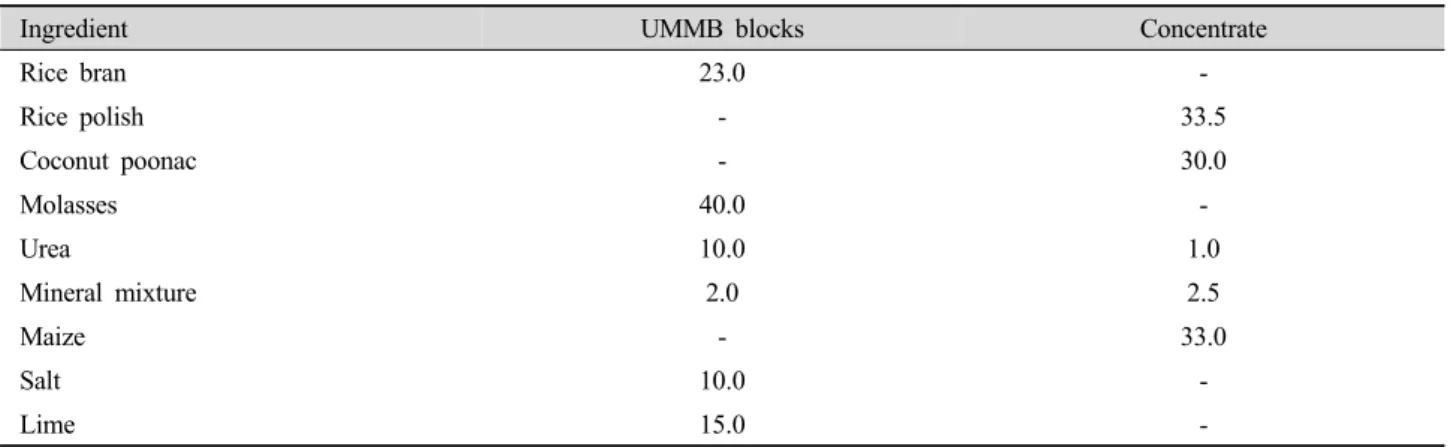
Table 1. Ingredient composition (%) of UMMB blocks and concentrate fed to dairy cows.
Ingredient UMMB blocks Concentrate
Rice bran 23.0 -
Rice polish - 33.5
Coconut poonac - 30.0
Molasses 40.0 -
Urea 10.0 1.0
Mineral mixture 2.0 2.5
Maize - 33.0
Salt 10.0 -
Lime 15.0 -
fiber, 74-78% neutral detergent fiber, 6.2-6.9% crude fat and 9.5-12.8% ash contents on dry matter basis (Premaratne and Premalal, 2006). In addition to the above basal diet, the treatment group animals received 300 g of crushed UMMB daily in three equal meals (100 g at a time) at 0700, 0100 and 1800 h. The ingredient composition of UMMB produced using the method described by Weerasinghe et al. (2004) and dairy cow concentrate feed are shown in Table 1.
2. Sampling and Data Collection
Cows were milked twice daily at 0700 and 1600 h using a mobile milking machine and the milk yields were recorded separately. Throughout the experimental period, milk samples were obtained in each week separately from cows in control and treatment groups for the chemical analysis. In addition, samples of UMMB were collected weekly, stored at -20°C and finally composited prior to analysis. Daily intake of rice straw was also recorded.
3. Chemical Analysis
The proximate composition of feed samples were analyzed according to the methods described in Association of official Analytical Chemists (AOAC;
2000) for dry matter (method 934.01), crude protein (method 988.05), ether extracts (method 920.39), and
ash (method 978.10) contents. In detail, ground samples (2 g) were dried in a dry oven (80°C; OV-9023A, Jiangsu Zhengji Instruments Co., Ltd., China) until constant weights were obtained. After being cooled in a desiccator, the dry weights were measured. The dry matter content was expressed as a percentage of the initial weight of the sample. Crude ash content was measured by igniting 2 g of ground samples in a muffle furnace (Gallenkamp, Loughborough, UK) at 550℃
overnight and expressed as a percentage of the initial weight of the sample. Ether extract and crude protein contents of feed samples were measured via the Soxhlet extraction system (TT 12/A, Gerhardt Ltd., Idar-Oberstein, Germany) and the Kjeldahl method (VAPO45, Gerhardt Ltd., Idar-Oberstein, Germany), respectively.
Milk fat, solids-non-fat (SNF), protein, and lactose contents were measured using a portable ultrasonic milk analyzer (Lactoscan MCC, Milkotronic Ltd., Bulgaria). The urea content in milk was estimated according to the method described by Malik and Sirohi (1998). In detail, 10 mL of well mixed milk sample was treated with 10 mL of trichloroacetic acid and subse- quently filtered through a filter paper (No. 42, Whatman Ltd., Kent, UK). Then, 5 mL of the filtrate was mixed with 5 mL of 1.6% dimethylamino benzaldehyde (DMAB) reagent. Absorbance of the sample was measured using a spectrophotometer (Jenway 6105, Staffordshire, UK) at 425 nm against a blank. The concentration of
Table 2. Proximate composition (%) of UMMB blocks and rice straw fed to dairy cows.
Item UMMB Rice straw
Dry matter 84.70 91.90
Crude protein 27.79 4.40
Ether extracts 2.51 0.95
Ash 3.95 31.62
Table 3. Performance of dairy cows fed control diet and diets supplemented with UMMB.
Item Control Treatment SEM p-Value
Straw intake (kg/d) 3.53 3.44 0.44 0.800
Milk yield (l/d) 5.34 5.66 0.38 0.205
Milk fat
Fat (%) 4.14 4.35 0.44 0.657
Fat yield (g/d) 225.6 234.2 18.74 0.670
Milk protein
Protein (%) 2.85 2.89 0.04 0.359
Protein yield (g/d) 152.4 163.6 13.54 0.455
Milk lactose
Lactose (%) 4.02 4.11 0.06 0.228
Lactose yield (g/d) 215.3 233.0 19.12 0.407
Milk SNF1)
SNF (%) 7.64 7.78 0.13 0.333
SNF yield (g/d) 409 440 36.1 0.434
MUN2) (mg/ml) 0.17 0.20 0.02 0.119
1)Milk SNF = milk solid-non-fat.
2)MUN = milk urea nitrogen.
urea was estimated by comparison with a standard curve.
4. Statistical Analysis
All the data were analyzed using the ProcGLM procedure (SAS Inst. Inc, Cary, NC) in a completely randomized design. The statistical significance was considered at p<0.05.
III. Results and Discussion
The ingredient composition of UMMB block used in this study is shown in Table 1. It was previously recommended that 100 g of urea per kilogram of block was sufficient to maintain an optimum rumen ammonia
levels for efficient microbial activity (Perera et al., 2007). In addition, Perera and Perera (1996) explained that the level of external urea intake depended on the nitrogen content of the diet. For instance, 10% of urea was sufficient for UMMB blocks when the animals were fed on medium quality forages with 10–12% crude protein. Hence, the ingredient composition of UMMB block used in this study was comparable to the above recommendations (Table 1). Further, Table 2 shows the chemical compositions of UMMB blocks and rice straw used in the current study, which clearly indicate the higher quality of UMMB as opposed to rice straw.
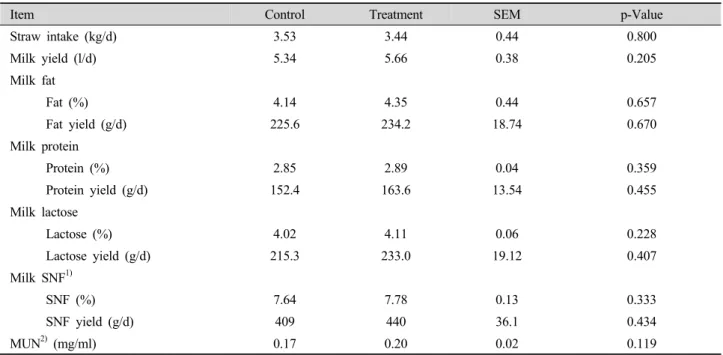
The effects of dietary supplementation of UMMB on the production performances of dairy cows are shown in Table 3. The straw intake was not significantly
affected (p>0.05) by the dietary supplementation of UMMB. Generally, the intake and beneficial effects of UMMB were affected by the type and the quality of the basal feed and other supplements (Soetanto et al., 1987). Confirming this, it was observed that an increase in dry matter intake was significant when the basal diet consisted mainly of poor quality roughages such as hay or straw (Badurdeen et al., 1989; Singh and Singh, 2003). Further, Kunju (1986) reported that when the quality of the basal diet improved with the inclusion of concentrate, the dry matter intake reduced. The basal diet of the current study included the chopped CO-3 grass (ad-libitum), dairy cow con- centrate feed (1 kg/day) during the day time and rice straw (5 kg) at night. The CO-3, a hybrid Napier variety, is considered as a good quality fodder grass (Premaratne and Premalal, 2006) while the concentrate feed used in the current study includes 30% of coconut poonac which is a good protein source (Table 2).
Further, treatment group were supplemented with UMMB which was a good nitrogen source. Therefore, lower straw intake in treatment group might be attributed to the high quality basal diet supplemented with UMMB. As the rice straw intake had not been increased (p>0.05) through the supplementation of UMMB in the current study, it can be further suggested that the basal feed containing the CO-3 and concentrate was adequate in providing optimum nutrition to the dairy cows, thus maintaining optimal nitrogen concentration in the rumen. Therefore, the cows were not in the need of increased ingestion of rice straw. Schiere et al. (1989) reported that the effect of UMMB on dry matter intake was not sig- nificant and this is comparable to the findings of the present study.
In addition, there were no significant differences (p>0.05) in the daily milk yields, proportions and yields of milk constituents including milk fat, protein, lactose and SNF contents between the control and treatment groups (Table 3). These low responses
in dairy cows used in this study could be due to comparatively lower nutrient demand due to smaller body size and lower milk yield, which may have been satisfied by the basal diet (Perera and Perera, 2000).
Nevertheless, the mean daily milk yield and other milk quality parameters were numerically higher in the treatment group than in the control group.
According to Table 3, approximately 6% numerical increase was observed in daily milk yield of cows fed the experimental diet in addition to higher milk fat and milk Solid-Non-Fat contents which are very important factors in determining the price of milk in Sri Lanka. In contrast, a recent study conducted by Weerasinghe et al. (2010) to evaluate the effects of supplementation of nitrogen through UMMB on the performance of dairy cows fed good quality forage based diets, highlighted that UMMB supplementation significantly (p<0.05) increased the milk yield and the yields of milk fat, protein, and SNF. Further, it was stated that Sahiwal crossbred cows and Nilli-Ravi buffaloes gave 12% and 11% more milk daily, respectively when their diets were supplemented with UMMB (Perera et al., 1997; Perera and Perera, 2000). Similar to this study, Uthayathas et al. (1998) and Sivayoganathan et al. (2001) reported that milk quality of Sahiwal and cross-bred cattle was improved due to higher milk fat content when the basal diets were supplemented with UMMB, respectively. As suggested by Weerasinghe et al. (2010) in the previous study, the numerically higher improvements in production performances of dairy cows fed treatment diet in this study might be associated with the improved digestibility of the basal diet supplemented with UMMB and the optimum rumen environment maintained thereby (Perera and Perera, 2000). Higher milk fat content of treatment group compared with that of control group may be associated with the higher cellulolytic fibre utilization by the microbes in the presence of the optimum urea ammonia provided by UMMB (Perera et al., 2007).
Therefore, it can be suggested that animals were in
positive energy and protein balance; hence they had no requirement for additional nutrients through straw intake. However, numerical increases in all the milk production parameters indicated that if basal diet was deficient in major nutrients, part of it can be fulfilled through UMMB supplementation.
Milk Urea Nitrogen, the concentration of urea nitrogen in milk, generally expresses how cows utilize the crude protein that they consume. In the current study, supplementation of basal diet with UMMB had no significant effect (p>0.05) on milk urea nitrogen (MUN) content. A well-balanced diet resulted in MUN in the range of 10 to 12 mg/ dL, but values increased when (a) excess Rumen Degradable Protein (RDP) was fed, or (b) excess Rumen Undegradable Protein (RUP) was fed, or (c) RDP was not balanced with dietary Non-fiber Carbohydrates (NFC; Miller, 2001). In these cases, the unutilized portion of dietary crude protein was converted to urea by the liver, which ended up in the blood, urine, and milk (Miller, 2001). However, the mean MUN content had numerically increased in the treatment group compared with the control group.
Higher average contents indicated excess nitrogen supply or it could be due to insufficient fermentable carbohydrates content in the diet.
IV. Conclusions
The supplementation of UMMB with the basal diet had no effect (p>0.05) on production performances of dairy cows in this study. As the basal diet consisted of a good quality roughage source and sufficient amount of concentrate feed, nutrients provided through UMMB would not be required by the animals for their milk production. The numerical increments observed in milk production and quality parameters as the dairy cows were fed diet supplemented with UMMB suggested that creating low nutrient contents in the basal diet through reducing concentrate feed and good quality roughages could be paid off through the provision of UMMB.
Acknowledgements
The technical support given by the staff members and laboratory assistants of the chemistry laboratory at the Veterinary Research Institute, Peradeniya, Sri Lanka is gratefully acknowledged.
References
Badurdeen AL, Ranawana SSE, Ibrahim MNM. 1989. Effects of ammonia treatment and urea molasses lick (mol-u-min) supplementation of rice straw on intake, digestibility and some bio-chemical parameters in cattle. Tropical Agricultural Research 1:159-174.
Kunju PJG. 1986. Urea Molasses Block Lick-a Feed Supplement for Ruminants. In: Ibrahim MNN, Schiere JB, editors. Rice Straw and Related Feeds in Ruminant Rations. Sri Lanka:
SUP Publication No. 2, Kandy Offset Printers Ltd. pp.
261-274.
Leng RA. 1983. The potential of solidified molasses based blocks for the correction of multinutritional deficiencies in buffaloes and other ruminants fed low quality agro industrial by-products. In: The Use Nuclear Techniques to Improve Domestic Buffalo Production in Asia. IAEA (International Atomic Energy Agency) pp. 135-150. Vienna, Austria.
Malik R, Sirohi SK. 1998. Applied Animal Nutrition Research Techniques. Dairy cattle Nutrition division, Dairy cattle Research Institute, KARNAL-132001. Haryana, India.
Perera ANF, Perera ERK, Abeygunawardane H. 2007. Development, use and impact of feed supplementation blocks: experiences in Sri Lanka. In: Feed supplementation blocks. Urea-molasses multinutrient blocks: simple and effective feed supplement technology for ruminant agriculture. FAO Animal Production and Health Paper 164:125-136. Accessed in ftp://ftp.fao.org/
docrep/fao/010/a0242e/a0242e03.pdf.
Perera ERK, Perera ANF. 2000. Response to multinutrient supplementation in Nilli-Ravi buffalo and Sahiwal cattle under semi-intensive management in the dry zone of Sri Lanka. In: Changing role of the buffalo in the new millennium in Asia. Proceedings of the 3rd Asian Buffalo Congress pp. 183-190. Kandy, Sri Lanka.
Perera BMAO, Jayasuriya MCN. 2008. The dairy industry in Sri Lanka: current status and future directions for a greater role in national development. Journal of the National Science Foundation of Sri Lanka 36:115-126.
Perera ANF, Abeygunawardane IS, Abeygunawardane H, Perera ERK, Subasinghe DHA, Dayananda W. 1997. Effect of supplementary feeding of dairy cattle in smallholder dairy farms in mid country of Sri Lanka. Proceedings of the Symposium on Nuclear Technique for Better Agricultural Productivity. Atomic Energy Authority of Sri Lanka, Colombo.
Premaratne S, Premalal GGC. 2006. Hybrid napier (Pennisetum purpureum × Pennisetum americarnum) Var. CO-3: A resourceful fodder grass for dairy development in Sri Lanka.
The Journal of Agricultural Sciences 2:22-33.
Saddul D, Boodoo AA. 2001. Response to urea molasses multinutrient blocks as a supplement in the diet of goats.
Agricultural Research and Extension. Accessed in http://www.
gov.mu/portal/sites/ncb/moa/farc/amas2001/pdf/p1.pdf Sansoucy R. 1995. New developments in the manufacture and
utilization of multinutrient blocks. FAO Animal Production and Health paper 82:78-83.
Schiere JB, Ibrahim MNM, Sewalt VJH, Zemmerlink G. 1989.
Response of growing cattle given rice straw to lick blocks containing urea and molasses. Animal Feed Science and Technology 26:179-189.
Singh PR, Singh M. 2003. Effect of UMMB(urea-molasses multinutrient block) supplementation on milk production in buffaloes and cows: An on farm trial. Indian Journal of Animal Nutrition 20:1-5.
Sivayoganathan B, Hemachandra HP, Sridharan AP, Perera ANF. 2001. Impact of UMMB(urea-molasses multinutrient block) in small-scale dairy farms in Central Province of Sri Lanka. In: Proceedings of the 53rd Annual Convention of the Sri Lanka Veterinary Association pp. 15. Kandy, Sri Lanka.
Soetanto H, Budi S, Sulstri. 1987. Digestibility and utilization of
low quality roughage in goat and sheep as affected by access to molasses urea block. In: Proceedings of the 7th Annual Meeting of AAFARR Network, pp. 214-221. Chiang Mai, Thailand.
Uthayathas S, Perera ANF, Perera ERK. 1998. Performance of dairy cows to urea supplementation with or without fishmeal under grazing management in the coconut triangle of Sri Lanka. Tropical Agricultural Research 10:383-391.
Weerasinghe WMPB, Silva SSP, Faizal ACM, Palliyeguru MWCD, Priyankarage N. 2004. Formulation of cement free UMMB(urea-molasses multinutrient block) for ruminants.
Sri Lanka Veterinary Journal 51:28.
Weerasinghe WMPB, Silva SSP, Priyankarage N, Mangalika ULP, Chandima RAT. 2010. Effects of supplementation of nitrogen through UMMB (urea-molasses multinutrient block) on the performance of dairy cows fed with good quality forage based diets. The 5th International Nitrogen Conference 2010. P. 419 (Abstr). New Delhi, India.
Wongnen N. 2007. Feed supplementation of dairy cattle with UMMB (urea-molasses multinutrient block) in the North Eastern region of Thailand. In: Feed supplementation blocks.
Urea-molasses multinutrient blocks: simple and effective feed supplement technology for ruminant agriculture. FAO Animal Production and Health Paper 164:111-124. Accessed in ftp://ftp.fao.org/docrep/fao/010/a0242e/a0242e03.pdf.