• 검색 결과가 없습니다.

Overview of muscle metabolism, muscle fiber characteristics, and meat quality

N/A
N/A
Protected

Academic year: 2021

Share "Overview of muscle metabolism, muscle fiber characteristics, and meat quality"

Copied!
8
0
0

로드 중.... (전체 텍스트 보기)

전체 글

(1)

Citation: Choe J. 2018. Overview of muscle metabolism, muscle fiber characteristics, and meat quality. Korean Journal of Agricultural Science 45:50-57.

DOI: https://doi.org/10.7744/kjoas.20180012 Editor: Dong Young Kil, Chung-Ang University, Korea

Received: January 16, 2018

Revised: March 5, 2018 Accepted: March 8, 2018

Copyright: © 2018 Korean Journal of Agricultural Science.

This is an Open Access article distributed under the terms of the Creative Com- mons Attribution Non-Commercial License (http:

//creativecommons.org/licenses/by-nc/4.0/) which permits unrestricted non-commercial use, distribution, and reproduction in any medium, provided the original work is properly cited.

OPEN ACCESS

ANIMAL

Overview of muscle metabolism, muscle fiber characteristics, and meat quality

Jeehwan Choe

*

Department of Animal Science and Biotechnology, Chungnam National University, Daejeon 34134, Korea

*Corresponding author: [email protected]

Abstract

Meat comes from the skeletal muscles of farm animals, such as pigs, chickens, and cows.

Skeletal muscles are composed of many muscle fibers. Muscle fibers are categorized into three types, fiber type I, IIA, and IIB, based on their contractile speed and metabolic properties. Different muscle fiber types have different biochemical, physiological, and biophysical characteristics. Especially, the characteristics of muscle fiber type I and IIB are opposite to each other. Muscle fiber type I has a relatively strong oxidative metabolic trait and a higher content of lipids. In contrast to fiber type I, muscle fiber type IIB has a strong glycolytic metabolic trait and a relatively lower content of lipids and a higher content of glycogen. Muscle fiber type IIA has intermediate properties between fiber type I and IIB.

Thus, muscles with different fiber type compositions exhibit different ante- and post-mortem muscle characteristics. In particular, the different metabolic traits of muscles due to the different compositions of the fiber types strongly affect the biochemical and physiological processes during the conversion of muscle to meat and subsequently influence the quality of the meat. Therefore, understating muscle metabolism and muscle fiber characteristics is very important when discussing the traits of meat quality. This review is an overview on basic muscle metabolism, muscle fiber characteristics, and their influence on meat quality and finally provides a comprehensive understanding about the fundamental traits of muscles and meat quality.

Keywords: meat quality, metabolites, muscle fiber, muscle metabolism

Introduction

Meat including pork, chicken, beef comes from skeletal muscle of farm animals. Although humans consume meats as a kind of food, skeletal muscles are a specialized tissue to convert chemical energy, such as adenosine triphosphate (ATP), to mechanical energy, locomotion, via muscle contraction (Aberle et al., 2001). Adenosine triphosphates are required during contraction and relaxation of skeletal muscle. Thus, skeletal muscles continuously metabolize and synthesize the nutrition to get ATPs (Aberle et al., 2001; Warriss, 2010).

Patterns of ATP synthesis and metabolism in skeletal muscles are influenced by muscle fiber

characteristics (Ryu and Kim, 2005; Choe et al., 2008, 2009; Choe and Kim 2014). Skeletal muscles

(2)

of animals are composed of different types of fibers, usually categorized as fiber type I, IIA, and IIB. Each muscle fiber type has different biochemical, physiological, and biophysical characteristics such as contraction speed, oxidative or glycolytic metabolic traits, metabolites contents (Schiaffino and Reggiani, 1996; Klont et al., 1998;

Karlsson et al., 1999; Park et al., 2017). So, fiber type composition of muscle can strongly affect not only antemortem muscle metabolism but also postmortem conversion of muscle to meat (Ryu and Kim, 2005; Choe et al., 2008, 2009;

Choe and Kim, 2014). Therefore, this paper was to overview muscle metabolism, muscle fiber characteristics, and their influence on meat quality.

Muscle metabolism and metabolites and their relationship with meat quality Muscle metabolism

Living and postmortem muscles maintain a stable and constant condition as possible (homeostasis) against dramatic changes. Adenosine triphosphate is also maintained at a constant level due to homeostasis. In living muscles, energy (ATP) production has two main alternative routes; the oxidative (aerobic) and the glycolytic (anaerobic) pathways (Pösö and Puolanne, 2005). The oxidative pathway is the most efficient way because it generates approximately 36 molecules of ATP via the complete aerobic oxidation of glucose-6-phosphate. However, this pathway requires a sufficient amount of oxygen and thus is adequate when muscles are working slowly (Yla-Ajos, 2006). On the other hand, the glycolytic pathway occurs when the amount of oxygen is insufficient or muscle are working rapidly. This glycolytic pathway changes glycogen, the polymer of glucose and the major energy source reserved in muscle and liver, into lactate generating 3 molecules of ATP. In living muscles, the lactate formed by the glycolytic pathway is converted back to glucose and glycogen in the liver through the circulation system (Pösö and Puolanne, 2005; Choe et al., 2008).

After slaughter/exsanguination, blood is removed and circulation system failed, resulting in no more oxygen supply to muscles. The muscles lack oxygen and becomes an anaerobic condition, so oxidative metabolism does not work.

Initially, ATP is buffered by the creatine kinase- and myokinase-catalyzed reaction (Scheffler and Gerrard, 2007).

Phosphocreatine (PCr) is present at a higher concentration (18 - 19 µmole/g) than ATP (6.6 - 6.8 µmole/g) in porcine longissimus muscle (Bendall, 1973). The enzyme creatine kinase catalyzes rephosphorylation of adenosine diphosphate (ADP) to ATP using PCr (1). Additionally, myokinase catalyzes the conversion of two ADP to adenosine monophosphate (AMP) and ATP (2) (Scheffler and Gerrard, 2007).

PCr + ADP → ATP + creatine (1)

2 ADP → ATP + AMP (2)

These two reactions allow the muscle to quickly increase ATP production in order to keep cellular ATP constant

level and maintain homeostasis. However, when about 70% of the initial PCr content has been degraded, ATP levels

rapidly decline (Bendall, 1951; Scheffler and Gerrard, 2007), and muscle glycogen must be metabolized by glycolysis

in order to rephosphorylate ADP to ATP (Scheffler and Gerrard, 2007). Glycolysis produces waste products, such as

lactate, a hydrogen ion (H

+

), and heat. Because postmortem muscle does not have the means to remove waste

products, lactate and H

+

accumulates in muscle tissue, and it causes a decline of muscle pH (Scheffler and Gerrard,

(3)

2007). When ATP breakdown exceeds ATP synthesis by glycolysis, less the amount of ATP is available to break actomyosin and thus the formation of actomyosin decreases sarcomere length, resulting in the onset of rigor mortis.

Rigor mortis is completed when the ATP supply is exhausted (Scheffler and Gerrard, 2007).

Muscle metabolites and meat quality

Postmortem muscles generate ATP via enzyme reactions using PCr and the glycolytic pathway. Especially, the glycolytic pathway converts glycogen reserved in muscle into lactate as an end-product. Lactate formed by glycolytic pathway accumulated in the muscle, resulting in decline of muscle pH. Thus, glycogen and lactate in muscle are important metabolites when discussing the conversion of muscle to meat at postmortem.

The rate and extent of metabolism and pH decline during the conversion of muscle to meat significantly impact the development of fresh meat quality attributes (Scheffler and Gerrard, 2007). Normally, pH declines gradually from 7.4 in living muscle to roughly 5.6 - 5.7 within 6 - 8 h of postmortem and then has an ultimate pH at 24 h (pH

24 h

) of about 5.3 - 5.7 (Briskey and Wismer-Pedersen, 1961). However, muscles with a rapid glycolysis exhibit an accelerated decline in muscle pH and produce large amounts of heat, which slows carcass chilling. In particular, muscle pH declines rapidly more less than 6.0 during the first hour after slaughter and reaches an ultimate pH of 5.3 - 5.7. The onset of rigor mortis at high temperature and low pH causes the excessive denaturation of approximately 20% of the sarcoplasmic and myofibrillar proteins (Honikel and Kim, 1986; Scheffler and Gerrard, 2007). Excessive denaturation of sarcoplasmic proteins results in greater precipitation and it is largely responsible for paler pork color, while excessive denaturation of myofibrillar proteins accounts for the reduced water holding capacity (WHC) in pale, soft, and exudative (PSE) pork (Joo et al., 1999).

Initial glycogen content in the muscle at slaughter is the main factor for extent of postmortem glycolysis. Postmortem glycolysis uses glycogen as a main substrate (Pösö and Puolanne, 2005; Yla-Ajos, 2006; Scheffler and Gerrard, 2007).

Glycogen is degraded into glucose subunit (glycogenolysis) and is left with one less glucose molecule by glycogen phosphorylase (Yla-Ajos, 2006). The free glucose is in the form of glucose-1-phosphate and is converted into glucose- 6-phosphate to be used for metabolism by phosphoglucomutase (Yla-Ajos, 2006; Scheffler and Gerrard, 2007). Glycolysis uses glycogen or glucose and produces ATP and lactate (Pösö and Puolanne, 2005; Yla-Ajos, 2006; Scheffler and Gerrard, 2007). An extended pH decline at normal rate due to high initial glycogen content in the muscle at slaughter contributes to a low ultimate pH (roughly 5.3 - 5.5), resulting in “acid meat” (Scheffler and Gerrard, 2007). The reduced net charge of myofibrillar proteins owing to abnormally low pH attracts thick and thin filaments closer together and it forces water out of the myofilament lattice (Irving et al., 1989; Offer et al., 1989). In addition, Joo et al.

(1999) have reported that a decreasing ultimate pH declines solubility in sarcoplasmic protein, which contributes to

paler pork color. Thus, the rate and extent of decline in muscle pH at the postmortem significantly influence on

ultimate meat quality and muscle metabolites, such as glycogen and lactate. Choe et al. (2008) and Choe and Kim

(2014) reported the relationships between muscle glycogen and lactate measured at 45 min and 24 h postmortem

muscle, glycolytic rate, and pork quality. In those studies, pork with lower glycogen and higher lactate contents at 45

min postmortem exhibited rapid glycolytic rate. Muscles with high glycogen and lactate contents at 45 min postmortem

showed rapid postmortem glycolysis, severe denaturation of myofibrillar and sarcoplasmic proteins, and thus

deteriorative pork quality like PSE condition. These results indicate that muscle metabolites, such as glycogen and

lactate, could explain variations in the postmortem glycolytic rate, protein denaturation, and ultimate meat quality.

(4)

Muscle fiber characteristics and their relationship with meat quality Muscle fiber characteristics

Meat is a result of postmortem changes of skeletal muscle. Skeletal muscle is composed of different types of fibers.

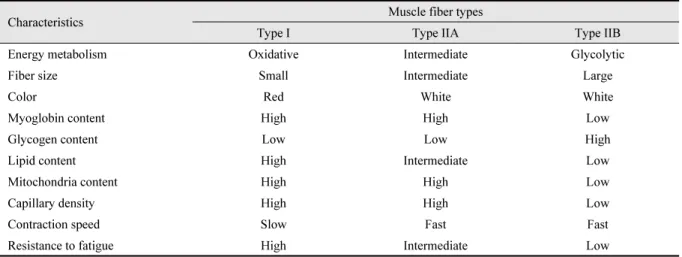
Each fiber type has different metabolic and contractile characteristics, such as oxidative and glycolytic capacities, contractile speed, color, content of mitochondria, myoglobin, glycogen, lipid, capillary density, resistance to fatigue, and fiber size (Schiaffino and Reggiani, 1996; Klont et al., 1998; Karlsson et al., 1999) (Table 1). The most widely accepted classification is based on differences in the acid and alkaline stability of the myofibrillar ATPase reaction (Brook and Kaiser, 1970; Ryu and Kim, 2005) (Fig. 1). According to this method, after acid or alkaline pre-incubations, muscle fiber types are divided into three types, I, IIA, and IIB. Muscle fiber type I, also known as red muscle fiber, is small and slow contracting. It has high contents of mitochondria, myoglobin, lipid, high capillary density, low content of glycogen, and strong resistant to fatigue. Therefore, muscle fiber type I have a predominantly oxidative metabolic capacity (Brook and Kaiser, 1970; Ryu and Kim, 2005). On the other hand, fiber type IIB, also known as white muscle fiber, is large, and fast contracting. It has low contents of mitochondria, myoglobin, low capillary density, and weakly

Table 1. Characteristics of muscle fiber type (Modified from Aberle et al., 2001).

Characteristics Muscle fiber types

Type I Type IIA Type IIB

Energy metabolism Oxidative Intermediate Glycolytic

Fiber size Small Intermediate Large

Color Red White White

Myoglobin content High High Low

Glycogen content Low Low High

Lipid content High Intermediate Low

Mitochondria content High High Low

Capillary density High High Low

Contraction speed Slow Fast Fast

Resistance to fatigue High Intermediate Low

Fig. 1. Representative image of porcine longissimus dorsi muscle stained using mATPase activity after pre-incubation at pH 4.7. Abbreviations: I, muscle fiber type I (slow-twitch & oxidative); IIA, muscle fiber type IIA (fast-twitch & oxido-glycolytic);

IIB, muscle fiber type IIB (fast-twitch & glycolytic).

(5)

resistant to fatigue. But glycogen content of type IIB is high, so it has a glycolytic and only weakly oxidative metabolic capacity (Peter et al., 1972; Hintz et al., 1984; Karlsson et al., 1999). The intermediate characteristic between type I and IIB is seen in muscle fiber type IIA. The comprehensive characteristic of a given muscle, especially metabolic characteristic, is determined by its relative composition of different muscle fiber type (Highley et al., 1999; Morita et al., 2000; Ryu et al., 2002). Therefore, it is generally accepted that the different fiber type composition of muscles may have different effects on postmortem changes during conversion of muscle to meat. Consequently, it determines the ultimate meat quality (Karlsson et al., 1999; Brocks et al., 2000; Ryu and Kim, 2006).

Muscle fiber characteristics and meat quality

Muscle fiber characteristics, such as muscle fiber number, size, and composition, are one of the factors that strongly affect the rate of postmortem metabolism, pH decline, and ultimate meat quality (Ryu and Kim, 2005). The total fiber number has been related to muscle mass, growth rate, and meat quality (Vann et al., 1998; Highley et al., 1999; Gentry et al., 2002). It is generally accepted that the low muscle fiber number correlated with greater fiber hypertrophy, and this may be associated with stress susceptibility and poor meat quality in modern meat-type breeds (Fiedler et al., 1999). The study of Lengerken et al. (1997) demonstrate the relationship between muscle fiber number and pH value in pork, and meat percentage at slaughter. They also investigated the optimum range of muscle fiber number for the high meat percentage and good meat quality at a moderate fiber size.

Several studies indicated that the size of the fibers may be of importance for muscle quantity (Staun, 1963; Fiedler et al., 2003), and meat quality (Allen et al., 1966; Fiedler et al., 2003). In modern meat type pigs, larger muscle fiber tends to have lower numbers of mitochondria (Rasmussen et al., 1996) and low capillary density (Fiedler et al., 1993), and they are similar characteristics with fiber type IIB (Rasmussen et al., 1996). Giant fibers were often observed in muscle presenting PSE meat properties (Solomon et al., 1990).

There are studies for the relation between muscle fiber composition and meat quality. In pigs, the occurrence of the PSE condition was generally related to content of fiber type IIA, and IIB (Henckel et al., 1997; Klont et al., 1998;

Candek-Potokar et al., 1999). According to Fiedler et al. (1993, 1999), higher percentage of fiber type IIB correlated with PSE meat condition and with stress susceptibility. Pigs with a higher proportion of fiber type IIB showed more rapid decline of pH, lower WHC, and lighter color than pigs with the lowest proportion of the fiber type IIB (Carpenter et al., 1963; Henckel et al., 1997; Klont et al., 1998; Candek-Potokar et al., 1999). A similar result was also observed in the study of Ryu and Kim (2005). In that study, area and number composition of muscle fiber type I and IIB were significantly correlated with the postmortem metabolic rate and ultimate pork quality. Another study showed that content of slow or fast myosin heavy chain (MHC) isoforms, which determine muscle fiber types, influence on muscle metabolites contents, postmortem glycolytic rate, and subsequently ultimate pork quality like muscle fiber composition.

Similar results can be found in other published papers (Choe et al., 2008; Choe and Kim, 2014), indicating that higher

composition of fiber type IIB was associated with rapid and extended decline of muscle pH and finally deteriorative

pork quality. Furthermore, Karlsson et al. (1999) have reported that composition of muscle fiber type determines the

metabolic characteristic of muscle, and it could influence energy metabolism in live animals. Thus, contents of

circulating metabolites, such as glucose and lactate, could be variable by muscle fiber type composition. It has also

potential to influence on metabolic characteristic of muscles when animals are subjected to stressful conditions, such

as adrenaline-induced glycogenolysis.

(6)

Acknowledgements

This work was supported by a Korea University grant. The author thank the Institute of Agricultural Science, Chungnam National University, and the Institute of Biomedical Science and Food Safety, Korea University Hall, for supporting of the research.

References

Aberle ED, Forrest JC, Gerrard DE, Mills EW. 2001. Principles of Meat Science. Kendall/Hunt Publishing Company, Iowa, USA.

Allen E, Forrest JC, Chapman AB, First N, Bray RW, Briskey EJ. 1966. Phenotypic and genetic associations between porcine muscle properties. Journal of Animal Science 25:962-968.

Bendall JR. 1951. The shortening of rabbit muscles during rigor mortis: Its relation to the breakdown of adenosine triphosphate and creatine phosphate and to muscular contraction. Journal of Physiology 144:71-88.

Bendall JR. 1973. Post mortem changes in muscle. In Structure and Function of Muscle (2nd) edited by Bourne GH.

Academic Press, NY, USA.

Briskey EJ, Wismer-Pedersen J. 1961. Biochemistry of pork muscle structure. I. Rate of anaerobic glycolysis and temperature change versus the apparent structure of muscle tissue. Journal of Food Science 26:297-305.

Brocks L, Klont RE, Buist W, de Greef K, Tieman M, Engel B. 2000. The effects of selection of pigs on growth rate vs leanness on histochemical characteristics of different muscles. Journal of Animal Science 78:1247-1254.

Brook MH, Kaiser KK. 1970. Three myosin adenosine triphosphatase systems: The nature of their pH liability and sulfhydryl dependence. Journal of Histochemistry and Cytochemistry 18:670-672.

Candek-Potokar M, Lefaucheur L, Zlender B, Bonneau M. 1999. Effect of slaughter weight and/or age on histological characteristics of pig longissimus dorsi muscle as related to meat quality. Meat Science 52:195-203.

Carpenter ZL, Kauffman RG, Bray RW, Briskey EJ, Weckel KG. 1963. Factors influencing quality in pork. A. histological observation. Journal of Food Science 28:467-471.

Choe JH, Choi YM, Lee SH, Nam YJ, Jung YC, Park HC, Kim YY, Kim BC. 2009. The relation of blood glucose level to muscle fiber characteristics and pork quality traits. Meat Science 83:62-67.

Choe JH, Choi YM, Lee SH, Shin HG, Ryu YC, Hong KC, Kim BC. 2008. The relation between glycogen, lactate content and muscle fiber type composition, and their influence on postmortem glycolytic rate and pork quality.

Meat Science 80:355-362.

Choe JH, Kim BC. 2014. Association of blood glucose, blood lactate, serum cortisol levels, muscle metabolites, muscle fiber type composition, and pork quality traits. Meat Science 97:137-142.

Fiedler I, Ender K, Kuchenmeister U, Wicke M, Lengerken G. 2003. Phenotypic variations of muscle fibre and intramuscular fat traits in longissimus muscle of F

2

population Duroc × Berlin miniature pig and relationships to meat quality. Meat Science 63:131-139.

Fiedler I, Ender K, Wicke M, Lengerken G. 1993. Relationships between micro-structure of muscle tissue and stress susceptibility in Landrace pigs (halothane sensitivity). Archives of Animal Breeding 36:525-538.

Fiedler I, Ender K, Wicke M, Maak S, Lengerken G, Meyer W. 1999. Structural and functional characteristics of muscle fibres in pigs with different malignant hyperthermia susceptibility (MHS) and different meat quality. Meat Science 53:9-15.

Gentry JG, McGlone JJ, Blanton Jr JR, Miller MG. 2002. Impact of spontaneous exercise on performance, meat

quality, and muscle fiber characteristics of growing/finishing pigs. Journal of Animal Science 80:2833-2839.

(7)

Henckel P, Oksbjerg N, Erlandsen E, Barton-Gade P, Bejerholm C. 1997. Histo- and biochemical characteristics of the longissimus dorsi muscle in pigs and their relationships to performance and meat quality. Meat Science 47:311-321.

Highley JR, Esiri MM, McDonald B, Roberts HC, Walker MA, Crow TJ. 1999. The size and fiber composition of the anterior commissure with respect to gender and schizophrenia. Biological Psychiatry 45:1120-1127.

Hintz CS, Coyle EF, Kaiser KK, Chi MMY, Lowry OH. 1984. Comparison of muscle fiber typing by quantitative enzyme assays and by myosin ATPase staining. Journal of Histochemistry and Cytochemistry 32:655-660.

Honikel KO, Kim CJ. 1986. Causes of the development of PSE pork. Fleischwirtsch 66:349-353.

Irving TC, Swatland HJ, Millman BM. 1989. X-ray diffraction measurements of myofilament lattice spacing and optical measurements of reflectance and sarcomere length in commercial pork loins. Journal of Animal Science 67:152-156.

Joo ST, Kauffman RG, Kim BC, Park GB. 1999. The relationship of sarcoplasmic and myofibrillar protein solubility to colour and water-holding capacity in porcine longissimus muscle. Meat Science 52:291-297.

Karlsson AH, Klont RE, Fernandez X. 1999. Skeletal muscle fibres as factors for pork quality. Livestock Production Science 60:255-269.

Klont RE, Brocks L, Eikelenboom B. 1998. Muscle fibre type and meat quality. Meat Science 49(S1):S219-S229.

Lengerken G, Wicke M, Maak S. 1997. Stress susceptibility and meat quality-situation and prospects in animal breeding and research. Archives of Animal Breeding 40:163-171.

Morita S, Iwamoto H, Fukumitsu Y, Gotoh T, Nishimura S, Ono, Y. 2000. Heterogeneous composition of histochemical fibre types in the different parts of M. longissimus thoracis from Mishima (Japanese native) steers. Meat Science 54:59-63.

Offer G, Knight PK, Jeacocke R, Almond R, Cousins T, Elsey J, Parsons N, Sharp A, Starr R, Purslow P. 1989. The structural basis of the water-holding, appearance and toughness of meat and meat products. Food Microstructure 8:151-170.

Park SH, Kim YH, Lee HJ, Baek YC, Kim MS, Jeong JY, Oh YK, Park SK. 2017. Inhibition of mitochondrial activity induces muscle fiber type change from slow to fast in C

2

C

12

myotubes. Korean Journal of Agricultural Science 44:586-594.

Peter JB, Barnard RJ, Edgerton VR, Gillespie CA, Stempel CE. 1972. Metabolic profiles of three fiber types of skeletal muscle in guinea pigs and rabbits. Biochemistry 11:2627-2633.

Pösö AR, Puolanne E. 2005. Carbohydrate metabolism in meat animals. Meat Science 70:423-434.

Rasmussen UF, Rasmussen HN, Andersen AJ, Jorgensen PF, Quistorff B. 1996. Characterization of mitochondria from pig muscle: Higher activity of exo-NADH oxidase in animals suffering from malignant hyperthermia. The Biochemical Journal 315:659-663.

Ryu YC, Kim BC. 2005. The relationship between muscle fiber characteristics, postmortem metabolic rate, and meat quality of pig longissimus dorsi muscle. Meat Science 71:351-357.

Ryu YC, Kim BC. 2006. Comparison of histochemical characteristics in various pork groups categorized by postmortem metabolic rate and pork quality. Journal of Animal Science 84:894-901.

Ryu YC, Lee SH, Rhee MS, Imm JY, Kim BC. 2002. Prediction of pork quality attributes using metabolic rate and muscle fiber characteristics. The 48th International Congress of Meat Science & Technology pp. 286-287, Rome, Italy.

Scheffler TL, Gerrard DE. 2007. Mechanisms controlling pork quality development: The biochemistry controlling postmortem energy metabolism. Meat Science 77:7-16.

Schiaffino S, Reggiani C. 1996. Molecular diversity of myofibrillar proteins: Gene regulation and functional significance.

(8)

Physiological Reviews 76:371-423.

Solomon MB, Campbell RG, Steele NC. 1990. Effect of sex and exogenous porcine somatotropin on longissimus muscle fiber characteristics of growing pigs. Journal of Animal Science 68:1176-1181.

Staun H. 1963. Various factors affecting number and size of muscle fibers in the pig. Acta Agriculture Scandinavica 13:293-322.

Vann RC, Althen TG, Smith WK, Veenhuizen JJ, Smith SB. 1998. Recombinant bovine somatotropin (rbST) administration to creep-fed beef calves increases muscle mass but does not affect satellite cell number or concentration of myosin light chain-1f mRNA. Journal of Animal Science 76:1371-1379.

Warriss PD. 2010. Meat science—an introductory text (2nd ed.). CABI, MA, USA.

Yla-Ajos MSK. 2006. Glycogen debranching enzyme activity in the muscles of meat producing animals. Ph.D.

dissertation, University of Helsinki., Helsinki, Finland.

수치

Table 1. Characteristics of muscle fiber type (Modified from Aberle et al., 2001).

참조

관련 문서

• Junction between motor neuron and muscle fiber. – Motor

1 John Owen, Justification by Faith Alone, in The Works of John Owen, ed. John Bolt, trans. Scott Clark, "Do This and Live: Christ's Active Obedience as the

Effects of Nitroglycerin(Ni) on Spontaneous Activity(S.A) and Oxytocin (OT) Induced Contractions in the Uterine Smooth Muscle. Data are expressed as mean

In the change of physical strength, The exercise group showed statistically significant differences in muscle strength(right), muscle strength(left),

The third was combination of levator palpebrae, superior rectus, inferior oblique muscle weakness(n=5) and the fourth was the third group plus medial rectus

In the change of functional fitness, muscle strength and endurance, cardiopulmonary endurance, wits, and flexibility showed significantly increased results,

The improvement factors of the performance showed significant increase in muscle strength, muscle endurance, cardiovascular endurance, power, agility and

In the health fitness category of the adult women who underwent instrument pilates exercise, they were statistically significant in muscle strength,