Awareness and Use of Complementary and Alternative Medicine in Korean Lung Cancer Patients
Joon Young Choi, M.D.
1, Wonjun Ji, M.D., Ph.D.
2, Chang-Min Choi, M.D., Ph.D.
2,3, Chaeuk Chung, M.D., Ph.D.
4, Jae Myoung Noh, M.D., Ph.D.
5, Cheol-Kyu Park, M.D., Ph.D.
6,7, In-Jae Oh, M.D., Ph.D.
6,7, Hong In Yoon, M.D., Ph.D.
8, Hyeong Ryul Kim, M.D., Ph.D.
9, Ho Young Kim, M.D., Ph.D.
10, Chang Dong Yeo, M.D., Ph.D.
11, Seung Hun Jang, M.D., Ph.D.
12, on behalf of the Public Relation Committee of the Korean Association for Lung Cancer
*Author affiliations appear at the end of this article.
Background: Complementary and alternative medicine (CAM) has been used frequently, and its use continues to increase in lung cancer patients, despite insufficient scientific of its efficacy. To investigate this situation, we analyzed the current awareness and use of CAM in Korean lung-cancer patients.
Methods: This prospective survey–based study was performed at seven medical centers in South Korea between August and October 2019. The survey assessed general patient characteristics and the awareness and use of CAM. We analyzed differences in the clinical parameters of patients aware and not aware of CAM and of CAM non-users and users.
Results: Of the 434 patients included in this study, 68.8% responded that they were aware of CAM and 30.9% said they had experienced it. In univariate analysis, the patients aware of CAM were younger with poor performance status, had advanced-stage lung cancer, received more systemic therapy, and received concurrent chemoradiation therapy (CCRT).
By multiple logistic regression, younger age, poor performance status, advanced stage, and prior CCRT were identified as independent risk factors for CAM awareness. There were no significant differences in the general characteristics and cancer-associated clinical parameters of CAM non-users and users.
Conclusion: Specific clinical parameters were associated with patients’ awareness of CAM, although there were no significantly different characteristics between CAM users and non-users.
Keywords: Complementary Therapies; Lung Neoplasms; Awareness; Cross-sectional Studies; Prospective Studies
Address for correspondence: Seung Hun Jang, M.D., Ph.D.
Division of Pulmonary, Allergy and Critical Care Medicine, Department of Internal Medicine, Hallym University Sacred Heart Hospital, Hallym University College of Medicine, 22 Gwanpyeong-ro 170 beon-gil, Dongan-gu, Anyang 14068, Republic of Korea
Phone: 82-31-380-3718, Fax: 82-31-380-3973, E-mail: [email protected] Address for correspondence: Chang Dong Yeo, M.D., Ph.D.
Division of Pulmonary, Critical Care and Sleep Medicine, Department of Internal Medicine, Eunpyeong St. Mary’s Hospital, College of Medicine, The Catholic University of Korea, 1021 Tongil-ro, Eunpyeong-gu, Seoul 03312, Republic of Korea
Phone: 82-2-2030-4310, Fax: 82-2-2030-2617, E-mail: [email protected]
Received: Sep. 3, 2020, Revised: Nov. 5, 2020, Accepted: Dec. 8, 2020, Published online: Dec. 8, 2020
cc
It is identical to the Creative Commons Attribution Non-Commercial License (http://creativecommons.org/licenses/by-nc/4.0/).
Copyright © 2021
The Korean Academy of Tuberculosis and Respiratory Diseases.
Introduction
Lung cancer is the most common cancer and responsible for the highest cancer-related mortality worldwide
1-4. Although the age-adjusted incidence and cancer-related mortality of lung cancer have decreased in previous decades, the treat- ment of lung cancer is still a challenging issue that devastates both clinicians and patients
5. Regarding these circumstances, some patients choose to use therapies that are not scientifi- cally proven or based on insufficient evidence. These thera- pies are used either as supplementary/additive measures (complementary medicine) or alternative measures (alterna- tive medicine) to conventional cancer treatment. Such thera- pies are usually referred to as complementary and alternative medicine (CAM)
6,7.
The motivations for using CAM are diverse. Patients expect to gain a better general condition, improve their immune system, relieve cancer symptoms or treatment side effects, and prolong survival
6,8. However, the results of previous stud- ies on the efficacy and safety of CAM vary from beneficial to harmful
6,7,9-13. Thus, a thorough understanding of these results by both patients and clinicians is needed before starting treat- ment with CAM. Nonetheless, previous studies have shown that many patients choose to use CAM regardless of the sci- entific basis, relying more on media or non-specialists than physicians, which may be biased by secondary gain, personal subjective experience, or unproven information
8. As CAM is now frequently used worldwide in cancer patients and its use continues to increase, its effects on cancer patients should not be overlooked
14-16. Therefore, it may be important to analyze the current status of CAM awareness and the use of CAM to guide patients in choosing their treatment.
In this study, we conducted a multicenter survey-based study to investigate the current status of CAM awareness and use in lung cancer patients, and analyzed the factors associ- ated with the awareness and use of CAM. Furthermore, we in- vestigated the adverse events, costs, and perspectives toward CAM in CAM users.
Materials and Methods
1.Study design and data collection
This study was a prospective survey-based study performed in seven medical centers in South Korea. The patients en- rolled in this study had pathologically confirmed lung cancer and replied to questionnaires in a survey on CAM use be- tween August 2019 and October 2019 (Supplementary Mate- rial). The survey consisted of two sections. The first section was composed of 13 questions on patient demographics and information associated with the patient’s disease (i.e., lung cancer staging and treatment), which was attained by the
attending physicians. The second section was composed of 15 questionnaires regarding the awareness and use of CAM, which was self-reported by the patient in the outpatient clinic.
2. General characteristics and awareness of CAM use The patients enrolled in this study were provided with a paper survey on personal CAM awareness and use. The ques- tionnaires consisted of general characteristics such as age, sex, Eastern Cooperative Oncology Group (ECOG) performance status, smoking history (ever or never smoker), and economic status (low vs. medium vs. high). We also gathered informa- tion associated with the patient’s disease, including lung cancer staging (TNM staging in non-small cell lung cancer [NSCLC], or limited/extended staging in small cell lung cancer [SCLC]), past treatment history (e.g., surgery, radiation thera- py, systemic therapy or concurrent chemoradiation therapy [CCRT]), candidates for targeted therapy (epidermal growth factor receptor [EGFR]/anaplastic lymphoma kinase [ALK]
mutation), line of systemic therapy, and treatment durations.
We analyzed the differences in these factors in patients aware and not aware of CAM and in CAM users and non-users. The general patient characteristics were also compared with a pre- vious unbiased Korean nationwide study that extracted data from the Korean Association of Lung Cancer Registry (KALC- R) in 2014 to investigate whether the enrolled patients repre- sented the general cancer population of Korea
17.
3. Awareness of CAM
The survey included questions on CAM awareness. The questionnaires of the awareness of CAM were answered in one of the three: “never heard”, “heard only a little” or “known thoroughly”. The patients were questioned about their famil- iarity with procedures or techniques of CAM, such as onco- thermia, high-dose vitamin C, mistletoe, selenium, Gerson therapy, bio-photon, thymosin alpha 1, nebulized oriental medicine, acupuncture or moxibustion, oriental medicine, mushrooms, ginseng, or reiki treatments. Furthermore, the questionnaire included questions on the route through which CAM information was obtained, the patient’s expectation of efficacy, and whether CAM was based on scientific evidence.
4. Current status of CAM use
In patients who were aware of CAM, they were asked whether they had received any CAM procedure or medicine.
The patients who selected ‘yes’ to that question were asked
what specific types of CAM they experienced, when they re-
ceived CAM (before, during, or after conventional therapy),
the duration of CAM use, and their economic status. Also, the
questionnaires asked about adverse events and the cost of us-
ing CAM.
5. Statistical analysis
All statistical analyses were performed with R software (ver- sion 3.5.2, R Development Core Team, Vienna, Austria). The quantitative variables are presented as mean±standard devia- tions, and the categorical variables are shown as numbers and percentages. The quantitative variables were assessed be- tween the two groups with a student’s t test and the categorical variables were compared with the chi-square test or Fisher ex- act test. A p-value of less than 0.05 was considered statistically significant.
We performed multiple logistic regression to reveal the relationship between CAM awareness and potential associ- ated factors. First, we performed univariate logistic regression
Table 1. Patient characteristics and comparison with Korean nationwide lung-cancer-registry study (KALC-R)
Clinical parameter This study
(n=434) KALC-R study (n=2,621)
Male sex 308 (71.0) 1,876 (71.6)
Age, yr 66 (60–74) 70 (61–76)
Performance status (ECOG)
0–1 382 (91.4) 1,756 (93.8)
2–4 36 (8.6) 117 (6.2)
Smoking history
Ever smoker 288 (66.4) 1,641 (63.6)
Never smoker 146 (33.6) 980 (36.4)
Stage
NSCLC 384 (88.5) 2,265 (86.4)
I–II 127 (33.0) 824 (36.9)
III–IV 257 (66.9) 1,410 (63.1)
SCLC 50 (11.5) 356 (13.6)
Limited 27 (52.9) 128 (36.6)
Extended 24 (47.1) 222 (63.4)
Treatments*
Surgery 167 (40.8) 861 (33.0)
Systemic therapy 225 (54.9) 870 (33.3)
Cytotoxic 157 (38.4) -
Immunotherapy 59 (14.4) -
Targeted therapy 71 (17.3) -
Chemoradiation 117 (28.5) 151 (5.8) Radiation therapy 79 (19.3) 205 (7.8) Values are presented as number (%), mean±SD, or median (IQR).
*Patients may have received more than two treatment modalities.
KALC-R: Korean Association of Lung Cancer Registry; ECOG:
Eastern Cooperative Oncology Group; NSCLC: non-small cell lung cancer; SCLC: small-cell lung cancer; SD: standard deviation; IQR:
interquartile range.
Table 2. Factors affecting CAM awareness of lung-cancer patients
Clinical parameter Aware (–) (n=135, 31.2%)
Aware (+) (n=298,
68.8%) p-value
Sex 0.41
Male 97 (71.9) 210 (70.5)
Female 38 (28.1) 88 (29.5)
Age, yr
≥65 86 (63.7) 155 (52.0) 0.03
<65 49 (36.3) 143 (48.0)
Performance status <0.01
ECOG 0 68 (53.5) 111 (38.3)
ECOG 1–4 59 (46.5) 179 (61.7)
Pathology 0.98
NSCLC 120 (88.9) 263 (88.3)
SCLC 15 (11.1) 35 (11.7)
Stage
NSCLC I 44 (36.7) 41 (15.6) <0.01 NSCLC II–IV 76 (63.3) 222 (84.4)
SCLC limited 7 (46.7) 20 (55.6) 0.79 SCLC extended 8 (53.3) 16 (44.4)
Treatments*
Surgery 58 (46.0) 108 (38.3) 0.17
Systemic therapy 59 (46.8) 165 (58.3) 0.04 Chemoradiation 20 (15.9) 97 (34.3) <0.01 Radiation therapy 18 (14.3) 60 (21.3) 0.13
EGFR/ALK (+) 34 (27.4) 75 (26.0) 0.87
Line of systemic therapy 0.46
1 37 (44.0) 73 (38.4)
≥2 47 (56.0) 117 (61.6)
Treatment duration, yr 0.72
≥1 69 (51.9) 159 (54.3)
<1 64 (48.1) 134 (45.7)
Economic status >0.99
Low 2 (28.6) 26 (26.3)
Medium-to-high 5 (71.4) 73 (73.7) Values are presented as number (%).
*Patients may have received more than two treatment modalities.
CAM: Complementary and alternative medicine; ECOG: Eastern Cooperative Oncology Group; NSCLC: non-small cell lung cancer;
SCLC: small cell lung cancer; EGFR: epidermal-growth-factor re-
ceptor; ALK: anaplastic lymphoma kinase.
Proven sufficiently Proven by some evidence Not proven to be scientific Don t know
Effective in many patients Effective in some patients Hardly effective
Don t know
By friends or acquaintance By internet or visiting stores
By family By advertisements By other patients Never heard
Heard only a little Known thoroughly 31%
7%
62%
24%
12%
12%
14% 21%
5%
27%
23%
45% 24%
8%
42%
26%
A B
C D
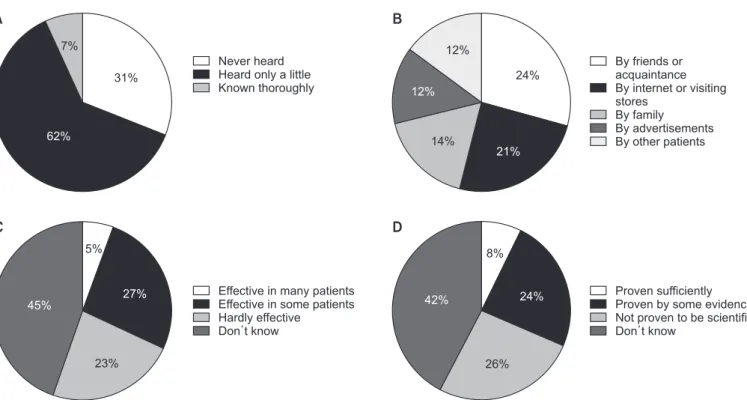
Figure 1. Patient awareness of complementary and alternative medicine (CAM): (A) proportion of patients aware of CAM, (B) route of acqui- sition of information on CAM, (C) patient awareness that CAM is effective, and (D) patient awareness of CAM as scientifically proven.
Table 3. Multiple logistic regression of factors associated with CAM awareness
Variable Univariate analysis Multivariate analysis
OR (95% CI) p-value OR (95% CI) p-value
Age, yr
<65 1.62 (1.07–2.46) 0.02 2.09 (1.24–3.53) <0.01
≥65 Reference Reference
Performance status
ECOG 1–4 1.86 (1.22–2.83) <0.01 2.03 (1.20–3.44) <0.01
ECOG 0 Reference Reference
NSCLC
Stage II–IV 3.13 (1.90–5.16) <0.01 1.96 (1.01–3.79) 0.046
Stage I Reference Reference
Systemic therapy
(+) 1.59 (1.04–2.42) 0.03 1.22 (0.69–2.17) 0.49
(–) Reference Reference
Chemoradiation
(+) 2.76 (1.62–4.73) <0.01 2.07 (1.05–4.06) 0.04
(–) Reference Reference
Hosmer Lemeshow goodness of fit, p=0.61.
CAM: complementary and alternative medicine; OR: odds ratio; CI: confidence interval; ECOG: Eastern Cooperative Oncology Group;
NSCLC: non-small cell lung cancer.
to select the candidate risk factors for CAM awareness. The variables included age (≥65 years vs. <65 years), sex, ECOG performance status (0 vs. 1–4), NSCLC staging (I vs. II–IV), and past treatment history (surgery, CCRT, systemic therapy, radiation therapy). Variables with a p-value of less than 0.05 in univariate analysis were selected for multiple logistic regres- sion analysis. The adjusted odds ratio (OR) of each variable for CAM awareness was calculated.
6. Ethics approval and consent to participate
Ethical approval was obtained from the Ethics Committee of Hallym University Sacred Hospital, and the IRB number was HALLYM201909001001-HE001. The requirement for in- formed consent was waived by the Ethics Committee of Hal- lym University Sacred Hospital.
Results
1. General characteristics
A total of 434 patients were enrolled in this study. The flow chart of patients’ enrollment is shown at Supplementary Figure S1. The general characteristics and comparison to the characteristics of a cancer population in a previous study (KALC-R) are shown in Table 1
17. In this study, 71.0% of the patients were male and 91.4% of the patients had an ECOG scale score of 0 to 1, which was similar to the KALC-R study.
The mean patient age in this study was 65.8±9.9 years, which was slightly younger than the patients in the KALC-R study.
The proportion of ever smokers was similar between the two studies (66.4% in the current study vs. 63.6% in the KALC- R study). In the analysis of cancer stages, the proportion of NSCLC patients was similar between the two studies. How- ever, our study showed more limited-stage SCLC patients than the KALC-R study (52.9% vs. 36.6%, respectively). Our study population received more treatment by all modalities compared with the KALC-R study (surgery, 40.8% vs. 33.0%;
systemic therapy, 54.9% vs 33.3%; CCRT, 28.5% vs. 5.8%; radio- therapy, 19.3% vs. 7.8%, respectively).
2. Awareness of CAM
We analyzed the differences in the characteristics and clini- cal parameters between patients aware of CAM and those not aware of CAM (Table 2). A total of 68.8% of patients were aware of CAM. Those aware of CAM were younger patients with poorer performance status. Among the NSCLC patients, patients aware of CAM had less stage I disease (15.6% vs.
36.7%, respectively, p<0.01), but there was no significant differ- ence in the cancer stage of the SCLC patients. Patients aware of CAM received more systemic therapy (58.3% vs. 46.8%,
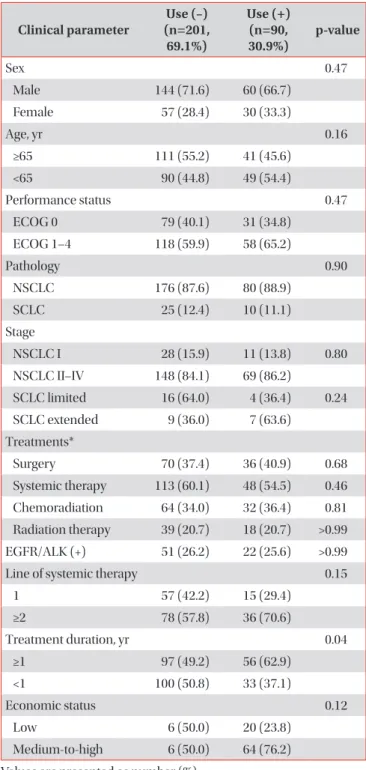
Table 4. Factors that affected CAM use by lung-cancer patients
Clinical parameter Use (–) (n=201,
69.1%)
Use (+) (n=90,
30.9%) p-value
Sex 0.47
Male 144 (71.6) 60 (66.7)
Female 57 (28.4) 30 (33.3)
Age, yr 0.16
≥65 111 (55.2) 41 (45.6)
<65 90 (44.8) 49 (54.4)
Performance status 0.47
ECOG 0 79 (40.1) 31 (34.8)
ECOG 1–4 118 (59.9) 58 (65.2)
Pathology 0.90
NSCLC 176 (87.6) 80 (88.9)
SCLC 25 (12.4) 10 (11.1)
Stage
NSCLC I 28 (15.9) 11 (13.8) 0.80
NSCLC II–IV 148 (84.1) 69 (86.2)
SCLC limited 16 (64.0) 4 (36.4) 0.24 SCLC extended 9 (36.0) 7 (63.6)
Treatments*
Surgery 70 (37.4) 36 (40.9) 0.68
Systemic therapy 113 (60.1) 48 (54.5) 0.46 Chemoradiation 64 (34.0) 32 (36.4) 0.81 Radiation therapy 39 (20.7) 18 (20.7) >0.99 EGFR/ALK (+) 51 (26.2) 22 (25.6) >0.99
Line of systemic therapy 0.15
1 57 (42.2) 15 (29.4)
≥2 78 (57.8) 36 (70.6)
Treatment duration, yr 0.04
≥1 97 (49.2) 56 (62.9)
<1 100 (50.8) 33 (37.1)
Economic status 0.12
Low 6 (50.0) 20 (23.8)
Medium-to-high 6 (50.0) 64 (76.2) Values are presented as number (%).
*Patients may have received more than two treatment modalities.
CAM: complementary and alternative medicine; ECOG: Eastern Cooperative Oncology Group; NSCLC: non-small cell lung cancer;
SCLC: small cell lung cancer; EGFR: epidermal-growth-factor re-
ceptor; ALK: anaplastic lymphoma kinase.
respectively, p=0.04) and CCRT (34.3% vs. 15.9%, respectively, p<0.01). However, there was no statistical difference in previ- ous surgery or radiotherapy between the two groups. Further- more, there was no statistical difference in sex, pathology type (NSCLC/SCLC), EGFR positivity or ALK mutations, the line of systemic therapy (1 vs. ≥2), treatment duration (≥1 year vs. <1 year), or economic status of the patients (low vs. medium-to- high).
In this study, 6.9% of the patients responded that they were thoroughly aware of CAM and 31.1% of the patients answered that they never heard of it (Figure 1A). The most commonly known CAM treatments were mushrooms, oncothermia, high-dose vitamin C, and ginseng (Supplementary Figure S2).
The most common route for obtaining information on CAM was through friends or acquaintances and by the internet or visiting stores (Figure 1B). Around one-third of the patients replied that CAM may be effective or was proven by scientific evidence, and the remainder regarded CAM as not effective, not proven scientifically, or did not know (Figure 1C, D).
Univariate analysis of CAM awareness with potential asso- ciated factors showed statistical significance with age (p=0.02), performance status (p<0.01), cancer staging in NSCLC (p<0.01), previous systemic therapy (p=0.03), and previous CCRT (p<0.01). Multiple logistic regression was performed with variables that showed significance in univariate analysis (Table 3). In this regression model, younger patients (OR, 2.09; p<0.01), poorer performance status (OR, 2.03; p<0.01), advanced stage in NSCLC (OR, 1.96; p=0.046), and previous CCRT (OR, 2.07; p=0.04) were associated with CAM aware- ness. The Hosmer Lemeshow goodness of fit had a calculated p-value of 0.61.
3. Usage of CAM
We investigated the differences in the characteristics and
clinical parameters between CAM users and non-users (Table 4). CAM users comprised 30.9% of our study population.
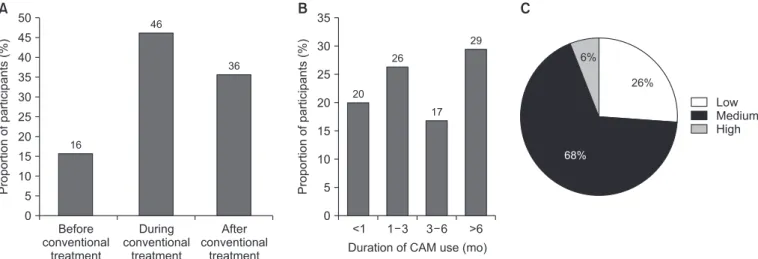
CAM users had a tendency to be younger (54.4% vs. 44.8%, re- spectively, p=0.16), more likely to be female (33.3% vs. 28.4%, respectively, p=0.47), and in advanced stages in the NSCLC patients (86.2% vs. 84.1%, respectively, p=0.80), but the find- ings did not meet statistical significance. Also, there were no statistical differences in performance status, pathology, treat- ments, or economic status between the two groups. The only statistically significant factor was treatment duration of more than 1 year, which was more common in the CAM user group compared to the non-user group (62.9% vs. 49.2%, respective- ly, p=0.04). However, no significantly different factors between the CAM users and non-users were found in multivariate analysis. The most frequently used CAM was mushrooms, on- cothermia, ginseng, and high-dose vitamin C (Supplementary Figure S3) and most of the CAM users received CAM during conventional treatment (Figure 2A). The duration of CAM treatment was not significantly different (Figure 2B), and 74.0% of the patients were in the medium-to-high economic group (Figure 2C). A total of 24.2% of the patients experienced adverse events from CAM, mostly pruritus or rash, fatigue, and insomnia (Supplementary Figure S4). Almost half of the pa- tients paid less than 1,000 USD and 21.1% of the patients paid over 5,000 USD for CAM (Supplementary Figure S5). Finally, only 18.9% of the CAM users were willing to recommend CAM to other patients and 45.3% of the patients were against recommending it (Supplementary Figure S6).
Discussion
In this study, we analyzed the awareness and usage of CAM in a multicenter survey-based lung cancer population. In the analysis of CAM awareness, 68.8% of the patients were
Low Medium High 26%
6%
68%
Before conventional
treatment 50
45 40 35 30 25 20 15 10 Proportionofparticipants(%) 5
0
During conventional
treatment
After conventional
treatment 16
46
36
Duration of CAM use (mo)
<1 35
30
25
20
15
10
Proportionofparticipants(%) 5
0
1 3 3 6 >6 20
26
17 29
A B C
Figure 2. Timing (A) and duration (B) of complementary and alternative medicine (CAM) use, and economic status (C) of the CAM users.
aware of CAM and more CAM users were younger patients with poor performance status, advanced stage in NSCLC patients, and those who received systemic therapy or CCRT.
In multivariate analysis, young age, poor performance status, advanced stage in NSCLC patients, and previous CCRT were independent factors associated with CAM awareness. In con- trast, there were no statistically significant variables that dif- fered between the CAM users and non-users.
The proportion of cancer patients who experienced CAM was shown to be 30.9% in our study, and was reported to vary between 11% and 90% in previous studies
18-20. Previous stud- ies showed some distinct characteristics of CAM users com- pared to non-users. CAM users were usually younger; consist- ed of more female, educated, and white-collar patients; lived in highly urban areas; had advanced-stage cancer; were less physically active, and received psychological support
8,14,21,22. Also, those who were interested in CAM or used CAM previ- ously chose to use CAM more frequently
8. Correspondingly, our study found that the CAM users were younger, more likely to be female, and at an advanced stage, but these findings did not reach statistical significance.
To our knowledge, no previous studies analyzed the factors associated with CAM awareness. However, it may be postulat- ed that patients aware of CAM and CAM users share similar characteristics. Our study showed that patients aware of CAM were more likely to be younger, have poor performance status, and advanced stage in NSCLC patients, which corresponded to the characteristics of CAM users reported in the previous study mentioned above. Also, between treatment modalities, only CCRT was an independent risk factor for CAM aware- ness. Patients with unresectable stable III NSCLC or limited SCLC disease receiving CCRT may have higher potential for cure but higher treatment-associated toxicity than more advanced patients receiving palliative chemotherapy, which may result in a higher awareness of CAM
23.
The World Health Organization (WHO) defined CAM as
“a broad set of healthcare practices that are not part of that country’s own tradition or conventional medicine and are not fully integrated into the dominant healthcare system
24.” Also, the organization mentioned that it might be used alternatively with traditional medicine. This definition implies that these interventions are not fully proven to be effective or safe, nor are they based on scientific evidence. Some experimental, retrospective studies or small prospective studies have shown the potential efficacy or safety of CAM, such as oncother- mia
25,26, high-dose vitamin C
25,27, mistletoe
11,28,29, thymosin alpha 1
30,31, or oriental medicine
10,12,32-34. However, some stud- ies have shown the harmful effects of CAM, such as treatment delay, treatment refusal, and increased mortality
7,13,35. At the crossroads of choice, clinicians and patients should fully un- derstand not only the potentially favorable outcomes but also the devastating consequences of CAM. However, our data and previous studies showed that the source of information about
CAM was mainly friends and the media
8,14. These previous studies also reported the lack of doctors’ roles in providing information about CAM. This situation may misguide patients to have meaningless hope, spend money recklessly, and, most seriously, refuse conventional treatment.
Most of the studies reported that the patients were usually satisfied
36,37with little or transient side effects
14,38. However, our study showed that only 18.9% of the CAM users were satisfied and 24.2% experienced side effects from CAM. Considering the heterogeneity of each CAM intervention, satisfaction, and side effects should be analyzed by the type of CAM adminis- tered
15.
There were some limitations to this study. First, this study was a cross-sectional study based on a survey. As a result, this study design may include some bias, such as recall bias or se- lection bias. Second, as this study population was mainly en- rolled in a secondary or tertiary hospital, it may not represent patients who were receiving conservative or palliative treat- ment in primary clinic or CAM clinics. Third, as described in Table 1, our patients consisted of more of limited-stage SCLC and were treated with all types of modalities compared to the previous population-based study
17. We contend that the expanded concept of lung cancer screening may have re- sulted in increased numbers of lung cancer patients detected at earlier stages or with treatable disease
39. Also, drastic im- provements in treatments such as immunotherapy in the last decade may have increased the number of patients indicated for treatment
40. Furthermore, as our survey was performed in outpatient clinics of secondary or tertiary hospitals, the patients enrolled in our study may have been more frequently followed-up and adhered to treatment.
Despite these limitations, there were some strengths to our study. First, to our knowledge, this was the first study to analyze factors associated with the awareness of CAM. We performed multivariate analysis to reveal the independent risk factors for patients aware of CAM. Also, we compared the variables that potentially differed between CAM users and non-users. Although there were no differences between the two groups, this was the first study that compared not only general characteristics such as age, sex, and economic status, but also the detailed variables associated with diagnosis and treatment, including pathology type, cancer staging, treatment modalities, EGFR/ALK mutation, and the line of systemic therapy. These factors were correspondingly analyzed be- tween patients aware and not aware of CAM, which were not evaluated in previous studies.
In conclusion, we analyzed the differences in characteristics
between patients aware of CAM and those not aware. By mul-
tivariate analysis, we concluded that patients with younger
age, poor performance status, advanced stage, and those who
received prior CCRT were more aware of CAM. They obtained
information on CAM mostly from friends and acquaintances,
and one-third of the patients responded that they believed
CAM was effective or scientifically proven. There were no significantly different characteristics between CAM users and non-users.
*Author Affiliations
1
Division of Pulmonary and Critical Care Medicine, De- partment of Internal Medicine, Incheon St. Mary’s Hospital, College of Medicine, The Catholic University of Korea, Seoul, Departments of
2Pulmonology and Critical Care Medicine and
3Oncology, Asan Medical Center, University of Ulsan College of Medicine, Seoul,
4Division of Pulmonology, De- partment of Internal Medicine, Chungnam National Univer- sity, Daejeon,
5Department of Radiation Oncology, Samsung Medical Center, Sungkyunkwan University School of Medi- cine, Seoul,
6Lung and Esophageal Cancer Clinic, Chonnam National University Hwasun Hospital, Hwasun,
7Department of Internal Medicine, Chonnam National University Medical School, Gwangju,
8Department of Radiation Oncology, Yonsei Cancer Center, Yonsei University College of Medicine, Seoul,
9