Introduction
Chronic cough is the most common disease in respiratory specialty and community clinics that impairs quality of life (QoL) and increases the economic burden
1,2. The common underlying causes associated with chronic cough included asthma syndromes, gastroesophageal reflux disease, upper airway disorders, and various combinations of these dis- eases
3. Although most patients are treated effectively, cough can persist even after extensive examination or treatment trials in some outpatients. These patients are diagnosed as unexplained chronic cough, idiopathic cough, or refractory chronic cough when there is no identifiable cause
4,5. This is always a considerable challenge in clinical practice. Consider- ing the significant medical burden of cough, it is important to establish more effective treatment of patients, especially with chronic cough.
A major hindrance for the development of chronic cough treatment is inadequate understanding of the pathophysi- ological mechanism of cough. Although it is induced by a va-
Efficacy and Safety of Gabapentin in the Treatment of Chronic Cough: A Systematic Review
Guanglin Shi, M.D.
1, Qin Shen, M.D.
2, Caixin Zhang, M.D.
2, Jun Ma, M.D.
1, Anaz Mohammed, M.D.
2and Huan Zhao, M.D.
11
Department of Respiratory Medicine, Nantong Pulmonary Hospital (The Sixth People's Hospital of Nantong), Nantong,
2
Medical School of Nantong University, Nantong, China
Despite recent clinical guidelines, the optimal therapeutic strategy for the management of refractory chronic cough is still a challenge. The present systematic review was designed to assess the evidence for efficacy and safety of gabapentin in the treatment of chronic cough. A systematic search of PubMed, Embase, Cochrane Library databases, and publications cited in bibliographies was performed. Articles were searched by two reviewers with a priori criteria for study selection.
Seven relevant articles were identified, including two randomized controlled trials, one prospective case-series designed with consecutive patients, one retrospective case series of consecutive patients, one retrospective case series with unknown consecutive status, and two case reports comprising six and two patients, respectively. Improvements were detected in cough-specific quality of life (Leicester Cough Questionnaire score) and cough severity (visual analogue scale score) following gabapentin treatment in randomized controlled trials. The results of prospective case-series showed that the rate of overall improvement of cough and sensory neuropathy with gabapentin was 68%. Gabapentin treatment of patients with chronic cough showed superior efficacy and a good safety record compared with placebo or standard medications. Additional randomized and controlled trials are needed.
Keywords: Gabapentin; Cough; Treatment; Review Literature as Topic; Safety
Address for correspondence: Huan Zhao, M.D.
Department of Respiratory Medicine, Nantong Pulmonary Hospital (The Sixth People's Hospital of Nantong), Nantong, 226000, Jiangsu, China Phone: 86-513-80886131, Fax: 86-513-80886132
E-mail: [email protected] Received: Jul. 31, 2017
Revised: Oct. 6, 2017 Accepted: Nov. 13, 2017 Published online: Jun. 19, 2018
cc It is identical to the Creative Commons Attribution Non-Commercial License (http://creativecommons.org/licenses/by-nc/4.0/).
Copyright © 2018
The Korean Academy of Tuberculosis and Respiratory Diseases.
riety of stimuli, cough reflex is mediated by the vagal primary afferent nerve that is distributed in the bronchial tree
6and in the extra visceral areas (main bronchus, trachea, and larynx)
7. It is widely accepted that the sensitivity of the cough reflex is increased in chronic cough
8,9. Meanwhile, more and more evidences showed that the sensory disorder of the laryngeal branches of vagus nerve is an important pathogenetic mecha-
nism
10-18. As pain and cough share the remarkably similar
pathways, gabapentin, traditionally used in treatment of neu- ropathic pain, was recently used as a non-specifc antitussives for chronic idiopathic cough
15,17,19.
Gabapentin has a similar lipophilic structure to the neu- rotransmitter gamma aminobutyric acid which notoriously performs central action
20. Accordingly, it may also cause central nervous system side effects in the patients taking it.
Systematically evaluating the evidence regarding the use of gabapentin medications in the treatment of refractory chronic cough cases may provide views about their efficacy and a bet- ter understanding of the studies related to this new therapeutic strategy. Current study is limited by a relatively small sample size, and there was no systematic review of studies regarding gabapentin antitussive therapies. Therefore, our systematic review was conducted to examine the articles concerning the use of gabapentin in the management of chronic cough. We performed the present systematic review to objectively assess the safety and efficacy of gabapentin in chronic cough so as to provide valuable references for clinical medication.
Materials and Methods
1. Data sources and literature search strategy
Data searching were performed using PubMed, Embase, CBM, and Cochrane Library database by two authors inde- pendently, from their dates of inception to 1 July 2017. No language and geographical restriction was imposed. We trans- lated non-English publications into English when they were satisfied for inclusion criteria. Search keywords used included:
(cough or bronchitis or respiratory tract infections or irritable larynx or pharyngeal diseases or laryngeal diseases or postvi- ral vagal neuropathy or central sensitisation) and (neurontin or gabapentin or gralise or neuromodulator). Unpublished data or data derived only from abstracts were not used. We also searched reference lists of all primary studies and review articles.
2. Inclusion and exclusion criteria
We used following inclusion criteria to select studies for the systematic review: (1) adults with chronic cough of unknown etiology at least 8 weeks’ duration, (2) purpose of the use of gabapentin for the treatment of cough, and (3) outcome
measures standard should be inclued. Exclusion criteria are as follows: (1) patients younger than 18 years; (2) nonhuman studies; (3) cough due to clear etiology like reflux disease, si- nonasal pathology, allergy, pulmonary diseases, angiotensin- converting enzyme inhibitors (ACEIs) and so on; (4) studies with unclear or incomplete information.
3. Outcome measures
One or more of the following outcomes should be included:
cough severity score, Leicester Cough Questionnaire (LCQ), visual analogue scale (VAS), QoL, cough severity, cough fre- quency, clinician assessment, urge-to-cough score, and laryn- geal dysfunction score.
4. Data extraction and quality assessment
Data were selected and extracted from all of the included studies independently by two authors. Each study was noted by the major information including the reference, country, year of publication, study type, number of participants, pa- tient age, medication regimen, follow-up time, inclusion and exclusion criteria of study, definition of effective treatment, and medication adverse effects. Two reviewers independently evaluated each relevant article and reached agreement for study inclusion. The quality of each trial was assessed by the following trial design features: (1) consecutive status of pa- tients for non randomized controlled trails, (2) type of study outcome, (3) whether study outcome was chosen a priori, and (4) exclusion/inclusion criteria for patient enrollment. Owing to the limited numbers of studies, variability in the quality of researches, and inconsistent reporting of outcomes, no meta- analysis was attempted.
Results
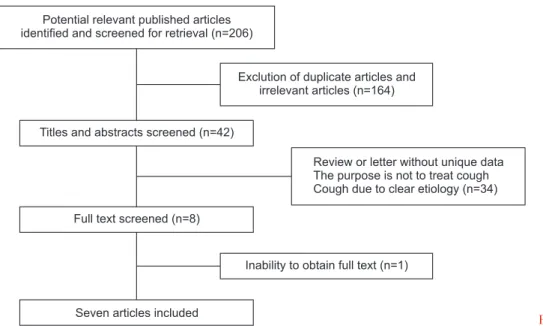
Initial data search identified a total of 206 potentially rel- evant articles (Figure 1). We removed 30 duplicated articles and excluded 134 after screening the title and abstracts. After reviewing the full-text articles, 34 studies were excluded, main- ly because they were reviews and letters without new data or were not satisfactory for the study selection; one study was not included because of the inability to obtain full text
21; we in- cluded one article which was a case report about evidence for chronic cough as a sensory vagal neuropathy, owing to it was also a cause of refractory chronic cough
18; a study published in China was also included as it was a relatively complete randomized controlled trials (RCTs)
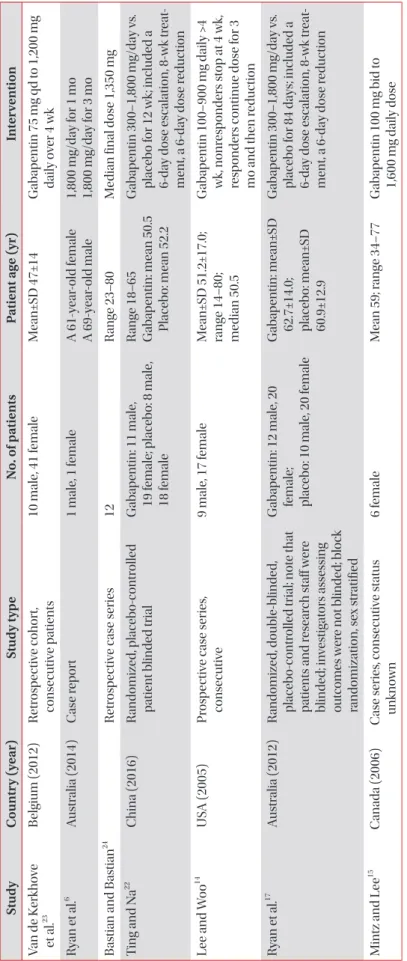
22; eventually, all together seven papers were selected for further analysis, and a detailed description of these studies is provided (Table 1).
Among these two studies were placebo controlled RCTs
17,22.
The RCTs were placebo controlled, one study participants
and researchers were blinded (investigators evaluating the outcome were not blinded)
17, and the other did not reported blind method
22. One study was a prospective case series design of consecutive patients
14; two studies were retrospec- tive trails
23,24, one was a retrospective cohort of consecutive patients, consecutive status in the other retrospective case se- ries was not reported. The rest of the two studies were a case report of two patients consist of one male and one female and a case series of six participants whose consecutive status were not clear
6,15. Two studies from same authors were funded by the National Health and Medical Research Council of Austra- lia
6,17. The rest of the studies did not describe the financial sup- port. All of the studies included patients with cough for at least 8 weeks (Table 2).
The inclusion/exclusion criteria adopted by the investiga- tors included a negative response to empirical treatment trials with proton pump inhibitors, inhaled corticosteroid, oral cor- ticosteroid or nasal corticosteroid treatment
6,21,22; normal spi- rometry
6,21; smoking
17; modified barium swallow, computed tomography (CT), magnetic resonance imaging (MRI), pH testing
14; gastroesophageal reflux disease and asthma
15,17,23.
In the research of Lee and Woo
14, most of the patients had received previous treatment and examination, including the treatment of gastroesophageal reflux disease, modified bari- um swallow, CT, MRI, and pH monitoring, but it was unclear whether these had been systematically carried out in all pa- tients. In the study by Mintz and Lee
15, all patients were treat- ed initially with corticosteroids therapy, not every patient had been evaluated for postnasal drip but did have prior empirical reflux treatment trials and surveys for pulmonary disease in some way. Only an RCT designed by Ryan et al.
17mentioned smoking and ACEI as inclusion criteria.
Different outcome criteria were used to evaluate the clinical
therapeutic effect of gabapentin (Table 3). The two RCTs used LCQ instruments, VAS and an objective cough monitor to determine cough frequency
17,22. Two studies categorized treat- ment response based on self-reported percent improvement.
A study by Lee and Woo
14simply referred to the improvement of clinical symptoms (yes or no), and if the system response was reported by patient’s self-reported or physician assess- ment was not clear
15. A cough severity score, which was corre- lated with the average of the four LCQ scores, was performed by Van de Kerkhove et al.
23. Mintz and Lee
15evaluated the symptom response using clinician reports
15. One RCT by Ryan et al.
17also used capsaicin cough challenge as a measurement to evaluate objective outcome, in which participants’ cough threshold was assessed in response to the chemical tussive capsaicin.
Gabapentin treatment improved symptoms of cough
17. In the two RCTs improvements were seen in cough-specific QoL (LCQ score), cough severity (VAS score), and there was a reduction in cough frequency
17,22. The RCT using capsaicin cough challenge showed that capsaicin cough reflex sensitiv- ity did not change significantly with gabapentin treatment
17. One study showed the rate of treatment response was 68%
using a binary rating of improvement, compared with 80% in the patients with demonstrable findings of laryngeal neuropa- thy, while patients without evidences of motor neuropathy had only a 37.5% response rate
14. In the study using clinician assessment response, half of the patients had complete re- mission and the remaining patients had improved to vary- ing degree in cough
15. One RCT study also evaluated clinical symptom improvement time and found the onset of action of gabapentin was within 4 weeks, and the treatment effect was maintained with maximal dosing during 8 weeks
17. Mintz and Lee
15noted the duration of improvement ranged from 6
Figure 1. Flowchart for study selection.
Potential relevant published articles identified and screened for retrieval (n=206)
Titles and abstracts screened (n=42)
Full text screened (n=8)
Seven articles included
Exclution of duplicate articles and irrelevant articles (n=164)
Inability to obtain full text (n=1)
Review or letter without unique data The purpose is not to treat cough Cough due to clear etiology (n=34)