Copyright © 2020 Korean Stroke Society
This is an Open Access article distributed under the terms of the Creative Commons Attribution Non-Commercial License (http://creativecommons.org/licenses/by-nc/4.0/) which permits unrestricted non-commercial use, distribution, and reproduction in any medium, provided the original work is properly cited.
Original Article
Outcome of Stroke Patients with Cancer and Nonbacterial Thrombotic Endocarditis
Joonsang Yoo, a,b Jin Kyo Choi, b Young Dae Kim, b,c Hyo Suk Nam, b,c Hyungjong Park, b,d Hye Sun Lee, e Ji Hoe Heo b,c
a
Department of Neurology, National Health Insurance Service Ilsan Hospital, Goyang, Korea
b
Department of Neurology, Yonsei University College of Medicine, Seoul, Korea
c
Integrative Research Center for Cerebrovascular and Cardiovascular Diseases, Yonsei University College of Medicine, Seoul, Korea
d
Department of Neurology, Keimyung University School of Medicine, Daegu, Korea
e
Biostatistics Collaboration Unit, Yonsei University College of Medicine, Seoul, Korea
Background and Purpose Nonbacterial thrombotic endocarditis (NBTE) is a cause of stroke in cancer. However, clinical characteristics and outcomes in stroke patients with cancer-associated NBTE are not well known.
Methods We included consecutive patients with stroke and active cancer over a 9-year period who underwent echocardiography. We retrospectively compared clinical characteristics and presence of metastasis between patients with NBTE, those with cryptogenic etiologies, and those with determined etiologies. We also investigated mortality and stroke events during the 6-month follow-up.
Results Among the 245 patients, 20 had NBTE, 96 had cryptogenic etiologies, and 129 had determined etiologies. Metastasis was seen in all 20 patients (100%) with NBTE, 69.8% in patients with cryptogenic etiology, and 48.8% in patients with or determined etiology. During the 6-month follow-up, 127 patients (51.8%) developed stroke and/or died (death in 110 [44.9%] and stroke events in 55 [22.4%]). Patients with NBTE showed significantly higher mortality (80%) and stroke occurrence (50%) than those with cryptogenic etiologies (mortality 54.2%, stroke 25.0%, log-rank P=0.006) and determined etiologies (mortality 32.6%, stroke 16.3%, log-rank P<0.001). In a multivariate Cox proportional hazard analysis, the presence of NBTE was independently associated with composite outcomes of mortality and stroke events (hazard ratio, 1.941; 95% confidence interval, 1.052 to 3.690).
Conclusions NBTE should be suspected as a potential cause of stroke in patients with metastatic cancer. Patients with NBTE have a high risk of recurrent stroke and mortality. Future studies are necessary to determine strategies to reduce stroke recurrence in patients with NBTE.
Keywords Stroke; Neoplasms; Metastasis; Mortality; Nonbacterial thrombotic endocarditis
Correspondence: Ji Hoe Heo Department of Neurology, Yonsei University College of Medicine, 50-1 Yonsei-ro, Seodaemun-gu, Seoul 03722, Korea
Tel: +82-2-2228-1605 Fax: +82-2-393-0705 E-mail: [email protected] Received: February 26, 2020 Revised: April 20, 2020 Accepted: April 21, 2020
Introduction
Cancer may be associated with stroke. In a large cohort study, the 6-month cumulative incidence of ischemic stroke was sig-
nificantly higher in patients with cancer than in matched con-
trols (3.0% vs. 1.62%).
1Nonbacterial thrombotic endocarditis
(NBTE) is characterized by noninfectious vegetation on the
cardiac valves.
2NBTE is a cause of stroke and most frequently
develops in patients with systemic cancer.
3,4Most information on NBTE in stroke is derived from case re- ports or post-mortem studies because of its rarity.
5-8Although patients with acute stroke and active cancer are known to have a substantial short-term risk of recurrent stroke,
9the outcomes of stroke patients with cancer-associated NBTE are not well known. In addition, the pathomechanism of NBTE is unknown.
However, pathological studies have shown that the vegetation and thrombi retrieved from stroke patients with NBTE have very high platelet fractions.
10,11Further, cancer is known to activate platelets, which play an important role in metastasis.
12These findings suggest a potential association between NBTE and me- tastasis. Previous case reports and post-mortem studies have shown frequent occurrences of metastasis in patients with NBTE. However, information on the presence of metastasis is insufficient in many cases.
13-16Therefore, the association be- tween NBTE and metastasis remains uncertain.
We hypothesized that development of NBTE has a relation- ship with metastasis. In this study, we investigated association between NBTE and metastasis, and the mortality and occur- rence of stroke events for 6 months following an initial stroke in patients with cancer-associated NBTE.
Methods
Study population
This retrospective study used a hospital-based prospective co- hort of consecutively enrolled patients with ischemic stroke within 7 days of symptoms onset. Routine evaluations per- formed were as follows: standard blood tests including D-di- mer; brain magnetic resonance imaging (MRI) and/or comput- ed tomography (CT) and cerebral angiography (magnetic reso- nance angiography, CT angiography, or conventional angiogra- phy); Holter monitoring or continuous electrocardiography monitoring during admission in the stroke unit; and trans- esophageal echocardiography (TEE) and/or transthoracic echo- cardiography (TTE). TEE was not performed in patients with de- creased consciousness, aphasia, impending brain herniation, poor systemic conditions, severe swallowing difficulty, tracheal intubation, or when informed consent could not be obtained.
17The study hospital is a tertiary university hospital with a dedicated cancer center where patients with cancer routinely undergo extensive evaluations for the presence of metastasis.
When cancer or NBTE is diagnosed during admission, patients are referred to oncologists for further evaluation and treat- ment.
This study included consecutive patients with active cancer who were registered between January 2010 and December 2018
and who underwent echocardiography. Active cancer was de- fined as cancer that was diagnosed within 6 months, required chemotherapy or surgical treatment within 6 months, or was re- current, metastatic, or inoperable.
18Patients with brain malig- nancy or hematologic malignancy were excluded. The cohort and this study were approved by the Institutional Review Board of the Yonsei University Health System. The need for an informed consent was waived due to the retrospective nature of the study.
Study group
Because the study participants had active cancer, patients were categorized into those with NBTE, those with cryptogenic eti- ology, and those with determined etiology.
11NBTE was deter- mined based on formal reports by cardiologists who diagnosed vegetation based on echocardiographic examinations. Five pa- tients with NBTE and co-existing atrial fibrillation were classi- fied into the NBTE group. Twenty-one patients with a patent foramen ovale without venous thrombosis and other determin- able etiologies were classified into cryptogenic etiology group.
Outcome assessments
All patients were regularly followed up after discharge by neu- rologists and clinical research assistants in the outpatient clinic using face-to-face interviews or by a telephonic interview us- ing a structured questionnaire.
19We reviewed the medical re- cords to obtain information on mortality and cause of death.
The cause of death was categorized as stroke-related, cancer- related, or others/unknown.
20Information on the occurrence of any new stroke events (cerebral infarction or intracerebral hemorrhage [ICH]) after the initial cerebral infarction was also obtained from medical records. The diagnosis of stroke was based on brain MRI and/or CT results.
Statistical analysis
Variables were expressed as mean±standard deviation, median (interquartile range), or number (percentage), as appropriate.
Baseline characteristics among the groups were compared using
one-way analysis of variance or the Kruskal-Wallis test for con-
tinuous variables and the chi-square test or Fisher’s exact test
for categorical variables. Post hoc analysis was performed using
Bonferroni’s correction or Dunn’s test. Kaplan-Meier estimates
and log-rank tests were performed (adjusted by Bonferroni’s cor-
rection) for mortality, occurrence of stroke, and composite out-
comes of mortality and stroke. To determine whether the pres-
ence of NBTE was associated with composite events of mortality
and stroke, we performed multivariate Cox proportional hazard
regression analyses. As all patients with NBTE had metastasis
and 90% of patients with NBTE had multiple territory infarc-
tions, we constructed two different multivariate regression mod- els to avoid multicollinearity. Model 1 included the presence of NBTE and Model 2 included metastasis and multiple territory in- farctions. All statistical analyses were performed using R statisti- cal software version 3.5.1 (http://www.R-project.org). A P<0.05 was considered statistically significant.
Results
During the 9-year study period, 289 patients with acute isch- emic stroke and active cancer were registered to the cohort. Of those, 245 patients (84.8%) underwent echocardiography and were included in this study (123 patients underwent both TEE and TTE, 25 patients underwent TEE only, and 97 patients un- derwent TTE only). The mean age of the included patients was 68.7 ±10.7 years, and 136 patients (55.5%) were men. Com- pared to patients who underwent echocardiography, those who did not undergo echocardiography were younger, had fewer atrial fibrillation and higher National Institutes of Health Stroke Scale (NIHSS) scores. Cancer types were not different between patients who did or did not undergo echocardiogra- phy (Supplementary Table 1).
Comparison between the groups
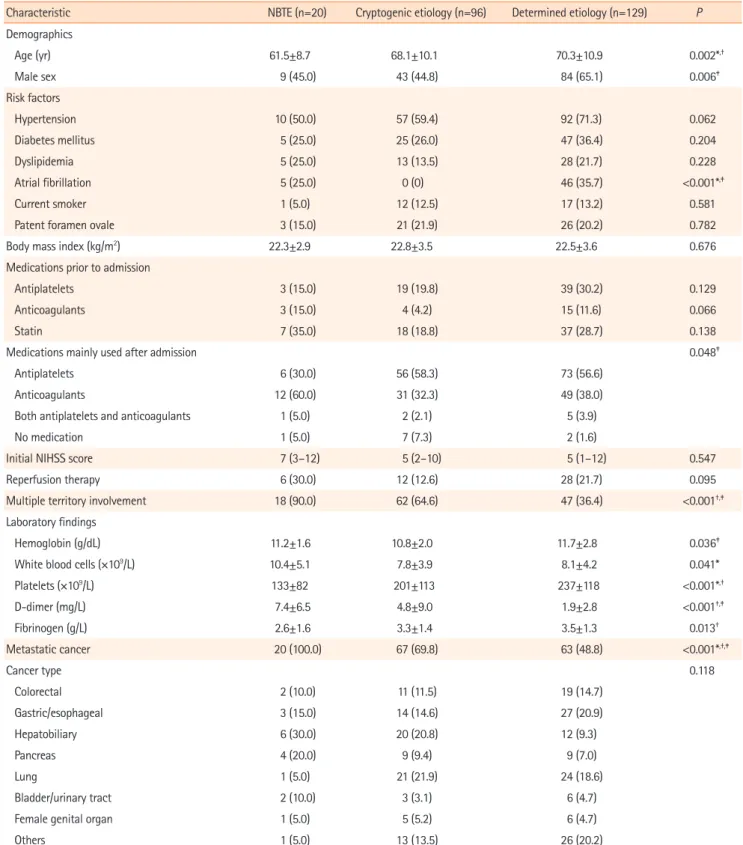
Of the 245 patients, 20 patients (8.2%) had NBTE, 96 (39.2%) had a cryptogenic etiology, and 129 (52.7%) had determined etiologies. In patients with determined etiologies, those with cardioembolism were 51, those with large artery atherosclero- sis were 46, and those with two or more causes were 19 (Sup- plementary Table 2). Of 150 patients (61.2%) with metastasis, NBTE was diagnosed in 20 patients (13.3%). Compared with patients with determined etiologies, those with NBTE were younger, had more frequent multiple vascular territory involve- ment, lower platelet counts, lower fibrinogen levels, and higher D-dimer levels (Table 1).
Metastasis, cancer type, and NBTE
All 20 patients with NBTE had metastasis, and NBTE was not detected in patients without metastasis. The presence of me- tastasis was significantly higher in patients with NBTE (100%) than in those with stroke with a cryptogenic etiology (69.8%;
P=0.014 after Bonferroni’s correction) or those with a deter- mined etiology (48.8%; P<0.001 after Bonferroni’s correction) (Table 1). The cancer type was not significantly different among the three groups (Table 1).
Six-month mortality and stroke events
All patients were followed up for 6 months after the initial
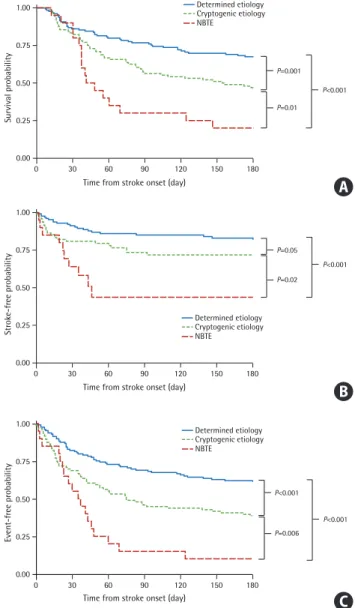
stroke event. During the follow-up, 127 patients (51.8%) de- veloped stroke events and/or died (110 [44.9%] died and 55 [22.4%] patients experienced stroke events). The median sur- vival of patients with NBTE was 44.5 days, and event-free sur- vival of composite outcomes of mortality and stroke was 36 days. During the 6-month follow-up, 90% (18/20) patients with NBTE died or developed stroke, while only 38.8% patients with a determined etiology died or developed stroke (50/129, P<0.001) (Table 2).
Compared to event-free patients, those with events (mortal- ity or stroke) were younger and had lower body mass indices and higher initial NIHSS scores. They also had lower hemoglo- bin levels, platelet counts, and fibrinogen levels, and higher white blood cell counts and D-dimer levels (Table 3). Metasta- sis and multiple vascular territory involvements were more common in patients with mortality or stroke events. Cancer type was also different between patients with or without events (Table 3).
In the Kaplan-Meier survival analysis, the 6-month mortality was different among the three groups (P<0.001). Patients with NBTE showed lower 6-month survival probability, lower stroke- free probability, and lower event-free probability than those with cryptogenic or determined etiologies (Figure 1). Mortality, stroke events, and composite outcomes were more common in patients with a cryptogenic etiology than in those with a de- termined etiology (Figure 1).
Causes of death
During the follow-up, more patients with NBTE died (16/20 [80.0%]) compared to those with a cryptogenic etiology (52/96 [54.2%]) and a determined etiology (32/129 [32.6%]) (P<0.001). Causes of death were cancer-related in 83 (75.5%), stroke-related in 21 (19.1%), and other/unknown in six (5.5%) patients. The cause of death did not significantly differ among the three groups (P=0.307) (Table 2).
Stroke events
During the 6-month follow-up, stroke events occurred in 55/245 (22.4%) of patients; 53 (21.6%) with ischemic stroke and two (0.8%) with ICH. Stroke was diagnosed using diffusion-weighted imaging in 49 patients (89.1%) and by CT in five patients (9.1%).
The type of imaging was uncertain in one patient who was diag-
nosed at another hospital (1.8%). Stroke events occurred most
frequently in patients with NBTE (10/20, 50%), followed by those
with a cryptogenic etiology (24/96, 25.0%) and those with a de-
termined etiology (21/129, 16.3%) (Table 2). Mortality was more
frequent in patients with stroke events than in those without
(69.1% [38/55] vs. 37.9% [72/190], P<0.001).
Table 1. Comparison of baseline characteristics according to stroke etiology
Characteristic NBTE (n=20) Cryptogenic etiology (n=96) Determined etiology (n=129) P
Demographics
Age (yr) 61.5±8.7 68.1±10.1 70.3±10.9 0.002*
,†Male sex 9 (45.0) 43 (44.8) 84 (65.1) 0.006
‡Risk factors
Hypertension 10 (50.0) 57 (59.4) 92 (71.3) 0.062
Diabetes mellitus 5 (25.0) 25 (26.0) 47 (36.4) 0.204
Dyslipidemia 5 (25.0) 13 (13.5) 28 (21.7) 0.228
Atrial fibrillation 5 (25.0) 0 (0) 46 (35.7) <0.001*
,‡Current smoker 1 (5.0) 12 (12.5) 17 (13.2) 0.581
Patent foramen ovale 3 (15.0) 21 (21.9) 26 (20.2) 0.782
Body mass index (kg/m
2) 22.3±2.9 22.8±3.5 22.5±3.6 0.676
Medications prior to admission
Antiplatelets 3 (15.0) 19 (19.8) 39 (30.2) 0.129
Anticoagulants 3 (15.0) 4 (4.2) 15 (11.6) 0.066
Statin 7 (35.0) 18 (18.8) 37 (28.7) 0.138
Medications mainly used after admission 0.048
‡Antiplatelets 6 (30.0) 56 (58.3) 73 (56.6)
Anticoagulants 12 (60.0) 31 (32.3) 49 (38.0)
Both antiplatelets and anticoagulants 1 (5.0) 2 (2.1) 5 (3.9)
No medication 1 (5.0) 7 (7.3) 2 (1.6)
Initial NIHSS score 7 (3–12) 5 (2–10) 5 (1–12) 0.547
Reperfusion therapy 6 (30.0) 12 (12.6) 28 (21.7) 0.095
Multiple territory involvement 18 (90.0) 62 (64.6) 47 (36.4) <0.001
†,‡Laboratory findings
Hemoglobin (g/dL) 11.2±1.6 10.8±2.0 11.7±2.8 0.036
‡White blood cells (×10
9/L) 10.4±5.1 7.8±3.9 8.1±4.2 0.041*
Platelets (×10
9/L) 133±82 201±113 237±118 <0.001*
,†D-dimer (mg/L) 7.4±6.5 4.8±9.0 1.9±2.8 <0.001
†,‡Fibrinogen (g/L) 2.6±1.6 3.3±1.4 3.5±1.3 0.013
†Metastatic cancer 20 (100.0) 67 (69.8) 63 (48.8) <0.001*
,†,‡Cancer type 0.118
Colorectal 2 (10.0) 11 (11.5) 19 (14.7)
Gastric/esophageal 3 (15.0) 14 (14.6) 27 (20.9)
Hepatobiliary 6 (30.0) 20 (20.8) 12 (9.3)
Pancreas 4 (20.0) 9 (9.4) 9 (7.0)
Lung 1 (5.0) 21 (21.9) 24 (18.6)
Bladder/urinary tract 2 (10.0) 3 (3.1) 6 (4.7)
Female genital organ 1 (5.0) 5 (5.2) 6 (4.7)
Others 1 (5.0) 13 (13.5) 26 (20.2)
Values are presented as mean±standard deviation, number (%), or median (interquartile range).
NBTE, nonbacterial thrombotic endocarditis; NIHSS, National Institutes of Health Stroke Scale.
*NBTE vs. Cryptogenic, P<0.05;
†NBTE vs. Determined, P<0.05;
‡Cryptogenic vs. Determined, P<0.05.
Factors associated with mortality and stroke events
In the multivariate Cox proportional hazard analysis, female sex and a lower body mass index were associated with com- posite outcomes of mortality and stroke both in Model 1 and Model 2. The composite outcomes were independently associ- ated with the presence of NBTE (hazard ratio [HR], 1.941; 95%
confidence interval [CI], 1.052 to 3.690) (Table 4, Model 1). The presence of metastasis (HR, 2.870; 95% CI, 1.648 to 4.996) and the involvement of multiple vascular territories (HR, 2.524;
95% CI, 1.570 to 4.058) were also independently associated with the composite outcomes (Table 4, Model 2).
Discussion
In this study, NBTE was diagnosed in approximately one of 11 stroke patients with active cancer. NBTE was also found exclu- sively in patients with metastasis. In addition, stroke patients with NBTE had a very high risk of mortality and stroke events during a 6-month follow-up.
The pathomechanism of NBTE remains unknown. Autopsy studies in patients with NBTE have shown that cardiac vegeta- tion is mainly composed of platelets,
21and examinations of thrombi retrieved during mechanical thrombectomy in stroke patients with NBTE have indicated very high platelet and low erythrocyte fractions.
11,22These studies suggest that platelet- mediated mechanisms play a key role in the development of cancer-associated NBTE. The role of platelets in cancer has been extensively studied; platelets play a crucial role in tumor growth and metastasis.
23Our study demonstrated that NBTE occurred exclusively in patients with metastasis. Platelets can contribute to tumor in-
vasion and metastasis via several mechanisms. Platelets are es- sential for the survival of circulating tumor cells,
24and these cells rapidly associate with platelets via their receptors and in- duce tumor cell-induced platelet aggregation (TCIPA).
25This TCIPA is critical for tumor cell survival as platelets form a phys- ical shield around tumor cells, protecting them from recogni- tion and lysis by natural killer cells and shear-induced dam- age.
26,27These findings suggest that the association of tumor cells with platelets during metastasis may somehow contribute to the development of platelet-rich vegetation in NBTE.
Stroke patients with active cancer have a substantial risk of recurrent stroke. In a retrospective study, ischemic stroke re- curred in 16% patients within 6 months of the initial stroke.
15In the present study cohort, ischemic stroke recurred in 21.6%
patients and ICH developed in 0.8% patients. Particularly, 50%
patients with NBTE developed stroke within 6 months, signifi- cantly higher than those without NBTE. Ninety percent of pa- tients with NBTE had lesions involving multiple vascular terri- tories, which suggests multiple embolization from the heart.
Patients with NBTE may be prone to a high risk of multiple thromboembolism because the platelet-rich vegetation (thrombus) is attached to the fast-moving cardiac valves.
This study showed that mortality differed significantly among the three etiology categories of stroke patients with active cancer. During the 6 months of follow-up, 80% patients with NBTE died. However, less than one-third of the patients with a determined etiology died. Patients with a cryptogenic etiology had an intermediate risk of 6-month mortality. The high mortality in patients with NBTE may be associated with metastasis since all patients with NBTE had it. In our previous study, 67.1% stroke patients with metastatic cancer died with- in 6 months,
20but the 6-month mortality in patients with Table 2. Causes of death and type of stroke event according to stroke etiology
Variable NBTE (n=20) Cryptogenic etiology (n=96) Determined etiology (n=129) P
Composite outcomes of mortality and stroke 18 (90) 59 (61.5) 50 (38.8) <0.001*
,†,‡Mortality 16 (80) 52 (54.2) 32 (32.6) <0.001
†,‡Causes of death 0.307
Cancer-related 13 (81.2) 43 (82.7) 27 (64.3)
Stroke-related 2 (12.5) 7 (13.5) 12 (28.6)
Other/unknown cause 1 (6.3) 2 (3.8) 3 (7.1)
Any stroke events 10 (50) 24 (25.0) 21 (16.3) <0.003
†Stroke type
Cerebral infarction 10 (100) 23 (95.8) 20 (95.2)
Intracerebral hemorrhage 0 (0) 1 (4.2) 1 (4.8)
Values are presented as number (%).
NBTE, nonbacterial thrombotic endocarditis.
*NBTE vs. Cryptogenic, P<0.05;
†NBTE vs. Determined, P<0.05;
‡Cryptogenic vs. Determined, P<0.05.
NBTE was even higher. In the present study, mortality was also higher in patients who developed recurrent stroke; therefore, frequent stroke reoccurrence in patients with NBTE might also increase the risk of death.
In this study, patients with NBTE had higher D-dimer levels and more frequent multiple vascular territory involvement than
those of patients with stroke of a determined etiology. These are known characteristics of cancer-related stroke.
3Our find- ings suggest that some features of cancer-related stroke may be associated with NBTE.
28,29Patients with a cryptogenic etiol- ogy had intermediate characteristics between those with NBTE and those with a determined etiology. Although NBTE is often not diagnosed despite TEE being performed,
30NBTE has been suggested as the likely cause of cryptogenic stroke in many pa- tients with cancer.
29Therefore, undiagnosed NBTE may have been present in some patients with a cryptogenic etiology.
This study has several limitations. First, although patients were enrolled prospectively, analysis for this study was per- Table 3. Comparison of characteristics between patients with and without
mortality/stroke events
Characteristic No events
(n=118) Events
(n=127) P
Demographics
Age (yr) 68.4±9.9 69.0±11.4 0.664
Male sex 80 (67.8) 56 (44.1) <0.001
Risk factors
Hypertension 79 (66.9) 80 (63.0) 0.607
Diabetes mellitus 39 (33.1) 38 (29.9) 0.697
Dyslipidemia 27 (22.9) 19 (15.0) 0.155
Atrial fibrillation 26 (22.0) 25 (19.7) 0.768
Current smoker 20 (16.9) 10 (7.9) 0.049
Body mass index (kg/m
2) 23.2±3.2 22.0±3.8 0.010 Metastatic cancer 42 (35.6) 108 (85.0) <0.001
Cancer type 0.020
Colorectal 19 (16.1) 13 (10.2)
Gastric/esophageal 22 (18.6) 22 (17.3)
Hepatobiliary 13 (11.0) 25 (19.7)
Pancreas 5 (4.2) 17 (13.4)
Lung 21 (17.8) 25 (19.7)
Bladder/urinary tract 8 (6.8) 3 (2.4)
Female genital organ 5 (4.2) 7 (5.5)
Others 25 (21.2) 15 (11.8)
Initial NIHSS score 3 (1–10) 6 (2–11.5) 0.007
Reperfusion therapy 25 (21.2) 21 (16.7) 0.460
Multiple vascular territory involvement 36 (30.5) 91 (71.7) <0.001
Stroke etiology <0.001
NBTE 2 (10.0) 18 (90.0)
Cryptogenic 37 (38.5) 59 (61.5)
Determined 79 (61.2) 50 (38.8)
Laboratory findings
Hemoglobin (g/dL) 11.6±2.1 11.0±2.7 0.033
White blood cells (×10
9/L) 7.5±3.7 8.9±4.5 0.008 Platelets (×10
9/L) 243±112 188±116 <0.001
D-dimer (mg/L) 1.1±1.5 5.7±8.3 <0.001
Fibrinogen (g/L) 3.6±1.2 3.2±1.5 0.021
Values are presented as mean±standard deviation, number (%), or median (interquartile range).
NIHSS, National Institutes of Health Stroke Scale; NBTE, nonbacterial thrombotic endocarditis.
0.00 0.25 0.50 0.75 1.00
0 30 60 90 120 150 180
0.00 0.25 0.50 0.75 1.00
Time from stroke onset (day)
0 30 60 90 120 150 180
0.00 0.25 0.50 0.75 1.00
0 30 60 90 120 150 180
Time from stroke onset (day)
Determined etiology Cryptogenic etiology NBTE
P=0.001
P=0.01
P=0.05 P=0.02
P<0.001
P=0.006 Determined etiology Cryptogenic etiology NBTE
Determined etiology Cryptogenic etiology NBTE
P<0.001
P<0.001
P<0.001
Survival probabilityStroke-free probabilityEvent-free probability
Time from stroke onset (day)