http://dx.doi.org/10.4491/KSEE.2015.37.7.396 ISSN 1225-5025, e-ISSN 2383-7810
낙동강 수계에서의 유기인계 난연제류 검출 현황: 본류, 지류 및 하수처리장 방류수 Occurrence of Organophosphorus Flame Retardants (OPFRs)
in Nakdong River Basin : Mainstreams, Tributaries and STP Effluents
서창동․손희종†․최진택․류동춘․유평종
Chang-Dong Seo․Hee-Jong Son†․Jin-Taek Choi․Dong-Choon Ryu․Pyung-Jong Yoo 부산광역시 상수도사업본부 수질연구소
Water Quality Institute, Water Authority, Busan
(Received January 19, 2015; Revised March 23, 2015; Accepted July 15, 2015)
Abstract : This study was investigated occurrence and distribution patterns of organophosphorus flame retardants (OPFRs) in Nakdong River basin (mainstream, tributaries and sewage treatment plant (STP) effluents). 3 (TCEP, TCPP and TBEP) out of 9 OPFRs were detected in 6 out of 20 sampling sites (mainstream and tributaries), The TCPP and TBEP concentration levels in mainstream samples were ND~114.9 ng/L ng/L and ND~49.1 ng/L, respectively. And the TCEP, TCPP and TBEP concentration levels in tributary samples were ND~1,865.3 ng/L, ND~519.2 ng/L and ND~210.4 ng/L, respectively. 4 (TBP, TCEP, TCPP and TBEP) out of 9 OPFRs were detected in effluents of 11 STPs around the Nakdong River basin. The TBP, TCEP, TCPP and TBEP concentration levels in 11 STP effluents were ND~458.5 ng/L, ND~2,932.7 ng/L, ND~1,320.7 ng/L and ND~655.2 ng/L, respec- tively. According to the sampling season, change ranges of distribution patterns and detected concentrations of OPFRs were highly variable in the same sampling sites.
Key Words : Organophosphorus Flame Retardants (OPFRs), TCPP, TCEP, Nakdong River Basin, STP Effluent, GC-MS/MS
요약 : 낙동강 수계에서의 유기인계 난연제류(OPFRs) 검출현황을 조사한 결과, 본류 및 지류 20지점 중 6지점에서 TCEP, TCPP 및 TBEP 3종이 검출되었으며, 본류에서는 고령에서만 TCPP가 ND~114.9 ng/L 및 TBEP가 ND~49.1 ng/L의 농도로 검 출되었으며, 지류의 경우는 금호강 상류, 신천, 금호강 하류, 진천천 및 양산천에서 TCEP가 ND~1,865.3 ng/L, TCPP가 ND~
519.2 ng/L 및 TBEP가 ND~210.4 ng/L의 농도로 검출되었다. 낙동강 주변에 위치한 11개 하수처리장 방류수들에서는 TBP, TCEP, TCPP 및 TBEP 4종이 각각 ND~458.5 ng/L, ND~2,932.7 ng/L, ND~1,320.7 ng/L 및 ND~655.2 ng/L의 농도로 검출되었 다. 낙동강 수계 및 낙동강 주변에 위치한 11개 하수처리장 방류수들에서의 계절별 OPFRs 분포비율을 분석한 결과, 동일 지 점에서도 채수시기에 따라 검출농도 뿐만 아니라 구성종 비율의 변화폭도 매우 크게 나타났다.
주제어 : 유기인계 난연제, TCPP, TCEP, 낙동강 수계, 하수처리장 방류수, GC-MS/MS
1. 서 론
최근에는 분석기술의 발달로 인해 다양한 신종오염물질 들(emerging contaminants)이 상수원이나 우리들이 음용하 는 수돗물에서 빈번히 검출된다.1,2) 최근에는 화재 초기발 생과 확산 억제를 위해 다양한 제품원료들에 첨가되는 화 학물질인 난연제류(flame retardants, FRs)에 대한 관심이 증대되고 있다. 이들은 1960년대부터 사용되어져 오고 있 으며, 최근 들어 플라스틱, 직물, 건축자재, 전기․전자제품 류들에서 사용량이 점진적으로 증가하고 있다.3)
이들 난연제들은 구성성분에 의해 유기계와 무기계로 구 분되며, 무기계 난연제들은 금속수산화물계, 안티몬계 등으 로 구분되며, 유기계 난연제들의 경우는 질소계, 할로겐계, 할로겐과 인의 혼합물계 및 인계 등으로 구분된다. 특히, 유 기계 난연제들 중 높은 환경 잔류성, 생물 농축성 및 생체 독 성을 유발하는 것으로 알려진 일부 할로겐계 난연제들이 제 4차 스톡홀름협약(Stockholm Convention on Persistent Organic Pollutants)에서 신규 사용금지 화학물질로 확정되었다.4)
신규 사용금지 화학물질로 확정된 일부 할로겐계 난연제 들의 대용으로 인계와 인과 할로겐 혼합물계 난연제들이 사용되고 있으며, 이들은 기존의 할로겐계 난연제들의 특 성을 잘 나타내면서도 환경적인 측면에서는 기존의 할로겐 계 난연제들에 비해 비교적 위해도가 낮은 것으로 알려져 있다.2)
그러나 최근의 여러 연구결과들에 의하면 인계와 인과 할 로겐 혼합물계 난연제들의 경우도 몇몇 물질들에서는 발암 및 돌연변이 가능성을 언급하고 있으며,5,6) 특히 이들은 간 이나 콩팥 등의 장기에 축적되어 장기적인 독성을 유발할 가능성이 있는 것으로 보고되고 있다.7) 인과 할로겐 혼합 물계 난연제들의 종류는 TCPP (tris(chloropropyl)phosphate), TCEP (tris(2-chloroethyl)phosphate), TDCP (tris(1,3-dichloro-2- propyl)phosphate) 등이며, 인계 난연제들의 종류는 TBP (tributyl phosphate), TiBP (tri-iso-butylphosphate), TPhP (triphenyl phosphate), TBEP (tris(2-butoxyethyl)phosphate), EHDPP (2-ethylhexyldi-phenyl phosphate), TEHP (tris(2- ethylhexyl)phosphate), TCrP (tricresyl phosphate) 등이 있다.2,8)
본 연구에서는 최근에 수중에 함유된 미량 오염물질들의 전처리에 간편하면서도 효율적인 교반막대 추출법(stir bar sorptive extraction, SBSE)을 이용9)하여 낙동강 수계의 본류, 주요지천 및 하수처리장의 방류수에 함유된 유기인계 및 유 기인과 할로겐 혼합물계 난연제(organic phosphorus flame retardants, OPFRs)들의 수환경에서의 잔류량 평가 및 물질 별 검출 특성을 분석함으로써 향후 생활기인 오염물질의 관리 방안 마련을 위한 기초자료를 제공하고자 하였다.
2. 실험재료 및 방법
2.1. 표준물질
유기인계 난연제 9종은 TBP (99%), TCEP (97%), TCPP (97.5%), TDCP (95.7%), TPhP (99%), TBEP (94%), EHDPP (97%), TEHP (97%) 및 TCrP (90%)로 Sigma-Aldrich사 (USA)에서 구입하여 분석에 사용하였으며, 내부표준물질은 Cambridge Isotope Laboratories사(USA)에서 TBP-d27 (98%~
99%)을 구매하여 사용하였다. 실험에 사용된 모든 용매(물, 메탄올)는 독일의 Merck 사에서 구입하여 사용하였다.
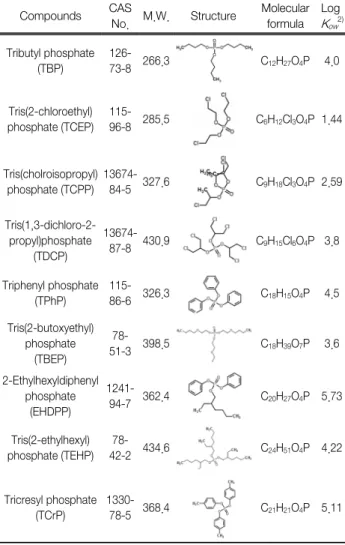
Table 1. Physico-chemical properties of OPFRs used in this study
Compounds CAS
No. M.W. Structure Molecular formula
Log Kow2)
Tributyl phosphate (TBP)
126-
73-8 266.3 C12H27O4P 4.0
Tris(2-chloroethyl) phosphate (TCEP)
115-
96-8 285.5 C6H12Cl3O4P 1.44
Tris(cholroisopropyl) phosphate (TCPP)
13674-
84-5 327.6 C9H18Cl3O4P 2.59
Tris(1,3-dichloro-2- propyl)phosphate
(TDCP)
13674-
87-8 430.9 C9H15Cl6O4P 3.8
Triphenyl phosphate (TPhP)
115-
86-6 326.3 C18H15O4P 4.5
Tris(2-butoxyethyl) phosphate
(TBEP)
78-
51-3 398.5 C18H39O7P 3.6
2-Ethylhexyldiphenyl phosphate
(EHDPP)
1241-
94-7 362.4 C20H27O4P 5.73
Tris(2-ethylhexyl) phosphate (TEHP)
78-
42-2 434.6 C24H51O4P 4.22
Tricresyl phosphate (TCrP)
1330-
78-5 368.4 C21H21O4P 5.11
각각의 표준물질들은 1,000 mg/L의 stock solution을 제조 한 후, 각각의 stock solution을 이용하여 1 mg/L의 혼합 표 준용액을 제조하였다. 1 mg/L의 혼합 표준용액을 이용하여 TBP, TPhP, TBEP 및 EHDPP는 20 ng/L~1,000 ng/L의 농도 범위로, TCEP, TCPP, TDCP, TEHP 및 TCrP는 100 ng/L~
5,000 ng/L의 농도 범위로 각각 6단계의 검량선을 작성하 여 정량에 사용하였으며, 각 물질별 검량선의 r2는 0.981 이 상으로 나타났다(TEHP의 r2=0.957). 실험에 사용된 표준물 질의 물리, 화학적 특성을 Table 1에 나타내었다.
2.2. 낙동강 및 하수처리장 방류수 채수
시료는 2014년 6월, 9월 및 11월에 걸쳐 3회 채수하였으 며, 1 L 갈색 유리병에 채수한 후 시료의 변질을 막기 위해 0.5% 메탄올(v/v)을 첨가하여 분석 전까지 4℃로 냉장 보관 하였다.
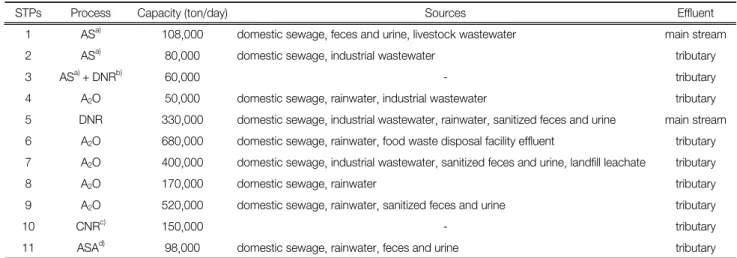
시료채수 지점은 낙동강 본류 11지점, 지류 9지점 및 낙동 강(본류 및 지류)으로 방류되는 하수처리장(처리용량 50,000 톤/일 이상) 방류수 11지점을 선택하여 채수하였다. 낙동강 본류(■), 지류(●) 및 하수처리장 방류수(★)에 대한 채수지점 을 Fig. 1에 나타내었으며, Table 2에는 11개 하수처리장의
S1: Banbyeon-cheon (Yongjeonggyo) S11: Guemho-down (Gangchanggyo) S2: Andong (Younghodaegyo) S12: Jincheon-cheon (Gura2gyo) S3: Naseong-cheon (Gyeongjingyo) S13: Goryeong (Goryunggyo) S4: Sangju (Sangpunggyo) S14: Daeam (Ugokgyo) S5: Nakdong (Nakdangyo) S15: Jeokpo (Jeokpogyo) S6: Gam-cheon (Seonjugyo) S16: Namgang (Songdogyo) S7: Gumi (Gumigyo) S17: Namji (Namjigyo) S8: Woegwan (Woegwangyo) S18: Samrangjin (Samrangjingyo) S9: Geumho-up (Mutaegyo) S19: Mulgeum (Withdrawl point) S10: Shin-cheon (Chimsangyo) S20: Yangsan-cheon (Hopodaegyo)
Fig. 1. Description of the sampling sites in Nakdong river basin.
Table 2. Description of the 11 surveyed sewage treatment plants (www.konetic.or.kr)
STPs Process Capacity (ton/day) Sources Effluent
1 ASa) 108,000 domestic sewage, feces and urine, livestock wastewater main stream
2 ASa) 80,000 domestic sewage, industrial wastewater tributary
3 ASa)+ DNRb) 60,000 - tributary
4 A2O 50,000 domestic sewage, rainwater, industrial wastewater tributary
5 DNR 330,000 domestic sewage, industrial wastewater, rainwater, sanitized feces and urine main stream 6 A2O 680,000 domestic sewage, rainwater, food waste disposal facility effluent tributary 7 A2O 400,000 domestic sewage, industrial wastewater, sanitized feces and urine, landfill leachate tributary
8 A2O 170,000 domestic sewage, rainwater tributary
9 A2O 520,000 domestic sewage, rainwater, sanitized feces and urine tributary
10 CNRc) 150,000 - tributary
11 ASAd) 98,000 domestic sewage, rainwater, feces and urine tributary
a)AS : activated sludge process
b)DNR : Daewoo nutrient removal process (modified A2O process)
c)CNR : Cilium nutrient removal process (modified A2O process)
d)ASA : Advanced step aeration process
처리공정, 용량 및 유입원 등을 나타내었다.
2.3. 시료 전처리 및 기기 분석
시료수의 전처리는 수중에 미량으로 함유된 유기성 오염 물질들의 전처리에 효과적으로 알려져 있는 교반막대 추출 법(SBSE)을 이용하였으며,9,10) 채수한 시료들은 별도의 여 과과정을 거치지 않고, 40 mL VOC 바이알에 시료수 40 mL를 취한 후 pH를 7로 조정하였다. PDMS (poyldimethyl siloxane)가 내외부에 코팅되어 있는 교반막대(32 mm SPE- tD, Markes, UK)를 VOC 바이알에 넣어 교반기(magnetic emotion, 2-mag, Germany)에서 1,000 rpm으로 120분간 회 전시키면서 시료수 중의 OPFRs를 흡착한 후 정제수로 세 척, 수분을 제거하여 분석에 사용하였다. 수중의 OPFRs를 교반막대(Markes, UK)에 흡착시킨 후 Markes사의 thermal desorber (TD-100, Markes, UK)를 이용하여 300℃에서 탈 착시켜 GC-MS/MS (7890N, Agilent, USA / 7000 triple Quad, Agilent, USA)로 주입하였다. TD의 흡착관(cold trap)은 general purpose hydrophobic trap (U-T2GPH-2S, Markes, UK) 을 사용하였고, GC 컬럼은 DB-5MS (J&W Scientific, USA) 를 사용하였다. TD와 GC 및 MS/MS의 분석조건을 Table 3 과 4에 각각 나타내었다.
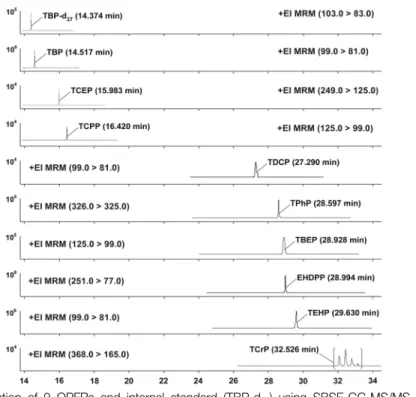
모든 시료수에서 OPFRs의 LOD (limit of detection)와 LOQ (limit of quantification)는 각각 5.4 ng/L~32.5 ng/L 및 16.8 ng/L~101.9 ng/L 범위였다. 또한, 정제수에 OPFRs 9종을 각각 2,000 ng/L의 농도로 투입하여 최적화된 교반막대 추 출조건으로 전처리한 후 GC-MS/MS를 이용하여 분석한 크로마토그램을 Fig. 2에 나타내었다. 내부표준물질(internal standard, IS)로 사용된 TBP-d27이 14.374분대에 검출되었으 며, OPFRs의 경우는 14.517분(TBP)~32.526분(TCrP) 사이에 각각 검출되었다.
Table 3. Analytical conditions of the TD and GC TD
- Pre-desorption : Prepurge 2 min - Tube/sample desorption : 270℃, 10 min - Trap setting
· Pre-trap fire purge : 1 min, Trap low : 10℃, Heating rate : max
· Trap high : 300℃, Trap hold : 5 min - Split ratio : 15:1
- Flow path temp. : 180℃
GC
- Column : 30 m (L) × 250 µm (ID) × 0.25 µm (film thickness) - Oven temp.
· Initial temp. : 60℃, hold 1 min
· 1st rate : 10℃ to 200℃, hold 5 min
· 2nd rate : 5℃ to 240℃, hold 0 min
· 3rd rate : 20℃ to 260℃, hold 1 min
· 4th rate : 10℃ to 300℃, hold 2 min
Table 4. Analytical parameters of OPFRs for MS/MS
Compounds RT (min)
Precursor (m/z)
Product (m/z) Quantification
(collision energy)
Confirmation (collision
energy) TBP-d27 14.374 103 83 (20 V) 63 (40 V)
TBP 14.517 99 81 (20 V) 63 (40 V)
TCEP 15.983 249 125 (10 V) 63 (20 V) TCPP 16.420 125 99 (10 V) 81 (30 V)
TDCP 27.290 99 81 (20 V) 63 (40 V)
TPhP 28.597 326 325 (10 V) 233 (20 V) TBEP 28.928 125 99 (10 V) 81 (20 V) EHDPP 28.994 251 77 (30 V) 95 (20 V)
TEHP 29.630 99 81 (20 V) 63 (40 V)
TCP 32.526 368 165 (20 V) 198, 183 (30 V)
Fig. 2. Chromatographic separation of 9 OPFRs and internal standard (TBP-d27) using SBSE-GC-MS/MS analysis.
3. 결과 및 고찰
3.1. 낙동강 수계에서의 OPFRs 검출 현황 및 특성 2014년 6월, 9월 및 11월에 채수하여 분석한 낙동강 본류 11지점과 지류 9지점에서 검출된 OPFRs 3종의 검출현황을 Table 5에 나타내었다.
낙동강 본류 및 지류 20지점 중 6지점에서 TCEP, TCPP 및 TBEP 3종이 검출되었으며, 본류에서는 고령(6월, TCPP 114.9 ng/L, TBEP 49.1 ng/L)을 제외하고는 검출되지 않았 으며, 지류의 경우는 금호강 상류(S9), 신천(S10), 금호강 하 류(S11), 진천천(S12) 및 양산천(S20)에서 검출되었다. 본류 에서 유일하게 검출된 지점인 고령(S13)의 경우는 Fig. 1에 서 볼 수 있듯이 상류에 위치한 금호강과 신천(S9~S11) 및 진천천(S12)의 영향을 받아서 검출된 것으로 판단된다. 이 들 금호강과 신천(S9~S11) 및 진천천(S12)은 STP6~STP9가 위치하고 있어서 이들 하수처리장들의 방류수에 함유된 OPFRs가 영향을 미친 것으로 보이며, 서 등11)과 손 등12)의 연구결과에서도 하수처리장 방류수에서 기인하는 인공 사 향물질이나 과불화 화합물과 같은 미량오염물질들이 비교 적 고농도로 검출되는 것으로 보고하고 있다. Fig. 3에서와 같이 채수시기에 따른 이들 지류들(S9~S12)에서의 검출농도 를 살펴보면 6월에는 192.1~476.8 ng/L의 농도범위로 검출되 었으며, 9월과 11월에는 각각 ND~312.2 ng/L 및 ND~181.2 ng/L의 범위로 검출되었다. 금호강 상류(S9)는 6월을 제외 하고는 검출되지 않았으며, 6월의 경우도 TBEP 1종이 검 출되었다. 9월의 경우는 진천천(S12)에서 TCEP 1종이 312.2 ng/L의 농도로 검출되었으며, 11월에는 신천(S10), 금호강 하류(S11) 및 진천천(S12) 지점에서 TCPP 1종이 121.6~181.2
Table 5. Detected concentrations (ng/L) of 3 OPFRs in Nakdong river basin (20 sites) from Jun. to Nov. 2014
Sampling site TCEP TCPP TBEP
Jun. Sep. Nov. Jun. Sep. Nov. Jun. Sep. Nov.
S1 : Banbyeon-cheona) ND ND ND ND ND ND ND ND ND
S2 : Andong ND ND ND ND ND ND ND ND ND
S3 : Naseong-cheona) ND ND ND ND ND ND ND ND ND
S4 : Sangju ND ND ND ND ND ND ND ND ND
S5 : Nakdong ND ND ND ND ND ND ND ND ND S6 : Gam-cheona) ND ND ND ND ND ND ND ND ND
S7 : Gumi ND ND ND ND ND ND ND ND ND
S8 : Woegwan ND ND ND ND ND ND ND ND ND S9 : Geumho-upa) ND ND ND ND ND ND 192.1 ND ND S10 : Shin-cheona)151.1 ND ND 219.1 ND 121.6 106.6 ND ND S11 : Guemho-downa) ND ND ND 271.1 ND 181.2 127.5 ND ND S12 : Jincheon-cheona)122.4 312.2 ND 262.3 ND 134.1 87.7 ND ND S13 : Goryeong ND ND ND 114.9 ND ND 49.1 ND ND
S14 : Daeam ND ND ND ND ND ND ND ND ND
S15 : Jeokpo ND ND ND ND ND ND ND ND ND S16 : Namganga) ND ND ND ND ND ND ND ND ND
S17 : Namji ND ND ND ND ND ND ND ND ND
S18 : Samrangjin ND ND ND ND ND ND ND ND ND S19 : Mulgeum ND ND ND ND ND ND ND ND ND S20 : Yangsan-cheona) ND 1,865.3 ND 401.6 519.2 94.0 192.2 210.4 ND Avg. 136.8 1,088.8 - 253.8 519.2 132.7 125.9 210.4 -
SD 20.3 1,098.2 - 103.3 - 36.4 57.5 - - Min. 122.4 312.2 - 114.9 519.2 94.0 49.1 210.4 - Max. 151.1 1,865.3 - 401.6 519.2 181.2 192.2 210.4 - DF 2/20 2/20 0/20 5/20 1/20 4/20 6/20 1/20 0/20
a): tributary, Avg : average, SD : standard deviation, DF : detection frequency
Fig. 3. Detected concentrations (numerical, ng/L) and proportion rates of OPFRs in 5 tributaries of Nakdong river.
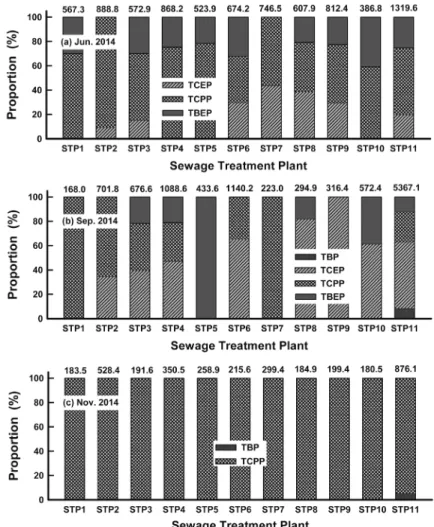
Fig. 4. Detected concentrations (numerical, ng/L) and proportion rates of OPFRs in final effluents of 11 STPs.
ng/L의 범위로 검출되었다. 이들 지류들(S9~S12)에서의 검 출농도 및 검출특성을 살펴보면 TCEP, TCPP 및 TBEP 3종 이 검출되는 것을 볼 수 있으며, 동일 지점에서도 채수시기 에 따라 검출농도 뿐만 아니라 구성종 비율의 변화폭도 매 우 컸으며, 특별한 우점종도 나타나지 않았다.
Andresen 등8)과 Martínez-Carballo 등13)의 연구결과에서도 하천이나 강과 같은 지표수에서의 주오염원을 하․폐수처리 장에서 완전히 제거되지 못한 OPFRs가 최종 방류수 중에 함 유되어 수계로 유출된 결과로 보고하고 있으며, 특히, TCPP,
TCEP 및 TDCP의 경우는 하․폐수처리장의 처리공정에서 제 거율이 낮은 것으로 보고되었다.14) 영국 Aire 강에서의 OPFRs 검출현황을 조사한 Cristale 등15)의 연구결과에서는 TCPP, TCEP, TDCP 및 TPhP가 검출되었으며, 특히, TCPP가 113~
26,050 ng/L의 농도범위로 검출되어 OPFRs의 주요 우점종으 로 평가하고 있으며, 특히, TCPP의 경우는 낮은 생물분해도 와 Log Kow값(2.59)으로 인해 하․폐수처리장에서의 제거율 뿐만 아니라 강이나 하천에서의 부유 입자나 저질 등에 의한 흡착 제거율도 낮아서 비교적 높은 농도로 검출된다.16)
Table 6. Concentration levels of OPFRs in the final effluents of 11 STPs
TBP TCEP TCPP TBEP
Jun. Sep. Nov. Jun. Sep. Nov. Jun. Sep. Nov. Jun. Sep. Nov.
Avg. - 458.5 47.8 205.9 702.1 - 440.1 452.7 311.0 187.4 289.7 -
SD - - - 90.4 917.5 - 198.8 395.7 201.1 64.9 218.6 -
Min. - 458.5 47.8 84.7 241.9 - 228.6 168.0 180.5 112.7 53.0 -
Max. - 458.5 47.8 327.4 2932.7 - 804.1 1320.7 828.3 333.3 655.2 -
DF 0/11 1/11 1/11 7/11 8/11 0/11 11/11 7/11 11/11 9/11 6/11 0/11
Avg : average, SD : standard deviation, DF : detection frequency
Table 7. Comparison of detected concentrations (ng/L) of OPFRs in various water sources around the world
Water source Location Total conc. [Analyte No.] Sample No. TBP TCEP TCPP TBEP Ref.
STP effluent Austria NG [9] 16 ND~810 <LOQ~1,600 310~1,400 13~2,900 13)
China NG [7] 1 54.1±6.4 124.7±2.2 187.9±2.8 NA 19)
Germany NG [6] NG NA 5~130 50~400 <10~500 8)
Germany NG [9] 16 2~28 3.3~69.9 24.3~570 <LOQ~103 20)
Korea 92~2,620 [1] 7 NA 92~2,620 NA NA 21)
Norway 9,590~11,886 [8] 3 270~1,300 1,600~2,200 1,700~2,100 1,600~3,300 22)
Spain 310~1,060 [6] 3 <LOQ~260 NA 120~460 ND~160 23)
Taiwan 12~21 [2] 3 12~21 NA NA NA 24)
UK NG [4] 13 NA 119~316 113~26,050 NA 15)
This study 180.5~5,367.1 [9] 33 ND~458.5 ND~2,932.7 ND~1,320.7 ND~655.2
River water Austria 141~922 [9] 4 20~110 13~130 33~170 24~500 13)
China 1,080~3,120 [9] 16 NA 220~1,160 150~1,150 NA 25)
Germany NG [7] NG 13~130 13~130 20~200 10~200 8)
Italy 584~774 [12] 2 82~114 ND~7 54~117 87~323 26)
Korea 14~81 [1] 8 NA 14~81 NA NA 21)
Taiwan 1.5~35 [2] 3 1.5~35 NA NA NA 24)
This study ND~2,594.9 [9] 60 ND ND~1,865.3 ND~519.2 ND~210.4
Lake water China NG [7] 1 ND 116.9±6.5 135.6±11.2 NA 19)
China 313.1~2,689.2 [8] 5 2.2~13 259.2~2,406 7.7~19.1 NA 27)
Italy NG [12] 39 <LOQ~784 <LOQ~64 <LOQ~62 8~127 28)
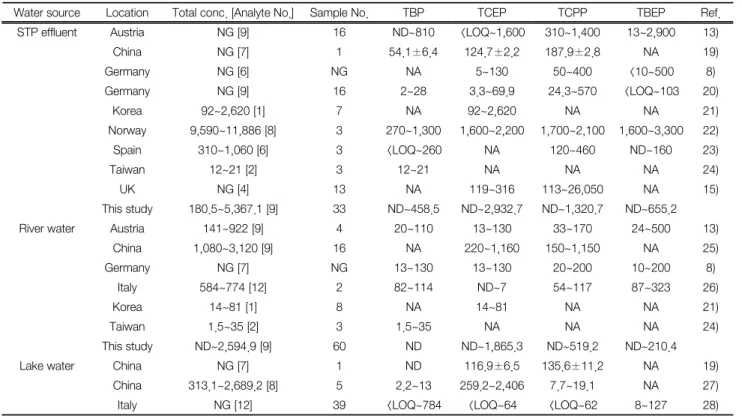
NG : not given, NA : not analyzed, ND : not detected
3.2. 하수처리장 방류수에서의 OPFRs 검출 현황 및 특성 낙동강 본류와 지류로 방류되는 하수처리장(STP) 중에서 50,000 m3/day 이상의 처리용량을 가진 11곳의 하수처리장 의 최종방류수를 분석한 결과를 Fig. 4에 나타내었다. 6월, 9월 및 11월에 채수한 시료수들에 대한 결과를 살펴보면 9 종의 OPFRs 중에서 TBP, TCEP, TCPP 및 TBEP 4종이 검 출되었다. 또한, STP11의 방류수에서의 OPFRs 검출농도가 876.1~5367.1 ng/L의 범위로 가장 높았으며, TBP는 STP11 의 방류수(9월, 11월)에서만 유일하게 각각 458.5 ng/L (8.5%) 및 47.8 ng/L (5.5%)의 농도로 검출되었다. 6월과 9월에는 특별한 주요 검출종은 없었으며, TCEP와 TCPP가 비교적 높은 구성비율을 차지하였다. 그러나 11월의 시료수에서는 11개의 하수처리장 방류수에서 TCPP가 94.5%~100%의 우 점율을 나타내었다. 그리고 6월(386.8~1,319.6 ng/L)과 9월 (168.0~5,367.1 ng/L)에 비해 11월(180.5~876.1 ng/L)에 채 수한 하수처리장 방류수들에서의 OPFRs 농도가 월등히 낮 게 나타나 하수처리장 방류수의 경우도 앞에서 서술한 낙
동강 지류들의 검출특성 결과와 마찬가지로 채수시기에 따 라 검출농도 뿐만 아니라 구성종 비율의 변화폭도 매우 큰 것으로 조사되었다.
스웨덴의 7개 하수처리장 방류수에 대해 9종의 OPFRs 검출특성을 조사한 Marklund 등의 연구결과14)에서는 방류 수 중의 OPFRs 농도는 7,900~39,000 ng/L로 나타났고, 주 요 검출종은 TBEP, TBP와 TCPP 순으로 보고하고 있으며, 각각의 하수처리장 유입수에 함유된 OPFRs 구성종과 농도 에 따라 방류수에 함유된 OPFRs의 구성종과 농도가 많은 영향을 받는 것으로 나타났다.
또한, Martínez-Carballo 등13)의 연구결과도 16개의 하수 처리장 방류수를 대상으로 9종의 OPFRs의 평균 검출농도 를 조사한 결과에서 TBEP (794~967 ng/L), TCPP (560~733 ng/L), TCEP (67~391), TBP (146~292 ng/L) 및 TDCP (81~
387 ng/L) 등 8종이 검출되었으며, TBEP를 제외하고는 하 수처리장에 따라 방류수에서 주요 구성종에는 다소 차이가 있었다. 하수처리장의 공정별 OPFRs의 제거특성을 연구한
Meyer와 Bester의 연구결과17)에서는 TCPP, TCEP 및 TDCP 의 경우는 다른 OPFRs에 비하여 하수처리 공정에서 제거 율이 매우 낮아 최종방류수에서의 검출농도 및 구성비율이 높은 것으로 보고하고 있으며, 이러한 경향은 Rodil 등의 연구결과18)와도 일치한다.
Table 6에는 6월~11월까지 하수처리장 방류수에서 검출된 TBP, TCEP, TCPP 및 TBEP에 대해 평균 검출농도, 최소 및 최대 검출농도 및 검출빈도(detection frequency, DF) 등을 간략히 요약하여 나타내었다. 하수처리장 방류수의 경우 TCPP가 6월, 9월 및 11월에 각각 11개, 7개 및 11개 하수 처리장의 방류수에서 검출되어 검출빈도가 가장 높았으며 다음으로 TCEP > TBEP > TBP 순이었다.
세계 각국의 하수처리장 방류수, 하천수 및 호소수에서 검출된 OPFRs의 농도를 비교한 것을 Table 7에 나타내었 다. Table 7에서 볼 수 있듯이 TBP, TCEP, TCPP 및 TBEP 4종 중에서 TCPP와 TCEP가 최대 검출농도를 나타낸 횟수 가 가장 많았으며, 이는 Table 6에 나타낸 하수처리장 방류 수에서의 검출 특성을 조사한 본 연구결과와 유사한 결과 를 나타내었다. 또한, Table 7에 나타낸 본 연구의 결과와 외국의 경우를 비교할 경우, 낙동강 주변에 위치한 하수처 리장의 방류수들과 낙동강의 본류 및 지류에서의 검출농도 가 비교적 높은 편으로 나타나고 있다.
4. 결 론
낙동강 수계와 낙동강 주변에 위치한 하수처리장들의 최 종 방류수들에서의 OPFRs 검출 특성을 조사한 결과 다음 과 같은 결론을 얻을 수 있었다.
1) 낙동강 수계에서 OPFRs가 검출된 지점은 본류 1지점 (고령)과 지류 5지점에서 TCEP, TCPP 및 TBEP 3종이 검 출되었다.
2) 낙동강 수계에서의 검출농도 범위는 본류인 고령의 경 우 TCPP가 ND~114.9 ng/L 및 TBEP가 ND~49.1 ng/L의 농 도로 검출되었으며, 지류의 경우는 하수처리장 방류수의 영 향을 받는 금호강 상류, 신천, 금호강 하류, 진천천 및 양산 천에서 TCEP가 ND~1,865.3 ng/L, TCPP가 ND~519.2 ng/L 및 TBEP가 ND~210.4 ng/L의 농도로 검출되었다.
3) 낙동강 주변에 위치한 11개 하수처리장 방류수들에서 는 TBP, TCEP, TCPP 및 TBEP 4종이 각각 ND~458.5 ng/L, ND~2,932.7 ng/L, ND~1,320.7 ng/L 및 ND~655.2 ng/L의 농도로 검출되었으며, 낙동강 하류에 위치한 STP11의 방류 수에서 총 OPFRs 농도가 876.1~5,367.1 ng/L로 가장 높게 나타났다.
4) 낙동강 수계 및 낙동강 주변에 위치한 11개 하수처리 장 방류수들에서의 계절별 OPFRs 분포비율을 분석한 결과, 동일 지점에서도 채수시기에 따라 검출농도 뿐만 아니라 구 성종 비율의 변화폭도 매우 크게 나타났다.
5) 외국의 지표수 및 하수처리장 방류수에서의 검출현황 을 조사한 연구결과들에서도 TBP, TCEP, TCPP 및 TBEP 4종이 주요 검출종으로 나타났으며, 낙동강 수계 및 낙동강 주변에 위치한 하수처리장 방류수에서의 검출농도가 외국 에 비해 비교적 높게 나타났다.
References
1. Haman, C., Dauchy, X., Rosin, C. and Munoz, J. F., “Oc- currence, fate and behavior of parabens in aquatic envi- ronments: a review,” Water Res., 68, 1~11(2015).
2. Van der Veen, I. and De Boer, J., “Phosphorus flame re- tardants: properties, production, environmental occurrence, toxicity and analysis,” Chemosphere, 88, 1119~1153(2012).
3. Kemmlein, S., Hahn, O. and Jann, O., “Emissions of orga- nophosphate and brominated flame retardants from selected consumer products and building materials,” Atmos. Environ.,
37, 5485~5493(2003).
4. UNEP, “Outcome of the Fourth Meeting of the Conference of the Parties Relevant to the Work of the Persistent Or- ganic Pollutants Review Committee, Stockholm Convention on Persistent Organic Pollutants, UNEP/POPS/POPRC.5/
INF/3(2009).
5. Ni, Y., Kumagai, K. and Yanagisawa, Y., “Measuring emi- ssions of organophosphate flame retardants using a passive flux sampler,” Atmos. Environ., 41, 3235~3240(2007).
6. Föllmann, W. and Wober, J., “Investigation of cytotoxic, genotoxic, mutagenic, and estrogenic effects of the flame retardants tris-(2-chloroethyl)-phosphate (TCEP) and tris-(2- chloropropyl)-phosphate (TCPP) in vitro,” Toxicol. Lett., 161, 124~134(2006).
7. Dishaw, L. V., Powers, C. M., Ryde, I. T., Roberts, S. C., Seidler, F. J., Slotkin, T. A. and Stapleton, H. M., “Is the pentaBDE replacement, tris (1,3-dichloropropyl) phosphate (TDCPP), a developmental neurotoxicant? Studies in PC12 cells,” Toxicol. Appl. Pharmacol., 256, 281~289(2011).
8. Andresen, J. A., Grundmann, A. and Bester, K., “Organo- phosphorus flame retardants and plasticisers in surface waters,”
Sci. Total Environ., 332, 155~166(2004).
9. Seo, C. D., Son, H. J., Yoom, H. S., Choi, J. T., Ryu, D.
C., Kwon, K. W. and Jang, S. H., “Analysis of synthetic fragrances (SFs) in water using stir bar sorptive extraction (SBSE) and GC-MS/MS,” J. Korean Soc. Environ. Eng., 36 (6), 387~395(2014).
10. Seo, C. D., Son, H. J., Jung, J. M., Choi, J. T. and Jang, S. H., “Analysis of UV filters in water using stir bar sorp- tive extraction (SBSE) and GC/MS-MS,” J. Environ. Sci.
Intl., 23(6), 1037~1047(2014).
11. Seo, C. D., Son, H. J., Lee, I. S. and Oh, J. E., “Detection of synthetic musk compounds (SMCs) in Nakdong river basin,” J. Korean Soc. Environ. Eng., 32(6), 615~624(2010).
12. Son, H. J., Hwang, Y. D., Yoom, H. S., Choi, J. T. and Kwon, K. W., “Detection of perfluorinated compounds (PFCs)
in Nakdong river basin,” J. Korean Soc. Environ. Eng., 35 (2), 84~93(2013).
13. Martínez-Carballo, E., González-Barreiro, C., Sitka, A., Scharf, S. and Gans, O., “Determination of selected organophosphate esters in the aquatic environment of Austria,” Sci. Total En-
viron., 388, 290~299(2007).
14. Marklund, A., Andersson, B. and Haglund, P., “Organophos- phorus flame retardants and plasticizers in Swedish sewage treatment plants,” Environ. Sci. Technol., 39, 7423~7429 (2005).
15. Cristale, J., Katsoyiannis, A., Sweetman, A. J., Jones, K. C.
and Lacorte, S., “Occurrence and risk assessment of Organo- phosphorus and brominated flame retardants in the River Aire (UK),” Environ. Pollut., 179, 194~200(2013).
16. Reemtsma, T., García-López, M., Rodríguez, I., Quintana, J. B. and Rodil, I., “Organophosphorus flame retardants and plasticizers in water and air I. Occurrence and fate,” TrAC,
27, 727~737(2008).
17. Meyer, J. and Bester, K., “Organophosphate flame retardants and plasticizers in wastewater treatment plants,” J. Environ.
Monit., 6, 599~605(2004).
18. Rodil, R., Quintana, J. B., Concha-Graña, E., López-Mahía, P., Muniategui-Lorenzo, S. and Prada-Rodríguez, D., “Emerg- ing pollutants in sewage, surface and drinking water in Galicia (NW Spain),” Chemosphere, 86, 1040~1049(2012).
19. Gao, Z., Deng, Y., Hu, X., Yang, S., Sun, C. and He, H.,
“Determination of organophosphate esters in water samples using an ionic liquid-based sol-gel fiber for headspace solid- phase microextraction coupled to gas chromatography-flame photometric detector,” J. Chromatogr. A, 1300, 141~150(2013).
20. Bollmann, U. E., Möller, A., Xie, Z., Ebinghaus, R. and Einax, J. W., “Occurrence and fate of organophosphorus flame retardants and plasticizers in costal and marine surface waters,”
Water Res., 46, 531~538(2012).
21. Kim, S. D., Cho, J., Kim, I. S., Vanderford, B. J. and Snyder, S. A., “Occurrence and removal of pharmaceuticals and en-
docrine disruptors in South Koren surface, drinking, and waste waters,” Water Res., 41, 1013~1021(2007).
22. Green, N., Schlabach, M., Bakke, T., Brevik, E. M., Dye, C., Herzke, D., Huber, S., Plosz, B., Remberger, M., Schoyen, M., Uggerud, H. T. and Vogelsang, C., Screening of Selected Metals and New Organic Contaminants 2007, Norwegian Pollution Control Agency(2008).
23. García-López, M., Rodríguez, I. and Cela, R., “Evaluation of liquid-liquid microextraction using polypropylene micro- porous membranes for the determination of organophosphorus flame retardants and plastcizers in water samples,” Anal.
Chim. Acta, 625, 145~153(2008).
24. Tsao, Y. C., Wang, Y. C., Wu, S. F. and Ding, W. H., “Micro- assisted headspace solid-phase microextraction for the rapid determination of organophosphate esters in aqueous samples by gas chromatography-mass spectrometry,” Talanta, 84, 406~
410(2011).
25. Wang, X., He, Y., Lin, L., Zeng, F. and Luan, T., “Appli- cation of fully automatic hollow fiber liquid phase micro- extraction to assess the distribution of organophosphate esters in the Pearl River Estuaries,” Sci. Total Environ., 470-471, 263~269(2014).
26. Bacaloni, A., Cavaliere, C., Foglia, P., Nazzari, M., Samperi, R. and Laganà, A., “Liquid chromatography/tandem mass spectrometry determination of organophosphorus flame re- tardants and plasticizers in drinking and surface waters,”
Rapid Commun. Mass Spectrom., 21(7), 1123~1130(2007).
27. Yan, X., He, H., Peng, Y., Wang, X., Gao, Z., Yang, S. and Sun, C., “Determination of organophosphorus flame retardants in surface water by solid phase extraction coupled with gas chromatography-mass spectrometry,” Chin. J. Anal. Chem.,
40(11), 1693~1697(2012).
28. Bacaloni, A., Gucci, F., Guarino, C., Nazzari, M., Samperi, R. and Laganà, A., “Occurrence of organophosphorus flame retardant and plasticizers in three volcanic lakes of central Italy,” Environ. Sci. Technol., 42, 1898~1903(2008).