1. INTRODUCTION
1.1 Necessity of Research
With the rapid changes in modern society, social issues have been caused by the rise of nuclear families, declining birth rate and increase of aging population, and the demand for customized welfare to suit these changes is also increasing, along with the interest in improving the working conditions of welfare facility workers. According to the National Statistical Office, the number of welfare facilities for the elderly was 76,371 and children’s welfare facilities 281, as of 2017, and the numbers are continuing to grow [1]. This increase of welfare facilities implies the relative
growth of workers who are employed in welfare facilities, and with social interest, the importance of such welfare facilities and workers has been highlighted in the recent years. As the improvement of working conditions for welfare facility workers is ultimately linked to the quality of service in welfare facilities, the necessity of research on the psychological aspects of welfare facility workers has been raised.
Social welfare facilities are institutions that provide human services, and the necessity of research on job-related effects or efficacies of human resources within the welfare organization has been raised.
Diener (1994) defines psychological wellbeing Mi-Kyung Kwak*, Sung-Je Cho**
Abstract The purpose of this study is to identify the relationship between psychological wellbeing of social welfare facility workers and their organizational commitment. The subjects of this study were 230 social welfare facility workers in OO city, Gyeongsangbuk-do, Korea. Analysis was conducted using the SPSS program, including frequency analysis, reliability analysis and correlation analysis, and regression analysis on the causal relationship between variables. The results of the study showed that the psychological wellbeing of social welfare facility workers had a meaningful effect on their emotional commitment, continuous commitment and normative commitment. These results confirmed that the higher the psychological wellbeing of social welfare facility workers, the higher the sub-factors of organizational commitment, such as emotional, continuous, normative commitment, resulting in positive effects on the achievement of goals and values that are pursued by the welfare facilities. This study aims to become foundational data for the improvement of working conditions to improve psychological wellbeing of social welfare facility workers to increase organizational commitment.
Key Words : Organizational commitment, Psychological wellbeing, Social welfare facility, Social welfare facility worker
*Department of Education at Dongbang Graduate University
**Department of Education at Dongbang Graduate University, Seoul, Korea
Received November 28, 2018 Revised December 07, 2018 Accepted December11, 2018
as the general satisfaction of life in the individual’s psychological aspect, where one would subjectively compare his/herself with their surroundings and feel satisfied [2]. In a study on psychological wellbeing against aged welfare facility workers, job characteristics was found to have a meaningful effect on psychological wellbeing, and job stress had a negative effect on psychological wellbeing, where the lower the job stress, the higher the psychological wellbeing of workers [3, 4]. This demonstrates that the psychological wellbeing factor has an important effect on the organizational commitment and performance of welfare facility workers.
Yong-Hak Kim (2010) argued that organizational commitment is the desire to stay as a member of the organization, including the sense of unity, attachment and loyalty, where the individual accepts the goals and values of the organization and shows the intention to strive for the organization [5]. Existing studies on organizational commitment explains that mediating effects of psychological wellbeing were found in the relationship between the manager’s coaching leadership and the team member’s organizational commitment (Jung-Min Lee, 2016) [6]. In addition, Eun-Young Yoo (2016) reported that that emotional commitment had a meaningful effect on psychological wellbeing of childcare teachers [7]. This demonstrates that emotional commitment to the organization has correlations with positive interpersonal relationships, as well as self-acceptance and organizational satisfaction.
So-Yeon Cho (2015) explains that organizational performance is a means of securing the social justification of the organization, and that it has an important
function as the visible output or performance of the organization [8]. On the other hand, Hye-Joo Yoon (2017) reports that psychological wellbeing as perceived by early childhood teachers has a meaningful effect on organizational effectiveness, and that psychological wellbeing is a positive factor that increases the effectiveness of the organization [9].
Most of the abovementioned existing studies discuss welfare facility workers, teachers and cabin crew [2-11]. Although there have been partial studies on organizational commitment of social welfare facility workers, there is limited research on the relationship between psychological wellbeing and organizational commitment [2-11]. Therefore, this study aims to provide foundational data to improve the working conditions of social welfare facility workers, by identifying the relationship between the psychological wellbeing of social welfare facility workers and their organizational commitment.
1.2 Research question
The purpose of this study is to analyse the relationship between psychological wellbeing of social welfare facility workers and their organizational commitment, and the detailed research question is as follows.
What is the effect of psychological wellbeing of social welfare facility worker on their organizational commitment in areas of emotional commitment, continuous commitment and normative commitment?
2. RESEARCH METHOD
2.1 Research Subjects
This study was conducted from 1 June 2018 to 31 July 2018, against social welfare workers in OO city of Gyeongsangbuk-do , Korea. The purpose and the method of the questionnaire were thoroughly explained to the subjects in advance, and the questionnaires were conducted by the self-entry method. A total of 230 questionnaires were collected and used for statistical analysis.
2.2 Research Tools
The tools used in this research consisted of 5 questions regarding general characteristics, 13 questions regarding psychological wellbeing and 15 questions regarding organizational commitment. General characteristics consisted of gender, age, highest level of education achieved, marital status and type of facility.
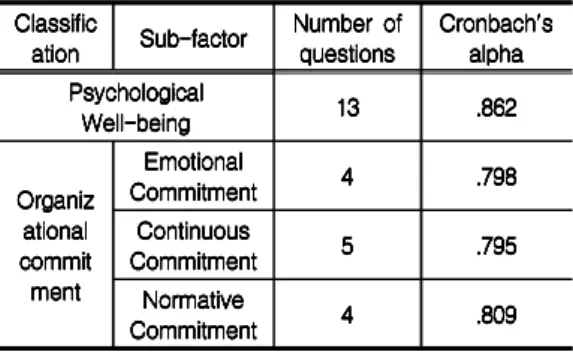
Hye-Jin Jang[3]’s psychological wellbeing measurement tool was used to measure the psychological wellbeing of social welfare facility workers, and each question was measured on a 5-point Likert scale. A total of 15 questions were used to measure organizational commitment, using Chan-Young Kim[12]’s organizational commitment measurement tool, which included the sub-factors of emotional commitment (4 questions), continuous commitment (5 questions) and normative commitment (4 questions), and each question was measured on a 5-point Likert scale.
2.3 Reliability
The reliability of each variable used in this study was verified, and the reliability of
psychological wellbeing was high with .862. The reliability of organizational commitment by sub-factor was .798 for emotional commitment, .795 for continuous commitment, and .809 for normative commitment.
2.4 Data processing and analysis methods The collected data was processed using the SPSS 22.0 program at a significance level of 5%, and the reliability of each research tool was calculated using Cronbach's α coefficient. The general characteristics of social welfare facility workers were analysed through frequency analysis, and the correlation analysis and causal relationship between psychological wellbeing and organizational commitment were found through regression analysis. Reliability of this research was measured using the Cronbach's alpha factor, and detailed results are shown in Table 1.
Table 1. General characteristic
3. RESULTS
3.1 General Characteristics
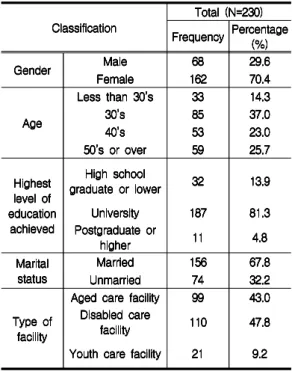
As for the general characteristics of the respondents, 68 of the social welfare facility workers were male(29.6%) and 162 were female (70.4%), with higher response rate of female workers. The most frequent age group was the
30’s with 85(37.0%), followed by 50’s or over with 59 respondents(25.7%), 40’s with 53 respondents(23.0%), and less than 30’s with 33 responyouth care facility with 21 respondents(9.2%). The analysis results of the general characteristics of social welfare facility workers are shown in Table 2. dents (14.3%). In the highest level of education achieved, university graduates accounted for 81.3% with 187 respondents, followed by high school or lower with 32 respondents(13.9%), and postgraduate or higher with 11 respondents (4.8%). In marital status, there were more married respondents(156 respondents, 67.8%) than unmarried (74 respondents, 19.0%). In the type of facility that social welfare facility workers work at, disabled care facility was the most frequent with 110 respondents(47.8%), followed by aged care facility with 99 respondents(43.0%), and
Table 2. General characteristic
3.2 Correlation between variables
Upon examining the correlation between psychological wellbeing perceived by social welfare facility workers and their organizational commitment, psychological wellbeing and organizational commitment were found to have a low positive correlation (r=.359~.393, p<.01).
The two sub-factors of organizational commitment of social welfare facility workers, emotional commitment factor and continuous commitment factor, were found to have a high level of positive correlation (r=.788, p<.01), and emotional commitment factor and normative commitment factor also had a high level of positive correlation (r=.700, p<.01).
3.3 Effect of psychological wellbeing on organizational commitment
3.3.1 Effect of psychological wellbeing on emotional commitment
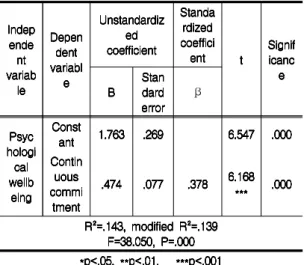
Upon conducting the regression analysis to find the effect of psychological wellbeing of social welfare facility workers on emotional commitment, R2, representing the explanatory power of psychological wellbeing on emotional commitment, was found to be .143, where 14.3% of the total variance accounts for the regression model. Also, in the analysis of variance, it was found that regression equation of F=38.050(p<.000) is suitable and statistically meaningful. Upon examining the effect of psychological wellbeing, psychological wellbeing was found to have a positive effect on emotional commitment under the level of statistical significance (β=.378, p<.001). This implies that the higher the psychological wellbeing of social welfare facility workers, the higher the emotional commitment. The analysis
results of the effect of psychological wellbeing of social welfare facility workers on emotional commitment are shown in Table 3.
Table 3. The Effect of Psychological Well-being on Emotional Commitment
3.3.2 Effect of psychological wellbeing on continuous commitment
Upon conducting the regression analysis to find the effect of psychological wellbeing of social welfare facility workers on continuous commitment, R2, representing the explanatory power of psychological wellbeing on continuous commitment, was found to be .155, where 15.5% of the total variance accounts for the regression model. Also, in the analysis of variance, it was found that regression equation of F=41.686(p<.000) is suitable and statistically meaningful. Upon examining the effect of psychological wellbeing, psychological wellbeing was found to have a positive effect on continuous commitment under the level of statistical significance (β=.359, p<.001). This implies that the higher the psychological wellbeing of social welfare facility workers, the higher the continuous commitment. The
analysis results of the effect of psychological wellbeing of social welfare facility workers on continuous commitment are shown in Table 4.
Table 4. The Effect of Psychological Well-being on Continuous Commitment
3.3.3 Effect of psychological wellbeing on normative commitment
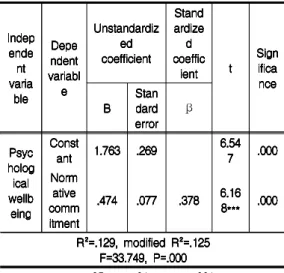
Upon conducting the regression analysis to find the effect of psychological wellbeing of social welfare facility workers on normative commitment, R2, representing the explanatory power of psychological wellbeing on normative commitment, was found to be .129, where 12.9% of the total variance accounts for the regression model. Also, in the analysis of variance, it was found that regression equation of F=33.749(p<.000) is suitable and statistically meaningful. Upon examining the effect of psychological wellbeing, psychological wellbeing was found to have a positive effect on normative commitment under the level of statistical significance (β=.378, p<.001). This implies that the higher the psychological wellbeing of social welfare facility workers, the β
β
higher the normative commitment. The analysis results of the effect of psychological wellbeing of social welfare facility workers on normative commitment are shown in Table 5.
Table 5. The Effect of Psychological Well-being on Normative Commitment
4. DISCUSSION & SUGGESTION
The purpose of this study was to analyze the relationship between the psychological wellbeing of social welfare facility workers and their organizational commitment. A detailed discussion based on the result of the study is as follows.
First, the psychological wellbeing of social welfare facility workers was found to have a meaningful effect on emotional commitment, continuous commitment, normative commitment, which are the sub-factors of organizational commitment. This implies that the higher the psychological wellbeing of social welfare facility worker, the higher the emotional commitment that they will associate with or contribute to the organization. Also, the higher
the psychological wellbeing, the higher the continuous commitment and normative commitment, where the individual will commit time and effort to remain in the organization.
These results were support by Min-Gyu Kim (2014), whose study showed similar results where the correlation between organizational commitment and psychological wellbeing had a meaningful effect in career counsellors in employment centers [7]. As such, the relationship between psychological wellbeing perceived by workers and organizational commitment reveal a significant power of influence, suggesting that the individual’s psychological aspect is related to the achievement of organizational goals.
As discussed above, further in-depth research must be continued by examining the psychological issues of social welfare facility workers, to improve their working conditions, to improve the efficiency of HR management of facilities, and ultimately to enhance the quality of welfare services.
REFERENCES
[1] http://www.mohw.go.kr, Sep 5 (2018).
[2] E. Diener, "Assessing subjective well-being:
Progress and opportunities." Social Indicators Research, (1994). 31, 103-157.
[3] H. J. Jang, "The Impact of Middle Age Women`s Social Volunteering on Psychological Wellbeing -Mediated Effect of Life Satisfaction and Depression-.", Department of Social Welfare The Graduate School of Hanyoung Theological University (2016).
[4] G. H. Kim, "The Mediating Effect of Job Stresson the Relationship between Job Characteristicsand Psychological Well-Being of workers at Senior Welfare Facilities.", Department of Social welfare Graduate β
School of Sonnchunhyang Universit (2012).
[5] Y. H. Kim, "ServantLeadershipand Organizational Commitment: TheRolesof Empowermentand Trustin Leader.", Department of Management Graduate School Yeungnam University (2010).
[6] J. M. Lee, "A Study on the Effect of Coaching Leadership on Organizational Commitment -Psychological Well-being Mediator Effect-.", Department of Coaching Graduate school of Health Welfare and Management Namseoul University (2016).
[7] E. Y. Yoo, "Effects of Teacher Efficacy and Organizational Commitment on Psychological Well-Being of Child Care Teachers.", Major in Early Childhood Education Graduate of Education Chungbuk National University of Education (2016).
[8] M. K. Choi, "The Influence of Women Entrepreneurship on Organization Performances : Mediating Effects of Organizational Culture, and Moderating Effects of Environmental Uncertainty and Competitive Intensity.", Department of Management Graduate School of Soongsil University (2015).
[9] H. J. Yun, "The Effects of Director's Coaching Leadership and Early Childhood Teacher's Psychological Empowerment and Psychological Well-Being on Organizational Effectiveness.", Department of Early Childhood Education Graduate School Korea National Open University (2017).
[10] H. S. Kim, "Impact of Married Female Flight Attendant's Multiple-role Commitment on Emotional Labor and Job Performance : Moderating Effects of Psychological Well-being.", Department of Hospitality &
Tourism Management The Graduate School Sejong University (2017).
[11] C. Y. Kim, "A Study on the Effect of Social Workers’ Job Stress on Organizational Commitment.", Dept. of Public Administration Graduate school of Konyang University (2014).
[12] Y. B. Kim, "Organizational characteristics and leadership styles in organizational life
cycle and their effects on performance in social welfare organizations.", Department of Social Welfare Graduate School of Konkuk University (2015).
Mi-Kyung Kwak [Full Member]
• February 2010. 02:
Graduated from Yeungnam University Graduate School (Family Welfare Consultation)
• March 2018. 02 : Graduated from Dongbang University Graduate School (Social Welfare)
<Research Interests>
Social Welfare, welfare
counseling, family
counseling,
parent education, child and adolescent counseling
Sung-Je Cho [Full Member]
• February 1977. 02 ~ Present: Hongik University,
PhD in Computer
Engineering
• March 2007. 03 ~ Present:
Professor at Dongbang University Department of Education
<Research Interests> Information, Education