• 검색 결과가 없습니다.

Clinical Application Status Analysis of Chuna Manual Therapy after Musculoskeletal Disorder Surgery

N/A
N/A
Protected

Academic year: 2021

Share "Clinical Application Status Analysis of Chuna Manual Therapy after Musculoskeletal Disorder Surgery"

Copied!
12
0
0

로드 중.... (전체 텍스트 보기)

전체 글

(1)

근골격계질환 수술후 추나 기법 임상적용 현황분석

이상진

1

, 이강준

1

, 박정식

1

, 송윤경

1

1가천대학교 한의과대학 한방재활의학교실

Clinical Application Status Analysis of Chuna Manual Therapy after Musculoskeletal Disorder Surgery

Sang-Jin Lee, K.M.D.

1

, Kang-Joon Lee, K.M.D.

1

, Jung-Sik Park, K.M.D.

1

, Yun-Kyung Song, K.M.D.

1

1

Department of Korean Rehabilitation Medicine, College of Korean Medicine, Gachon University

Received : 2019. 11. 20 Reviewed : 2019. 11. 21 Accepted : 2019. 12. 09

■ Corresponding Author주

Yun-Kyung Song, Department of Korean Rehabilitation Medicine, College of Korean Medicine, Gachon University, 21 Keunumul- ro, Jung-gu, Incheon 22318, Korea

Tel : (032) 770-1341 Fax : (032) 468-4033 E-mail : [email protected]

Objectives : The purpose of this study was to analyze the clinical application status in papers related to Chuna Manual Therapy after musculoskeletal disorder surgery.

Methods : We searched 6 electronic databases(RISS, DBpia, KISS, NDSL, OASIS, Pubmed) and 2 associated journals (Korea CHUNA Manual Medicine for Spine & Nerves, Korean Medicine Rehabilitation). We classified the papers by related musculoskeletal region and analyzed them in detail.

Results : 1. Of the 24 papers included in the final analysis list, 13 were carried out for fascia and 18 for joints.

2. There were positive effects on the improvement of symptoms, including the relief of pain in patients, and there were no cases of severe side effects and adverse events.

3. Thus, CMT can be used as a safe and effective treatment if a skilled practitioner makes proper use of the follow-up procedure based on accurate judgment of the patient's postoperative condition.

Conclusions : Through this paper, we expect that there will be active research on the clinical applications of Chuna Manual Therapy in Korean rehabilitation treatment after musculoskeletal disorder surgery.

Key words : Chuna manual therapy, Musculoskeletal disorder surgery, Literatural review, Korean medicine, Rehabilitation

(2)

Ⅰ. 서 론

2017년 기준 수술이 다빈도로 시행된 질환 20위 중 1위는‘H25-노년백내장’ , 2위는‘K64-치핵및 항문주위정맥혈전증’ 이었고, 15위 이내에‘M17-무 릎관절증’ , ‘M51-기타추간판장애’ , ‘M48-기타척 추병증’ , ‘S32-요추및골반의골절’ 의 근골격계 질 환이 4가지나 포함되어 있었다. 현재 근골격계 질환 에 대한 수술적 치료가 많이 시행되고 있으며

1)

, 이 러한 수술적 치료의 수요는 평균 수명 연장의 시대 적 흐름과 더불어 지속적으로 증가하고 있다

2)

. 그러 나 수술후에도 지속적으로, 혹은 재발성으로 통증을 호소하는 경우도 많고

3)

, 수술후에 적극적인 재활치 료가 이루어지지 않을 경우 관절기능제한이 남는 경 우도 많아

4)

추나요법을 비롯한 한의학적 재활치료 의 중요성이 날로 높아져 가고 있다

5)

.

2019년 04월 08일부터 추나요법이 건강보험 및 의료급여에 적용을 받게 되면서 추나요법에 대한 수 요가 증가하고 있고

6)

, 치료효과에 대한 만족도 조사 에서 92.8%에서‘만족’이상의 좋은 평가를 보였다

7)
. 이러한 추나요법은 손상된 조직과 세포를 스스로 재생, 회복시키는 재활치료로서의 효능을 가지고 있 으며

8)

, 통증 완화, 골격근기능 향상

9)

, 혈액순환 및 림프흐름 개선을 비롯한 국소순환 증가

10)

등의 작용 을 하기에 근골격계질환의 수술후 재활과정에 있어 서도 효과적으로 적용될 수 있을 것으로 보인다.

현재 한의계에서는 슬관절 전치환술후

2)

, 요추 수 술후

11)

, 회전근개 수술후

12)

한의표준임상진료지침을 필두로 하여 근골격계질환 수술후 한방재활치료 동 향에 관한 연구

5)

등 관련된 많은 연구가 이루어지고 있는 실정이나, 치료에 있어서 추나요법만을 대상으 로하여 체계적으로 정리한 연구는 현재까지 보고된 바가 없다.

이에 저자는 근골격계 질환의 수술후에 적용된 추 나요법에 대한 논문들을 정리 및 분석하여 이를 바 탕으로 앞으로의 연구에 도움이 되고자 한다.

Ⅱ. 대상과 방법

1. 연구대상

문헌 검색을 위해 국내 데이터베이스로는 RISS (www.riss.kr), DBpia(www.dbpia.co.kr), KISS (kiss.kstudy.com), NDSL(www.ndsl.kr), OASIS(oasis.kiom.re.kr)의 5가지 온라인 데이터 베이스에서‘수술후’ 와‘추나’ , ‘한의’ , ‘한방재활’

의 키워드를 조합하여 검색하였으며, 누락된 논문의 추가 검색을 위해‘수술실패증후군’ , ‘한방재활치 료’ 의 키워드로 검색된 논문 중 근골격계 수술후의 상태를 대상으로 하며 치료기법에 추나가 명시된 논 문을 연구 대상에 포함시켰다. 또한 해당 주제와 관 련된 전문적 학술지인 척추신경추나의학회지, 한방 재활의학과학회지의 2000년 이후 전체 논문을 검 색하여 본 연구에 필요한 내용을 포함하고 있으나 제목에 키워드를 포함하고 있지 않았던 논문들도 포 함시켰다. 더불어 해외 데이터베이스로는 Pubmed (www.ncbi.nlm.nih.gov/pubmed/)에서

‘Chuna’ 의 검색어를 사용하여 근골격계 수술 후 추나기법을 사용한 국내 논문을 추가로 분석대상에 포함시켰다. 2019년 10월까지 출판된 임상논문을 대상으로 하였으며, 해당 논문에서‘근골격계 수술 후 추나기법 적용’ 이 증례의 일부에만 해당되는 경 우에도 본 연구의 대상으로 포함시켰다.

2. 연구방법

검색된 논문의 제목과 초록을 우선적으로 검토하

고 중복 검색된 논문을 제외한 후 원문 전체를 검토

하였으며, 이후 최종적으로 선정된 논문들을 대상으

로 관련된 근골격계 부위별로 나누어 수술명, 표본

크기, 시행된 추나기법, 평가도구, 결과 등을 정리

및 분석하였다.

(3)

Ⅲ. 결 과

1. 자료 선별

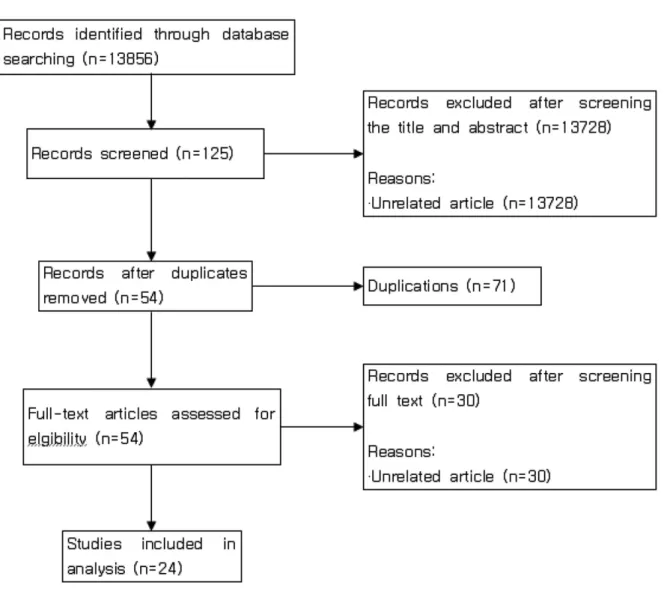
6개의 온라인 데이터베이스와 2개의 학술지를 이 용해 검색한 결과 검색된 논문의 총 개수는 13856 개였다. 스크리닝을 통해 주제와 관련성이 없는 논 문 13728편, 중복으로 검색된 논문 71편을 제외하 였고, 원문 전체를 평가하여 해당 주제와 관련성이

없는 논문 30편을 제외하여 최종 분석 대상으로 24 편을 선정하였다(Fig. 1).

2. 선정 논문의 분석

최종 선정된 24편의 논문을 관련된 근골격계 부 위에 따라 분류한 결과 요추부 수술후에 대한 논문 이 10편으로 가장 많았고, 경추부가 2편, 상지부가 4편, 하지부가 총 8편이었다. 각 연구에 기술된 추

Fig. 1. A flow chart describing the trial selection process.

(4)

나기법은 추나의학 전문교과서

8)

를 기준으로 분류하 고 분석을 진행하였다.

1) 경추(cervical vertebrae)

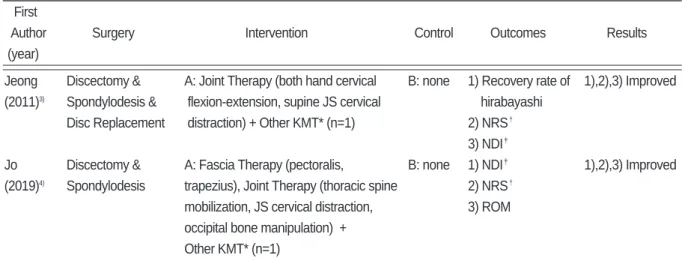
Discectomy, Spondylodesis, Disc Replace- ment 등의 수술 후 상태를 그 대상으로 한 2편의 논문 중 관절에 대한 추나요법은 2편

3-4)

모두에서 시 행되었고, 근막기법은 1편

4)

에서 추가 시행되었다 (Table Ⅰ).

2) 요추(lumbar vertebrae)

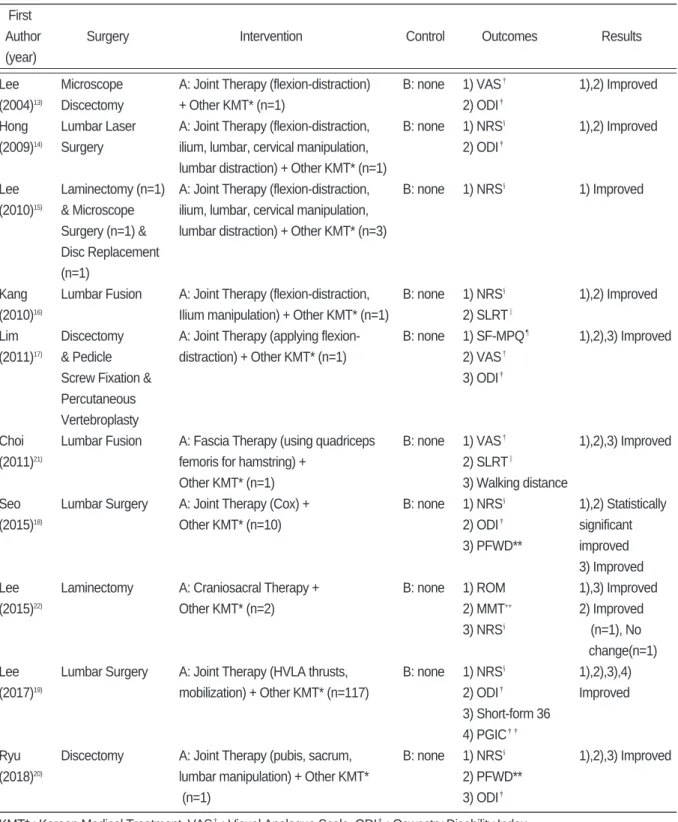
Disectomy, Laminectomy, Disc Replace- ment, Lumbar Fusion, Pedicle Fixation, Vertebroplasty 등의 수술 후 상태를 그 대상으로 한 10편의 논문 중 관절에 대한 추나요법은 8편

13-20)

에서 시행되었고, 근막추나

21)

와 두개천골추나

22)

는 각각 1편에서 시행되었다(Table Ⅱ).

3) 상지(upper part)

Clavicle Fixation, Radius Reduction &

Fixation, Radioulnar joint Sauve-Kapandji, Arthroscopic Bankart Repair 등의 수술 후 상태 를 그 대상으로 한 4편의 논문 중 근막에 대한 추나

요법

23-25)

, 관절에 대한 추나요법

24-26)

이 각각 3편에서

시행되었다(Table Ⅲ).

4) 하지(lower part)

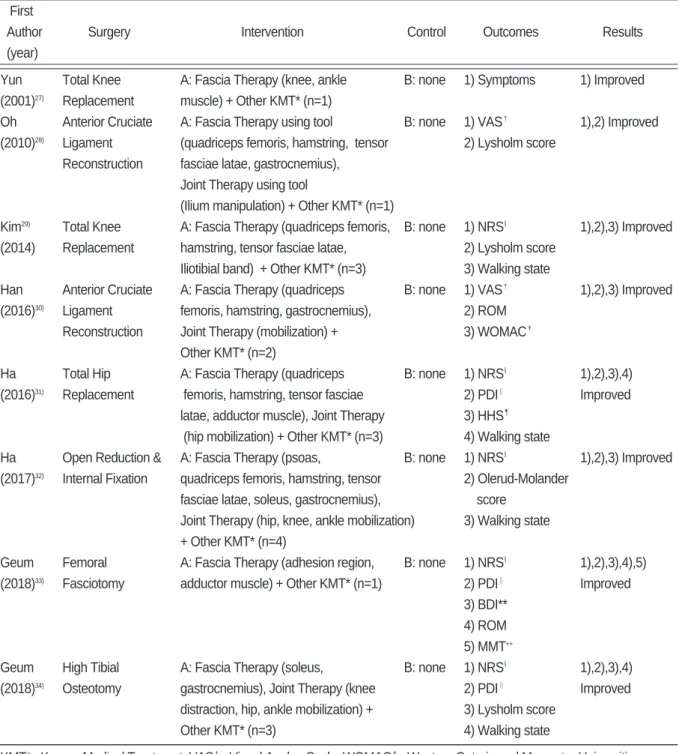
Total Hip Replacement, Total Knee Replacement, Antrerior Cruciate Ligament Reconstruction, Femoral Fasciotomy, Tibial Osteotomy, Ankle Reduction&Fixation 등의 수 술 후 상태를 그 대상으로 한 8편의 논문 모두에서

근막추나

27-34)

가 시행되었으며, 관절에 대한 추나요

28,30-32,34)

은 5편에서 시행되었다(Table Ⅳ).

Table Ⅰ. Papers for Cervical Vertebrae First

Author Surgery Intervention Control Outcomes Results

(year)

Jeong Discectomy & A: Joint Therapy (both hand cervical B: none 1) Recovery rate of 1),2),3) Improved (2011)

3)

Spondylodesis & flexion-extension, supine JS cervical hirabayashi

Disc Replacement distraction) + Other KMT* (n=1) 2) NRS

3) NDI

Jo Discectomy & A: Fascia Therapy (pectoralis, B: none 1) NDI

1),2),3) Improved (2019)

4)

Spondylodesis trapezius), Joint Therapy (thoracic spine 2) NRS

mobilization, JS cervical distraction, 3) ROM occipital bone manipulation) +

Other KMT* (n=1)

KMT* : Korean Medical Treatment, NRS

: Numerical rating scale, NDI

: Neck Disability Index

(5)

Table Ⅱ. Papers for Lumbar Vertebrae First

Author Surgery Intervention Control Outcomes Results

(year)

Lee Microscope A: Joint Therapy (flexion-distraction) B: none 1) VAS

1),2) Improved

(2004)

13)

Discectomy + Other KMT* (n=1) 2) ODI

Hong Lumbar Laser A: Joint Therapy (flexion-distraction, B: none 1) NRS

§

1),2) Improved (2009)

14)

Surgery ilium, lumbar, cervical manipulation, 2) ODI

lumbar distraction) + Other KMT* (n=1)

Lee Laminectomy (n=1) A: Joint Therapy (flexion-distraction, B: none 1) NRS

§

1) Improved (2010)

15)

& Microscope ilium, lumbar, cervical manipulation,

Surgery (n=1) & lumbar distraction) + Other KMT* (n=3) Disc Replacement

(n=1)

Kang Lumbar Fusion A: Joint Therapy (flexion-distraction, B: none 1) NRS

§

1),2) Improved (2010)

16)

Ilium manipulation) + Other KMT* (n=1) 2) SLRT

Lim Discectomy A: Joint Therapy (applying flexion- B: none 1) SF-MPQ

1),2),3) Improved (2011)

17)

& Pedicle distraction) + Other KMT* (n=1) 2) VAS

Screw Fixation & 3) ODI

Percutaneous Vertebroplasty

Choi Lumbar Fusion A: Fascia Therapy (using quadriceps B: none 1) VAS

1),2),3) Improved

(2011)

21)

femoris for hamstring) + 2) SLRT

Other KMT* (n=1) 3) Walking distance

Seo Lumbar Surgery A: Joint Therapy (Cox) + B: none 1) NRS

§

1),2) Statistically

(2015)

18)

Other KMT* (n=10) 2) ODI

significant

3) PFWD** improved

3) Improved

Lee Laminectomy A: Craniosacral Therapy + B: none 1) ROM 1),3) Improved

(2015)

22)

Other KMT* (n=2) 2) MMT

++

2) Improved

3) NRS

§

(n=1), No

change(n=1) Lee Lumbar Surgery A: Joint Therapy (HVLA thrusts, B: none 1) NRS

§

1),2),3),4)

(2017)

19)

mobilization) + Other KMT* (n=117) 2) ODI

Improved

3) Short-form 36 4) PGIC

‡‡

Ryu Discectomy A: Joint Therapy (pubis, sacrum, B: none 1) NRS

§

1),2),3) Improved

(2018)

20)

lumbar manipulation) + Other KMT* 2) PFWD**

(n=1) 3) ODI

KMT* : Korean Medical Treatment, VAS

: Visual Analogue Scale, ODI

: Oswestry Disability Index,

NRS

§

: Numeral Rating Scale, SLRT

: Straight-Leg Raising Test, SF-MPQ

: Short Form-Mcgill Pain Questionnarie,

PFWD** : Pain-Free Walking Distance, MMT

++

: Muscle Manual Test, PGIC

‡‡

: Patient Global Impression of Change

(6)

Ⅳ. 고 찰

추나요법은 한의사가 손 또는 신체의 일부분이나 추나 테이블 등 기타 보조기구를 이용하여 환자의 신체 구조에 유효한 자극을 가하여 구조나 기능상의 문제를 치료하는 한방 수기요법으로 시술부위 및 난 이도에 따라 근막추나, 관절가동추나, 관절신연추 나, 관절교정추나를 비롯하여 내장기추나, 탈구추 나, 두개천골추나 등으로 분류되며 시술목적에 따라 다양하게 적용될 수 있다

8)

.

최종분석대상에 포함된 24편의 논문 중 근막에 대한 추나는 13편, 관절에 대한 추나는 18편에서 시 행되었으며 24편 논문 전체에서 추나요법은 환자의

통증 완화를 비롯한 증상의 개선에 긍정적인 효과를 보였으며, 심한 부작용 및 이상반응을 보였던 사례 는 없었다.

경추부에서는 대흉근, 소흉근, 승모근에 대한 근 막기법 및 JS 경추부 신연기법이 활용되었다. 요추 부에서는 10편 중 6편에서 디스크 내에 음압을 유도 하고, 후종인대를 견인하며, 舒筋通絡, 利筋整겖의 작용을 하는 굴곡신연기법

8)

이 사용되었으며 요추부 신연기법, 골반 교정기법, HVLA thrusts, 햄스트 링에 대한 근막기법이 활용되었고, 요추수술후 한의 표준임상진료지침

11)

에서도 근막기법을 위주로 하여 선택적으로 신연기법 및 골반부위 교정을 고려할 수 있음을 권고하였다. 상지부에서는 승모근, 견갑거 Table Ⅲ. Papers for Upper Part

First

Author Surgery Intervention Control Outcomes Results

(year)

Jo Clavicle A: Fascia Therapy (pectoralis, B: none 1) NRS

1),2),3) Improved (2012)

23)

Closed Fixation levator scapulae, trapezius, 2) ROM

latissimus dorsi) + Other KMT* (n=1) 3) SPADI

Ha Open Reduction A: Fascia Therapy (flexor, extensor B: none 1) NRS

1),2) Improved (2018)

24)

and Internal & muscle of wrist), Joint Therapy 2) DASH score

§

External Fixation (finger, elbow, shoulder, wrist (n=1) mobilization) + Other KMT* (n=2) Closed Reduction

and External Fixation (n=1)

Cho Sauve-Kapandji A: Joint Therapy (elbow, wrist, B: none 1) ROM 1),2),3),4)

(2019)

26)

finger mobilization) + Other KMT* (n=1) 2) MMT

Improved

3) NRS

4) PDI

Geum Arthroscopic A: Fascia Therapy (levator scapulae, B: none 1) NRS

1),2),3),4) (2019)

25)

Bankart Repair trapezius), Joint Therapy (elbow, wrist 2) PDI

Improved

mobilization) + Other KMT* (n=1) 3) ROM 4) MMT

KMT* : Korean Medical Treatment, NRS

: Numerical rating scale, SPADI

: Sholuder Pain and Disability Score,

DASH score

§

: Disabilities of the Arm, Shoulder, Hand score, MMT

: Muscle manual test, PDI

: Pain disability index

(7)

Table Ⅳ. Papers for Lower Part First

Author Surgery Intervention Control Outcomes Results

(year)

Yun Total Knee A: Fascia Therapy (knee, ankle B: none 1) Symptoms 1) Improved (2001)

27)

Replacement muscle) + Other KMT* (n=1)

Oh Anterior Cruciate A: Fascia Therapy using tool B: none 1) VAS

1),2) Improved (2010)

28)

Ligament (quadriceps femoris, hamstring, tensor 2) Lysholm score

Reconstruction fasciae latae, gastrocnemius), Joint Therapy using tool

(Ilium manipulation) + Other KMT* (n=1)

Kim

29)

Total Knee A: Fascia Therapy (quadriceps femoris, B: none 1) NRS

§

1),2),3) Improved (2014) Replacement hamstring, tensor fasciae latae, 2) Lysholm score

Iliotibial band) + Other KMT* (n=3) 3) Walking state

Han Anterior Cruciate A: Fascia Therapy (quadriceps B: none 1) VAS

1),2),3) Improved (2016)

30)

Ligament femoris, hamstring, gastrocnemius), 2) ROM

Reconstruction Joint Therapy (mobilization) + 3) WOMAC

Other KMT* (n=2)

Ha Total Hip A: Fascia Therapy (quadriceps B: none 1) NRS

§

1),2),3),4) (2016)

31)

Replacement femoris, hamstring, tensor fasciae 2) PDI

Improved

latae, adductor muscle), Joint Therapy 3) HHS

(hip mobilization) + Other KMT* (n=3) 4) Walking state

Ha Open Reduction & A: Fascia Therapy (psoas, B: none 1) NRS

§

1),2),3) Improved (2017)

32)

Internal Fixation quadriceps femoris, hamstring, tensor 2) Olerud-Molander

fasciae latae, soleus, gastrocnemius), score Joint Therapy (hip, knee, ankle mobilization) 3) Walking state + Other KMT* (n=4)

Geum Femoral A: Fascia Therapy (adhesion region, B: none 1) NRS

§

1),2),3),4),5) (2018)

33)

Fasciotomy adductor muscle) + Other KMT* (n=1) 2) PDI

Improved

3) BDI**

4) ROM 5) MMT

++

Geum High Tibial A: Fascia Therapy (soleus, B: none 1) NRS

§

1),2),3),4) (2018)

34)

Osteotomy gastrocnemius), Joint Therapy (knee 2) PDI

Improved

distraction, hip, ankle mobilization) + 3) Lysholm score

Other KMT* (n=3) 4) Walking state

KMT* : Korean Medical Treatment, VAS

: Visual Analog Scale, WOMAC

: Western Ontario and Mcmaster Universities Arthritis Index, NRS

§

: Numeric Rating Scale, PDI

: Pain Disability Index, HHS

: Harris Hip Score,

BDI** : Beck Depression Inventory, MMT

++

: Manual Muscle Test

(8)

근, 대흉근, 소흉근 등에 대한 근막기법을 필두로 인 접 상지 관절에 대한 관절가동기법이 주를 이루었으 며, 회전근개 수술후 한의표준임상진료지침

12)

에서도 근막추나기법과 관절가동기법의 활용을 고려할 수 있음을 권고하였다. 하지부에서는 8편의 논문 모두 에서 관절주위 비정상적인 조직긴장을 완화시키고 연부조직의 단축을 치료하는 근막추나

31)

가 사용되었 는데 대퇴사두근, 햄스트링, 내전근, 외전근, 비복 근, 가자미근 등 다양한 부위에 적용되었으며, 인접 하지 관절에 대한 관절가동기법이 병행된 사례가 많 았고, 슬관절 전치환술후 한의표준임상진료지침

2)

에 서도 하지부 근육에 대한 근막추나기법과 슬관절 관 절가동기법의 활용 가능성을 고려할 수 있음을 권고 하였다.

이외에도 경항통 환자의 흉추부에 관절가동추나 를 시행한 연구

4)

, 요통 환자의 경추에 교정기법을 시행한 연구

14-15)

, 요통 환자에 두개천골추나기법을 활용한 연구

22)

, 슬관절 통증 환자에 장골교정기법을 시행한 연구

28)

, 족관절 통증 환자의 장요근에 근막 추나를 시행한 연구

32)

, 근골격계 질환의 수술 후 재 활치료 과정에서 Soft tissue, Neuromuscular technique, SCS, MET, HVLA, Joint mobilization, Cranioscaral therapy, Rib raising 등 다양한 수기치료를 복합적으로 시행한 해외 수기치료 동향에 관한 연구

35)

등을 보았을 때 수술 후 상태에 추나치료를 적용할 때에도 추나치료 의 적응증은 수술부위에만 국한되는 것이 아니라 전 신에 존재하는 체성기능부전 모두가 그 치료의 대상 이 될 수 있으리라 생각된다.

수술 후 상태의 관절은 추나요법의 상대적 금기증 에 해당하는데

8)

경추간판 수술 환자에게 처음 일주 일은 흉근과 흉추부에 추나치료를 시행하다가 2주 차부터 경추부에 대한 추나치료를 시작한 연구

4)

, 견 관절 복원술 환자에게 관련 근육에 대한 추나치료를 첫 6주 동안은 환측이 아닌 건측에만 시행한 연구

25)

, 고관절 전치환술 환자에게 고관절 관련 근육에 대한 근막추나를 시행함에 있어서 첫 4주간은 인공관절

탈구의 우려로 내전근에 대한 추나는 배제하였던 연 구

31)

등을 보았을 때 수술 후에는 정확한 진단을 바 탕으로 수술부위에 대한 직접적인 추나치료의 시행 여부 및 정도를 결정하여야하며, 수술부위가 아닌 주변부위에 대한 추나치료 또한 효과적으로 활용될 수 있을 것으로 사료된다.

또한 골절, 탈구 등은 추나요법의 절대적 금기증 에 해당하기에

8)

사지의 절골술

26,34)

, 또는 골절에 관 한 정복술 및 고정술

24,32)

후의 상태에 추나기법이 적 용되었던 연구에서는 부목과 고정이 필요한 첫6주 정도는 수술부위에 직접적인 추나치료를 활용하지 않는 대신에 인접한 다른 상하지관절에 초기부터 관 절가동추나를 실시하여 근위부 상하지의 불용성 근 위축 및 근육약화를 방지하였다

32)

. 이를 보았을 때 해당 부위의 추나치료가 금기시되는 경우일지라도 다른부위에 다른형태로 적용되는 추나치료는 재활 과정에 있어 안전하며 유용할 것으로 판단된다.

추나치료에 관한 효과를 논하는 연구들 이외에 추 나치료의 안정성을 입증하기 위한 연구들도 진행되 고 있는데

36-38)

, 추나치료가 환자의 생명을 위협하는 심각한 부작용을 초래하는 경우는 드물지만, 의사의 부적절한 진단이나 숙련되지 못한 테크닉에 의한 부 작용 및 합병증이 보고되는 사례도 있기에 주의가 필요하다

36)

. 경추부의 경우 경추의 과회전시 유발되 는 추골동맥의 손상에 유의하여야 하며

37)

, 요추부의 경우 측와위에서 교정법을 행함에 있어 추간판 섬유 륜 손상 가능성에 유의하여야 한다

38)

. 더불어 수술 후 재활과정에 있어서는 추나요법 시행에 앞서서 금 기사항

8)

에 관한 숙지가 더욱 중요시되어야 하며, 시 술자의 보다 정확한 진단 및 숙련된 기술의 중요성 이 일반적인 근골격계 질환의 치료에서보다 더욱 클 것으로 생각된다.

이상의 내용을 고찰하였을 때, 숙련된 시술자가

환자의 수술 후 상태에 대한 정확한 판단을 바탕으로

추나요법을 적절하게 활용한다면, 근골격계 수술후

의 재활과정에서 추나요법이 안전하며, 동시에 효과

적인 치료법으로 활용될 수 있을 것이라 사료된다.

(9)

선정된 24편의 논문 모두 증례보고 형식에 해당 한다는 점, 대부분의 논문에서 증례의 수가 적었다 는 점, 추나요법이 단일중재로 사용된 연구가 없다 는 점 등에서 아쉬움이 남으며 향후에는 추나요법을 단일중재로 사용하는 연구를 비롯하여 RCT와 같이 근거수준이 높은 연구들을 위한 노력이 뒤따라야 할 것으로 생각된다.

Ⅴ. 결 론

이상으로 본 연구를 통하여 현재까지 근골격계 질 환의 수술 후 재활치료에 있어서 추나요법이 어떻게 행해졌는지 분석하여 향후의 연구에 보탬이 되고자 하였다. 본 연구를 계기로 하여 앞으로 적극적인 관 심으로, 근골격계 수술 후 추나요법 임상적용에 대 한 연구가 효과적으로 이루어지기를 기대한다.

Ⅵ. 참고문헌

1. Statistics Korea. Top 20 Disease with frequent operating surgery (2017).

[internet] 2017 [cited 2019 Nov 03].

Available from: URL:http://kosis.kr/

statisticsList/statisticsListIndex.do?me nuId=M_01_01&vwcd=MT_ZTITLE&parm TabId=M_01_01#SelectStatsBoxDiv 2. Guideline center for Korean Medicine.

Korean Medicine Clinical Practice Guideline for Post-operative treatment of total knee arthroplasty. [internet]

2017 [cited 2019 Nov 05]. Available from: URL:http://www.nckm.or.kr/

user/fr/pg/detail.do?scpgId=SCPG_0000 00000000280&pageIndex=1&searchCondi tion=0&searchKeyword=&kcdSearch=#

3. Jeong SY, Lee JB. A Case Report on HIVD-Cervical Spine Failed Back Surgery Syndrome Applied Chuna Treatment. The Journal of Korea CHUNA Manual Medicine for Spine &

Nerves. 2011;6(1):105-11.

4. Jo DC. The Case Report of Korean Medical Treatment including Chuna on Post-operative State of Cervical Spine.

J Korean Med Rehabil. 2019;29(1):85- 90.

5. Lee KJ, Park CH, Lee YJ, Lee JH, Cho JH, Park TY, Yang NR, Hwang EH, Song YK. Trends of Korean Medicine Treatment after Musculoskeletal Disorder Surgery: A Literatural Review.

J Korean Med Rehabil. 2017;27(3):61- 70.

6. Kim HJ, Byun DY, Kim GB, Park J, Kwon YS, Yu JE, Lee HW, Oh MS. The Statistics Study on Patients visiting a Korean Medicine Hospital according to the Application of Chuna Therapy Health Insurance and Medical benefits.

J Korean Med. 2019;40(3):188-97.

7. Kim SH, Ryu JS, Lee KM, Kwon BJ, Lim BM. Patients` Satisfaction with Chuna Manual Therapy in the Pilot Coverage Program of National Health Insurance. Journal of Society of Preventive Korean Medicine.

2019;23(2):1-10.

8. Korean Society of Chuna Manual Medicine for Spine & Nerves. Chuna manual medicine. 2.5th ed. Seoul:

Korean Society of Chuna Manual

Medicine for Spine & Nerves Publishing.

(10)

2019:4-5, 33-9, 48-53, 99-104, 166- 72, 274-5, 456-7.

9. Ahn MY, Song YK, Lim HH. Effect of Chuna on Nervous system -Based on Experimental Chuna Science-. The Journal of Korea CHUNA Manual Medicine for Spine & Nerves.

2013;8(2):47-56.

10. Ahn MY, Song YK, Lim HH. Effect of Chuna on circulatory system -Based on Experimental Chuna Science-. The Journal of Korea CHUNA Manual Medicine for Spine & Nerves. 2014;

9(2):1-9.

11. Guideline center for Korean Medicine.

Korean Medicine Clinical Practice Guideline for Post-operative treatment of Lumbar spinal disorders. [internet]

2017 [cited 2019 Nov 05]. Available from:

URL:http://www.nckm.or.kr/user/fr/pg/

detail.do?scpgId=SCPG_0000000000002 80&pageIndex=1&searchCondition=0&se archKeyword=&kcdSearch=#

12. Guideline center for Korean Medicine.

Korean Medicine Clinical Practice Guideline for Post-operative treatment of Rotator cuff Injuries. [internet] 2017 [cited 2019 Nov 05]. Available from:

URL:http://www.nckm.or.kr/user/fr/pg /detail.do?scpgId=SCPG_000000000000 280&pageIndex=1&searchCondition=0&s earchKeyword=&kcdSearch=#

13. Lee JH, Kim Y, Park JM, Park SG, Sim WJ, Kim SY, Shin JS. The Effect o f C onservative T reatment on Failed B ack Surgery Syndrome. J Korean Med Rehabil. 2004;14(4):149-59.

14. Hong SS, Jin ES. The Case Report of Conservative Treatment on Failed Back Surgery Syndrome. The Journal of Korea CHUNA Manual Medicine for Spine & Nerves. 2009;4(2):163-72.

15. Lee JH, Min KS, Kim SY, Kim SJ. The Case Report on 3 case of Conservative Treatment on Failed Back Surgery Syndrome. The Journal of Korea CHUNA Manual Medicine for Spine &

Nerves. 2010;5(2):57-68.

16. Kang MJ, Kong DH, Kim WY, Cho TY, Nam HW. The Case Report of Conservative Treatment on the Herniation of Intervertebral Disc Patient After the Fusion Surgery of a Lumbar Segment. The Journal of Korea CHUNA Manual Medicine for Spine &

Nerves. 2010;5(2):127-34.

17. Lim GM, Moon SJ, Jun KS, Shin HK, Ko YS. A Clinical Case of Oriental Medical Treatment on Failed Back Surgery Syndrome. The Journal of Korea CHUNA Manual Medicine for Spine & Nerves. 2011;6(2):23-32.

18. Seo YW, Park HS, Kim MC, Kim SY, Seo YH, Lee SM, Kim YJ, Hong JR, Kim JS, Kim KO, Kim TH. Korean Medicinal Combination Treatments for Failed Back Surgery Syndrome: A Retrospective Case Series. The Acupuncture.

2015;32(2):217-27.

19. Lee JH, Shin JS, Lee YJ, Kim MR, Choi

A, Lee JH, Shin KM, Shin BC, Cho JH,

Ha IH. Long-Term Course of Failed

Back Surgery Syndrome (FBSS) Patients

Receiving Integrative Korean Medicine

(11)

Treatment: A 1 Year Prospective Observational Multicenter Study. PLoS ONE. 2017;12(1):e0170972.

20. Ryu HS, Kim MH. A Case Report on Conservative Treatments with Chuna manual therapy on patient who has Failed Back Surgery Syndrome owing to herniated intervertebral lumbar disc with scoliosis. The Journal of Korea CHUNA Manual Medicine for Spine &

Nerves. 2018;13(2):65-73.

21. Choi HS, Kim MY, Choi YI, Choo WJ, Nam HW. A Case Report of Hamstring shortening after Spinal Fusion, Treated by Chuna Manual Therapy. The Journal of Korea CHUNA Manual Medicine for Spine & Nerves. 2011;6(2):133-43.

22. Lee JH, Chang DH, Kim JS, Kim DE, Park SE, Cho SW. A Case Report of 2 Failed Back Surgery Syndrome Patients Treated by Chuna Cranio-Sacral Therapy with Korean medical treatments. The Journal of Korea CHUNA Manual Medicine for Spine &

Nerves. 2015;10(2):37-49.

23. Jo DC, Moon SJ, Kong JC, Lee SY, Song YS, Ko YS, Lee JH. Case Report about Postoperative Rehabilitation of Oriental Medicine for the Distal Clavicular Fracture. Journal of Physiology & Pathology in Korean Medicine. 2012;26(1):98-104.

24. Ha WB, Geum JH, Koh NY, Lee JH.

The Clinical Effect of Rehabilitation Protocol for Distal Radius Fracture in Korean Medicine: A Report of 3 Cases.

J Korean Med Rehabil. 2018;28(3):97-

106.

25. Geum JH, Baek DG, Lee JH. A Rehabilitation protocol for Arthroscopic Bankart repair in Korean Medicine : A Case Report. The Journal of Korean Medicine. 2019;40(3):177-87.

26. Cho EB, Geum JH, Baek DG, Lee JH. A Case Report of Korean Medicine Rehabilitation Treatment after Sauve- Kapandji Procedure. The Journal of Korea CHUNA Manual Medicine for Spine & Nerves. 2019;14(1):49-59.

27. Yun HJ, Kim YK, Kim KN, Song YS, Song YK, Lim HH. A Clinical Case Study of Peroneal Nerve Palsy following Total Knee Arthroplasty. J Korean Med Rehabil. 2001;11(2):209-17.

28. Oh WK, Kwon YD, Song YS.

Effectiveness of Oriental Medical Therapy and Bongchuna on Anterior Cruciate Ligament Rupture of Knee, Two Case Reports. J Korean Med Rehabil. 2010;20(4):241-54.

29. Kim CG, Lee JH, Jo DC, Moon SJ, Park TY, Ko YS, Song YS, Lee JH. Korean Medical Rehabilitation for Total Knee Replacement. J Korean Med Rehabil.

2014;24(1):111-8.

30. Han KI, Shin SH, Joung JS, Kim JH, Lee JH, Ko YS. Korean Medical Rehabilitation with CHUNA Manual Therapy and Exercise Therapy on Postoperative of Anterior Cruciate Ligament Rupture of Knee. Two Case Reports.. The Journal of Korea CHUNA Manual Medicine for Spine & Nerves.

2016;11(2):35-44.

(12)

31. Ha WB, Lee JH, Ko YS, Lee JH. A Rehabilitation for Total Hip Replacement in Korean Medicine: A Report of Three Cases. J Korean Med Rehabil. 2016;26(3):153-64.

32. Ha WB, Lee JH, Lee YS, Jo DC, Lee JH, Lee JH. A Rehabilitation for Ankle Fracture in Korean Medicine: A Report of 4 Cases. J Korean Med Rehabil.

2017;27(4):171-84.

33. Geum JH, Ha WB, Lee JH. Korean Medical Treatment after Surgical Treatment of Necrotizing Fasciitis on Thigh : A Case Report. The Journal of Korea CHUNA Manual Medicine for Spine & Nerves. 2018;13(2):85-95.

34. Geum JH, Ha WB, Koh NY, Lee JH. A Rehabilitation Protocol for High Tibial Osteotomy in Korean Medicine: A Report of 3 Cases. J Korean Med Rehabil. 2018;28(3):107-18.

35. Sposato NS, Bjersa°K. Osteopathic

Manipulative Treatment in Surgical Care: Short Review of Research Publications in Osteopathic Journals During the Period 1990 to 2017. J Evid Based Integr Med. 2018;23:1-8.

36. Jeong SY, Lee CR. Research about Adverse Effect of Spinal Manipulation Therapy : Systemic Review of Literature in Korea and Pubmed. The Journal of Korea CHUNA Manual Medicine for Spine & Nerves. 2015;10(1):15-33.

37. Ko YS, Park TY, Kong JC, Oh WK, Song YS, Shin BC. The Safety of Cervical Chuna Manipulation; Mechanism, Adverse Reactions and Case Report. J Oriental Rehab Med. 2006;16(4):83-95.

38. Park TY, Kong JC, Lee EG, Song TS,

Shin BC. The Safety of Lumbar

Manipulation; Adverse Reactions,

Mechanism and Case Reports. J

Oriental Rehab Med. 2007;17(3):191-

206.

수치

Fig. 1. A flow chart describing the trial selection process.
Table Ⅰ. Papers for Cervical Vertebrae First
Table Ⅱ. Papers for Lumbar Vertebrae First
Table Ⅳ. Papers for Lower Part First

참조

관련 문서

Music therapy was used in this study and participants were diagnosed with de- pressive disorder, according to the Diagnostic and Statistical Manual of Mental disorder 4 th

It considers the energy use of the different components that are involved in the distribution and viewing of video content: data centres and content delivery networks

After first field tests, we expect electric passenger drones or eVTOL aircraft (short for electric vertical take-off and landing) to start providing commercial mobility

1 John Owen, Justification by Faith Alone, in The Works of John Owen, ed. John Bolt, trans. Scott Clark, "Do This and Live: Christ's Active Obedience as the

Pathology, Internal Medicine, Neuroscience, Psychiatry, Pediatrics, Dermatology, Surgery, Thoracic and Cardiovascular Surgery, Neurosurgery, Orthopedic Surgery,

Median overall survival of 28 multiple myeloma patients treated with Cyclophosphamide-Prednisone combination regimens as a primary therapy was 115 weeks.. Median

Seven patients underwent H. pyroli eradication therapy. Three patients showed complete response, but four patients failed... Conclusion

period was prolonged unavoidably, (3) by explaining the risk factors associated with the failure to patients honestly, and subsequently performing