• 검색 결과가 없습니다.

Analysis of Factors Affecting Performance of Integrated INS/SPR Positioning during GPS Signal Blockage

N/A
N/A
Protected

Academic year: 2021

Share "Analysis of Factors Affecting Performance of Integrated INS/SPR Positioning during GPS Signal Blockage"

Copied!
8
0
0

로드 중.... (전체 텍스트 보기)

전체 글

(1)

Journal of the Korean Society of Surveying, Geodesy, Photogrammetry and Cartography Vol. 32, No. 6, 599-606, 2014

http://dx.doi.org/10.7848/ksgpc.2014.32.6.599

Analysis of Factors Affecting Performance of Integrated INS/SPR Positioning during GPS Signal Blockage

Kang, Beom Yeon

1)

· Han, Joong-hee

2)

· Kwon, Jay Hyoun

3)

Abstract

Since the accuracy of Global Positioning System (GPS)-based vehicle positioning system is significantly degraded or does not work appropriately in the urban canyon, the integration techniques of GPS with Inertial Navigation System (INS) have intensively been developed to improve the continuity and reliability of positioning. However, its accuracy is degraded as INS errors are not properly corrected due to the GPS signal blockage. Recently, the image-based positioning techniques have been started to apply for the vehicle positioning for the advanced in processing techniques as well as the increased the number of cars installing the camera. In this study, Single Photo Resection (SPR), which calculates the camera exterior orientation parameters using the Ground Control Points (GCPs,) has been integrated with the INS/GPS for continuous and stable positioning.

The INS/GPS/SPR integration was implemented in both of a loosely and a tightly coupled modes, based on the Extended Kalman Filter (EKF). In order to analyze the performance of INS/SPR integration during the GPS outage, the simulation tests were conducted with a consideration of factors affecting SPR performance. The results demonstrate that the accuracy of INS/SPR integration is depended on magnitudes of the GCP errors and SPR processing intervals. Additionally, the simulation results suggest some required conditions to achieve accurate and continuous positioning, used the INS/SPR integration.

Keywords : GPS Signal Blockage, INS, SPR, EKF, GCPs

599 ISSN 1598-4850(Print) ISSN 2288-260X(Online) Original article

Received 2014. 11. 28, Revised 2014. 12. 15, Accepted 2014. 12. 22

1) Member, Dept. of Geoinformatics, University of Seoul (E-mail: [email protected]) 2) Member, Dept. of Geoinformatics, University of Seoul (E-mail: [email protected])

3) Corresponding Author, Member, Dept. of Geoinformatics, University of Seoul (Email: [email protected])

This is an Open Access article distributed under the terms of the Creative Commons Attribution Non-Commercial License (http://

creativecommons.org/licenses/by-nc/3.0) which permits unrestricted non-commercial use, distribution, and reproduction in any medium, provided the original work is properly cited.

1. Introduction

The Global Positioning System (GPS) has been dominantly used in the car navigation systems, but does not appropriately operate in the urban canyon when its signals are blocked by the buildings. In this case, however, the accuracy of vehicle positioning is significantly degraded (Skog and Handel, 2009), or the positioning is even impossible. The GPS has been integrated with the Inertial Navigation System (INS) to improve the accuracy and continuity of GPS-based positioning system over the last two decades (Godha and Cannon, 2007; Zhou et al., 2010; Leung et al., 2011). Although

the INS/GPS integration is applied for the vehicle positioning, if GPS signals are blocked for long time, the accuracy and reliability of positioning are degraded so as the divergent of INS navigation solution. Therefore, other sensors, attached on the vehicle or camera, have been considered to provide an additional position and attitude information.

The vehicle-sensors, such as the Steering Angle Sensor (SAS) and the odometer, also provide additional position or attitude of the car to correct the INS navigation solution.

There have been a great number of researches developing

the vehicle positioning, based on integrating INS, GPS, and

vehicle-sensors (Yang and Farrell, 2003; Gao et al., 2008;

(2)

Journal of the Korean Society of Surveying, Geodesy, Photogrammetry and Cartography, Vol. 32, No. 6, 599-606, 2014

600

Georgy et al., 2011; Jo et al., 2012). However, the results of positioning based on the integration between vehicle-sensor and INS/GPS have errors up to several tens of meters because the vehicle-sensors provide inaccurate and deficient data for correcting the INS navigation solution.

Image-based positioning techniques, such as the visual odometry, vision system, and the Single Photo Resection (SPR), can determine position and attitude more accurately compared with to the other vehicle- sensors. Recently, as the image processing techniques have been well-developed, the image-based positioning has been applied for the vehicle positioning. The video black box is widely used application following developments in image processing techniques.

Nister et al. (2004) has developed and applied the visual odometry, which estimates a relative position and attitude between two consecutive frames by using the conjugate points, for the vehicle positioning. In fact, the visual odometry has positioning errors that are increased as the number of image frames and the driving distance are increased. Vu et al. (2012) calculated the relative distance between the car and the known point using the vision system and corrected the error in INS solution. Park(2013) estimated the relative attitudes of car with the displacements of vanishing point, detected on the image. Since the image-based positioning of the vanishing point only provide relative attitude, it is not enough to sufficiently correct the errors of INS solution. Han et al. (2014) has developed the vehicle positioning algorithm based on the loosely coupled approach using the integration of GPS, INS and SPR, which determined the position and attitude of camera using coordinates of Ground Control Points (GCPs) and image points, and verified its performance depending on the geometric constellation of GPS satellite and GCP on the image. It can be analyzed the positioning accuracy of INS/GPS/SPR integration was less than 1m and irrelevant to GPS signal environment if the SPR worked properly, however, it did not consider the various factors affecting on SPR performance.

In this paper, we implement the INS/GPS/SPR integration algorithm, where the INS is combined with the GPS in loosely coupled approach and integrated with the SPR in tightly coupled one. Also, the performance of INS/SPR integration is analyzed with the consideration of factors affecting the

SPR under the GPS signal blockage environment. The target accuracy of positioning by INS/SPR integration set to 2.5m.

At section two, the INS/GPS/SPR integration algorithm, based on the Extended Kalman Filter (EKF) technique, is introduced. The section three describes results of performance analysis of the INS/SPR integration under the GPS blockage environments with a consideration of magnitudes of GCP errors, distances between GCPs in the driving direction and SPR processing intervals. The section four finally summarizes all the results and proposes for future researches.

2. INS/GPS/SPR Integration Algorithm

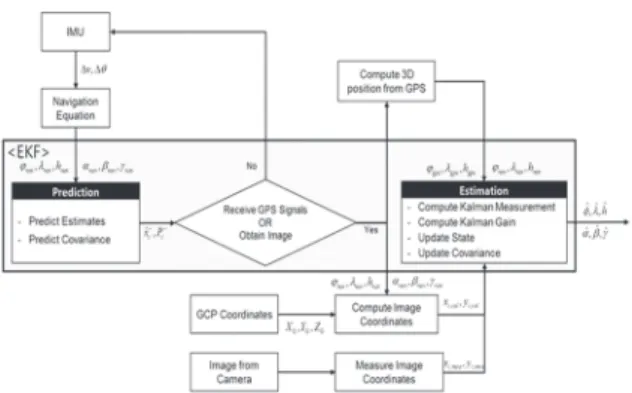
The INS/GPS/SPR integration algorithm can estimate the stable and reliable positions and attitudes because the algorithm reduces the navigation solution errors of the INS with the GPS, or the SPR. Fig. 1 is a diagram of the INS/

GPS/SPR integration algorithm. To estimate the position and attitude, we firstly solve the navigation equation with an acceleration and angular velocity, obtained from inertial sensors. The position and attitude are updated by EKF with the 3D position information that has determined by GPS. If more than 4 satellites are available, or use SPR solution, if GCPs are obtained enough to conduct SPR.

The eighteen states EKF for the INS/GPS/SPR integration algorithm are designed when the state vector is composed of errors in the orientation, the velocity towards North-East- Down (NED) coordinates system and the position towards the World Coordinate System 1984 (WGS84), bias in the gyroscope and the accelerometer, and scale factor in the

Fig. 1. Diagram of INS/GPS/SPR integration algorithm

수치

Fig. 1. Diagram of INS/GPS/SPR integration algorithm
Table 2. Camera specification (Model : GEViCAM GD- GD-155000C) Sensor Specification Camera Number of pixel 2456 × 2058  (5milion pixels) Focal length 17mm Pixel size 3.45μm
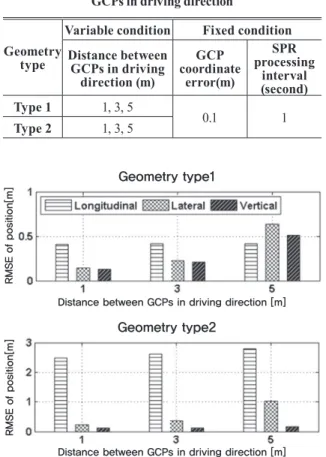
Table 5. Simulation conditions for the distance between  GCPs in driving direction
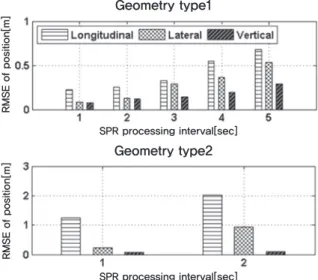
Fig. 6. Compared RMSE of position depend on SPR  processing interval for geometry type1 and 2

참조

관련 문서

이를 위해 이종재 AI5083과 SGAFC1180의 SPR 단독공정과 Adhesive를 병행한 Hybrid 접합부의 인장 전단강도를 비교하고자 하였으며 아울러 피로수명 평가를

– General controls with Special controls AND Premarket Approval (PMA) – PMA approval requires the safety and effectiveness of the

6.1.3.1 Satellite Infrastructures 6.1.3.2 Cellular Infrastructures 6.1.3.3 Indoor Infrastructures.. 6.2

_____ culture appears to be attractive (도시의) to the

• Analysis: A band-limited signal of finite energy that has no frequency components higher than W herts is completely described by specifying the values of the signal at

It considers the energy use of the different components that are involved in the distribution and viewing of video content: data centres and content delivery networks

After first field tests, we expect electric passenger drones or eVTOL aircraft (short for electric vertical take-off and landing) to start providing commercial mobility

1 John Owen, Justification by Faith Alone, in The Works of John Owen, ed. John Bolt, trans. Scott Clark, "Do This and Live: Christ's Active Obedience as the