http://dx.doi.org/10.6111/JKCGCT.2013.23.6.320
Physico-chemical effects of cerium oxide on catalytic activity of CeO
2-TiO
2prepared by sol-gel method for NH
3-SCR
Buyoung Kim, Byeongkil Shin, Heesoo Lee and Ho Hwan Chun*,†
School of Materials Science & Engineering, Pusan National University, Busan 609-735, Korea
*Department of Naval Architecture & Ocean Engineering, Pusan National University, Busan 609-735, Korea (Received October 14, 2013)
(Revised October 25, 2013) (Accepted November 8, 2013)
Abstract The effects of CeO2 on catalytic activity of CeO2-TiO2 for the selective catalytic reduction (SCR) of NOx were investigated in terms of structural, morphological, and physico-chemical analyseis. CeO2-TiO2 catalysts were synthesized with three different additions, 10, 20, and 30 wt% of CeO2, by the sol-gel method. The XRD peaks of all specimens were assigned to a TiO2 phase (anatase) and the peaks became broader with the addition of CeO2 because it was dispersed as an amorphous phase on the surface of TiO2 particles. The specific surface area of TiO2 increased with the addition of CeO2
from 60.6306 m2/g to 116.2791 m2/g due to suppression of TiO2 grain growth by CeO2. The 30 wt% CeO2-TiO2 catalyst, having the strongest catalytic acid sites (BrΦnsted and Lewis), showed the highest NOx conversion efficiency of 98 % at 300oC among the specimens. It was considered that CeO2 contributes to the improvement of the NOx conversion of CeO2- TiO2 catalyst by increasing specific surface area and catalytic acid sites.
Key words CeO2-TiO2 catalyst, Sol-gel method, Particle growth suppression, Catalytic activity
CeO
2가 졸겔법으로 합성한 CeO
2-TiO
2계 SCR용 촉매의 활성에 미치는 물리화 학적 영향
김부영, 신병길, 이희수, 전호환*,†
부산대학교 재료공학부, 부산, 609-735
*부산대학교 조선해양공학과, 부산, 609-735 (2013년 10월 14일 접수)
(2013년 10월 25일 심사완료) (2013년 11월 8일 게재확정)
요 약 CeO2의 첨가가 CeO2-TiO2계 SCR촉매 활성에 미치는 영향을 구조적, 형상학적, 물리화학적 분석을 통해 규명하 였다. 순수한 TiO2 분말과 10, 20, 30 wt%의 CeO2를 첨가한 CeO2-TiO2 분말을 졸겔법으로 합성한 결과, 분말 모두 TiO2의 아나타제 (anatase)상을 나타내었고 CeO2를 첨가할수록 TiO2 표면에 결정성이 낮은 CeO2가 분산되어 피크강도가 낮아짐을 확인하였다. 순수한 TiO2의 비표면적이 60.6306 m2/g인데 반해 CeO2-TiO2의 비표면적은 30 wt%의 CeO2를 첨가한 경우 116.2791 m2/g으로 비표면적이 증가하였고 따라서 첨가된 CeO2가 TiO2의 응집을 억제한 것으로 예상된다. NOx 제거효율은 30 wt% CeO2-TiO2 촉매가 300oC에서 98 %로 다른 분말보다 높은 효율을 나타내는데 이는 FT-IR을 이용하여 촉매의 산점 변화를 확인한 결과 30 wt% CeO2-TiO2 분말의 경우가 다른 분말들에 비해 산점이 상대적으로 많았기 때문이다. 따라서 졸 겔법으로 합성한 SCR용 CeO2-TiO2계 촉매에서 CeO2의 첨가는 TiO2의 입성장을 억제하여 비표면적을 증가시키고 BrΦnsted 및 Lewis 산점을 증가시킴으로써 촉매 효율을 향상시켰다고 판단된다.
†Corresponding author
†Tel: +82-51-510-2341
†Fax: +82-51-581-3718
†E-mail: [email protected]
1. 서 론
선택적 촉매환원법(Selective Catalytic Reduction, SCR) 은 80~95 %의 높은 질소산화물 제거효율과 낮은 SO2
산화율을 보여 고정원에서 배출되는 질소산화물을 제거 하기 위한 가장 효과적인 방법 중 하나이다[1]. V2O5/ WO3-TiO2계 촉매는 300~450oC에서 높은 활성과 작동 환경에서 열안정성이 우수하여 SCR 시스템에서 널리 상용화되고 있다[2].
V2O5/WO3-TiO2계 촉매는 고온(300~450oC)의 촉매 효 율이 높기 때문에 보일러 또는 엔진 바로 뒤에 설치 되 는데, 집진기나 탈황기를 거치지 않은 배기가스가 촉매 와 반응하게 되어 석탄회, 황산화물 등이 미세기공을 막 는 피독 현상이 발생하게 된다. 따라서 질소산화물 제거 효율이 운전시간의 경과에 따라 점차 감소하는 비활성화 (Deactivation) 현상이 발생하며[3-6], 또한 vanadium의 독성으로 인해 SCR 촉매용 대체물질 개발이 요구되고 있다.
이러한 문제점들을 보완하기 위해 MnOx, Cu/TiO2, FexTiOy, CeO2-TiO2와 같은 전이 금속산화물과 희토류계 를 이용한 촉매 개발이 진행 되고 있다[7-10]. 그 중 CeO2-TiO2는 산화·환원 조건에서 Ce4+와 Ce3+ 사이에 산소가 자유롭게 이동하는 산화환원성(redox properties) 를 통해 산소를 저장/방출하는 능력이 우수하여 SCR 시 스템에서 촉매로서의 활성이 높은 것으로 알려져 있다 [11, 12].
CeO2-TiO2의 합성법에 따른 촉매 효율에 대한 이전 연구에서 10 wt% CeO2-TiO2촉매를 졸겔법과 함침법으 로 합성한 결과 비표면적이 각각 123.41 m2/g, 47.91 m2/ g 로 졸겔법으로 합성한 촉매가 더 높은 비표면적을 나 타내었다. NOx 제거 효율 또한 함침법보다 졸겔법으로 합성한 촉매가 우수함을 확인하였다[2].
본 연구에서는 CeO2 함량이 CeO2-TiO2계 촉매 활성 에 미치는 영향을 확인하기 위하여 TiO2에 각각 10, 20, 30 wt%의 CeO2를 첨가하여 졸겔법으로 합성한 촉매의 형상학적, 구조적, 물리-화학적 분석을 통해 비교 및 고 찰 하였다.
2. 실험방법
촉매 및 담체로 사용되는 TiO2는 Titanium(IV) iso- propoxide(Ti[OCH(CH3)2]4, TTIP)를 10 : 1의 비율로 혼 합 후 상온에서 약 2시간 동안 교반 하고, 혼합액과 증 류수를 1 : 5의 비율로 1시간 교반 하였다. 촉매 전구체 물질로 Cerium(III) nitrate hexahydrate(CeN3O9· 6H2O) 를 첨가한 후 다시 1시간 교반하여 각각 10, 20, 30
wt%의 CeO2를 포함한 CeO2-TiO2 분말을 합성하였다.
교반이 끝난 용액을 70oC에서 24시간 동안 건조시킨 후 110oC에서 다시 24시간 건조시켰다. 건조된 분말을 500oC, 대기분위기에서 3시간 동안 하소하여 촉매를 제 조하였다.
촉매의 결정상 분석은 X-ray Diffraction(XRD, Ultima- IV, Rigaku)를 이용하였다. 파장이 0.1543 nm인 Cu Kα X-ray를 이용하여 2θ = 10~90o, scan speed 4o/min의 조 건으로 분석하였다. CeO2 함량에 따른 촉매의 표면특성 분석을 위해 200oC 진공분위기에서 시료를 전처리 하였 고, 비표면적 측정 장비(Brunauer-Emmett-Teller method, ASAP-2010, Micrometritics)를 이용하여 비표면적 변화 를 관찰하였다. Scanning Electron Microscope(SEM, MIRA3, TESCAN)을 이용하여 CeO2-TiO2촉매 분말의 미세구조 및 형상학적 변화를 분석하였다. 촉매 표면에 형성된 산점 변화를 확인하기 위해 촉매 시료에 1,000 ppm의 NH3 가스를 100 ml/min의 속도로 1시간 동안 흘려준 후 Fourier transform infrared spectroscopy(FT- IR, Thermo Nicolet 6700, Thermo Electron Corporation) 을 이용하여 4,000 cm−1에서 1,000 cm−1까지 4 cm−1의 resolution으로 측정하였다.
NOx 제거효율은 100~350oC에서 0.5 ml의 촉매를 포함 한 석영 관형 고정층 촉매 반응기로 측정하였다. 주입 가 스는 1000 ppm NO, 1000 ppm NH3, 200 ppm SO2그리고 5 % O2로 만들었다. N2를 balance gas로 기체의 유속은 100 ml/min로 Mass Flow Controller(Sierra Instruments, Inc. and Hi-Tec Co.)을 통하여 조정하였고, NOx Analyzer (42C, Thermo Ins.)를 통하여 NO와 NO2의 농도 변화 를 관측하였다. NOx 제거효율은 아래의 수식을 이용해 계산하였다.
(1)
CiNO: 반응기 유입 전의 NO 농도(ppm) CNO: 반응기 통과 후의 NO 농도(ppm)
3. 결과 및 고찰
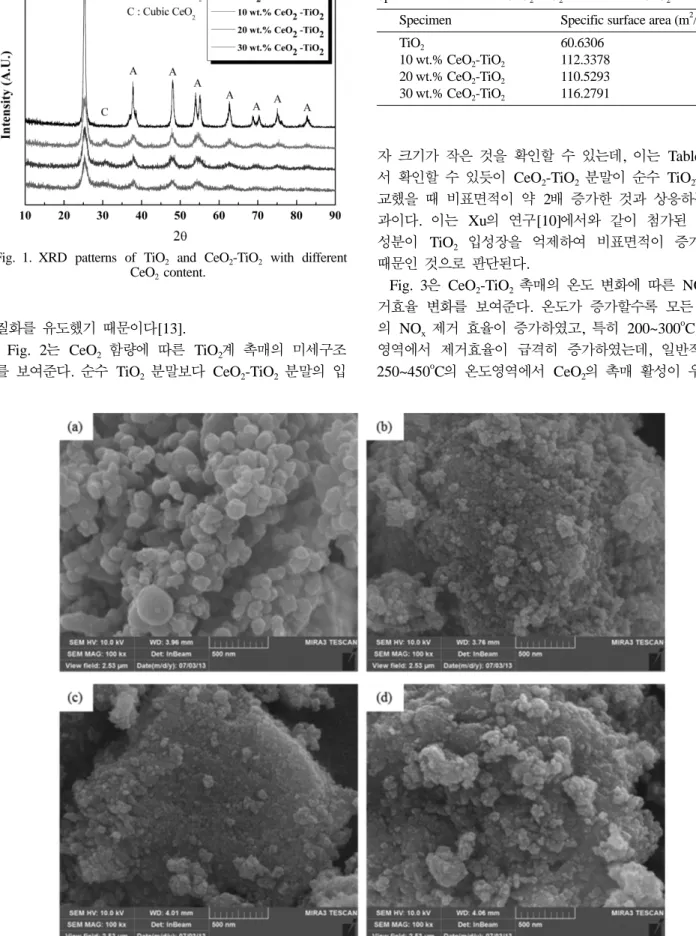
CeO2함량에 따른 CeO2-TiO2의 XRD 패턴을 Fig. 1에 나타내었다. 졸겔법으로 합성한 순수한 TiO2와 CeO2- TiO2 촉매 모두 anatase상이 확인되었고, CeO2 첨가 시 30o 부근에 CeO2의 cubic상이 확인되었다. 또한 CeO2
첨가량이 증가할수록 anatase상의 peak intensity가 감소 하는 것을 알 수 있었는데, 일반적으로 CeO2는 TiO2에 비해 결정성이 낮은 것으로 알려져 있으며, 이로 인해 CeO2가 TiO2 표면에 분산되어 CeO2-TiO2 촉매의 비정
NOx conversion %( ) = 100 cNO i − cNO
cNO
---
×
질화를 유도했기 때문이다[13].
Fig. 2는 CeO2 함량에 따른 TiO2계 촉매의 미세구조 를 보여준다. 순수 TiO2분말보다 CeO2-TiO2분말의 입
자 크기가 작은 것을 확인할 수 있는데, 이는 Table 1에 서 확인할 수 있듯이 CeO2-TiO2분말이 순수 TiO2와 비 교했을 때 비표면적이 약 2배 증가한 것과 상응하는 결 과이다. 이는 Xu의 연구[10]에서와 같이 첨가된 CeO2
성분이 TiO2 입성장을 억제하여 비표면적이 증가됐기 때문인 것으로 판단된다.
Fig. 3은 CeO2-TiO2촉매의 온도 변화에 따른 NOx제 거효율 변화를 보여준다. 온도가 증가할수록 모든 촉매 의 NOx제거 효율이 증가하였고, 특히 200~300oC 온도 영역에서 제거효율이 급격히 증가하였는데, 일반적으로 250~450oC의 온도영역에서 CeO2의 촉매 활성이 우수하 Fig. 1. XRD patterns of TiO2 and CeO2-TiO2 with different
CeO2 content.
Fig. 2. SEM images of the CeO2-TiO2 powders with different CeO2 content: (a) TiO2 (b) 10 wt.% CeO2-TiO2 (c) 20 wt.% CeO2-TiO2
(d) 30 wt.% CeO2-TiO2. Table 1
Specific surface area of CeO2-TiO2 with different CeO2 content Specimen Specific surface area (m2/g)
TiO2 60.6306
10 wt.% CeO2-TiO2 112.3378 20 wt.% CeO2-TiO2 110.5293 30 wt.% CeO2-TiO2 116.2791
기 때문인 것으로 판단된다[13]. CeO2 함량이 증가함에 따라 모든 온도 영역에서 NOx제거 효율이 증가하였으 며, CeO2 30 wt%를 첨가한 촉매의 경우 300oC 부근에서 98 %로 가장 우수한 촉매 성능을 보였다. 반면 20 wt%
이상의 CeO2를 첨가하였을 경우 300oC 이상에서 NOx
제거 효율이 감소하는 경향이 나타났는데, 이는 순수한 CeO2가 열 안정성이 낮아 고온 영역에서 입자의 소결이 발생되어 결정질 CeO2가 형성됨에 따라 촉매 효율이 감 소되는 것이라고 사료된다[13].
선택적 촉매 환원 공정에서 암모니아에 의한 NOx 제 거 주 반응은 다음과 같다.
4NO + 4NH3+ O2→ 4N2+ 6H2O (2) 암모니아는 촉매의 산점에 흡착된 후 NOx와 반응하여 N2와 H2O로 분해가 이루어지므로 촉매의 산점 종류 및 양은 NOx제거효율 변화에 직접적인 원인이 된다. 따라 서 CeO2의 첨가가 TiO2계 촉매의 산점에 미치는 영향을 확인하기 위해 FT-IR 분석을 실시하였고 이를 Fig. 4에 나타내었다. Fig. 4(a)에서 CeO2을 첨가 함으로써 3424 cm−1의 파장 영역에서 피크 강도가 높아 지는 것을 알 수 있는데, 여기서 3424 cm−1 피크는 Lewis 산점에 형 성된 υas(NH3) 흡착종의 특성피크를 의미한다[14]. 또한 Fig. 4(b)에서는 1402 cm−1, 1560 cm−1, 1628 cm−1 부근 의 파장영역에서 피크가 형성되는 것을 할 수 있다.
1402 cm−1및 1628 cm−1는 δas(NH4+)와 δs(NH4+)에 의해 형성된 BrΦnsted 산점을 나타내고, 1560 cm−1의 경우 Lewis 산점에 흡착된 δas(NH3)의 흡착종을 나타내는 특 성피크이다[15, 16]. 특히, 1628 cm−1의 파장 영역 부근 에서는 CeO2의 함량이 증가 할수록 피크의 강도가 강해 짐을 알 수 있다. 따라서 CeO2는 TiO2계 촉매의 Lewis
및 BrΦnsted 산점을 증가시켜 NOx제거 효율을 증가시 킨 것을 알 수 있다.
4. 결 론
CeO2-TiO2 촉매를 sol-gel법으로 제조하여 CeO2의 함 량이 촉매 활성에 미치는 영향을 구조적, 형상학적, 물리 화학적 분석을 통해 규명하였다. XRD 분석 결과 CeO2
의 함량이 각각 0, 10, 20, 30 wt%인 CeO2-TiO2 분말 모두 anatase 상만이 존재 하였고 결정성이 낮은 CeO2
입자가 TiO2 표면에 분산되어 CeO2의 함량을 증가시킬 수록 피크가 완만해짐을 관찰 할 수 있었다. 또한 첨가 된 CeO2가 TiO2 분말의 응집을 억제하여 CeO2-TiO2가 순수 TiO2보다 높은 비표면적 값을 나타내었다. FT-IR 분석결과 CeO2함량이 증가 할수록 BrΦnsted 및 Lewis 산점이 증가 함을 확인하였고, NOx 제거 효율 역시 30 wt% CeO2-TiO2가 300oC에서 98 %로 가장 높게 나타내 며 촉매 활성도가 향상되는 것을 알 수 있었다. 따라서 Fig. 4. FT-IR spectra of CeO2-TiO2 with different CeO2 con- tent: wavelength of (a) 3000~3800 cm−1 and (b) 1200~2000 cm−1. Fig. 3. Variation of NOx conversion of CeO2-TiO2 at operating
temperature (Reaction conditions: [NO] = [NH3] = 1,000 ppm, [O2] = 3 %, balance N2, total flow rate 100 ml/min, catalyst
0.6 ml).
첨가된 CeO2가 TiO2의 비표면적을 증가시키고 산점을 증가시킴으로써 촉매 효율을 향상시킨 것으로 판단된다.
감사의 글
이 논문은 부산대학교 자유과제학술연구비(2년)에 의 하여 연구되었습니다.
참 고 문 헌
[ 1 ] Y. Traa, B. Burger and J. Weitkamp, “Zeolite-based materials for the selective catalytic reduction of NOx with hydrocarbons”, Microporous Mater. 30 (1999) 3.
[ 2 ] M.C. Shin, J.H. Kim, J.S. Cha, B.K. Shin and H.S. Lee,
“Powder characteristics and catalytic activity of CeO2/ TiO2 catalysts prepared by the sol-gel method for SCR of NOx”, Korean J. Met. Mater. 51 (2013) 57.
[ 3 ] S. Djerad, M. Crocoll, S. Kureti, L. Tifouti and W.
Weisweiler, “Effect of oxygen concentration on the NOx reduction with ammonia over V2O5-WO3/TiO2 cata- lyst”, Catal. Today 113 (2006) 208.
[ 4 ] Y. Komatsubara, S. Ida, H. Fujitsu and I. Mochida,
“Catalytic activity of PAN-based active carbon fibre (PAN-ACF) activated with sulphuric acid for reduction of nitric oxide with ammonia”, Fuel 63 (1984) 1738.
[ 5 ] K. Kusakabe, M. Kashima, S. Morooka and Y. Kato,
“Rate of reduction of nitric oxide with ammonia on coke catalysts activated with sulphuric acid”, Fuel 67 (1988) 714.
[ 6 ] E. Richter, H.J. Schmidt and H.G. Schecker, “Adsorp- tion and catalytic reactions of NO and NH3 on acti- vated carbon”, Chem. Eng. Technol. 13 (1990) 332.
[ 7 ] X. Tang, J. Hao, W. Xu and J. Li, “Low temperature selective catalytic reduction of NOx with NH3 over amorphous MnOx catalysts prepared by three meth-
ods”, Catal. Commun. 8 (2007) 329.
[ 8 ] G. Ramis, L. Yi, G. Busca, M. Turco, E. Kotur and R.J.
Willey, “Adsorption, activation, and oxidation of ammo- nia over SCR catalysts”, J. Catal. 157 (1995) 523.
[ 9 ] F. Liu, H. He and C. Zhang, “Novel iron titanate cata- lyst for the selective catalytic reduction of NO with NH3 in the medium temperature range”, Chem. Commun.
(2008) 2043.
[10] W. Xu, Y. Yu, C. Zhang and H. He, “Selective catalytic reduction of NO by NH3 over a Ce/TiO2 catalyst”, Catal. Commun. 9 (2008) 1453.
[11] B.M. Reddy, A. Khan, Y. Yamada, T. Kobayashi, S.
Loridant and J.C. Volta, “Structural characterization of CeO2TiO2 and V2O5/CeO2TiO2 catalysts by raman and XPS techniques”, J. Phys. Chem. B 107 (2003) 5162.
[12] T.H. Kang, S.M. Koo, C.H. Jung, K.T. Hwang and W.K.
Kang, “Synthesis of nano Cerium(IV) oxide from recy- cled Ce precusor”, J. Korean Cryst. Growth Cryst.
Technol. 23 (2013) 101.
[13] G. Xiang, J. Ye, Z. Yi, L. Zhongyang and C. Kefa, “The activity and characterization of CeO2-TiO2 catalysts pre- pared by the sol-gel method for selective catalytic reduction of NO with NH3”, J. Hazard. Mater. 174 (2010) 734.
[14] R. Jin, Y. Liu, Z. Wu, H. Wang and T. Gu, “Low-tem- perature selective catalytic reduction of NO with NH(3) over Mn-Ce oxides supported on TiO2 and Al2O3: a comparative study”, Chemosphere 78 (2010) 1160.
[15] D.A. Peña, B.S. Uphade, E.P. Reddy and P.G. Smirni- otis, “Identification of surface species on titania-sup- ported manganese, chromium, and copper oxide low temperature SCR catalysts”, J. Phys. Chem. B 108 (2004) 9927.
[16] S.H. Yoon, J.H. Kim, B.K. Shin, S.S. Park, D.W. Shin and H.S. Lee, “Effects of anatase-rutile phase transition and grain growth with WO3 on thermal stability for TiO2 SCR catalyst”, J. Korean Cryst. Growth Cryst.
Technol. 21 (2011) 181.