| Abstract |
Purpose: This study investigated the muscular activity of abdominal muscles during a variety of plank exercises following changes in the leg and head positions.
Methods: Thirty healthy individuals participated in this study. They performed six variations of plank exercises, including three changes in head position and two changes in leg position. Each plank was defined as head neutral-leg neutral, head up-leg neutral, head down-leg neutral, head neutral-leg wide, head up-leg wide, and head down-leg wide. During the plank excises, the muscle activities of the rectus abdominis, internal oblique, erector spinae, and upper trapezius were measured.
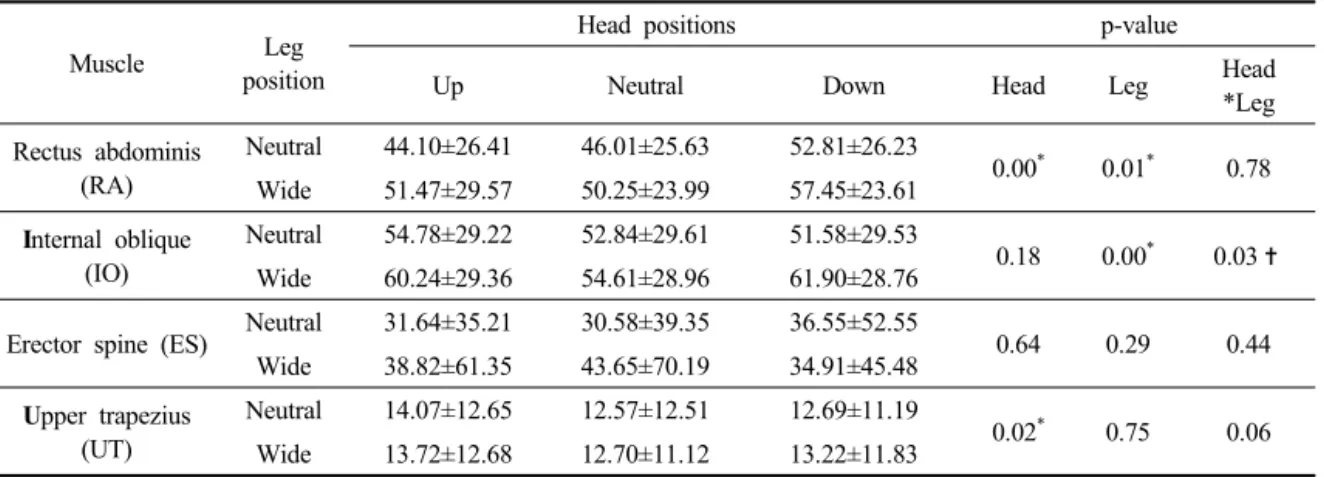
Results: The head down position significantly increased the rectus abdominis activity compared to other head positions (p<0.05).
On the other hand, the upper trapezius muscle activity was significantly higher with the head up position compared to other head positions (p<0.05). Regardless of head positions, both the rectus abdominis and internal oblique muscles were significantly activated with leg wide position compared to the leg neutral position (p<0.05).
Conclusion: Head and leg positions could change the muscular activities of abdominal muscles during plank exercises. For example, the head down position is effective for activating the rectus abdominis while the leg wide position could be advantageous for enhancing the internal oblique and rectus abdominis.
Key Words: Core muscle, EMG, Plank exercise, Prone bridge exercise
†Corresponding Author : Se-Yeon Park ([email protected])
Original Article Open Access
플랭크 운동 동안에 머리와 다리 위치가 몸통근육과 위등세모근의 근활성도에 미치는 영향