• 검색 결과가 없습니다.

Effects of Pelvic Floor Muscle Function on Mode of Delivery

N/A
N/A
Protected

Academic year: 2021

Share "Effects of Pelvic Floor Muscle Function on Mode of Delivery"

Copied!
8
0
0

로드 중.... (전체 텍스트 보기)

전체 글

(1)

| Abstract |

Purpose: The purpose of this study was to investigate of the effects of the mode of delivery on pelvic floor muscle function by examining bladder base movement and urinary incontinence.

Methods: This study was conducted on 100 females who had delivered in the previous 3–8 months. There were 2 groups: 56 vaginal deliveries and 44 cesarean section deliveries. Prior to the study, a survey was conducted on the subjects’ general status, delivery mode, urinary incontinence, and physical activity. The groups could not be blinded due to scar tissue from the operations.

The function of the pelvic floor muscle was observed with the bladder base movement using transabdominal ultrasound during pelvic floor contraction. To objectify and measure the subjective symptoms of subjects suffering from urinary incontinence, an incontinence quality of life (I-QoL) test was administered. Statistical analysis of the data was performed using SPSS version 20.0.

An independent t-test was used to assess the statistical significance of pelvic floor muscle function between the 2 groups after delivery.

Results: The movement of the bladder base in the pelvic floor muscle function was decreased in the vaginal delivery group, but the difference was not significant. Urinary incontinence was significantly increased in the vaginal delivery group.

Conclusion: The function of the pelvic floor muscles was better in the cesarean section group and the incidence of urinary incontinence was relatively low in this group. Therefore, vaginal delivery requires more efforts to restore the function of the pelvic floor muscles than cesarean delivery.

Key Words: Vaginal delivery, Cesarean section, Pelvic floor muscle

†Corresponding Author : Yu-Jeong Kwon ([email protected])

Original article Open Access

분만방법 유형이 골반바닥근육 기능에 미치는 영향

권유정

⋅이현옥

11)

동의과학대학교 물리치료과,

1

부산가톨릭대학교 물리치료과

Effects of Pelvic Floor Muscle Function on Mode of Delivery

Yu-Jeong Kwon

⋅Hyun-Ok Lee

1

Department of Physical Therapy, Dong-Eui Institute of Technology

1
Department of Physical Therapy, Catholic University of Pusan

Received: October 31, 2017 / Revised: November 13, 2017 / Accepted: November 13, 2017

ⓒ 2017 Journal of Korea Proprioceptive Neuromuscular Facilitation Association

This is an Open Access article distributed under the terms of the Creative Commons Attribution Non-Commercial License

(http://creativecommons.org/licenses/by-nc/3.0) which permits unrestricted non-commercial use, distribution, and reproduction

in any medium, provided the original work is properly cited.

(2)

Ⅰ. 서 론

임신은 여성의 몸에서 중요한 변화를 초래하는 사 건이며, 임신으로 인해 초래되는 변화들은 허리골반 부 통증의 원인 될 수 있다. 임신 중 호르몬에 의한 인대의 이완은 골반의 비대칭을 초래할 수 있으며, 이는 주위 근육 길이에 영향을 미쳐 근력, 근육 동원을 변화시키는 역학적 변화로 이어질 수 있다(Pool- Goudzwaard et al., 2005).

분만방법은 크게 질식분만 (vaginal delivery)과 제왕 절개 분만 (cesarean section)으로 나눌 수 있다. 질식분 만은 제왕절개 분만에 비해 재원기간과 회복기간이 짧고 마취 합병증 및 자궁속막 내 감염이나 추후 임신 시 태반유착의 빈도를 감소시키는 장점이 있지만 골 반바닥근육이나 신경, 결합조직 등에 강제적인 신장 이나 열상을 초래할 수 있다. 여러 신경생리학적 연구 들에서 질식분만은 대부분의 여성에서 골반바닥근육 에 부분적인 탈신경을 야기하고(Allen et al., 1990;

Snooks et al., 1990), 골반바닥근육 중 두덩꼬리근에 13∼36%정도 결손을 초래할 수 있다고 하였다 (Delancey et al., 2003; Dietz et al., 2005; Shek et al., 2010). 또한 질식분만은 제왕절개분만 보다 안정 시 질압의 감소와 골반바닥근육의 근력과 지구력의 감소 로 인하여 요실금을 초래할 있다고 하였다(Dietz, 2006).

제왕절개 분만은 산모의 자궁벽과 배벽을 절개하 여 태아를 분만하는 방법으로 , 분만이 지연될 때 태아 나 산모 또는 양쪽에 심각한 손상을 초래하거나 질식 분만을 안전하게 진행할 수 없을 때 주로 사용하게 된다 . 제왕절개 수술은 자궁하부 가로절개 방법이 많 이 시행되고 있으며 마취, 수혈 및 항생제의 발달로 모성 사망과 합병증이 감소하게 되어 비교적 안전하 게 시행되며 (Kainu et al., 2010), 그 빈도는 지속적으로 증가하고 있다(Menacker et al., 2006).

우리나라 제왕절개 분만율은 1990년 18.1% 이후 지속적으로 증가하여 1998년 39.9%, 2001년은 40.5%

까지 급증하였다. 이후 정부와 여러 단체의 노력으로

2012년에는 36.9%로도 감소하였으나, 여전히 세계보 건기구가 권장하는 5∼15%에 비해 2배 이상 높은 수 준이다(Carine et al., 2002). 제왕절개 분만은 산모나 태아를 분만 위험 요인으로부터 안전하게 구하는 분 만방법이지만 마취 및 수술로 인한 합병증 등으로 산 모와 태아에게 부정적인 결과를 초래할 수도 있다.

특히 수술 후 골반과 배 안쪽의 유착은 장폐색, 반복 수술의 어려움 , 불임, 만성 골반통 등의 원인이 될 수 있다 (Al-took et al., 1999; Kligman et al., 1993). 이처럼 분만과정에서 허리골반부 안정성에 기여하는 구조물 즉, 골반바닥근육과 배근육에 비가역적인 변화를 초 래할 수밖에 없다.

분만에 대한 선행 연구들을 살펴보면, 질식분만 이 후 두덩결합 분리의 위험 요인과 비율에 대한 연구 (Boraiah et al., 2013; Yoo et al., 2014)와 다양한 치료적 접근방법에 대한 연구(Aniebue, 2008; Shim et al., 2012) 가 있었으며, Weis 등(2015)은 질식분만을 한 여성과 분만경험이 없는 여성들의 휴식 시 배근육 두께를 비 교하였다. 그리고 Sancho 등(2015)은 분만방법 유형에 따라 복부근육 운동 중재가 배곧은근 분리에 미치는 영향을 연구하였으며, Kim (2014)은 분만을 경험한 여성들을 대상으로 나이에 따라 질압의 변화를 연구 하였다.

이와 같이 분만 이후 여성을 대상으로 한 선행연구

들은 분만 경험의 유무에 따른 연구들이거나 , 분만방

법에 따른 연구들도 허리골반부 통증을 가지고 있는

대상자의 골반부 통증과 요실금 등에 대한 연구한 것

이 대부분이다. 허리골반부 통증이 없는 대상자들의

분만이후 분만방법에 따라 골반바닥근육의 기능 회복

에 대한 연구들은 부족한 실정이다 . 따라서 본 연구는

허리골반부 통증이 없는 분만여성을 대상으로 분만방

법 유형이 골반바닥근육의 기능에 미치는 영향을 알

아보고자 하였다.

(3)

Ⅱ. 연구 방법

1. 연구 대상

본 연구의 대상자는 부산광역시에 거주하는 20-40 대 여성으로 최근 3∼8개월 이내에 분만을 경험한 여성 총 100명 중 질식분만 그룹 56명, 제왕절개 분만 그룹 44명으로 구성되었다. 일반적으로 분만 후 완전회복을 기대할 수 있는 6개월을 기준으로 하여 전(3∼5개월), 후(7∼8개월)기간으로 설정하여 분만을 경험한지 3∼

8개월이 경과된 대상자를 모집하여 본 연구를 진행하 였다. 일반적 특성에서 두 그룹 간에 유의한 차이는 없었다 . 대상자 선정에 있어 출산 경험은 3회 이하로 제한하였다. 본 연구는 부산가톨릭대학교 윤리위원회 의 승인을 받아 진행하였다(CUPIRB-2015-022).

연구의 목적을 이해하고 실험에 자발적으로 참여 할 의사가 있는 성인 여성으로 실험 전 대상자에게 동의를 받았으며 출산 전 요실금 병력이 있는 자 , 허리 골반부 신경학적 손상이 있는 자, 비만도(body mass index, BMI)가 30이상인 자, 이해력이 부족하여 운동수 행이 불가능한 자, 질식분만과 제왕절개 분만을 모두 경험한 자는 실험에서 제외하였다 . 실험 대상자 모두 실험 전 BMI, 키, 연령, 몸무게, 병력 및 일반적 특성을 조사하였으며, 신체활동량과 요실금자가기입설문지 (incontinencequality of life)를 작성하도록 하였다.

2. 연구 방법

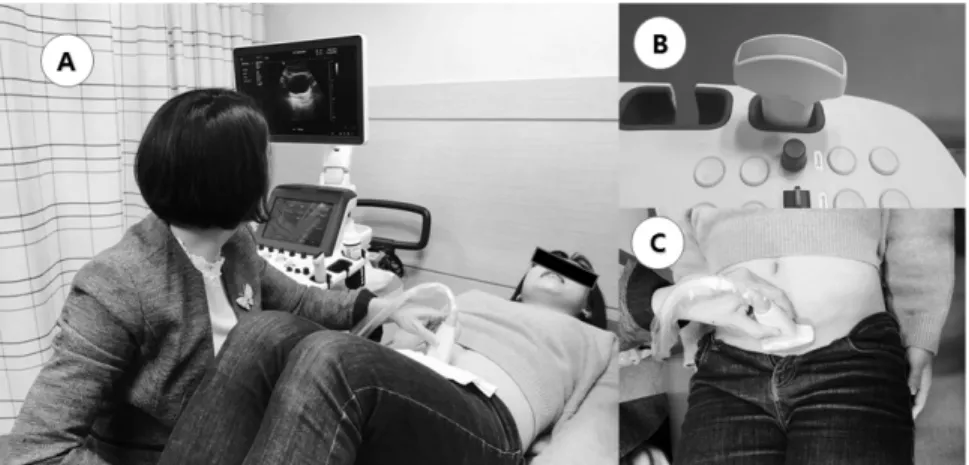
1) 골반바닥근육 수축 시 방광바닥 움직임 골반바닥근육의 기능을 평가하기 위해 다양한 임 상적 방법들이 사용되어지고 있으며 가장 일반적인 방법에는 임상적 관찰, 촉진, 질수축 압력, 근전도, MRI 등을 들 수 있다(Bo et al., 2005; Frawley et al., 2006). 최근에는 초음파를 사용하여 골반바닥근육의 수축을 통해 골반바닥을 들어올리는 능력을 평가하는 가로배(transabdominal, TA)초음파 방법이 많이 사용 되어지고 있다(Bo et al., 2003). 이는 골반바닥근육 수 축 시 방광바닥 움직임의 거리를 측정하여 골반바닥 근육의 기능을 평가하게 된다 . 즉, 골반바닥근육의 기 능이 감소되었다면 방광바닥 움직임 또한 감소하게 될 것이다. 분만방법에 따른 골반바닥근육의 기능을  평가하기 위하여 방광바닥의 움직임의 변화를 초음파 영상을 통하여 측정하였다. 초음파 영상은 곡면 선형 도자(4.9MHz)를 통한 고화질 영상 기기(UGEO H60, Samsung medison, Korea)를 이용하여 가로배접근 방식 을 통해 수행하였다 (Fig. 1). 이 방법은 골반바닥근육 의 수축 정도를 측정하기 위한 방법으로 Thompson 등 (2005)과 Sherburn 등(2005)의 연구에서 신뢰도가 확 립되었다. 방광바닥의 이미지를 선명하게 촬영하기 위해 대상자들에게 검사 전 1시간∼1시간 30분 전에

Fig. 1. Measurement of the bladder distance using real-time ultrasound imaging.

A: measurement, B: probe, C: placement of transducer

(4)

600∼700㎖의 물을 마셔서 방광을 충분히 채우도록 하였다. 대상자의 자세는 바로누운자세에서 엉덩관절 과 무릎관절을 60°정도 굽히고 허리뼈는 중립위치가 되도록 하였다 . 초음파 도자를 두덩뼈 위부분 중간에 가로로 놓고 뒤-꼬리쪽으로 기울이면 방광의 아래-

뒤쪽면의 이미지를 가장 명확하게 얻을 수 있다. 이 기울기는 대상자의 방광이 채워진 정도에 따라 다양 하고 거의 15∼30°정도이다. 초음파 영상은 연속적으 로 시행하면서 호흡에서 날숨의 마지막에서 측정하였 으며, 측정을 위한 마크는 방광바닥 부위에 놓고 골반 바닥근육의 수축동안 시각적인 가장 큰 변위를 가지 는 위-아래 영역을 연결하였다(Fig. 2,3). 영상은 3회 수집하였으며, 방광거리에 대한 변화율을 백분율로 계산하였다.

방광거리의 퍼센트 변화율 =

휴식 시 방광 거리 - 골반바닥근육수축 시 방광 거리 휴식 시 방광거리 ×100

2) 요실금

요실금에 관한 주관적인 불편함과 증상을 객관화 하고 정량화하기 위해 요실금자가기입설문지 (incontinence quality of life, I-QoL)를 사용하였다. 이는 미국의 Wagner 등(1996)에 의해 개발된 측정도구로 요실금 환자들의 삶의 질을 측정하는데 있어서 재현 성과 타당도가 있는 것으로 알려져 있다 (Patrick et al.,

1999). 22개의 질문 항목으로 구성된 설문지로 각 항목 답변은 증상의 심한 정도에 따라 1(“매우 그렇다”)에 서 5(“전혀 그렇지 않다”) 중 하나를 선택하여 응답하 도록 이루어져 있다 . 총 점수는 모든 항목의 응답 점수 를 더하면 된다 . 점수가 낮을수록 요실금에 대한 불편 감이 높은 것을 의미하고 점수가 높을수록 삶의 질이 높은 것을 의미한다. 모든 항목의 점수를 합한 총점이 0점(가장 심각한 최대 점수)에서 110점(전혀 문제가 없는 상태 )까지 분포할 수 있다.

3. 자료 처리

본 연구의 수집된 자료는 SPSS 20.0 for windows 프로그램을 이용해 분석하고, 통계적 검증을 위한 유 의수준(α)은 0.05로 하였다. 연구대상자의 일반적인 특성 및 분만의 병력은 기술통계와 빈도 (%)로 산출하 였고, 그룹간의 동질성을 확인하기 위해 독립 표본 t-검증(independent t-test)과 카이제곱 검증(chi-square test)을 실시하였다. 두 그룹간의 골반바닥근육의 기능 을 비교하기 위해 독립 표본 t-검증을 실시하였다.

Ⅲ. 연구 결과

1. 연구 대상자의 일반적 특성

본 연구의 대상자는 질식분만을 경험한 여성 56명, Fig. 2. Transabdominal image of the bladder during rest. Fig. 3. Transabdominal image of the bladder duringng

maximal pelvic floor contraction.

(5)

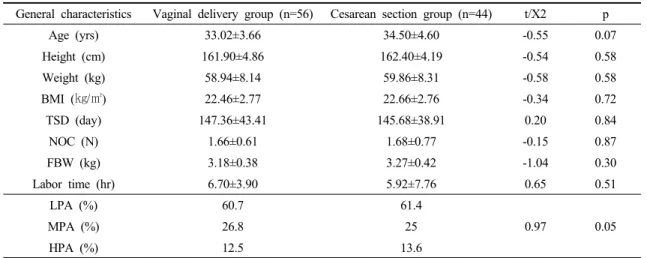
제왕절개 분만을 경험한 여성 44명으로 전체 100명이 참여하였다. 연구 대상자의 일반적인 특성은 (Table 1) 과 같다.

2. 골반바닥근육 수축동안 방광거리에 대한 초음파 측정의 신뢰도

휴식 시와 골반바닥근육의 최대 수축 시 방광 거리 측정에 대한 측정간 신뢰도는 다음과 같다(Table 2).

휴식 시 방광거리 측정에 대한 급간 상관계수는 0.97(95% CI 0.96∼0.98)이며 최대 수축 시 방광 거리 측정에 대한 급간 상관계수는 0.96(95% CI 0.94∼0.97)

로 매우 높은 신뢰도를 보였다(Table 2).

3. 골반바닥근육 수축 시 방광바닥 움직임 골반바닥근육의 최대 수축에 따른 방광바닥 움직 임 변화율은 질식분만과 제왕절개 분만 그룹에서 유 의한 차이를 보이지 않았다(Table 3).

4. 요실금

두 그룹 간에 요실금으로 인한 불편감을 평가한 요실금자가기입설문지 점수를 비교한 결과 질식분만 그룹에서 제왕절개 그룹보다 유의하게 감소하여 질식 분만에서 요실금으로 인한 불편감이 더 크게 나타났 다(p<0.05)(Table 3).

Vaginal delivery group (n=56) Cesarean section group (n=44) t p

Bladder base movement (%) 9.46±5.11 11.08±4.57 -1.64 0.10

Incontinence quality of life (score) 97.70±19.67 105.06±9.04 -2.29 0.02 Table 3. The comparison of the bladder base movement and urinary incontinence in the vaginal delivery and cesarean

section groups

ICC (2,1) 95% CI

Rest 0.97 0.96-0.98

Contraction 0.96 0.94-0.97

Table 2. Intra-rater reliability of the bladder distance during pelvic floor muscle contraction

General characteristics Vaginal delivery group (n=56) Cesarean section group (n=44) t/X2 p

Age (yrs) 33.02±3.66 34.50±4.60 -0.55 0.07

Height (cm) 161.90±4.86 162.40±4.19 -0.54 0.58

Weight (kg) 58.94±8.14 59.86±8.31 -0.58 0.58

BMI (㎏/㎡) 22.46±2.77 22.66±2.76 -0.34 0.72

TSD (day) 147.36±43.41 145.68±38.91 0.20 0.84

NOC (N) 1.66±0.61 1.68±0.77 -0.15 0.87

FBW (kg) 3.18±0.38 3.27±0.42 -1.04 0.30

Labor time (hr) 6.70±3.90 5.92±7.76 0.65 0.51

LPA (%) 60.7 61.4

0.97 0.05

MPA (%) 26.8 25

HPA (%) 12.5 13.6

BMI: body mass index, TSD: time since delivery, NOC: number of children,

FBW: fetal birth weight, LPA: low physical activity, MPA: moderate physical activity, HPA: high physical activity Table 1. General characteristics and physical activity of vaginal delivery and cesarean section groups

(N=100)

(6)

Ⅳ. 고 찰

임신기간 동안 허리골반부 이완은 정상적인 생리 학적 반응이지만 많은 여성들에게 골반부 통증과 불 안정을 야기하기도 한다(Ablert et al., 2002; Olsson et al., 2004). 이러한 생리적 반응은 분만 이후 자연 회복 되어진다고 하였지만 분만의 유형에 따라 손상되는 구조물이 다르기 때문에 회복의 정도도 달라질 것으 로 생각한다. 따라서 본 연구에서는 분만 후 3∼8개월 이 경과된 여성을 대상으로 분만방법 유형에 따른 골 반바닥근육의 회복 정도를 알아보고자 하였다.

골반바닥근육은 배와 골반 사이 공간의 아래벽을 형성하고 척추근육, 가로막, 배근육과 함께 배압을 유 지하고 엉치엉덩관절에 국소적 안정성을 제공한다 (Pool-Goudzwaard et al., 1998). 특히 골반바닥근육과 지배신경은 질식분만 동안 강제적으로 신장되고, 태 아의 머리가 나올 때는 휴식 시 길이보다 3배 이상 신장되게 되며(Lien et al., 2004), 항문올림근을 지배하 는 신경의 35%가 좌상을 입는다고 하였다(Lien et al., 2005). 그러므로 분만의 방법에 따른 골반바닥근육의 기능 회복을 알아보고자 최대 수축에 따른 방광바닥 의 움직임 변화를 측정하였다 . 측정결과 두 그룹 간에 유의한 차이를 보이지 않았지만 질식분만이 9.46%로 제왕절개 분만 11.08%에 비해 감소하는 경향을 보였 다 . 그러므로 분만을 경험한 여성의 중 질식분만 여성 에서 골반바닥근육의 수축력이 다소 저하되는 것으로 생각되어지며, 골반바닥근육에 대한 더 적극적인 관 리가 필요하다고 생각되어진다.

이러한 골반바닥근육의 기능저하는 긴장성 요실금 과 많은 연관성을 가진다 . 긴장성 요실금은 배뇨근의 수축 없이 배압 증가에 의한 방광내압이 최고 요도 수축 압을 넘어 불수의적으로 뇨의 누출이 발생하는 것으로 방광목부와 요도를 지지하는 해부학적 구조이 상으로 인한 조임근 기능부전이 가장 중요한 역할을 한다고 할 수 있다 . 조임근 기능부전에 가장 흔한 요인 들은 임신, 질식분만, 선천성 골반근 약화, 폐경 등을 들 수 있고 임신⋅분만력이 높을수록 증가한다고 하

였다 (Thom et al., 2010). 본 연구에서 긴장성 요실금을 알아보고자 요실금자가기입설문지를 실시한 결과 질 식분만의 경우 97.7점, 제왕절개 분만의 경우 105.06점 으로 질식분만이 유의하게 감소하였다. Rortveit 등 (2003)의 연구에서도 제왕절개 분만 보다 질식분만의 경우에서 요실금이 더 많이 초래되며 , 분만력이 증가 할수록 더 증가하였다고 보고하였다. 그리고 이러한 결과는 방광바닥 움직임 변화율에서 질식분만이 더 감소하였던 이유로 설명할 수 있다.

각 그룹별 개월 수에 따른 배근육과 골반바닥근육 의 기능을 비교해 본 결과 개월 수에 따른 유의한 차이 를 보이지 않았다. 이는 분만 3개월 이후에는 회복의 정도가 비슷하게 유지되는 것으로 생각할 수 있고 시 간이 지날수록 자연적으로 회복되어짐을 기대할 수 없음을 알려주는 결과이다 . Rortveit 등(2003)의 연구 에서는 요실금의 경우 분만 이후 시간이 경과될수록 더 증가하였다고 보고하였다. 이처럼 임신과 분만으 로 인한 배근육과 골반바닥근육의 기능장애는 분만 이전의 상태로 자연회복 되기보다는 기능저하 상태로 만성적으로 고착화 될 가능성이 있음을 시사해 준다 . 따라서 분만과정으로 인한 배근육과 골반바닥 근육에 비가역적인 변화들은 피할 수 없지만 이러한 변화로 초래된 문제들을 해결하기 위한 적극적인 관리가 필 요하다고 볼 수 있다.

Ⅴ. 결 론

본 연구는 최근 3∼8개월 이내에 분만을 경험한

여성을 대상으로 분만방법 유형이 골반바닥근육의 기

능에 미치는 영향을 알아보기 위해 실시하였다. 그

결과 골반바닥근육의 기능이 질식분만에서 제왕절개

분만보다 낮고 요실금의 발생이 상대적으로 높은 것

으로 나타났다. 그러므로 질식분만의 경우 제왕절개

분만보다 골반바닥근육의 기능을 회복하기 위한 노력

들이 필요할 것으로 사료된다.

(7)

Acknowledgement

본 논문은 권유정의 2017학년도 박사학위논문의 내용을 발췌 정리하였습니다.

References

Albert HB, Godskesen M, Westergaard JG. Incidence of four syndromes of pregnancy-related pelvic joint pain.

Spine. 2002;27(24):2831–2834.

Allen RE, Hosker GL, Smith AR, et al. Pelvic floor damage and childbirth: a neuro-physiological study. British Journal of Obstetrics and Gynaecology. 1990;

97(9):770-779.

Al-took S, Platt R, Tulandi T. Adhesion-related small-bowel obstruction after gynecologic operations. American Journal of Obstetrics and Gynecology. 1999;180(2):

313-315.

Aniebue UU. Symphyseal diastasis following vaginal deliveries:

a report of two cases. West African Journal of Medicine.

2008;27(1):47-49.

Bo K, Sherburn M. Evaluation of female pelvic-floor muscle function and strength. Physical Therapy. 2005;85(3):

269-282.

Boraiah S, Krishna SA, Rangappa SS. Rare occurrence of symphysis pubis diastasis following normal vaginal delivery. Journal of Obstetrics and Gynaecology of India. 2013;63(6):418-419.

Carine R, Omna MRC, Jeanne M, et al. Questioning the indicators of need for obstetric care. Bulletin of the World Health Organization. 2002;80(4):317-324.

DeLancey JO, Kearney R, Chou Q, et al. The appearance of levator ani muscle abnormalities in magnetic resonance images after vaginal delivery. Obstetrics and Gynecology. 2003;101(1):46-53.

Dietz HP, Lanzarone V. Levator trauma after vaginal delivery.

Obstetrics and Gynecology. 2005;106:707-712.

Dietz HP. Pelvic floor trauma following vaginal delivery.

Current Opinion in Obstetrics & Gynecology. 2006;

18(5):528-537.

Frawley H, Galea M, Phillips B, et al. Reliability of pelvic floor muscle strength assessment using different test positions and tools. Neurourology and Urodynamics.

2006;25(3):236-242.

Kainu JP, Sarvela J, Tiippana E, et al. Persistent pain after caesarean section and vaginal birth: a cohort study.

International journal of obstetric anesthesia.

2010;19(1):4-9.

Kim HR. Comparison between muscle activity and bladder movement during vaginal pressure change in parous women. Daegu University. Dissertation of Doctorate Degree. 2014.

Kligman I, Drachenberg C, Papadimitriou J, et al.

Immunohistochemical demonstration of nerve fibers in pelvic adhesions. Obstetrics and Gynecology.

1993;82(4):566-568.

Lien KC, Mooney B, Delancey JO, et al. Levator ani muscle stretch induced by simulated vaginal birth. Obstetrics and Gynecology. 2004;103(1):31-40.

Lien KC, Morgan DM, Delancey JO, et al. Pudendal nerve stretch during vaginal birth: a 3D computer simulation.

American Journal of Obstetrics and Gynecology.

2005;192(5):1669-1676.

Menacker F, Declercq E, Macdorman MF. Cesarean delivery:

background, trends, and epidemiology. Seminars in perinatology. 2006;30(5):235-241.

Olsson C, Nilsson-Wikmar L. Health-related quality of life and physical ability among pregnant women with and without back pain in late pregnancy. Acta Obstetricia et Gynecologica Scandinavica. 2004;

83(4):351-357.

Patrick DL, Martin ML, Bushnell DM, et al. Quality of life

of women with urinary incontinence: further

(8)

development of the incontinence quality of life instrument (I-QoL). Urology. 1999;53(1):71-76.

Pool-Goudzwaard AL, Slieker MC, Vierhout ME, et al.

Relations between pregnancy related low back pain, pelvic floor activity and pelvic floor dysfunction.

International Urogynecology Journal and Pelvic Floor Dysfunction. 2005;16(6):468-474.

Pool-Goudzwaard AL, Vleeming A, Stoekart.R, et al.

Insufficient lumbo-pelvic stability: a Clinical anatomical and biomechanical approach to a-specific low back pain. Manual Therapy. 1998;3(1):12-20.

Rortveit G, Daltveit AK, Hannestad YS, et al. Urinary incontinence after vaginal delivery or cesarean section.

The New England Journal of Medicine. 2003;

348(10):900-907.

Sancho MF, Pascoal AG, Mota P, et al. Abdominal exercises affect inter-rectus distance in postpartum women: a two-dimensional ultrasound study. Physiotherapy.

2015;101(3):286-291.

Shek KL, Dietz HP. Intrapartum risk factors for levator trauma.

British Journal of Obstetrics and Gynaecology.

2010;117(12):1485-1492.

Sherburn. M, Murphy CA, Carroll S, et al. Investigation of trasabdominal real-time ultrasound to visualise the muscles of the pelvic floor. The Australian Journal of Physiotherapy. 2005;51(3):167-170.

Shim JH, Oh DW. Case report: physiotherapy strategies for a woman with symphysis pubis diastasis occurring during labour. Physiotherapy. 2012;98(1):89-91.

Snooks SJ, Swash M, Mathers SE, et al. Effect of vaginal delivery on the pelvic floor: a 5-year follow-up. The British Journal of surgery. 1990;77(12):1358-1360.

Thom DH, Rortveit G. Prevalence of postpartum urinary incontinence: a systematic review. Acta Obstetricia et Gynecologica Scandinavica. 2010;89(12):1511- 1522.

Thompson JA, O’sullivan PB, Briffa K. Assessment of pelvic floor movement using transabdominal and trasperineal ultrasound. International Urogynecology Journal and Pelvic Floor Dysfunction. 2005;16(4):285-292.

Wagner TH, Patrick DL, Bavendam TG, et al. Quality of life of persons with urinary incontinence: development of a new measure. Urology. 1996;47(1):67-71.

Weis CA, Triano JJ, Barrett J, et al. Ultrasound assessment of abdominal muscle thickness in postpartum women vs nulliparous women. Journal of Manipulative and Physiological Therapeutics. 2015;38(5):352-357.

Yoo JJ, Ha YC, Lee YK, et al. Incidence and risk factors of symptomatic peripartum diastasis of pubic symphysis. Journal of Korean Medical Science.

2014;29(2):281-286.

수치

Fig. 1. Measurement of the bladder distance using real-time ultrasound imaging.
Table 2. Intra-rater reliability of the bladder distance  during pelvic floor muscle contraction

참조

관련 문서

Injury is a burden on athletes, but the rehabilitation exercise of this study suggests that the improvement of knee muscle function and knee function

The purpose of this study was to investigate the effects of a disability awareness program on improving the attitudes of regular elementary school

The purpose of this study is to analyze the effects of word- recording on learning vocabulary, reading and listening of English. control groups to answer

The purpose of this study is to investigate the effects on elementary school students' academic English improvement, interest, and self-confidence through the

The purpose of this study is to analyze the effects of sports marketing strategy fit on organizational attitude and organizational citizenship behavior

The purpose of this study is to analyze the effects of service quality on customer satisfaction and revisit intention perceived by Chinese golf range

Objectives : The purpose of this study was to investigate the effects of general characteristics, health characteristics, mental health characteristics, suicidal

The purpose of this study was to examine the effects of 8 weeks of Zumba dance exercise for obese middle-aged women on blood lipid index and vascular aging.. The subjects of