1. Introduction
Currently, dyes have great attention due to their ap- plication in various fields such as thermochromic ma- terials, luminescent and other optical storage materials
1-4). Already, many examples were available for thermochromic materials such as crystal violet lac- tone (CVL), fluorans, spiropyrans, metal-complexes and polydiacetylnes
5-8). In the aforementioned mate- rials, CVLs have significant interest due to their very good photo-physical properties in response to heat- ing and cooling process. Up to now, CVLs used as a dye for thermochromic system
9-11)as well as pressure recording materials
12-14). In addition, numerous amount of xanthene and leuco dyes were used as ther- mochromic materials via three component formula- tions
15,16). These three component mixture consisting with color producer (leuco dyes), color developer (proton donor), and low melting solvent
17). The color formation in solid state is due to proton transfer be-
tween the weak acid and leuco dye in low tempera- ture, resulting a formation of ring-opened structure in active dye.
In these three components, low melting co-sol- vents have vital role, because it controls the associa- tion between color former and color developer on its own melting point. Thus, the creation of the ther- mochromic properties is mainly depends on the de- sign of the three component systems. To prepare thermochromic system, the three components solid mixtures were heated until the color former and color developer was dissolved completely in the low melt- ing solvents and to get the homogeneous liquid.
Henceforth, the homogeneous three components liquid mixture was slowly cool down and the color of the cooled mixture was turned to visible color. How- ever, these three components system produce high reversibility with heating and cooling process (Scheme 1)
18-21). Because the interactions between dye and proton donor must be alter in the phase be-
Received_October 23, 2017 Revised_December 18, 2017 Accepted_December 22, 2017
Textile Coloration and Finishing TCF 30-1/2018-3/1-8
ⓒ2018 The Korean Society of Dyers and Finishers
Abstract In the present study, three morpholine substituted crystal violet lactone (CVL) have been synthesized to monitor the thermochromic property. This work is explaining the role of substituent on the lactone ring. The methyl substituents induced greater chromic ef- fects than the chloro substituents. Furthermore, the three-component mixtures that con- tained CVL, bisphenol-A, and methyl stearate were used to analyse the thermochromic effect of the CVLs as bulk samples with various temperature. The thermochromic properties of the CVLs were evaluated using solid-state UV-Vis and FT-IR spectroscopic techniques.
Finally, one of the synthesized CVL has been successfully converted into the form of a test paper similar to pH paper for use as thermal indicators.
Keywords CVL, leuco dyes, morpholine, substituent effect, thermal indicator
tween the colored solid and colorless liquid phase de- pend on the temperature
21, 22).
Based on the literature survey, the CVL act as a po- tential candidate in pressure and thermo-sensitive recording materials
23-25). In such a manner, Ondrej Panak et al. have developed the relation between color and structural changes in thermochromic sys- tems comprising crystal violet lactone, bisphenol A, and tetradecanol
26). In recent years, our research group studied the synthesis of novel tert-butyl sub- stituted fluorans and an investigation of their ther- mochromic behavior
27). Similarly, in this present endeavor, we synthesized three morpholine substi- tuted CVL, which have different substituents on the lactone ring, such as electron donating methyl, elec- tron withdrawing chloro and unsubstituted lactone.
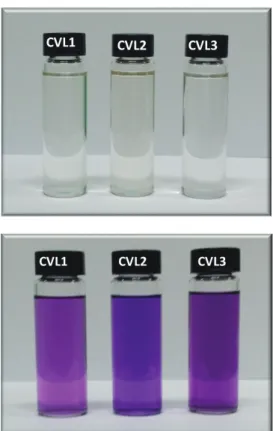
Furthermore, we discuss the thermochromic prop- erties of the CVL (CVL1-CVL3) with respect to elec- tronic effects. Eventually, we discussed the thermochromic properties of CVL1-CVL3 in the solid state and subse- quently achieved paper strip as thermal indicator.
2. Experimental Section
2.1 Equipment and reagents
All chemicals and reagents were purchased from ei- ther Aldrich or TCI chemicals and were used as such.
NMR spectra were recorded on a Bruker Avance 300 MHz instrument (
1H NMR 300MHz) with tetramethyl-
silane as an internal reference. Flash column chro- matography was used for purify new compounds by using 230-400 mesh silica gel. Solid state UV-Vis ab- sorption spectra of the new CVLs in methyl stearate and bisphenol-A were performed on a Shimadzu Solid Spec-3700. FT-IR spectra were recorded using a Perkin Elmer Spectrum One spectrophotometer equipped. The intermediates(1-3) and CVLs (CVL1- CVL3) for this endeavor were synthesized as depicted in Scheme 2.
2.2 General method for the preparation of inter- mediates(1-3)
AlCl
3(2.0 equiv) was added portion wise in to the stirred solution of 4-phenylmorpholine(1.0 equiv) and substituted phthalic anhydride(1.0 equiv) in chloroben- zene under N
2and the reaction mixture was heated at 60 °C for 2h then allowed to RT. The resulting reac- tion mass was diluted with distilled water, and acidi- fied with 1N HCl at 0°C, and stirred the reaction mixture for 0.5h at ambient temperature. Then the solid substance filtered through the filter paper. The crude half-white solid was obtained by recrystalliza- tion with water and methanol mixture.
2.2.1 2-(4-morpholinobenzoyl)benzoic acid (1)
To acquire the pure intermediate 1, the crude ma-
terial was purified by column chromatography by
using 20% ethylacetate in petroleum ether. (White
Scheme 1. Thermochromic response of CVL-bisphenol A system.
solid, Yield=60.0 %)
2.2.2 3-methyl-2-(4-morpholinobenzoyl)benzoic acid (2) To acquire the pure intermediate 2, the crude ma- terial was purified by column chromatography by using 15% ethylacetate in petroleum ether. (White solid, Yield=69.0%)
2.2.3 2,3,4,5-tetrachloro-6-(4-morpholinobenz- oyl)benzoic acid (3)
To acquire the pure intermediate 3, the crude ma- terial was purified by column chromatography by using 30% ethylacetate in petroleum ether. (Pale yel- low solid, Yield=45.0%)
2.3 General method for the preparation of CVL1-CVL3 A solution of intermediates(1-3) and 4-phenylmor- pholine in aceticanhydride was heated at 90°C for 2h and cooled to ambient temperature then 20mL of 30% NaOH was slowly added in drops to the reaction mixture. Further the reaction mixture was stirred at room temperature for 1h. Finally, the obtained crude solid was filtered and purified by column chromatog- raphy with gradual enhancement of ethylacetate in petroleum ether to obtain a pure product.
2.3.1 3,3-bis(4-morpholinophenyl)isobenzofur- an-1(3H)-one (CVL1)
1
H NMR(DMSO-D6, 300MHz), δ(ppm): 3.05(t, 8H, J =
9.0Hz), 3.72(m, 8H), 6.95(d, 4H, J = 9.0Hz), 7.15(d, 4H, J = 7.8Hz), 7.65(t, 1H, J = 7.2Hz), 7.76(m, 3H)(Yield = 65.0%).
2.3.2 5-methyl-3,3-bis(4-morpholinophenyl)isobenz- ofuran-1(3H)-one (CVL2)
1
H NMR(DMSO-D6, 300MHz), δ(ppm): 2.35(s, 3H), 3.08(t, 8H, J = 7.8Hz), 3.70(t, 8H, J = 4.8Hz), 6.92(m, 4H), 7.12(m, 4H), 7.52(m, 2H, J = 7.2Hz), 7.76(m, 1H)(Yield
= 68.0%).
2.3.3 4,5,6,7-tetrachloro-3,3-bis(4-morpholinophenyl) isobenzofuran-1(3H)-one(CVL3)
1